10 minute read
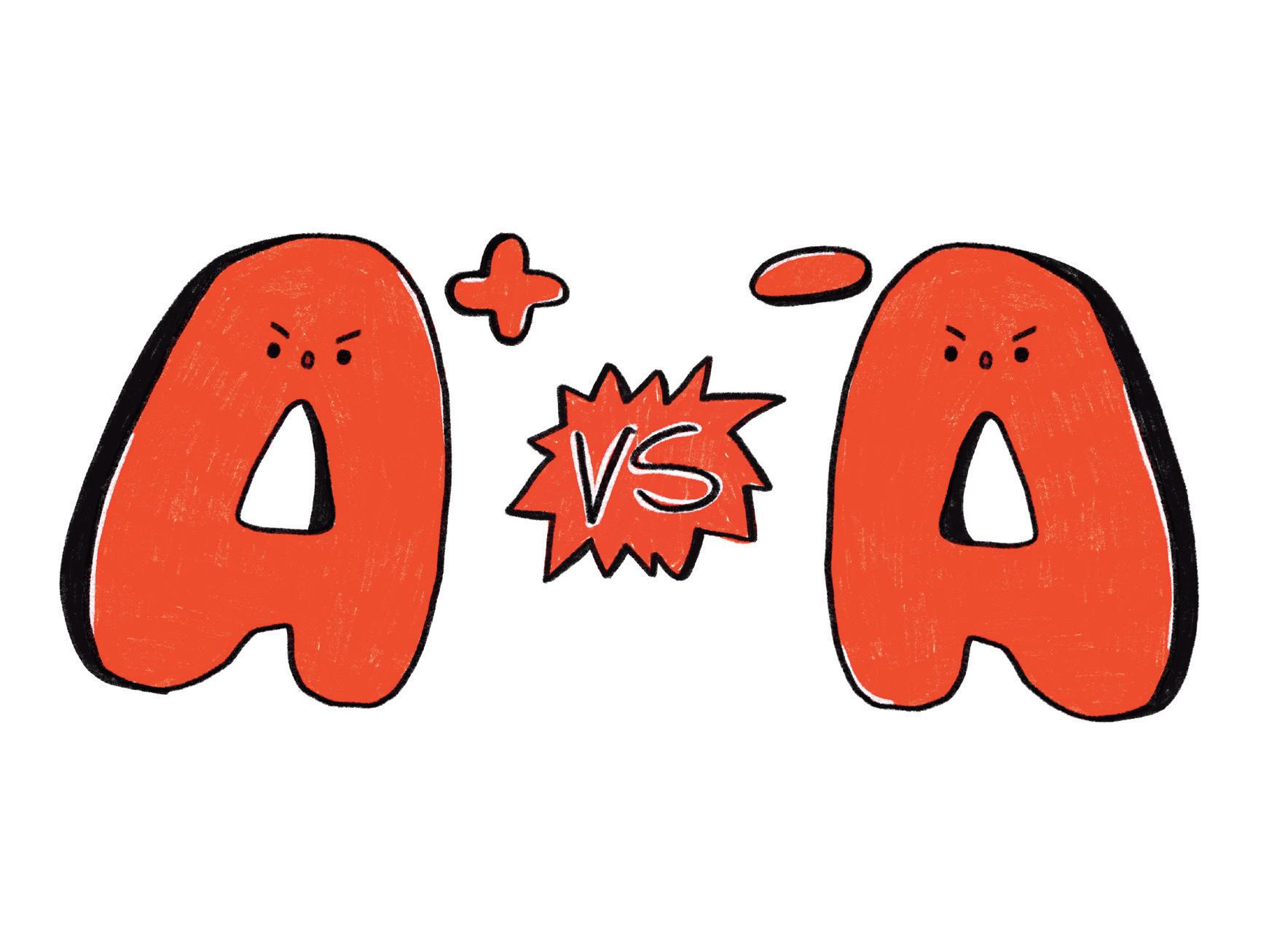
UM students bash plus-minus grading system

AKILAH FRYE thedmnews@gmail.com
At the end of the semester, a students’ hard work comes down to a matter of grading. As students complete work throughout the semester, they are simultaneously calculating how that work will be weighted, whether that be a pass-fail system or a plus-minus system.
Advertisement
These systems can make or break a student’s GPA, which can further affect standings within organizations or eligibility for scholarships that help pay tuition.
“I feel that ‘A’ and ‘A-’ should have no effect on your grade. You are basically doing the same amount of work and study time to get either an ‘A’ or an ‘A-’ but one is better than the other,” freshman pharmaceutical sciences major Jianna Lowe said. “I think that the plus-minus system is put in place as an incentive to make students try harder, but in most cases it hurts students because a tenth or hundredth of a point could determine whether their GPA keeps them in their individual programs.”
Another student concurred, for similar reasons.
“It’s a system I am not fond of, especially because it’s not the system that I was taught on, and I also don’t believe
Tiktok
continued from page 1 hole, however, as many apps and games popular on smartphones are owned by large Chinese companies that could pose a security risk. Additionally, students will have no problem accessing the app as they can switch to their individual data plans instantly.
Some UM students express concern that the app compromises their privacy.
“I think it makes sense. Our military has already banned their members from using the app, and I don’t think it is a secret that they are stealing our data. I personally would gladly like an excuse to stop using the addicting app,” sophomore accounting major John Budd said.
Other students believe that this ban will have little impact on whether students use TikTok.
“I do have concerns about TikTok but not in regards to my schooling career. I understand a ban for government officials,” sophomore IMC major Gretchen Taylor said. “Students will still find a way to use TikTok, whether it’s using a VPN or turning off Wi-Fi. However, it could affect Ole Miss related TikTok accounts, such as those promoting the sports teams or the general Ole Miss TikTok profile.
Associate Athletics Director for Brand Strategy Kyle Campbell, speaking for Ole Miss Athletics, that substantial grades should be given a minus. A ‘C’ letter grade is a ‘C. ’ We’ve earned that,” freshman journalism major Daylan Flowers said.
The plus-minus system was implemented at the University of Mississippi in the fall semester of 2011.
“The primary purpose of adding the plus and minus grade options is to give instructors the ability to more accurately assess and report a student’s performance,” the Office of the Registrar website reads.
Many arguments for the plus-minus system hinge upon combatting grade inflation, the phenomenon in which students often are awarded a higher grade than they deserve. The logic goes that a student barely earning an ‘A’ does not deserve the same grade as a student earning a perfect 100.
“Professors have always enjoyed the freedom to give grades as they choose since the creation of the university system in the 13th century. Grade inflation, a consequence of the privatization of the American public university, is the bigger concern. ‘Consumer scholars,’ not ‘citizen scholars,’ expect a higher grade for the money they are pouring into the system. I don’t blame them either,” UM professor of history and former Dean of the Sally McDonnell Barks - declined to comment on how the ban will affect TikTok accounts run by the Department of Athletics.
These accounts are primarily a tool for Ole Miss Athletics to provide content to fans, potential students and athletes. Accounts such as @Olemissbsb (Ole Miss Baseball) and @Olemissfootball (Ole Miss Football) have approximately 360,000 and 100,000 followers, respectively, and millions of content views.
The pages remain active, with some like @Olemissfootball having posted as recently as Tuesday afternoon, after the directive banning TikTok on university devices and WiFi was issued.
University of Mississippi’s chief legal officer and general counsel David Whitcomb declined to comment on whether university affiliated TikTok accounts would have to be deleted in accordance with the ban, referring The Daily Mississippian to the University of Mississippi Public Relations Department.
UMPR did not respond in time to a request for information from The Daily Mississippian.
As TikTok has exploded with popularity in recent years, many companies utilize the platform to market products and reach new audiences. Knowledge about the app and how to advertise on it is becoming increasingly important for those entering the job market.
One UM professor teaches TikTok marketing as part of his course curriculum.
“A ban could certainly com- dale Honors College Douglass Sullivan-González said. Sullivan-González went on to explain why some administrators consider the plus-minus system a boon for underperforming students.
“Why create debt peonage with a harsh grading scale that intentionally fails the weaker portion of the class? Instead, we create the ‘C-’ to give them some portion of credit while retracting credit for the major. Grading should be another pedagogical tool to encourage the acquisition of knowledge and to deepen one’s understanding of a subject,” Sullivan-González said.
“I give ‘A;, ‘B+’, ‘B’, ‘B-’, ‘C+’, ‘C’, ‘D’ and ‘F’ in my courses.
I’ve become more disenchanted with the awarding of ‘C-’ since many departments consider it to be the equivalent of a ‘D’ or an ‘F’ for non-credit towards the major.”
Many students think that professors ought to consider the fact students juggle multiple classes and involvement in organizations while simultaneously maintaining a social life, claiming that a student’s grade in a class does not always represent the work ethic. plicate our methods of teaching about what is, by far, the most popular and important communication platform in popular culture today,” Instructional Assistant Professor of Social Media and Data Analytics Brad Conaway said.
“In my opinion, professors should extend students’ grace by putting them in the best position to have a high GPA. I am not suggesting for students to just be given credit where it is not due. If a student has proven that they put a lot of effort into a particular course, it would be appreciated if the professor adjusts their grading accordingly,” freshman general studies major Brooklyn Hall said.
Ultimately, Conaway does not think the ban will get in the way of his teaching the course.
“While we can’t show live TikTok videos in class from our state-issued devices, we will still be allowed to show previously downloaded TikTok videos. Also, while we won’t be able to access TikTok through the university’s Wi-Fi network, we should still be able to use the app by switching to individual data plans, if nec- essary. And we’ll still be allowed to assign work dealing with the viewing, analysis and creation of TikTok content.” Conaway said. “So, the good news is, for now, we’re not banned from talking about TikTok or teaching about it. We’ll just need to be more careful about how and when we access it.”
Other states that have taken steps to regulate the app include Alabama, Arkansas, Florida, Georgia, Idaho, Indiana, Iowa, Kansas, Kentucky, Louisiana, Maryland, Montana, Nebraska, New Hampshire, New Jersey, North Carolina, North Dakota, Ohio, Oklahoma, Pennsylvania, South Carolina, South Dakota, Tennessee, Texas, Utah, Virginia and West Virginia.
“The ban does have the vibe of parents banning dancing in the 1950s when Rock and Roll first started, doesn’t it? They still think it’s all about lip-syncing and dance trends,” Conaway said.
Conaway also expressed skepticism about the political motives behind the ban.
“I’d love to know if the government officials have evidence they’re not revealing to the public,” Conoway said. “So far, with what we know, TikTok feels like a convenient political punching bag that’s being used to score points, without any appreciation of the positive role it’s played in the lives of its users, marginalized voices and even in marketing.” skills.”
Elicit is an “AI research assistant” meant to streamline researchers’ workflow, while Fermat offers a wide variety of tools such as image generation and brainstorm assistance.
Microsoft announced on Jan. 23 that it is continuing a partnership with OpenAI while also investing $10 billion dollars in the company and considering implementing ChatGPT into Microsoft Word, Outlook and Powerpoint. Some of the most popular education software might be outfitted with AI soon.
OpenAI recently released a statement on educator considerations for ChatGPT outlining the potential uses and problems with AI in the classroom. The company also released plans to give students the ability to share ChatGPT usage as part of an assignment.
“Ultimately, we believe it will be necessary for students to learn how to navigate a world where tools like ChatGPT are commonplace. This includes potentially learning new kinds of skills, like how to effectively use a language model, as well as about the general limitations and failure modes that these models exhibit,” the article reads.
Watkins agrees with this sentiment.
“AI literacy is going to be a major topic for students and teachers, and this literacy isn’t going to be limited to language models. We’re increasingly seeing AI employed in search engines, self-driving vehicles, surveillance proctoring services, even the live captioning feature in Zoom uses natural language processing, a form of
AI. It’s all around us, and we need to be aware of its impact on our day-to-day lives,” Watkins said.
At the University of Mississippi, Watkins is part of the AI Task Force led by Robert Cummings, executive director of academic innovation for the Academic Innovations Group and associate professor of writing and rhetoric for the Department of Writing and Rhetoric.
“Writing is changing. Literacy is changing,” Cummings said. “One key thing to point out is that prior to the arrival of these tools, if we looked at a piece of writing, we assumed that a human had written it. That has changed and it’ll never go back. We can no longer assume that there’s a human behind a piece of writing. It’s going to take a long time for our brains to adjust.”
Cummings believes that using AI generators for writing is going to become increasingly commonplace and essential to many aspects of our lives in the coming years.
“Teaching writing is going to become more and more about the management of these tools, because everybody’s first draft is going to be increasingly AI generated. And I don’t just mean a first draft for papers in academia, but a first draft for business memos, a first draft on anything, it’s all going to have an increasing amount of AI generated content,” Cummings said. “It’s going to be increasingly important to be able to sort through whether your ideas are your ideas or AI ideas, and what’s going to happen is going to be a shift between humans staring at a blank page to him staring at a first draft generated by an AI, and thinking to himself, ‘Does this first draft say what I want it to say? Is that accurate? Is it my voice?’”
OpenAI has released a tool to determine whether text was possibly written by AI called the AI Text Classifier, but OpenAI admits that AI-generated text can be easily altered to by-
We’ll have courses about AI and how it impacts their field.” the world will be sad. I don’t think that’s going to happen.”
RABRIA MOORE editor-in-chief dmeditor@gmail.com
VIOLET JIRA managing editor dmmanaging@gmail.com
ZACH SPOONER copy chief thedmcopy@gmail.com
HAL FOX MARY BOYTE news editors thedmnews@gmail.com
AIDAN GALLARDO sports editor thedmsports@gmail.com
JANE ROB PANNELL assistant sports editor thedmsports@gmail.com
HG BIGGS photo editor thedmphotos@gmail.com
ASHTON SUMMERS assistant photo editor thedmphotos@gmail.com
JUSTICE ROSE opinion editor thedmopinion@gmail.com
KHARLEY REDMON arts and culture editor thedmfeatures@gmail.com pass it.
Cummings announced that the AI Task Force is developing courses about AI for university undergraduates.
“We’re in the process of developing an AI certificate or digital badge for undergraduates. Ambitiously, I hope to announce enrollments in the fall, but I don’t know if we’ll get there,” Cummings said. “It’s gonna be a three-course sequence; the first course is the principles of AI, so it’s going to be the fundamentals of how AI
As Google announces an AI that can generate music from text prompts and OpenAI’s Dall·E 2 image generator creates complex and strange works of art, many are worried that human creativity might soon be outcompeted by AI superiority. What’s more, many prominent AI art generators are currently facing lawsuits from artists who claim the AI was trained on their art without permission.
“You’re not composing music because you think you’re going to erase Bach from the face of the earth. You’re composing music, because it means something to you, right?” Cummings said. “If you stopped doing that because Google has developed an AI generator that’s going to create music for you based on textual inputs, you will be sad,
Like the vision of ChatGPT and AI creating the first draft of your essay, Cummings has a similar idea for how AI will impact human creative works.
“I just think it’s going to alter the way that you play music. Our first idea is more likely to be influenced by AI and where you take it from there is going to be up to you,” Cummings said.
However, Cummings acknowledged that this is the viewpoint pushed by shareholding companies and developers of AI, and what these impacts will be is impossible to forecast.
“I think the developers want us to believe that it’s about access and democratization. It remains to be seen,” Cummings said.
The AI Task Force is open for students and faculty to join and will hold its next meeting on Feb. 23 in student union room 326. The task force also held a meeting open to faculty and students on Feb. 1 at noon in the Union Ballroom.
Watkins made sure to highlight that while ChatGPT and AI technology are certainly impressive, they are far from being able to replace a human’s writing skills.
“One thing to keep in mind is language models like ChatGPT don’t actually write text — they generate it. To write something, a human being brings an understanding of purpose, audience, context, even morality into the process of writing,” Watkins said. “ChatGPT has no such capacity. It cannot tell you the purpose behind a response, who an audience is, reality test a source, or anything that a human can because AI cannot think.”
WILL JONES assistant arts and culture editor thedmfeatures@gmail.com
ERIN FOLEY LIBBY FLANAGAN design editors thedmdesign@gmail.com
SAVANNAH SHOOK SEDLEY NORMAND visuals editors thedmvisuals@gmail.com
CAROLINE BEACH social media editor thedmsocialmedia@gmail.com
BRITTANY KOHNE multimedia editor dailymissmedia@gmail.com
S. Gale denley student media center
LARZ ROBERTS Director of Student Media
DENNIS MOORE Editorial Director
ROY FROSTENSON Assistant Director/Advertising
JAYLIN JONES Advertising Sales Manager dmads@olemiss.edu
SALES ACCOUNT
EXECUTIVES Owen Pustell decided