“
AS A RURAL PHYSICIAN, YOU’RE WEARING ALL OF THOSE HATS AND YOU’RE SPREAD VERY THIN ALREADY. THAT’S PART OF THE NATURE OF THE PRACTICE THAT EVERYONE LIKES. THAT’S WHY YOU DO IT. BUT ALL OF THOSE THINGS WERE MAGNIFIED (BY THE PANDEMIC) AND YOU’RE SPREAD EVEN THINNER.
The other lasting impression, he says, is of the impact the pandemic has had on patients and families – in particular people who had to be transferred to a hospital in a different community or to an assisted isolation site. “It’s scary for people to find out that they’ve tested positive, and then you follow up that news by telling them, ‘You have to leave, and you don’t get any visitors, and it could be a couple of days, or it could be a couple of weeks,’ ” says Dr. Bayda. “That’s a difficult conversation to have, and I think it’s really hard for patients. They’re trying to notify their family. They’re concerned about themselves. And they have to leave town. It was really hard, trying to help people navigate all of that.”
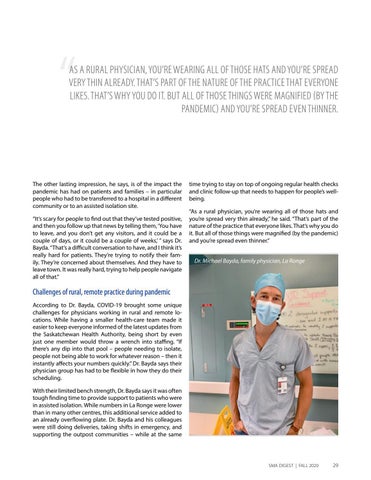
time trying to stay on top of ongoing regular health checks and clinic follow-up that needs to happen for people’s wellbeing. “As a rural physician, you’re wearing all of those hats and you’re spread very thin already,” he said. “That’s part of the nature of the practice that everyone likes. That’s why you do it. But all of those things were magnified (by the pandemic) and you’re spread even thinner.” Dr. Michael Bayda, family physician, La Ronge
Challenges of rural, remote practice during pandemic According to Dr. Bayda, COVID-19 brought some unique challenges for physicians working in rural and remote locations. While having a smaller health-care team made it easier to keep everyone informed of the latest updates from the Saskatchewan Health Authority, being short by even just one member would throw a wrench into staffing. “If there’s any dip into that pool – people needing to isolate, people not being able to work for whatever reason – then it instantly affects your numbers quickly.” Dr. Bayda says their physician group has had to be flexible in how they do their scheduling. With their limited bench strength, Dr. Bayda says it was often tough finding time to provide support to patients who were in assisted isolation. While numbers in La Ronge were lower than in many other centres, this additional service added to an already overflowing plate. Dr. Bayda and his colleagues were still doing deliveries, taking shifts in emergency, and supporting the outpost communities – while at the same
SMA DIGEST | FALL 2020
29