When did you start to get interested in astronomy – what inspired you? It was the books. Reading was, and is, my passion. I refused to go anywhere without a book. The city of Cape Town has a mobile library service to areas that do not have a public library. I used to have to walk a long way home from school, and I knew every place that the library bus parked on different days. I was only allowed to take out three books at a time from the children’s section, and would finish them in less than a week. I still feel great joy whenever I see those library buses, and very glad that they are still operating in the city. I loved maths and science at school and my teachers nurtured these interests. I gradually started getting interested in science fiction and fantasy, then came across the works of Isaac Asimov and Arthur C. Clarke. Then I started reading nonfiction works, including Cosmos by Carl Sagan. There was also a TV series about astronomers, around the late 80s/early 90s, that I found really exciting and inspiring. How did that lead to a career in this field? I managed to get a full costs bursary to the University of Cape Town (UCT), which enabled me to study maths and physics and whatever astronomy courses were on offer at the time. People kept telling me that I would not find a job as an astronomer, but people also kept saying that if you had these skills you could do anything. So I just went on my way, bugging my astronomy professors for chances to look through a telescope. My first trip to the South African Astronomy Observatory at Sutherland during the holidays just cemented my love for astronomy. For my honours degree I did my research project in astronomy. It was an optical project that involved running up to the top of a ladder every few minutes to change filters on the 0.5 m telescope and manually centre the target on the crosshairs. I think today’s health and safety practitioners would be horrified! I was all alone in the telescope dome, and there was just a call at midnight from the observer at the 1.9 m telescope every night to make sure everyone else was still OK. That project still didn’t put me off, so I did my master’s degree in astronomy at Potchefstroom University (now Northwest University), and continued on to do my PhD while based at the Hartebeesthoek Radio Astronomy Observatory (HartRAO). I found that I really enjoy the technical aspects of observations, and getting to know my instruments really well. When did the SKA project enter the picture? After I completed my PhD, I spent six months in Bonn, Germany at the Max Planck Institute for Radio Astronomy, learning more about interferometry and sub-millimetre observing in particular. I returned to HartRAO as a staff astronomer, but my eye was very quickly caught by what was then called the SKA Africa project, since they were
NOVEMBER
2023
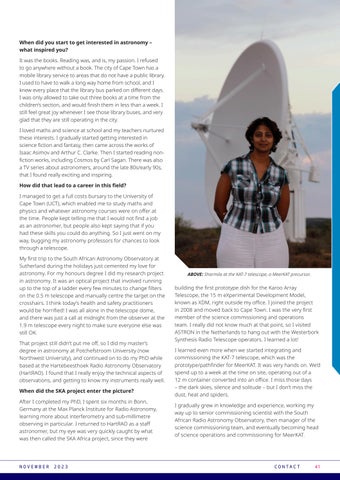
ABOVE: Sharmila at the KAT-7 telescope, a MeerKAT precursor.
building the first prototype dish for the Karoo Array Telescope, the 15 m eXperimental Development Model, known as XDM, right outside my office. I joined the project in 2008 and moved back to Cape Town. I was the very first member of the science commissioning and operations team. I really did not know much at that point, so I visited ASTRON in the Netherlands to hang out with the Westerbork Synthesis Radio Telescope operators. I learned a lot! I learned even more when we started integrating and commissioning the KAT-7 telescope, which was the prototype/pathfinder for MeerKAT. It was very hands on. We’d spend up to a week at the time on site, operating out of a 12 m container converted into an office. I miss those days – the dark skies, silence and solitude – but I don’t miss the dust, heat and spiders. I gradually grew in knowledge and experience, working my way up to senior commissioning scientist with the South African Radio Astronomy Observatory, then manager of the science commissioning team, and eventually becoming head of science operations and commissioning for MeerKAT.
C O N TA C T
41