12
ST. JOHN’S SCHOOL
THE REVIEW
MARCH 10, 2022
CULTURE
Students skirt dress code to express individuality By Serina Yan & Annie Villa
T
hroughout the halls of SJS, pops of bright colors and eye-catching patterns shine through a sea of navy and white polo shirts, plaid skirts and beige khakis. Although every student wears a uniform, many still find ways to stand out. Uniforms create a sense of community and alleviate the stress of selecting an outfit every day, but they can also limit self-expression. Students are forced to find alternative and original ways to display their individuality. “In a weird way, uniforms can demonstrate self-expression because, if you want to be expressive, you need to really want to,” senior Lily Pesikoff said. “When you see people do cool things with their makeup, you know that they're putting in the extra effort.” Although the dress code sets guidelines for clothing, students are free to experiment with footwear, jewelry and makeup. North Face backpacks, claw clips, double piercings and Nike Blazer sneakers have cemented themselves as SJS staples. When it comes to shoes, Nike remains the most common, but brands like OnCloud, Hoka and Golden Goose are gaining popularity. Senior Lindsay Frankfort rotates three pairs of Doc Martens throughout the week, while freshman Elise DiPaolo often wears colorful platform shoes to school. “Footwear is really making a breakthrough into our sense of style,” said freshman Talulah Monthy, who sports platform Oxfords. “Usually we’d express ourselves through shirts or pants, but instead we express ourselves through different kinds of shoes.”
Many trends are driven by social media platforms. Sites like TikTok and Instagram contribute to increasingly fast trend cycles, making it difficult for people to keep up with what is considered trendy. While most students still look to social media for fashion inspiration, others like Monthy are making an effort to find ideas elsewhere.
Your outfit is a way to strike up conversation and represent who you are. LILY PESIKOFF
“I want to stay away from big trends that are going to go away in a week,” she said. Although TikTok has greatly contributed to the rise of fast fashion and micro trends, the app also promotes self-expression and creativity. Junior Aspen Collins is a part of a “niche subgroup” of TikTok where “people wear whatever they want, despite what others say.” These outfits can seem over-the-top and ugly to some, but Collins notes that the creators of the videos are always happy and confident in their attire. Because of TikTok, Collins feels more comfortable experimenting with fashion. “I saw something that said what you’re wearing is either hot or camp,” Collins said. “I think a lot of the TikTokers I’m seeing are going more towards camp outfits—they’re so avantgarde and fashionable.” The pandemic has had a significant impact on fashion trends as well. When Covid-19 first hit, loungewear dominated fashion trends since people were forced to stay at
home and had fewer incentives to dress formally. Collins noticed that when students returned to in-person classes in 2021, loungewear and comfortable clothing like sweatpants and leggings remained common. Covid and subsequent lockdowns also prompted students to discover new hobbies, developing their sense of style. While quarantining at home in 2020, Pesikoff took up embroidery. She “fell in love” with the craft and began embroidering her school sweatshirts with colorful patterns and symbols — it allowed her to stand out from her peers and express herself within the boundaries of the uniform. “If you give me a quick glance and only see my sweatshirt, you can take away bits and pieces of who I am,” Pesikoff said. Accessories also allow students to showcase their styles. Sophomore Audrey Liu wears bright red shoes and leg warmers with her uniform to combat the cold, while senior Gabe de la Cruz dons unique earrings. Frankfort applies vibrant eyeliner that contrasts her monochromatic Doc Martens. “You can tell a lot about a person by how they wear their uniform,” Liu said. “You can show your style without worrying about what you're going to wear everyday.” Free dress days and spirit days provide an opportunity for students to express
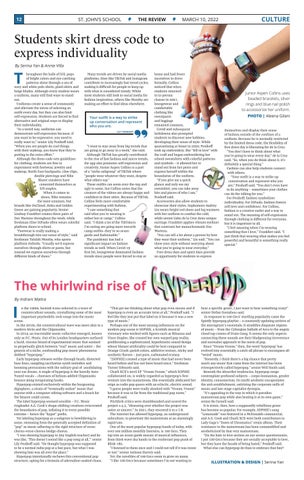
Junior Aspen Collins uses beaded bracelets, silver rings and blue nail polish to accessorize her uniform. PHOTO | Aleena Gilani themselves and display their sense of fashion outside of the confines of a uniform. Because he is normally restricted by the limited dress code, the flexibility of free dress day is liberating for de la Cruz. “You don't have to think about what you’re going to wear every day,” de la Cruz said. “So, when you do think about it, it's definitely a special thing.” Fashion can also help students connect with others. “Your outfit is a way to strike up conversation and represent who you are,” Pesikoff said. “You don't even have to do anything — sometimes your clothes can do the talking for you.” For Pesikoff, fashion symbolizes individuality. For DiPaolo, fashion fosters self-love and confidence. For Collins, fashion is a creative outlet and a way to stand out. The meaning of self-expression through clothing is different for everyone, but it is important to all. “I feel amazing when I'm wearing something that I love,” Frankfort said. “I just think that wearing what makes you feel powerful and beautiful is something really special.”
The whirlwind rise of By Indrani Maitra
I
n the 1960s, beatnik icons ushered in a wave of counterculture sounds, crystallizing some of the most important psychedelic rock songs into the music scene. In the 2010s, the countercultural wave was more akin to a modern Alvin and the Chipmunks. In 2014, an inscrutable music collective emerged, known only as P.C. Music. Out of its London headquarters surfaced a lucid, viscous brand of experimental music that seemed to perpetually glitch between “real” music and satire — the genesis of a niche, confounding pop-music phenomena dubbed “hyperpop.” Early hyperpop releases writhe through brash, distorted bass lines, sampling saccharine synth melodies and booming percussions with the solitary goal of annihilating your ear drums. A staple of hyperpop is the heavily AutoTuned vocals — choruses of helium-addled Chipmunks bounce along invigorating hooks. Hyperpop existed exclusively within the burgeoning digisphere, a strain of “terminally online” music that anyone with a computer editing software and a knack for the bizarre could create. The label hyperpop seemed sensible — P.C. Music ringleader A.G. Cook’s shape-shifting creations eviscerated the boundaries of pop, inflating it to every possible extreme — hence the “hyper” prefix. Yet labeling hyperpop as a subgenre is bewildering to some, stemming from the generally accepted definition of “pop” as music adhering to the rigid structure of versechorus-verse-chorus-bridge-chorus. “I was showing hyperpop to [my English teacher] and he was like, ‘This doesn’t sound like a pop song at all,’” senior Lily Pesikoff said. “He thought hyperpop was supposed to be a normal radio pop at a fast pace, but what I was showing him was all over the place.” Hyperpop intentionally eschews this conventional pop structure, opting for a formula of adrenaline-soaked chaos.
“That got me thinking about what pop even means and if hyperpop is even an accurate term at all,” Pesikoff said. “I feel like they just put that label on it because it was a new type of music.” Perhaps one of the most unsung influences on the modern pop scene is SOPHIE, a Scottish musical visionary who worked with figures such as Rihanna and Vince Staples. She created her own warped pop reality, proliferating a sophisticated, hyperkinetic sound design whose blatant artificiality could be best compared to Orange Crush: garish colors, addictive texture, sticky and synthetic flavors — just pure, carbonated ecstasy. “[SOPHIE] created a type of music that had never been heard before and has not been heard since,” freshman Turner Edwards said. Charli XCX’s 2016 EP “Vroom Vroom," which SOPHIE collaborated on, is widely regarded as hyperpop’s first venture into the mainstream. She essentially abdicated her reign as radio pop queen with an eclectic, electric sound. “I guess people were really shocked with “Vroom, Vroom" because it was so far from the traditional pop norm,” Pesikoff said. Pitchfork critics were dumbfounded and scored the project a 4.5, “obsessing over whether the project was satire or sincere.” In 2021, they rescored it to a 7.8. The Internet has allowed hyperpop, an underground subculture, to penetrate the mainstream at an alarmingly rapid rate. One of the most popular hyperpop bands of today, with over one million monthly listeners, is 100 Gecs. They tap into an avant-garde mosaic of musical influences, from third-wave ska bands to the exuberant pop-punk of Blink-182. “I listened to them once and I could not tell if it was ironic or not,” senior Jackson Harvey said. Yet, the novelties of 100 Gecs seem to grow on many. “I like 100 Gecs because sometimes I’m not wanting to
hear a specific genre, I just want to hear something crazy!” senior Stefan Gustafson said. In response to 100 Gecs’ startling popularity came the Spotify hyperpop playlist — a constantly updating archive of the microgenre’s essentials. It straddles disparate regions of music — from the Cyborgian ballads of Arca to the angsty cloud rap croons of Drain Gang. It seems the only aspects connecting these sounds are their bludgeoning irreverence and surrealist approach to the norm of pop. Since “Vroom Vroom," then, the word ‘hyperpop’ has evolved into essentially a catch-all phrase to encompass all “weird” music. “Honestly, I think there’s a big chance that pretty much any music that came from the internet has been retrospectively called hyperpop,” senior Will Smith said. Beneath the absurdist tendencies, hyperpop songs contemplate profound subjects — corpo-humanism, gender identity, consumerism. Its misfit aesthetic encapsulates the anti-establishment, satirizing the corporate mills of music and late-stage capitalist dystopia. “It's appealing in the way in which it parodies mainstream pop while also beating it at its own game,” senior Bo Farnell said. It is ironic, then, how a supposedly rebellious genre has become so popular. For example, SOPHIE’s song "Lemonade" was featured in a McDonalds commercial, and A.G. Cook and Charli XCX were both contributors to Lady Gaga’s “Dawn of Chromatica” remix album. Their resistance to the mainstream has been commodified and aestheticized by that very mainstream. “On the hate to love section on our senior questionnaire, I put 100 Gecs because they are socially acceptable to love, but they have the facade of being hated,” Pesikoff said. What else can hyperpop do than to embrace that fate?
ILLUSTRATION & DESIGN | Serina Yan