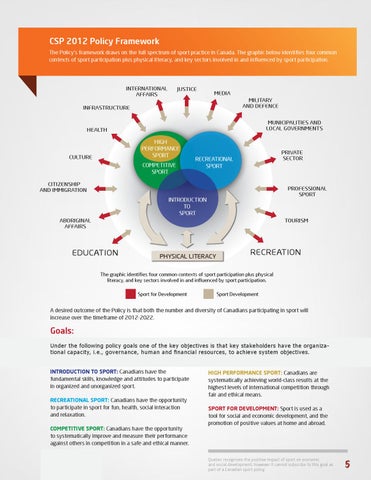
CSP 2012 Policy Framework The Policy’s framework draws on the full spectrum of sport practice in Canada. The graphic below identifies four common contexts of sport participation plus physical literacy, and key sectors involved in and influenced by sport participation.
CSP 2012 Policy Framework The Policy’s framework draws on the full spectrum of sport practice in Canada. The graphic below identifies four common INTERNATIONAL JUSTICE contexts of sport participation plus physical literacy, and key sectors involved in and influenced by sport participation. MEDIA
AFFAIRS
MILITARY AND DEFENCE
INFRASTRUCTURE
HEALTH
INTERNATIONAL AFFAIRS
INFRASTRUCTURE
CULTURE HEALTH
CITIZENSHIP CULTURE AND IMMIGRATION
JUSTICE
HIGH PERFORMANCE SPORT COMPETITIVE HIGH SPORT PERFORMANCE SPORT
MEDIA
MUNICIPALITIES AND LOCAL GOVERNMENTS MILITARY AND DEFENCE MUNICIPALITIES PRIVATE AND LOCAL SECTOR GOVERNMENTS
RECREATIONAL SPORT
PRIVATE SECTOR PROFESSIONAL SPORT
RECREATIONAL COMPETITIVE SPORT SPORTINTRODUCTION TO SPORT
CITIZENSHIP AND IMMIGRATION ABORIGINAL AFFAIRS
PROFESSIONAL TOURISM SPORT
INTRODUCTION TO SPORT
ABORIGINAL EDUCATION AFFAIRS
PHYSICAL LITERACY
TOURISM RECREATION
The graphic identifies four common contexts of sport participation plus physical
literacy, and key sectors involved in and influenced by sport participation. RECREATION EDUCATION PHYSICAL LITERACY Sport for Development
Sport Development
The graphic identifies four common contexts of sport participation plus physical
literacy, key sectors involved in and and influenced byCanadians sport participation. A desired outcome of the Policyand is that both the number diversity of participating in sport will increase over the timeframe of 2012-2022.
Goals:
Sport for Development
Sport Development
A desired outcome the Policy is that both Canadians participating in sport will INTRODUCTION TOofSPORT: Canadians havethe thenumber and diversity of PERFORMANCE SPORT: Canadians are Under the following policyofgoals one of the key objectivesHIGH is that key stakeholders have the organizaincrease over the timeframe 2012-2022. fundamental skills, knowledge and attitudes to participate systematically achieving world-class results tional capacity, i.e., governance, human and financial resources, to achieve system objectives. at the in organized and unorganized sport. highest levels of international competition through Goals: fair and ethical means. RECREATIONAL Canadians havehave the the opportunity INTRODUCTION SPORT: TO SPORT: Canadians HIGH PERFORMANCE SPORT: Canadians are to participateskills, in sport for fun, health, social interaction SPORT FOR DEVELOPMENT: Sport isresults used as fundamental knowledge and attitudes to participate systematically achieving world-class at athe and relaxation. tool for social economic development, the in organized and unorganized sport. highest levels and of international competition and through promotion of positive fair and ethical means.values at home and abroad. COMPETITIVE SPORT: Canadians have the opportunity RECREATIONAL SPORT: Canadians have the opportunity to systematically improve and measure their performance to participate in sport for fun, health, social interaction SPORT FOR DEVELOPMENT: Sport is used as a against others in competition in a safe and ethical manner. and relaxation. tool for social and economic development, and the COMPETITIVE SPORT: Canadians have the opportunity to systematically improve and measure their performance against others in competition in a safe and ethical manner.
promotion of positive values at home and abroad. Quebec recognizes the positive impact of sport on economic and social development; however it cannot subscribe to this goal as part of a Canadian sport policy.
Quebec recognizes the positive impact of sport on economic and social development; however it cannot subscribe to this goal as part of a Canadian sport policy.
5