SINGING_Techinfo_2019_EN 7. 8. 2019 6:45 Stránka 5
How to take care of hardware and other metal climbing equipment? Always keep in mind that metal parts of the equipment are subject to corrosion, therefore allow them to dry thoroughly after use. Fabric parts are damaged by moist, in which mould can appear. Basic classification of the carabiners according to EN12275:98 is by its construction and strength requirements in different way of use. In real conditions we choose a carabiner according to the purpose of use, material and type of locking mechanism:
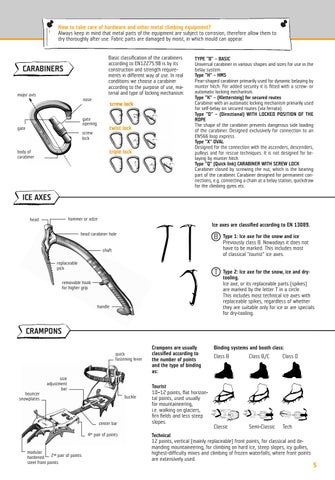
CARABINERS major axis nose
screw lock
gate opening
twist lock
gate screw lock
triple lock
body of carabiner
TYPE “B“ – BASIC Universal carabiner in various shapes and sizes for use in the belay system. Type “H” – HMS Pear-shaped carabiner primarily used for dynamic belaying by munter hitch. For added security it is fitted with a screw- or automatic locking mechanism. Type “K” – (Klettersteig) for secured routes Carabiner with an automatic locking mechanism primarily used for self-belay on secured routes (via ferrata). Type “D” – (Directional) WITH LOCKED POSITION OF THE ROPE The shape of the carabiner prevents dangerous side loading of the carabiner. Designed exclusively for connection to an EN566 loop express. Type “X” OVAL Designed for the connection with the ascenders, descenders, pulleys and for rescue techniques. It is not designed for belaying by munter hitch. Type “Q” (Quick link) CARABINER WITH SCREW LOCK Carabiner closed by screwing the nut, which is the bearing part of the carabiner. Carabiner designed for permanent connections, e.g. connecting a chain at a belay station, quickdraw for the climbing gyms etc.
ICE AXES hammer or adze
head
Ice axes are classified according to EN 13089. head carabiner hole
B
Type 1: Ice axe for the snow and ice Previously class B. Nowadays it does not have to be marked. This includes most of classical "tourist” ice axes.
T
Type 2: Ice axe for the snow, ice and drytooling. Ice axe, or its replaceable parts (spikes) are marked by the letter T in a circle. This includes most technical ice axes with replaceable spikes, regardless of whether they are suitable only for ice or are specials for dry-tooling.
shaft replaceable pick removable hook for higher grip
handle
CRAMPONS quick fastening lever
size adjustment bar bouncer snowplates
buckle
center bar th
4 pair of points
modular nd hardened 2 pair of points steel front points
Crampons are usually classified according to the number of points and the type of binding as: Tourist 10–12 points, flat horizontal points, used usually for mountaineering, i.e. walking on glaciers, firn fields and less steep slopes.
Binding systems and booth class: Class B
Class B/C
Class D
Classic
Semi-Classic
Tech
Technical 12 points, vertical (mainly replaceable) front points, for classical and demanding mountaineering, for climbing on hard ice, steep slopes, icy gullies, highest-difficulty mixes and climbing of frozen waterfalls, where front points are extensively used.
5