STARGAZING ON SCILLY Our tiny archipelago is blessed with truly dark and unpolluted skies, making it the perfect destination for stargazing. Charlie Payne from the Community Observatory on St. Martin’s tells us what we can look out for on Scilly.
W
hether you’re a beginner or aficionado, when it comes to astronomy, gazing at the stars, planets, galaxies and other objects in the night sky is a truly amazing sight – and nowhere more so than on Scilly. With no light pollution, the Isles of Scilly enjoy pristine night skies. On a clear night, the sheer number of stars is breath-taking; for many visitors, seeing the Milky Way arc across the sky is an unforgettable experience. Crucially, as islands, being surrounded by large stretches of water, stargazers on Scilly benefit from fantastic sightlines. Our long, low horizons mean you have the chance to see objects – particularly the planets – that you would miss in a built up area with tall trees or buildings. With the shorter days, autumn, winter and early spring offer the promise of an earlier glimpse of the heavens. For many, September marks the start of the annual stargazing season. October half term is an excellent opportunity for stargazing with lots to see and skies darkening by 8pm. Ideally, you need the sky to be truly dark and your eyes adjusted so the best time for stargazing is an hour and a half after sunset. Leave your mobile phones in your pockets (or on night mode) and if you need a torch, only »
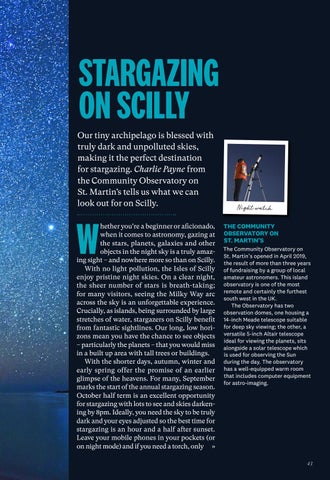
Night watch THE COMMUNITY OBSERVATORY ON ST. MARTIN’S The Community Observatory on St. Martin’s opened in April 2019, the result of more than three years of fundraising by a group of local amateur astronomers. This island observatory is one of the most remote and certainly the furthest south west in the UK. The Observatory has two observation domes, one housing a 14-inch Meade telescope suitable for deep sky viewing; the other, a versatile 5-inch Altair telescope ideal for viewing the planets, sits alongside a solar telescope which is used for observing the Sun during the day. The observatory has a well-equipped warm room that includes computer equipment for astro-imaging.
43