Next-Gen Technology I
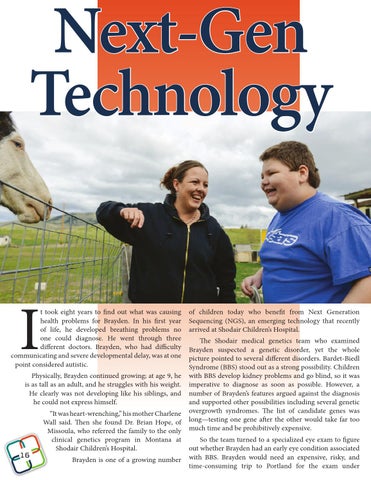
t took eight years to find out what was causing health problems for Brayden. In his first year of life, he developed breathing problems no one could diagnose. He went through three different doctors. Brayden, who had difficulty communicating and severe developmental delay, was at one point considered autistic. Physically, Brayden continued growing; at age 9, he is as tall as an adult, and he struggles with his weight. He clearly was not developing like his siblings, and he could not express himself. “It was heart-wrenching,” his mother Charlene Wall said. Then she found Dr. Brian Hope, of Missoula, who referred the family to the only clinical genetics program in Montana at Shodair Children’s Hospital. Brayden is one of a growing number
of children today who benefit from Next Generation Sequencing (NGS), an emerging technology that recently arrived at Shodair Children’s Hospital. The Shodair medical genetics team who examined Brayden suspected a genetic disorder, yet the whole picture pointed to several different disorders. Bardet-Biedl Syndrome (BBS) stood out as a strong possibility. Children with BBS develop kidney problems and go blind, so it was imperative to diagnose as soon as possible. However, a number of Brayden’s features argued against the diagnosis and supported other possibilities including several genetic overgrowth syndromes. The list of candidate genes was long—testing one gene after the other would take far too much time and be prohibitively expensive. So the team turned to a specialized eye exam to figure out whether Brayden had an early eye condition associated with BBS. Brayden would need an expensive, risky, and time-consuming trip to Portland for the exam under