S&S-8
The Griffin Report of Food Marketing • JUNE 2014
Stop & Shop Celebrates 100 Years More Coverage @ thegriffinreport.com
Stop & Shop 100-Year History Marked By Commitment, Innovation & Teamwork
1914
T 1918
1930
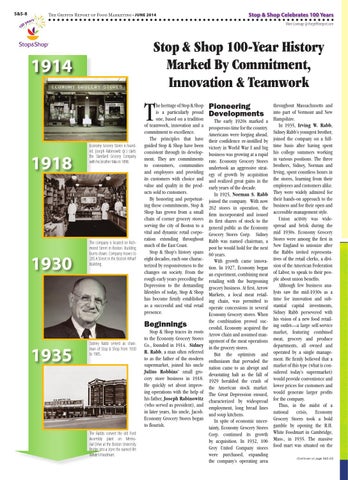
Economy Grocery Stores is founded. Joseph Rabinowitz (Jr.) starts the Standard Grocery Company with his brother Max in 1898.
The company is located on Richmond Street in Boston. Building burns down. Company moves to 205 A Street in the Boston Wharf Building.
he heritage of Stop & Shop is a particularly proud one, based on a tradition of teamwork, innovation and a commitment to excellence. The principles that have guided Stop & Shop have been consistent through its development. They are commitments to consumers, communities and employees and providing its customers with choice and value and quality in the products sold to customers. By honoring and perpetuating these commitments, Stop & Shop has grown from a small chain of corner grocery stores serving the city of Boston to a vital and dynamic retail corporation extending throughout much of the East Coast. Stop & Shop’s history spans eight decades, each one characterized by responsiveness to the changes on society. From the rough early years preceding the Depression to the demanding lifestyles of today, Stop & Shop has become firmly established as a successful and vital retail presence.
Beginnings
1935
Sidney Rabb served as chairman of Stop & Shop from 1930 to 1985.
The Rabbs convert the old Ford Assembly plant on Memorial Drive at the Boston University Bridge into a store the named RH White’s Foodmart.
Stop & Shop traces its roots to the Economy Grocery Stores Co., founded in 1914. Sidney R. Rabb, a man often referred to as the father of the modern supermarket, joined his uncle Julius Robbins’ small grocery store business in 1918. He quickly set about improving operations with the help of his father, Joseph Rabinowitz (who served as president), and in later years, his uncle, Jacob. Economy Grocery Stores began to flourish.
Pioneering Developments The early 1920s marked a prosperous time for the country. Americans were forging ahead, their confidence re-instilled by victory in World War I and big business was growing at a rapid rate. Economy Grocery Stores undertook an aggressive strategy of growth by acquisition and realized great gains in the early years of the decade. In 1925, Norman S. Rabb joined the company. With now 262 stores in operation, the firm incorporated and issued its first shares of stock to the general public as the Economy Grocery Stores Corp. Sidney Rabb was named chairman, a post he would hold for the next 60 years. With growth came innovation. In 1927, Economy began an experiment, combining meat retailing with the burgeoning grocery business. At first, Arrow Markets, a local meat retailing chain, was permitted to operate concessions in several Economy Grocery stores. When the combination proved successful, Economy acquired the Arrow chain and assumed management of the meat operations in the grocery stores. But the optimism and enthusiasm that pervaded the nation came to an abrupt and devastating halt as the fall of 1929 heralded the crash of the American stock market. The Great Depression ensued, characterized by widespread employment, long bread lines and soup kitchens. In spite of economic uncertainty, Economy Grocery Stores Corp. continued its growth by acquisition. In 1932, 106 Grey United Company stores were purchased, expanding the company’s operating area
throughout Massachusetts and into part of Vermont and New Hampshire. In 1935, Irving W. Rabb, Sidney Rabb’s youngest brother, joined the company on a fulltime basis after having spent his college summers working in various positions. The three brothers, Sidney, Norman and Irving, spent countless hours in the stores, learning from their employees and customers alike. They were widely admired for their hands-on approach to the business and for their open and accessible management style. Union activity was widespread and brisk during the mid 1930s. Economy Grocery Stores were among the first in New England to unionize after the Rabbs invited representatives of the retail clerks, a division of the American Federation of Labor, to speak to their people about union benefits. Although few business analysts saw the mid-1930s as a time for innovation and substantial capital investments, Sidney Rabb persevered with his vision of a new food retailing outlet—a large self-service market, featuring combined meat, grocery and produce departments, all owned and operated by a single management. He firmly believed that a market of this type (what is considered today’s supermarket) would provide convenience and lower prices for customers and would generate larger profits for the company. Thus, in the midst of a national crisis, Economy Grocery Stores took a bold gamble by opening the R.H. White Foodmart in Cambridge, Mass., in 1935. The massive food mart was situated on the (Continues on page S&S-10)