80
Thought Leader Q&A
WHAT’S DRIVING THE COLD CHAIN EXPANSION IN THE PHILIPPINES? A number of factors, including a shift from ‘wet markets,’ the growing population, and post-harvest needs, says cold chain expert Anthony Dizon. ― By Devin Yoshimoto
T
he Philippine government's Department of Agriculture recently highlighted the need for additional cold chain infrastructure in the Philippines to help reduce post-harvest food loss. (See "More Cold Storage Facilities Needed in Philippines to Curb Food Waste," Accelerate Magazine, April-May 2020.) But there are several other factors driving the country’s growing cold chain. Consumer preferences are shifting from the traditional “wet markets” — where food is sold directly to the public without cold chain intervention — towards purchasing chilled or frozen foods at supermarkets.
Accelerate Special Issue #110
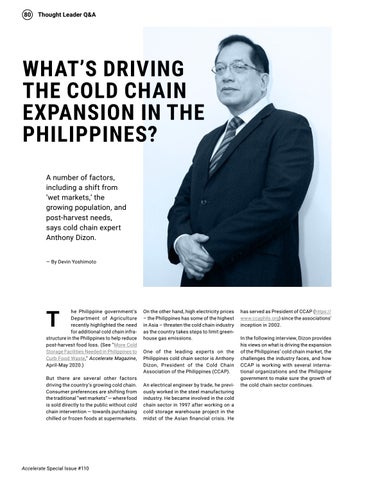
On the other hand, high electricity prices – the Philippines has some of the highest in Asia – threaten the cold chain industry as the country takes steps to limit greenhouse gas emissions. One of the leading experts on the Philippines cold chain sector is Anthony Dizon, President of the Cold Chain Association of the Philippines (CCAP). An electrical engineer by trade, he previously worked in the steel manufacturing industry. He became involved in the cold chain sector in 1997 after working on a cold storage warehouse project in the midst of the Asian financial crisis. He
has served as President of CCAP (https:// www.ccaphils.org) since the associations' inception in 2002. In the following interview, Dizon provides his views on what is driving the expansion of the Philippines’ cold chain market, the challenges the industry faces, and how CCAP is working with several international organizations and the Philippine government to make sure the growth of the cold chain sector continues.