16 // Infographic
How to build an eco-friendly supermarket Tips and tricks from SuperSmart, an EU-funded project promoting uptake of efficient HVAC&R systems in European food retail.
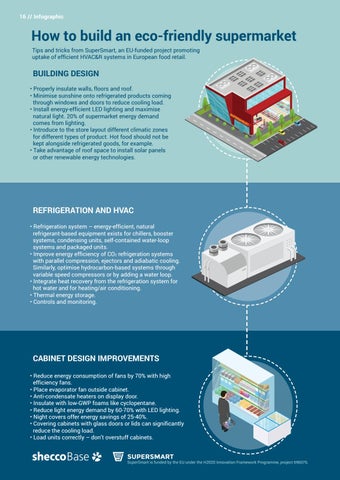
BUILDING DESIGN • Properly insulate walls, floors and roof. • Minimise sunshine onto refrigerated products coming through windows and doors to reduce cooling load. • Install energy-efficient LED lighting and maximise natural light. 20% of supermarket energy demand comes from lighting. • Introduce to the store layout different climatic zones for different types of product. Hot food should not be kept alongside refrigerated goods, for example. • Take advantage of roof space to install solar panels or other renewable energy technologies.
REFRIGERATION AND HVAC • Refrigeration system – energy-efficient, natural refrigerant-based equipment exists for chillers, booster systems, condensing units, self-contained water-loop systems and packaged units. • Improve energy efficiency of CO2 refrigeration systems with parallel compression, ejectors and adiabatic cooling. Similarly, optimise hydrocarbon-based systems through variable speed compressors or by adding a water loop. • Integrate heat recovery from the refrigeration system for hot water and for heating/air conditioning. • Thermal energy storage. • Controls and monitoring.
CABINET DESIGN IMPROVEMENTS • Reduce energy consumption of fans by 70% with high efficiency fans. • Place evaporator fan outside cabinet. • Anti-condensate heaters on display door. • Insulate with low-GWP foams like cyclopentane. • Reduce light energy demand by 60-70% with LED lighting. • Night covers offer energy savings of 25-40%. • Covering cabinets with glass doors or lids can significantly reduce the cooling load. • Load units correctly – don’t overstuff cabinets.
SuperSmart is funded by the EU under the H2020 Innovation Framework Programme, project 696076.
Accelerate Europe // Autumn 2018