44 // Cover Story
The CO 2 cascade systems use ammonia as the primary refrigerant, which in turn chills a glycol solution; the glycol, serving as an intermediary, chills CO 2 . The CO 2 is then delivered to the evaporators serving freezer loads. By incorporating glycol in its CO 2 cascade freezer systems, Campbell is leveraging the glycol already being used as a result of an earlier decision to replace ozone -layer- depleting R22 systems at five of its Pepperidge Farm plants (Downingtown, Lakeland and Denver, as well as plants in Richmond, Utah, and Willard, Ohio) with low-charge ammonia systems. (See “Campbell Low-Charge Recipe,” Accelerate America, April 2016.) The bakeries – which produce such iconic brands as Milano Cookies and Goldfish crackers – are now more than 90% R22-free, said Cheng, who has overseen the transition from R22 to natural refrigerants at Pepperidge Farm. Campbell has deviated from using a direct ammonia/CO 2 cascade system (with no intermediary), an option increasingly utilized by industrial companies such as US Cold Storage and Mexican storage provider Frialsa. But in so doing, the soup company avoids having to deal with the possibility that ammonia and CO 2 would accidentally mix in the heat exchanger, producing system-clogging ammonium carbamate. With its new CO 2 ventures, Campbell is adding another chapter to its pioneering career as a natural refrigerant innovator. That started in the early 1990s, when former longtime head of refrigeration Bob Czarnecki introduced one of the industry’s first low-charge ammonia designs, followed in the late 1990s with low-charge packaged ammonia units. Most of Campbell thermal plants (which make soup, sauces, beverages and other products) emphasize low-charge ammonia chiller packages circulating glycol.
Starting in Lakeland Campbell first CO 2 cascade project took place in 2017 at the Lakeland, Fla., Pepperidge Farm facility as it underwent its conversion from R22, which was replaced by ammonia/glycol for HVAC and chilled water applications. “We included enough capacity in that new system for a CO 2 skid,” which serves a small formerly R22 ingredient freezer, said Cheng. “CO 2 is better for low-temperature applications” than glycol, he added. The cascade system was provided by engineering firm CRT Design, Jacksonville, Fla. The same approach will be followed in the early spring of 2019 at the Denver plant, though the CO 2 rack (from Zero Zone) will be located on the roof rather than in an engine room. “The load at Denver was remote enough [from the engine room] to put the CO 2 skid out there,” said Cheng.
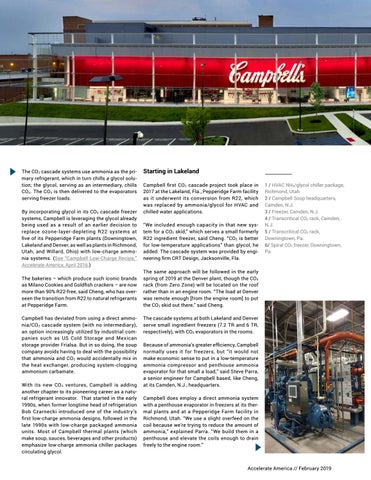
1 / HVAC NH3/glycol chiller package, Richmond, Utah 2 / Campbell Soup headquarters, Camden, N.J. 3 / Freezer, Camden, N.J. 4 / Transcritical CO2 rack, Camden, N.J. 5 / Transcritical CO2 rack, Downingtown, Pa. 6/ Spiral CO2 freezer, Downingtown, Pa.
1/
The cascade systems at both Lakeland and Denver serve small ingredient freezers (7.2 TR and 6 TR, respectively), with CO 2 evaporators in the rooms. Because of ammonia’s greater efficiency, Campbell normally uses it for freezers, but “it would not make economic sense to put in a low-temperature ammonia compressor and penthouse ammonia evaporator for that small a load,” said Steve Parra, a senior engineer for Campbell based, like Cheng, at its Camden, N.J., headquarters. Campbell does employ a direct ammonia system with a penthouse evaporator in freezers at its thermal plants and at a Pepperidge Farm facility in Richmond, Utah. “We use a slight overfeed on the coil because we’re trying to reduce the amount of ammonia,” explained Parra. “We build them in a penthouse and elevate the coils enough to drain freely to the engine room.”
Accelerate America // February 2019