Foodservice
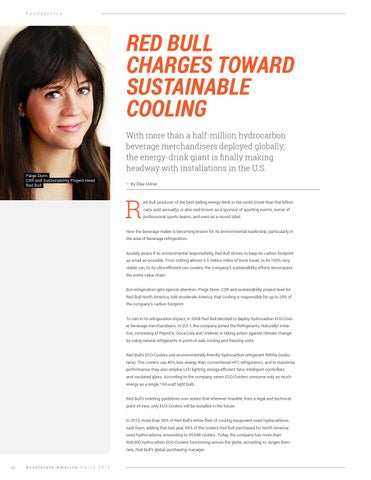
RED BULL CHARGES TOWARD SUSTAINABLE COOLING Paige Dunn CSR and Sustainability Project Head Red Bull
With more than a half-million hydrocarbon beverage merchandisers deployed globally, the energy-drink giant is finally making headway with installations in the U.S. — By Elke Milner
R
ed Bull, producer of the best-selling energy drink in the world (more than five billion cans sold annually), is also well known as a sponsor of sporting events, owner of professional sports teams, and even as a record label.
Now the beverage maker is becoming known for its environmental leadership, particularly in the area of beverage refrigeration. Acutely aware if its environmental responsibility, Red Bull strives to keep its carbon footprint as small as possible. From cutting almost 5.5 million miles of truck travel, to its 100% recyclable can, to its ultra-efficient can coolers, the company’s sustainability efforts encompass the entire value chain. But refrigeration gets special attention. Paige Dunn, CSR and sustainability project lead for Red Bull North America, told Accelerate America, that cooling is responsible for up to 20% of the company’s carbon footprint. To rein in its refrigeration impact, in 2008 Red Bull decided to deploy hydrocarbon ECO-Cooler beverage merchandisers. In 2011, the company joined the Refrigerants, Naturally! initiative, consisting of PepsiCo, Coca-Cola and Unilever, in taking action against climate change by using natural refrigerants in point-of-sale cooling and freezing units. Red Bull’s ECO-Coolers use environmentally friendly hydrocarbon refrigerant R600a (isobutane). The coolers use 45% less energy than conventional HFC refrigerators, and to maximize performance, they also employ LED lighting, energy-efficient fans, intelligent controllers and insulated glass. According to the company, seven ECO-Coolers consume only as much energy as a single 100-watt light bulb. Red Bull’s ordering guidelines now states that wherever feasible, from a legal and technical point of view, only ECO-Coolers will be installed in the future. In 2013, more than 50% of Red Bull’s entire fleet of cooling equipment used hydrocarbons, said Dunn, adding that last year, 65% of the coolers Red Bull purchased for North America used hydrocarbons, amounting to 59,948 coolers. Today, the company has more than 500,000 hydrocarbon ECO-Coolers functioning across the globe, according to Jürgen Brenneis, Red Bull’s global purchasing manager.
30
Accelerate America March 2015