Technology
75
an HFC system,” Wilson says. “We are seeing power reductions of 60% compared to a conventional R404A system. The payback is usually about five years between the two, so it’s not for everyone. Power is not going to get cheaper, ever! Less power is the only way to reduce your cost and higher power cost shortens the payback.”
Policy dimension While government can play a key role in helping, managing, and encouraging change, Jensen sees lack of government aid as the biggest failure in Australia’s case. “To ensure the long-term survival [of the industry] this needs to change, but it needs to happen without individual business entities accepting excessive technical and commercial risks. For instance, the industry could be assisted by government with funding for demonstration projects.” One way government can help is by implementing a change management process. “This should be put in place rather than merely leaving it to industry to deliver what is needed for compliance with the COP21 agreement this government ratified, as well as the amended Montreal Protocol,” Jensen argues. “This is, to a very large extent, a function of how change is managed. This is a responsibility that rests with government. The Australian government has issued conflicting signals previously in relation to environmental issues. One example was the carbon tax. Another was the carbon equivalent levy on HFC refrigerants introduced in 2012 and abolished in 2014,” he says. Wilson, too, admits that the carbon tax helped a great deal. “Since its removal, most of our competitors offer R134a and R404A, and in the majority of cases the end user wants the cheaper option. The industry has a long way to go before it’s ready for the HFC phase-out that’s inevitably coming.”
What’s next? Jensen urges the Australian government to move quickly to implement the Kigali amendment to the Montreal Protocol, which obliges developed nations to phase down HFCs by 85% by 2036. “It is also worth observing that Australia does not appear to have a national energy plan similar to some of the EU-based energy agencies that were implemented following the energy crisis way back in 1974,” he says. “Now that the Australian government has joined with 196 other parties in amending the Montreal Protocol and also finally ratifying the COP21 agreement, it is time to send a clear signal to industry as to what the direction for HVAC&R will be,” Jensen believes. The market needs clear signals as to which way the wind is blowing. “A ban on the use of HFC refrigerants in all new Spring 2017
Accelerate Europe
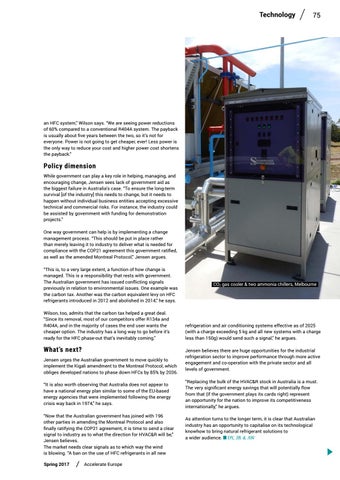
CO2 gas cooler & two ammonia chillers, Melbourne
refrigeration and air conditioning systems effective as of 2025 (with a charge exceeding 5 kg and all new systems with a charge less than 150g) would send such a signal,” he argues. Jensen believes there are huge opportunities for the industrial refrigeration sector to improve performance through more active engagement and co-operation with the private sector and all levels of government. “Replacing the bulk of the HVAC&R stock in Australia is a must. The very significant energy savings that will potentially flow from that (if the government plays its cards right) represent an opportunity for the nation to improve its competitiveness internationally,” he argues. As attention turns to the longer term, it is clear that Australian industry has an opportunity to capitalise on its technological knowhow to bring natural refrigerant solutions to a wider audience. DY, JR & AW