BUSINESS
Page D2 • Sunday, July 21, 2013
Northwest Herald / NWHerald.com
Stop the busy work; start the work that matters We live in an age where there is simply too much! Too much information coming at us more quickly than we have any chance of processing it. Too many daily innovations in ways to reach people and interact or react through social media. Too many details to track and too many distractions to think. Our leadership bias has moved to doing vs. thinking. What is so often missing is time to think. When we catch ourselves thinking, we might even feel guilty about wasting time. There is just so much to do! Most of us know when we are doing good work. Good work is the work we do day to day that pays the bills and provides the fulfillment of providing services, goods, and information that is valued and useful. This is work we do to meet the needs of others (if we are successful with it). Doing good work meets our needs as well – our needs for income, steadiness, comfort, and predictability. We are happy when things are running
smoothly and we are producing good work. Good work is important. But then, there’s Great Work. Great Work is work that is going to stretch you personally. It may or may not have anything to do with your daily bread and butter. This is work that is is for you. Work you do for you. Not that others may not like, appreciate, and benefit from it. Those are not the reasons you do it. You do it for you. It is the work that stretches, challenges, and opens you. It takes you away from the daily limits of who you think you are and moves you into a zone of exploration and deeper understanding of yourself, your capabilities, and the world in which you find yourself. When you do Great Work, time seems suspended, practical creative ideas flow easily, your sense of self is coherent and you know that you are doing your “right stuff.” Great Work also can be a time of groping your way through, of confusing and
MOTIVATION Bob Sandidge & Anne Ward contradictory ideas, of uncertainty about things fitting together and working out. Doing Great Work can test your will and perseverance. Your own Great Work may be an elusive idea that seems far out of reach. Work that you will do someday – when you can get enough bankable good work done to buy the time to get down to the creative struggle of producing your Great Work. Great Work may be a lifetime pursuit or happen in a moment. Where are you with your Great Work? On a scale of one to 10, how committed are you to doing the Great Work that is calling you? Is your number high enough to ignite the fire of motivation in you? If not, perhaps you haven’t discovered your
Great Work yet. If it’s a 10, what would need to be different for you to get really engaged with your great work project? The idea of work that matters is explored by Michael Bungay Stainer in his book “Do More Great Work.” Stainer is a consultant and trainer who spends time exploring how Great Work comes into being. He says that we need to start by taking a look at what we are doing now. We all do some bad work, some good work, and even some Great Work. Here’s data from people around the world: 10-40 percent Bad Work, 40-80 percent Good Work, 0-25 percent Great Work. Yes, we all do some bad work. That’s work that wastes our time and does nothing for us or anyone else. Sometimes it seems like we are doing good work when we are actually using bad work to keep us from doing good work. More importantly, we often use good work as an excuse to not get going on our Great Work project.
If you are curious about how to get more Great Work into your life, Stainer’s book has 15 maps that will help you sort out where you are and how to make the choices you need to get more Great Work in your life and even into your organization. Of course, like most good things, doing Great Work will take commitment, motivation and some time for thinking and working. “Do More Great Work – Stop the busywork, and start the work that matters.” (Michael Bungay Stainer – Workman Publishing).
• Anne Ward and Bob Sandidge, CreativeCore Media in Algonquin, are marketing, communication, management and training consultants who help small business and non-profits overcome the marketing and motivational myths that are keeping them and their businesses from unbounded success. AnneBob@CreativeCore.com – www. NLPeople.com.
8FACES & PLACES
Brake Parts Inc. earns United Way Landmark Award
Robert Cormier Jr. reappointed to chair IBA panel
McHENRY – What can $1 a day do in McHenry County? As the leadership team at Brake Parts Inc. recently learned, it helps one in four people in need throughout McHenry County, according to the United Way of Greater McHenry County. Steve Otten, executive director for the United Way of Greater McHenry County, presented David Overbeeke, president and CEO of BPI, with the United Way Landmark Award, which goes to companies that raise $100,000 or more for the United Way in the year-long fundraising drive. During the award presentation this month, leaders from BPI and the United Way of Greater McHenry Country discussed ways to shine a spotlight on the need within McHenry county, and additional ways to increase business and community support for the United Way campaign. “We truly appreciate the support,” Otten said. “You have to partner with people in order for it to be a victory for everybody. BPI is definitely one of the most valued partners we have in helping us reach our goals.” The group discussed the challenges and opportunities faced by United Way. As he moves forward with his upcoming campaign, Otten said that the ideas discussed during the meeting will help United Way reach out more effectively to the larger community. “The United Way is something that I’ve always participated in,” Overbeeke said. “My wife has a real passion for helping kids, so we’ve been involved for a long time.” Overbeeke said he tries to drive that same mentality at McHenry-based BPI, and it seems to be working. While some people believe only high earners can afford to donate to organiza-
Robert Cormier Jr., executive vice president at Home State Bank N.A., Crystal Lake, recently was reappointed to chair of the Illinois Bankers Association Education Advisory Committee by IBA Chairman Charie A. Zanck, American Community Bank & Trust, Woodstock. As chairman of the Education Advisory Committee, Cormier will assist in recommending strategies for the development, marketing and implementation of educational offerings, and will serve in an adviRobert Cormier Jr. sory role to the IBA Board of Directors on timely and important banking topics. He also will assist in examining the quality of all educational programs offered and marketed by the association to ensure that the professional development needs of all Illinois bankers are met. The Illinois Bankers Association is a full-service trade association dedicated to creating a positive business climate that benefits the entire banking industry and the communities they serve. Founded in 1891, the IBA brings together state and national banks, savings banks, and savings and loan associations of all sizes in Illinois. Collectively, the IBA represents nearly 90 percent of the assets of the Illinois banking industry, which employs more than 100,000 men and women in more than 5,000 offices across the state.
Provided photo
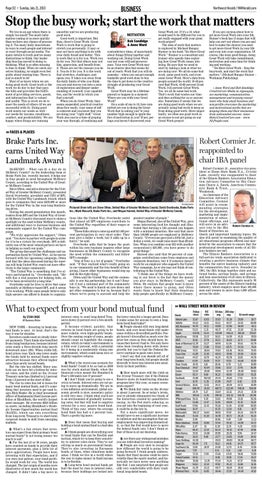
Pictured (from left) are Steve Otten, United Way of Greater McHenry County; David Overbeeke, Brake Parts Inc.; Mark Massoth, Brake Parts Inc.; and Megan Harned, United Way of Greater McHenry County. tions like the United Way, Overbeeke noted that almost all BPI employees contribute to the United Way regardless of their wages or compensation. “These folks always come up and hit 100 percent participation in very short order. They may give a dollar a week, but it adds up in a hurry,” he said. Overbeeke adds that he hopes the push within his own business inspires other large businesses in McHenry County to recognize the need within the community and follow BPI’s example. “One of four is a lot of people,” Overbeeke said. “If they realized what’s really going on in our community and the true benefit of their giving, I know other businesses would step up and do the right thing.” Otten said the United Way and the community is one big partnership, but it can’t flourish if just a minimal part of the community buys in. “We need to knock on new doors and get other companies to buy in, because that’s where we’re going to succeed and help the
greatest number of people.” Megan Harned, also of the United Way, gave some interesting food for thought and illustrated that turning a life around can happen with a minimal donation. She said that more than 159,000 people are employed in McHenry County. “If everyone gave just a little bit, just a dollar a week, we could raise more than $8 million. When you combine your $52 with another corporation’s $50,000, you have power to do great things.” Harned also said that 90 percent of campaign contributions come from employee and corporate donations, but it if someone doesn’t work for an employer who supports the United Way campaign, he or she may not think of contributing to the United Way. “I think one of the things we have working in our favor is the fact that the money you give stays in McHenry County,” said Otten. He realizes that people want to know where there money is going, and Otten wants them to know that their donations help people specifically in McHenry County.
What to expect from your bond mutual fund By STAN CHOE AP Business Writer NEW YORK – Investing in bond mutual funds is easy. At least, that’s the way it was for decades. Investors could count on steady interest payments. Their funds also benefited from rising bond prices, because interest rates made a three-decade-long march downward since 1981. When yields fell, bond prices rose: Each step lower made the bonds held by mutual funds more attractive because they offered higher rates than newly issued bonds. But the tide has shifted. Many analysts say we have hit a bottom for interest rates, and the yield on the 10-year Treasury note has climbed to 2.5 percent from 1.6 percent at the start of May The rise in rates has led to losses for many bond mutual funds, and it’s something that investors need to get used to, says Rick Rieder. He is chief investment officer of fundamental fixed income portfolios at BlackRock, the world’s largest asset manager. He oversees $650 billion in assets, including BlackRock’s Strategic Income Opportunities mutual fund (BASIX), which can own everything from long-term Treasurys to short-term corporate bonds to debt from emerging markets.
Q: What’s a fair return that investors can expect from their primary bond mutual funds? Is not losing money too much to ask? A: For the last 25 or 30 years, people have counted on bonds to provide their interest payments, plus a little bit of price appreciation. People have been investing with that expectation, and if you were just patient, your bond portfolio would work for you. The world has changed. The last couple of months were illustrative of how much the world has changed. It didn’t take a big move in
interest rates to send long-dated Treasurys down 12 percent over a two-month period. It became evident, quickly, that returns in bond funds are going to be more volatile, even high-quality bonds. Over the coming couple of years, people should count on hopefully the coupon return, which in today’s environment is a little over 2 percent, with a potential for it being in a moderately rising rate environment, which could mean zero or slightly negative returns.
Q: What’s the worst-case scenario for bond funds? Could it be as bad as 2008 was for stock mutual funds, when the financial crisis meant the Standard & Poor’s 500 index lost 37 percent? A: I don’t think you’re going to see a crisis in bonds. Interest rates are not going to move up dramatically: We are in a low-inflation environment, global economic growth is slow, monetary policy is still very easy. I think what you’ll see is an environment of gradually increasing rates, but that will lead to negative returns for a core, passive bond fund. Think of this year, where the average bond fund has had a 4 percent loss. That’s a pretty big move. Q: Does that mean that buying and holding a bond mutual fund is a bad idea now? A: I think people are diversifying now to bond funds that can be flexible and tactical, which try to keep their sensitivity to interest rates down. They’re not relying so much on government bonds. They’re also investing in European bonds, at times, when valuations make sense. I think we live in a world where the way to make money in fixed income is to be flexible. Q: Long-term bond mutual funds get hurt the most by rises in interest rates, because their holdings are locked into
the lower rates for a longer period. Does it make sense for anyone to own a longterm bond fund today? A: People should still own long-dated bonds, and core bond funds still make sense within a diversified portfolio. People haven’t diversified as much over the prior few years as they should have, because they haven’t had to. Not only have rates been trending down with slower growth, but you’ve had the Federal Reserve continue to push rates lower. I don’t say that you should sell all of your long-term bonds, but people should diversify to have less interest-rate sensitivity in their portfolio.
Q: How much more will the yield on the 10-year Treasury rise if the Federal Reserve slows its bond-buying stimulus program later this year, as many economists expect? A: We think fair value on the 10-year is about 3 percent. So at today’s levels, you’ve already eliminated two thirds of the distortion created by quantitative easing. As the Fed starts reducing, as you get into the beginning of next year, it could be in the low 3s. For a more significant move, we would have to see a significant increase in inflation and the assumption that unemployment was improving dramatically, so that the Fed would have to move the federal funds rate. I don’t think either of those is at our doorstep. Q: Are there any widespread mistakes you see individual investors making? A: People are very slow to recognize how different the world is going to be going forward. I think people underestimate that fixed income could be more volatile than the equity market, and historically we have never seen anything like that. I am surprised that people are still very comfortable with their traditional long-dated bonds.
8WALL STREET WEEK IN REVIEW Friday close Stock 35.87 Abbott Labs 44.52 AbbVie AGL Resources 45.76 52.10 Allstate 424.95 Apple 59.58 AptarGroup 35.81 AT&T Bank of Montreal 62.39 74.04 Baxter 74.75 CME Group 41.09 Coca-Cola 44.57 Comcast 61.93 Covidien 10.45 Dean Foods Dow Chemical 34.67 32.04 Exelon 95.17 Exxon 25.88 Facebook 16.76 Ford General Motors 36.61 896.59 Google 34.74 Hillshire 193.54 IBM JPMorganChase 56.16 52.86 Kohl’s 57.66 Kraft Foods 16.47 Live Nation 100.27 McDonald’s 31.40 Microsoft 11.99 Modine Moto Solutions 59.85 11.47 OficeMax 86.41 Pepsi 19.36 Pulte Homes 26.15 Safeway Sears Holdings 44.38 95.44 Snap-On Southwest Air. 13.81 7.39 Supervalu 72.55 Target United Contint. 34.51 78.08 Wal-Mart 50.61 Walgreen Waste Mgmt. 42.39 Wintrust Fincl. 41.54
P/E ratio
50-day 200-day avg. avg.
10.93 13.15 18.21 11.31 10.14 25.57 27.70 10.27 17.88 28.64 21.50 18.79 16.09 3.16 42.64 28.68 9.68 562.63 11.36 12.55 26.83 5.27 13.35 9.39 12.47 21.43 18.60 16.20 18.86 .16 22.14 24.88 9.80 7.71 26.97
35.93 43.21 43.06 48.37 425.99 56.91 35.51 58.94 70.53 74.63 40.53 41.24 57.37 10.26 33.66 30.94 91.22 24.54 15.90 34.31 887.72 33.64 198.55 53.81 51.95 55.26 15.25 98.92 34.78 10.96 57.54 11.28 82.13 19.90 23.77 45.01 91.12 13.50 6.51 70.26 31.81 75.54 47.92 40.77 38.46
17.05 15.39 22.14 24.22 16.95
35.28 40.77 42.06 47.32 446.14 54.99 36.03 61.45 69.75 63.36 39.90 40.78 57.01 8.70 33.13 32.49 89.93 26.84 14.07 30.59 822.85 33.32 202.32 49.90 48.04 51.36 12.54 97.87 30.72 9.49 59.32 11.35 78.42 20.26 23.05 48.00 84.91 12.73 5.15 67.03 29.81 74.24 45.22 38.69 37.29
52-week range 29.98 33.33 36.90 33.38 385.10 45.19 32.71 55.61 54.54 49.54 35.58 31.05 44.68 5.21 27.45 28.40 83.50 17.55 8.82 18.72 598.18 24.31 184.78 33.10 41.35 42.00 8.16 83.31 26.26 5.80 44.98 4.20 67.39 9.96 14.89 38.40 64.75 8.45 1.68 58.01 17.45 67.37 31.88 30.82 34.40
38.77 48.00 46.11 52.38 705.07 59.93 39.00 64.79 74.14 79.45 43.43 44.70 61.93 10.89 36.00 39.82 95.25 32.51 17.29 36.99 928.00 37.28 215.90 56.56 55.25 58.05 16.77 103.70 36.43 12.32 64.72 14.92 87.06 24.47 28.42 68.77 95.77 14.56 8.26 73.00 35.27 79.96 51.45 43.00 41.92