together,
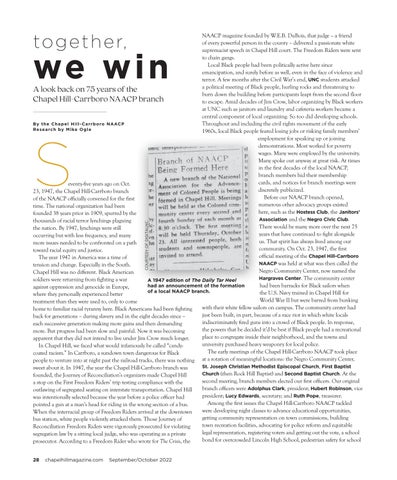
NAACP magazine founded by W.E.B. DuBois, that judge – a friend of every powerful person in the county – delivered a passionate white supremacist speech in Chapel Hill court. The Freedom Riders were sent to chain gangs. Local Black people had been politically active here since emancipation, and surely before as well, even in the face of violence and terror. A few months after the Civil War’s end, UNC students attacked a political meeting of Black people, hurling rocks and threatening to A look back on 75 years of the burn down the building before participants leapt from the second floor Chapel Hill-Carrboro NAACP branch to escape. Amid decades of Jim Crow, labor organizing by Black workers at UNC such as janitors and laundry and cafeteria workers became a central component of local organizing. So too did developing schools. By t h e C hap e l H ill- Car r b o ro NAAC P Throughout and including the civil rights movement of the early Res e arc h by M i ke O g le 1960s, local Black people feared losing jobs or risking family members’ employment for speaking up or joining demonstrations. Most worked for poverty wages. Many were employed by the university. Many spoke out anyway at great risk. At times in the first decades of the local NAACP, branch members hid their membership cards, and notices for branch meetings were eventy-five years ago on Oct. discretely publicized. 23, 1947, the Chapel Hill-Carrboro branch Before our NAACP branch opened, of the NAACP officially convened for the first numerous other advocacy groups existed time. The national organization had been here, such as the Hostess Club, the Janitors’ founded 38 years prior in 1909, spurred by the Association and the Negro Civic Club. thousands of racial terror lynchings plaguing There would be many more over the next 75 the nation. By 1947, lynchings were still years that have continued to fight alongside occurring but with less frequency, and many us. That spirit has always lived among our more issues needed to be confronted on a path community. On Oct. 23, 1947, the first toward racial equity and justice. official meeting of the Chapel Hill-Carrboro The year 1947 in America was a time of NAACP was held at what was then called the tension and change. Especially in the South. Negro Community Center, now named the Chapel Hill was no different. Black American Hargraves Center. The community center soldiers were returning from fighting a war A 1947 edition of The Daily Tar Heel had been barracks for Black sailors when had an announcement of the formation against oppression and genocide in Europe, of a local NAACP branch. the U.S. Navy trained in Chapel Hill for where they personally experienced better World War II but were barred from bunking treatment than they were used to, only to come with their white fellow sailors on campus. The community center had home to familiar racial tyranny here. Black Americans had been fighting just been built, in part, because of a race riot in which white locals back for generations – during slavery and in the eight decades since – indiscriminately fired guns into a crowd of Black people. In response, each successive generation making more gains and then demanding the powers that be decided it’d be best if Black people had a recreational more. But progress had been slow and painful. Now it was becoming place to congregate inside their neighborhood, and the towns and apparent that they did not intend to live under Jim Crow much longer. university purchased heavy weaponry for local police. In Chapel Hill, we faced what would infamously be called “candyThe early meetings of the Chapel Hill-Carrboro NAACP took place coated racism.” In Carrboro, a sundown town dangerous for Black people to venture into at night past the railroad tracks, there was nothing at a rotation of meaningful locations: the Negro Community Center, St. Joseph Christian Methodist Episcopal Church, First Baptist sweet about it. In 1947, the year the Chapel Hill-Carrboro branch was Church (then Rock Hill Baptist) and Second Baptist Church. At the founded, the Journey of Reconciliation’s organizers made Chapel Hill second meeting, branch members elected our first officers. Our original a stop on the First Freedom Riders’ trip testing compliance with the branch officers were Adolphus Clark, president; Hubert Robinson, vice outlawing of segregated seating on interstate transportation. Chapel Hill president; Lucy Edwards, secretary; and Ruth Pope, treasurer. was intentionally selected because the year before a police officer had Among the first issues the Chapel Hill-Carrboro NAACP tackled pointed a gun at a man’s head for riding in the wrong section of a bus. were developing night classes to advance educational opportunities, When the interracial group of Freedom Riders arrived at the downtown getting community representation on town commissions, building bus station, white people violently attacked them. Those Journey of town recreation facilities, advocating for police reform and equitable Reconciliation Freedom Riders were vigorously prosecuted for violating legal representation, registering voters and getting out the vote, a school segregation law by a sitting local judge, who was operating as a private bond for overcrowded Lincoln High School, pedestrian safety for school prosecutor. According to a Freedom Rider who wrote for The Crisis, the
we win
COURTESY OF DIGITALNC
S
28
chapelhillmagazine.com
September/October 2022