CHAPEL HILL • CARRBORO • HILLSBOROUGH • OR ANGE COUNT Y
M AY/J U N E 2 0 2 1
Businesswomen. Public servants. Healers.
Meet 15 trailblazers you ought to know
POWE R MOVE Jaimie Lee opened her own self-defense fitness studio on East Franklin Street.
our 8th Annual
Women’s Issue page 44
Bring their SMILES back Bringwith theirMUSIC! SMILES back
with MUSIC!
CHAPELHILL M AY/J U N E 2 02 1
C H A P E L H I L L M AG A Z I N E .CO M E DITOR
Jessica Stringer E DITORIAL E X E C U T IV E MANAGING E DITO R
Amanda MacLaren
ASS ISTANT E DITOR
Hannah Lee
E DITORIAL ASS ISTANT & DIGITAL E D I TO R
Marie Muir
MANAGING E DITOR, C H ATH A M MAG A Z I N E
Anna-Rhesa Versola
E DITORIAL ASS ISTANT
Renee Ambroso
E DITORIAL INT E RNS
Meredith Alling, Janet Alsas, Aubrey Austin, Grace Beasley, Claire Burch, Chiara Evans, Nicole Moorefield, Aashna Shah, Greta Travaglia CONT RIB U TORS
Hannah McClellan, Moreton Neal, James Stefiuk, Anne Tate
T T
Call us at 919-960-6898 or Callus usat: at admin@chsma.com 919-960-6898 or email email us at: admin@chsma.com
chsma.c m chsma.c m
ART C RE AT IV E DIRE C TOR
Kevin Brown
P H OTOGRAP H E R
John Michael Simpson JU NIOR GRAP H IC DE S IGNE R & P RODU C T ION COORDINATO R
Lauren Wilkinson CONT RIB U TORS
CC Kallam, Jean Carlos Rosario-Montalvo ADV E RT IS ING For advertising inquiries, email advertising@chapelhillmagazine.com
Melissa Crane melissa@chapelhillmagazine.com Chris Elkins chris@chapelhillmagazine.com Lauren Phillips lauren@durhammag.com Kem Johnson kem@durhammag.com P RODU C T ION MANAGE R
Lizzie Jones
CORP ORAT E C H IE F OP E RAT ING OF F IC E R
Rory Kelly Gillis P RE S IDE NT
Dan Shannon V IC E P RE S IDE NT OF P L ANNING & DE V E LO PM E N T
Ellen Shannon
P U B L IS H E R, H EA RT OF NC WED D I N G S
Jenna Parks
V IC E P RE S IDE NT OF F INANC E & ADMIN I STR AT I O N
Amy Bell
C U STOME R S E RV IC E S P E C IAL I ST
Brian McIndoo
DIST RIB U T ION
Caleb Rushing
Chapel Hill Magazine is published 8 times per year by Shannon Media, Inc. 1777 Fordham Blvd., Ste. 105, Chapel Hill, NC 27514 tel 919.933.1551 fax 919.933.1557 Subscriptions $38 for 2 years – subscribe at chapelhillmagazine.com
2
chapelhillmagazine.com
May/June 2021
DENTAL IMPLANTS • BONE GRAFTING • WISDOM TEETH • FACIAL TRAUMA • CORRECTIVE JAW SURGERY • PRE-PROSTHETIC SURGERY • ORAL PATHOLOGY • SLEEP APNEA
FOR MORE THAN 50 YEARS, the practice of Oral and Maxillofacial Surgery Associates has been trusted to provide specialized care in the Chapel Hill, Durham, and Sanford communities. Our five board certified oral and maxillofacial surgeons provide the highest quality of patient care with the latest diagnostic and treatment tools available to assure patient safety and comfort. Drs. Frost, Sacco, Vandersea, Ruvo and Serlo practice a full scope of oral and maxillofacial surgery with expertise ranging from corrective jaw surgery to wisdom tooth removal.
OMSANC.COM
DAVID E. FROST DDS, MS DEBRA M. SACCO DMD, MD BRIAN VANDERSEA DDS ANDREW T. RUVO DMD, MD ADAM D. SERLO DMD, MD
CHAPEL HILL 501 Eastowne Drive, Suite 110 Chapel Hill 27514 919.929.2196 DURHAM 2823 North Duke Street Durham 27704 919.479.0707 SANFORD 109 Dennis Drive Sanford 27330 919.775.1615
MAY/JUNE
CO NT EN TS
CHAPELHILLMAGAZINE.COM
VOLUME 16 NUMBER 4
T HE WOMEN ’S I SSU E 44
V. Dianne Peerman-Pledger, Tabitha Elien and Barbara M. Foushee Divine Nine Sorority Members
46
Heidi Kim English and Comparative Literature Professor, UNC & Director, Asian American Center
28 End of an Era Readers share their favorite Roy Williams memories after the longtime UNC men’s basketball coach retired on April 1 34 Our Top Dentists 64 At Your Service The South Orange Rescue Squad marks five decades of providing emergency medicine and education to the Orange County community
48 Jessica Murley and Katerina Gmitter Co-founders, Healing Pines Respite 50
Janet Hadar President, UNC Hospitals
52
Jaimie Lee Owner, The Coalition
53
Jen Feldman Rabbi, Kehillah Synagogue
H O M E & G A R DEN 70 A Peace of Piedmont Two health care workers retreat to a modern oasis overlooking the Chapel Hill countryside. D E PA R TME N TS & CO LUM NS 6 Editor’s Letter 8 About Town Events not to miss
54 Chieko Murasugi Artist 56
Pam Herndon Licensed Insurance Agent and Chartered Financial Professional, State Farm
58
Jean McDonald Family Nurse Practitioner, UNC Campus Health
59
Quintana Stewart Director, Orange County Health Department
60
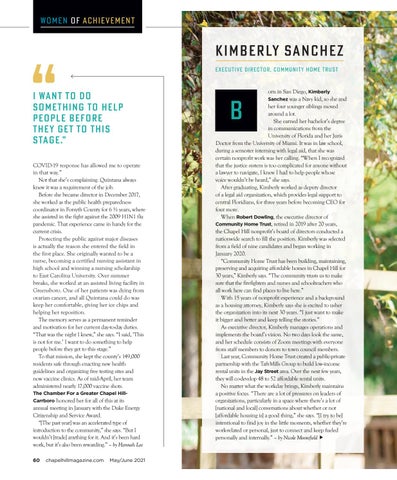
Kimberly Sanchez Executive Director, Community Home Trust
62
Valerie Paige Foushee Senator, North Carolina General Assembly
F EATURES 25
Carolina on Our Mind The Stone Center’s oldest program gives underserved students a boost of confidence
PAGE
54
PAGE
59
14 Noted What we’ve heard around town ... 18 What We’re Eating News from our restaurant community, plus a dish we love 88 Dining Guide 92 Joyous Cooking: One-Stop Shopping 96 Wedding Frances Cosgrove & Jonathan Reda P E O P L E & P L ACES 10 OCHAR’s Annual Awards Safe & Social Tailgate Awards Party 11 Teddy Bear Connection Day at The Cedars S P O N S O R E D CO NT ENT 31
The Big Give Our local nonprofits, how they support the community and how you can get involved
PHOTOGRAPHY BY JOHN MICHAEL SIMPSON
ORIENTAL RUGS
SALE 30% -75% OFF MAY 1 THROUGH MAY 31
919-489-8362 5634 CHAPEL HILL BLVD., DURHAM (Corner of I-40 and 15-501 at Exit 270)
persiancarpet.com
L ET TE R F R O M TH E E DI TO R
WELCOME
HOME FROM
Honor Ro ll HERE FOR ALL OF YOUR DESIGN NEEDS STUDI O HO URS: Monday to Friday: 10am - 5pm Saturday by appointment
5850 Fayetteville Rd, Suite 104, Durham, NC 27713 (919) 806-3638 design@MaxHugoInteriors.com FOL LO W US! @MaxHugoI nt er ior s MAXHUGOINTERIORS.COM
W
jessica@chapelhillmagazine.com
e couldn’t have asked for better weather on that Monday in April when we scheduled our Women’s Issue photo shoot. It was sunny and 75 degrees – and a week before the pollen took over – at the North Carolina Botanical Garden. Photographer John Michael Simpson had scoped out pockets of greenery and blooming flowers. I was armed with a case of water and an almost comically oversized sun hat while on light reflector duty, assisting John Michael. Over the course of the day, each woman showed up for her moment in the sun. It’s always a feat to pinpoint who to feature in this annual issue. There are just so many who deserve a spotlight for all they do for our towns. This year, I knew at least one woman we had to reach out to and learn more about. A few months ago, I received a nomination email from Allie Mendelsohn praising her friend Jean McDonald. Allie signed off with, “I have barely even scraped the surface of who she is and how much she gives and has given to our community, but it is my hope that you will contact her and find out for yourself what a treasure she is.” That day at the photo shoot, I finally found myself in the presence of Jean, the last scheduled subject. She was warm and had us laughing as John Michael rushed to capture her at closing time. You’ll find Allie’s deeply personal tribute to Jean on page 56. And, although I know it will only make my job harder next year, I encourage you to send me an email with your nominations of some amazing Orange County women. Until then, I invite you to learn more about Jean, along with 14 other incredible women, starting on page 44. CHM
T HE COVER P h o to by J o h n Mic ha el Sim pson 6
chapelhillmagazine.com
May/June 2021
E X C L U S I V E LY AT
A B O UT TOWN
Compiled by Meredith Alling EVENTS ARE SUBJECT TO CHANGE; CHECK WITH ORGANIZERS PRIOR TO ATTENDING
EVENTS NOT TO MISS
Garden Tour hillsboroughgardenclubnc.org The MAY
15
Hillsborough Garden Club
hosts a socially distanced, self-guided tour of 12 residential gardens in the Forest Ridge subdivision and historic downtown Hillsborough. All proceeds go to the club.
PHOTO BY HOLLIS CHATELAIN
10 a.m. to 4 p.m.
The dozen gardens on display during the Hillsborough Garden Club’s spring tour feature a range of plants from perennials to mature trees and shrubs.
Dining for Others May 5, 7-8 p.m. mowocnc.org Meals on Wheels Orange County, NC
hosts its annual fundraising dinner virtually. Participants can pick up dinner from Carrboro United and enjoy it at home during the Zoom program. Proceeds from the event fund meals and check-ins for older adults in the community.
Freight Train Blues Concert Series Fridays, May 14–June 11 musicmaker.org The Carrboro Recreation, Parks & Cultural Resources Department and Music Maker Relief Foundation present a virtual Blues
8
chapelhillmagazine.com
May/June 2021
and Roots concert series every Friday evening featuring performances from Alexa Rose, Amythyst Kiah, Johnny Ray Daniels, The Hamiltones and Harvey Dalton Arnold.
Party on the Porch
Midway: A Virtual Tour of the Black Financial District
to celebrate its 30th anniversary. Attendees receive wine from Chapel Hill Wine Company, cupcakes and a link to the livestream program, which includes a silent auction, live music and stories from CHT homeowners.
May 16, 3-4 p.m. chapelhillhistoricalsociety.org Danita Mason-Hogans, a local historian and project manager for the Center for Documentary Studies at Duke University, provides a virtual tour of the Black financial district in Chapel Hill. Danita will share stories and history about Midway, the business and social hub for Black families.
May 20, 7 p.m. communityhometrust.org Community Home Trust throws a virtual party
An Evening with Three Dance Trailblazers” May 21 carolinaperformingarts.org Carolina Performing Arts digitally premieres
new dance pieces from artists Bobbi Jene Smith, Hope Boykin and Shamel Pitts, whose new work provokes discussions of vulnerability, race, gender and new parenthood. CHM
I N T R O D U C I N G
THE BUTTERFLY BRUISES BY PALMER SMITH
@ S P D E V S M I T H W R I T E R
Palmer Smith is a newly acclaimed Southeastern poet. Her book, The Butterfly
Bruises, is a meditation on animals, the ocean, miscommunication, childhood, Northeastern vs. Southern American culture, nature vs. technology, and the imagination of the introvert. Many of her poems pertain to North Carolina mountain life and coastal life. You can order her newly acclaimed book at Epilogue Books Chocolate Brews in Chapel Hill and McIntyre’s
“…inventive, insightful, and highly readable.” – David Farley, Travel Writer
Books in Fearrington Village. Available May 15, 2021. Smith will also be giving a poetry reading on Thursday, May 20 at The Carolina Inn. Please visit thebutterflybruisesbook.com to RSVP to the event.
May/June 2021
chapelhillmagazine.com
9
PEOP LE & P LACES
OCHAR’s Annual Awards Safe & Social Tailgate Awards Party The Orange Chatham Association of Realtors held its annual awards ceremony – tailgate style – in the Cosgrove parking lot on March 26. The event featured live music by the band 3 Under Par, eats from Mex Etc and drinks provided by Carolina Brewery. Eight awards were given out: Chris Holt (affiliate of the year), Matt Demson (broker in charge of the year), Inna Shapiro (Realtor of the year), Ashlie Campbell (community service), Christine Khoury (Realtor’s choice), Rachael Elliott (organization service), Pat Serkedakis (milestone) and Danielle Boggess (rising star). Attendees could buy raffle tickets with proceeds going to Meals on Wheels and received a swag bag with gift cards for local businesses. Photography by CC Kallam CHM 1
1 Jane Serkedakis and Pat Serkedakis. 2 Mitzi Powell, OCHAR Chief Executive Officer Cub Berrian, Ron Griffin, Debbie Del Corro, OCHAR Director Gayle Claris, OCHAR Operations Manager Ashley Johnson, Rachael Elliott, Chris Holt and Cenaira James. 3 Daniel Carbajal and Teri Lowry of Carolina Brewery. 4 Jeff Rupkalvis and James Blackburn. 5 Kathryn Walker, Connolly Walker and Adelle Fournier. 6 3 Under Par’s Roman Del Corro, Lee Hines and Tom Del Corro with guest guitarist Ken Swayze. The group typically performs music from the 1950s, 1960s and 1970s.
2
3
4
6
10
chapelhillmagazine.com May/June 2021
5
Teddy Bear Connection Day at The Cedars On March 17, The Cedars of Chapel Hill held a Teddy Bear Connection Day where Meadowmont resident and toddler Teddy Duthe made window visits to seniors at The DuBose Health Center. He was accompanied by his mom, his nanny and a group of seniors known as the DuBose Outsiders who all carried stuffed animals and regularly held window visits throughout the pandemic to bring cheer to fellow friends and neighbors. CHM
1
1 From left to right: Nic Orrison, Harper Orrison, Miriam Villatoro, Mary Gilland, Nancy Sewall, Margaret Rook, Teddy Duthe, Betsey Duthe, Sue Tiedeman, Sonia Coffin, Rhonda Innes, Leona Whichard, Ellen Herron and Florence Shedd. 2 Harper Orrison, Teddy Duthe and Miriam Villatoro visit with Ken Sewall.
2
PREVENTIVE, RESTORATIVE & COSMETIC DENTISTRY
Studio G is a Pankey Phylosophy Practice
2010-2021
N OW O F F E R I N G
Now Welcoming New Patients!
PROSTHODONTICS SERVICES
MANDY GHAFFARPOUR, DDS • T. J DAKERMANJI, DMD & ALEXANDRA YARBOROUGH, DDS, FACP
COME EXPERIENCE THE GENTLE SIDE OF DENTISTRY 104 N. ELLIOTT RD, CHAPEL HILL, NC 27514 • 919.942.7163 • STUDIOGDENTIST.COM
May/June 2021
chapelhillmagazine.com
11
ATING R B E L E C ARS OF 3 YE POINT! SOUTH
XCHANGE YOUR KEYS & CELEBRATE WITH
HENDRICK SOUTHPOINT WE WILL UPGRADE YOUR VEHICLE WITH A NEWER/NEW VEHICLE OF YOUR CHOICE! WE ARE ECSTATIC TO BE COMPLETING OUR THIRD YEAR AT OUR SOUTHPOINT LOCATION AND WE WANT YOU TO COME CELEBRATE WITH US.
THE BEST PART - WE ARE HAVING THE BIRTHDAY, AND YOU GET THE GIFT!
PROGRAM BENEFITS OF UPGRADING 3 YR / 36 MILES COMPLIMENTARY MANUFACTURER SCHEDULE MAINTENANCE
4 YR / 50 K MILES MANUFACTURER
LATEST SAFETY FEATURES
MOST RECENT TECHNOLOGY AND ENTERTAINMENT FEATURES
IMPROVED FUEL ECONOMY & HYBRID / PLUG-IN OPTIONS
MORE FINANCE / LEASE OPTIONS
2021 ASCENT
2021 IMPREZA
2021 CROSSTREK
ALSO, WHEN YOU XCHANGE OR BUY A VEHICLE (NEW OR USED) DURING 5/01/2021 - 5/31/2021, YOU WILL BE AUTOMATICALLY ENTERED TO WIN A $500 GIFT VOUCHER 1 WINNER OF $500 GIFT CARD EACH WEEK DURING THE 4 WEEKS PROMOTION. $500 GIFT CARD CAN BE REDEEMED AT BOUTIQUE ITEMS, SERVICE OR PARTS. THE GIFT VOUCHER IS VALID UNTIL 03/31/2022. SEE DEALER FOR COMPLETE DETAILS.
2021 FORESTER
2021 OUTBACK
2021 LEGACY
200 KENTINGTON DRIVE, DURHAM, NC 27713
919.928.5442 | SUBARUSOUTHPOINT.COM
*COLLISION CENTER ON THE CORNER OF HWY 70 & PAGE RD.
SALES & FINANCING
MON - FRI 9am - 7pm SAT 9am - 6pm
SERVICE & PARTS
MON - FRI 7am - 6pm SAT 8am - 5pm
COLLISION CENTER*
MON - FRI 7:30am - 6pm SAT & SUN CLOSED
®
N OT E D. GIVING BACK CIMG Residential Mortgage partnered
with The Nature Conservancy to restore longleaf pine habitats in North Carolina. For every mortgage processed by CIMG this year and beyond, a seedling will be planted. “At CIMG, giving back to our local community is an integral part of the company culture,” said Jeremy Salemson, CEO of CIMG. As of April, Weaver Street Market’s four stores raised $16,000 for two Asian American Pacific Islander organizations in the area: North Carolina Asian Americans Together and Asian Focus’ Project Unity.
WHAT AN HONOR McDougle Elementary School fourth grader Katarina Rosario-Soto placed first
in the North Carolina PTA Reflections Arts Program competition in the intermediate category for her dance choreography. Katarina has previously received recognition for her choreography as a first grader and now moves on to the national level with those winners announced at the beginning of May.
WHAT WE’VE HEARD AROUND TOWN … Compiled by Chiara Evans
In her current role on the Girl Scout Gold Committee, she focuses on supporting older girls striving to earn their highest awards. As a philanthropist, Barbara has dedicated her time to a variety of causes and served as PTA president at both McDougle Elementary School and Frank Porter Graham Elementary School. Jackie Thompson, a Girl Scout volunteer
of more than 15 years, also received the GSUSA Thanks Badge in April. She serves in a leadership capacity as the service unit manager for southern Orange County, providing support and guidance to volunteer troop leaders. She has been an area delegate for several years and helps coordinate the local troop mentor and community partner program in Orange County. In March for Girl Scout Week, she facilitated a local proclamation, which was read by Carrboro Mayor Lydia Lavelle and received on behalf of Orange County Girl Scouts by Daisy Dozen Elite Troop 1402. Outside of Girl Scouts, Jackie works for the Town of Chapel Hill as the human services coordinator for the Housing and Community department. Annette Moore was the third local recipient
In April, Barbara Putney received the GSUSA Thanks Badge, one of the highest awards adult Girl Scout volunteers can achieve. Barbara has been with Girl Scouts for more than 25 years. 14
chapelhillmagazine.com
May/June 2021
of the GSUSA Thanks Badge in April. She is a member of the board of directors for Girl Scouts – North Carolina Coastal Pines and has served Girl Scouts for more than 15 years on
the board and executive committee. Annette is an advocate for diversity, equity and inclusion and is instrumental to the Girl Scouts’ commitment and work on equity and belonging. Annette is the director of the Orange County Department of Human Rights & Relations and the senior staff attorney for
the county. Outside of Girl Scouts, Annette’s volunteer experience also includes having previously served as president of National Association of Human Rights Workers, president of the North Carolina Chapter of NAHRW and chair of the Dispute Settlement Center. East Chapel Hill High School senior Ryan Lewis committed
to Evangel University, becoming the first person eligible for the Special Olympics to play National Association of Intercollegiate Athletics men’s basketball. As a child, Ryan dealt with a traumatic brain injury that resulted in intellectual and physical disabilities. Ryan’s dedication to his adolescent dream of becoming a basketball player led him to receive invitations from multiple elite basketball camps. On March 20, Ryan’s achievements were celebrated during his signing at Sheraton Imperial Hotel Raleigh-Durham, with guests such as Phillips Middle School’s Sammy “Coach R” Rape in attendance. Kathryn Peters,
executive director of UNC Center for Information, Technology and Public Life competed on two
episodes of “Jeopardy!” in March, taking home a total of $20,000.
Right coverage. Right price. Right here in town. Pam Herndon CLU LUTCF ChFC, Agent 104 S Estes Drive, Suite 105 Chapel Hill, NC 27514 Bus: 919-240-0155 pam@pamherndon.com
Here’s the deal. The right insurance should help you feel confident and comfortable. I’m the right good neighbor for that. Call me today. Like a good neighbor, State Farm is there.®
State Farm Bloomington, IL 2001290
A virtual birthday bas
h!
At Home with Community Home Trust:
Party on the Porch
Thursday, May 20, 7 p.m. www.communityhometrust.org/party-on-the-porch
May/June 2021
chapelhillmagazine.com
15
NOTED
herself as a calming agent during the agency’s integration and received numerous recognitions, including the Pauli Murray Award. Bonnie retired in 1990 after a career that spanned four decades and died in 2018. The center is slated to open later this year.
ARTS & CULTURE Smith Middle School eighth grade student Teresa Fang won second place at the
C-SPAN StudentCam 2021 competition in March. Teresa received $1,500 for her documentary, “U.S.-China Survive or Thrive,” which focuses on foreign policy and trade with China. The documentary aired on C-SPAN on April 13.
As part of its ongoing efforts to support women playwrights, PlayMakers Repertory Company announced two upcoming plays by Bekah Brunstetter and Charly Evon Simpson. These plays are the first of @PLAY, a works development program for women playwrights sharing diverse stories.
A.L. Stanback Middle School eighth grade student Cana Gerald
ON THE MOVE
PHOTO BY CHANTRISSE HOWARD
County Board of Commissioners
unanimously voted on March 16 to name the new Environment and Agriculture Center
located off U.S. 70 in Hillsborough after the late Bonnie B. Davis, a longtime extension agent. She led the 4-H programs for Black youth at the beginning of her career, proved 16
chapelhillmagazine.com
May/June 2021
In partnership with the Chatham Arts Council, Durham Arts Council and United Arts Council, the Orange County Arts Commission’s Big Night In for the Arts amassed 35,000 viewers on WRAL and raised $43,000 for OCAC. The funds support arts programming and equity in the arts, as well as post-pandemic arts relief efforts. OCAS will donate Send us your some of the proceeds noteworthy toward the Orange moments! County Arts Support From births Fund, an initiative to awards which provides to new biz grants to artists, arts and more – noted@ industry workers and chapelhill arts organizations. magazine.com
➾
The Orange
The Carrboro Town Council approved plans on March 16 to develop The ArtsCenter’s new home on Jones Ferry Road. The plans for the two-story building incorporate permeable pavers to allow water through the soil and sand filter systems as well as bicycle parking spaces.
OLIVE YOU A LOT
won the Duke Regional Spelling Bee. She will advance to the Scripps National Spelling Bee in Orlando, Florida, on July 8.
On March 1, Woodrena Baker-Harrell was sworn in as public defender for District 15b, which covers Orange and Chatham counties. Woodrena previously served as the interim public defender and has represented impoverished clients for more than two decades.
NEW ON THE SCENE
When Abby Hohne and Brian Dunlop moved to Carrboro from Baltimore, they hoped to continue their long-held tradition of eating pizza on Friday nights after work. They were relieved to find Pazzo! in Southern Village, and they quickly became regulars. In December 2019, Pazzo! closed, and the couple was back to searching for a new pizza place, this time landing on Carrboro Pizza Oven. “Every Friday since that day, we have had Carrboro Pizza Oven pizza for dinner and relaxed away the stress of each week with board games, puzzles and movies,” Brian says. “When I think of family, I think of feeling at home wherever it may be. Asking Abby to marry me [in February] through a Carrboro Pizza Oven pizza just made perfect sense.” CHM
Let Us Exceed Your Expectations Where We Shine. 80+ 5-Star Google Reviews
Jodi Bakst Broker, Owner
Real Estate Sales:
Property Management:
Guiding Home Buyers
Protecting Your Investment
Positioning Homes for Sales
Thorough Tenant Screening
High Performance Homes
Online Systems 24/7 Repair Response Superior Communication
It’s All About You! Bill Matthes
Broker, Owner, Property Mgt
919.928.5131 | realestateexperts.net | info@realestatexperts.net 501 Eastowne Dr, Ste 140, Chapel Hill, NC 27514
May/June 2021
chapelhillmagazine.com
17
W H AT WE’RE EATING
PHOTO BY HANNAH LEE
NEWS FROM OUR RESTAURANT COMMUNITY, PLUS A DISH WE LOVE
RASA INDI-CHINESE RESTAURANT 1826 Martin Luther King Jr. Blvd., Chapel Hill; 919-929-2199; rasachapelhill.com
18
chapelhillmagazine.com
May/June 2021
T
he rainbow of colors delicately plated in each separate compartment have become ubiquitous at Rasa Indi-Chinese Restaurant. But this plate – and many others – are more than an emblem of Asian American food. They are symbols of struggle, entrepreneurship and the will to make it in a country far from home. Owners Richard Lee and Laxmi Tiwari Lee hail from India – he from Kolkata (home to the country’s only Chinese settlement) and she from Delhi. They moved to Chapel Hill in 2008 after short stints in Miami and Durham. As first-generation immigrants, they worked in restaurants as a way to provide for their now 8-year-old son and 3-year-old daughter in a country where the job industry felt almost impossible to crack without an extensive education. “After coming to this country in my early 20s,” Laxmi says, “I wanted to pursue [a career in] pharmacy, but [my degree] was not valid; I’d have to redo it. That threw me off a cliff. I’m like, ‘After four years of studying so hard?’ But [we] have always been foodie people. Richard has been cooking his whole life, since a really young age.” Before they opened Rasa in September 2013, Richard worked his way up in the local restaurant industry, from the now-shuttered Pao Lim Asian Bistro & Bar in Durham to Hunam Chinese
HAIRCUTS
TOP 100 SALONS IN U.S. 2011+2012+2013+2014
COLOR BALAYAGE SMOOTHING TREATMENTS
FREE GIFT
RISE & SHINE KIT BY ORIBE $30 RETAIL VALUE NEW CLIENTS ONLY
919.929.2209 3110 ENVIRON WAY CITRINESALONNC.COM
U N PA R A L L E L E D A R T I S T R Y EXTENSIVE EXPERIENCE I N N O VAT I V E T E C H N O L O G Y
Finn Plastic Surgery is a comprehensive aesthetic practice serving patients seeking a variety of services, from minimally invasive treatments and physician-prescribed skincare to surgical procedures. In their fully accredited, on-site, surgical suite, Dr. Finn and Dr. Elkins-Williams perform a full complement of facial, breast, and body plastic surgery procedures. At Finn Plastic Surgery, only fully trained plastic surgeons perform injectable treatments like Botox and fillers. Drs. Finn and ElkinsWilliams offer unparalleled artistry, extensive experience, and innovative technology. Schedule your consultation with Finn Plastic Surgery, and rest assured knowing you have chosen the practice voted “Best of Chapel Hill” for 7 years in a row! WINNER
2017
WINNER
BEST OF CHAPEL HILL 2016
2015
Cosmetic Surgery • Lasers • Non-Invasive Procedures Reconstructive Surgery • Skin Care • Injectable Treatments 1390 ENVIRON WAY, CHAPEL HILL, NC | 919.933.9522 | finnplasticsurgery.com
May/June 2021
chapelhillmagazine.com
19
W HAT WE’RE EAT I N G
➾ Restaurant and Red Lotus. And everywhere he went, the feeling of a frying pan and spatula
evoked the same emotions – belonging and joy. You can catch glimpses of those feelings with every spicy bite at Rasa. Despite growing up in two different cultures, Richard and Laxmi’s Chinese and Indian experiences are united by a strong work ethic instilled during childhood. This special lunch platter was inspired by Diwali, the Hindu festival of lights celebrated in late fall. It takes customers through a train ride of flavors beginning with the wonton soup, to the murgh makhani (butter chicken), to the sweet rice pudding garnished with pistachios. Non-Veg Thali Platter, $14.50 – By Hannah Lee
NEWS BITES FAN-FLAIR, PLEASE! Town Hall Grill in Southern Village reopened in April after being closed since June 21, 2020. The spot offers a new menu with some Italian flair. THE PASTA-BILITIES Giorgios Hospitality Group opened a modern Italian eatery, Osteria Georgi, in the former location of Living Kitchen on South Elliott Road in late April. Chef and partner Daniel Jackson’s menu includes house-made pasta, braised meat dishes and antipasto with an emphasis on local ingredients. The restaurant was named to honor Giorgios Bakatsias’ Italian friend, the late George Tarantini, former North Carolina State University soccer coach. Kipos Greek Taverna, another Giorgios Hospitality Group restaurant, introduced a weekly market featuring signature specialty Greek foods in February. Items like tzatziki and taramasalata are available by the pint alongside classic Kipos entrees such as moussaka and spanakopita, plus side dishes and a large selection of house-made Greek desserts. NEW NOVELTIES FROM OLD FAVORITES Lady Edison and Piedmont Wine Imports launched a monthly Wine & Swine collaboration in April. Each package includes ingredients, recipes and a Zoom discussion with Sam Suchoff of Lady Edison and Jay Murrie of Piedmont Wine Imports to share tasting notes on everything in the box.
Feels Like Family
You are in safe hands! DLC is committed to protecting the safety of our patients, staff, and our community while maintaining high-quality care. We look forward to seeing you!
Chris G. Adigun, MD, FAAD Karlee Wagoner, ANP-BC Leighanne McGill, PA-C Voted Best Of Chapel Hill 2017-2020 Voted Best of Chatham 2019-2020
Located in The Veranda at Briar Chapel
20
chapelhillmagazine.com
58 Chapelton Court, Suite 120 Chapel Hill, NC
May/June 2021
919.942.2922 www.dlcofchapelhill.com
Carolina Brewery hosted a shrimp boil and tapping party on the expanded patio of its Pittsboro location to introduce its new beer, the Costero Mexican lager, on April 10. The Costero is now available on tap at bars, including the brewery’s West Franklin Street location, and restaurants throughout the Carolinas. “Costero is the ideal beer for the summer,” executive brewer Becky Hammond says. SAYING FAREWELL Cafe Carolina and Bakery permanently closed its Meadowmont Village location in March. The neighborhood cafe will remain open at two other locations in the Triangle. The News & Observer published a story in early March announcing that West End Wine Bar will not reopen and the building is being sold to Mediterranean Deli owner Jamil Kadoura, who plans to open an event space. The Chapel Hill site is historic, as it is the location of the former Colonial Drug Store where nine Black high schoolers staged a sit-in in 1960. The sale was expected to close in early May. CHM – Compiled by Aubrey Austin
Spring/Summer 2021
50
ways to just do you.
Muralist Scott Nurkin at Elizabeth Cotten mural at 111 N. Merritt Mill Road by SP Murray
Spring 2021 Guide to Orange County If you’re visiting our North Carolina communities in spring and summer 2021, you’ll want to take note of the new lay of the land, including safety precautions, restaurant choices, outdoor activities and where to relax and enjoy a beer.
Visit safely
We’re open, but we’re still taking precautions. If you’re looking for ways to make your visit safer, visit one of our three Visitor Centers: Downtown Franklin Street Welcome Center (limited hours) 501 W Franklin St, Chapel Hill (919) 245-4320 Guides/maps are available in the drop box
Go exploring
12 trails, parks and walks 12
Battle Park & Forest Theatre
13 14
Bolin Creek Booker Creek
15
Chapel Hill walking tour (Free)
16
North Carolina Botanical Garden
17
Southern Community Park Triangle & Conservancy Nature Preserves
UNC Visitors Center 134 E Franklin St, Chapel Hill (919) 962-1630 Hillsborough Visitors Center 150 E King St, Hillsborough (919) 732-7741
Get out & dig in
18
11 restaurants with patio seating 1 2 3 4 5 6
Explore nature in your backyard. Scan this code to see a complete list of where to hop on the trails.
Al’s Burgers Carolina Brewery Crossroads Chapel Hill at Carolina Inn Kipos Greek Taverna Market and Moss Merritt’s Grill
20
UNC Campus self-guided tour Hillsborough Riverwalk
21
Eno Spring Hike Series
19
See the wildflowers that bloom along the Eno, visit a historical site or follow a scenic path on the river. Scan this code to watch video.
22 24
7 8 9 10 11
Antonia’s on Historic Churton Street Colonial Inn Sunday Brunch Nomad Hickory Tavern and Garden Pub IZA Whiskey & Eats
Hank Anderson Park & Disc Golf Course Murals walking tour (self-guided)
Town Color Key Chapel Hill
Hillsborough
Carrboro
Toast to new adventures
7 bars, pubs, and coffee/tea shops
Shop ’til you drop
14 unique shops & restaurants 37
Crook’s Corner
24
The Crunkleton
38
25
The Honeysuckle Tea House Radius Pizzeria & Pub
39
Epilogue Books • Chocolate • Brews Flyleaf Books
40
FRANK Gallery at University Place
26 27
Wooden Nickel Pub
41
28
Craftboro Brewing Depot
42
Il Palio Gourmet Italian at Siena Hotel IP3 Italian Pizzeria III
43
SAGE Vegetarian Cafe
44
SallyMack
45 46
Trophy Room at Graduate Hotel Carlisle & Linny Vintage Jewelry
47
Melissa Designer Jewelry
48
Uniquitiques Carr Mill Mall restaurants and shops
29 30
Gray Squirrel Coffee Company Open Eye Café
While you’re here
6 festivals and farmers’ markets 31 32 33
49
Chapel Hill Farmers’ Market Fridays on the Front Porch Southern Village Music & Movies
Shop or dine at more than 25 local and family-owned businesses in the heart of Carrboro. Scan this code to learn more.
50
34 35 36
Eno River Farm Last Fridays Carrboro Farmers’ Market
This & That Gift Gallery
www.visitchapelhill.org
There’s no one way to experience Chapel Hill. For a comprehensive list of things to do, www.visitchapelhill.org Chapel Hill/Orange County Visitors Bureau 501 W. Franklin Street, Chapel Hill, NC 888-968-2060
CAROLINA ON OUR MIND H A P P E N I N G S AT U N C
C l ass Acts The Sonja Haynes Stone Center for Black Culture and History’s oldest program gives underserved K-12 students a boost of confidence By Renee A m broso
S
ince he was 2 years old, Cyrus Goldwater wanted to be a chef. “He’s already got his restaurant name [picked out],” says his mother, Savannah Savage. Savannah learned about the Communiversity Youth Program at The Sonja
Cyrus. Chris even added a few other sixth graders to the group of twelve so that the Culbreth Middle School student wouldn’t feel alone. During the pandemic, Savannah, Cyrus and his younger brother Leo Goldwater have cooked meals together each Wednesday, guided by CYP instructors virtually. Volunteers deliver the necessary ingredients to their Carrboro apartment. They’ve learned to make galettes, sushi and chili, among other foods, from Lantern’s James Beard Award-winning owner/ chef, Andrea Reusing, and other local chefs. CYP serves Chapel
Haynes Stone Center for Black Culture and History at UNC from the
parent of a participant and was eager for Cyrus to enroll, excited that he might get to attend their culinary classes at Lantern. Each week, the program’s fourth and fifth graders don aprons Mahlaya Diallo, center, gets instruction from food and nutrition journalist to learn how to grate Toni Tipton-Martin, left, and chef Andrea Reusing, right, during a CYP cheese and measure spices cooking class at Lantern restaurant. in the downtown Chapel Hill restaurant’s kitchen. Hill-Carrboro City There was just one problem – Cyrus was already in sixth grade. Schools students, providing activities such as the cooking classes Christopher Wallace, manager of undergraduate programs and CYP at no cost to families. Other programming, which in pre-pandemic at The Stone Center for the last nine years, made an exception for times was held at University United Methodist Church, includes May/June 2021
chapelhillmagazine.com
25
C AROLIN A ON OU R M I N D
private music lessons through Musical Empowerment, theater and dance classes, and mentorship from UNC students. STEM and city planning activities hosted at
The current Monday through Thursday programming is available to any student who may benefit from the resources CYP provides. Chris and CYP’s volunteers from Morehead Planetarium & Science Center UNC form close bonds with the 40-odd are guided by members of the National students they call “scholars.” Chris describes Society of Black Engineers. the dynamic between participants similar Cyrus is now learning to play the clarinet. to that of a family. By exposing students to “Being able to practice an instrument enriching experiences, the aim is to build … is a great privilege for me,” he says. self-esteem and foster personal growth. Savannah agrees, noting the lessons aren’t “You see in … not just the kindergartens within her budget as a single mother of to 12th graders who we serve, but also three. CYP focuses on providing kids the college [student volunteers] a level of with opportunities and experiences they confidence – just this aura of confidence wouldn’t otherwise have access to. that hovers over the program,” Chris says. CYP’s history reaches back to 1992 when it Parents notice this confidence appearing Volunteer Olivia Wilson reads to a group began as a Saturday school program. A UNC too. Genevieve Harris describes her shy of students including Ahniyah Diallo. freshman at the time, Bonita Joyce says 11-year-old son, Mario Goins. “For about About 60 UNC students get involved with she and a group of her peers envisioned a two years straight, he did not talk to Chris,” CYP each school year. program to educate local youths about Black Genevieve says. “[Mario] has to get to know culture and history, while serving as a liaison people before he starts to open up to them.” between the community and university. Now a social worker at Scroggs Now, she says, Mario feels comfortable enough to speak up during his Elementary School, Bonita continues to advocate for students. music lessons and afternoons at Lantern.
4221 GARRETT RD. DURHAM • 919.493.1204
ExperienceTheEdge.com | UprightAthlete.com 26
chapelhillmagazine.com
May/June 2021
C A R O L I NA O N O UR M I ND
Chris Wallace with CYP scholar Mackenzie Garrett.
Savannah echoes the same sentiment. “I have seen Cyrus go from being petrified of speaking in front of a group … to now being completely confident [doing] that. And that is from Communiversity directly,” she says. For his leadership in the program, Chris received the annual Robert E. Bryan Public Service Award from UNC in 2016, which recognizes outstanding engagement and service to the community. He credited the award to Communiversity. “It’s like when a basketball player wins [MVP],” Chris says. “It was an opportunity to share that moment with my team.” Chris and about 30 UNC students who sign on for semester-long stints as volunteers work like a team as the program continuously evolves around students’ needs. In its nearly 30-year existence, CYP has grown from serving just elementary schoolers to students K-12 and from three days a week to four. Extending the program was simple because “[students] wanted to continue working with us,” Chris says. Some high school students who previously attended CYP now mentor younger kids or help lead lessons. Chris hopes CYP activities will build strong foundations of selfconfidence that bolster participants as they mature, complete high school and pursue college degrees and job opportunities. “You see them grow and go and become better versions of themselves,” Chris says. CHM
We sleep. Do you? • • • •
T e m pu r -Pe dic S e a ly S t e a r n s & Fost e r a n d m o re
Harry Styles and owner, Erin Hooks
Raising Your Standards Of Sleep • Superior Customer Service • Luxury Sleep Products • Locally Owned And Operated R a m ’ s P l a z a • 1 7 2 8 F o r d h a m B lv d . S u i t e 1 1 7 • 9 1 9 . 9 6 7 . 8 8 1 1 • a g o o d n i g h t s l e e p s t o r e . c o m May/June 2021
chapelhillmagazine.com
27
CAROLINA ON OUR MIND HAP P ENIN G S AT U N C
E nd of an Era Readers share their favorite Roy Williams memories after the longtime UNC men’s basketball coach retired on April 1
“G
rowing up in Chapel Hill, it wasn’t unusual to have a Coach Williams sighting. I’ve sat next to Roy at the DMV, shared a bar with him at Top of the Hill [Restaurant & Brewery] and exchanged ‘hellos’ at the grocery store. My favorite moment, though, was when our worlds collided back when I was in high school at Chapel Hill High [School]. He was recruiting Isaiah Hicks at the time, and my high school basketball team was playing Isaiah’s in a state playoff game. Naturally, word got out that Coach Williams and some of his starters would be at the game, so there wasn’t an empty bleacher in sight. He met every starry-eyed high schooler and parent alike with his friendly smile and didn’t mind the paparazzi attempts, even when the camera was just a flip phone with questionable quality. Thank you for all you have done for our wonderful university and for the town we call home.” – L E A H KO M A DA, C H H S C lass 201 2 a n d UNC Class o f 2 016
[We ran into Roy while] he was visiting his daughter in Concord, North Carolina. She was a neighbor of the Claris family. [My grandson] Crosby’s parents are both NC State grads, but all four of his grandparents are UNC alumni.” – G AY L E C L A R I S
28
chapelhillmagazine.com
May/June 2021
Several years ago, I worked as a nanny on Gimghoul Road and frequently took the baby out in a stroller. Roy Williams and his coaching staff were fans of strolling, too, and our paths crossed a few times. Roy always greeted us with a smile and some kind words, and that’s a happy memory for me.” – A MY TR OJA N OWSKI
My favorite memory of Coach Roy comes from when I was running for town council in the fall of 2017. I walked into the dry cleaners on a crisp Saturday morning, and there Coach was, standing and waiting for his clothes. After debating in my mind whether to introduce myself as a candidate, I got up the gumption to do it. ‘Coach, I’m a very big fan,’ I started. In 15 seconds, I introduced myself and told him I was running for council. He patiently and graciously listened. He took an interest, asking me a few questions. He then flashed a big smile, shook my hand, and he wished me the very best in my race. Coach was down-to-earth and a class act. He will be greatly missed!” – Chapel Hi ll Town Cou n c il m em ber A L L EN B UA N SI
NOW ENROLLING!
AGES 3 - ADULT
SUMMER CLASSES AND CAMPS FOR KIDS & NUTCRACKER IN JULY WORKSHOP
Rowan M. as the Mouse King
Triangle Youth Ballet Graduate Amanda M.
TRIANGLE YOUTH BALLET DANCERS PHOTOGRAPHED BY STEVE CLARKE
Triangle Youth Ballet Graduate Rosita A.
D
ancing is the most natural thing in the world. Children, with their high levels of creative energy, take to it effortlessly with their high levels of creative energy. Turn on music and watch all the children within earshot start to sway, jump, rock and smile. Learning to dance classically - as in ballet - trains the body and mind to be strong and sensitive. It is filled with short- and long-term goals, teaching children to persevere and think beyond the next class or show or year. To communicate without words, as dancers do, takes a special combination of openness, imagination and skill - both as individual dancers and as a group working together. These skills must be nurtured from the first class to the last, however long a child’s dance career lasts, because ultimately dancing is all about communication. At Triangle Youth Ballet, your dancer will develop the confidence that comes from learning and executing a new skill well in a loving environment. You’ll be amazed at the improvement in motor skills and the discipline your child will develop while she or he is having a ton of fun. The collaborative nature of dancing together has a magical effect on everyone, including children. The stress of pandemic life melts away as class starts and the dancers focus on pliés, tendus, leaps, friends, and more. We’ve been dancing alone together, but we’re ready to dance together together! We hope you will join us. ~ By Kate P. Currin
Please contact us about placement classes or a free trial class. 919.932.2676 TYB.Registrar@gmail.com
triangleyouthballet.org
C AROLIN A ON OU R M I N D
Thank you, Roy Williams. Eve Carson said what I believe so many of us feel: ‘I love the quad in spring and the arboretum in the fall. I love the Pit on a sunny day and Graham Memorial Lounge on a rainy one. I love Roy all the time.’” – M A RY B R O O KS R ICE
My mother-in-law is [UNC field hockey coach] Karen Shelton, and we were all out watching a big game on Nov. 4, 2019, against Duke. Coach was there [and he took a photo with my daughter, Poppy]. And UNC won 2-0!”
– LAU R A ZI MMERMA N WHAYN E
– JU L I A H OWA R D S CRO GGS
We received so much support from the UNC basketball office for my daughter LewLew Whayne to get a medical diagnosis for a mysterious illness and during the periods before and after three major surgeries over the course of three years. The basketball office was the one place that she could just forget about her illness and worries and just have fun. It became and still is her favorite place to be. LewLew’s grandfather, Bill Tate, [pictured right with Roy and LewLew] is good friends with Roy Williams and Wanda Williams. And our family has been friends with Hubert Davis, Leslie Davis and their kids since [the kids] were all tiny. When they found out that LewLew was sick, they rallied around her. I remember I stopped to talk with Roy in the neighborhood right before LewLew was having her first surgery. She was trying to practice at volleyball without being able
30
chapelhillmagazine.com
to eat and drink. She was so weak. Roy told me to tell her what he tells his ‘kids’ when they have an injury: ‘LewLew, when my players have really hard injuries to overcome, I tell them all to remember that Rome was not built in a day, but it was worked on every day.’ And then he said, ‘And this is to my players about injuries. LewLew is out there trying to be with her team and fighting literally for her life. You tell her that I said she is one of the bravest kids I have ever known.’”
May/June 2021
A while ago, when the UNC basketball team used to put on those free New Year’s Day basketball clinics for local kids, my son was amongst the hundreds of kids in the Dean Dome stands eager to rub elbows with UNC hoops luminaries. Also in those stands, in a sea of light blue, was a single kid whose parents dressed him in head-to-toe Duke gear. He stood out like a sore thumb. When Roy was making his opening comments to the kids, he noticed the Duke fan and made a little joke about ‘that guy.’ It’s the kind of joke that adults would laugh at and move on from. But kids can be mean, and one could tell this kid was really uncomfortable as the other kids were kind of pointing him out. Roy quickly realized he had put that Duke kid in a bad position, so he spent the rest of the camp checking in on this kid and giving him singular coaching. Roy really impressed me that day as a good, decent, kind person.” – MATT WELCH CHM
Special Advertising Section
PHOTO COURTESY OF EVH
GRAPHIC BY JON FULLER
Our local nonprofits, how they support the community and how you can get involved
El Vínculo Hispano, the Hispanic Liaison of Chatham County, delivered care packages to students in the Orgullo Latinx Pride Youth Program.
Our Mission
Women’s Theatre Festival “Occupy the Stage 2020,” a staged reading marathon of previously unproduced plays by marginalized genders.
Upcoming Events
The Mary Duke Biddle Foundation supports the arts and K-12 education in Chatham, Durham, Orange, and Wake Counties, as well as Duke University.
• 2021 Arts Grant Program: Application period: June 1-June 15, 2021 Pre-application conversations: May 1-May 31, 2021
Background
• 2022 K-12 Education Grant Program: Application period: March 1-March 15, 2022 Pre-application conversations: February 1-February 28, 2022
Mary Duke Biddle established the foundation in 1956, following the philanthropic example set by her family’s investments in Duke University, North Carolina Central University, and numerous other charitable organizations. Today, MDBF supports K-12 education nonprofits that promote student success and learning and offer high-quality arts instruction for underserved students. In addition, MDBF supports cultural organizations in recognition of the vital role of the arts in creating strong, vibrant communities. Duke University also receives support.
Brag Lines In 2021, MDBF anticipates awarding $800,000 in grants to support K-12 education, the arts, and COVID-19 relief. Go to mdbf.org for specific funding goals, eligibility criteria, grant amounts, and application guidelines. In 2020, the foundation responded to the COVID-19 crisis by awarding $225,000 to support K-12 students, artist relief funds and arts organizations, and community-based relief efforts, in addition to $575,000 in its regular grantmaking programs.
Get in Touch! 919-493-5591 info@mdbf.org mdbf.org
A Sampling of Recent Grants • Chatham Education Foundation, Pittsboro • El Vínculo Hispano/The Hispanic Liaison, Siler City • Student U, Durham • TheGifted Arts, Raleigh • Walltown Children’s Theatre, Durham • The ArtsCenter, Carrboro • Hayti Heritage Center, Durham • Hillsborough Arts Council, Hillsborough • NorthStar Church of the Arts, Durham • Women’s Theatre Festival, Raleigh
Special Advertising Section Our local nonprofits, how they support the community and how you can get involved
Mission Statement
TABLE’s mission is to deliver healthy food and nutrition education to children in Orange County, North Carolina. We envision a community where all children have equitable access to nutritious food and the knowledge to promote optimal health, well-being and dignity.
Save the Date
Every year TABLE host’s its Empty Bowls fundraiser to benefit the children in Orange County. The event has become a tradition where local businesses, restaurants, potters, bands and the community come together to help raise money to support our mission of delivering healthy, nutritious food to local kids. This year will be TABLE’s 10th Empty Bowls. More information will be available at tablenc.org later this summer.
Wish List
• Nonperishable food donations can be ordered online and delivered directly to TABLE’s office or can be dropped off during normal business hours. Visit tablenc.org/donate-food for food items we accept.
TABLE volunteers assembling bags to be delivered to local children.
Background
2020 Empty Bowls attendee receives her dinner “to go” and a handcrafted bowl.
TABLE has been providing food and nutrition education to children in the community since 2008. Through their programs, they deliver healthy, nutritious food every week to local kids and educational information about healthy eating habits and fun recipes. Nearly 6,000 students in Orange County are at risk for hunger when they do not have access to meals while at school. TABLE seeks to fill the nutritional needs of these children while away from school meals.
Brag Lines
Since 2008, TABLE has delivered over 190,000 bags of healthy, fresh food to children in Orange County. Thanks to their dedicated volunteers and donors, they are able to offer 735 local kids access to nutritious food every week along with the knowledge to live healthier lives. When asked how they feel when TABLE delivers food to their doorstep, one parent responded, “I’m so happy. My children have never eaten better. It is amazing!”
• Financial donations that will be used to support our TABLE@Home program through which we deliver bags of healthy, nutritious food to local children. Donations can be made online, by mail or in-person. Visit tablenc.org/donate to make your donation. • Volunteers to help us sort and shelve food; assemble bags; and deliver food directly to children’s homes. Visit tablenc.org/volunteer to sign up!
Get in Touch!
209 E. Main Street Carrboro, NC 27510 919-636-4860 tablenc.org Facebook: @TABLENC Instagram: @table_nc
Sponsored By:
VIKI PACE-MORRIS
Broker/Realtor®
vikipacemorris.com
COMMITTE D TO HE R COMMU NITY
Special Advertising Section Our local nonprofits, how they support the community and how you can get involved
Mission Statement
TROSA is an innovative, multiyear residential program that empowers people with substance use disorders to be productive, recovering individuals by providing comprehensive treatment, experiential vocational training, education, and continuing care.
®
TROSA Graduate Alex in the TROSA Thrift Store
TROSA Graduate and Staff Member Andrea
Background
An essential community resource, TROSA has served more than 9,000 men and women since its founding in 1994. TROSA residents are courageous, resilient and strong. Many have experienced years — sometimes decades — in addiction, and they can rebuild their lives and reclaim their futures at TROSA. TROSA’s services are cost-free, thanks to generous support from you, our community. Removing the burden of cost and barriers for treatment allows residents to focus on what matters most: recovery.
Our Woman of Achievement
TROSA graduate Elisha Gahagan-McLawhorn marvels at how her life has truly come full circle: “I think my story is nothing short of a miracle. If it weren’t for TROSA, I wouldn’t be here today.” After years in addiction, Elisha turned to TROSA. Today, Elisha is TROSA’s associate director of program operations. She is a healthy, confident member of her family and community; a certified alcohol and drug counselor with an inspiring career helping others; and a Durham-Chapel Hill 2014 Woman of Achievement honoree.
Wish List
Support Our TROSA Women’s Program Campaign: Substance use disorder is a public health crisis. The need for treatment continues to grow and TROSA has a special campaign to enhance our TROSA Women’s Program. We are building new housing and a community center for our female residents. During our campaign, we have a special way to say “thank you.” Make a donation on our website in honor of a strong and courageous woman in your life, and we will send a special card to your honoree!
Get in Touch!
To learn more about our program or to make a donation in honor of strong women in your life: Visit: trosainc.org/donate Follow: facebook.com/trosainc Email: development@trosainc.org Call: 919-419-1059
o ur to p
de n t ists
F
or the 12th straight year, Chapel Hill Magazine commissioned a peer-to-peer survey of the local dental community – from endodontists to prosthodontists. The following listing is the result. Dentists were asked the telling question: “If you had a patient in need of a dentist, which dentist would you refer them to?” The Chapel Hill area is well-served by the dental community. Hundreds of dentists, specialists and support professionals have made this area home, and the overall quality of dental care in our communities is second to none. What good dentist wouldn’t want to practice here?
34
chapelhillmagazine.com
May/June 2021
A LITTLE BACKGROUND The Top Dentists list for Chapel Hill is the result of a rigorous evaluation process consisting of peer-to-peer surveys of area dentists and professionals. This survey was conducted and managed by the nationally recognized third-party firm topDentists LLC of Augusta, Ga. This list is excerpted from the 2021 topDentists™ list, a database that includes listings for dentists and specialists in the Chapel Hill area. The list is based on detailed evaluations of dentists and professionals by their peers. The complete database is available at usatopdentists.com. topDentists management has more than 60 years combined experience compiling peer-review referral guides in the dental, medical and legal fields. Working from this experience, along with the input of several prominent dentists from throughout the United States, topDentists created a selection process that has earned the respect of the country’s leading dental professionals. For more information, call 706-364-0853; write P.O. Box 970, Augusta, Georgia, 30903; email info@usatopdentists.com or visit usatopdentists.com. The purchase of advertising has no impact on who is included in the Top Dentists list.
E N DODON TICS Alessandra L. Ritter Ritter Endodontics 501 Eastowne Dr., Ste. 155, Chapel Hill 919-403-5000, ritterendo.com Andrew L. Rudd Chapel Hill Endodontics 891 Willow Dr., Ste. 4, Chapel Hill 919-932-1616, chapelhillendo.com Peter Z. Tawil Carolina Dentistry 919-537-3376, dentistry.unc.edu
Laura A. Collatz
Credle A. Harris
Enchanting Smiles Family Dentistry
Chapel Hill Dental Group
360 W. St., Ste. 100, Pittsboro
1721 E. Franklin St., Chapel Hill
919-542-2712,
919-967-9291, teethpeople.com
enchantingsmilesdentistry.com Shaina Holman Dennis W. Ellis
Holman Family Dental Care
Ellis General Dentistry
1836 Martin Luther King Jr. Blvd.,
88 Vilcom Center, Ste. 190, Chapel Hill
Chapel Hill
919-968-9806, dennisellisdds.com
919-391-3651, holmanfamilydentalcare.com
James P. Furgurson
Susanne P. Jackson
Chapel Hill Family & Cosmetic Dentistry
77 Vilcom Center Dr., Ste. 180, Chapel Hill
501 Eastowne Dr., Ste. 150, Chapel Hill
919-968-9874, susannejacksondds.com
919-251-9313, chapelhilldds.com Jerre L. Kennedy
G ENERAL DEN T I ST RY
Mandy Ghaffarpour
Atkins Dentistry
Studio G Aesthetic & Family Dentistry
50130 Governors Dr., Chapel Hill
Jessica L. Bishop
104 N. Elliott Rd., Ste. C, Chapel Hill
919-537-8337, 1dentist-chapel-hill.com
6015 Farrington Rd., Ste. 102, Chapel Hill
919-942-7163, studiogdentist.com
919-489-2793, jessicabishopdds.com
Ben Lambeth Milltown Family Dentistry 310 E. Main St., Ste. 335, Carrboro 919-590-0945, milltownfamilydentistry.com
Where art, science & technology meet 104 N. Elliott Rd., Ste. C, Chapel Hill, NC 27514 919-942-7163 • StudioGDentist.com
A
t Studio G Aesthetic & Family Dentistry, Mandy Ghaffarpour, DDS, Alexandra Yarborough, DDS, FACP, and Thomas J. Dakermanji, DMD provide comprehensive, restorative dentistry. By focusing on each individual and involving patients in their treatment plans, their team places patient care at the core of their practice. Following The Pankey Institute’s advanced dental techniques, their team takes full advantage of the latest, state of the art dental technology. By helping patients in Chapel Hill achieve their healthiest smiles, Studio G strives to improve their quality of life through excellent dental care both now and for years to come.
2010-2021
Studio G is a Pankey Phylosophy Practice
May/June 2021
chapelhillmagazine.com
35
TOP DEN TISTS
Megumi Lambeth
Allen D. Samuelson
Andrew J. Wagoner
Milltown Family Dentistry
Carolina Dentistry
77 Vilcom Center Dr., Ste. 110, Chapel Hill
310 E. Main St., Ste. 335, Carrboro
919-537-3866, dentistry.unc.edu
919-968-9697, wagonerdds.com
919-590-0945, milltownfamilydentistry.com Tamara C. Samuelson
Joel M. Wagoner
Andre Mol
77 Vilcom Center Dr., Ste. 180, Chapel Hill
77 Vilcom Center Dr., Ste. 110, Chapel Hill
Carolina Dentistry
919-968-9874, susannejacksondds.com
919-968-9697, wagonerdds.com
919-537-3142, dentistry.unc.edu John R. Sturdevant
Jeffrey C. West
Gustavo M. Oliveira
Carrboro Family Dentistry
601 W. Rosemary St., Ste. 219, 2nd floor,
Carolina Dentistry
610 Jones Ferry Rd., Ste. 206, Carrboro
Chapel Hill
919-537-3242, dentistry.unc.edu
919-929-5160, carrborofamilydentistry.com
919-636-9123, drjeffreywest.com
Lauren L. Patton
Laura D. Tawil
Stewart P. Wignall
Carolina Dentistry
Parkway Dental Center
1502 E. Franklin St., Chapel Hill
919-537-3582, dentistry.unc.edu
79 Falling Springs Dr., Ste. 110, Chapel Hill
919-942-8880, chapelhilldentist.com
919-636-9717, briarchapeldentist.com Bilal Saib Chapel Hill Advanced Dentistry
Keith A. Taylor
O R A L A N D M AX I L LO FACI AL
400 Market St., Ste. 220, Chapel Hill
110 Banks Dr., Chapel Hill
S U R G E RY
919-933-3388,
919-942-5652, keithtaylordds.com
chapelhilladvanceddentistry.com
George H. Blakey III Carolina Dentistry 919-537-3944, dentistry.unc.edu
DR. FREDERICK G. LEHMANN, DDS, PA The dental practice of Dr. Frederick G. Lehmann has proudly served the community for 25 years. With an experienced staff, our quality of care is personal in a relaxed atmosphere. The comfort of our patients is our priority. Dr. Lehmann also fosters a collaborative relationship with many of the area’s dental specialists to further facilitate all of your dental needs. • Conveniently located in the Europa Center offices, across from the Sheraton Hotel, at 100 Europa Drive in Chapel Hill. • Wide array of restorative, cosmetic and family dental services. • Specializing in the latest CAD-CAM based Cerec Technology, allowing many dental restorations and individual crowns to be generated in a single visit.
Some of the cosmetic dentistry options available to our clients include: • • • • • •
Family Dental Services Cosmetic Esthetic Dentistry Preventative Care Same Day Crowns Dental Implants Dentures
100 Europa Drive, Suite 310, Chapel Hill, NC 27517 • 919-967-9999 PLEASE VISIT OUR WEBSITE CHAPELHILLNCDENTISTRY.COM FOR SAFETY GUIDELINE UPDATES
36
chapelhillmagazine.com
TOP DENTISTS
May/June 2021
NEW PATI E N ALWA TS W E L C YS OME
C E L E B R AT I N G 2 0 + Y E A R S S E R V I N G P I T T S B O R O ! Contact Us Today to Get Star ted on Your Journey to a Beautiful Smile!
Drs. Tammy R. Severt, DDS, MS and Laura Jacox, DMD, PhD, provide orthodontic treatment in a personalized and caring enviornment. • Highly trained staff and the most up-to-date technology • Offering Damon Braces and Invisalign • Platinum Invisalign Provider for children, teens, and adults • Virtual consults available to fit your schedule
VOT E D B EST ORTHODONTIST
919.542.5481
S E V E R T S M I L E S .C O M
101 Conner Dr., Suite #401, Chapel Hill, NC 35 Thompson Street, Pittsboro, NC
TOP DEN TISTS
David L. Hill, Jr.
Andrew T. Ruvo
Adam D. Serlo
Chapel Hill Implant and Oral Surgery Center
Oral & Maxillofacial Surgery Associates
Oral & Maxillofacial Surgery Associates
77 Vilcom Center Circle, Ste. 120, Chapel Hill
501 Eastowne Dr., Ste. 110, Chapel Hill
501 Eastowne Dr., Ste. 110, Chapel Hill
919-238-9961, chapelhilloralsurgery.com
919-929-2196, omsanc.com
919-929-2196, omsanc.com
Glenn J. Reside
Debra Sacco
Brian Vandersea
Carolina Dentistry
Oral & Maxillofacial Surgery Associates
Oral & Maxillofacial Surgery Associates
919-537-3944, dentistry.unc.edu
501 Eastowne Dr., Ste. 110, Chapel Hill
501 Eastowne Dr., Ste. 110, Chapel Hill
919-929-2196, omsanc.com
919-929-2196, omsanc.com
O R A L PATH O LO GY Valerie A. Murrah Carolina Dentistry 919-537-3162, dentistry.unc.edu
James P. Furgurson, DDS, FAGD Nathan O. White, DDS Education. Experience. Compassionate Care.
Ricardo J. Padilla Carolina Dentistry 919-537-3156, dentistry.unc.edu
O R TH O DO N TI C S T. Lenise Clifton Clifton & Mauney Orthodontics & Pediatric Dentistry 77 Vilcom Center Circle Dr., Ste. 310, Chapel Hill 919-933-1007, cliftonandmauney.com Barbara T. Hershey Hershey Orthodontics 1525 E. Franklin St., Chapel Hill 919-967-0474; 406 Millstone Dr., Hillsborough 919-732-4655, hersheyorthodontics.com
General Dentistry
Restorative & Cosmetic Dentistry
Dental Implants
Gavin C. Heymann Smith & Heymann Orthodontics
501 Eastowne Dr., Suite 150, Chapel Hill Conveniently located off 15-501 near I-40 and Durham
919.251.9313 chapelhilldds.com @chapelhilldds
@chapelhillcosmeticdentist
1506 E. Franklin St., Ste. 304, Chapel Hill 919-493-4911, smithandheymann.com Tung T. Nguyen Carolina Dentistry 919-537-3764, dentistry.unc.edu Tammy R. Severt Severt Smiles 101 Conner Dr., Ste. 401, Chapel Hill 919-929-2365, severtsmiles.com
38
chapelhillmagazine.com
May/June 2021
& on
Maun
ey
Clif t
Or thodontics & Pediatric Dentistry
Sparkling Smiles since 1997
Dr. Lenise Clifton & Dr. Charles Mauney
Your one-stop practice for family ortho & pediatric dentistr y! cliftonandmauney.com | 919.933.1007 | 77 Vilcom Center Dr., Chapel Hill, NC @cliftonandmauney
TO P D E N TI STS
TRIANGLE RESTORATION DENTISTRY A Prosthodontic Specialty Practice
Mark S. Scurria, DDS | Rosanna Marquez, DDS 1920 East Hwy. 54 Suite 410 Durham | 919.544.8106 trianglerestorationdentistry.com
D
Richard F. Uhlir Southern Village Orthodontics 400 Market St., Ste. 200, Chapel Hill 919-808-1188, southernvillageorthodontics.com P E DI ATR I C DE N TI STRY Alexandra Boudreau Chatham Pediatric Dentistry 79 Falling Springs Dr., Ste. 120, Chapel Hill
oesn’t your smile deserve a specialist’s care? As prosthodontists, we specialize in restoring and replacing teeth using the best technology available. TRIOS scanning allows us to provide crowns, bridges, and partials without messy impressions. We’re also proud to offer our signature digital dentures, which provide the best fit possible with fewer appointments.
919-391-3813, chathampediatricdentistry.com Kimon Divaris Carolina Dentistry 919-537-3556, dentistry.unc.edu We are conveniently located off of I-40, at the intersection of 54 and 55. Meet Dr. Scurria, Dr. Marquez, and the rest of our caring team and discover your dental home.
TOP magazine
Annelise C. Hardin Southern Village Pediatric Dentistry 410 Market St., Ste. 430, Chapel Hill 919-967-2773, southernvillagepedo.com Lorne D. Koroluk
DENTISTS
Top Dentists for the 12th consecutive year
Carolina Dentistry 919-537-3784, dentistry.unc.edu
A . K . B O B BY MALLIK D.M . D. PRACTICE LIMITED TO ENDODONTICS AND ENDODONTIC SURGERY
O
ur team realizes the importance of your dental health and strives to provide all your endodontic needs in a clean, comfortable and stress-free environment. We utilize state-ofthe-art technology to ensure you are receiving the specialized care you deserve. Using the most advanced knowledge and techniques available today, we can perform many different endodontic treatments with ultimate precision and comfort.
ROOT CAN AL THERAP Y | R E T R E AT M E NT AP ICAL S U RGERY | TRAU M AT I C I NJ U R I E S C B C T IM AGIN G
DU RH A ME NDO. C OM 40
chapelhillmagazine.com
May/June 2021
PATTER S O N PL ACE 5324 MCFARL AND D RIVE, S TE. 120, D URH AM NC 27707
Dr. David Lee Hill, Jr. Oral & Maxillofacial Surgeon 77 Vilcom Center Circle, Suite 120 Chapel Hill, NC 27514 919-238-9961
Are you in need of oral surgery? If your dentist has recommended oral surgery, whether it’s to remove one or more
Meet Dr. David Lee Hill, Jr.
teeth, implants, or something more involved, you probably have a lot of questions
People who meet Dr. Hill are quickly won over by his knowledge and easy-going
and concerns. What are my options? What about cost? What can I expect? Will I be
style. He is a stickler for detail and in his profession, every little detail matters.
in pain? How long will it take? What kind of surgical safeguards are used?
His commitment to patient safety protocols and surgical precision as well as
It’s normal to be apprehensive about a surgical procedure and at Chapel Hill
his uncompromising philosophy toward care is reflected in the state-of-the-art
Implant and Oral Surgery Center, they understand. That is why Dr. Hill has created
surgical facility he has designed from the ground up. He also places emphasis on
a top notch facility and a team of professionals whose one goal is to help you
his patient’s comfort and it shows - from the warm and inviting surroundings to
understand your options and make your procedure as stress free as possible.
the caring staff, focused on the patient’s well being.
You are invited to experience what makes Chapel Hill Implant and Oral Surgery
If your case calls for implant or oral surgery, let Dr. Hill and his capable team
Center different. Call them for a personal consultation and case review. They will
welcome you for a tour and a discussion about your unique needs.
welcome you with a guided tour of their state-of-the-art surgical facility and take the time to answer all of your questions.
W W W.C H A P E L H I L LO R A L S U R G E R Y.C O M
TOP DEN TISTS
Charles U. Mauney, Jr.
P ERI O DO N TI C S
Clifton & Mauney Orthodontics
Jonathan Reside Carolina Dentistry
Craig Dorion
& Pediatric Dentistry
919-537-3727, dentistry.unc.edu
Dorion & Associates
77 Vilcom Center Circle Dr., Ste. 310,
920 Martin Luther King Jr. Blvd., Chapel Hill
Chapel Hill
919-636-3091, ncimplantcenter.com
919-933-1007, cliftonandmauney.com
P R OSTH O D O N TI C S Liliana Gandini
Rocio B. Quinonez
Ingeborg J. De Kok
Dorion & Associates
Carolina Dentistry
920 Martin Luther King Jr. Blvd., Chapel Hill
919-537-3347, dentistry.unc.edu
919-636-3091, ncimplantcenter.com
Avni C. Rampersaud
Timothy W. Godsey
Chapel Hill Pediatric Dentistry
Chapel Hill Periodontics & Implants
205 Sage Rd., Ste. 202, Chapel Hill
150 Providence Rd., Ste. 200, Chapel Hill
919-929-0489, bigsmiles4kids.com
919-968-1778, chapelhillperio.com
Kevin Ricker
Hana Hobbs
Chatham Pediatric Dentistry 79 Falling Springs Dr., Ste. 120, Chapel Hill 919-391-3813, chathampediatricdentistry.com
406 Millstone Dr., Hillsborough 919-590-0564, drhanahobbs.com Antonio Moretti
J. Tim Wright
Carolina Dentistry
Carolina Dentistry
919-537-3727, dentistry.unc.edu
919-537-3216, dentistry.unc.edu
Carolina Dentistry 919-537-3963, dentistry.unc.edu Ibrahim S. Duqum Carolina Dentistry 919-537-3964, dentistry.unc.edu E. Leland Webb Chapel Hill Dental Group 1721 E. Franklin St., Chapel Hill 919-967-9291, teethpeople.com Alexandra B. Yarborough Studio G Aesthetic & Family Dentistry 104 N. Elliott Rd., Ste. C, Chapel Hill 919-942-7163, studiogdentist.com CHM
The world always looks
brighter
from behind a smile
Martha Ann Keels, DDS, PhD Dylan S. Hamilton, DMD, MS Erica A. Brecher, DMD, MS
TOP magazine
DENTISTS
We are accepting new patients!
2020
We want to keep your child’s smile healthy for a lifetime! 2711 North Duke Street, Durham, NC 27704
42
chapelhillmagazine.com
May/June 2021
919-220-1416
www.dukestreetsmiles.com
Summers Are for Smiles! Orthodontic treatment with braces or Invisalign can give you the smile you’ve always dreamed of! Our team of expert doctors will create a customized treatment plan that fits your lifestyle and your budget. Visit smithandheymann.com or call 919- 493-4911 to schedule a free initial consultation with our team!
ORTHODONTIST SPOTLIGHT
Dr. Katya Skillestad attended UNC for both her undergraduate and graduate degrees. She loves bringing healthy, happy smiles to Chapel Hill and the surrounding communities!
44
chapelhillmagazine.com
May/June 2021
the 8th annual
W OME N’S ISSU E Meet 15 extraordinary women – from academics and artists to health care leaders – making an impact on our community every day Photography by J ohn Mi chael Si m pson
V. Dia n n e P eerma n - P l edge r, Ta bith a El i en & Ba rba ra M. F o ushe e D ivin e N in e S orority Me mbe r s he Divine Nine is composed of the nine historically Black Greek letter organizations, known for their service and community involvement, in the National Pan-Hellenic Council. These three Divine Nine women in Orange County honor their sororities’ legacies of giving back. “When early college campus groups excluded Black Americans, we created our own groups and have continued their mission of service throughout the years,” Barbara M. Foushee, a Zeta Phi Beta Sorority, Inc. member, says. “America’s Black fraternities and sororities are a unique and vital part of 20th-century African American history.” Barbara was initiated into Zeta’s Phi Beta Chapter at Saint Augustine’s College (now Saint Augustine’s University) in Raleigh in the fall of
T
May/June 2021 chapelhillmagazine.com
45
W OM E N OF A C HI EV EM EN T 1985. “I pledged Zeta because of what the sorority exemplifies through its founding principles of service, scholarship, sisterly love and finer womanhood,” Barbara says. “We want to directly affect positive change; we are a community-conscious, action-oriented organization.” Barbara, who is a senior technologist in a molecular oncology laboratory and also Carrboro’s mayor pro tem, is an active member and the basileus of the Eta Phi Zeta Graduate Chapter. The group partners with nonprofits such as the Compass Center and participates in events like the African American Read-In at Estes Hills Elementary School and the Back-toSchool Bash with the Rogers-Eubanks Neighborhood Association. “It is a blessing not only to be in touch with my Zeta sorors, but also to engage with women in the other Divine Nine sororities,” Barbara says. “We can always count on one another and look for ways to support one another within the community.” Realtor Tabitha Elien attended Florida A&M University but did not join a sorority until after graduation. After moving to Orange County in 2011, she was initiated into the Gamma Rho Omega Chapter of Alpha Kappa Alpha Sorority, Inc. as a graduate member six years ago, joining her mother, cousins and family friends in the sisterhood. “I grew up watching the positive impact that these amazing women had on the lives of those in the community,” Tabitha says. “I have always served the community either through work or my community involvement, and I knew I wanted to be a part of something bigger than me.” Tabitha currently works with AKA’s Chapel Hill graduate chapter, Mu Omicron Omega. The chapter is active, hosting an annual Black History Knowledge Bowl and Poetry Slam with the Chapel Hill-Carrboro City Schools’ AVID program. Additionally, the chapter provides annual scholarships to high school seniors. During the pandemic, its members focused on food and toiletry needs in the community. They collaborated with EmPOWERment, Inc. and the Lincoln High School Alumni Association to provide household items to the Chase Park and Elliott Woods communities and helped stock the pantries at the Rogers-Eubanks Neighborhood Association Community Center and Hillside Church. V. Dianne Peerman-Pledger, a lifelong Orange County resident and the vice president of development and communications for Habitat for Humanity of Orange County, was initiated into the Alpha Lambda Chapter of Delta Sigma Theta Sorority, Inc. at North Carolina Central University in the fall of 1978, joining her mother and sister. “I sought membership into DST to affiliate with an organization of bold and action-oriented women whose mission is to lead, empower and engage through public service, social action and work to become a change agent for my community as a servant leader,” Dianne says. Dianne’s been an active member of the Chapel Hill-Carrboro Area Alumnae Chapter of DST for more than 25 years. The chapter’s goal is to develop and implement projects and programs to focus on issues that affect African Americans and the community. The group hosts events like its annual MLK Blood Drive and provides scholarships to graduating Orange and Chatham students, totaling more than $150,000. The alumnae group collaborates with various sororities, including Zeta’s local chapter, on programs like a Women Running for Public Office Forum. “It is extremely gratifying to join other like-minded, college-educated women, members of the Divine Nine who join the movement to engage the community and embrace public service,” Dianne says. – by Anne Tate 46
chapelhillmagazine.com
May/June 2021
H ei di K im E n glis h an d Comparative Lite rature Pr o f esso r , UN C & D ire ctor, As ian Ame rican Ce n t er
f you ask UNC professor Heidi Kim about her favorite spots in town, she’ll probably mention being a Battle Park devotee, as well as her love for the Chapel Hill Public Library. The latter comes as no surprise, as Heidi is an associate professor (soon to be full professor, following a promotion this summer) in the English and Comparative Literature department. Heidi came to UNC in 2010 after completing her Ph.D. in English at Northwestern University. Her teaching and research interests range across 19th- and 20th-century American literature and Asian American studies. She also founded and currently co-chairs the English department’s Diversity & Inclusion committee and advises graduate students. And her book “Illegal Immigrants/Model Minorities: The Cold War of Chinese American Narrative” was published in February. To manage that workload, Heidi lives by what she calls the 80-20 rule, which means that 80% of the work you do is accomplished in 20% of the time you spend on it. “I really try to keep that philosophy in mind to maintain some kind of balance,” Heidi says. Outside of work, Heidi previously served on the Town of Chapel Hill’s Environmental Stewardship Advisory Board and is the chair of the board of North Carolina Asian Americans Together along with working with various nonprofits that do educational or civic work. Last July, Heidi was tapped to found the new Asian American Center at UNC. She’s spent the year preparing for a physical opening and planning virtual events including scholarly talks, interactive workshops and student-curated events. “We’ve had a lot of great collaborations and partnerships across campus which was really important to me,” Heidi says. “The goal is to educate and engage the entire campus on Asian American studies and Asian American issues and communities, and that work is really best done in partnership.” Through the AAC, Heidi kick-started a Fellows Program that brings visiting scholars and artists to campus to engage in in-depth dialogues with campus and community members. “When I look back, I’m kind of amazed at the sheer volume of what we were able to do,” Heidi says. “I was advised, mind you, to start slowly, which is clearly not advice I followed, although I definitely agree with it, but I think it wouldn’t have been acceptable to our community [to start small].” The day after the Atlanta shootings in March claimed the lives of six women of Asian descent, Heidi planned a virtual vigil in partnership with North Carolina Asian Americans Together. Hundreds of people attended. “That was tremendously meaningful,” Heidi says. “That really was a moment where I felt like all of the effort that I had been putting in all year with the Asian American Center really paid off, because so many of those partnerships came together and served the community in a really powerful way.” – by Greta Travaglia
I
May/June 2021 chapelhillmagazine.com
47
W OM E N OF A C HI EV EM EN T
J e s si ca Mu rle y & Kat eri na G mi t t er Co - f o u nd e r s, H ealing Pines Respit e
acknowledge the gift of healing lies within myself” is Katerina Gmitter’s favorite mantra. It’s one of the affirmations that she and Jessica Murley share with the women diagnosed with cancer who attend the two-night hotel stays organized through their nonprofit Healing Pines Respite. The two women have lived across the street from each other in Lake Hogan Farms for five years and became fast friends, bonding over shared experiences as stay-at-home moms. When Jessica’s father, artist Fred Good, died from cancer in 2017, she knew her neighbor could understand the loss. Katerina’s mother died of breast cancer, and Katerina herself was diagnosed at the age of 32. At the time, her son, Nate, was 2, and her daughter, Lillian, was just 4 months old. “I was sick from chemo and changing diapers and dealing with 2-year-old tantrums,” she recalls. “My healing was … the last thing on my mind.” The pair founded Healing Pines Respite in 2019 to help women diagnosed with cancer heal through respites, connection with others and nature-based activities. “We joined forces together,” Jessica says. Katerina drew on her expertise from leading a Young Survival Coalition support group through the UNC Lineberger Comprehensive Cancer Center, and Jessica pulled from her career as a social worker, as well as motivation to honor her father. The kinship between the two also informed the purpose of the nonprofit. Jessica says they both feel strongly that women need a way “to connect with other survivors to know that they’re not alone.” The retreats for groups of eight to 10 women who have been diagnosed with cancer, or are up to two years post-treatment, are offered at no cost several times a year at The Umstead Hotel and Spa in Cary and The Carolina Hotel in Pinehurst. Katerina knows firsthand how taxing a diagnosis can be. “Your life after is filled with uncertainty and inability to plan, isolation, distress and fear,” she says. A break from that weight can open the door for healing. The program includes free time between group meals, yoga, art and writing activities to ensure that women have opportunities to rest and reflect. Group sizes are kept small to cultivate connection. “We want women to be able to take the skills that they learn or these connections [they make] and bring them home … to foster a sense of well-being, to go from surviving to thriving,” Katerina says. Healing Pines Respite also offers a half-day spa experience at Hillsborough Spa and Day Retreat that includes a yoga class. Periodically, Katerina and Jessica also host yoga, hikes and meditation sessions. Despite pausing respites in 2020, Katerina and Jessica’s motivation hasn’t lost momentum. They are tentatively planning to resume the gatherings in September and aim to host retreats as often as monthly to serve hundreds more women diagnosed with cancer. When they talk about the future, Jessica’s tone is optimistic, and Katerina’s tenacity is unflinching. “We’re really passionate about growing this,” Jessica says. “Our vision for carrying out our mission [after the first year] was furthered in a great way.” – by Renee Ambroso
“I
48
chapelhillmagazine.com
May/June 2021
May/June 2021 chapelhillmagazine.com
49
W OM E N OF A C HI EV EM EN T
50
chapelhillmagazine.com
May/June 2021
Ja n et H a da r P re s id e n t, UN C Hos p itals
hen it’s not her impatient rescue dog, Millie, it’s Janet Hadar’s passion that gets her out of bed in the morning at her Carrboro home. As president of UNC Hospitals, that means early. Luckily, Janet’s an early riser. “It’s a privilege to plan and build programs that impact the health of our communities, and it’s a privilege to work in an environment that surrounds me with so many bright and intellectually stimulating people,” Janet says. Originally from New Jersey, Janet has worked in health care for just over 30 years, 18 of those with UNC. She and her husband, Eldad Hadar, who is a physician at UNC, have two sons, David and Daniel, who both attend Penn State University. Janet loves the fast-paced, collaborative and constantly evolving nature of her “typical workday,” which often consists of back-toback meetings. But no matter what, Janet always blocks out time throughout the day to walk around, interact with staff and hear how everyone is doing. In addition to Chapel Hill’s campus, Janet also has responsibility for UNC Hospitals at WakeBrook in Raleigh, UNC Hospitals Hillsborough’s campus and Chatham Hospital. Over the past year she has witnessed front-line health care workers unselfishly step up to care for patients. At the same time, Janet and her co-workers shifted operations to support the most urgent needs from increasing the supply of personal protective equipment and changing visitor policies to setting up and staffing vaccination clinics. Only recently has Janet been able to reflect on the last year of the pandemic. “This year, people have had to deal with so much stress and uncertainty around their finances, their jobs and their health,” Janet says. “But by practicing empathy, I think we’re better able to understand the feelings and experiences of our co-workers, and we can build better relationships and a more productive work environment. I think in our line of work, empathy provides better patient experience, and I clearly knew that, being a leader in health care for many years, but I don’t think I’ve ever fully appreciated it as much as I did this past year.” Janet encourages young professionals to enjoy the process of discovering their career. After all, “we spend more of our awake hours at work, so it’s important that you enjoy what you’re doing.” She hopes the recent boost of media attention on health care workers will inspire more youth to pursue careers in the field. “It’s an incredibly noble and rewarding profession ... and I continue to hope that most Americans will step up and get vaccinated. We’re not out of the woods yet, we can’t become complacent.” – by Marie Muir
W
May/June 2021 chapelhillmagazine.com
51
W OM E N OF A C HI EV EM EN T
Ja i mie l e e Own e r, The Coalition urned out from her workload as an academic advisor at UNC, Jaimie Lee looked for an outlet. Growing up in Chapel Hill, she took classes at Sandell Dance Studio. But as an adult, Jaimie turned to self-defense classes, and after just one session, she was hooked on the Israeli martial art of Krav Maga. “I had never experienced such a fun workout where I actually felt tough and powerful by the end of the class!” Jaimie says. “My background in dance has definitely helped me pick up movements more quickly, and luckily Krav Maga is designed to be relatively easy to pick up.” She excelled so quickly, in fact, her instructor encouraged her to get certified. Jaimie began teaching Krav Maga in any space she could find, gaining loyal clients. As her clientele grew, Jaimie decided to open up her own fitness studio, The Coalition. “It’s an encouraging environment that builds a sense of comradery. We’re focusing on empowering one another, and we have a blast,” Jaimie says. “It’s intense in terms of the physical warmup, but by the end of the hour class, you’ve had a full workout and learned a new self-defense technique.” The East Franklin Street gym celebrated its two-year anniversary in February. For Jaimie, Krav Maga helped spark a passion that brought a new approach to self-defense, one that focuses on empowerment. “The idea of fighting is not only about violence. I don’t have the desire to hurt anyone,” Jaimie says. “It’s all about protecting the peace that we enjoy.” Every Thursday, she teaches Krav Ma-Dance, combining her two passions. Even with things coming full circle, Jaimie says her proudest moments come from her clients, including one with multiple sclerosis. “Despite being in a wheelchair, after recovering from hip replacement surgery, she stood up from the floor almost completely unassisted. She can now do boxing and even knee and kick strikes!” Jaimie says. “I’m always excited to come in every week and see increased mobility and strength in my clients.” – by Janet Alsas
B
52
chapelhillmagazine.com
May/June 2021
J e n F e l d ma n R a bbi , K e h i l l a h Sy nago gu e fter 2 ½ years with United Way Association of South Carolina’s housing partnership initiative, Jen Feldman was ready for something new. Although she founded the nonprofit housing program in rural South Carolina, she wanted to explore ways to lead the Jewish community she grew up in to make an impact in the broader community. So, she started the process of becoming a rabbi. “I have such joy and love for the Jewish tradition and was looking for a way to make that accessible for as many people to draw from as possible,” she says. In 1994, Jen started her six years of rabbinical school in Philadelphia. She was ordained in 2000 and became the assistant rabbi at Germantown Jewish Centre. In 2002, Jen moved to Chapel Hill to become Kehillah Synagogue’s first full-time rabbi. “I was [searching] for a vibrant community with a wonderful cultural scene and strong public schools and a chance to help build something for the Jewish community,” she says. As Jen became more familiar with her role and the community, she looked for ways to build bridges of understanding. She helped found the broad-based coalition Orange County Justice United in 2010, creating a network of local faith, community-based and civic organizations to address pressing issues of social and economic equity. “There was a real desire for us to work together across faith lines,” she says.
A
After the 2018 Tree of Life synagogue shooting in Pittsburgh, Jen organized a vigil that
May/June 2021 chapelhillmagazine.com
53
W OM E N OF A C HI EV EM EN T
Th e re was a re a l de sire f or us to w o rk tog et her a cross fait h li ne s.”
Ch i eko Muras ug i artis t
was open to all. That day the 500-seat Kehillah sanctuary was packed with 750 people. “In response to such horror, it was very powerful to see how we all came together,” Jen says. In January 2020, Jen started The Harmony Project to bring people together again. People from a variety of faith communities gathered and sang songs from their different traditions, connecting over music and shared values of justice, peace and love. That same month, Jen was awarded the annual Martin Luther King Jr. Citizenship Award for leading interfaith social justice work in Orange County. When Jen arrived at the ceremony, she didn’t know she had won – she was completely surprised. “I thought I was just saying the blessing over the meal,” she says. “I was very humbled to receive that award.” In an effort to make all students feel more welcomed in schools, Nyah Hamlett, the new superintendent of Chapel Hill-Carrboro City Schools, invited Jen to convene religious leaders around the community to create an interfaith advisory group, who most recently curated a calendar that lists the key holidays of all different faiths, including the meanings of each one and the associated rituals. In her free time, Jen loves to hike trails, like Johnston Mill Nature Preserve. She and her family frequent Vimala’s Curryblossom Café and Mediterranean Deli – they love the food and how both restaurants give back to the community. As people pass through the courtyard of Kehillah, whether it’s families gathering or Shabbat morning regulars arriving, Jen takes a moment to reflect in her favorite spot. “It’s a great community embedded in a great community,” she says. “I feel very lucky.” – by Anne Tate 54
chapelhillmagazine.com
May/June 2021
hen Chieko Murasugi graduated with a second bachelor’s – this one in fine arts – she was too scared to be an artist. “I didn’t believe in my talent,” Chieko says about her 20-something self. So, she stayed in school and earned a doctorate in experimental psychology, focusing on visual perception – how we see what we think we see. Now in her 60s, Chieko is one of the South’s rising stars in contemporary art, and she affirms the talent of emerging artists with a connection to the South through a collaborative project space called BASEMENT. It is a grand experiment that began as a conversation with fellow 2019 graduates of the master’s in fine arts program at UNC. Chieko offered the unfinished basement in her Chapel Hill home, and they transformed it into a white-walled gallery. The first in-person showing was in November 2019, and it operates as a virtual gallery for the foreseeable future. “We worked really hard to make that space into a gallery,” Chieko says. “I’m more of a painter than a curator, but I’ve loved having this [space] so a group of young artists who are just starting out can have the experience of curating. And it feels like it might be helping them along in their careers. It’s such a difficult field, you know, to be an artist.” Chieko’s own work – contemporary collages – integrates materials that connect the viewer to her family history. Her surname, “Murasugi,” descends from her samurai ancestors. Born in Tokyo to her painter mother and mathematician father and raised in Toronto, Chieko lived in San Francisco for 20 years before moving to Chapel Hill in 2012 with her neuroscientist husband. They have two grown kids. Her collages include layers of acrylic paint, paper cutouts and mixed media like swatches of cheesecloth, a material used in World War II to wrap napalm bombs dropped over Tokyo. Her parents remember fleeing their burning homes and jumping into the Sumida River in Tokyo to escape the flames. Papery strips of Japanese nori, which is seaweed, and patches of North Carolina clay give texture to her montages as do pages torn from her handwritten teenage diaries. She finds inspiration in origami colors and in the curves and lines of samurai weapons and armor. Living in North Carolina gives her a new perspective and an opportunity to question her assumptions about what she thought she knew of the South. “I never in a million years thought I would be living in the South,” Chieko says, reflecting on her progressive lifestyle in San Francisco. “When you live in a certain place in a certain cultural milieu, you accept those beliefs and values without question, and I think that accepting without question is the dangerous part. We see evidence of that every day. I think you have to be really taken out of the context, that bubble. When you’re in it, you don’t realize that there’s a kind of groupthink going on. ... The difficulty in creating a narrative is discerning truth from fiction. Life is like that. It’s a huge confusing question mark with lots of elements that you have to somehow pull together. And in my art, I pull it all together.” – by Anna-Rhesa Versola
W
May/June 2021 chapelhillmagazine.com
55
W OM E N OF A C HI EV EM EN T
Pa m H ern do n Lice n s e d In s uran ce Age n t an d Charte red Fin an cial P rofe s s ion al, s tate farm he just celebrated 30 years with State Farm, 22 years of those as an agent with a focus on finance and insurance and eight years in State Farm Leadership. So, one of Pam Herndon’s biggest pet peeves is when people ask if retirement is in her future. Pam’s response is, “I’m not retiring as long as I can do what I love and love what I do.” One aspect of the job she does love is mentoring, developing people who either want to be career insurance professionals or who want to open their own agency. When it comes to helping her clients, she channels her preState Farm career as a teacher. “I never view myself as a salesperson but rather as an educator.” A Durham native, Pam attended Meredith College for her bachelor’s degree and East Carolina University for her master’s in educational administration. However, she left the area when her husband, Wayne Herndon, enlisted in the Air Force in 1977. For decades, the couple lived all over the country, including Nevada, Pennsylvania and North Carolina towns like Cape Carteret. They returned in 2004 when Pam was asked to open her own agency in Chapel Hill. She says she was thrilled – in part because she’s a die-hard Carolina fan. “We couldn’t have asked for a better place to grow my business,” Pam says. When she isn’t at work, Pam spends her time with her family as she also wears the hats of wife, mother and grandmother. She is happily married to her best friend and high school sweetheart, and they will celebrate 48 years of marriage this year. In her free time, Pam likes to stay involved in the community. She joined the East Chapel Hill Rotary Club in 2004, going on mission trips with the club as well as getting involved with the annual teacher supply store, which gives teachers the items they need for their classrooms so they don’t have to pay for some things out of pocket. She explains that she “loves volunteering with that project given [her] background in teaching and educational administration prior to State Farm.” She also volunteers with the SECU Family House, cooking meals once a month. Though she still isn’t done learning, Pam shares a lesson she tries to live by: “If you’re not making mistakes, you’re not doing anything.” – by Aashna Shah
S
56
chapelhillmagazine.com
May/June 2021
C
M
Y
CM
MY
CY
CMY
K
We’re taking 3D mammography to the next level. 3D Mammogram Image
2D Mammogram Image
3D + Artificial Intelligence
85%
Overlapping rose petals hide important details
More details are visible with 3D imaging
Areas of concern are marked for a focused review by our breast imaging radiologist
Wake Radiology UNC REX Introduces ProFound AI
®
We’re the first outpatient radiology practice in the Triangle to adopt ProFound AI, the first FDA cleared artificial intelligence platform designed for use with 3D screening mammography. ProFound AI runs in the background while our breast imaging radiologist reviews a patient’s 3D mammogram images. It marks areas of potential concern for a more focused look, acting as a “second check” to aid in cancer detection. More good news! There is no extra charge to you for our doctors using the latest aid in breast cancer detection. iCAD ProFound AI
Schedule Your 3D Mammogram Today Outpatient offices throughout the Triangle Scheduling: 919-232-4700 WakeRad.com/Mammography
W OM E N OF A C HI EV EM EN T
Jean M c Dona ld Fa m i ly Nu r se Pr act it io ner, U N C Ca m pus He alt h y friend Jean McDonald is a native North Carolinian and one of those people who can give you a quick, fascinating snippet of history about almost anywhere in the Triangle. She knows where there are abandoned graves, probably from before the Civil War; she gets misty-eyed when talking about the days of Pyewacket in The Courtyard; she can describe the drive past farmland from RDU to town on Highway 54 before they extended I-40. She met her husband when they were both students at UNC, and she raised three kids (triplets, no less!). I tell you all that just to give you a sense of how rooted she is in this area, but this is not why I admire her so much. The thing about Jean is she is always out there doing and helping others. She has made that her life’s work. Jean is a nurse by profession but has always picked jobs where she is serving people who are less likely to get the best of our medical services. She has worked at the Orange County Health Department and as a UNC Campus Health nurse. She has worked as a school nurse at Glenwood Elementary School. Jean volunteers as a nurse on trips to remote areas of Central America. And those are just some of the things she does as a nurse. She also volunteers with Get Out the Vote, does 5K and 10K runs for a wide range of causes and is the kind of person who stops her car to get a box turtle out of the road. Jean is active with the Be Loud! Sophie Foundation and loved Sophie Steiner with all her heart. To know any of the Steiners is to love and support them. But that’s not extraordinary – there are many, many others who have leaned on her for medical advice, emotional support or just a long, quiet hug. I count myself as one of those. She is smart, funny, insightful and has never met a stranger. I do not exaggerate when I tell you that to know Jean is to love her. She is simply extraordinary, and we are lucky indeed to have her in our community. – by Allie Mendelsohn
M
58
chapelhillmagazine.com
May/June 2021
Qu i n ta na St e wart Di r e c t o r , O r a n ge Co u nt y H e a lt h D e pa r t m ent
t
he Christmastime wind was bonechilling. Quintana Stewart carefully stepped out of her car and onto an icy parking lot
at Lattisville Grove Missionary Baptist Church in Hurdle Mills. It was not the ideal day to be volunteering outside at a vaccination pod (point of dispensing), but it was a ready reprieve from her back-toback Zoom meetings about the changing COVID-19 guidelines. She had never explored the northernmost part of the county in her three years directing the Orange County Health Department. But Quintana felt a sudden sense of relief as she greeted community members who lined up to receive their first dose. “I can finally see the light at the end of the tunnel,” she thought. Finally. A word that never rang more true than in 2021, thanks to her. There’s no book on how to handle a global crisis. Yet Quintana stayed calm all the same this past year. “That’s just my personality in general,” she says. “I don’t do well with this panicky kind of response. I like to take a deep breath – pause. Think it through.” She remembers March 13, 2020, like it was yesterday: Orange County’s first confirmed case and her first formal briefing to announce the news. Since then, she has led at least one pandemicrelated briefing a day, whether that’s with her staff of 120-plus employees or for elected officials and policymakers. “I like to say I am an introvert by nature,” she says, “but nothing about this
May/June 2021 chapelhillmagazine.com
59
W OM E N OF A C HI EV EM EN T
K i mberly Sa n che z E xe cutive D ire ctor, Commun ity Hom e T r ust
I wa n t to do s ome th i ng t o hel p p e ople b ef ore th e y g e t to t his s ta g e .” COVID-19 response has allowed me to operate in that way.” Not that she’s complaining. Quintana always knew it was a requirement of the job. Before she became director in December 2017, she worked as the public health preparedness coordinator in Forsyth County for 6 ½ years, where she assisted in the fight against the 2009 H1N1 flu pandemic. That experience came in handy for the current crisis. Protecting the public against major diseases is actually the reason she entered the field in the first place. She originally wanted to be a nurse, becoming a certified nursing assistant in high school and winning a nursing scholarship to East Carolina University. Over summer breaks, she worked at an assisted living facility in Greensboro. One of her patients was dying from ovarian cancer, and all Quintana could do was keep her comfortable, giving her ice chips and helping her reposition. The memory serves as a permanent reminder and motivation for her current day-to-day duties. “That was the night I knew,” she says. “I said, ‘This is not for me.’ I want to do something to help people before they get to this stage.” To that mission, she kept the county’s 149,000 residents safe through enacting new health guidelines and organizing free testing sites and now vaccine clinics. As of mid-April, her team administered nearly 17,000 vaccine shots. The Chamber For a Greater Chapel HillCarrboro honored her for all of this at its
annual meeting in January with the Duke Energy Citizenship and Service Award. “[The past year] was an accelerated type of introduction to the community,” she says. “But I wouldn’t [trade] anything for it. And it’s been hard work, but it’s also been rewarding.” – by Hannah Lee 60
chapelhillmagazine.com
May/June 2021
B
orn in San Diego, Kimberly Sanchez was a Navy kid, so she and
her four younger siblings moved around a lot. She earned her bachelor’s degree in communications from the University of Florida and her Juris Doctor from the University of Miami. It was in law school, during a semester interning with legal aid, that she was certain nonprofit work was her calling. “When I recognized that the justice system is too complicated for anyone without a lawyer to navigate, I knew I had to help people whose voice wouldn’t be heard,” she says. After graduating, Kimberly worked as deputy director of a legal aid organization, which provides legal support to central Floridians, for three years before becoming CEO for four more. When Robert Dowling, the executive director of Community Home Trust, retired in 2019 after 20 years, the Chapel Hill nonprofit’s board of directors conducted a nationwide search to fill the position. Kimberly was selected from a field of nine candidates and began working in January 2020. “Community Home Trust has been building, maintaining, preserving and acquiring affordable homes in Chapel Hill for 30 years,” Kimberly says. “The community trusts us to make sure that the firefighters and nurses and schoolteachers who all work here can find places to live here.” With 15 years of nonprofit experience and a background as a housing attorney, Kimberly says she is excited to usher the organization into its next 30 years. “I just want to make it bigger and better and keep telling the stories.” As executive director, Kimberly manages operations and implements the board’s vision. No two days look the same, and her schedule consists of Zoom meetings with everyone from staff members to donors to town council members. Last year, Community Home Trust created a public-private partnership with the Taft-Mills Group to build low-income rental units in the Jay Street area. Over the next few years, they will co-develop 48 to 52 affordable rental units. No matter what the workday brings, Kimberly maintains a positive focus. “There are a lot of pressures on leaders of organizations, particularly in a space where there’s a lot of [national and local] conversations about whether or not [affordable housing is] a good thing,” she says. “[I try to be] intentional to find joy in the little moments, whether they’re work-related or personal, just to connect and keep fueled personally and internally.” – by Nicole Moorefield
May/June 2021 chapelhillmagazine.com
61
W OM E N OF A C HI EV EM EN T
62
chapelhillmagazine.com
May/June 2021
he thing about public service is that it’s not studying at UNC, Valerie left to marry Stan Foushee. Years later, she knew about you,” Valerie Paige Foushee says, patting she had to finish what she started at Carolina. Two months after retiring her pearl necklace. “It’s about the people, and from CHPD in 2008, Valerie graduated with her bachelor’s. particularly people who don’t feel they have an Valerie’s acumen for politics began at First Baptist Church. “You have advocate, or people who feel like they’re not being to network, just like in politics,” Valerie says. “You have to have a message, heard, or people who just don’t know how to just like in politics. You have to be able to identify a base for any position navigate a system.” that you get in church. So I learned politics – the good, the bad and the Valerie worked as an administrator for the Chapel ugly – in church.” Hill Police Department for two decades before she Valerie often works 12-hour-plus days when got into politics. She volunteered in her sons’ schools the state legislature is in session, tackling issues and took her involvement to the next level in 1997 surrounding education, the environment, the when she was elected to the Chapel Hill-Carrboro economy and equality. All the work is worth it when City Schools Board of Education. In 2004, she Valerie sees residents like those in the historically became the first African American woman elected Black Rogers-Eubanks community, who fought to the Orange County Board of Commissioners, for more than 40 years to close a landfill in their serving as its chair from 2008 to 2010. In 2012, neighborhood. Valerie credits the residents’ she was elected to the state General Assembly “persistence and insistence to hold elected officials representing Orange and Durham counties. This accountable for environmental justice. My bit role S e n ator, N orth Carolin a year marks her fifth term as a legislator, now serving was to acknowledge, support and stand up for the Ge n e ral As s e mbly Orange and Chatham counties in District 23. justice they deserved.” “If there’s any lesson that has carried me As a public servant, Valerie addresses a long throughout my life, it is the fact that everybody checklist of policies and tasks for the greater wants to be respected,” Valerie says. “I was taught good. Though when asked about her greatest that you treat people the way you want to be treated.” accomplishment, the answer is familiar to most parents – her kids. “Bless Valerie was born in 1956, a time when Chapel Hill’s neighborhoods, their hearts, they’re so much like their Dad,” she says, then pauses, taking schools and churches were still segregated by race. She grew up in Pine her hand away from her pearls before continuing, “and praise God, not so Knolls, where her family lived for three generations. After two years much.” – by Anna-Rhesa Versola CHM
“T
Va l eri e Pa ig e F o us h ee
Female Financial Advisors serving Chatham, Orange and Durham Counties Durham County Tamra K. Ellis 1530 N Gregson St, Suite 3A 919-479-8064
Chatham County Sharon A. Dickens, AAMS 50101 Governors Dr, Suite 118 919-967-9968
®
Kathy Brommage, CFP® 190 Chatham Downs Dr, Suite 103 919-960-6119 Laura M. Clapp, CFP® 301 East Raleigh St. 919-663-1051
Orange County Jessica L. Villagrana 180 Providence Rd, Suite 1C 984-219-6635 Emily L. Parker 115 Oakdaile Dr, Suite 4 919-732-1059
edwardjones.com
Member SIPC
Marie E. Baker, AAMS® 404 Hunt St, Suite 130 919-286-1222 Julie G. Kelly, CFP® 3100 Tower Blvd, Suite 1615 919-489-8111 Mackenzie P. Davis 404 Hunt St, Suite 130 919-286-1222 Donna G. Collins 3805 University Dr, Unit C 919-419-8010 Mary-Charles Nassif, CFP®, ChFC® 3620 Shannon Rd, Suite 100 919-419-1761 Linda P. Chabinsky, CFP® 5826 Fayetteville Rd, Suite 205 919-973-3142 Marva York 3710 University Dr, #305 919-382-0005
May/June 2021 chapelhillmagazine.com
63
64
chapelhillmagazine.com
May/June 2021
at your
service The South Orange Rescue Squad marks five decades of providing emergency medicine and education to the Orange County community By Hannah McCl el l an Photography by J ohn Mi chael S im ps on
W
hen the South Orange Rescue Squad was founded in 1971, emergency medical services as we know them didn’t exist. The 911 system was in its infancy, and in lieu of ambulances, funeral homes dispatched hearses to transport the sick and injured. The Carrboro Fire-Rescue Department decided to create a better system, relying on volunteers and a donated 1954 Cadillac Meteor hearse retrofitted as an ambulance to transport people to the hospital. “So they got together, and they founded the South Orange Rescue Squad as a response to this need,” says Fred Stipe, SORS board chairperson. On June 11, SORS will celebrate 50 years since its founding — five decades of
From left to right: Marie Rosettie, Parker Frankiewicz, Leyla Ozelkan, Matthew Mauzy, Jacques Morin, Catie Asbill, 7, Haley Asbill, 5, Josh Asbill, Christy Asbill, Fred Stipe, Daniel Folger, Thomas Parrott, Caroline Williams, Allison Eaton, Bill Waddell and Jane Waddell.
May/June 2021
chapelhillmagazine.com
65
emergency medicine, education and training services to the Orange County community. The organization started with 35 members and a focus on ambulance transport and vehicular extrication and has grown to 100 members across three divisions: emergency medical services (EMS), technical rescue team and the community education programs. Volunteers include a broad spectrum of students from UNC, new residents and those like Fred who’ve been in the area for decades. South Orange EMT Parker Frankiewicz inspects equipment on the ambulance before the start of a shift. Some go on to careers in emergency medicine; most volunteer on top of other full-time jobs or school commitments. “The most important thing that we talk about now is the fact that we’re still after 50 years all-volunteer, which is very unusual,” Fred says. “At one point, there were a lot of them, but gradually most of them became paid county or municipal squads that were funded by people’s tax money.” Bill Waddell and Jane Waddell first joined the squad in the early 1990s, where they worked as EMTs and later as paramedics, before Orange County disallowed volunteer paramedic services. At the time, Jane was a music teacher and Bill worked in computer software development. Volunteering multiple times a week wasn’t always easy, but it was something they enjoyed and found meaning in, which they say made the effort worth it. “We decided, well, we could do this together. … We just made Hospitality infused workspaces. it work.” Bill says. “If you’ve got 40 hours a week that you work – Enriching experiences. goodness, you’ve got another 120 hours to do other stuff.” Preferred amenities. Jane adds, “There’s some things you say, ‘Well, if it’s not working, you shouldn’t be doing it.’ But it somehow always seemed to work.” About five or six years ago, the Waddells “phased out” of volunteering at SORS. Of course, that’s how they put it — they both still volunteer with the community division and teach the organization’s free CPR classes, where they are the course’s leading instructors every year, according to Fred. Bill says the squad is still a big part of their lives. “South Orange is important to me because of what it’s done across the state and then people inside the community,” he says. “And it’s also helped durhamid.com the people who have served within it and moved people along in
Your daily experience, redefined.
66
chapelhillmagazine.com
May/June 2021
DESIGN BUILD REMODEL
2020
WE AT CQC HOME ARE PROUD TO BE A WOMEN-DRIVEN COMPANY. Come visit our showroom and meet our fantastic team members.
SERVING CHAPEL HILL, CHATHAM, DURHAM, MORRISVILLE AND RALEIGH
CQCHOME.COM 919 971 5119
➾ MOVING ON UP
SORS alumni, including the ones below, have had impressive careers all over the country Dr. Jeff Williams Deputy Medical Director for Wake County Emergency Medical Services Raleigh Dr. Jane Brice Chairperson, UNC School of Medicine Department of Emergency Medicine Medical Director for Orange County Emergency Medical Services Chapel Hill Ross McKamey Quality & Compliance Manager for Guilford County Emergency Services Greensboro, North Carolina Clint Osborn Chief of Operations, District of Columbia Homeland Security and Emergency Management Agency Washington, D.C. Mike Reitz Director, Chatham County Emergency Communications Pittsboro Kent McKenzie Director of Communications, 911 Emergency Communications Center, Lake County Sheriff’s Office Libertyville, Illinois Jim Albright Director of Emergency Services for Guilford County Greensboro, North Carolina Dr. Seth Hawkins Medical Director, North Carolina State Parks System Attending physician, Catawba Valley Medical Center Morganton, North Carolina Jeanette Jones (Retired) Orange County Emergency Services Hillsborough Dr. Tom Griggs (Retired) Medical Director, North Carolina State Highway Patrol Chapel Hill
ABOVE SORS chief Matthew Mauzy. RIGHT Early members of South Orange Rescue Squad with the first three ambulances in the grass next to the Carrboro Fire Station (where these vehicles were housed, until the construction of the SORS station on Roberson Street, in 1974).
Robert Bosworth (Retired) Deputy Chief, Chapel Hill Fire Department Durham 68
chapelhillmagazine.com
PHOTO COURTESY OF THE SOUTH ORANGE RESCUE SQUAD
May/June 2021
S O U TH O R A N G E RESCUE SQ UAD
their careers and in their lives. But it’s also been a bunch of good 1990s. Though he wasn’t an EMT and didn’t “climb ropes or ride people working together.” on ambulances,” Fred says he found a place to support SORS Dr. Tom Griggs – who joined the squad as one of the very first through fundraising and helping with tasks like cleaning the station EMS volunteers in 1971 along with his wife, Pat Griggs – went or ambulances. on to become the medical director for the North Carolina State “It’s a family — it’s just like any other close-knit group of people Highway Patrol for many years. Still in Orange County, he also who have the same vision and the same value set,” Fred says of praises the squad members and keeps in touch with some. “Some of SORS. “It’s meant an awful lot to me. This 50-year anniversary for my favorite people are those folks — even now,” Tom says. Recently, us is a big deal, and we’re thinking about where we want to be in two doctors, both SORS alumni, helped remove a basal cell another 50 years.” CHM carcinoma from Pat’s nose. A lot has changed in the 50 years SORS has provided volunteer services. When the squad was first established, two locations were constructed, with Station 1 in Hillsborough and Station 2 on Roberson Street in Carrboro. In 2004, the Hillsborough station split away from SORS, who now just retain the Roberson Street location. While the group always worked in partnership with the county, the specifics of that relationship have also changed over the years. Currently, SORS has one ambulance integrated into the county’s 911 system every day, with additional ambulances and volunteers on call when county services are overloaded. The group still offers swiftwater rescue services — for which it’s received two national awards for excellence — and completes other rescue missions statewide when needed, like in the case of hurricanes or other natural disasters. And of course, SORS continues to strive to for voting us Best of Chapel Hill help the people it was first created year after year! to serve: its neighbors. “I have a very deeply personal • FAVORITE OPHTHALMOLOGIST reason for supporting the rescue • FAVORITE PLACE FOR GLASSES squad,” Fred says. In the ’80s and ’90s, his father experienced multiple medical emergencies. John H. Wood, MD & David R. Haas, MD In each of those emergencies, BOARD CERTIFIED OPHTHALMOLOGISTS, PHYSICIANS, AND SURGEONS members of SORS were the people Comprehensive Eye Care • Dropless Cataract Surgery who responded. Bladeless Laser and Premium Lens Cataract Surgery “I have a deep personal debt of Glaucoma Treatment and Surgery gratitude to them, because of the Lasik / Refractive Surgery • Full-service Optical Shop with Contact Lenses fact that they did such a great job of taking care of my father — and they 110 Connor Dr. | Suite 2, Chapel Hill, NC 27514 also took care of my mother one time later on in her life,” he says. Fred first signed on as a community member in the late
THANK YOU
919.942.8701
ChapelHillEye.com May/June 2021
chapelhillmagazine.com
69
HOME & GARDEN
a peace of
Piedmont Two health care workers retreat to a modern oasis overlooking the Chapel Hill countryside By M ar ie M u ir | P h o to g rap hy by Jo h n Mi chael Si m pson
D
ori Baboolal and Dr. Hemanth Baboolal met and fell in love in an operating room at UNC Medical Center in 2013. Dori, a pediatric
certified registered nurse anesthetist, and Hemanth, a pediatric anesthesiologist, bonded over their shared passions for art, nature and helping children. In 2014, they tied the knot twice, with a Western wedding ceremony in Durham and an Indian wedding ceremony in South Africa, Hemanth’s home country. The newlyweds soon moved into a cookie-cutter, suburban house in Carrboro. “[Our first house] had no openness, and the utilization of space wasn’t 70
chapelhillmagazine.com
May/June 2021
Dori Baboolal and Dr. Hemanth Baboolal read to their daughters, Kira and Hana, while Lola the labradoodle naps on the couch. May/June 2021 chapelhillmagazine.com
71
H OME & GARDEN
ABOVE Dori chose removable wallpaper in a contemporary floral pattern for Kira (pictured) and Hana’s Jack-and-Jillstyle playroom. LEFT A tranquil master bedroom was a “must-have” for parents and health care workers Dori and Hemanth.
great,” Dori says. They literally and figuratively “hit a wall” during extensive renovations, one of which resulted in a burst pipe, and were eventually ready for something new. So they sold their first house, moved into their rental property in Carrboro and started to search for a new home. With an infant daughter, Hana, and another child on the way, Dori and Hemanth sped up their hunt. When they found a peaceful plot of land just a 10-minute drive away from UNC, the reality of their dream house began to take shape. Dori and Hemanth worked with award-winning architect Arielle Condoret Schechter to design a modern house that complements the countryside landscape. Arielle, daughter of modernist architect Jon Condoret, believes that every project should begin with 72
chapelhillmagazine.com
May/June 2021
Celebrating extraordinary women lending on a first-name basis For more info, visit
CIMGINC.COM NMLS # 3 946 0
On the north side of the house, the Baboolals have a deck nestled beneath a cantilevered roof that appears to be floating.
consideration of the site and how to build with the landscape instead of against it. By applying the Japanese architectural principle of “shakkei,” meaning “borrowed landscape or scenery,” Arielle and Kevin Murphy, president and founder of Newphire Building, built a house with a breathtaking view of a beautiful meadow and farmland fading into the distance. “[The meadow] didn’t belong to them,” Arielle says. “It belonged to the next-door neighbor, but it was never going to be May/June 2021 chapelhillmagazine.com
73
H OME & GARDEN
Kira and Hana play together outside on a new playset built by Efland-based company Kids Korner Playsets.
developed. So from the start, we focused on the house having this amazing view of ‘borrowed landscape.’” Construction began in November 2019. Despite the stress of pandemic-related building delays and Dori’s pregnancy, the couple says Kevin and the Newphire Building team made every step of the building experience efficient and manageable. After the birth of their second daughter, Kira, Dori and Hemanth were ecstatic to move into the onestory, 2,400-square-foot home in July 2020. The finished result shows that both architect and builder listened carefully to their clients’ wants and needs, which included windows (and lots of them) and an open floor plan for a combined kitchen/dining/living area. Other must-haves were a tranquil master bedroom and bathroom to help both health care workers recharge, a bedroom for each daughter that are connected by a Jackand-Jill-style playroom and a private study/vinyl-listening room. At the entrance of the house, a warm red door opens
74
chapelhillmagazine.com
May/June 2021
Dedicated to Extraordinary Client Service and Exceptional Results
SHANNON KENNEDY 919.448.6664 shannon.kennedy@sothebysrealty.com
Investment Advisors Our primary focus is the preserva�on and growth of investment capital. We employ a highly-selec�ve approach ve�ed by in-house research. Our bou�que model is powerful.
May/June 2021 chapelhillmagazine.com
75
H OME & GARDEN
Dori and Hemanth got married in 2014. The couple shares a love for art, nature and wine from Chapel Hill Wine Company.
into the main living space. Floor-to-ceiling sliding glass doors on the entire north wall of the living/dining/kitchen area create a seamless connection between the indoors and outdoors. “One of my favorite things about the house in general is the view of trees throughout almost every room,” Dori says. The house includes two outdoor living areas. The first is a screened porch on the east side that faces a forest of pine trees that gently slope down to meet a creek. And the second is a stunning single-level deck on the north, meadow-facing side of the house. This deck is nestled beneath an enormous cantilevered roof that appears to be floating. The residence was designed as a “net-zero house” – a house built so airtight and energy-efficient that it produces as much renewable 76
chapelhillmagazine.com
May/June 2021
The Next Move Is Yours “Gretchen was great. She was every bit a personal counselor as much as a real estate agent. Her guidance and observations were spot on in every instance during our buying and selling process.” - Stephen, March 2021 “Gretchen guided us through an unexpectedly tricky process selling our home. Her knowledge, professional contacts and support were invaluable.” - Mary, March 2021 “Gretchen’s intelligent use of online marketing vehicles was the reason we were able to sell our home in 10 days – sight unseen. Gretchen is what every real estate agent wants to be – a trusted advisor in one of the most critical financial decisions we made in the past several years.” - Bev & Gary, December 2020
GRETCHEN CASTORINA 919.951.5566 GretchenCastorina.com
Only
H OME & GARDEN
ABOVE Sisters Hana and Kira play ice-cream shop in their Jack-and-Jill-style playroom. LEFT The Baboolal house has an open floor plan for a combined kitchen/dining/living area.
energy as it consumes. To earn this status, the Baboolal residence has 30 rooftop-mounted solar panels. The house is also “grid-tied,” which means the homeowners will buy some energy from the power company during winter, when there’s less sunlight. In turn, the power company will buy the excess power created from the solar power system during the summer, when energy generation is at its highest. The goal is that over a yearlong period, the owners’ energy bills will average to $0. Arielle and 78
chapelhillmagazine.com
May/June 2021
I have been with this insurance agency for auto and home insurance for over 5 years now and even kept them when I moved because they were so helpful, organized, and offered great rates. I fortunately didn't have any accidents up until now, but can say that following a recent accident Chan has been super helpful and genuinely seems to care for the well-being of his customers. I was recommending this agency to others before now, and will absolutely continue to recommend them to anyone who is searching for a great insurance agency. - ANGELA K.
15 0 P R O V I D E N C E R O A D , S T E . 1 0 0 - A , C H A P E L H I L L
9 19 . 3 4 1 . 1 6 0 6
CHANWRIGHTINSURANCE.COM
LEFT Dori and architect Arielle Condoret Schechter designed these modern shelves to hold Hemanth’s books, records and keepsakes. RIGHT The family colors together at the kitchen table.
from traditional neighborhoods to urban living
We find people cool places to live check us out – we can help you, too
FranklinStreetRealty.com 919.929.7174
Sammy and the Franklin Street agents know how to navigate this hot market – they’ve done it for 30+ years
80
chapelhillmagazine.com
May/June 2021
Kevin expect the Baboolal residence to be net zero by the end of the year and will analyze production at that time, adding a solar panel or two to the roof if needed. Arielle says net-zero houses are a huge step forward in helping to slow climate change by reducing our carbon footprints. “We’d like to be off the grid one day,” Hemanth says. “But we would need batteries for our solar panels, and that battery technology is kind of expensive right now.” Nonetheless, the days of “through-the-roof electricity bills” are behind them. Now that they’ve been in their home nearly a year, the Baboolals say they look forward to making memories together. Since the majority of their relatives are deceased or live overseas, Dori and Hemanth have focused on growing local family roots. They welcomed Katia Bomze, a retired physicist from Ukraine, as a nanny weeks before Hana was born. The couple was impressed by her kindness from the start, and Katia, who lives in Durham with her husband, also a physicist, has become a vital part of the family. “That’s why we made her the girls’ godmother,” Hemanth says. Even Katia’s mother, Babula, has become an honorary grandmother for
Love your window decor! Family Owned & Operated
VISIT OUR SHOWROOM
OPEN WEEKDAYS, 9AM – 5PM
BLINDS
•
SHUTTERS
•
SHADES
•
DRAPES
•
HOME
AU TO M AT I O N
5131 NC Hwy. 55, Ste. 104, Durham | 919-361-0495 | budgetblinds.com/durham May/June 2021 chapelhillmagazine.com
81
H OME & GA RDE N
C H A P E L
H I L L ’ S
Premier Furniture Store
919.444.2778 • STEELROOTSHD.COM
O’Mara Landscaping & Lawn Care, Inc.
Hemanth’s at-home office functions as a quiet place to work or listen to records. James & Kate
3-year-old Hana and 22-month-old Kira. Between building fairy houses in the woods or playing dress-up with Lola, their 4-year-old labradoodle, the girls love and adore their new family members. As for Dori and Hemanth, after-work activities often include dinner from their favorite restaurant in Carrboro, Pizzeria Mercato, and watching the sunset with wine from Chapel Hill Wine Company. Piedmont paradise indeed. CHM 2020
82
chapelhillmagazine.com
May/June 2021
Voted Favorite Landscaper by Chapel Hill Magazine Readers
919.942.5051|omaralandscaping.com
HOME S | CONDOS | APA RT ME N TS | COMME RCIA L
REAL ESTATE & HOME SERVICES GALLERY
T HE M C C ORMICK T EAM Luxury Home Specialists
REPRESENTING BUYERS AND SELLERS
in this Southern Part of Heaven
Among the top 1% of all BHHS brokers nationwide Mark McCormick 919.632.6542 mark.mccormick95@gmail.com
Debbie McCormick 919.270.2937 debbie@themccormickteam.com
viki pace-morris Broker/Realtor® 919.593.5190 | 919.869.1120 vpacemorris@fmrealty.com vikipacemorris.com
404 Meadowmont Village Circle, Chapel Hill, NC 27517
themccormickteam.com
please contact viki for a free buyer or seller consultation
For Your Private Oasis 32600 Archdale, Governors Club
Only
hodgekittrellsir.com 919.800.0799 Each Office Is Independently Owned and Operated.
REAL ESTATE & HOME SERVICES GALLERY
HO M E S | CO ND OS | APA RT M E N TS | CO M M E R C I A L
Looking for the perfect experience of buying or selling your home?
24/7 Service • Appliance Repair • Carpentry Heating/Air Conditioning • Electrical • Plumbing
Covering the Triangle, Mebane and the Triad
Expert representation with the professionalism and attention to detail you expect from your physician, attorney and financial advisor.
GOOGLE REVIEW 919.323.6068 • rachelz@kw.com • rachelzamorski.com
RachelZTeam
A REAL TRENDS 500 TOP PRODUCING BROKER
NC License No. 15764 | NCGC License No. 76632
919.929.0203
BUDMATTHEWS.COM
Let Us Exceed Your Expectations Where We Shine. 80+ 5-Star Google Reviews
Bill Matthes
Broker, Owner, Property Mgt
Jodi Bakst Broker, Owner
919.928.5131 | info@realestatexperts.net 501 Eastowne Dr, Ste 140, Chapel Hill, NC 27514
RealEstateExperts.net
CALL FOR A FREE HOME ASSESSMENT!
HOME S | CONDOS | APA RT ME N TS | COMME RCIA L
REAL ESTATE & HOME SERVICES GALLERY
Elizabeth Lindquist, Realtor
Luxury Defined In Gated Governors Club
ALWAYS WORKING FOR YOU
Offered at $1,895,000
97507 Franklin Ridge, Chapel Hill
An Eye for Excellence, Design, Marketing & Negotiating I’m a native Chapel Hill business owner and a Durham resident. Put my experience and expertise to work for you!
ELindquist@cbadvantage.com 919-656-3325 ELindquist.CBAdvantage.com
GRETCHEN CASTORINA 919.951.5566 GretchenCastor ina.com
Coldwell Banker Advantage 1130 Weaver Dairy Rd., Chapel Hill Each Office Is Independently Owned and Operated.
Honored to help people call Governors Club home from the very beginning.
DESIGN | BUILD | REMODEL
2020
A BOLD REAL ESTATE FIRM
Preview homes, set up search alerts & more at www.governorsclub.com.
CQCHOME.COM 919 971 5119
REAL ESTATE & HOME SERVICES GALLERY
HO M E S | CO ND OS | APA RT M E N TS | CO M M E R C I A L
Your Local Real Estate Specialist
Tony Hall
RESIDENTIAL REAL ESTATE 901 Willow Drive, Suite 3 • Chapel Hill, NC 27514 919.933.8500 • 800.382.0673 • tonyhall@tonyhallassociates.com
www.tonyhallassociates.com
from rural settings to urban living
We find people cool places to live Build With Passion. Build BOLD BOLD.
Sammy and the agents at Franklin Street have helped thousands of clients buy and sell property for 30+ years
Personalized attention. Unparalled quality. BOLD. Distinctive custom homes. That’s BOLD
check us out – we can help you, too
BOLD
CONSTRUCTION
919.929.6288 buildBOLDnc.com Chapel Hill, Pittsboro, Hillsborough, Durham
FranklinStreetRealty.com 919.929.7174
HOME S | CONDOS | APA RT ME N TS | COMME RCIA L
REAL ESTATE & HOME SERVICES GALLERY
SOUTHERN VILLAGE Small Office Spaces
600 MARKET STREET CHAPEL HILL Attractive spaces with a shared conference room equipped with a new 75” smart TV and virtual video conferencing system. Located at top of commercial circle with parking in rear and alongside building. $450-$850/month, full service.
now building! new homes! available now! Ryan’s Crossing
Manns Chapel Road - Pittsboro
Morgan Ridge
Jones Ferry Road - Chapel Hill
IndividualMembers Member Individual
919.291.5024 info@HorizonCustomBuilders.com
919-942-1141 • morriscommercial.com
HorizonCustomBuilders.com
H eating a nd Air S ervice You Can Trust Fa mi ly Own ed and O per ated
1 8 C e rt i f i e d an d H i gh ly T r ai n e d sta ff e m p loy e es
Ap ex & p it ts boro O f f i c e
( 91 9) 3 62 - 58 46
C h a p el H i ll O f f i ce
2020
(9 1 9) 942-0380
24/7 service with after hours (919) 818-8826
Awarded NC Customer Care Dealer of the Year! GE T A FREE QU OTE TODAY ! Financing Availab l e !
ba n dth e at in ga n da ir. c o m
SHANNON KENNEDY shannon.kennedy@sothebysrealty.com hodgekittrellsir.com 919.448.6664 Each Office Is Independently Owned and Operated.
D I NING GUIDE
* DE TAI L S ARE S U B J E C T TO C H A N G E . C H E C K RE STAU RANT W E B S I TE S AND S OC I AL ME DI A C H A N N E LS P RI OR TO V I S I T I NG.
INCLUDES RESTAURANTS, DELIS AND BISTROS IN CHAPEL HILL, CARRBORO, HILLSBOROUGH AND NORTHERN CHATHAM COUNTY
CHAPEL HILL East Franklin Street Bandido’s Mexican Cafe Burritos, salads, quesadillas, tacos. 159½ E. Franklin St.; 919-967-5048; bandidoscafe.com Benny Cappella’s Pizza by the slice or whole pie. 122 E. Franklin St.; 919-240-5062; bennysva.com Carolina Coffee Shop Casual American cuisine for breakfast, lunch and dinner. 138 E. Franklin St.; 919-942-6875; carolinacoffeeshop.com Cosmic Cantina Burritos, salads, quesadillas, tacos. 128 E. Franklin St.; 919-960-3955; cosmiccantina.com Curry Point Express Indian fare including curry, biryani and wraps. 118 E. Franklin St.; 919-903-9000; currypointexpresstogo.com Down Time Craft beer, pizza, tacos, wraps, paninis and more. 201 E. Franklin St.; 919-240-7008; downtimechapelhill.com Epilogue Books Chocolate Brews Independent bookstore and Mexican-style chocolatería. 109 E. Franklin St., Ste. 100; 919-913-5055; epiloguebookcafe.com Four Corners American fare, nachos, wings, pasta. 175 E. Franklin St.; 919-537-8230; fourcornersgrille.com Hibachi & Company Japanese fast-casual spot serving healthy hibachi- and teriyakistyle dishes. 153 E. Franklin St.; 919-903-8428; hibachicompany.com Imbibe Bottle shop and restaurant serving pizza, salads and appetizers. 108 Henderson St.; 919-636-6469; imbibenc.com Jed’s Kitchen Gyro pitas, shawarma wraps, subs and other Moroccan dishes. 105 E. Franklin St.; 919-240-7003; jedskitchen.com Linda’s Bar & Grill Local beer, sweet potato tots, cheese fries, burgers. 203 E. Franklin St.; 919-933-6663; lindas-bar.com Möge Tee Bubble tea shop offering cheese foam fruit tea, fresh milk tea, fruit parfaits and fruit yakult. 151 E. Franklin St.; 984-234-3278; mogeteechapelhill.com Sup Dogs Creative hot dogs and sides like jalapeño popper tots and funnel cake sticks. 107 E. Franklin St.; 919-903-9566; supdogs.com 88
chapelhillmagazine.com
May/June 2021
Sutton’s Drug Store Old-fashioned diner known for its hot dogs, burgers and sandwiches like “Roy’s Reuben.” 159 E. Franklin St.; 919-942-5161; suttonsdrugstore.com Time-Out Southern comfort food 24 hours a day. 201 E. Franklin St.; 919-929-2425; timeout247.com Top of the Hill A Chapel Hill brewery that also offers American food, like burgers and flatbreads. 100 E. Franklin St.; 919-929-8676; thetopofthehill.com
Brandwein’s Bagels Classic New York bagels and breakfast sandwiches. 505 W. Rosemary St.; 919-240-7071; brandweinsbagels.com Bread & Butter Bakery & Coffeeshop Bread, cinnamon rolls, scones, desserts. 503 W. Rosemary St.; 919-960-5998; chapelhillbakery.com BUNS Gourmet burgers, fries and shakes made from fresh ingredients. 107 N. Columbia St.; 919-240-4746; bunsofchapelhill.com
TRU Deli & Wine Bar Build-your-own sandwiches and wine. 114 Henderson St.; 919-240-7755; trudeli.com
Carolina Brewery The fifth-oldest brewery in the state featuring Carolina cuisine. 460 W. Franklin St.; 919-942-1800; carolinabrewery.com
Yaya Tea Japanese cafe with a variety of bubble teas and imported snacks. 157 E. Franklin St.; 919-914-6302; yayatea.com
Cat Tales Cat Cafe A two-story coffee/beer/ wine cafe home to 12 adoptable cats. 431 W. Franklin St.; cattalescatcafe.com
West Franklin Street
Chimney Indian Kitchen + Bar Traditional Indian dishes and unique options like pista korma and lobster pepper masala. 306 W. Franklin St., Ste. D; 984-234-3671; chimneyindiankitchen.com
411 West Fresh pasta, seafood and pizzas inspired by the flavors of Italy and the Mediterranean, with a healthy California twist; outdoor dining. 411 W. Franklin St.; 919-967-2782; 411west.com Al’s Burger Shack Gourmet burgers and fries. 516 W. Franklin St.; 919-904-7659; alsburgershack.com
CholaNad Restaurant & Bar Contemporary and traditional South Indian cuisine. Catering available. 310 W. Franklin St.; 800-246-5262; cholanad.com Crook’s Corner Southern classics like shrimp and grits, Hoppin’ John and jalapeño-cheddar hushpuppies. 610 W. Franklin St.; 919-929-7643; crookscorner.com
Beer Study Bottle shop with in-store drafts and growlers to go. 106 N. Graham St.; 919-240-5423; beerstudy.com Blue Dogwood Public Market Food hall with individually-owned food stalls including traditional Persian, vegan soul food, North Carolina barbecue and a nutrient-dense weekly pre-order menu. 306 W. Franklin St., Ste. G; 919-717-0404; bluedogwood.com
Crossroads Chapel Hill at The Carolina Inn New American cuisine and seasonal specialties; all ABC permits; outdoor dining. 211 Pittsboro St.; 919-918-2777; crossroadscuisine.com
Blue’s on Franklin North Carolina barbecue, burgers, hot dogs, sandwiches and salads. 110 West Franklin St.; 919-240-5060; bluesonfranklin.com
Elaine’s on Franklin Fine regional American cuisine, made with the freshest local ingredients. 454 W. Franklin St.; 919-960-2770; elainesonfranklin.com
Boro Beverage Co. Locally made kombucha and craft sodas on tap. 400 W. Rosemary St., Ste. 1005; 919-942-1110; borobeverage.com
Heavenly Buffaloes Chicken wings as well as vegan wings with more than 25 rubs and sauces. 407 W. Franklin St.; 919-914-6717; heavenlybuffaloes.com/chapel-hill
Italian Pizzeria III Pizza, Italian entrees, calzones and subs. The “place to be” in Chapel Hill for 40 years. 508 W. Franklin St.; 919-968-4671; italianpizzeria3.com
Talulla’s Authentic Turkish cuisine; all ABC permits. 456 W. Franklin St.; 919-933-1177; talullas.com Trolly Stop - The Beach on Franklin Specialty hot dogs and burgers. 104 W. Franklin St.; 919-240-4206; trollystophotdogs.com
Kurama Sushi & Noodle Express Dumplings, salads, noodle dishes. 105 N. Columbia St.; 919-968-4747; kuramasushinoodle.com
Trophy Room A Graduate Hotels concept serving up shareable plates, salads and burgers. 311 W. Franklin St.; 919-442-9000; graduatehotels.com/chapel-hill/restaurant
La Résidence French-inspired cuisine made from fresh ingredients. 202 W. Rosemary St.; 919-967-2506; laresidencedining.com
Vimala’s Curryblossom Café Traditional Indian tandoori and thali. 431 W. Franklin St.; 919-929-3833; curryblossom.com
Lantern Pan-Asian cuisine. 423 W. Franklin St.; 919-969-8846; lanternrestaurant.com
YoPo of Chapel Hill Frozen yogurt, treats and shakes with unique flavors since 1982. 106 W. Franklin St.; 919-942-7867; yogurtpump.com
Lime & Basil Vietnamese fare. 200 W. Franklin St.; 919-967-5055; limeandbasil.com Mama Dip’s Traditional Southern specialties, brunch and dinner classics like fried chicken and Brunswick stew. 408 W. Rosemary St.; 919-942-5837; mamadips.com Mediterranean Deli Offers healthy vegan, vegetarian and gluten-free Mediterranean options. 410 W. Franklin St.; 919-967-2666; mediterraneandeli.com Might As Well Bar & Grill Bar favorites. 206 W. Franklin St.; 984-234-3333; chapelhill.mightaswellbarandgrill.com
Village Plaza/East Franklin Street/ Eastgate Crossing/Rams Plaza Breadman’s A variety of burgers, sandwiches, salads and grilled meat, with daily soup and specials. All-day breakfast; catering available. 261 S. Elliott Rd.; 919-967-7110; breadmens.com
Mint Indian Cuisine North Indian subz korma and chicken jalfrezi. 504 W. Franklin St.; 919-929-6188; mintunc.com
Caffé Driade Carrboro Coffee, bowlsize lattes, local baked goods, beer and wine. 1215-A E. Franklin St.; 919-942-2333; caffedriade.com
The Northside District Specialty cocktails and international small plates. 403 W. Rosemary St.; 919-391-7044; thenorthsidedistrict.com
Casa Maria Latin Cuisine Street tacos, nachos, burritos and salads. 1502 E. Franklin St.; 919-929-6566; casamariacuisine.com
Pho Happiness Pho noodle soup, vermicelli plates and vegetarian/gluten-free options. 104 N. Graham St.; 919-942-8201; phohappiness.com The Pizza Press Build-your-own pizza, salads and craft beer. 133 W. Franklin St., Ste. 120; 984-234-0081; thepizzapress.com The Purple Bowl Acai bowls, toast, smoothies, coffee. 306-B W. Franklin St.; 919-903-8511; purplebowlch.com Que Chula Authentic Mexican food, tacos and craft tequilas. 140 W. Franklin St., Ste. 110; 919-903-8000; quechulatacos.com Spicy 9 Sushi Bar & Asian Restaurant Sushi, Thai curries, bibimbap and other Asian entrees. 140 W. Franklin St., Ste. 150; 919-903-9335; spicy9chapelhill.com Summit Coffee Cold brews, lattes, teas, special blends and more. 140 W. Franklin St., Ste. 120; 704-895-9090; summitcoffee.com
The Casual Pint Upscale craft beer market with beer, wine, and ice-cream sandwiches. 201 S. Elliott Rd., Ste. 51; 919-967-2626; chapelhill.thecasualpint.com CAVA Customizable Mediterranean bowls, salads, pitas and soups. 79 S. Elliott Rd.; 919-636-5828; cava.com Chopt Unique salads, grain and quinoa bowls. Eastgate Crossing; 919-240-7660; choptsalad.com Clean Juice Certified organic juices, smoothies, bowls and snacks. Eastgate Crossing; 919-590-5133; cleanjuice.com Crab House Company Fresh, flavorful seafood. 237 S. Elliott Rd.; 919-903-9015; crabhouseco.com Dunk & Slide at Whole Foods Market Allday breakfast, sushi and more. 81 S. Elliott Rd.; 919-968-1983; wholefoodsmarket.com
The Ghost Kitchen & Delivery Co. Deliveryonly restaurant group consisting of two virtual restaurants, Bistro 501 and The BBQ Company of Chapel Hill. 1322 N. Fordham Blvd.; ghostkitcheneats.com Guglhupf Bake Shop European-style breads, pastries and coffee. Eastgate Crossing; 919-914-6511; guglhupf.com/chapel-hill-bake-shop Il Palio at The Siena Hotel Italian specialties like butternut squash ravioli. 1505 E. Franklin St.; 919-918-2545; ilpalio.com Japan Express Hibachi-style meals and sushi. 106 S. Estes Dr. Just Salad Salads, wraps, smoothies, soups, grain bowls and more. 111 S. Elliott Rd.; 984-999-3700; justsalad.com Kipos Greek Taverna Greek cuisine in a relaxed, upscale setting with outdoor dining. Eastgate Crossing; 919-425-0760; kiposchapelhill.com La Hacienda Burritos, salads, quesadillas, tacos. 1813 Fordham Blvd.; 919-967-0207 The Loop Pizza Grill Pizzas, soups, salads, sandwiches, burgers. Eastgate Crossing; 919-969-7112; looppizzagrill.com Min Ga Authentic Korean cuisine like bibimbap, bulgogi and variety of homemade kimchi. 1404 E. Franklin St.; 919-933-1773; min-ga.com Monterrey Mexican Grill Tacos, quesadillas, burritos and more. Rams Plaza; 919-969-8750; monterreychapelhill.com Mr. Tokyo Japanese Restaurant Unlimited sushi and hibachi. Rams Plaza; 919-240-4552; mrtokyojapanese.com/chapel-hill Osteria Georgi House-made pasta, braised meat dishes and antipasto. 201 S. Elliott Rd.; osteriageorgi.com Squid’s Fresh seafood options include woodgrilled fillets, Maine lobster, fried seafood and oysters. 1201 Fordham Blvd. (15-501); 919-942-8757; squidsrestaurant.com Sunrise Biscuit Kitchen Drive-thru biscuits, sandwiches. 1305 E. Franklin St.; 919-933-1324; sunrisebiscuits.com Sutton’s in the Atrium A cafe version of Sutton’s Drug Store with its famous hot dogs, salads and more. 100 Europa Dr.; 919-240-4471; suttonsdrugstore.com Tandoor Indian Restaurant Traditional Indian cuisine, vegan options. 1301 E. Franklin St.; 919-967-6622; tandoorindian.com
May/June 2021
chapelhillmagazine.com
89
DINING GUIDE
Twisted Noodles Thai noodle soups, pan-fried noodles. Eastgate Crossing; 919-933-9933; twistednoodlesch.com University Place Alfredo’s Pizza Villa Pizzas, calzones, salads, subs, pasta, desserts. 919-968-3424; alfredospizzanc.com bartaco Tacos, fresh-juice cocktails, poke and mole options. 910-807-8226; bartaco.com Hawkers Inspired by Southeast Asia's street fare, this eatery features homemade favorites, from dumplings to curries. Outdoor seating available. 919-415-1799; eathawkers.com Maple View Mobile Ice cream outpost of the Hillsborough dairy farm. 919-244-1949; mapleviewmobile.com
Martin Luther King Jr. Boulevard (Airport Road) Hunam Chinese Restaurant Cantonese cuisine. 790 MLK Jr. Blvd.; 919-967-6133; hunamrestaurant.net Kitchen Bistro-style dining with a seasonal menu that always includes mussels. 764 MLK Jr. Blvd.; 919-537-8167; kitchenchapelhill.com Lucha Tigre Latin-Asian cuisine and sake tequila bar. 746 MLK Jr. Blvd.; 919-904-7326; luchatigre.com The Root Cellar Cafe & Catering Sandwiches, salads, desserts and more. Weekly prepared meals, groceries to-go box and Friday night specials. 750 MLK Jr. Blvd.; 919-967-3663; rootcellarchapelhill.com Timberlyne/Chapel Hill North Area
Stoney River Steakhouse and Grill Southern favorites such as deviled eggs meet steakhouse mainstays like the legendary 12 oz. filet. 919-914-6688; stoneyriver.com
Chapel Hill Wine Company Wine store with bottles from all over the globe. 2809 Homestead Rd.; 919-968-1884; chapelhillwinecompany.com
Trilogy American cafe featuring innovative twists on classic dishes. Outdoor seating available. Silverspot Cinema; 919-357-9887; silverspot.net
Deli Edison Neighborhood deli with bagels, sandwiches, salads. 630 Weaver Dairy Rd.; 919-929-7700; deliedison.com
The Place to Be!
COME EXPERIENCE OUR NEW LOCATION!
Farm House Restaurant Steaks, salads, potatoes. 6004 Millhouse Rd. (N.C. 86 N.); 919-929-5727; farmhousesteakhouse.com Joe Van Gogh Coffee, tea and pastries. Timberlyne Shopping Center; 919-967-2002; joevangogh.com Magone Italian Grill & Pizza Italian mains. Timberlyne Shopping Center; 919-904-7393; magone-italian-grill-pizza.business.site Margaret’s Cantina Mexican and Southwestern cuisine. Timberlyne Shopping Center; 919-942-4745; margaretscantina.com New Hope Market Breakfast and daily specials like burgers, soups and more. 6117 N.C. Hwy. 86 S.; 919-240-7851 OiShii Specialty rolls, teriyaki, stir-fry, sushi. Timberlyne Shopping Center; 919-932-7002; oishiiroll.com The Pig Barbecue, fried tofu, collards. 630 Weaver Dairy Rd., Ste. 101; 919-942-1133; thepigrestaurant.com Piggyback Classic cocktails, beer and wine and unexpected, creative bar food. 630 Weaver Dairy Rd.; 919-240-4715
C H A P E L H I L L R E S TA U R A N T G R O U P INTRODUCING THE NEWEST MEMBER OF OUR RESTAURANT FAMILY
Serving Pan-Asian Street Food from Nationally Acclaimed Chef William D’Auvray CHAPEL HILL FAVORITE FOR 40 YEARS BEST PHILLY CHEESE STEAK IN THE TRIANGLE!
ITALIAN PIZZERIA III
Serving Breakfast ALL DAY LONG with Classic Lunch and Dinner Fare! OUTSIDE SEATING, CURBSIDE PICK-UP & DINE-IN
WE CATER! Call 919.428.4470
261 s. Elliott rd., Chapel Hill 919.967.7110 breadmens.com 90
chapelhillmagazine.com
May/June 2021
FOR CATERING OF ANY OCCASION, PLEASE GIVE US A CALL! 508 WEST FRANKLIN STREET, CHAPEL HILL
919 968 4671 italianpizzeria3.com
5418 Page Rd, Durham 919-908-1851 Visit lulubangbangnc.com for hours and menu
D I NI NG GUI D E
Pop’s Pizzeria Pizzas, calzones, stromboli, pasta. 1822 MLK Jr. Blvd.; 919-932-1040; pops-pizzeria.com Queen of Pho Vietnamese offerings like banh mi and, of course, pho beef noodle soup. Timberlyne Shopping Center; 919-903-8280; queenofphochapelhill.com Rasa Indi-Chinese Authentic North Indian and Chinese cuisine, with fusion and Thai dishes. Weekly specials. Patio dining. 1826 MLK Jr. Blvd.; 919-9292199; rasachapelhill.com Sage Vegetarian Cafe Vegetarian fare. Timberlyne Shopping Center; 919-968-9266; sagevegetariancafe.com Sal’s Pizza & Ristorante Thin-crust and deep-dish pizzas plus an array of Italian comfort food. 2805 Homestead Rd.; 919-932-5125; salspizzaofchapelhill.com YOPOP Frozen Yogurt Frozen yogurt shop featuring 14 flavors, bubble tea and smoothies. Timberlyne Shopping Center; 919-537-8229
N.C. 54 East/Raleigh Road Amante Gourmet Pizza Create-your-own pizzas. 6209-B Falconbridge Rd.; 919-493-0904; amantepizza.com BIN 54 Steaks, seafood and other fine American food. Everything made in-house. Glen Lennox Shopping Center; 919-969-1155; bin54chapelhill.com Brenz Pizza Co. Specialty pizzas, subs, salads. 3120 Environ Way, East 54; 919-636-4636; brenzpizzaco.com Coco Bean Coffee Shop Locally owned coffee shop offering Carrboro Coffee Roasters coffee and a vegan market. 1114 Environ Way, East 54; 919-883-9003; cocobeancoffeeshop.com elements Cuisine combining classical and modern Asian and European cooking techniques; check out the wine bar with full menu next door. 2110 Environ Way, East 54; 919-537-8780; elementsofchapelhill.com First Watch French toast, pancakes and specialty omelets. 1101 Environ Way, East 54; 919-537-8488; firstwatch.com
Hawthorne & Wood Fine dining cuisine with an outdoor patio, a fully stocked bar and an extensive international wine list. 3140 Environ Way, East 54; 919-240-4337; hawthorneandwood.com Jujube Eclectic, modern cuisine inspired by the classic flavors of China and Vietnam. Glen Lennox Shopping Center; 919-960-0555; jujuberestaurant.com Nantucket Grill & Bar Clam chowder, lobster rolls and more. 5925 Farrington Rd.; 919-402-0077; nantucketgrill.com Old East Tavern Elevated food, wine, craft beer and cocktails. 1118 Environ Way, East 54; 919-903-8699; oldeasttavern.com Thai Palace Soup, curries, pad thai. Glenwood Square Shopping Center; 919-967-5805 Meadowmont Village Brixx Wood Fired Pizza Specialty pizzas and salads. 501 Meadowmont Village Circle; 919-929-1942; brixxpizza.com Fusion Fish Tapas, family-style dinners and sushi. 100 Meadowmont Village Circle; 919-903-8416; fusionfishcuisine.com
Eat Healthy. Be Happy!
Authentic North Indian and Chinese Cuisine, with Fusion and Thai Dishes
RASA Indi-Chinese Restaurant The One & Only Chapel Hill Location!
Ma y 7 th ro u g h O cto b er 1 • 5 -8 P M
C U R B S I D E • PAT I O • D I N E - I N • D E L I V E R I E S
c a ro l i n a i n n . c o m
1826 MLK Jr. Blvd. • 919.929.2199 • 919.942.6365
Chapel Hill North – Timberlyne
rasachapelhill.com
May/June 2021
chapelhillmagazine.com
91
JOYO U S CO O KING MORETON NE AL IS AN AUTHOR AND INTERIOR DESIGNER WHO LIVES IN CHAPEL HILL. SHE IS A LIFELONG FOODIE, HAVING CO-FOUNDED LA RÉSIDENCE IN 1976.
It bills itself as a grocery store. Sure, you can buy canned goods or soft drinks or meat or bread there, just like any other grocery store. But that’s where the resemblance ends. Wegmans is more than a supermarket – it’s an experience, a kaleidoscope of food. When you round the corner from the entrance, you’re confronted with supermarket sensory overload. Hey, look at all the different kinds of bread! And isn’t that a build-your-own-sub station? And the cookies – look at all those cookies! Then you see vegetables – a small farm’s worth of vegetables! And that’s just the first 10 feet. The first time I ventured into Wegmans, I was stunned. Where to go? It’s not laid out like any other grocery store you’ve been in. Mixed in with the groceries, there’s a pizza shop, a sandwich shop and a burger station. It’s got all the usual things, plus much, much more. The seafood section features not just every kind of shellfish and filets, but also the ugliest whole fish you’ll ever see – a monkfish. After seeing this monster, my husband, Drake, will never eat it again. Your typical packaged bread and bagels are here, but there’s also a wide range of baked goods from apple fritters and sticky buns to almond croissants, all made in the store. You will find significant quantities of just about every kind of meat you can think of, including whole ducks and rabbits, as well as a full-service butcher shop. And 700 – yes, 700 – kinds of cheeses. Did I mention the Asian and Italian food sections? Are you tired yet? Because we’ve only been through about 20% of the store. As you continue on your journey through the wonderful world of Wegmans, you come across things you don’t usually find anywhere else in our area: several varieties of Russian caviar, Tuscan porchetta and Spanish ham made from pigs raised solely on acorns. There are all the expected things, too: paper towels, canned vegetables (including a lot of Wegmans house brand items) and condiments. It may be an experience, but it’s still a grocery store. Some of us have been mourning the loss of the extensive beer and wine selections of Southern Season. Well, cast off your sackcloth and ashes, and visit the next best thing. Wegmans has a beer and wine
92
chapelhillmagazine.com May/June 2021
section that’s the size of some grocery stores. And the service is topnotch with so many smiling, helpful employees, just happy to be there. Wegmans has it all – that’s the allure. My husband was so impressed with Wegmans’ cheese selection – with gratifying representation from our local cheesemakers – that he asked me to recreate the recipe for the wonderful goat cheese cheesecake (that’s right, goat cheese) I made recently. You won’t have any trouble finding chèvre at Wegmans. The difficulty will be deciding which one to buy.
GOAT CHEESE CHEESECAKE Serves 10 to 12
6 Tbsp. salted butter, melted, plus more for greasing the pan 1¾ cups graham crackers or gingersnap crumbs ¾ tsp. salt, divided 1 lb. goat cheese, room temperature 1 lb. cream cheese, room temperature ¾ cup sugar 1 Tbsp. grated lemon zest 2 cups sour cream, room temperature ⅓ cup honey 5 large eggs, plus 2 yolks Before starting this recipe, set out the goat cheese, cream cheese, sour cream and eggs to make sure all come to room temperature. Heat the oven to 325 F. Grease the bottom of a 9-inch round springform pan with butter or a cooking spray. In a large bowl, stir melted butter, crumbs and ¼ teaspoon salt until well mixed. Pour crumb mixture into the prepared pan and press into an even layer. Bake for 10 minutes or until the crust is golden. Cool to room temperature. Turn the oven to 450 F. Grease the inside walls of the cooled pan with butter, then
PHOTO BY JAMES STEFIUK
ONE-STOP SHOPPING
set on a baking sheet. With an electric mixer, beat the goat cheese and cream cheese until creamy and combined. Add sugar, ½ teaspoon salt and lemon zest, then beat until the mixture is smooth and fluffy. Gradually add the sour cream, followed by the honey. Add the eggs and yolks one at a time, beating until combined after each addition. Pour into the springform pan and smooth out the surface. Bake the cheesecake for 20 minutes. Turn off the oven and prop open the door slightly for 10 minutes. Close the oven door and set the oven to 250 F. Continue to bake for 35 to 40 minutes or until the center is almost firm in the middle. It will continue to cook after you take it out. Set the baking sheet with the cheesecake on a wire rack and cool. After about 10 minutes, run a knife around the edge of the cheesecake to loosen the sides. Cool to room temperature, then refrigerate for several hours before removing the pan’s sides and serving. CHM
D I NI NG GUI D E
Meet Fresh Taiwanese desserts and teas. 407 Meadowmont Village Circle; 984-999-4983; meetfresh.us/en Quickly Hot and cold tea drinks in addition to Asian street food. 503 Meadowmont Village Circle; 984-234-0401; quicklychapelhill.com Southern Village Al’s Burger Shack Gourmet burgers and fries. 708 Market St.; 919-914-6694; alsburgershack.com La Vita Dolce Pastries, sorbet, gelato, coffee. 610 Market St.; 919-968-1635; lavitadolcecafe.com Market and Moss American cuisine made with fresh local ingredients. 700 Market St.; 919-929-8226; marketandmoss.com Rasa Malaysia Authentic Malaysian dishes. 410 Market St.; 984-234-0256; rasamalaysiach.com Town Hall Grill Sandwiches, steak, seafood, Italian dishes. 410 Market St.; 919-960-8696; thetownhallgrill.com Weaver Street Market Food bar items available as grab and go. 716 Market St.; 919-929-2009; weaverstreetmarket.coop
CARRBORO Downtown 401 Main Upscale dive bar and sandwich shop serving shareable bar snacks, local brews and po’boys. 401 Main St.; 919-390-3598; 401main.com Acme Food & Beverage Co. Entrees with a Southern touch. 110 E. Main St.; 919-929-2263; acmecarrboro.com Akai Hana Japanese cuisine including sushi, tempura and teriyaki. 206 W. Main St.; 919-942-6848; akaihana.com Armadillo Grill Tex-Mex burritos, enchiladas, tacos, nachos. 120 E. Main St.; 919-929-4669; armadillogrill.com Carrburritos Burritos, tacos, nachos and margaritas. 711 W. Rosemary St.; 919-933-8226; carrburritos.com Cham Thai Cuisine Authentic Thai, Siamese and Chinese cuisine. 370 E. Main St., Ste. 190; 984-999-4646; chamthaicuisineatcarrboro.com Coronato Pizza Roman-style pizza, snacks and salads. 101 Two Hills Rd., Ste. 140; 919-240-4804; coronatopizza.com
Craftboro Brewing Depot Bottle shop and brewery with taps of craft beer. 101 Two Hills Dr., Unit 180; 919-240-4400; craftborobrewing.com Glasshalfull Mediterranean-inspired food and wine. 106 S. Greensboro St.; 919-967-9784; glasshalfull.net Gourmet Kingdom Sichuan cuisine. 301 E. Main St.; 919-932-7222; thegourmetkingdom.com The Honeysuckle Cafe & Bar Coffeehouse serving tea and meads in addition to breakfast, lunch and dinner. 601 W. Main St.; 919-967-9398; thehoneysuckle.org/cafe-bar Krave Kava Bar & Tea Lounge Offers a wide range of tea and herbal drinks, all made from kava, a type of plant root. 105 W. Main St.; 919-408-9596; kravekava.com Luna Rotisserie & Empanadas South American cuisine meets the American South. 307 E. Main St.; 919-537-8958; lunarotisserie.com Mel’s Commissary & Catering Changing lunch-only menu of comfort food. 109 W. Main St.; 919-240-7700; melscarrboro.com Napoli Cafe Wood-fired pizza, espresso, artisanal gelato made from scratch, teas and local craft beer and wines. 105 E. Main St.; 919-667-8288; napolicarrboro.com Neal’s Deli Buttermilk biscuits and traditional deli fare. 100-C E. Main St.; 919-967-2185; nealsdeli.com Oakleaf “Immediate” cuisine like pastas and seafood using ingredients from the chef’s own garden. 310 E. Main St.; 984-234-0054; oakleafnc.com Open Eye Cafe Locally roasted Carrboro Coffee and espresso, tea, beer, wine and baked goods. 101 S. Greensboro St.; 919-968-9410; openeyecafe.com Paco’s Tacos Steak, chicken, seafood and vegetarian tacos. Located in Mel’s Commissary & Catering. 109 W. Main St.; 919-240-7700 Pizzeria Mercato Pizza, antipasto, soups, fritti and gelato. 408 W. Weaver St.; 919-967-2277; pizzeriamercatonc.com Spotted Dog Vegetarian- and veganfriendly entrees. 111 E. Main St.; 919-933-1117; thespotteddogrestaurant.com Tesoro 18-seat neighborhood restaurant with house-made pasta, seasonal plates, and classic sweets. 100 E. Weaver St.; tesorocarrboro.com. Opening soon! Wings Over Has 27 flavors of wings. 313 E. Main St.; 919-537-8271; wingsoverchapelhill.com
East Main Square Amante Gourmet Pizza Create-your-own pizzas, salads and pasta. 300 E. Main St.; 919-929-3330; amantepizza.com Gray Squirrel Coffee Co. Roastery and espresso bar. 360 E. Main St., Ste. 100; graysquirrelcoffee.com Hickory Tavern Burgers, sandwiches and build-your-own salads. 370-110 E. Main St.; 919-942-7417; thehickorytavern.com Iza Whiskey & Eats Japanese fusion cuisine serving small plates, sushi, ramen, whiskey, sake and cocktails. 370 E. Main St., Ste. 140; 919-537-8645; izaeats.com Rise Southern Biscuits & Righteous Chicken Biscuits, doughnuts, chicken and coffee. 310 E. Main St., Ste. 100; 919-929-5115; risebiscuitschicken.com Vecino Brewing Co. Dozens of craft beer choices plus flavorful small plates. 300 E. Main St., Ste. C; 919-537-9591; vecinobrewing.com Carr Mill Mall/North Greensboro Street B-Side Lounge Small plates like flatbread, bacon-wrapped dates and fondue. Plus, inspired cocktails. Carr Mill Mall; 919-9047160; b-sidelounge.com Carrboro Pizza Oven Pizza, calzones. Carr Mill Mall; 919-904-7336; carrboropizzaoven.com Dingo Dog Brewing Company The nanobrewery/nonprofit features 16 taps and outdoor seating. 410 N. Greensboro St., Ste. 150; dingodogbrewing.com Oasis Organic coffee, tea, beer and wine. Carr Mill Mall; 919-904-7343; oasisincarrmill.com Tandem Farm-to-table, modern American cuisine with full service bar. Carr Mill Mall; 919-240-7937; tandemcarrboro.com Thai Station Authentic, fresh Thai dishes. 201 E. Main St., Ste. C.; 984-234-3230; thaistationnc.com Venable Rotisserie Bistro Upscale comfort food with a heavy emphasis on seasonal ingredients. Carr Mill Mall; 919-904-7160; venablebistro.com Weaver Street Market Hot food bar items are available as grab and go. Carr Mill Mall; 919-929-0010; weaverstreetmarket.coop N.C. 54 West/Carrboro Plaza Aidan’s Pizza Pizza, wings and salads. 602-D Jones Ferry Rd.; 919-903-8622; aidanspizza.com Anna Maria’s Pizzeria Italian cuisine. Carrboro Plaza; 919-929-1877; annamariasnc.wordpress.com
May/June 2021
chapelhillmagazine.com
93
DINING GUIDE
Fiesta Grill Burritos, chimichangas, fajitas, tacos. 3307 N.C. Hwy. 54 W.; 919-928-9002; fiestagrill.us
Pueblo Viejo Traditional Mexican food. 370 S. Churton St.; 919-732-3480
Monterrey Mexican Grill Traditional Mexican cuisine. Carrboro Plaza; 919-903-9919; monterreychapelhill.com
Radius Wood-fired pizzas, housemade pastas, sandwiches, salads and desserts. Outdoor dining. 112 N. Churton St.; 919-245-0601; radiuspizzeria.net
Wingman Wings and hot dogs. 104 N.C. Hwy. 54 W.; 919-928-9200; bestwingman.net
Saratoga Grill New England-style cuisine. 108 S. Churton St.; 919-732-2214; saratogagrill.com
HILLSBOROUGH
Steve’s Garden Market & Butchery Local meat, baked goods, pimento cheese. 610 N. Churton St.; 919-732-4712; stevesgardenmarket.com
Antonia’s Italian cuisine. 101 N. Churton St.; 919-643-7722; antoniashillsborough.com C&B Community Store (OPENING SOON!) The gas station turned community kitchen serves breakfast and lunch five days a week and wood-fired pizzas on weekends. 5515 N.C. Hwy. 86 Cup A Joe Coffee and pastries. 112 W. King St.; 919-732-2008; hboro-cupajoe.com El Restaurante Ixtapa Authentic fromscratch Mexican dishes. 162 Exchange Park Ln.; 919-644-6944; ixtapa.homestead.com/ homepage.html Hillsborough BBQ Company Barbecue plates and sandwiches, sides and desserts. 236 S. Nash St.; 919-732-4647; hillsboroughbbq.com
Village Diner Southern fare and takeout pizza. 600 W. King St.; 919-245-8915; villagedinernc.com Vinny’s Italian Grill and Pizzeria Italian favorites. 133 N. Scottswood Blvd.; 919-732-9219; vinnyshillsborough.com Weaver Street Market Food bar items are available as grab and go. 228 S. Churton St.; 919-245-5050; weaverstreetmarket.coop
Napoli Hillsborough Neapolitan pizzeria and gelateria. 230 S. Nash St.; 919-245-8566; napolihillsborough.com Nomad International street food-inspired eatery. 122 W. King St.; 984-217-0179; thenomadnc.com Panciuto Offering rotating weekly suppers called Panciuto: At Home and operating as a temporary pop-up called Hillsborough Bakeshop. 110 S. Churton St.; hillsboroughbakeshop.com 94
chapelhillmagazine.com May/June 2021
PITTSBORO
Allen & Son Bar-B-Que N.C. barbecue. 5650 U.S. 15-501; 919-542-2294; stubbsandsonbbq.com
CHATHAM COUNTY
Matthew’s Chocolates Gourmet chocolates, frozen treats and baked goods. 104 N. Churton St.; 919-732-0900
Town Hall Burger and Beer Burgers plus tacos, wings and salads. 58 Chapelton Ct.; 984-234-3504; townhallburgerandbeer.com
Wooden Nickel Pub Pub fare. 113 N. Churton St.; 919-643-2223; thewnp.com
The House at Gatewood Chophouse and oyster bar with dishes like signature cracker-crusted pork chop with grits and greens. 300 U.S. 70; 919-241-4083; houseatgatewood.com
Maple View Farm Country Store Drive-up or window service for homemade ice cream and milk. 6900 Rocky Ridge Rd.; 919-960-5535; mapleviewfarm.com
O’YA Cantina Latin cuisine from all over the world. 72 Chapelton Ct.; 984-999-4129; oyacantina.com
Al’s Diner Traditional American classics for breakfast, lunch and dinner. 535 West St.; 919-542-5800; alsdiner.net
Yonder: Southern Cocktails & Brew Beer, wine, frose and more. 114 W. King St.; yonderbarnc.com
Los Altos Serving Mexican dishes, like tacos and chiles rellenos, for breakfast and lunch six days a week and dinner on weekends. 126 W. King St.; 919-241-4177
Moon Asian Bistro An Asian fusion restaurant ASIAN BISTRO offering sushi, Chinese dishes like sweet-and-sour chicken, Thai curry dishes, rice and noodles. 111 Knox Way, Ste. 100; 919-869-7894; moonasianbistroch.com
Whit’s Frozen Custard Ice cream and frozen treats. 240 S. Nash St.; 919-245-8123; whitscustard.com
Hot Tin Roof Games and specialty cocktails. 115 W. Margaret Ln.; 919-296-9113; hottinroofbar.com
Jay’s Chicken Shack Chicken, buffalo wings, breakfast biscuits. 646 N. Churton St.; 919-732-3591; jayschickenshack.com
Captain John’s Dockside Fish & Crab House American seafood dishes. 11550 U.S. Hwy. 15-501 N.; 919-968-7955; docksidechapelhill.com
Governors Village Ciao Bella Pizzeria Pizzas, pastas, sandwiches. 1716 Farrington Point Rd.; 919-932-4440 Flair Restaurant & Wine Bar Frenchinfluenced food, coffee and Sunday brunch. 50100 Governors Dr.; 919-967-9990; flairfusionrestaurant.com Gov’s Burger & Tap Burgers, hot dogs, salads, wraps and sandwiches. 50050 Governors Dr.; 919-240-5050; govsburgerandtap.com Tarantini Italian cuisine. 50160 Governors Dr.; 919-942-4240; tarantinirestaurant.com North Chatham 501 Pharmacy Maple View Farm ice cream, plus malts and shakes. 98 Chapelton Ct., Ste. 300; 984-999-0501; 501rx.com Breakaway Cafe A casual cafe serving breakfast, lunch and dinner, along with coffee. 58 Chapelton Ct., Ste. 100; 984-2343010; breakawaync.co Capp’s Pizzeria & Trattoria Traditional Italian cuisine including fresh pastas, pizzas and more. 79 Falling Springs Dr., Ste. 140; 919-240-4104; cappspizzeria.com
Angelina’s Kitchen Greek and Southwestern dishes including gyros. 23 Rectory St.; 919545-5505; angelinaskitchenonline.com Aromatic Roasters Small-batch coffee shop specializing in Aztec mochas, chai lattes and Thai teas. 697 Hillsboro St.; 919-259-4749; aromaticroasters.com The Belted Goat Lunch, dinner and wine shop, offering salads and sandwiches. Fearrington Village Center; 919-545-5717; fearrington.com/belted-goat Buzz Cafe at Chatham Marketplace Sandwiches, daily changing hot bar, sushi, salads and baked goods. Chatham Mills; 919-542-2643; chathammarketplace.coop Carolina Brewery The fifth-oldest brewery in the state. Outdoor seating available. 120 Lowes Dr., Ste. 100; 919-545-2330; carolinabrewery.com/pittsboro-brewery The City Tap Classic bar food. 89 Hillsboro St.; 919-545-0562; thecitytap.com Compadres Tequila Lounge Mexican restaurant with a variety of classic dishes. 193 Lowes Dr., Ste. 107; 919-704-8374; compadresnc.com Copeland Springs Farm & Kitchen Grains and greens bowls, small plates and bar snacks. 193B Lorax Ln.; 919-261-7211; copelandspringsfarm.com
DI N I N G G U I DE
Davenport’s Café Diem Carrboro Coffee Roasters coffee and espresso offerings. 439 Hillsboro St.; 919-704-4239; davenports-cafediem.com
Elizabeth’s Pizza Pizzas, calzones, sandwiches, salads and pasta. 160 Hillsboro St.; 919-545-9292; elizabethspizzapittsboro.com The Fearrington House Restaurant Contemporary fine dining. Reservations are needed. Fearrington Village Center; 919-542-2121; fearrington.com/house Greek Kouzina Made from scratch hummus, gyros, kebabs and more. 964 East St.; 919-542-9950; greekkouzina.com Goodness Gracious Juice Co. Breakfast, juices and smoothies. 517 West St.; 919-726-2033; goodnessgraciousnc.com House of Hops Bar and bottle shop with a large craft beer selection on tap. Outdoor seating available. 112 Russet Run, Ste. 110; 919-542-3435; houseofhopsnc.com John’s Pizza Restaurant Pizzas, pastas, wraps, calzones and strombolis. 122 Sanford Rd.; 919-542-5027; johnspizzarestaurant.com The Mod Wood-fired pizza, salads, small plates and a full bar. Outdoor seating available. 46 Sanford Rd.; 919-533-6883; themodernlifedeli.com New Japan Hibachi-style Japanese cooking. 90 Lowes Dr.; 919-542-4380 ODDCO An art and design store and music venue featuring regional craft beers. 684 West St.; 919-704-8832; realoddstuff.com Postal Fish Company Fresh seafood from North Carolina’s coast. Serving dinner only. 75 W. Salisbury St.; 919-704-8612; postalfishcompany.com The Phoenix Bakery Small-batch and seasonal baked goods and specialty cakes. 664 West St.; 919-542-4452; thephoenixbakerync.com
S&T’s Soda Shoppe Soda fountain, American fare. 85 Hillsboro St.; 919-545-0007; sandtsodashoppe.com Small B&B Cafe Offbeat, eco-friendly eatery offering farm-to-table fare for breakfast and lunch. Offering outdoor dining. 219 East St.; 919-537-1909; smallbandbcafe.com Starrlight Mead Tastings of honey wines and honey. 130 Lorax Ln.; 919-533-6314; starrlightmead.com Village Pizza and Pasta A neighborhood pizza place serving up subs, calzones, pastas and salads. 11312 U.S. Hwy. 15-501 S., Ste. 300; 919-960-3232; villagepizzapasta.com Virlie’s Grill Soups, salads, burgers, sandwiches. 58 Hillsboro St.; 919-542-0376; virliesgrill.com
recipes + local events + foodie news
eat& drink newsletter
Willy’s Cinnamon Rolls, Etc. Bakery selling cinnamon rolls, scones, muffins, cookies and bread with ’40s and ’50s flair. 35 W. Chatham St.; 252-305-9227; willysrolls.com
ALSO CHECK OUT THESE DURHAM RESTAURANTS … LuLuBangBang Chapel Hill Restaurant Group’s newest venture features handcrafted PanAsian street food with fresh local ingredients. 5418 Page Rd.; 919-908-1851; lulubangbangnc.com MEZ Contemporary Mexican Creative Mexican dishes, based on traditional recipes with a fresh, healthy twist. 5410 Page Rd.; 919-941-1630; mezdurham.com Page Road Grill Traditional American dishes, from housemade soup and bread to burgers to vegetarian options. 5416 Page Rd.; 919-908-8900; pageroadgrill.com Plum Southern Kitchen & Bar Southern small plates and big bar by Lisa Callaghan and Chef Kevin Callaghan. 501 Washington St.; 919351-6446; plumdurham.com The Loop Restaurant Burgers, thin-crust or cauliflower crust pizzas and hand-dipped milkshakes. 1116 Broad St.; 919-408-7448; thelooprestaurant.com
D EL I V ER ED
M O N T H LY
BY
Chapel Hill Magazine, Chatham Magazine and Durham Magazine
Roost Beer Garden Wood-fired pizza, local brews and live music. Open April through October. Fearrington Village Center; 919-542-2121; fearrington.com/roost The Root Cellar Cafe & Catering Sandwiches, prepared salads, desserts and more. 35 Suttles Rd.; 919-542-1062; rootcellarpbo.com
SIGN UP TODAY! chapelhillmagazine.com
May/June 2021
chapelhillmagazine.com
95
W EDDIN GS
Cosgrove & Reda BY CLAIRE BURC H PHOTOGRAP HY BY G R I F F I N HA R T DAV I S, G RIFFIN DAVISP HOTO.COM
J
onathan Reda and Frances Cosgrove just kept
missing each other. He moved to Chapel Hill in second grade and graduated from East Chapel Hill High School in 2003. Frances left Richfield, North Carolina, in 2005 to attend UNC for nursing. Just as she was arriving, Jonathan moved to New York to attend Fordham University. The two eventually ended up in the area at the same time, meeting online in 2018 before their first date at Los Tres Mexican Restaurant in Durham. “We wore matching outfits to the date,” the couple says. “We have been together ever since.” Christmastime in New York City was Jonathan’s idea of the perfect time and place to propose, so during a trip on Dec. 29, 2019, he popped the question in Washington Square Park, an ode to “When Harry Met Sally,” Frances’ favorite movie and the first one the two watched together. The ceremony and reception were held on Jan. 2, 2021, at The Cloth Mill at Eno River on a beautiful, 65-degree day with 40 guests, including the groom’s parents, Rob Reda and Susan Reda and Barbara Rivera and Eric Rivera, in attendance. The reception featured a four-course meal from Beau Catering and memorable toasts from friends and family, including the bride’s parents, Richard Cosgrove and Kay Cosgrove. Emily Robinson and Janine Brumfield, the couple’s sisters, compiled a video of congratulatory messages from those unable to attend. “[The video] was truly special, and we will cherish [it] forever,” the couple says. Jonathan and Frances live in Durham. He works as an assurance manager at PricewaterhouseCoopers, while she is a nurse practitioner at Duke. CHM 96
chapelhillmagazine.com
May/June 2021
Heat ing a nd A ir S e rv i c e Yo u Ca n Tru st Fa m ily Ow n e d a n d O p erated
18 Ce rti f i e d a nd Hi ghly-Tra i ne d e mpl oye es
2020
Our Core Values As a second-generation company, we are committed to continuing the tradition of providing our community with top quality, affordability and dependable services that we’ve always been known for, which Barry Horton worked so hard to establish since opening the doors in 1988. Awarded
NC Customer Care Dealer of the Year!
AIR CONDITIONING
HEATING
ENJOY QUIET COMFORT AND REDUCED ENERGY COST WHEN YOU UPGRADE TO A NEW HIGHLY EFFICIENT AIR CONDITIONING SYSTEM FROM B & T
LOOKING TO REPLACE YOUR FURNACE WITH AN ENERGY-EFFICIENT COMBINED HEATING AND COOLING SOLUTION?
INDOOR AIR QUALITY
MAINTENANCE
DID YOU KNOW THAT AIR QUALITY IN YOUR HOME CAN ACTUALLY BE WORSE THAN SMOG-FILLED CITY AIR?
WITH REGULAR MAINTENANCE, YOUR AIR CONDITIONER AND HEATING SYSTEMS WILL RUN EFFICIENTLY FOR YEARS
Cha pel Hill Office (919) 942-0380
A pex & pi t ts b o ro O f f i c e (919) 36 2 -5 8 46
24/7 service with after hours (919) 818-8826
GET A F REE Q UOT E TODAY !
F ina ncing Availab le!
bandtheatingandair. c o m