A cure for the first hangover of the year Taste, C-1
Locally owned and independent
Wednesday, January 1, 2014
www.santafenewmexican.com 75¢
2013: A LOOK BACK AT THE YEAR’S TOP STORIES
Gay-marriage ruling struck chord across state
Lasting impressions Notable Santa Feans who died in 2013 include a former governor and a beloved religious leader. LOCAL NEWS, B-1
Supporters hail historic decision while foes vow to continue fight
NAFTA falls short of goals after 20 years The historic trade agreement has brought economic growth, but also added poverty. PAGE A-3
By Steve Terrell The New Mexican
here was no shortage of news to dominate New Mexico headlines last year — a controversial shake-up in the state mental health system, a governor getting more and more national attention, a video-gone-viral of a state police officer shooting at a minivan full of children in Taos County. There was even an uproar over Frito pies. But ultimately, 2013 might be remembered as the year same-sex marriage became legal in New Mexico. Until recent months, the idea of marriage equality becoming a reality in New Mexico seemed like a distant dream for same-sex couples who wanted legal recognition of their relationships. The Legislature, despite being controlled by Democrats, repeatedly rejected bills that would have established state-recognized “domestic partnerships” for gay couples. But by the time the state Supreme Court published its decision on same-sex marriage in the case known as Griego v. Oliver on Dec. 19, some county clerks in the state already had been issuing marriages licenses to gay couples, and nobody, it seemed, was even talking about domestic partnerships anymore. The high court made it official, ruling that prohibiting same-sex couples from getting married was a violation of the state constitution. And thus, New Mexico became the 17th state to allow gay marriage. In March, the state’s chapter of the American Civil Liberties Union had filed a lawsuit on behalf of gay couples who had been denied a marriage license by the Bernalillo County Clerk. Shortly afterward, State Rep. Brian Egolf, a lawyer as well as a Democratic state representative, filed a similar lawsuit against the Santa Fe County clerk for denying a marriage license to a Santa Fe couple. And in August, the dam started breaking. On Aug. 16, the state Supreme Court declined to immediately hear the marriage equality cases, but urged state District Courts to hear the cases on an expedited basis. In Las Cruces, Doña Ana County Clerk Lynn Ellins came to the conclusion that there’s nothing in state law prohibiting gay marriage, so it should be allowed. He began to issue marriage licenses to same-sex couples. The next day, state District Judge
T
‘Living wage’ may increase to $10.65 Raises across U.S. take place today; S.F. hike won’t come until March GAY MARRIAGE: Santa Fe County Clerk Geraldine Salazar, right, congratulates Miriam Komaromy, left, and Julie Rosen on their marriage in August. The state Supreme Court declared same-sex marriage legal Dec. 19. JANE PHILLIPS/THE NEW MEXICAN
MINIVAN SHOOTING: A chaotic traffic stop in October led to the termination of State Police officer Elias Montoya, left, who fired three shots at a minivan full of children near Taos. COURTESY NEW MEXICO STATE POLICE
THE YEAR IN PICTURES u See more memorable moments from 2013 captured by New Mexican photographers. PAGE A-4
Sarah Singleton in Santa Fe ruled that Santa Fe County Clerk Geraldine Salazar must issue a license to Egolf’s clients, and she did so. In the days to follow, six more counties followed suit, including Bernalillo, where a judge ruled that prohibiting same-sex marriage violated the state constitution. In some counties, including Doña Ana, a group of Republican legislators filed court actions trying to stop marriage licenses from being issued to same-sex couples. And with all
Obituaries Curtis Sollohub, 66, Las Vegas, N.M., Dec. 23 Gloria Montoya-Manary, 56, Española, Dec. 25 Dolores Duke Ortiz, 88, Santa Fe, Dec. 27 Vera L. Kegel, 89, Santa Fe, Dec. 26 Lauren Harold Peppler, 84, Albuquerque, Dec. 27 Anthony David Silva Sr., 89, Cuarteles, N.M., Dec. 27 Ann Marie Maskalenko, 56, Dec. 28 Ronald S. Ortiz, San Ysidro, Dec. 28
Calendar A-2
Classifieds C-3
www.pasatiempomagazine.com
Please see YEAR, Page A-6
Please see WAGE, Page A-6
By Ricardo Alonso-Zaldivar
Cowgirl BBQ Folk rockers The Bus Tapes will perform with Heather Tanner on guitar and vocals, Case Tanner on bass guitar, David Gold on lead guitar, and Milton Villarubia on drums, 8 p.m., 319 S. Guadalupe St., 505-982-2565, no cover.
Lotteries A-2
than a decade has proved unwilling to take a stand one way or another on the issue. Other major stories of 2013: The mental health shake-up: In late June, the state’s 15 largest behavioral health providers learned that the state was suspending their Medicaid payments following an outside audit by a Boston firm that identified $36 million in alleged overpayments and the state Human Services Department’s finding that there were “credible allegations of fraud.” Though this news stunned the providers — some of whom would be forced out of business by the Medicaid reimbursement freeze — Human
The minimum wage is set to go up in 13 states and several municipalities Jan. 1, but the increase for Santa Fe workers will not happen until March 1, the date mandated by city ordinance. Under Santa Fe’s Living Wage Ordinance, the minimum hourly pay for workers, now set at $10.51 per hour, will be adjusted according to the 12-month cost-of-living index for the Western region. If that adjustment were made today, the wage would increase 14 cents to $10.65 an hour, said city spokeswoman Jodi Porter. But the official calculation will not be completed until after the December cost-of-living numbers are published by the Bureau of Labor Statistics — in mid-January. “I will be working with the Economic Development Division and the Finance Department on the final calculations for the living wage hike,” Porter said in an email. Regardless of what the final number will be, it’s certain that in 2014, Santa Fe will lose its distinction of having the second-highest minimum wage in the United States, behind San Francisco. San Francisco’s minimum wage will increase to $10.74 per hour on New Year’s Day. But the same day, transportation and hospitality workers in a town near the Seattle-Tacoma airport in Washington state called SeaTac will begin earning the highest minimum wage in the country. Voters in the community approved
Affordable Care Act takes effect amid worries of more headaches
Pasapick
Comics C-8
The New Mexican
FRITO PIE: Loraine Chavez prepares a Frito pie at the Five & Dime on the Plaza on Sept. 27. Anthony Bourdain angered many by criticizing the Plaza staple. LUIS SÁNCHEZ SATURNO/THE NEW MEXICAN
those counties, including the state’s three most populous, allowing gay marriage, the state association for county clerks petitioned the state Supreme Court to hear the issue. In October, the hearing finally came, and even state Sen. Bill Sharer of Farmington and other opponents of gay marriage said it appeared the writing was on the wall. He was proved right Dec. 19. That doesn’t mean the fight is over. The day after the court ruling, Sharer prefiled a proposed constitutional amendment that would define marriage in New Mexico as being between one man and one woman. But before that would go to the voters, it would have to go through the state Legislature, which for more
Today A full day of sunshine. High 48, low 25. PAGE A-8
PAGE B-2
Index
By Bruce Krasnow
Opinion A-7
Police notes B-2
Editor: Ray Rivera, 986-3033, rrivera@sfnewmexican.com Design and headlines: Dennis Rudner, drudner@sfnewmexican.com
The Associated Press
WASHINGTON — All things good, bad and unpredictable converge Jan. 1 for President Barack Obama’s health care overhaul as the law’s major benefits take effect, along with an unpopular insurance mandate and a risk of more nerve-wracking disruptions to coverage. The changes bring big improvements for
Sports B-5
Time Out C-7
some, including Howard Kraft of Lincolnton, N.C. A painful spinal problem left him unable to work as a hotel bellman. But he’s got coverage because federal law now forbids insurers from turning away people with health problems. “I am not one of these people getting a policy because I’m being made to,” Kraft said. “I need one to stay alive.” What’s good for millions like Kraft is
Taste C-1
Main office: 983-3303 Late paper: 986-3010
Please see CARE, Page A-3
Three sections, 24 pages 165th year, No. 1 Publication No. 596-440
A-2
THE NEW MEXICAN Wednesday, January 1, 2014
NATION&WORLD
MarketWatch DOW JONES RUSSELL 2000
s +25.88 16,504.29 t -0.50 1,160.59
Slovakia takes last Uighurs from Gitmo MIAMI — Three members of a persecuted ethnic minority from China have been released from Guantánamo Bay and sent to the Central European country of Slovakia, officials said Tuesday, resolving a diplomatic dilemma that had kept the men imprisoned long after a judge had ordered their release. The three men were the last three ethnic Uighurs held at the U.S. base in Cuba and their release after months of intense diplomatic efforts comes amid a renewed effort by President Barack Obama to close down the prison. Slovakia had accepted three other Guantánamo prisoners in 2009 and allowed the resettlement of the Uighurs after other countries refused because of pressure from the Chinese government, which has sought to take custody of the men.
By Kristen Wyatt The Associated Press
Alexis Pier of Santa Fe photographs a farolito with a picture of Stew Reed, a World War II pilot, who is the father of a friend of hers, at Light Up a Life on Tuesday. PHOTOS BY LUIS SÁNCHEZ SATURNO/THE NEW MEXICAN
Kerry seeks final peace framework WASHINGTON — A senior State Department official says Secretary of State John Kerry will try this week to get Israel and the Palestinians to agree on a framework for negotiating a final peace agreement, yet cautions against raising expectations for Kerry’s latest round of shuttle diplomacy. The official says that when Kerry heads to the region on Wednesday, he will test ideas for breaching gaps between the two parties, but says a “big breakthrough” is not expected this week in the decades-long dispute. The official spoke on condition of anonymity to brief reporters on Kerry’s trip.
The farolito lighted for Stefan Matijasevic.
F
arolitos in memory of the life of a loved one burned brightly on The Plaza on Tuesday night. Proceeds from the sale of the farotitos will benefit The Hospice Center in Santa Fe, a nonprofit program operated by Presbyterian Medical Services. Hundreds gathered for the annual New Year’s Eve event. The New Mexican
The Associated Press
Gary Bobolsky and his son, Alexander, 4, from Santa Fe, pose for Carol Ruth Bobolsky, Gary’s mother, at the Light Up A Life event.
2014: Protests and fireworks mark celebrations By Aya Batrawy The Associated Press
DUBAI, United Arab Emirates ith fireworks, dancing and late-night revelry, millions around the world welcomed 2014 on Tuesday, gathering for huge displays of jubilation and unity as the new year arrived. Dubai, a Persian Gulf city known for glitz, glamour and over-the-top achievements like the world’s tallest skyscraper, sought to break another record by creating the largest fireworks show. In Ukraine, anti-government protesters hoped to set their own record for the most people to sing a national anthem at the same time. Crowds heading to New York City’s Times Square could expect the traditional ball drop but no mayor this year. The new year was to be rung in by U.S. Supreme Court Justice Sonia Sotomayor instead. The Dubai skyline was a canvas for a dazzling 30-minute show capping off with six minutes of fireworks that engulfed the city’s man-made, palm-
W
shaped island, with its fronds and trunk shimmering in thousands of lights. On Kiev’s main square, at least 100,000 Ukrainians sang their national anthem in a sign of support for integration with Europe. The square has been the scene of massive proEuropean protests for more than a month, triggered by President Viktor Yanukovych’s decision to ditch a key deal with the European Union. Britain planned to welcome 2014 with a mixture of futuristic fireworks and torch-lit tradition. For people in London, the New Year offered the opportunity to taste the fireworks. In Sydney, Australia, fireworks organizers expected to set off 7.7 tons of pyrotechnics in 12 seconds in a display that sprayed from the sails of the Sydney Opera House and the city’s harbor bridge. New Zealand concluded 2013 with its own fireworks that erupted from Auckland’s Sky Tower while cheering crowds danced in the streets of the South Pacific island nation’s largest city. In Tokyo, five priests at the Zojoji temple used ropes to swing a wooden pole against a large bell,
Contact us The Santa Fe New Mexican Locally owned and independent, serving New Mexico for 164 years
UNIQUE THIS WEEK
Home delivery 986-3010 1-800-873-3372 circulation@sfnewmexican.com
Daily and Sunday: $51.25, 3 months EZpay: $12.95 per month Weekend paper: $41.55, 3 months If your paper is not delivered by 6 a.m., please report by 10 a.m. to Circulation at 986-3010 or 1-800-873-3372.
Ginny Sohn
Owner
Publisher
Ray Rivera
Tamara Hand
Classified line ads
Editor
Advertising Director
986-3000 1-800-873-3362 classad@sfnewmexican.com
Operations Director
Michael Campbell
Mike Reichard
Technology Director
Browse or place ads at sfnmclassifieds.com Fax: 984-1785 Billing: 995-3869
Circulation Director
William A. Simmons
Tom Cross Group Controller
Secretary/ Treasurer
Obituaries 986-3000 classad@sfnewmexican.com After 5 p.m. death notices: 986-3035
Printed on recycled paper
Advertising 995-3852 1-800-873-3362
To reach us The Santa Fe New Mexican P.O. Box 2048 Santa Fe, NM 87504-2048 Main switchboard: 983-3303 PUBLICATION NO. 596-440 PUBLISHED DAILY AND PERIODICALS POSTAGE PAID AT ONE NEW MEXICAN PLAZA, SANTA FE, NM. POSTMASTER: SEND ALL ADDRESS CHANGES TO CIRCULATION, P.O. BOX 2048, SANTA FE, NM 87504 ©2013 THE SANTA FE NEW MEXICAN ISSN-1938-4068
sounding the first of 108 gongs to mark the new year. Simultaneously, “2014” lit up in white lights on the modern Tokyo Tower in the background. China planned light shows at part of the Great Wall near Beijing and at the Bund waterfront in Shanghai. Pope Francis used his year-end prayer service of thanksgiving to urge people to ask themselves: Did they spend 2013 to further their own interests or to help others? More than 260 people had been injured by firecracker blasts and celebratory gunfire in the Philippines, a nation marking the end of a year of tragic disasters, including a Nov. 8 typhoon that left more than 6,100 dead and nearly 1,800 missing. In New York City, outgoing Mayor Michael Bloomberg was sitting out this year’s festivities to spend time with family and friends. Mayor-elect Bill de Blasio will be sworn in at 12:01 a.m. Wednesday at his Brooklyn home. Sotomayor, a New York City native, will lead the final 60-second countdown and push the ceremonial button to drop the ball.
DENVER — Police were adding extra patrols around pot shops in eight Colorado towns that plan to allow recreational sales to anyone over 21 on Jan. 1. Officials at Denver International Airport installed new signs warning visitors their weed can’t legally go home with them. And at a handful of shops, owners were scrambling to plan celebrations, set up coffee stations, arrange food giveaways and hire extra security to prepare for potential crowds and overnight campers ready to buy up to an ounce of legal weed. While smoking pot has been legal in Colorado for the past year, socalled Green Wednesday represents another historic milestone for the decades-old legalization movement: the unveiling of the nation’s first legal pot industry. Preparation for the retail market started more than a year ago, soon after Colorado voters in 2012 approved the legal pot industry. Pot advocates had argued it would generate revenue for state coffers and save money in locking up drug offenders. Still, setting up regulations, taxation and oversight for a drug that’s never been regulated before took some time. Colorado set up an elaborate planttracking system to try to keep the drug away from the black market, and regulators set up packaging, labeling and testing requirements, along with potency limits for edible pot. The U.S. Justice Department outlined an eight-point slate of priorities for pot regulation, requiring states to keep the drug away from minors, criminal cartels, federal property and other states in order to avoid a federal crackdown. Pot is still illegal under federal law. With the additional police patrols, the airport warnings and various other measures, officials are hoping they had enough safeguards in place to avoid predictions of public health and safety harm from the opening of the pot shops. But they confessed anxiety about the opening of retail sales.
Lara Herzog trims away leaves from pot plants at Medicine Man marijuana dispensary in Denver. Colorado is making final preparations for marijuana sales to begin Jan. 1, a day some are calling ‘Green Wednesday.’ BRENNAN LINSLEY/THE ASSOCIATED PRESS
Calendar
Robin Martin
Al Waldron
t -2.39 4,154.20 t -0.33 1,841.07
Colorado readies for pot sales
LIFE LIGHTS ON THE PLAZA
In brief
NASDAQ COMPOSITE STANDARD & POOR’S 500
advertising@sfnewmexican.com Fax: 984-1785 Legal ads: 986-3000
Newsroom 986-3035
Please recycle
News tips 986-3035 newsroom@sfnewmexican.com Business news: 986-3034 Capitol Bureau: 986-3037 City desk: 986-3035
Pasatiempo: 995-3839 Sports: 986-3045, 1-800-743-1186
Letters to the editor 986-3063 letters@sfnewmexican.com P.O. Box 2048, Santa Fe, N.M., 87504-2048
Online 986-3076
Wednesday, Jan. 1 CRYSTAL SINGING BOWLS: From 2 to 4 p.m. at Santa Fe Center for Spiritual Living, a New Year’s Day event at 505 Camino de los Marquez.
NIGHTLIFE Wednesday, Jan. 1 COWGIRL BBQ: Folk rockers The Bus Tapes, with Heather Tanner on guitar and vocals, Case Tanner on bass guitar, David Gold on lead guitar, and Milton Villarubia on drums, 8 p.m. 319 S. Guadalupe St. DUEL BREWING: Funk-rock trio Mushi, 4-7 p.m. 1228 Parkway Drive EL FAROL: Nacha Mendez with Santastico, 8 p.m. 808 Canyon Road. LA FIESTA LOUNGE AT LA FONDA: Bill Hearne Trio, classic country, 7:30-11 p.m. 100 E. San Francisco St. LA POSADA DE SANTA FE RESORT AND SPA: Omar Villanueva, Latin fusion, 7 p.m. 330 E. Palace Ave. THE PANTRY RESTAURANT: Acoustic guitar and vocals with Gary Vigil, 6 p.m. 1820 Cerrillos Road. TINY’S: 505 Electric Jam with Nick Wimett and M.C. Clymer, 8 p.m. 1005 St. Francis Drive UPPER CRUST PIZZA: Singer/ songwriter Dana Smith, origi-
Lotteries nal country-tinged folk tunes, 6-9 p.m. 329 Old Santa Fe Trail. VANESSIE: Pianist/vocalist Doug Montgomery, 6:30 p.m. 427 W. Water St.
SKI RESORTS Be sure to check with individual ski area for conditions before you head to the slopes. SKI SANTA FE: Distance from Santa Fe: 16 miles. Call 982-4429. Visit www. skisantafe.com or call 983-9155 for snow report. PAJARITO: Distance from Santa Fe: 35 miles. Call 662-5725. Visit www. skipajarito.com or call 662-7669 for snow report SIPAPU SKI & SUMMER RESORT: Distance from Santa Fe: 75 miles. Call 575-587-2240. Visit www. sipapunm.com or call 800-587-2240 for snow report. TAOS SKI VALLEY: Distance from Santa Fe: 90 miles. Snowboarding is allowed. Call 575-776-2291. Visit www. skitaos.org or call 505-776-2916 for snow report ANGEL FIRE: Distance from Santa Fe: 94 miles. Call 575-377-6401. Visit www. angelfireresort.com or call 800-633-7463, ext. 4222 for snow report. RED RIVER SKI AREA: Distance from Santa Fe:
106 miles. Call 575-754-2223. visit www.redriverskiarea.com or call 575-754-2223 for snow report. SKI ENCHANTED FOREST CROSSCOUNTRY SKIING & SNOW-SHOE AREA: Distance from Santa Fe: 106 miles. No downhill skiing or snowboarding. Call 1-800-966-9381. Visit www.enchantedforestxc.com or call 575-754-2374 for snow report. SKI APACHE: Distance from Santa Fe: 200 miles. Call 575-336-4356. Visit www. skiapache.com or call 575-257-9001 for snow report
VOLUNTEER DOG WALKERS WANTED: The Santa Fe animal shelter needs volunteer dog walkers for all shifts, but especially the Coffee & Canines morning shift from 7 to 9 a.m. For more information, send email to krodriguez@sfhumanesociety. org or call Katherine at 983-4309, ext. 128. THE HORSE SHELTER: If you are 16 years old or older and have some experience with horses, the Horse Shelter could use your help with a variety of chores. For more information, send an email to info@thehorseshelter.org, visit www.thehorseshelter.org or call 471-6179.
For winning numbers and prize amounts, please see www.santafenewmexican. com.
Corrections The New Mexican will correct factual errors in its news stories. Errors should be brought to the attention of the city editor at 986-3035. THE AMERICAN CANCER SOCIETY: Volunteers are needed to support the Cancer Resource Center at the Christus St. Vincent Cancer Center. Call Geraldine Esquivel at 463-0308. KITCHEN ANGELS: Join the crew by volunteering two hours a week. It will make a real difference in the lives of homebound neighbors. Kitchen Angels is looking for drivers to deliver food between 4:30 and 6:30 p.m. Visit www.kitchenangels.org or call 471-7780 to learn more. For more events, see Pasatiempo in Friday’s edition. To submit an events listing, send an email to service@sfnew mexican.com.
NATION & WORLD
Care: Sign-up errors still plague records record of, but mysteriously the information does not appear in the government’s computers. secured through what other The Health and Human people see as an imposiServices department says the tion: requiring virtually every American to get covered, either rate of such errors has been through an employer, a govern- dramatically reduced, and insurers agree. The catch is that the ment program, or by buying a volume of sign-ups has also plan directly. surged, which means even with But the biggest health care headlines early in the year could a lower error rate the number of problem cases keeps growing. come from continued unpreAnd there is no automated way dictable consequences of the to clear up mistakes; it has to be administration’s messy rollout. done manually. The consumer-facing side “Some people are actually of the HealthCare.gov website going to start using their covernow appears to be largely fixed age Jan. 1, and that is a good — with more than 2 million thing for them,” said Mark people enrolled, the adminisMcClellan, who oversaw the tration said Tuesday. But on rollout of Medicare’s prescripthe back end, insurers say they tion drug benefit — a program are still receiving thousands of that also had its share of issues. erroneous sign-ups from the “But there are going to be probgovernment. lems for any number of people That means early in the year, who thought they had signed patients who signed up could up, and it won’t work right off go for a medication refill — or the bat. turn up in the emergency room “It would be particularly dis— only to be told there is no ruptive for people in the midst record of their coverage. of treatment.” One of the main worries now Although the stated goal is over certain error-tainted of the law was to cover the enrollment records that insurers uninsured, at least 4.7 million call “orphans” and “ghosts.” insured people had current “Orphans” are sign-ups that individual policies canceled the government has a record that didn’t measure up to new of, but they do not appear in requirements. insurer systems. Insurers say That forced an apology those customers never left the from the president, who had government’s “orphanage” to famously promised that if you “go and live” with the carrier like your health plan, you can they selected. keep it. It remains to be seen “Ghosts” are new customhow many of those people suffer a break in coverage. ers that the insurer does have a
Continued from Page A-1
NAFTA goals remain elusive after 20 years street. Still, motioning to the gleaming sport utility vehicle he drives for his boss, he noted MEXICO CITY — Lookthat “before, there were only a ing around a Mexico dotted couple of brands, now you can by Starbucks, Wal-Mart and choose among many.” Krispy Kreme outlets, it’s hard Economist Alfredo Coutino, to remember the country before director for Latin America at the North American Free Trade Moody’s Analytics, says “the Agreement, which has drabenefits arrived, but perhaps not matically expanded consumer of the magnitude that had been choice and trade since it took hoped for.” He notes that “if this effect 20 years ago on Jan. 1. agreement had not been signed, While it changed the country Mexico would have been in a in some fundamental ways, much worse situation than it has the treaty never met many of been over the last 20 years.” its sweeping promises to close The trade accord, globalizaMexico’s wage gap with the tion and foreign investment creUnited States, boost job growth, ated jobs, albeit low-paid ones. fight poverty and protect the Shoppers are now familiar environment. Mexico’s weak with everything from cranberunions and competition from ries to chai and lemons (as Asia and Central America kept opposed to the Mexican lime) wages down; the tightening of that few had tasted before the security along the U.S. border treaty tore down trade barriers closed off Mexico’s immigration and tariffs between Mexico, “escape valve,” and environCanada and the United States. mental provisions in the agreeConsumer goods and clothment proved less powerful than ing that were trendy among those protecting investors. Mexico’s wealthy are now availMexico took advantage of the able to everyone, with more accord with the U.S. and Canada products and choices, especially in some areas. The auto, elecamong electronics and cars. tronics and agriculture sectors NAFTA is almost forgotten grew, and foreign banks moved in the latest controversial freein, increasing access to credit, trade effort, the Trans-Pacific but a majority of Mexicans saw Partnership, a negotiation little benefit in income. While among 12 countries, including there is undoubtedly a larger NAFTA’s three, to open trade middle class today, Mexico is between Asia and the Americas. the only major Latin American Opposition to the TPP is remcountry where poverty also has iniscent of the dire predictions grown in recent years. when NAFTA was being negotiAccording the Economic ated in the early 1990s. Commission for Latin America, At the time, NAFTA oppopoverty fell from 48.4 percent in nents predicted millions of U.S. 1990 to 27.9 percent in 2013 for jobs would move south, and all of Latin America. In Mexico, labor and farm groups forecast where it stood at 52.4 percent in a mass exodus from the Mexi1994, the poverty rate dropped can countryside. But as a 2010 to as low as 42.7 percent in Congressional Research Service 2006; but by 2012, it had risen report said, “Most studies after again to 51.3 percent. NAFTA have found that the “About 30 or 40 percent effects on the Mexican economy of what they promised (in tended to be modest at most.” the trade pact) never came But Mexico’s auto jobs are through,” said Rodolfo Hurtado low-paying, and little progress Corona, 65, a chauffeur waiting has been made in closing the for his boss on a Mexico City wage gap with the U.S. By Mark Stevenson The Associated Press
WE’RE CLOSED for New Year’s Day Wednesday, Jan. 1, 2014 The offices of The New Mexican will be closed Wednesday, Jan. 1, and will reopen 8 a.m. Thursday, Jan. 2. While normal delivery will occur New Year’s day, Circulation Customer Service will be closed, and the call center will reopen at 6 a.m., Jan. 2. The newsroom can be reached at 986-3035.
Have a fun and safe holiday!
Wednesday, January 1, 2014 THE NEW MEXICAN
A-3
High court halts birth control mandate don their religious convictions and take actions that facilitate access to abortion-inducing drugs, contraceptives and sterilization for their employees and students,” lawyer Noel J. Francisco said in appeals to Chief Justice John Roberts and Justice Elena Kagan. The law requires employers to provide insurance that covers a range of preventive care, free of charge, including contraception. The Catholic Church prohibits the use of contraceptives. The Supreme Court in 2012 upheld the constitutionality of the core of the Affordable Care Act, saying its insurance mandate and the tax penalty enforc-
Sotomayor issues stay after hearing request from nuns The Associated Press
WASHINGTON — A Supreme Court justice has blocked implementation of part of President Barack Obama’s health care law that would have forced some religion-affiliated organizations to provide health insurance for employees that includes birth control. Justice Sonia Sotomayor’s decision came Tuesday night after a different effort by Catholic-affiliated groups from around the nation. Those groups rushed to the federal courts to stop Wednesday’s start of portions of the Affordable Care Act, also known as Obamacare. Sotomayor acted on a request from an order of Catholic nuns in Colorado, whose request for a stay had been denied by the lower courts. Sotomayor is giving the government until Friday morning to respond to her decision. Several organizations, including the Roman Catholic Archbishop of Washington, the Catholic Diocese of Nashville, Catholic University and the Michigan Catholic Conference, earlier on Tuesday asked justices to block the law until their arguments are heard. On that day, “a regulatory mandate will expose numerous Catholic organizations to draconian fines unless they aban-
ing it fell within the power of Congress to impose taxes. The Obama administration crafted a compromise, or accommodations, that attempted to create a buffer for religiously affiliated hospitals, universities and social service groups that oppose birth control. The law requires insurers or the health plan’s outside administrator to pay for birth control coverage and creates a way to reimburse them. That isn’t enough, Francisco said. “In short, under the accommodation, applicants must authorize their third party administrators or insurance companies to provide the very
products and services they find morally objectionable,” he said. “Suffice it to say, the ‘accommodation’ does not resolve applicants’ religious objection to participation in this regulatory scheme.” Roberts and Kagan handle emergency requests for the U.S. Court of Appeals for the Federal Circuit and the Sixth Circuit. They can act by themselves or involve the rest of the court. Francisco said 11 federal judges have entered permanent or preliminary injunctions against the birth control mandate as it applies to nonprofit religious organizations, while six have refused to do so.
• www.LeishmansOfSantaFe.com •
IN STOCK!
of Santa Fe EKORNES® OFFICE CHAIRS HAVE ARRIVED!
FINE FURNITURE
HUGE ACME PEN SALE 25% TO 50% OFF Sanbusco Center 989-4742
MATTRESSES • UPHOLSTERY • PATIO FURNITURE
504 W. Cordova Rd., Santa Fe • Just up from Trader Joe’s • 982-5555 • leishmansofsantafe.com MON, FRI & SAT 9-7, TUES-THUR 9-6, SUN 1 1-6
www.santafepens.com
SHOP TODAY 10 A.M. TO 7 P.M.
ONE DAY ONLY! TAKE AN ADDITIONAL
PERMANENTLY REDUCED MERCHANDISE FROM: LADIES’ SPORTSWEAR, SUITS & DRESSES ACCESSORIES, JEWELRY & HANDBAGS • LINGERIE & SLEEPWEAR JUNIORS’ SPORTSWEAR • CHILDREN’S SPORTSWEAR MEN’S SPORTSWEAR • MEN’S OUTERWEAR MEN’S TAILORED CLOTHING • SHOES • HOME PLUS, THESE AND OTHER GREAT SAVINGS!
65
%
OFF ORIGINAL PRICE
75
%
OFF ORIGINAL PRICE
ENTIRE STOCK
ENTIRE STOCK
MEN’S GIFTS
TRIM-A-HOME SEASONAL FOOD & CANDY
50
% OFF
REGULAR PRICE
65
%
OFF ORIGINAL PRICE
ENTIRE STOCK CHRISTMAS MOTIF: HOUSEWARES, DINNERWARE, LINENS & CRYSTAL
ONE DAY ONLY! ENTIRE STOCK MEN’S: Dress Shirts • Neckwear Sweaters • Outerwear • Tailored Clothing
NO PHONE ORDERS ACCEPTED. Selected styles. Selection varies by size and store and limited to stock on hand. No price adjustments given on previous purchases.
A-4
THE NEW MEXICAN Wednesday, January 1, 2014
On our website u Find more of the best photos of the year and watch the best videos from 2013 at
www.santafenewmexican.com
Wednesday, January 1, 2014 THE NEW MEXICAN
A-5
LEFT: Fidel Serano, left, and Jose Perez use a canoe in September to help their Chili, N.M., neighbors whose properties were flooded by a raging Rio Chama after heavy rains in the Jemez Mountains. JANE PHILLIPS/THE NEW MEXICAN
BELOW: Yon Hudson, left, kisses his partner, Alex Hanna, after they obtained their marriage license in August from the Santa Fe County Clerk’s Office. BELOW: St. Michael’s Jeff Groenewold battles for the ball in March with Albuquerque Hope Christian’s Austen Drake during the Class AAA state championship game in The Pit. Hope Christian avenged a loss to the Horsemen in the 2012 finals with a 42-29 win.
JANE PHILLIPS/THE NEW MEXICAN
CLYDE MUELLER/THE NEW MEXICAN
The year in
pictures A few of the memorable moments captured in 2013 by ‘New Mexican’ photographers
ABOVE: Smoke and flames billow from the Thompson Ridge Fire in the Valles Caldera National Preserve in June. The Thompson Ridge blaze scorched almost 24,000 acres in the preserve.
ABOVE: Bystanders watch in February as Santa Fe firefighters battle a blaze that destroyed a historic Palace Avenue home. LUIS SÁNCHEZ SATURNO THE NEW MEXICAN
CLYDE MUELLER THE NEW MEXICAN
RIGHT: The scene of a November shooting on Camino Carlos Rey near Herb Martinez Park. A state police officer shot and killed 39-year-old Jeanette Anaya following an early morning chase. The case has added to public scrutiny of the state police, which was heightened after the release of video of an incident near Taos that led to the firing of another state police officer on Dec. 5. LUIS SÁNCHEZ SATURNO THE NEW MEXICAN
LEFT: David Old of Pecos surveys the aftermath of the Tres Lagunas Fire on Viveash Ranch east of Pecos Canyon in June. LUIS SÁNCHEZ SATURNO THE NEW MEXICAN
RIGHT: A rocket launches in November from Spaceport America southeast of Truth or Consequences. It was the 20th vertical launch from the spaceport. JANE PHILLIPS THE NEW MEXICAN
ABOVE: Shaila Roybal, 18, waits with her baby, Zaidynn ByrneGonzales, 14 months, during March deliberations in the Adrian Gonzales murder trial. Gonzales was acquitted of first- and second-degree murder in the 2011 stabbing death of Roybal’s fiancé, Victoriano Moises ByrneGonzales. JANE PHILLIPS THE NEW MEXICAN
A-6
THE NEW MEXICAN Wednesday, January 1, 2014
Year: Taos minivan shooting incident draws national attention Continued from Page A-1 Services had been preparing for this move for months. The department already had lined up five providers from Arizona — and agreed to pay them more than $17 million via no-bid contracts — to step in and take over the caseloads from the New Mexico providers, who now were under criminal investigation by the state Attorney General’s Office. Those under investigation complained that they never were told the specific allegations against them and thus had been denied any opportunity to defend their reputations. Several of those providers petitioned a federal court for a restraining order. However, a judge denied the request. Human Services as well as Attorney General Gary King steadfastly resisted requests to release the full audit, claiming that would jeopardize the investigation. The state Foundation for Open Government and some news organizations filed court actions to get the audit, but two separate judges ruled in favor of the state. Democratic lawmakers, including two gubernatorial candidates, state Sens. Linda Lopez and Howie Morales, have been vocal in lambasting the Republican administration’s handling of the situation. There have been radio ads from both sides of the issue. But the full audit has yet to be released, and the attorney general’s investigate still is ongoing. Our rising GOP star: Even before she was sworn in as governor three years ago, some national pundits were speculating that Susana Martinez could be a possible contender for national office. That didn’t slow down in 2013. In fact, it gained steam in early November, when Martinez campaigned in New Jersey for the re-election of Gov. Chris Christie, a possible 2016 Republican presidential contender. The main things Martinez has going for her, the commentators said, was that she is a female Hispanic — which covers two
GOP RISING STAR: New Mexico Gov. Susana Martinez attends a campaign stop for New Jersey Gov. Chris Christie on Nov. 4 in Hillside, N.J. The national media have speculated that Martinez could be someone of influence come 2016. ASSOCIATED PRESS FILE PHOTO groups with whom the GOP has to improve its appeal — and she’s a governor in a time when being a member of Congress isn’t automatically seen as a huge plus. There were many articles in national publications about Martinez, most of them glowing. One major exception was a piece in The National Journal that basically pummeled her political adviser, Jay McCleskey, presenting him as someone with too much power and influence over the governor. Of course, it’s still a long way until 2016. There’s the question of whether she really wants to be on the ticket. She’s repeatedly said she doesn’t, though that’s what they all say. Either way, Martinez would have to win re-election this year if she’s going to be considered as anyone’s running mate. A police shooting in Taos: What started out as a routine speeding stop by state police in Taos County turned into a frantic chase that drew national attention. The incident was captured on video, which soon went “viral” on the Internet. On Oct. 28, Officer Tony DeTavis pulled over Oriana Farrell, a mother of five from Memphis, Tenn., for driving 71 mph in a 55 mph zone. But instead of taking the ticket, Farrell drove away. The officer caught up with her, stopped
her again, and a scuffle ensued between him and Farrell, as well as her 14-year-old son. Two other officers arrived at the scene, and the family members locked themselves inside their van. DeTavis tried to break a window with his baton. Once again, Farrell sped away, and Officer Elias Montoya fired three shots at the van’s rear wheels. A chase ensued through Taos, reaching speeds up to 100 mph. Farrell and her son later were arrested. Montoya, a 12-year veteran of state police, was fired in December. He has said he will appeal the termination. Floods and drought: Normally, New Mexicans are thankful for any rain we can get. This September, however, proved that too much of a good thing can be a bad thing. The mid-September showers caused floods along the Pecos River and prompted officials to issue hazardous driving warnings. Some areas of Central and Eastern New Mexico received record-setting amounts of rain, according to the National Weather Service. Flood-plagued roads in Southern New Mexico prompted Carlsbad Caverns to shut down and evacuate visitors and staff. The Red Cross reported that families from 200 flooded Carlsbad homes had to be evacuated. National Guard helicopters flew
to a mobile-home park 15 miles south of Artesia to help rescue people stranded there by the flooding. But don’t think the floods signaled the end of the drought. A study by the U.S. Bureau of Reclamation released last month said that higher temperatures, faster snowmelt and more drought in the Upper Rio Grande Basin are among the challenges Northern New Mexico faces due to climate change. A surprise tax deal: Gov. Martinez’s tax proposals, including a cut to the corporate tax rate, had appeared to be stalled in the 2013 legislative session. But on that last day in midMarch, the Senate pushed through lengthy amendments to a bill dealing with tax incentives for television productions. It included items Republicans liked, such as cutting the corporate tax to 5.9 percent from 7.6 percent. It also included a pot sweetener for the Democrats, a long-sought provision to tax out-of-state retail stores at the same rate as smaller, homeowned businesses. The amendment passed by a large, bipartisan margin and went back to the House, where the leadership of both parties had united behind it. Some Democrats complained that new House Speaker Kenny Martinez bent or even broke
rules by limiting debate on the bill. Some insist that the final vote was taken after the adjournment deadline. One lingering controversy over the bill is the fact that to pay for the tax cuts, local governments will lose their “hold harmless” payments, which began in 2004 when the state stopped collecting gross receipts taxes on food and medicine. Those payments, which reimburse local governments for the taxes that they would have collected on food and medicine, are being phased out over the next 15 years. Education battles: Gov. Martinez’s educational reforms continued to stir controversy in 2013. Her proposal to retain third-graders who can’t read once again hit the wall in the Legislature. And although the Senate Rules Committee, after three years, finally held a hearing for Public Education Secretarydesignate Hanna Skandera, the committee failed to have a vote on the nomination. But Martinez and Skandera went around the Legislature in August to establish, by executive order, a system of teacher evaluations that bases teachers’ evaluations on the results of three years of student test scores, classroom observations by trained administrators and teacher attendance records. Opponents, including teacher unions and Democratic legislators, blasted the action. The matter went to court in November, where an Albuquerque judge ruled the administration didn’t act illegally. Death at a rave: A 14-yearold Santa Fe Santa Fe High School student, Hannah Bruch, died Aug. 11 after an all-night “rave” concert at Expo New Mexico in Albuquerque. Police investigators determined the cause of her death was a type of Ecstasy known as “Molly.” Bruch, investigators said, took five doses of the drug with her friends. In November, state police arrested Eric Stone, 26, in Rio Rancho in connection with Bruch’s death.
He was charged with three counts of distributing a controlled substance to a minor, a second-degree felony. He could face a maximum sentence of 28 years on those charges. After Bruch’s death, Expo New Mexico announced it would halt all-ages events and electronic music shows. Horse slaughter: A Roswell firm, Valley Meat Co., was a source of much controversy through the year with its plan to open a horse meat processing plant. The meat would be shipped to other countries for human consumption, as well as animal and zoo food. Animal rights advocates filed a federal court action to try to stop Valley, but a federal judge tossed out the case. State Attorney General Gary King filed a lawsuit last month claiming the operation would violate state laws related to food safety, water quality and unfair business practices. Valley’s lawyer gas called the case frivolous. A district judge in Santa Fe on Friday will hear King’s request for a temporary restraining order. Frito pies: Insult our politicians, our weather, our tepid nightlife, but don’t mess with our Frito pies. That’s the message that TV chef and food critic Anthony Bourdain got in September when he said some unpleasant things about the delicious bag of corn chips topped with chile, cheese and vegetables. Bourdain, who visited the store for his CNN series Parts Unknown, ate a Frito pie on camera at the Five & Dime General Store on the Santa Fe Plaza. He told viewers, “It feels like you’re holding warm crap in a bag,” and claimed, inaccurately, it’s made from “canned Hormel chili and day-glow orange cheese-like substance.” The insults angered many locals. Some didn’t seem to hear him when he called it delicious and a guilty pleasure. In November, Five & Dime owner Earl Potter said the controversy didn’t hurt the store. “We had our best October ever,” he said.
Wage: Washington sets high bar Continued from Page A-1 a $15-an-hour minimum wage in November that a judge ruled can now take effect for some 1,600 workers. Washington state also has the highest state minimum wage of $9.19 per hour. Spurred by Mayor David Coss when he was a city councilor, Santa Fe passed its so-called “living wage” law in 2003 on a 7-1 vote. The law set an initial minimum of $8.50 per hour on Jan. 1, 2004, and an increase to $9.50 in 2006. It has since withstood a court challenge and a University of New Mexico economic impact analysis, and has been adjusted nearly every year to reflect the rising cost of living. The measure was amended in 2007 to cover all workers — not just those working for larger employers — and pegged future increases to the cost-of-living
SANTA FE LIVING WAGE ORDINANCE February 2003: Law is approved by City Council. Jan. 1, 2004: Wage is set at $8.50. Jan. 1, 2006: Wage is increased to $9.50. November 2007: Bill is amended so wage would be adjusted automatically each March 1. March 2009: Wage is set at $9.85. March 2012: Wage is set at $10.29. March 2013: Wage is set at $10.51. March 2014: Wage is estimated to reach $10.65.
index, not the City Council’s whim. Since then, the words of then Councilor David Pfeffer, who was the sole vote against the original ordinance, have come to pass. “This will be impossible to rescind,” Pfeffer said during the 2003 council meeting. “Why are we passing it? Because the nation is watching us, and we are a test case.” In Albuquerque, a voterapproved wage hike increases the minimum wage there on
Jan. 1 to $8.60 an hour, while the minimum wage for tipped workers goes from $3.83 to $5.16. Nationwide, there are now 21 states with a higher wage than the federal minimum of $7.25 an hour. California is set to raise its minimum to $9 in July, and the new mayor of Seattle is looking to raise the minimum in that city to $15. Contact Bruce Krasnow at 9863034 or brucek@sfnewmexican. com.
HEAR THE BIG GAME! Special Hearing Event Monday – Friday • January 13 th – 17th
Call (855) 697-7710
“Roses are Red, Violets are Blue, we have a
Couple’s Giveaway just for you!”
Win an indulgent night out for two! Send us a picture of you and your sweetheart, and 100 words or less on why you should win.
to reserve your spot today! Introducing an invisible* hearing aid you can afford.
$ 1500 A PAIR
TM
FOR THIS SPECIAL EVENT ONLY: • FREE comprehensive hearing consultation ($250 value) • Risk FREE trial with 30-day money back guarantee • Interest FREE financing for 12 months
CALL TODAY!
Submission Deadline: January 23, 2014 Email: contests@sfnewmexican.com
(855) 697-7710 TAOS • 1350 Paseo del Pueblo, Sur #3 • Taos, NM 87571 LOS ALAMOS • 3917 West Rd, Ste. 250 • Los Alamos, NM 87544 SANTA FE • 1651 Galisteo, Ste. 7 • Santa Fe, NM 87505 www.premierhearing.com *Individual results may vary. Invisibility may vary based on your ear’s anatomy.
SPACE IS LIMITED — RSVP TODAY! ↗ (855) © 2013 Starkey. All Rights Reserved. 11/13 21316-13_M2623
697-7710
Sponsored by:
Wednesday, January 1, 2014 THE NEW MEXICAN
OPINIONS
The West’s oldest newspaper, founded 1849 Robin M. Martin Owner
COMMENTARY: STEPHEN L. CARTER
In 2014: Events of last year linger A s we await the dawning of the new year, I would like to look back on a pair of stories that received less coverage than they should have during 2013. Although different, each raises profound questions about our future. I don’t claim that these are the most important stories, or that nobody noticed them at all — only that we should be paying more attention, and should ponder their implications, both in the year to come and in the decades beyond. In February, a meteor struck the Earth’s atmosphere and exploded above Chelyabinsk, Russia, causing more than 1,000 injuries but no deaths. Had it approached at a slightly different angle, the carnage would have been titanic. The explosion should have served as a warning. Instead, the story flashed briefly across the world’s consciousness, then vanished. The dissipating of interest is easy to understand: A meteor strike in which nobody dies is “dog bites man,” not “man bites dog.” But we should be paying closer attention. In November, the journal Nature published two papers that concluded that impacts of similar meteorites are more frequent than previously thought, and they could do enormous damage should the kinetic energy not be absorbed in the atmosphere. The Chelyabinsk meteorite, as it turns out, had a diameter of only about about 66 feet but caused damage 60 miles away. It weighed at least 12,000 metric tons, far heavier than initially thought. It exploded with the energy of a 500-kiloton nuclear blast (by way of comparison, the bombs in Hiroshima and Nagasaki had yields of 15 and 20 kilotons, respectively). So a ground burst would have been a disaster. Historically, the atmosphere has protected the surface of the Earth from collisions with relatively small asteroids. But there are plenty out there measuring almost 165 feet in diameter and more, the size known to astronomers as “city killers.” An extraterrestrial object of that size would likely survive contact with the atmosphere and produce
A-7
Robert M. McKinney Owner, 1949-2001 Inez Russell Gomez Editorial Page Editor
Ray Rivera Editor
OUR VIEW
Start small, make big gains
T a devastating ground burst. The University of Hawaii’s Asteroid Terrestrial- Impact Last Alert System, funded by a grant from NASA, is designed to give one week’s warning of the impact of asteroids of city-killer size — or larger. It is expected to be in place by the end of 2015. If, as researchers believe, a city killer arrives about once a century, then we are due: The last one struck Siberia in June 1908. We’re not close to ready. There are a number of truly imaginative plans out there, including one that involves white paint. Yet NASA lacks the money for a serious response system, even though it is under congressional mandate to have one by 2020. No doubt there will be endless appropriations (and recriminations) once a city killer actually strikes. “Any fool can tell a crisis when it arrives,” wrote Isaac Asimov. “The real service to the state is to detect it in embryo.” Pope Francis has captured the imagination of the world, even if his messages have been widely misunderstood. Even Time magazine, which named Francis its person of the year, had to correct its erroneous assertion that he had rejected church dogma. If we hope to understand Francis, we might begin not by celebrating his carefully
nuanced statements on issues around which our politics revolve, but by studying his considered words about the Christian faith itself. I would suggest an examination of the only encyclical he has issued so far, Lumen Fidei (“Light of Faith”). There Francis has this to say: “Love and truth are inseparable. Without love, truth becomes cold, impersonal and oppressive for people’s day-to-day lives.” In the midst of the holiday season, these words ought to resonate. Francis, of course, is speaking of the light of Christ, but one needn’t be Christian, or even religious, to see the broader point. All of us have a terrible tendency toward unwarranted certainty — certain we are right, certain others are wrong, certain that if our ideas were only adopted all would be sweetness and light to the end of time. When we find the truth, we often decide that what really matters is that everybody else honor the truth that we have discovered. And when we discover that others don’t honor our truths — that they have truths of their own — we turn against them in confusion and even horror. This isn’t the place to catalog the woeful character of our political debate. But the mentality against which Francis warns does not manifest
itself only in the meanness that we ascribe to our opponents. Too often it characterizes the very design of policy. We tend to work at high levels of abstraction, dealing with people as statistical masses rather than as individuals with their own interests and desires and — most important — their own dignity. Our seeming inability to look with love upon those who differ leads to a profound alienation from both politics and policy. I suspect that it lies behind the movement in Silicon Valley toward searching for a place to found an alternative country, one less regulated, in which there is a greater freedom to experiment, not just technologically but in other ways as well — “to peacefully opt out,” in the words of Stanford University lecturer Balaji Srinivasan. Even if we followed Francis’ advice and tempered truth with love, there would still be many dissatisfied with government policy. But I would like to believe that such a change would help make our politics less alienating, and our government more respectful. That belief, I suppose, is itself an act of faith. If so, this is the right season for it. Stephen Carter is a Bloomberg View columnist and a professor of law at Yale University.
The past 100 years
LETTERS TO THE EDITOR
Remember the Golden Rule with others
I
want to commend you for your Christmas Eve editorial (“Celebrating the season,” Dec. 24). I think you got it right on several counts. Your call for tolerance is nothing less than a statement of the Golden Rule, known to all religions. I send along Hills Mid-latitude Holy Day Calendar, which I used as a teaching tool during the latter part of my 43-yearcareer in support of your use of the concept of the return of the light. Santa Fe is definitely special in both respects. Again, thank you for a most enlightened editorial. R. Kermit Hill Jr.
Santa Fe
and was taken by ambulance from a parking lot to St. Vincent, where I received the most incredible, up-to-date medical care imaginable. The emergency room attendees were swift, gracious and very capable. Their diagnosis was quick and accurate. The doctor was educated with the latest surgical techniques and sized up the situation. He took care of it immediately. Further, the four-night stay was pleasant and painless due to the terrific nursing staff in the orthopedic wing. I feel blessed to have had such care. I truly hope the people of Santa Fe will put their trust in St. Vincent. We need such a facility in our little community. Marilyn Jensen
A capable facility I have lived in Santa Fe for more than 50 years and Christus St. Vincent Regional Medical Center has been the medical facility I have used for much of my life. Thank you, St. Vincent for still being here. Recently, I had a traumatic experience
he start of a new year is a perfect time to take stock, reassess and make goals — while realizing, of course, that by February, many resolutions will be forgotten in the rush of daily living. On Jan. 1, people promise to exercise, eat more vegetables, save money, smile more and by late February, they are back in the drive-thru getting a hamburger while idling the car, scowling as the fast-food worker counts out the change. But resolutions do not have to be doomed to failure. And change doesn’t have to be big and overnight. Change can happen, one step at a time, if people take the time and energy to figure out what matters. Incremental change can result in a big difference one year from now. Take, for example, the ever-popular New Year’s Resolution to shed holiday pounds. Rather than set a big goal — 20 pounds by bikini season, what experts say works better is to break that goal down. Resolve to lose a pound a week, and then set exercise and eating goals that can make that possible. Schedule three, 30-minute workouts to start. There will be plenty of specials on gym memberships and classes in the first weeks of the new year, or take advantage of Santa Fe’s outdoors and start walking along the trail system. Committing to better health doesn’t have to be a sacrifice, but can be a way to improve life — not to mention saving money because such conditions as diabetes and obesity are delayed, or even avoided all together. The savings on health costs and the better quality of life will pay off. Eating better can be complicated, what with the competing health claims of different products. One good habit — easy enough not to drive a person nuts — is to start eating foods with fewer ingredients. Cutting out processed foods and replacing them with whole foods can improve health, energy, and eventually, lead to weight loss. The website, 100 Days of Real Food, (www.100daysof realfood.com) offers concrete ideas to start changing your diet in simple, yet effective ways. Try one of their “10-Days of Real Food pledge” or a “weekly mini-challenge.” The site’s tips even help busy families plan snacks and quick meals so they can avoid the fast-food trap. And guess what? Eating foods prepared at home can end up fulfilling another resolution — you will save money by not eating out. That is enough to make anyone smile. Small changes add up. They become the building blocks toward achieving big goals. By taking small steps, come 2015, this year’s resolutions can become a way of life.
Santa Fe
An easy target In July 1692, Don Diego de Vargas and a small contingent of soldiers surrounded the city of Santa Fe and called on the
MALLARD FILLMORE
Section editor: Inez Russell Gomez, 986-3053, igomez@sfnewmexican.com, Twitter @inezrussell
Pueblo people to surrender, promising clemency. When the capital had been taken, de Vargas ordered some 70 of the Pueblo men killed. Women and children were distributed as servants to the colonists. Similar bloody fighting occurred at many of the other pueblos before the governor felt the Native people had truly submitted to his and the king’s authority. The plundering of Pueblo stocks of corn and other supplies, to sustain the struggling colony, was a periodic occurrence that inflamed animosity. Is it surprising that the statue honoring this man is periodically vandalized? Would anyone be surprised if a statue in Tel Aviv honoring Hitler became the target of attacks? Remove the statue and replace it with one honoring a Native American hero or with one of Allan Houser’s statues showing the majesty and dignity of a Native American. Barry M. Panter, M.D.
From The Santa Fe New Mexican: Jan. 1, 1989: After heated internal debate, the Pentagon has decided to modify its most powerful laser so it can be fired at old U.S. satellites to see how effective attacks against satellites can be, military officials and congressional experts said last week. A decision to actually fire the laser would require approval at the top levels of government, including the White House. Until now, the huge, ground-based laser has been part of the Reagan administration’s efforts to devise ways to shoot down enemy missiles.
We welcome your letters Letters to the editor are among the best-read features of The New Mexican. We do our best to get every opinion in the paper. It doesn’t have to agree with ours. In fact, the wider the variety of ideas on the Opinions page, the better our readers are served. We try to run them in their turn. They’re all edited — for language, spelling and length. To give all readers a chance to speak out, we limit letter submissions per individual to once a month. Please limit letters to 150 words. Please print or type your name, and give us your address and telephone numbers — home and work — for verification. We keep numbers and addresses confidential. Email letters to: letters@sfnewmexican.com.
Santa Fe
DOONESBURY
BREAKING NEWS AT WWW.SANTAFENEWMEXICAN.COM
A-8
THE NEW MEXICAN Wednesday, January 1, 2014
Louis C.K., left, and Jerry Seinfeld appear in a scene from Seinfeld’s new Web series talk show Comedians in Cars Getting Coffee. The series launched on the Crackle digital network in 2012, and its third season cranks up Thursday with Seinfeld joining Louis C.K. for a cup of joe after a zany ride on a clown-car-scale 1959 Fiat Jolly. AP PHOTO/CRACKLE
Cars and coffee on Seinfeld’s Web talk show By Frazier Moore The Associated Press
NEW YORK erry Seinfeld loves cars. He’s fond of coffee. And, of course, he’s a comedian who loves to talk comedy. But the inspiration for his online talk show, Comedians in Cars Getting Coffee (wherein he and a fellow comedian crack wise while powered by a car and caffeine), was inspired by an episode of his eponymous 1990s sitcom. In that memorable episode, Jerry’s sad-sack pal, George, decided success might await him if he lived his failed life in the opposite manner. “That,” recalls Seinfeld in a recent interview, “gave me the idea to create a talk show that was the opposite of the typical show. “With a typical talk show,” he explains, “you have to go to a studio. You have to tell them in advance what you’re going to talk about. You have to dress up. You have to put on makeup. It’s very, very organized. “I thought, maybe there’s a different way than being stuck on a couch: Outside and moving is the opposite of inside and still. “That,” he sums up, “is where it began.” Comedians in Cars Getting Coffee launched on the Crackle digital network in 2012, and its third season hits the road Thursday with Seinfeld joining Louis C.K. for a cup of joe after a zany ride on a clown-car-scale 1959 Fiat Jolly. “I pick you up at your house and we literally go out for a cup of coffee.” Future ridealongs include Patton Oswalt, Howard Stern, Tina Fey, Todd Barry and Jay Leno. “I wanted to make a show that people would like to be on, instead of groaning, ‘Yeah, all right, I’ll do it,’ ” says Seinfeld in his office in Manhattan’s famed Brill Building, where he will soon begin another editing session to whittle the Leno episode to a tight 18 minutes from the three hours of recorded chitchat.
J
Newsmakers ‘Murder, She Wrote’ star Angela Lansbury honored
Angela Lansbury
Penelope Keith
Mitt Romney
LONDON — Hollywood star Angela Lansbury, best known as the clue-collecting supersleuth in the television series Murder, She Wrote, has been made a Dame of the British Empire. The 88-year-old actress was one of more than 1,000 people who were recognized by Queen Elizabeth II in the New Year’s Honors List. For the first time since the Order of the British Empire was founded in 1917, most of them were women. Actress Penelope Keith, known to Brits as the snobbish Margot Leadbetter in the 1970s sitcom The Good Life, was also made a dame.
MSNBC host apologizes to Romney family NEW YORK — An MSNBC host is apologizing to Mitt Romney’s family after she and guests on her show joked about a picture that showed the 2012 Republican presidential candidate’s adopted, African American grandson. Melissa Harris-Perry said Tuesday her intention was to celebrate diversity. The photo shows infant Kieran Romney with his grandparents and their 21 other grandchildren, all of them white. The Associated Press
TV
top picks
Today’s talk shows
1
6:30 p.m. on ESPN 2014 Tostitos Fiesta Bowl Two very talented quarterbacks are on display tonight at University of Phoenix Stadium in Glendale, Ariz., where Bryce Petty leads Baylor against Blake Bortles and Central Florida. 8 p.m. on CBS Criminal Minds The BAU team heads for California when the burned bodies of homeless people start turning up on the Santa Monica Pier. Rossi (Joe Mantegna, pictured) has a reunion with Harrison Scott (Meshach Taylor), his former Marine sergeant from Vietnam, in “The Fallen.”
2
8 p.m. LIFE Kim of Queens The Kim of this new series is Kim Gravel, a pageant coach who works with her mother and sister to turn young diamonds in the rough into beauty queens. While pageants have their critics, the former Miss Georgia says they teach youngsters valuable lessons about believing in themselves — and she encourages her charges to be more than just another pretty face.
3
Each show is meticulously crafted. But that’s no surprise, considering how, at age 59 with nothing left to prove, Seinfeld continues to revise and refine his stand-up act. Here, too, Seinfeld is a stickler for detail, as when he huddles with an editor a few minutes later to tweak the music accompanying a shot of the car (a 1949 Porsche 356/2) he and Leno will share. “Do you feel like that music is a little bit of a rough transition?” he muses. “It’s a little abrupt. But you know the second phrase of that track is a little more gentle. Maybe we could start there, you know what I mean?” Even so, the flavor of each episode is insistently no-frills, candid and off-the-cuff. Seinfeld says he never prepares for a taping. “Things just occur to me. Like asking Howard Stern to tell me how his life ends, what he’s doing in that last moment. It just occurred to me as we were driving. He seemed like a guy who’s really afraid of death. So I wanted to ask him about it.” As for Oswalt, “he seemed very comic-book geeky, so I asked him, ‘What’s your favorite superhero?’ And he froze. That was like the worst thing I could ask him. He couldn’t commit to one comic book superhero being his favorite!” Needless to say, Seinfeld mostly focuses on comedy with each guest. “That’s what I normally talk about during the day,” he says, looking very Jerry at his desk clad in jeans, a gray sweater with a rakish black scarf at his throat and a pair of Nike Shox. “At least 50 percent of the waking life of every comedian is gossiping and analyzing with other comedians about comedy. Comedy is a very mysterious profession, so we’re always trying to figure it out.” In the untainted back-andforth that results on his show, Seinfeld proves to be an excellent audience, clearly enjoying each guest’s bons mots as much as he enjoys delivering his own.
8:30 p.m. on PBS Great Performances The Vienna Philharmonic celebrates New Year’s Day with this performance, broadcast worldwide from the Golden Hall of the city’s Musikverein. As always, “From Vienna: The New Year’s Celebration 2014” features, but is not limited to, the music of Johann Strauss and family, with an emphasis this year on the work of Josef Strauss.
4
9 p.m. on CBS CSI: Crime Scene Investigation Finlay (Elisabeth Shue) revisits her past when the team investigates the discovery of five bodies at what appears to be a meteor crash site, and she realizes she knew one of the victims. Dylan Walsh (Unforgettable) and Brian Van Holt (Cougar Town) guest star in CSI on Fire. Ted Danson and George Eads also star.
5
3:00 p.m. KOAT The Ellen DeGeneres Show Zooey Deschanel (New Girl); Ricky Martin performs. KRQE Dr. Phil Two survivors of a road-rage incident caught on tape tell their story. KWBQ The Bill Cunningham Show Couples decide if their love is enough to be together. CNN The Situation Room 4:00 p.m. KOAT The Dr. Oz Show Thyroid disease; foods to fight stress and belly fat; medium Theresa Caputo. KASY The Steve Wilkos Show Coleman says he fears that the girl he got pregnant at age 12 is an unfit mother. FNC Special Report With Bret Baier 5:00 p.m. KASA Steve Harvey The most common bad advice given by women; behind-
the-scenes with Ellen DeGeneres and Dr. Phil. 6:00 p.m. FNC The O’Reilly Factor 9:00 p.m. FNC The O’Reilly Factor TBS Conan Chris Hemsworth; Marc Maron; Gavin Degraw. 9:30 p.m. KCHF Life Today With James Robison James and Betty Robison. 10:00 p.m.KASA The Arsenio Hall Show Comic Mike E. Winfield; R. Kelly performs. 10:30 p.m. TBS Conan Chris Hemsworth; Marc Maron; Gavin Degraw. 10:34 p.m. KOB The Tonight Show With Jay Leno Kristen Bell; David Gregory; Julian Lennon performs. 10:35 p.m. KRQE Late Show With David Letterman Emma Thompson; Josh Groban presents the Top Ten List; Andy Cohen; Nick Lowe performs.
11:00 p.m. KNME Charlie Rose KOAT Jimmy Kimmel Live Tim Robbins; Bill Simmons and Jalen Rose; HAIM performs. 11:30 p.m. KASA Dish Nation Personalities discuss Miley Cyrus, Paula Deen, Kardashians. 11:37 p.m. KRQE The Late Late Show With Craig Ferguson 12:00 a.m. E! Chelsea Lately Animal expert Bradley Trevor Greive. 12:06 a.m. KOB Late Night With Jimmy Fallon Julie Bowen; Mandy Patinkin; Dierks Bentley; Mike McCready. 1:00 a.m. KASY The Trisha Goddard Show FNC The Five 1:06 a.m. KOB Last Call With Carson Daly Humor Abuse; Tomahawk performs; The Pack A.D.
WEDNESDAY, JANUARY 1, 2014 THE NEW MEXICAN
Obituaries B-2 Police notes B-2 Sports B-5
Sports,B-5
LOCAL NEWS
B
Rose Bowl turns 100 as Stanford meets Michigan State.
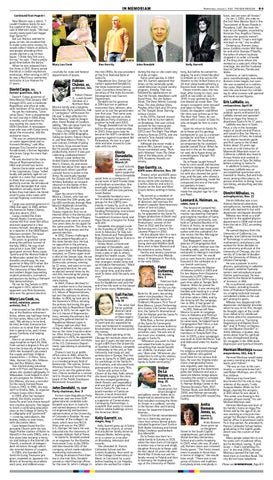
A LOOK BACK AT SOME OF THE NOTABLE PEOPLE WHO DIED IN 2013
David Cargo, governor of New Mexico from 1967 through 1970, died July 5. NEW MEXICAN FILE PHOTO
Hundreds of people attended Rabbi Leonard A. Helman’s funeral at the Cathedral Basilica of St. Francis of Assisi on June 10. The rabbi was known for his hat and tap shoes. JANE PHILLIPS/THE NEW MEXICAN
Rabbi Leonard A. Helman
David Cargo
IN MEMORIAM COMPILED BY ANNE CONSTABLE THE NEW MEXICAN
Steve Armenta, 73, Christian Brother, July 13 Steve Armenta, a longtime t least three veterans of the wartime Manhattan Project, including teacher at St. Michael’s High a former director of Los Alamos National Laboratory, were School, was a champion of the poor who “didn’t squander his among notable Santa Feans who died in 2013. time on Earth,” according to his brother, Ray Armenta. The list also includes religious leaders (a prominent rabbi, a Christian A native Santa Fean, Steve Armenta was 14 when he joined the Christian Brothers of St. Brother and a woman known as the “spiritual mother of Santa Fe”), John Baptist de La Salle, finishing his high school education in New Orleans. He received a teaching a former governor, a survivor of the Bataan Death March, and many degree from what was then St. Michael’s College, prominent artists and business leaders. which later became the College of Santa Fe and then the Santa Fe University of Art and Design. Here, we celebrate the lives of some who made an impact on our After receiving his degree, Steve Armenta moved back to Louisiana and taught at Archcommunity. bishop Rummel High School in New Orleans — where he is listed as a founding teacher — before Harold Agnew, 92, Joe Alvarez, 85, leaving for Central America in the late 1960s. scientist, Sept. 29 business owner, July 31 Until 1994, he worked with orphans in various Harold Agnew, former director Ynacio “Joe” Alvarez, who came countries, including Nicaragua, Honduras and Guatemala. His brother said Steve Armenta was of Los Alamos National Laborato Santa Fe to sell watermelons such a vocal opponent of the government in Guatory, came to Los Alamos as a in the 1950s, operated Rachel’s temala that an assassin was sent to kill him. The graduate student during the ManCorner, a produce and ristra stand person who took his place in Guatemala was killed hattan Project, the wartime proat the corner of West Alameda instead. gram that led to the creation of Street and St. Francis Drive. Throughout the 1970s and 1980s, Steve the world’s first atomic bomb. He was present at In July 1955, Alvarez delivered a load of waterArmenta worked in Nicaragua, Costa Rica and Enrico Fermi’s first neutron chain reaction at the melons to Paul’s Grocery Store on College Avenue, Honduras. University of Chicago in 1942 and at the Trinity now Old Santa Fe Trail, where he met Rachel EspiWhen his mother fell ill in 1994, he returned Test in New Mexico. He also flew on observation nosa, who was then a student at Loretto Acadto Santa Fe and worked at St. Michael’s High planes over Japan in 1945, during the bombings of emy. She caught his eye when she held the door School. After he retired from teaching, while still Hiroshima and Nagasaki. open for him. He immediately moved to Santa Fe caring for his father, Armenta worked at Catholic After the war, Agnew completed his doctorate from Texas to be near her. Charities and the St. Vincent de Paul Society and under Fermi in Chicago in 1949 and returned to The couple operated produce stands out of taught Bible study. Los Alamos to work on weapons development. He trucks in Santa Fe, Pojoaque and Española before became the laboratory’s Weapons Division leader opening a permanent stand on Guadalupe Street. Cindy Bellinger, 62, from 1964 to 1970. In the early 1970s, they bought the tract at the journalist, April 4 From 1970 to 1979, he served as the third direc- northeast corner of West Alameda Street and Fiercely independent and tor of Los Alamos National Laboratory, succeeding St. Francis Drive, where they established Rachel’s unafraid to try new things, the Robert Oppenheimer and Norris Bradbury. Corner, where all the family worked. longtime Pecos journalist packed Under Agnew’s leadership, LANL developed an Rachel Alvarez’s brother, Marty Espinosa, said, her 62 years with adventures as underground nuclear test containment program, “He used to sit and talk and have customers a horse wrangler, ballet teacher, completed the Clinton P. Anderson Meson Physfrom all over the United States, including movie dog musher, woodcutter, baker, ics Facility, acquired the first Cray supercomputer stars and celebrities and politicians. All kinds of designer, editor and poet. and trained the first ever class of International people would stop at the stand and chat with him “She didn’t want to have regrets. If something Atomic Energy Agency inspectors. for hours and buy stuff from him. He was one of interested her, she went for it,” said Frances Kean, Following his career at Los Alamos, Agnew those memorable people that once you knew him, Bellinger’s friend since 1978. “She didn’t live her served as a science adviser to the White House he was like an old friend that you’ve known for life on the surface.” After she was diagnosed with a rare sarcoma from 1982 to 1989. years. He was a character.”
A
on her arm, Bellinger chronicled her journey in a funny, poignant and insightful blog up until a few days before her death. At some point, when the cancer robbed her of her ability to type, she dictated, while friends typed her posts. Her books are packed with her sense of humor. She wrote about her foray into homebuilding in her book Someone Stole My Outhouse (2001). Her cabin was heated only by a wood stove, which provided plenty of material for her 2011 book Into the Heat: My Love Affair with Trees, Fire, Saws and Men. The year-round garden she cultivated at the cabin fed the book she wrote for High Country Gardens on Waterwise Garden Care. She became fascinated with sheep and wool and launched a magazine, The Woolly Times.“I always called her a renaissance frontier woman,” Kean said. The publications Bellinger wrote for spoke to her diverse interests: American Hunter, New Mexico Magazine, Orion Nature Review and Ceramics Monthly were among more than a dozen magazines that carried her work. When she was diagnosed with cancer, her posts explored the challenges of dealing with the health care system and the sudden, inexorable changes in her life. In one of her last posts, Bellinger noted she had few regrets. But she didn’t expect to succumb to cancer. “I always thought a tree would fall on me or I’d get eaten by a cougar,” she wrote.
Zenas ‘Slim’ Boone, 94, explosives expert, Aug. 13 Zenas “Slim” Boone came to Los Alamos as a GI in June 1945, just as the Manhattan Project was preparing to test the world’s first atomic bomb. At the outbreak of World War II, at age 24, he joined the Army. At first, he worked for the U.S. Special Police, escorting troops to their assignments. Then he was assigned with 59 other soldiers to the Special Engineering District and was sent to the top-secret Manhattan Project in Los Alamos. He had been recruited because of his previous experience with explosives. “I wasn’t afraid of working with those materials,” he said in A.J. Melnick’s book, They Changed the World: People of the Manhattan Project (Sunstone Press, 2006).
Friday hearing set in N.M. on horse slaughter King stepped in this month with a The Associated Press lawsuit saying Valley Meat’s operations would violate state laws related ALBUQUERQUE — A Friday court to food safety, water quality and unfair hearing is set on the latest effort to business practices. Although the meat block a Roswell company from resum- would not be sold domestically, ing domestic horse slaughter. it would be processed and shipped State District Judge Matthew Wilto other countries for human conson in Santa Fe has issued a temporary sumption and use as animal and zoo restraining order preventing Valley food. Meat Co. from opening before he Valley Meat attorney Blair Dunn can hold the initial hearing on New calls the lawsuit frivolous and was Mexico Attorney General Gary King’s preparing a response Tuesday challawsuit against the plant. lenging the state District Court’s jurisIt is the latest in a series of stops diction in the matter. and starts for Valley and a Missouri Meantime, Valley owner Rick De company, which have been preparing Los Santos said he has been working to open in the coming weeks after a with state Environment Department federal judge threw out a lawsuit officials to get the proper permits by animal protection groups and a for removing wastewater in hopes of federal appellate court lifted a stay opening in the next week or two. on operations pending the group’s He said he is planning to initially appeal. only slaughter horses under contract Following the federal court rulings, with a larger Canadian slaughterBy Jeri Clausing
house, which he said will supply drugfree horses from their feedlots. “A big deal with Gary King is that we are going to be putting drugged meat into the food chain,” De Los Santos said. “ … The [company] actually buys the horses and puts them in the feedlot and has them graze there for 180 days to ensure there is no drug residue. … So I think that is the best way to do it, especially at the beginning. People think, oh they are going to be buying horses here and there, and they are going to be stealing little girls’ ponies. It’s not that way at all.” In Missouri, Rains Natural Meats had horses on site ready to open but has run into its own roadblocks with its state environmental permits, Dunn said. Valley, Rains and an Iowa company last year won federal permits to become the first horse slaughterhouses to operate since Congress
Section editor: Howard Houghton, 986-3015, hhoughton@sfnewmexican.com Design and headlines: Stephanie Proffer, sproffer@sfnewmexican.com
effectively banned the practice by cutting funding for inspections at the plants in 2006. The last of the domestic plants closed in 2007, but Congress in 2011 reinstated the funding. The Iowa company switched to cattle after being blocked from opening in August by the filing of the lawsuit by The Humane Society of the United States and other groups. De Los Santos has led the effort to force the Department of Agriculture to permit the plants, sparking an emotional, national debate on whether horses are livestock or companion animals. Animal protection groups have thrown their support behind King. Proponents argue it is better to slaughter unwanted horses domestically than have them shipped thousands of miles to Canada or less humane facilities in Mexico.
Please see IN MEMORIAM, Page B-3
Man arrested on DWI charge blows 0.0 Early Tuesday morning, Santa Fe County Sheriff’s deputies arrested Joshua Martinez, 21, of Chimayó on charges of DWI, driving without a license, careless driving, driving without insurance and registration, as well as failure to appear and violating his probation. Martinez was arrested at Española Hospital, where he was transported by Española police, and treated for minor injuries sustained when he crashed his car into a ditch on N.M. 76. At the hospital, Martinez failed field sobriety tests, but had a breath-alcohol content of 0.0, so his blood was drawn to test for other intoxicants. According to Lt. William Pacheco, results on the blood test can take several months. Pacheco also said that it was unclear why Martinez was on probation. The New Mexican
BREAKING NEWS AT WWW.SANTAFENEWMEXICAN.COM
B-2
LOCAL & REGION
THE NEW MEXICAN Wednesday, January 1, 2014
Empty Stocking donations u Linda Abernethy, in memory of Dan Abernethy, $50 u Lori Diehl and Mark Adamson, in memory of Susan Q. Kuchma, $200 u Tracy Akers, $40 u Barbara Anderson-Acosta, in honor of military members of the U.S. who died for their country,
$100 u Anonymous, in honor of the Duvall-Gonzales-Nielsen family, $200 u Anonymous (18), $4,355 u Ana and Gail Atkins, $250 u Jess Maes and Margaret Baca, $100 u Paul Barnes, $125
u JoAnn Bethel, $250 u The Brooks children and grandchildren, $150 u Pamela Buffington, in memory of Nick Buffington, $200 u Richard and Patricia Buffler, $50 u Sophie Caruthers, $20 u Leslie and John Cunningham, $200 u James H. Duncan Sr., $200 u Dorothy and Claire Gantos, in memory of Douglas Gantos, $250
u Rosalie Gonzales, in memory of Red and Stella Gonzales, $50 u William F. Hoadley, $100 u Jacqueline Jadrnak, $300 u Kim Keahbone, in memory of Robert Keahbone, $100 u David King, $100 u Bruce Weydemyer and Charlotte Kinney, $200 u Judy Kahn and Richard Lees, $250 u Ray Lyon, $50 u Nancy and Richard Maner, $50
u John and Kathleen McCarthy, in memory of Fidel Gutierrez, $100 u John Donnell and Judy McGowan, $200 u Janet and James C. McKay, $50 u Dal and Teri Moellenberg, $500 u The Nathanson family, $500 u John Pell, $300 u Sandra Place, $100 u Mike and Jennifer Saladen, $100 u Steven A. Sandoval, $50 u Annette Kelley and Jeff Scatter-
good, $100 u Alan Shapiro, $50 u Linda Siegle, $100 u Liz Stefanics, $100 u Steffi and Don Tashjian, $250 u Pamela Homer and James Taylor, $175 u Mr. and Ms. J.K. Treat, $25 u Cath and Steve Washburn, $100 u Ed Winter-Tamkin, in memory of Mary L. Cook, $200 Cumulative total: $169,337.61
Police notes Funeral services and memorials The Santa Fe Police Department is investigating the following reports: u Police responded to the report of an unattended death of an 85-year-old woman in the 200 block of Rosario Boulevard around 8:30 a.m. Monday. u A woman living in the 1100 block of Calle del Pajarito reported that someone broke the driver’s-side window of her vehicle between 7 p.m. Saturday and 11 a.m. Sunday. u A woman living in the 2700 block of Camino Chueco reported that a guest at her home stole about $600 worth of jewelry and mascara from her bathroom between 9:30 and 11 a.m. Saturday. Police have interviewed a suspect, and the case is under investigation. u Someone broke into a home in the 1200 block of Zepol Road between 4:30 and 6:30 p.m. Saturday by shooting a window with a BB gun. The victim reported $60 in change was stolen. No suspects have been identified. u Someone entered a home in the 2800 block of Calle Dulcinea, stealing a pillowcase from the master bedroom and rummaging through the house. Nothing else was reported missing. u Monday morning, a New Mexico Gas Co. employee reported that about $2,400 worth of copper wiring was stolen from the transformer near his building, 1700 St. Michael’s Drive, leaving him without power. The Santa Fe County Sheriff’s Office is investigating the following reports: u Someone broke into a home in the 6100 block of Airport Road early Monday and stole a Ruger revolver and an iPad mini. u Sometime between 10 a.m. and 6 p.m. Monday, somebody stole a bicycle from a home on Tano Escondido, in the Tano Road area. u Someone broke into a home in the 2300 block of Casa Rufina Road and stole an unknown amount of money from a countertop sometime Monday.
DWI arrests u Santa Fe police arrested Jordan Block, 34, 2230 Camino Pintores, early Tuesday morning on charges of speeding and aggravated DWI. u Bernardo Rodelas, 32, 2144 Camino Polvoso, was arrested early Tuesday morning on charges of DWI, driving without a license, and driving with an open container after police pulled him over for having a missing taillight. This is the second time Rodelas has been arrested on charges of DWI, according to a police report. u Marisol Ornelas, 34, 2825 Vereda Oriente, was arrested around 11:30 p.m. Monday on charges of DWI and driving with an open container. Since Ornelas’ 6-yearold son was in the back seat of her car, she was also charged with child abuse, and her son was released into his aunt’s custody. According to a police report, this is Ornelas’ fourth DWI. u Sherriff’s deputies arrested Silvia Galdamezdemagana, 39, of Santa Fe on charges of DWI after they pulled her over Monday. Galdamezdemagana registered a breath alcohol content of 0.09, according to a police report. u Angel Carrillo, 23, of Santa Fe was arrested Monday by sheriff’s deputies on charges of careless driving and DWI. Deputies responded to a collision at West Alameda Street and Siler Road, where they found that Carrillo had crashed into a light pole. She registered a breath alcohol content of 0.22, according to a police report.
Speed SUVs u The Santa Fe Police Department listed the following locations for mobile speed-enforcement vehicles: SUV No. 1 on Zia Road on VoTech Road; SUV No. 2 on Rodeo Road between Richards Avenue and Paseo de los Pueblos; SUV No. 3 on Airport Road at Fields Lane.
DOLORES DUKE ORTIZ Dolores Duke Ortiz, aged 88 of Santa Fe, passed away at her home on Dec. 27, 2013. Dolores was the spouse of Ambassador Frank V. Ortiz of Santa Fe. Dolores was born on August 8, 1925 at Fort Riley, Kansas and the daughter of General James T. Duke and Guadalupe O’Neill Duke. She referred to her upbringing as that of an "Army brat" with her father being posted in Europe after World War II where she lived and studied in France and Germany. Dolores married Frank V. Ortiz on May 2, 1953 at the Post Chapel, Fort Myer, Virginia and celebrated 52 years of marriage before his passing in 2005. As the wife of a career diplomat they were posted in Ethiopia, Mexico, Washington D.C., Peru, Uruguay, Barbados, Guatemala, Panama and Argentina before finally returning to Santa Fe in 1990. She was a faithful member of the congregation of the Cathedral Basilica of St Francis of Assisi of Santa Fe, New Mexico and was active in many organizations in Santa Fe including the National Dance Institute (NDI), Friends of the Palace of the Governors amongst others. Dolores is survived by her brother Leonard Duke and his wife Rosetta of Louisville, Kentucky and her four children; Tina of Santa Fe, NM; Frank, Jr. and his spouse Susan and their children Corinna and Andrew of Potomac, Maryland; Stephen and his spouse Mary and their children Victoria Marie and Alexander of Taos, New Mexico and James and his spouse Nicola and their children Cassian and Lucas of Tampa, Florida. Dolores will lie for viewing at the Berardinelli Funeral Home, 1399 Luisa Street, Santa Fe from 1 -3 pm on Tuesday, December 31st and a mass celebrating Dolores’ life will be performed at the Cathedral Basilica of St Francis of Assisi on Thursday, January 2nd at 10 am. Dolores will be laid to rest with her husband Frank at the Rosario Cemetery in Santa Fe on Friday, January 3rd at 10 am. In lieu of flowers, the family would appreciate contributions to the Ambassador and Mrs. Frank V. Ortiz Palace of the Governors Endowment Fund, c/o Museum of New Mexico Foundation, P.O. Box 2065, Santa Fe, New Mexico 87505 www.museumfoundation.org
VERA L. KEGEL Vera L. Kegel, 89 of Santa Fe passed away December 26, 2013 in Santa Fe. Vera was born February 27, 1924 in Hiawatha, Kansas. Vera is survived by her daughter Margaret Kegel, sons Jay Kegel (Kathy), David Kegel (Darlene) and Robert Kegel; Grandchildren Jason Kegel (Eliza), Tasha Andrews (Nick), Erin Acosta (Greg). Eric Kegel, Jeremy Wozniak, Conrad Kegel, Andrew Kegel, Michelle Springer (Matt), John Ossorgin, Nick Ossorgin, Jr.; Great-grandchildren Elijah, Isla, Kailea, Claudia, Ava, Isabella, D.J., Matthew and Thomas. Vera was predeceased by her parents, Dr. Joseph and Vera E. Bansbach, of St. Joseph, Missouri. Vera was a graduate of Stephen’s College and the University of Missouri at Columbia. She was a member of the Tri-Delta Sorority, the American Association of University Women, the Citizen’s Review Board, Northern New Mexico Quilters Guild, her beloved second Tuesday Bridge Club, and many others. Vera retired from the State of New Mexico Children Youth and Families Department, where she was the supervisor of the Adoptions Unit for many years. A Rosary will be recited on Friday, January 3, 2013 at Saint Francis Cathedral at 10:00am followed by a Mass of Christian Burial at 11:00am. A burial will follow at Rosario Cemetery. Memorial contributions may be forwarded to Saint Elizabeth’s Shelter, 804 Alarid St, Santa Fe, NM 87505.
Berardinelli Family Funeral Service 1399 Luisa Street Santa Fe, NM 87505 (505) 984-8600 Please sign our guestbook for the family at: www.berardinellifuneralhome.com
ANN MARIE MASKALENKO 56, East Kingston NH, formerly of Santa Fe NM, passed away December 28, 2013, at home surrounded by great love, after a courageous battle with breast cancer. Ann was born on June 6, 1957 to Edward and Mary (Pat) Maskalenko of Bedford, MA. Ann was married to Thomas Densford on August 14, 2001. Ann earned a Master of Arts at Lesley College in 1985 in Psychotherapy. Ann worked as a psychotherapist and counselor for many years in Santa Fe, NM as a counselor at Sweeney, Acequia Madre, and Wood-Gormley Elementary Schools, and then at St. John’s College. Ann also had a private psychotherapy practice, and taught courses in psychotherapy at Southwestern College. Ann was a nurturing mother; loving wife, daughter, and sister; and treasured friend. She was also a very talented artist and painter, spending many hours in her studio and producing many beautiful art pieces. Ann always had a great garden, loved hiking, walking on the beach, and enjoying time with friends and family. Ann is survived by her husband Tom; daughters Eva Maskalenko and Kira Densford; stepson Owen Densford; mother Pat; sisters Mary and Martha; brothers Gerard, Tom, and Joe; cousins MaryJane and John; and all their families. Ann is also survived by many great friends who provided incredible support and comfort. Ann was a beautiful person, provided a fulfilling home to her family, and extended generous love and nurturing to those around her. Ann will be dearly missed for a long time. An interactive website has been created at http://ann.maskalenko.muchloved.com to share more about Ann’s life. Ann’s funeral mass will be held on Saturday, January 4, at 10:00 a.m. at: Saint Michael Parish Church 90 Concord Road Bedford, MA 01730 (781) 275-6318 In lieu of flowers or other gifts, we ask those who wish, to make a donation in memory of Ann Maskalenko’s to: Metastatic Breast Cancer Network PO Box 1449 New York, NY 10159 http://mbcn.org/get-involved/category/donate
GLORIA MONTOYAMANARY
56, Resident of Espanola, passed away suddenly on Christmas Day, December 25, 2013. She is preceded in death by her daughter, Mona Barragan. She is survived by her loving husband of thirteen years to Charles Rollo Manary; her parents, Jose & Rose Montoya; sister, Shirley Montoya; godson/nephew, Chris Montoya; nieces, Chantel Montoya & Mercady Montoya (Lawrence Garcia) and their children Steven Garcia and Danielle Garcia, stepson, Bret Manary; stepdaughters, Charla McKinney (Larry); Carla Manary (Joe); Dessa Manary (Rolland); son-in-law, Robert Tito Barragan; sister in-laws, Charla Pinney (Owen)& Lorie Garcia (Rudy). Having retired from the City of Santa Fe with the Santa Fe Public Library as an Assistant Librarian. She was also a very active member with the Union AFSCME Local Union 3999. A Memorial Service will be recited at the Elk’s Lodge on Friday, January 3, 2014 at 11:00 a.m. All services are going thru Rivera Family Funeral Cremations.
Rivera Family Funerals and Cremations 417 East Rodeo Rd. Santa Fe, NM 87505 Phone: (505)989-7032 Fax: (505)820-0435 santafefuneraloption.com
RONALD "RONNIE" S. ORTIZ
Beloved brother and lifelong resident of San Ysidro (Gusano), Ronald Ortiz, passed away suddenly on December 28, 2013. He is preceded in death by his parents Trinidad and Sadie, brothers Don (Sharky) and Arsenio. Brother-in-law Xavier Espinoza. He is survived by sisters: Marcella, Viola (Roy), Lillian, Kathy (Billy), Norella and Drucilla (James). Brothers Jake and Gilbert. Sister-in-law Patricia. Numerous nieces, nephews, aunts, uncles, cousins and friends. All services will be held at our Nuestra Señora De Guadalupe Church in San Ysidro Sur as follows: Rosary will be recited at 7:00pm Thursday, January 2, funeral Mass will be celebrated at 11:00am, Friday, January 3. Burial will follow the mass in San Ysidro. Pallbears will be Lester Ortiz, Alvin Sandoval, Edmund Ortiz, Billy Aragon Jr., Eli Espinoza, James Gonzales, Max Lucero and Clarence Perea Sr. Honorary pallbearers are Conrad Ortiz, Steve Matejicka and the rest of his nephews and nieces. Please visit http://www.nelsonfuneralhom elv.com/ for online condolences. Funeral arrangements for Ronald have been entrusted to Nelson Funeral Home; 801 Douglas Avenue, Las Vegas, NM; (505)425-6551.
CURTIS SOLLOHUB Curtis John Sollobub died at home in Las Vegas NM December 23, 2013. He was born in El Paso, TX June 1, 1947 to Raymond John Sollohub and Josephine Forman Sollohub who predeceased him. He earned a Master’s in Counseling Psychology while a Catholic seminarian leaving before ordination. He married Ishwari Immel in California in 1981, earning his Computer Science degree at San Francisco State University and welcoming their first daughter in 1983. In 1987 the family moved to Las Vegas, NM where their second daughter was born and where Curtis rose in rank to become a tenured professor of computer science at New Mexico Highlands University. Curtis was devoted to teaching and advocating for workplace fairness. He helped establish Highland’s Media Arts Program and served as President of the faculty union. Curtis belonged the Religious Society of Friends Las Vegas Worship Group. Among many community engagements Curtis was President of Las Vegas Habitat for Humanity, President of the Acequia Madre de Los Vigiles and Vice President of the Rio de Las Gallinas Acequia Association. Curtis was working on a book based on conversations with people in the West Bank and Gaza about their lives under Israeli rule. He was an active member of Amnesty International. In 2011 Curtis met his wife Martha McCabe of San Antonio, Texas, a writer and retired lawyer. Curtis is survived by daughters Tekla Currie of Rock Spring, GA and Sierra Sollohub of Chapel Hill, NC; wife Martha McCabe; sisters Jody Wilbert, Deborah Sollohub and Cathy Sollohub and three grandchildren. A Celebration of Life will be held 4-7 p.m. Saturday, January 4, 2014 at Traveler’s Café on the Plaza in Las Vegas. In lieu of flowers, gifts to Las Vegas Habitat for Humanity, PO Box 2933, LV NM 87701. Online guest book http://www.danielsfuneral.com/?page=southernchapel
LAUREN HAROLD PEPPLER Age 84, Born in Reed City, Michigan, a lifelong resident of Albuquerque. He passed away peacefully at home surrounded by, and in the comfort of his family, on December 27, 2013. He is survived by his loving wife Mary L.W. Peppler, and his two devoted daughters, Patricia L. Peppler and Mary L. Peppler with blessings of four grandchildren, Sam W. Roberts, Patricia L. Roberts; Elissa A. Peppler, Sharra L. Peppler/Montgomery along with great grandchildren Jacob W. Roberts, Nevaeh R. Roberts, and Wyatt E. Montgomery. He became a Real Estate Broker/Owner of Pep Realty Corporation. A Visitation will be held Thursday, January 2, 2014, from 4:00 7:00 p.m., at FRENCH - University. Funeral services will be held on Friday, January 3, 2014 at 1:00 p.m., at Immanuel Lutheran Church, 300 Gold S.E., with Rev. Randy Walquist officiating. Interment will follow at Sandia Memory Gardens, 9500 San Pedro Dr. NE. A reception will follow Interment in the Parish Hall at Immanuel Lutheran Church. In lieu of flowers, memorial contributions may be made to Immanuel Lutheran Church for Ysleta Lutheran Mission in El Paso, Texas. Please visit our online guest book for Lauren at www.FrenchFunerals.com. FRENCH - University 1111 University Blvd NE 505-843-6333
ANTHONY DAVID SILVA SR. JUNE 13, 1944 ~ DECEMBER 27, 2013
Anthony David Silva Sr. passed away on December 27, 2013 at his home in Cuarteles, NM surrounded by his loving wife and family. Mr. Silva battled cancer for many years and his family asks that in lieu of flowers donations be made in his name to the American Cancer Society. Funeral arrangements are being handled privately to allow the family to mourn their great loss. Thank you for your prayers and condolences.
Celebrate the memory of your loved one with a memorial in The Santa Fe New Mexican
Call 986-3000
IN MEMORIAM
Wednesday, January 1, 2014 THE NEW MEXICAN
Continued from Page B-1 New Mexico was a shock. “I couldn’t believe Santa Fe was the capital of the state,” he said in Melnick’s book. “We had county seats back East bigger than Santa Fe.” But Los Alamos seemed to grow on him. He recalled that to make some extra money, he would collect tickets at dances, and people attending often would slip him a sip of their liquor. “I think they felt sorry for me,” he said. “I had a pretty good time before the dance.” When he was released from the Army in 1947, Boone joined the lab as a civilian explosives technician. After retiring in 1977, he was a Red Cross swimming instructor in Los Alamos for 17 years.
David Cargo, 84, former governor, July 5 David F. Cargo, governor of New Mexico from January 1967 through 1970, was a moderate Republican and often at odds with members of his own party. He got his nickname, “Lonesome Dave,” from a sheepherder he met one day in 1966 along a muddy, rural road when he was touring the state in his 1959 Chevrolet. A newspaperman who was with Cargo wrote about the encounter, and the nickname stuck. “He was so underestimated, so under-appreciated and so forward-thinking,” said Albuquerque City Councilor Janice Arnold-Jones, a former legislator who knew Cargo for more than 45 years. He was elected to the state House of Representatives in 1962 and served two terms. Dennis Domrzalski wrote that in the Legislature, Cargo “railed loudly and publicly against corruption in a state that seemed to think that corruption was perfectly normal. He introduced bills that demanded that state legislators actually report the bribes they had taken. He threatened to pave state roads with corrupt highway commissioners.” Cargo was elected governor in 1966 and again in 1968, defeating Democrat Fabian Chavez, who also died in 2013. Cargo created the state Human Rights Commission, started the first state film office and even appeared in a few movies himself, including a role as a reporter in the 1969 Robert Mitchum western The Good Guys and the Bad Guys. His years as governor came during the political turmoil of the late 1960s. He was chief executive in June 1967 when land-grant activist Reies Lopez Tijerina and the Alianza Federal de Mercedes raided the Tierra Amarilla courthouse. He was governor in May 1970 when the National Guard was called to The University of New Mexico and soldiers began bayoneting student protesters, journalists and passers-by during a Vietnam War demonstration. He ran for the Senate in 1970 and again in 1972, when his opponent was Pete Domenici, who won the general election.
Mary Lou Cook, 95, artist, minister, peace activist, Oct. 7 Interviewed on her 95th birthday at the Beehive retirement home, where she had been living for four years, Mary Lou Cook said, “My advice is to be kind, be kind, be kind. Everyone has a choice as to what their attention is going to be, and I chose peace, harmony and helping people.” Born in an elevator at a Chicago hospital on April 29, 1918, Cook earned a degree in fine art from the University of Kansas in 1939. Her husband’s job meant the couple and their children moved often — El Paso; Tulsa, Okla.; Kansas City, Mo.; Milwaukee and Des Moines, Iowa. She started doing volunteer work in El Paso and Kansas City, where she studied calligraphy. In Milwaukee, Cook helped to start an arts program for children. In Des Moines, she was a recruiter for the newly formed Peace Corps in 1962. In 1966, she was sent to Omaha, Neb., to organize a Peace Corps office there. In 1969, after her husband retired, the family moved to Santa Fe, and Cook threw herself into creative pursuits. She began to teach a continuing education class at the College of Santa Fe in calligraphy and “pastecraft” — covering solid objects, like bottles, books or even trees, with decorative fabric. Cook helped found the Dispensable Church with the late Hugh Prather (author of Notes to Myself) in the early 1980s, and a few years later became a minister and bishop in the Eternal Life Church, a network of independent ministers through which she married dozens of couples. In 1984, she founded the Santa Fe Living Treasures program, modeled on Japanese traditions of honoring local elders each year, and lobbied unsuc-
Mary Lou Cook
cessfully for state and federal departments of peace.
Dan Gerrity
the mid-1980s, he was president of the First National Bank of Santa Fe. Republican Gov. Garrey CarFabian Chávez, 88, ruthers appointed Dendahl to politician, Jan. the State Investment Council. Later, Carruthers hired him as 21 secretary of the state Economic Fabian Chávez Development and Tourism Jr., a well-known Department. member of a Dendahl ran for governor Northern New in 1994 but lost to political Mexico family and a longtime newcomer Gary Johnson, who Democratic Party politician, had went on to win the general eleca “contagious” enthusiasm for tion that year. That same year, life and “a deep affection for Dendahl was elected as state New Mexico,” said his biograRepublican Party chairman, a pher, David Roybal of Cundiyó, position he held until 2003. adding, “We can never have too Though Dendahl lost his final many people like Fabian.” bid for the party chairmanship “I was a free spirit,” he told in 2003, three years later he Roybal in his 2008 biography, became the GOP’s candidate for Taking on Giants: Fabian Chavez governor against incumbent Bill Jr. and New Mexico Politics. “I Richardson. He lost in a landwas curious. Instead of going slide and later moved to Coloto school, I’d go around town. rado with his wife. But I’d usually spend my time productively, even if it was just Gloria collecting cardboard boxes.” Donadello, Almost a year before the 87, activist, United States entered World March 14 War II, Chávez, 16, and seven Local activist, friends lied about their ages and academic and signed each others’ parentalopera supporter consent forms to enlist in the Gloria Donadello Army. He eventually headed spent time as a professor of for Europe with the 153rd Field social work at both Florida State Artillery Battalion as forward and Fordham universities. She observer in the Battle of Noreventually migrated to Santa mandy and the Battle of the Fe in 1991 with her late partner, Bulge. Sarah Barber. Upon his return to New Donadello founded a numMexico, Chávez, who had not ber of charities and advocacy yet finished the 10th grade, got his GED certificate through New groups for the LGBTQ community in Santa Fe, such as the Mexico Highlands University. Lesbian and Gay Community In 1948, the 24-year-old Funding Partnership, now known Chávez made his first run at elected office in the Democratic as the Santa Fe Community primary for the House of Repre- Foundation’s Envision Fund, and Hope House, a hospice for those sentatives and came in second. Two years later, he ran again for with HIV. Donadello also played a role the same position. This time, he in the founding of SAGE, or Serwon both the primary and the vices & Advocacy for Gay, Lesgeneral election. bian, Bisexual and Transgender In 1952, Chávez challenged Elders (formerly Senior Action in the incumbent Republican in a Gay Environment.) the state Senate race. He had Honey Ward, a friend and no opposition in the primary, caretaker of Donadello, said but lost in the general election. Donadello was always ready to Four years later, the Republican crack a joke or talk to others resigned, so Chávez again took a shot at the Senate seat. He ran despite her health issues. “She against six other hopefuls in the had that kind of energy to her that strangers would come and Democratic primary, winning by 22 votes, and went on to win up introduce themselves,” Ward said. “She was always ready the general election. He was for a good time, and she didn’t re-elected several times by his want to leave until the party was mid-30s, becoming the youngover.” est Senate majority leader in Donadello also had an abiding state history. love for Buddhism and until the In 1964, Chávez declined to seek another term in the Senate, end of her life went to the Upaya setting his sights instead on the Zen Center every Wednesday. U.S. House of Representatives, Gail Factor, but lost the primary to Johnny 70, artist, Walker. In 1968, he took aim at July 16 the Governor’s Office, winning the primary but losing the genThe artist Gail eral election to Republican David Factor painted Cargo. In 1970, he ran again for abstract landthe U.S. House of Representascapes, many tives, winning the primary, but of them depictlosing the general election to ing the faraway horizon, planes Republican Manuel Lujan Jr. of earth and sky separated by Chávez laid low after that color and rendered in sweeping string of defeats, taking a posibrushstrokes that extend across tion as the state insurance direc- the canvas. tor. After Jimmy Carter won the She studied painting at the presidency in 1976, he appointed Chicago Art Institute when she Chávez as an assistant secretary was just 5 years old and went on of the U.S. Commerce Departto get a BFA from the University ment, specializing in promoting of Southern California, complete tourism. a fellowship in fine arts at Yale Chávez’s last try at public University and study art and office came in 1982, when he architecture in Europe. She first ran for governor of New Mexico came to Santa Fe in 1989, partly in a crowded primary field of for workshops at the Santa Fe Democrats. The winner, former Art Institute, and relocated here Attorney General Toney Anaya, permanently in the early ’90s. went on to win the general elecFactor was active in the tion. Chávez worked as a consul- Church of the Holy Faith, where tant to Anaya and served on the she loved singing in the choir. board of the Public Employees She also enjoyed gardening Retirement Association. (both flowers and vegetables) and was part of a garden club John Dendahl, 75, GOP here in Santa Fe. She was a Party chairman, Nov. 9 board member of Canticum Former state Republican Party Novum, a local choral and instrumental ensemble, and was chairman and one-time GOP a supporter of Cornerstones gubernatorial candidate John Community Partnerships, a Dendahl was born in Santa Fe nonprofit that works to restore and earned degrees in electrihistoric adobe buildings across cal engineering and business administration at the University the American West. of Colorado in Boulder. He was Kelly Garrett, 69, a member of the college’s ski singer, Aug. 7 team, which won two NCCA titles and was on the 1960 Kelly Garrett grew up in Santa U.S. Olympic Ski team. He was Fe singing at church, at school inducted into the University of and around her family home on Colorado Athletic Hall of Fame. Acequia Madre, before going In Santa Fe, Dendahl worked on to a career as a vocalist as an engineer for the Eberline on Broadway, television and Instrument Corp. in the 1960s records. and later became CEO of the She attended St. Francis company, which made radiation- Cathedral School and the monitoring instruments. Loretto Academy, then went on During an absence from Eber- to the College Conservatory of line in the mid-’60s, Dendahl Music in Cincinnati for a year served as chief financial officer before heading to Los Angeles, for the new St. John’s College. In where she worked for a bank
John Dendahl
during the day so she could sing in clubs at night. Fame came quickly. In 1964 and ‘65, Garrett appeared four times on the nationally syndicated television musical-variety program, Shindig. That was followed by appearances on Your Hit Parade, Headliners with David Frost, The Jim Nabors Show, The Dean Martin Comedy Hour, The Joey Bishop Show, Playboy After Dark and 29 turns on The Tonight Show Starring Johnny Carson. In the 1970s, Garrett moved to New York to try her talents on Broadway. She won critical acclaim for her musical performances in Mother Earth (1972) and The Night That Made America Famous (1975), and she earned a Tony Award nomination for the latter. Although she never made a feature film, Garrett sang an Oscar-nominated song, “Richard’s Window” from The Other Side of the Mountain, at the 1976 Academy Awards ceremony.
Dan Gerrity, 59, KSFR news director, Nov. 20 Theater artist and KSFR news director Dan Gerrity was a New Jersey native who worked as a writer, director and actor in theater on the East and West Coasts before settling in Santa Fe. He served as a member of the Santa Fe Playhouse board of directors and oversaw the theater’s popular Benchwarmers series of one-act plays. Among other Santa Fe credits, he appeared in the Santa Fe Stages production of Death and the Maiden in 2000, Ironweed Productions’ version of Our Town in 2012 and the Lensic Performing Arts Center’s The Laramie Project in 2010. He also played roles in a number of television and film projects over the years, including Swing Vote and Wildfire (both films shot in New Mexico) and the television series Frasier. Gerrity and Jeremy Lawrence co-authored the play Melody Jones: A Striptease in Two Acts, in the early 1990s.
Kelly Garrett
berg, but before he earned his degree, he and a friend decided to embark on a trip across the Atlantic to the United States in a 30-foot sloop handcrafted by a Russian boat maker. He was 20. Eleven months later, the tiny boat, after losing its mast, was adrift at sea when on July 4, 1949, it was spotted by someone aboard an ocean liner. The sloop’s occupants were rescued and taken to New York’s Ellis Island, his daughter said.When the story was written up in the The New York Times, he connected with a cousin in Sana Fe, who arranged for him to come here. Upon his return to Santa Fe, de la Harpe put his geology background to use as a uranium prospector and flew a small plane all over the Southwest, accompanied by his standard poodle named Victor. When he was not in the air, his daughter said, de la Harpe drove an emerald-green Triumph TR3 convertible. De la Harpe taught himself how to carve wood and became a furniture designer. He opened a gallery on Canyon Road, where his wife also showed her paintings, and the pair, who shared a passion for gardening, made the compound into one of the lushest gardens in town. De la Harpe designed and made the original sign for Canyon Road.
B-3
town, and we were all friends.” On Jan. 1, 1950, she rode on the first New Mexico float in the Tournament of Roses Parade in Pasadena, Calif. She took the train to Los Angeles, escorted by historian Fray Angélico Chávez, because her parents weren’t able to attend. “I had a real tight rein kept on me,” she recalled. Growing up, Romero Jones knew Zozobra creator Will Shuster and artist Georgia O’Keeffe, the latter of whom routinely stopped in to order a limeade at the drug store where she worked as a soda jerk. After her marriage, she and her husband lived in California, Florida and Idaho. Santeros, or saint makers, were overwhelmingly men when Romero Jones began, but soon she was accepted as a santera. Her sister, Marie Romero Cash, said she was known for combining tin altar screens with painted and hand-carved figures.
Eric LaMalle, 50, restaurateur, April 16 Longtime restaurateur and outdoor sports enthusiast Eric LaMalle owned and operated Ristra on Agua Fría Street in downtown Santa Fe for 17 years. LaMalle was born in SaintFlour, a city in the Auvergne region of south-central France, and raised in Brie Sur Marne, a suburb east of Paris. He trained as an alpine mountain guide and first came to the United States about 20 years ago to work as a ski instructor at Mammoth Mountain resort in California. LaMalle also lived in Arroyo Hondo and worked as an instructor at Taos Ski Valley before coming to Santa Fe. In addition to being a businessman, LaMalle was an accomplished sportsman who traveled to Alaska, Bali and Indonesia, among other places, to pursue interests in skiing, mountain biking, windsurfing and kite boarding.
Dimitri Mihalas, 74, astrophysicist, Nov. 21 Dimitri Mihalas was a Los Alamos National Laboratory astrophysicist, humble about his mind, who learned to live with depression and bipolar disorder. Mihalas was hired as a staff scientist in the applied physics department in 1998 and retired from the lab in 2012, according to LANL. He earned degrees from the University of California, Los Angeles, and California Institute of Technology in astronomy, mathematics and physics and worked for three decades as an astronomy professor at the University of Chicago, the University of Colorado at Boulder and the University of Illinois at Urbana-Champaign. He was a pioneer in astrophysics, specializing in radiation transport, radiation hydrodynamics and astrophysical quantitative spectroscopy. He was elected to the National Academy of Sciences in 1981. He co-authored seven scientific books, including Foundations of Radiation Hydrodynamics, a highly technical manual considered a bible on the subject among his peers. Mihalas was diagnosed with depression and bipolar disorder when he was in his 40s, though he thought signs of the conditions dated to his childhood. He wrote about his experiences in essays such as “Surviving Depression and Bipolar Disorder” and “A Primer on Depression and Bipolar Disorder” in 2002. Mihalas, a Quaker, also wrote about how his spirituality was strengthened during his struggles in his 1996 book Depression and Spiritual Growth.
Leonard A. Helman, 86, rabbi, June 6 The funeral of Leonard Helman, an attorney, judge, bridge master, tap-dancing champion and longtime member of Santa Fe’s religious community, was held at Cathedral Basilica of St. Francis of Assisi, an arrangement the rabbi had made years earlier with the cathedral’s former rector, the Rev. Monsignor Jerome Martinez y Alire. Gail Rappaport, executive director of Congregation Beit Tikva, of which Helman was the founding rabbi, said this was a testament to Helman’s interfaith commitment that “he would just as soon have his Jewish soul honored in the cathedral as in our Jewish sanctuary.” After receiving his Master Fidel of Hebrew Letters in 1955 and Gutierrez, his law degree from Duquesne 51, banker, University in 1970, Helman Nov. 3 came Santa Fe in 1974 to be a Fidel Lee Guti- part-time rabbi at Temple Beth errez worked Shalom. When he joined the for the Los Ala- congregation, it was serving 60 mos National families and meeting in a small Bank for 26 years, becoming building. He was hired as the senior vice president. He volfull-time rabbi in 1986, and by unteered with the Santa Fe the time he left the congregaChildren’s Museum, First Tee of tion in 1991, it had grown to New Mexico, Lensic Performing serve more than 300 families. Arts Center, Life Center FoundaIn 1991, Helman left New tion, the Santa Fe International Mexico to work at congregaFolk Art Market and the Santa Fe tions in Alabama and PennsylChamber of Commerce. vania, returning in 1995. When Billie Blair, a former president he came back, he helped found of the Santa Fe Community Congregation Beit Tikva, a JewFoundation who knew Gutierrez ish Reform congregation, at through his community service the behest of about 20 former activities, said, “He was one of members of Temple Beth Shathe most civic-minded, caring lom. In 2005, a new synagogue people in Santa Fe. was built at 2230 Old Pecos Trail “Whenever you went to Fidel and dedicated under his leaderand asked the bank to give to ship. something that would benefit Though well-known through our children, he always said Herman Montoya former his religious and professional yes,” Blair said. “Whenever you mayordomo, 102, July 9 work, Helman also gained asked him to roll up his sleeves local fame for his various hobHerman Montoya would wake and help, he was eager to join bies. He won the Virginia state up every morning and say, “God hands to build community.” chess championship twice, leads, and I follow.” was regularly seen tap danc“He was an icon in the comVolker ing or singing at the downtown munity — everyone knew him,” piano bar Vanessie and was a De La said Ruben Montoya, one of his Gold Life Master bridge player, five children. Harpe, 84, traveling the world to compete Montoya may have been woodcarver, in tournaments. The Leonard best known for his role as mayAug. 25 A. Helman Bridge Center in the ordomo of the nearly 7-mile Santa Fe Thomas Business Park, 3827 Acequia Madre. When he first woodcarver, fur- Thomas Road, was dedicated in began cleaning the acequia niture designer 2008, and Helman personally in 1915 when he was about 5, and gallery owner Volker de la contributed $50,000 toward the “the water was flowing in the Harpe had an adventurous life facility. acequia all year round,” his son that included crossing the AtlanMichael Montoya said. tic Ocean in a sailboat, serving Anita Herman Montoya was born at in the Korean War and training his family’s home on Agua Fría Romero horses for Japanese Emperor Street and by the age of 10, he Jones, 82, Hirohito. was working as a bicycle messantera, Santa Fe friends remembered senger for Western Union, which March 11 him as a charming and grahad an office in downtown Santa cious host whose dinner guests Anita Romero Fe in that period. He attended St. included Supreme Court Justice Jones grew up Francis Cathedral School before Ruth Bader Ginsburg and famed on Houghton graduating in the eighth grade, Dallas Cowboys quarterback Street in the South Capitol which was the custom at that Don Meredith. neighborhood, and attended time. De la Harpe was born to a Wood Gormley Elementary Many people asked him to run noble family in Estonia in 1929, School and Loretto Academy. for some sort of political office, when the main form of transport In 1949, when she was 18 years but he declined, saying, “A poliin winter was a horse and sleigh, old, Romero Jones was crowned tician — that’s something I’m daughter Krista de la Harpe said. Fiesta queen. “The Fiesta meant not.” In the mid-1930s, Herman He was about 10 years old when more to people in those days Montoya opened the fuel and World War II broke out and his in terms of religion,” she would feed store on Cerrillos Road. The family moved to Poland and then later recall. “There was a real city did not have telephone to Germany. He studied geolsense of history and tradition. ogy at the University of HeidelEverybody knew everybody in Please see IN MEMORIAM, Page B-4
B-4
THE NEW MEXICAN Wednesday, January 1, 2014
Continued from Page B-3
Born in Santa Rita, a coppermining town near Silver City, lines servicing that area, so Ojinaga’s parents had emigrated Montoya would walk over to from revolution-torn Mexico in his office on nearby Hickox 1910. Upon graduation from high Street to use that phone to take school in 1937, Ojinaga worked orders for coal and wood. In the as a carpenter in the copper mid-1990s, the Montoya family mine. As war neared, Ojinaga relocated the store to its current and his brothers agreed that the site on Agua Fría Street. first to be drafted would join the Herman Montoya worked military, so the others would there until 2009, when he was not be obligated. But when an 99 years old. older brother received his draft notice, Ojinaga hid it until his Diego Mulli- own arrived. He was sent to the Philipgan, 62, radio pines, where he became one of host, July 21 75,000 Filipino and American Diego Mulsoldiers, including 1,800 New ligan, host of Mexicans, who were taken capthe afternoon drive-time radio tive by the Japanese when the United States forces surrentalk and interview show The Journey Home on dered in the province of Bataan and Corregidor Island in April KSFR was an avid environmentalist who educated a generation 1942. In a prison camp in Japan, of Santa Feans about climate issues and the human condition. Ojinaga and other New Mexican POWs would “get together and Born in Miami, he grew up talk in Spanish about the matanin the Bahamas, where he was part of a community of pioneers, zas [village barbecues], the burriñates [lamb intestines] and resort developers, underwater all the other great food that we divers and seafarers. had back home,” he recalled in a He became involved in commercial radio in 1968 after drop- 2009 interview. “When we woke up in the morning, we didn’t feel ping out of college. Mulligan as hungry.” joined the all-volunteer military Upon his release from the in 1973. After completing U.S. prison camp, Ojinaga weighed Army Aviation College with top about 95 pounds — almost half honors, he became a Federal Aviation Administration-licensed what he did before the war. Ojinaga enrolled in Western air-traffic controller, serving at one of Europe’s busiest airports. New Mexico University in Silver City, then transferred to The UniHere, he earned the nickname “Emergency Mulligan,” due to “a versity of New Mexico, where he graduated with a degree in busihigh number of pilots declaring ness administration in 1950. emergencies during his shift,” his biography said. Manuel In the mid-1970s, he became involved in the “sustainable Ortiz, 79, community development” Boy Scout movement, working on several leader, May 4 projects in Europe and Africa. Manuel After moving to Santa Fe, he “Manny” Ortiz created the Center for Sustainwas one of able Community. He was a coSanta Fe’s most founder of The Commons on the enthusiastic Scout leaders, but Alameda and was a consultant he didn’t become involved with for projects including Aldea de the Boy Scouts of America until Santa Fe and Oshara Village, a 1999, when he retired from state 462-acre “sustainable transition government. town” now under construction Ortiz worked as a loan officer in Santa Fe County. at several banks, and after living He returned to radio in 1993 in San Antonio, Texas, became with the Connections Radio an auditor and administrator Journal on KVSF. He started his for the New Mexico Highway show The Journey Home in 1997. Department — now the Department of Transportation. Darragh As a Scout leader, he worked Nagle, 94, with more than 200 boys and physicist, in 2005 was awarded ScoutApril 22 ing’s highest honor — the Silver Beaver Award. In 2006, his volDarragh unteer work with the Boy Scouts E. Nagle, a led him to be named as a Santa physicist who Fe Living Treasure. worked on the first nuclear reactor in Chicago Gifford Phillips, 94, and on the first nuclear exploart collector/political activsion in New Mexico, studied ist, April 17 physics at the Massachusetts Institute of Technology, CamGifford Phillips, a liberal politibridge University in England and cal activist and avid art collecColumbia University in New York tor, lived in Santa Fe part-time City, where one of his teachers since 1968 and full-time since was the famed Italian physicist 1990. Enrico Fermi. “Art is no longer the exclusive In 1942, Nagle, then 23, joined province of mugwumps in New Fermi at the University of ChiEngland studios, Bohemian cago, where weeks earlier the painters in Greenwich Village, world’s first nuclear reaction professors of English at Ivy had been initiated in Chicago League universities, or scions of Pile-1, a pile of enriched uranium old families gracing the boards pellets and graphite blocks in of civic symphonies and art an underground rackets court museums,” he wrote in a 1966 beneath the bleachers of a foot- paper urging President Lyndon ball field. Johnson to create the National Later, Nagle was sent to Los Endowment for the Arts. “The Alamos. “We were a little group great American middle of the that did experiments that Fermi mid-twentieth century has wanted done,” he said. arrived on the scene in full In preparation for the Trinity strength and ready for action.” Test, his job was to collect soil Phillips, son of the heir to samples from the crater as soon the Jones Laughlin Steel Co., as possible after the explosion, was raised in Charford Castle, which involved fitting out a a residence south of Denver. Sherman tank with lead shieldHe attended Stanford Univering. “One of my jobs was to sity, then transferred to Yale supervise the placement of the University, where he graduated lead shielding,” he said. “I was in 1943. His introduction into very interested in that because I art philanthropy began when, knew I was going to have to ride in that tank, and the lead shield- heeding the advice of his uncle ing was what was going to keep Duncan Phillips, he donated Paul Cézanne’s oil painting Ginger Pot my radioactive dose to somewith Pomegranate and Pears to thing perhaps tolerable.” the Phillips Collection in memHe and two other physicists ory of his father. took turns sticking a spade in Gifford Phillips moved to the ground through a hole in the floor of the tank. “We didn’t Los Angeles to found Frontier magazine, a liberal West Coast allow Fermi to go in,” he said. political monthly, with edi“We couldn’t risk him in such a tor Phil Kerby in 1949. Frontier place. We knew that the Shercontinued until 1966, when it man tanks have a habit of stallwas merged with The Nation of ing, and so we wondered what would happen if the tank stalled New York City. Phillips served as associate publisher of that in the crater, and we knew the answer. I mean, that would have magazine from 1966 to 1970. His involvement with Califorbeen the end. No way we could nia Democratic politics began have gotten out. Fortunately, when he served as treasurer for none of the runs ended that Helen Gahagan Douglas’ unsucway.” cessful 1948 campaign for the U.S. Senate against Republican Vicente Richard Nixon, who infamously Ojinaga, 95, branded Douglas as the “Pink Bataan Death Lady.” March surviHe served as a delegate to the vor, Sept. 30 Democratic National Convention in 1952, 1960 and 1964, and was After World an early supporter of presidenWar II ended, Vicente Ojinaga, tial aspirants Eugene McCarthy in 1968 and George McGovern a survivor of the Bataan Death in 1972. He was delighted to March, sometimes would tell learn that he had been named to his children stories about his three and a half years of captiv- Nixon’s “enemies list.” In 1990, he and his wife ity by the Japanese, “but not in moved permanently to Santa Fe, detail,” said daughter Teri Gonwhere they had been summer zales said.”He said what kept residents and involved in local him alive was faith and prayer arts groups since 1968. Gifford and his family, knowing he was going to come back to his famPhillips chaired the Santa Fe ily.” Chamber Music Festival and was
IN MEMORIAM was not just a ‘religion’ but a whole way of being and seeing.” She moved to Colorado in Amarante Romero, 92, 1958 and then to New Mexico Agua Fría businessman, in 1985, settling in the Santa Fe Aug. 31 area in the early 1990s. Well before chain-operated In an interview with Pasaconvenience stores dotted the tiempo, Wood said in New landscape, Amarante Romero’s Jersey, people often were Joe Wood, grocery store and gas station repressed, patriarchal and 89, judge, in the village of Agua Fría was a bigoted and saw nature as an Sept. 9 handy place to pick up houseadversary. Joe Wood was hold staples. Some locals in the Wood’s first book in 1963 was in the first gradleafy community downstream a volume of photographs with uating class of from Santa Fe proper described her second husband, Myron The University the business as “Grand Central Wood, also a photographer, of New Mexico Station” because it also served called Central City: A Ballad as a hub for politics and local School of Law, and was one of of the West, followed by eight chatter. the original members of the Made of adobes formed New Mexico Court of Appeals. other nonfiction works with by Romero and his brother, “The thing I remember most photographs, eight volumes of Filemon, the family-run store about him, he had a knack poetry, five works of adult ficopened in 1948 and stayed in of writing concise appellate tion, five works of children’s John Wadleigh , 85, operation until the early 1980s. decisions and they were well fiction and one anthology of artist and writer, September “It was the news center for researched and he got them Pueblo Indian prose, poetry and John Wadleigh wanted one of out quickly and his opinions the village,” said Lois Montoya art. two obituaries written after his Mee, who grew up a few doors were models for other judges Her most recent book was — short, succinct and supdown from the store and used to death. “One would have said, ‘John go there to buy penny candy in ported by the law, and fair,” said published last year by UNM Press. The Soledad Connection paper bags. “[Romero] was very Wadleigh died,’ and that’s it. his longtime friend and former The second would have been a is the fictional story of Lorenzo judge Tom Donnelly. friendly, and he liked to joke a 50-page memorial [accounting lot with people. When customWood graduated from Little Soledad, a Catholic priest in the ers were running on hard times, for] everything he did,” his son Rock High School in Arkanlast years of the 19th century Thaddeus Wadleigh said. sas and joined the U.S. Navy he gave credit to people who who loses his faith as he bonds John Wadleigh, artist, writer, in December 1941 after the couldn’t afford to pay for their with a small group of Indians critic and one of the founders of Japanese attacked Pearl Harbor. things.” called the Calabazas. The New Mexican’s arts magaBecause he was only 17 at the Romero was known as the zine, Pasatiempo, lived in Santa “mayor of Agua Fría,” a sign of time, he had to get his father’s George Yates, 74, Fe from about 1960 to 1980 and permission to enlist. reverence for his service to his died in Oregon, where he had community. Wood attended midshipman’s former Nambé Pueblo relocated about 25 years ago. Romero was active in the school at Notre Dame University, official, June 18 “Santa Fe was the ultimate played on the tennis team and, Democratic Party and spent George Yates, former lieutendream for a kid who grew up at the war’s end, hitchhiked to much of his life as a volunteer ant governor of Nambé Pueblo, in Hell’s Kitchen,” Thaddeus Albuquerque to enroll in UNM’s in civic affairs, working for 35 physicist and president of the newly created law school. years on city and county govern- Wadleigh said of his father. “He Nambé Pueblo Development always wanted to escape [New After graduating in 1950, he ment panels. He helped estabCorp., is remembered for his York City]. He dreamed of the moved to Santa Fe to work for lish a clinic, a park, a cemetery commitment to Native AmeriWild West. That’s what New the Legislative Council Service, and a fire station in Agua Fría, can issues and his dedication to Mexico was to him.” where he wrote a book about and helped create an ordinance Wadleigh was born in a New New Mexico’s community prop- his job at Los Alamos National that made it easier for families York City tenement, joined the erty code. Its publication in 1954 Laboratory. to transfer plots of land to their Army as World War II was comresulted in amendments to the children. Yates joined the lab in 1965, ing to a close and later used code that “made it fairer,” Donworking in the field testing divifinancing from the GI Bill to nelly said. Alfred Collins sion as an electronics techniattend Columbia University. In Wood then moved to Farmcian. By the time he retired in von Bachmayr, 65, the late 1950s, Wadleigh worked ington to practice law with architect, Aug. 11 2001, he had several patents as an editorial assistant at The one of his law school friends. and more than 150 research Alfred Collins von Bachmayr, New Yorker before publishing In 1966, he returned to Santa papers to his name. an architect known for his his first novel, The Bitter PasFe after Gov. Jack Campbell Debbie Reese, Yates’ eldest dedication to sustainably built sion. (“The taboo affair of an appointed him as one of the first homes using natural materials, American girl and a native man!” five judges of the state Court of daughter, said she and her father was also a triathlete and had the paperback cover proclaims.) Appeals, which had been creboth received their degrees at kayaked most of the big rivers in Shortly thereafter, he drove a the same commencement exerated by a state constitutional the West, including six runs on 1949 Pontiac out to Santa Fe. amendment. cises at The University of New the Colorado River through the Wadleigh was a handsome, He served on the Court of Mexico in 1984. “He liked to joke Grand Canyon. hard-drinking man who liked to Appeals for 20 years — half that he or I occasionally needed He was a co-founder of Build- wear a soiled cowboy hat, blue the time as chief judge — and to fail a class to make sure we ers Without Borders and founder jeans, a cowboy shirt, and a one- retired in 1986. graduated at the same time,” of the World Hands Project, concha belt buckle. He drove Reese said. which built homes in Mexico and Jeeps or pickups, and someNancy Yates helped found the AmeriNicaragua. During two years as where along the way he bought Wood, 76, can Indian Science and Engidirector of the Earthworks Insti- a World War I ambulance. photographer neering Society, which works to tute, he supervised a low-cost, Sometime in the early 1960s, and writer, sustainable housing project in Wadleigh and fellow writers Oliincrease the number of AmeriMarch 12 the Fiji Islands. ver LaFarge and Spud Johnson, can Indian youth involved in Nancy Wood, science fields. And he worked to “Alfred was a pioneer in natu- among others, started the initial a photographer ral building,” said architect Paula Pasatiempo arts magazine. He develop cameras that monitored and writer who Baker-LaPorte. “He and Joe also painted and sculpted. high-speed nuclear reactions. In McGrath co-invented the strawWadleigh reportedly wrote 55 published more than two dozen 1994, Yates received the Howbooks, said that when she first clay tumbler, a big, motorized novels, of which 13 were pubard E. Edgerton award from the tube with pitchforks in it that lished. His pen name was Oliver visited Taos Pueblo in 1962, “It International Society of Optical was 180 degrees from what I saved many hours in mixing the Lange. His most famous work Engineering and accepted the knew growing up [back East]. straw-clay material for building is 1971’s Vandenberg, about a award at a conference in San houses.” group of middle-aged New Mexi- Nature was the center. I began Diego that year. to think in those terms — here Von Bachmayr was project can mavericks who decide to a trustee of the Wheelwright Museum.
leader on a 2005-06 improvement to the Santo Niño Clinica Guadalupana in Colonia Anapra, Ciudad Juárez, Mexico. The straw bale additions he designed are used for massage and hydrotherapy treatments for children with neurological disorders. Von Bachmayr graduated from the John Gaw Meem-designed Fountain Valley School, then earned his bachelor’s degree in architecture at the University of Colorado in Boulder in 1971. He moved to Santa Fe in the early 1990s and in his later life lived more simply. Two of his most recent projects were the All Creatures Memorial Park on Bishops Lodge Road and the straw bale Seed Bank, a collaboration with Tesuque Pueblo.
resist a Communist takeover of their land. That story bears more than a passing resemblance to the 1984 film Red Dawn, in which teenagers led by Patrick Swayze are the heroes defending their town against Soviet forces.
Bulletin Board Community Announcements, Workshops, Classes and Alternative Healing Services in Santa Fe and Northern New Mexico
START YOUR NEW YEAR WITH MINDFULNESS PRACTICE AT UPAYA - a Zen Buddhist Center invites you to come for daily MEDITATION sits at 7:00 am, 12:20 pm, 5:30 pm and Dharma Talk, Wednesday 1/8 at 5:50 pm by Joshin Brian Byrnes. Register for all or part of the 1/8-26 WINTER PRACTICE PERIOD which includes 1/11 ZAZENKAI: a Day-long meditation retreat; 1/17-19 ZEN WEEKEND and 1/21-26 SESSHIN: Multi-day meditation retreats. For deep practice and service, Resident and Chaplaincy programs are offered. Visit www.upaya.org for details on all that Upaya offers. Upaya Zen Center, 1404 Cerro Gordo Road, Santa Fe, NM. 505-986-8518
SAVVY SOCIAL SECURITY PLANNING WORKSHOP - presented by Peter Murphy, Retirement
& Estate Planning Specialist. This FREE two hour seminar is offered at Garrett's Desert Inn, 311 Old Santa Fe Trail, on Wednesday, January 8th, from 6pm to 8pm. You will learn the following and much more: Five factors to consider in deciding when to apply for benefits; Innovative strategies for coordinating spousal benefits; How to coordinate benefits with other income sources; How to minimize taxes on Social Security benefits; and Special rules on divorced spouses and survivor benefits. RSVP is required. Call 505-2160838 or email Register. SantaFe@1APG.com to register.
DOUGLAS A. PURYEAR MD practice will close December 20, 2013. Medical records may be obtained or transferred by contacting Dr. Puryear 505-983-4867, 4 Camino
de Vecinos Santa Fe, NM 87507.
SANTA FE DOORWAYS. LIFE, DEATH AND BEYOND: Experiencing the Extraordinary. Presenter: Stephen Young. Thursday, January 9th, 11:45 am1:00 pm. Is there life after death? Today's medical technology can perform resuscitation. Of the small percentage of individuals who are successfully revived, a few have Near Death Experiences. What do they experience? Is it the same for each person? Stephen Young died and was resuscitated four times. He had two near death experiences. Stephen states, "What I experienced was overwhelmingly transformative. It is a story of life, death, and beyond." Ponce de Leon Retirement Center 640 Alta Vista. All welcome. Brown Bag Lunch. 505-474-8383
Call 986-3000 or email classad@sfnewmexican.com to place your Bulletin Board ad
WEDNESDAY, JANUARY 1, 2014 THE NEW MEXICAN
SPORTS
B-5
NBA: Warriors beat Magic for 6th straight win. Page B-8
NFL
LOBOS MEN’S BASKETBALL
Brees presents tough challenge for Eagles
Kirk calls his performance ‘terrible’
Philly allowed the most yards during season By Rob Maaddi
Coach Neal says it’s a matter of perspective By Will Webber
Lobos starting center Alex Kirk, shown in March, is unhappy with his performance this season.
The New Mexican
ALBUQUERQUE — As the son of a coach, it’s safe to say that Alex Kirk’s own worst critic resides within the confines of his own home. In this case, however, it’s not his dad who’s offering the feedback. It’s himself. As The University of New Mexico men’s basketball team headed into the holiday break after
ASSOCIATED PRESS FILE PHOTO
winning nine of 12 games to start the season, the 7-foot Lobos junior was asked to assess his own play through the nonconference slate. In a word, he said, “Terrible.” “We’ve had a couple struggles there where, if I were able to put things together, I think we win a couple of those games,” Kirk said. “But that’s what it is and we’ve moved on.” The team’s starting center, alongside power forward Cameron Bairstow and a three-guard lineup that now includes Kendall Williams, Deshawn Delaney and Cullen Neal, Kirk had six straight
UP NEXT Colorado State (9-4, 0-0 MWC) at New Mexico (9-3, 0-0), 4:05 p.m. Saturday in The Pit TV: ESPNU Radio: KVSF-AM (1400), KKOB-AM (770) Twitter: @sfnmsports
double-doubles to start the season. He has had just two in the last six games and he has failed to score more than 10 points three times. The low point came in a loss
Please see KIRK, Page B-8
The Associated Press
PHILADELPHIA — If Kyle Orton threw for 358 yards against the Philadelphia Eagles, Drew Brees could set a record. The Eagles (10-6) are facing quite a challenge against Brees and the New Orleans Saints (11-5) in their NFC wild-card playoff game Saturday night. No team allowed more yards passing than Philadelphia this season and only four quarterbacks in NFL history have thrown for more yards than Brees. It sets up for an air show. “Drew Brees has excellent numbers, blitz, no blitz, coverage, noncoverage,” Eagles defensive coordinator Billy Davis said Tuesday. “This offense is so efficient, and it is run on Drew Brees and his decision-making
COLLEGE FOOTBALL
Triple digit game Rose Bowl turns 100 as No. 5 Stanford meets No. 4 Michigan State
Please see BREES, Page B-7
New Orleans Saints quarterback Drew Brees passes in the second half of Sunday’s game against the Tampa Bay Buccaneers in New Orleans. BILL FEIG/THE ASSOCIATED PRESS
Will 2014 live up to all its promises?
T
oday marks the start of a new year, and with that comes everybody’s favorite new year activity: New Year’s resolutions. It’s that time of year where everyone tells themselves that the new year is going to be better and they will become a better person. The time of year where people say “2013 was good, but 2014 will be better,” or, “2013 was terrible, but 2014 will be awesome.” Resolutions are made with good intentions, but Edmundo oftentimes they Carrillo just become holCommentary low words. Much like those people who crowd the gyms in early January, those New Year’s resolutions will slowly fade into oblivion. What was once an effort to be a “new you” quickly becomes a broken promise. I am guilty of such broken promises. Many years ago, I made a resolution that I would get good at guitar, yet I still have trouble fingering through the intro of Stairway to Heaven, which apparently is a mustknow for would-be axe thrashers. Although we may forget about these broken promises throughout the year, we remember them once the New Year comes around again, and we quickly become disappointed that we couldn’t keep them. So what other disappointments and broken promises will 2014 bring? Will Robert Griffin III live up to his No. 2 overall pick, or will he continue
Please see 2014, Page B-7
Michigan State quarterback Connor Cook looks to throw the ball Friday during practice in Carson, Calif., for the Rose Bowl against Stanford on New Year’s Day. JAE C. HONG/THE ASSOCIATED PRESS
By Greg Beacham The Associated Press
PASADENA, Calif. he game considered to be the first Rose Bowl was staged in 1902 to help pay for the Tournament of Roses Parade. An unexpectedly huge crowd of about 8,000 sat on temporary stands in a park and watched Stanford lose 49-0 to Michigan. No. 5 Stanford has returned to Pasadena 112 years later, facing No. 4 Michigan State on Wednesday in the 100th edition of college football’s quintessen-
T
Stanford quarterback Kevin Hogan leads the Cardinals (11-2), who are in their fourth consecutive BCS bowl game after winning the Pac-12. DANNY MOLOSHOK/THE ASSOCIATED PRESS
“
I would say this is the biggest game in our program’s history.” Kurtis Drummond, Michigan State safety tial bowl game. Far fewer fans will show up to Arroyo Seco on horses and buggies this time, and the game probably won’t be called early because of a blowout. The Spartans and Cardinal still believe they’ll put on a display of throwback football for the Grand-
daddy of Them All’s centennial celebration. “There is a special quality to it,” said David Yankey, Stanford’s AllAmerican left guard. “The Rose Bowl will still go on, but it’s kind of an end of an era in some sense, and we’re excited to be part of that.” Both the Rose Bowl game and the
stadium have evolved since that initial outing was eventually followed by the institution of an annual New Year’s Day game in 1916. The 100th game falls during the final season of the Bowl Championship Series, and the stadium also will host the last BCS title game on Monday. Both Stanford and Michigan State fell just shy of contending for that title shot, but it’s tough to find any disappointed players on either team during the usual week of Southern California festivities for the Rose Bowl teams. The Cardinal (11-2) are in their
Please see GAME, Page B-7
Hundley, UCLA rout Virginia Tech in Sun Bowl By John Erfort The Associated Press
EL PASO — Brett Hundley threw two touchdown passes and ran for two more scores to help No. 17 17 UCLA 42 UCLA rout Va. Tech 12 Virginia Tech 42-12 on Tuesday in the Sun Bowl. The Bruins (10-3) outscored the Hokies (8-5) 28-5 in the second half. Hundley had an 86-yard touchdown run and finished with 161 yards on 10 carries, and completed 16 of 29 passes for 226 yards. He was selected the co-MVP along with linebacker Jordan Zumwalt, who had 10 tackles and an interception. After Virginia Tech cut it to
14-10 on Michael Branthover’s 22-yard field goal with 3:53 left in the third quarter, UCLA answered with a 12-play, 85-yard drive, capped by Paul Perkins’s 5-yard run early in the fourth. Hokies backup quarterback Mark Leal then threw a pass under heavy pressure that linebacker Myles Jack intercepted and returned 29 yards for a touchdown that made it 28-10. Virginia Tech, which lost starting quarterback Logan Thomas to an injury in the second quarter, got its final points when UCLA punter Sean Covington stepped on the end line for a safety with 9:38 left. UCLA pushed it to 35-12 on Hundley’s 8-yard touchdown pass to Thomas Duarte with 7:31 to play. The Bruins stayed
aggressive late, and Hundley fired a 59-yard scoring strike down the right sideline to Shaquelle Evans for another score with 5:49 remaining. UCLA led 14-7 after the first half. Hundley had six carries for 168 yards in the half. He set the Sun Bowl record for rushing yards by a quarterback by halftime. Worse for Virginia Tech, which entered the game ranked No. 4 in the nation in total defense, was that the Bruins rushed for 202 yards in the first half. That already was the most rushing yards the Hokies had given up in a game this season. UCLA finished with 250 yards. The Bruins struck first on
Sports information: James Barron, 986-3045, jbarron@sfnewmexican.com Design and headlines: Eric J. Hedlund, ehedlund@sfnewmexican.com
Please see BOWL, Page B-7
UCLA quarterback Brett Hundley is brought down by Virginia Tech’s Kyshoen Jarrett after a 17-yard pickup during the Hyundai Sun Bowl on Tuesday in El Paso. VICTOR CALZADA/THE ASSOCIATED PRESS
BREAKING NEWS AT WWW.SANTAFENEWMEXICAN.COM
B-6
NATIONAL SCOREBOARD
THE NEW MEXICAN Wednesday, January 1, 2014
HOCKEY NHL Eastern Conference Atlantic GP W Boston 40 26 Tampa Bay 39 23 Montreal 41 23 Detroit 41 18 Toronto 41 20 Ottawa 42 17 Florida 41 15 Buffalo 40 11 Metro GP W Pittsburgh 42 29 Washington 40 20 Philadelphia39 19 New Jersey 41 17 N.Y. Rangers41 20 Carolina 40 15 Columbus 40 17 N.Y. Islanders41 13
BASKETBALL BASKETBALL
HOCKEY L OL Pts GFGA 12 2 54 117 86 12 4 50 110 93 14 4 50 103 94 14 9 45 107117 16 5 45 115118 18 7 41 118135 20 6 36 96 130 25 4 26 71 113 L OL Pts GFGA 12 1 59 131 96 15 5 45 122119 16 4 42 101110 16 8 42 97 103 19 2 42 96 109 16 9 39 96 118 19 4 38 109117 21 7 33 107138
Western Conference Central GP W L OL Pts GFGA Chicago 42 28 7 7 63 158115 St. Louis 39 27 7 5 59 139 93 Colorado 39 24 11 4 52 114100 Dallas 39 20 12 7 47 115113 Minnesota 42 20 17 5 45 97 109 Winnipeg 42 19 18 5 43 114121 Nashville 40 18 18 4 40 95 119 Pacific GP W L OL Pts GFGA Anaheim 41 28 8 5 61 131103 San Jose 39 25 8 6 56 128 98 Los Angeles 41 25 12 4 54 110 83 Vancouver 41 23 11 7 53 111 97 Phoenix 38 19 10 9 47 116117 Calgary 39 14 19 6 34 95 122 Edmonton 41 13 24 4 30 106139 Note: Two points are awarded for a win; one point for an overtime or shootout loss. Tuesday’s Games N.Y. Rangers 2, Florida 1, SO New Jersey 2, Pittsburgh 1 St. Louis 2, Minnesota 1 N.Y. Islanders 5, Boston 3 Winnipeg 3, Buffalo 0 Carolina 5, Montreal 4, OT Dallas 3, Los Angeles 2 Colorado 5, Columbus 3 San Jose at Anaheim Philadelphia at Calgary Edmonton at Phoenix Monday’s Games Philadelphia 4, Vancouver 3, SO Ottawa 3, Washington 1 Chicago 1, Los Angeles 0 Nashville 6, Detroit 4 Wednesday’s Games Toronto vs. Detroit at Ann Arbor, MI, 10 a.m. Tampa Bay at Vancouver, 8 p.m. Thursday’s Games Nashville at Boston, 5 p.m. Chicago at N.Y. Islanders, 5 p.m. Carolina at Washington, 5 p.m. Winnipeg at Ottawa, 5:30 p.m. Los Angeles at St. Louis, 6 p.m. Buffalo at Minnesota, 6 p.m. Montreal at Dallas, 6:30 p.m. Philadelphia at Colorado, 7 p.m. Columbus at Phoenix, 7 p.m. Edmonton at San Jose, 8:30 p.m.
Boxscores Devils 2, Penguins 1 Pittsburgh 0 1 0—1 New Jersey 1 1 0—2 First Period—1, New Jersey, Henrique 9 (Clowe, Ryder), 1:38. Penalties— Crosby, Pit (hooking), 6:17. Second Period—2, New Jersey, Ryder 12 (Henrique, Brodeur), 2:45. 3, Pittsburgh, Niskanen 4 (Crosby, Kunitz), 6:58. Penalties—Bortuzzo, Pit (tripping), 9:34; Sutter, Pit (tripping), 14:01. Third Period—None. Penalties—Orpik, Pit (interference), 10:23; Salvador, NJ (interference), 15:12. Shots on Goal—Pittsburgh 8-5-7—20. New Jersey 13-11-6—30. Power-play opportunities—Pittsburgh 0 of 1; New Jersey 0 of 4. Goalies—Pittsburgh, Fleury 22-10-1 (30 shots-28 saves). New Jersey, Brodeur 12-8-3 (20-19). A—16,592 (17,625). T—2:22.
Rangers 2, Panthers 1, SO N.Y. Rangers 0 0 1 0—2 Florida 0 1 0 0—1 N.Y. Rangers won shootout 1-0 First Period—None. Penalties—Miller, NYR (hooking), 1:06. Second Period—1, Florida, Boyes 10 (Barkov), 9:18. Penalties—Huberdeau, Fla (interference), :36; Barch, Fla (holding), 3:41; Kreider, NYR (crosschecking), 5:46; Olsen, Fla (crosschecking), 12:19. Third Period—2, N.Y. Rangers, Girardi 3 (Stepan), 17:50. Penalties— Richards, NYR, double minor (highsticking), 7:47. Overtime—None. Penalties—None. Shootout—N.Y. Rangers 1 (Zuccarello NG, Stepan NG, Richards G), Florida 0 (Barkov NG, Huberdeau NG, Boyes NG). Shots on Goal—N.Y. Rangers 5-13-84—30. Florida 6-9-7-0—22. Power-play opportunities—N.Y. Rangers 0 of 3; Florida 0 of 4. Goalies—N.Y. Rangers, Lundqvist 12-15-2 (22 shots-21 saves). Florida, Thomas 9-10-2 (30-29). A—16,083 (17,040). T—2:34.
Blues 2, Wild 1 St. Louis 0 2 0—2 Minnesota 0 0 1—1 First Period—None. Penalties—None. Second Period—1, St. Louis, Oshie 6 (Schwartz), 6:49. 2, St. Louis, Schwartz 14 (Tarasenko, Elliott), 15:59. Penalties—Brodin, Min (highsticking), :24; Jackman, StL (boarding), 18:04. Third Period—3, Minnesota, Suter 2 (Coyle, Koivu), 19:51. Penalties— Lapierre, StL (holding stick), 2:23; Berglund, StL (cross-checking), 11:22. Shots on Goal—St. Louis 7-9-7—23. Minnesota 9-5-11—25. Power-play opportunities—St. Louis 0 of 1; Minnesota 0 of 3. Goalies—St. Louis, Elliott 10-1-2 (25 shots-24 saves). Minnesota, Harding 18-7-3 (23-21). A—18,919 (17,954). T—2:17.
Jets 3, Sabres 0 Buffalo 0 0 0—0 Winnipeg 1 1 1—3 First Period—1, Winnipeg, Ellerby 2 (Ladd), 10:42. Penalties—Scott, Buf (roughing), 2:28; Wheeler, Wpg (cross-checking, unsportsmanlike conduct), 4:10; Moulson, Buf (delay of game), 14:58; Byfuglien, Wpg (tripping), 16:59; Enstrom, Wpg (interference), 19:23. Second Period—2, Winnipeg, Trouba 3 (Thorburn, Setoguchi), 13:06. Penalties—None. Third Period—3, Winnipeg, Peluso 2 (Kane, Scheifele), 18:32 (en). Penalties—Moulson, Buf (interference), 11:59; Scott, Buf, misconduct, 18:32. Shots on Goal—Buffalo 10-12-5—27. Winnipeg 8-10-8—26. Power-play opportunities—Buffalo 0 of 4; Winnipeg 0 of 3. Goalies—Buffalo, Enroth 1-8-3 (25 shots-23 saves). Winnipeg, Montoya 8-2-1 (27-27). A—15,004 (15,004). T—2:24.
Hurricanes 5, Canadiens 4, OT Montreal 2 1 1 0—4 Carolina 0 0 4 1—5 First Period—1, Montreal, Eller 9 (Galchenyuk), 1:20. 2, Montreal, Pacioretty 16 (Desharnais, Markov), 7:46 (pp). Penalties—E.Staal, Car (goaltender interference), 3:00; Eller, Mon (tripping), 5:22; Faulk, Car (slashing), 6:02; Plekanec, Mon (holding), 12:34; Emelin, Mon (holding), 13:58; Faulk, Car (hooking), 15:35; Gorges, Mon (interference), 19:35. Second Period—3, Montreal, Pacioretty 17 (Subban, Desharnais), 14:24. Penalties—Desharnais, Mon (tripping), 2:23; Galchenyuk, Mon (slashing), 9:23; Montreal bench, served by Bournival (too many men), 9:38; Gorges, Mon (roughing), 19:39; E.Staal, Car (face-off violation), 19:57. Third Period—4, Carolina, Skinner 15 (Jo.Staal, Sekera), 1:38 (pp). 5, Carolina, Skinner 16 (Sekera, E.Staal), 2:15 (pp). 6, Carolina, E.Staal 10 (Skinner, Bellemore), 4:07. 7, Carolina, Malhotra 2 (Boychuk, Ruutu), 8:16. 8, Montreal, Subban 6 (Markov, Desharnais), 10:16 (pp). Penalties—Markov, Mon (hooking), :11; Montreal bench, served by Gallagher (unsportsmanlike conduct), 1:38; Ruutu, Car (interference), 9:24; E.Staal, Car (boarding, unsportsmanlike conduct), 16:31. Overtime—9, Carolina, Semin 5 (Hainsey, E.Staal), 3:27. Penalties—None. Shots on Goal—Montreal 11-5-72—25. Carolina 10-15-15-2—42. Power-play opportunities—Montreal 2 of 6; Carolina 2 of 10. Goalies—Montreal, Price 18-11-3 (42 shots-37 saves). Carolina, Ward 6-7-5 (25-21). A—16,807 (18,680). T—2:46.
Islanders 5, Bruins 3 N.Y. Islanders 0 3 2—5 Boston 1 2 0—3 First Period—1, Boston, Krejci 9 (Iginla, Lucic), 4:25. Penalties—Clutterbuck, NYI (roughing), 10:52; Caron, Bos (holding), 13:49. Second Period—2, N.Y. Islanders, Nielsen 14 (Tavares, Okposo), 5:56 (pp). 3, Boston, Bergeron 10 (Spooner, Smith), 12:33 (pp). 4, Boston, Paille 5 (Chara), 12:58. 5, N.Y. Islanders, Nielsen 15 (Vanek, Tavares), 16:30 (pp). 6, N.Y. Islanders, Okposo 15 (MacDonald), 19:57 (pp). Penalties—Bartkowski, Bos (holding), 5:28; de Haan, NYI (cross-checking), 10:47; Krug, Bos (boarding), 16:05; Lucic, Bos (cross-checking), 16:33; Rask, Bos, served by Smith (delay of game), 19:19. Third Period—7, N.Y. Islanders, Tavares 15 (Vanek, Hickey), :32. 8, N.Y. Islanders, Tavares 16 (MacDonald, Okposo), 13:17 (pp). Penalties—McDonald, NYI (roughing), 12:48; Marchand, Bos, double minor (roughing), 12:48; Strait, NYI (hooking), 14:35; Lucic, Bos (boarding, unsportsmanlike conduct), 16:03. Shots on Goal—N.Y. Islanders 8-1211—31. Boston 13-11-14—38. Power-play opportunities—N.Y. Islanders 4 of 8; Boston 1 of 3. Goalies—N.Y. Islanders, Nabokov 8-7-5 (38 shots-35 saves). Boston, Rask 20-9-2 (31-26). A—17,565 (17,565). T—2:36.
THIS DATE ON ON THIS DATE January 1 1934 — Columbia upsets Stanford 7-0 in the Rose Bowl when Al Barabas scores in the third quarter on a 17yard hidden-ball play. 1935 — Bucknell beats Miami 26-0 in the first Orange Bowl. 1991 — Georgia Tech routs Nebraska 45-21 in the Citrus Bowl to finish as college football’s only unbeaten team (11-0-1). 1992 — Miami beats Nebraska 22-0 in the Orange Bowl, the first shutout of the Cornhuskers since 1973, and finishes with a 12-0 record. 1993 — No. 2 Alabama wins its first national championship in 13 years and deprives Miami of its fifth title as the Crimson Tide defense humbles the No. 1 Hurricanes 34-13 in the Sugar Bowl. 1993 — Florida State beats Nebraska 27-14 in the Orange Bowl to set an NCAA record by winning eight consecutive bowl games. 1999 — Ron Dayne rushes for 246 yards and a record-tying four touchdowns as Wisconsin beats UCLA 38-31 in the Rose Bowl. 2000 — Georgia’s Hap Hines kicks a 21-yard field goal in overtime to complete the greatest comeback in bowl history. The Bulldogs pull out a 28-25 victory over Purdue after trailing 25-0 early in the second quarter in the Outback Bowl.
TRANSACTIONS TRANSACTIONS FOOTBALL National Football League ARIZONA CARDINALS — Signed WR Mike Thomas to a reserve/future contract. BALTIMORE RAVENS — Signed TEs Matt Furstenburg and Nathan Overbay (TE), WRs Gerrard Sheppard and Kamar Aiken, DT Cody Larsen, OT David Mims, QB Nick Stephens and C Reggie Stephens to reserve/future contracts. BUFFALO BILLS — Signed DB Brandon Burton to a reserve/future contract. DALLAS COWBOYS — Signed WR Tim Benford, G Ray Dominguez, WR Lance Lewis, DE Caesar Rayford, LB Jonathan Stewart and OT John Wetzel to reserve/future contracts. HOUSTON TEXANS — Signed WRs Rico Richardson, Andy Cruse and Uzoma Nwachukwu; DB Steven Terrell; and CB Loyce Means to reserve/ future contracts. JACKSONVILLE JAGUARS — Signed WRs Jabin Sambrano and Chad Bumphis, DEs Will Pericak and D’Aundre Reed, OT DeMarcus Love, QB Matt Scott, TE Brandon Barden and RB Shaun Chapas to reserve/future contracts. NEW ENGLAND PATRIOTS — Signed C Matt Stankiewitch. PITTSBURGH STEELERS — Signed RB Alvester Alexander, WRs Justin Brown and Kashif Moore, Gs Bryant Browning and Chris Hubbard, S Ross Ventrone and LB Kion Wilson to reserve/future contracts.
HOCKEY National Hockey League OTTAWA SENATORS — Recalled F Mark Stone from Binghamton (AHL) on an emergency basis. TAMPA BAY LIGHTNING — Reassigned F Pierre-Cedric Labrie to Syracuse (AHL). TORONTO MAPLE LEAFS — Signed D Dion Phaneuf to a seven-year contract.
NBA Eastern Conference Atlantic Toronto Boston Brooklyn Philadelphia New York Southeast Miami Atlanta Washington Charlotte Orlando Central Indiana Detroit Chicago Cleveland Milwaukee
W 14 13 10 9 9 W 24 18 14 14 10 W 25 14 12 10 6
L 15 18 21 21 21 L 7 14 14 18 21 L 5 19 18 21 24
Pct .483 .419 .323 .300 .300 Pct .774 .563 .500 .438 .323 Pct .833 .424 .400 .323 .200
GB — 2 5 5½ 5½ GB — 6½ 8½ 10½ 14 GB — 12½ 13 15½ 19
Western Conference Southwest W L Pct GB San Antonio 25 7 .781 — Houston 21 13 .618 5 Dallas 18 13 .581 6½ New Orleans 14 15 .483 9½ Memphis 13 17 .433 11 Northwest W L Pct GB Oklahoma City 25 6 .806 — Portland 25 7 .781 ½ Minnesota 15 16 .484 10 Denver 14 16 .467 10½ Utah 10 24 .294 16½ Pacific W L Pct GB L.A. Clippers 21 12 .636 — Phoenix 19 11 .633 ½ Golden State 20 13 .606 1 L.A. Lakers 13 18 .419 7 Sacramento 10 20 .333 9½ Tuesday’s Games Atlanta 92, Boston 91 Indiana 91, Cleveland 76 Golden State 94, Orlando 81 Sacramento 110, Houston 106 San Antonio 113, Brooklyn 92 Toronto 85, Chicago 79 Portland 98, Oklahoma City 94 Milwaukee at L.A. Lakers Wednesday’s Games Dallas at Washington, 4 p.m. Indiana at Toronto, 5 p.m. New Orleans at Minnesota, 6 p.m. Philadelphia at Denver, 7 p.m. Charlotte at L.A. Clippers, 7:30 p.m.
Boxscores Hawks 92, Celtics 91 ATLANTA (92) Scott 4-12 0-0 8, Millsap 12-19 10-14 34, Brand 1-2 2-2 4, Teague 6-17 4-4 16, Korver 5-11 3-3 14, Antic 2-5 0-0 5, Williams 0-8 0-0 0, Mack 1-9 2-2 5, Schroder 0-0 0-0 0, Ayon 0-4 0-0 0, Martin 2-4 0-0 6. Totals 33-91 21-25 92. BOSTON (91) Green 4-10 0-0 8, Bass 2-6 5-6 9, Sullinger 1-6 0-0 2, Crawford 3-15 1-1 8, Bradley 2-10 4-4 8, Humphries 7-13 4-4 18, Lee 5-7 0-0 11, Pressey 0-1 0-0 0, Wallace 3-5 0-0 6, Olynyk 8-11 2-2 21. Totals 35-84 16-17 91. Atlanta 20 19 23 30—92 Boston 23 21 23 24—91 3-Point Goals—Atlanta 5-29 (Martin 2-4, Antic 1-4, Mack 1-4, Korver 1-6, Millsap 0-1, Scott 0-3, Teague 0-3, Williams 0-4), Boston 5-20 (Olynyk 3-5, Lee 1-1, Crawford 1-7, Pressey 0-1, Wallace 0-1, Green 0-2, Bradley 0-3). Fouled Out—None. Rebounds— Atlanta 60 (Millsap 15), Boston 52 (Humphries, Sullinger 10). Assists— Atlanta 21 (Korver, Mack, Teague 5), Boston 28 (Crawford, Pressey, Olynyk 5). Total Fouls—Atlanta 15, Boston 22. Technicals—Boston defensive three second. A—18,624 (18,624).
Pacers 91, Cavaliers 76 CLEVELAND (76) Clark 2-11 2-2 7, Thompson 3-11 1-4 7, Varejao 5-13 4-6 14, Irving 3-9 4-4 10, Miles 2-5 1-1 5, Waiters 5-13 2-2 12, Zeller 3-5 1-2 7, Bennett 2-4 2-2 6, Jack 4-9 0-0 8, Sims 0-0 0-0 0, Gee 0-0 0-0 0. Totals 29-80 17-23 76. INDIANA (91) George 7-19 5-6 21, West 4-11 0-0 8, Hibbert 8-13 3-4 19, G.Hill 5-9 0-0 13, Stephenson 3-7 0-0 6, Granger 3-7 6-6 12, Scola 2-6 2-2 6, Watson 0-2 0-0 0, Mahinmi 2-3 2-4 6, Butler 0-0 0-0 0, Sloan 0-0 0-0 0. Totals 34-77 18-22 91. Cleveland 25 19 22 10—76 Indiana 23 18 24 26—91 3-Point Goals—Cleveland 1-12 (Clark 1-5, Miles 0-1, Waiters 0-2, Irving 0-2, Jack 0-2), Indiana 5-25 (G.Hill 3-6, George 2-11, Watson 0-1, Stephenson 0-3, Granger 0-4). Fouled Out—None. Rebounds—Cleveland 57 (Thompson 13), Indiana 47 (Scola 9). Assists— Cleveland 15 (Jack 6), Indiana 22 (Stephenson 8). Total Fouls—Cleveland 22, Indiana 16. Technicals—Cleveland defensive three second. A—18,165 (18,165).
Warriors 94, Magic 81 GOLDEN STATE (94) Iguodala 3-6 0-0 8, Lee 11-15 0-0 22, Bogut 4-5 0-2 8, Curry 4-10 0-0 9, Thompson 7-12 0-0 15, Barnes 1-7 0-0 2, Green 3-5 0-0 6, Speights 3-10 4-4 10, Douglas 0-3 0-0 0, Bazemore 4-9 2-4 12, Kuzmic 1-3 0-0 2. Totals 41-85 6-10 94. ORLANDO (81) Harris 2-11 1-2 5, Davis 4-10 2-3 10, Vucevic 2-5 0-0 4, Nelson 4-11 0-0 11, Afflalo 7-18 1-3 15, Oladipo 3-7 2-2 8, Moore 1-4 0-0 3, O’Quinn 2-4 0-0 4, Nicholson 2-6 0-0 5, Harkless 2-4 1-1 5, Maxiell 4-5 0-0 8, Price 0-1 0-0 0, Lamb 1-3 1-2 3. Totals 34-89 8-13 81. Golden State 26 32 16 20—94 Orlando 15 20 24 22—81 3-Point Goals—Golden State 6-27 (Bazemore 2-4, Iguodala 2-5, Curry 1-5, Thompson 1-5, Speights 0-1, Green 0-2, Barnes 0-2, Douglas 0-3), Orlando 5-19 (Nelson 3-7, Moore 1-1, Nicholson 1-3, Harkless 0-1, Harris 0-3, Afflalo 0-4). Fouled Out—None. Rebounds—Golden State 64 (Bogut 11), Orlando 44 (Harris 9). Assists— Golden State 21 (Curry 8), Orlando 19 (Nelson 6). Total Fouls—Golden State 13, Orlando 13. Technicals— Golden State defensive three second. A—15,062 (18,500).
Spurs 113, Nets 92 BROOKLYN (92) Pierce 5-11 2-2 13, Teletovic 4-9 2-2 12, Garnett 0-5 2-2 2, Williams 4-11 1-1 9, Johnson 4-8 0-0 9, Terry 0-0 0-0 0, Anderson 5-13 2-2 13, Plumlee 6-11 3-4 15, Kirilenko 2-2 0-1 4, Livingston 7-14 1-1 15, Shengelia 0-0 0-0 0. Totals 37-84 13-15 92. SAN ANTONIO (113) Leonard 3-6 0-0 6, Duncan 7-11 1-2 15, Splitter 3-6 6-6 12, Parker 4-7 9-9 18, Belinelli 4-6 0-1 10, Ginobili 3-8 6-6 15, Diaw 4-5 0-0 8, Green 1-3 0-0 3, Ayres 1-3 2-2 4, Mills 5-15 0-0 12, Bonner 0-1 0-0 0, Joseph 2-3 0-2 4, Baynes 3-4 0-0 6. Totals 40-78 24-28 113. Brooklyn 20 16 32 24—92 San Antonio 30 29 39 15—113
3-Point Goals—Brooklyn 5-15 (Teletovic 2-3, Johnson 1-2, Pierce 1-3, Anderson 1-4, Livingston 0-1, Williams 0-2), San Antonio 9-20 (Ginobili 3-5, Belinelli 2-3, Mills 2-7, Parker 1-1, Green 1-1, Bonner 0-1, Leonard 0-1, Joseph 0-1). Fouled Out—None. Rebounds—Brooklyn 38 (Plumlee 13), San Antonio 53 (Ayres 8). Assists— Brooklyn 24 (Williams, Pierce 6), San Antonio 27 (Parker 6). Total Fouls—Brooklyn 24, San Antonio 17. Technicals—Brooklyn defensive three second 2. A—17,409 (18,797).
Kings 110, Rockets 106 SACRAMENTO (110) Gay 9-19 6-6 25, Thompson 3-3 2-2 8, Cousins 7-13 3-4 17, Thomas 6-17 4-6 17, McLemore 5-12 1-2 13, Gray 0-0 0-0 0, Thornton 6-9 0-0 15, Williams 0-1 0-0 0, Outlaw 0-0 0-0 0, Fredette 4-8 2-2 10, Acy 2-3 1-1 5. Totals 42-85 19-23 110. HOUSTON (106) Parsons 5-11 2-6 13, Jones 6-10 0-0 12, Howard 5-9 5-11 15, Lin 7-10 0-0 14, Harden 12-26 9-10 38, Brooks 1-5 2-2 4, Casspi 2-7 1-2 6, Garcia 1-3 2-2 4. Totals 39-81 21-33 106. Sacramento 29 29 22 30—110 Houston 24 28 34 20—106 3-Point Goals—Sacramento 7-22 (Thornton 3-5, McLemore 2-7, Gay 1-4, Thomas 1-4, Fredette 0-2), Houston 7-28 (Harden 5-11, Casspi 1-1, Parsons 1-7, Lin 0-2, Jones 0-2, Garcia 0-2, Brooks 0-3). Fouled Out—None. Rebounds—Sacramento 46 (Cousins 16), Houston 55 (Jones 11). Assists— Sacramento 22 (Thomas 10), Houston 16 (Lin 6). Total Fouls—Sacramento 26, Houston 23. Technicals—Thompson, Harden. A—18,232 (18,023).
Trail Blazers 98, Thunder 94 PORTLAND (98) Batum 6-15 2-2 15, Aldridge 10-23 5-6 25, Lopez 5-8 2-2 12, Lillard 6-15 5-5 21, Matthews 5-16 4-4 16, Wright 0-2 0-0 0, Williams 2-7 0-2 5, Freeland 1-3 0-0 2, Leonard 1-2 0-0 2, Watson 0-0 0-0 0. Totals 36-91 18-21 98. OKLAHOMA CITY (94) Durant 12-26 10-12 37, Ibaka 8-14 1-2 17, Perkins 1-4 0-0 2, Jackson 5-13 2-4 12, Sefolosha 1-2 2-2 4, Collison 2-4 0-0 4, Fisher 1-4 2-2 4, Adams 1-4 2-2 4, Lamb 5-11 0-0 10, Jones 0-0 0-2 0. Totals 36-82 19-26 94. Portland 24 18 29 27—98 Oklahoma City 30 24 24 16—94 3-Point Goals—Portland 8-33 (Lillard 4-10, Matthews 2-9, Williams 1-5, Batum 1-7, Wright 0-2), Oklahoma City 3-14 (Durant 3-9, Ibaka 0-1, Lamb 0-2, Fisher 0-2). Fouled Out—None. Rebounds—Portland 51 (Aldridge 14), Oklahoma City 60 (Durant 14). Assists—Portland 26 (Lillard 11), Oklahoma City 15 (Jackson 6). Total Fouls—Portland 22, Oklahoma City 20. Technicals—Ibaka. A—18,203 (18,203).
NCAA Men’s AP Top 25 Poll The top 25 teams in The Associated Press’ college basketball poll, with first-place votes in parentheses, records through Dec. 29, total points based on 25 points for a first-place vote through one point for a 25thplace vote and last week’s ranking: Rec Pts Prv 1. Arizona (60) 13-0 1,620 1 2. Syracuse (5) 12-0 1,550 2 3. Ohio St. 13-0 1,462 3 4. Wisconsin 13-0 1,408 4 5. Michigan St. 11-1 1,364 5 6. Oklahoma St. 11-1 1,278 7 7. Duke 10-2 1,144 9 8. Wichita St. 13-0 1,067 10 9. Baylor 10-1 1,013 11 10. Oregon 12-0 987 12 11. Villanova 11-1 943 8 12. Florida 10-2 915 13 13. Iowa St. 11-0 869 14 14. Louisville 11-2 812 6 15. Kentucky 10-3 753 18 16. Kansas 8-3 666 16 17. UConn 11-1 647 15 18. Memphis 9-2 625 17 19. North Carolina 9-3 413 19 20. Colorado 11-2 373 21 21. San Diego St. 10-1 371 20 22. Iowa 11-2 258 22 23. UMass 11-1 160 23 24. Gonzaga 11-2 78 24 25. Missouri 11-1 76 25 Others receiving votes: Illinois 57, Texas 40, George Washington 37, Oklahoma 36, Toledo 32, Florida St. 24, UCLA 19, Harvard 10, Michigan 7, Creighton 5, Kansas St. 3, Pittsburgh 2, LSU 1. Ballots Online: http://collegebasketball.ap.org/
Men’s Top 25 Schedule Tuesday’s Games No. 2 Syracuse 70, Eastern Michigan 48 No. 3 Ohio State 78, Purdue 69 No. 5 Michigan State 79, Penn State 63 No. 7 Duke 86, Elon 48 No. 11 Villanova 76, Butler 73, OT No. 13 Iowa State 99, Northern Illinois 63 No. 14 Louisville 90, UCF 65 No. 17 UConn at Houston No. 18 Memphis 88, South Florida 73 No. 19 N. Carolina 84, UNC Wilmington 51 No. 22 Iowa 67, Nebraska 57
Women’s AP Top 25 Poll The top 25 teams in The Associated Press’ women’s college basketball poll, with first-place votes in parentheses, records through Dec. 29, total points based on 25 points for a first-place vote through one point for a 25th-place vote and last week’s ranking: Rec Pts Prv 1. UConn (36) 13-0 900 1 2. Notre Dame 11-0 841 2 3. Duke 12-1 822 3 4. Stanford 11-1 808 4 5. Tennessee 11-1 736 5 6. Kentucky 12-1 717 6 7. Louisville 13-1 695 7 8. Maryland 12-1 648 8 9. Baylor 10-1 626 9 10. North Carolina 11-2 515 10 11. Oklahoma St. 11-0 511 11 12 12. Colorado 10-1 472 13. South Carolina 12-1 462 13 14. Iowa St. 11-0 447 14 15. Penn St. 9-3 341 15 16. LSU 9-2 308 16 17. Purdue 9-2 299 17 18. Nebraska 10-2 278 18 19. Georgia 12-1 228 19 20. Syracuse 11-1 213 20 21. Florida St. 12-1 187 22 22. Iowa 12-2 180 21 23. California 8-3 116 23 24. Arizona St. 10-1 91 25 25. Oklahoma 9-4 65 25 Others receiving votes: Arkansas 49, San Diego 33, NC State 27, Indiana 23, Georgia Tech 8, Rutgers 8, West Virginia 8, Gonzaga 7, Saint Joseph’s 7, Texas 7, Middle Tennessee 6, Saint Mary’s (Cal) 5, UTEP 4, DePaul 2. Ballots Online: http://tinyurl. com/43tz39t
Women’s AP Top 25 Tuesday’s Games No games scheduled.
FOOTBALL
FOOTBALL
NFL PLAYOFFS Wild-card Playoffs Saturday, Jan. 4 Kansas City at Indianapolis, 2:35 p.m. (NBC) New Orleans at Philadelphia, 6:10 p.m. (NBC) Sunday, Jan. 5 San Diego at Cincinnati, 10:05 a.m. (CBS) San Francisco at Green Bay, 2:40 p.m. (FOX)
AFC Leaders Week 17 Quarterbacks Att Com Yds TD P. Manning, DEN 659 450 5477 55 P. Rivers, SND 544 378 4478 32 Rthlsbrger, PIT 584 375 4261 28 A. Smith, KAN 508 308 3313 23 Dalton, CIN 586 363 4296 33 Rushers Att Yds Avg LG J. Charles, KAN 259 12874.97 46 R. Mathews, SD 285 12554.40 51 C. Johnson, TEN 279 1077 3.86 30t Moreno, DEN 241 10384.31 31 Spiller, BUF 201 927 4.61 77 Receivers No Yds Avg LG A. Brown, PIT 110 149913.6 56 A. Johnson, HOU 109 1407 12.9 62t Edelman, NWE 105 105610.1 44 A.. Green, CIN 98 142614.6 82t Ke. Wright, TEN 94 107911.5 45
Int 10 11 14 7 20 TD 12 6 6 10 2 TD 8 5 6 11 2
NFC Leaders Week 17 Quarterbacks Att Com Yds TD Foles, PHL 317 203 2891 27 J. McCown, CHI 224 149 1829 13 A. Rodgers, GB 290 193 2536 17 Brees, NOR 650 446 5162 39 R. Wilson, SEA 407 257 3357 26 Rushers Att Yds Avg LG L. McCoy, PHL 314 16075.12 57t Forte, CHI 289 13394.63 55 A. Morris, WAS 276 12754.62 45t A. Peterson, MIN 279 1266 4.54 78t M. Lynch, SEA 301 12574.18 43 Receivers No Yds Avg LG Garcon, WAS 113 134611.9 53t B. Marshall, CHI 100 1295 13.0 44 De. Bryant, DAL 93 123313.3 79 Jeffery, CHI 89 142116.0 80t J. Graham, NOR 86 121514.1 56t
Int 2 1 6 12 9 TD 9 9 7 10 12 TD 5 12 13 7 16
Total Team Yardage AFC Offense Denver San Diego New England Cincinnati Houston Indianapolis Cleveland Buffalo Pittsburgh Kansas City Tennessee Oakland N.Y. Jets Miami Baltimore Jacksonville Defense Cincinnati Houston Cleveland Buffalo N.Y. Jets Baltimore Pittsburgh Tennessee Denver Indianapolis Miami Oakland San Diego Kansas City New England Jacksonville
Yards 7317 6293 6152 5894 5556 5468 5423 5410 5400 5396 5390 5340 5090 5007 4918 4701 Yards 4888 5081 5319 5334 5359 5368 5395 5407 5696 5713 5750 5819 5864 5885 5969 6070
Rush 1873 1965 2065 1755 1743 1743 1383 2307 1383 2056 1894 2000 2158 1440 1328 1260 Rush 1544 1958 1781 2063 1412 1687 1849 1795 1626 2002 1998 1727 1725 1923 2145 2108
Pass 5444 4328 4087 4139 3813 3725 4040 3103 4017 3340 3496 3340 2932 3567 3590 3441 Pass 3344 3123 3538 3271 3947 3681 3546 3612 4070 3711 3752 4092 4139 3962 3824 3962
Rush 2566 2136 1473 1792 1828 2164 1540 2081 1247 1507 2188 2201 2026 1332 1752 1612 Rush 1626 1391 1786 1535 1351 1743 1646 1596 1762 1769 2000 2173 1671 2583 1767 2056
Pass 4110 4268 4918 4482 4281 3751 4002 3427 4243 3954 3236 2979 3043 3588 3125 2820 Pass 2752 3429 3105 3536 3728 3573 3874 3950 3806 3896 3956 3897 4636 3730 4598 4589
NFC Offense Philadelphia Green Bay New Orleans Detroit Chicago Washington Arizona Minnesota Atlanta Dallas Seattle San Francisco Carolina N.Y. Giants St. Louis Tampa Bay Defense Seattle Carolina New Orleans San Francisco Arizona N.Y. Giants St. Louis Detroit Tampa Bay Washington Green Bay Atlanta Philadelphia Chicago Minnesota Dallas
Yards 6676 6404 6391 6274 6109 5915 5542 5508 5490 5461 5424 5180 5069 4920 4877 4432 Yards 4378 4820 4891 5071 5079 5316 5520 5546 5568 5665 5956 6070 6307 6313 6365 6645
NCAA FBS Bowls Tuesday AdvoCare V100 Bowl At Shreveport, La. Arizona 42, Boston College 19 Sun Bowl At El Paso, Texas UCLA 42, Virginia Tech 12 Liberty Bowl At Memphis, Tenn. Mississippi 44, State Rice 7 Chick-fil-A Bowl At Atlanta Texas A&M (8-4) vs. Duke (10-3) Wednesday Heart of Dallas Bowl At Dallas UNLV (7-5) vs. North Texas (8-4), 10 a.m. (ESPNU) Gator Bowl At Jacksonville, Fla. Nebraska (8-4) vs. Georgia (8-4), 10 a.m. (ESPN2) Capital One Bowl At Orlando, Fla. Wisconsin (9-3) vs. South Carolina (10-2), 11 a.m. (ABC) Outback Bowl At Tampa, Fla. Iowa (8-4) vs. LSU (9-3), 11 a.m. (ESPN) Rose Bowl At Pasadena, Calif. Stanford (11-2) vs. Michigan State (12-1), 3 p.m. (ESPN) Fiesta Bowl At Glendale, Ariz. Baylor (11-1) vs. UCF (11-1), 6:30 p.m. (ESPN)
Thursday, Jan. 2 Sugar Bowl At New Orleans Alabama (11-1) vs. Oklahoma (10-2), 6:30 p.m. (ESPN) Friday, Jan. 3 Orange Bowl At Miami Ohio State (12-1) vs. Clemson (10-2), 8 p.m. (ESPN) Cotton Bowl At Arlington, Texas Missouri (11-2) vs. Oklahoma State (10-2), 5:30 p.m. (FOX) Saturday, Jan. 4 BBVA Compass Bowl At Birmingham, Ala. Vanderbilt (8-4) vs. Houston (8-4), 11 a.m. (ESPN) Sunday, Jan. 5 GoDaddy.com Bowl At Mobile, Ala. Arkansas State (7-5) vs. Ball State (10-2), 7 p.m. (ESPN) Monday, Jan. 6 BCS National Championship At Pasadena, Calif. Florida State (13-0) vs. Auburn (12-1), 6:30 p.m. (ESPN)
ARIZONA 42, BOSTON COL. 19 Arizona 7 14 14 7—42 Boston College 3 3 0 13—19 First Quarter Ari—Carey 2 run (J.Smith kick), 7:51. BC—FG Freese 32, 1:11. Second Quarter BC—FG Freese 41, 8:45. Ari—Parks 69 interception return (J.Smith kick), 4:16. Ari—Griffey 26 pass from Denker (J.Smith kick), :30. Third Quarter Ari—Carey 5 run (J.Smith kick), 12:11. Ari—Denker 14 run (J.Smith kick), 4:56. Fourth Quarter Ari—Griffey 3 pass from Denker (J.Smith kick), 13:40. BC—A.Williams 4 run (run failed), 12:00. BC—Rouse 6 run (Freese kick), :35. A—36,917. Ari BC First downs 28 20 Rushes-yards 49-254 45-145 Passing 275 206 Comp-Att-Int 17-24-0 17-28-2 Return Yards 69 0 Punts-Avg. 2-31.5 5-38.4 Fumbles-Lost 2-2 0-0 Penalties-Yards 2-23 5-55 Time of Possession 24:50 35:10 INDIVIDUAL STATISTICS RUSHING—Arizona, Carey 27-169, Denker 14-51, Jenkins 7-34, Team 1-0. Boston College, A.Williams 26-75, Rouse 6-54, Willis 5-25, Bordner 1-4, Amidon 1-(minus 4), Rettig 6-(minus 9). PASSING—Arizona, Denker 17-24-0275. Boston College, Rettig 16-26-2191, Bordner 1-2-0-15. RECEIVING—Arizona, Phillips 9-193, Griffey 3-41, Grant 2-18, J.Jackson 1-11, T.Miller 1-11, Wharton 1-1. Boston College, Amidon 10-129, Sinkovec 2-15, Parsons 1-15, Wolford 1-15, Rich 1-14, Jackson 1-9, Naples 1-9.
No. 17 UCLA 42, VIRG. TECH 12 Virginia Tech 7 0 3 2—12 UCLA 7 7 0 28—42 First Quarter UCLA—Hundley 7 run (Fairbairn kick), 13:26. VT—Coleman 1 run (Branthover kick), 8:14. Second Quarter UCLA—Hundley 86 run (Fairbairn kick), 9:17. Third Quarter VT—FG Branthover 22, 3:53. Fourth Quarter UCLA—Perkins 5 run (Fairbairn kick), 14:20. UCLA—Jack 24 interception return (Fairbairn kick), 13:22. VT—Safety, 9:38. UCLA—Duarte 8 pass from Hundley (Fairbairn kick), 7:31. UCLA—Evans 59 pass from Hundley (Fairbairn kick), 5:49. A—47,912. VT UCLA First downs 17 22 Rushes-yards 38-143 36-197 Passing 176 250 Comp-Att-Int 15-36-2 17-30-0 Return Yards 0 73 Punts-Avg. 9-41.2 6-43.5 Fumbles-Lost 1-0 3-1 Penalties-Yards 13-109 7-70 Time of Possession 35:20 24:40 INDIVIDUAL STATISTICS RUSHING—Virginia Tech, Thomas 3-49, Parker 6-40, Wright 7-27, Mangus 6-26, Coleman 9-22, Knowles 1-6, Leal 6-(minus 27). UCLA, Hundley 10161, Manfro 5-37, James 5-9, Perkins 8-3, Thigpen 1-2, Jack 1-0, Covington 1-(minus 3), Jones 2-(minus 3), Fafaul 3-(minus 9). PASSING—Virginia Tech, Leal 11-24-2128, Thomas 4-12-0-48. UCLA, Hundley 16-29-0-226, Fafaul 1-1-0-24. RECEIVING—Virginia Tech, Stanford 3-34, Coleman 3-29, Byrn 2-25, Coles 2-22, Knowles 2-22, Rogers 2-7, Cline 1-37. UCLA, Evans 4-92, James 3-35, Lucien 2-41, Payton 2-24, Sweet 1-24, Perkins 1-10, Manfro 1-9, Duarte 1-8, Fuller 1-7, Thigpen 1-0.
MISSISSIPPI ST. 44, RICE 7 Rice 7 0 0 0— 7 Mississippi St. 7 20 14 3—44 First Quarter Rice—Ross 1 run (Boswell kick), 6:41. MSSt—Perkins 10 pass from Prescott (Sobiesk kick), 2:01. Second Quarter MSSt—Shumpert 1 run (Sobiesk kick), 9:49. MSSt—M.Johnson 13 pass from Prescott (kick blocked), 4:32. MSSt—Samuel 4 pass from Prescott (Sobiesk kick), :10. Third Quarter MSSt—Prescott 5 run (Sobiesk kick), 7:25. MSSt—Prescott 11 run (Sobiesk kick), 1:42. Fourth Quarter MSSt—FG Earhart 19, 4:45. A—57,846. Rice MSSt First downs 7 27 Rushes-yards 32-61 46-239 Passing 84 294 Comp-Att-Int 8-16-0 18-30-0 Return Yards 0 33 Punts-Avg. 7-39.4 1-31.0 Fumbles-Los 2-1 1-1 Penalties-Yards 3-18 2-30 Time of Possession 24:42 35:18 INDIVIDUAL STATISTICS RUSHING—Rice, Ross 10-28, Davis 7-21, Turner 4-17, Parks 1-2, Team 1-(minus 1), McHargue 6-(minus 2), D.Jackson 3-(minus 4). Mississippi St., Prescott 14-78, Perkins 13-47, J.Robinson 3-45, Shumpert 7-29, Griffin 4-18, Williams 3-11, Cowart 1-6, Hand 1-5. PASSING—Rice, McHargue 8-15-084, D.Jackson 0-1-0-0. Mississippi St., Prescott 17-28-0-283, Williams 1-2-0-11. RECEIVING—Rice, Parks 3-38, Cella 1-19, Kubiak 1-15, Moore 1-6, Gautreaux 1-4, Taylor 1-2. Mississippi St., Lewis 9-220, Wilson 3-37, M.Johnson 1-13, R.Johnson 1-10, Perkins 1-10, Samuel 1-4, J.Robinson 1-3, Shumpert 1-(minus 3)
SPORTS
Game: Both schools have run-first offenses
ON THE AIR
Today on TV Schedule subject to change and/or blackouts. All times local. COLLEGE FOOTBALL 10 a.m. on ESPN2 — Gator Bowl, Nebraska vs. Georgia, in Jacksonville, Fla. 11 a.m. on ABC — Capital One Bowl, Wisconsin vs. South Carolina, in Orlando, Fla. ESPN — Outback Bowl, Iowa vs. LSU, in Tampa, Fla. 3 p.m. on ESPN — Rose Bowl, Stanford vs. Michigan St., in Pasadena, Calif. 6:30 p.m. on ESPN — Fiesta Bowl, UCF vs. Baylor, in Glendale, Ariz. NHL HOCKEY 11 a.m. on NBC — Winter Classic, Toronto vs. Detroit, in Ann Arbor, Mich. SOCCER
Michigan State defensive end Shilique Calhoun, from left, defensive end Marcus Rush and defensive coordinator Pat Narduzzi attend a news conference Friday in Los Angeles. JAE C. HONG/THE ASSOCIATED PRESS
Hogan had another quietly solid season. Stanford’s defense is no joke against the run, allowing the nation’s fourth-fewest yards per carry, but Michigan State is No. 1. Langford’s turn: While Gaffney gets plenty of attention, Michigan State tailback Jeremy Langford racked up a schoolrecord eight 100-yard games among his 1,338 yards rushing. Langford is confident his Spartans will thrive in adversity. “I actually wanted it to be a hard route to get to the Rose Bowl,” he said. “Every game was a
team trying to stop us from our dream.” Fan frenzy: Magic Johnson isn’t the only Michigan State fan in Hollywood these days. After a 26-year Rose Bowl absence, the Spartans faithful should cover the stadium in green, with athletic director Mark Hollis expecting more than 50,000 fans. While Stanford’s alumni base is smaller with more recent BCS success, the Cardinal represented well last year. “They were coming out of the woodwork,” Gaffney remembered.
3 p.m. on NBCSN — Olympic trials, speed skating: women’s 5000 and men’s 10000 long track, in Kearns, Utah
PREP SCHEDULE This week’s varsity schedule for Northern New Mexico high schools. For additions or changes, call 986-3060 or email sports@sfnewmexican.com.
Today Nothing scheduled
Thursday Boys Basketball — Northern Rio Grande Tournament at Ben Lujan Gym in Pojoaque, first round (shows tournament seed for each team): 7-Dulce vs. 2-Escalante, 11:30 a.m.; 6-Pecos vs. 3-Peñasco, 2:30 p.m.; 8-Mesa Vista vs. 1-McCurdy, 5:30 p.m.; 5-Mora vs. 4-Coronado, 8:30 p.m. Girls Basketball — Northern Rio Grande Tournament at Ben Lujan Gym in Pojoaque, first round (shows tournament seed for each team): 6-Peñasco vs. 3-Escalante, 10 a.m.; 5-Dulce vs. 4-McCurdy, 1 p.m.; 7-Pecos vs. 2-Mesa Vista, 4 p.m.; 8-Coronado vs. 1-Mora, 7 p.m.
Friday Boys Basketball — Northern Rio Grande Tournament at Ben Lujan Gym in Pojoaque, semifinals: Pecos-Peñasco winner vs. Dulce-Escalante winner, 7 p.m.; Mora-Coronado winner vs. Mesa Vista-McCurdy winner, 8:30 p.m.; Consolation round: PecosPeñasco loser vs. Dulce-Escalante loser, 11:30 a.m.; Mora-Coronado loser vs. Mesa Vista-McCurdy loser, 2:30 p.m. Girls Basketball — Northern Rio Grande Tournament at Ben Lujan Gym in Pojoaque, semifinals: Peñasco-Escalante winner vs. Pecos-Mesa Vista winner, 4 p.m.; Dulce-McCurdy winner vs. Coronado-Mora winner, 5:30 p.m.; Consolation round: PeñascoEscalante loser vs. Pecos-Mesa Vista loser, 10 a.m.; DulceMcCurdy loser vs. Coronado-Mora loser, 1 p.m.
Hundley’s 7-yard TD run in the first quarter. That capped a sixplay, 74-yard drive that opened the game. After an exchange of punts, Virginia Tech answered with J.C. Coleman’s 1-yard scoring dive midway through the quarter. Thomas, Virginia Tech’s career passing leader, left after taking a big hit along the UCLA sideline early in the second quarter. The hit resulted in a 15-yard penalty on the Bruins.
Saturday Boys Basketball — Northern Rio Grande Tournament at Ben Lujan Gym in Pojoaque, final round: Seventh place, 11:30 a.m.; Fifth place, 2:30 p.m.; Third place, 5:30 p.m.; Championship, 8:30 p.m. Girls Basketball — Northern Rio Grande Tournament at Ben Lujan Gym in Pojoaque, final round: Seventh place, 10 a.m.; Fifth place, 1 p.m.; Third place, 4 p.m.; Championship, 7 p.m.
ADVOCARE V100 BOWL
Virginia Tech’s Jerome Wright, left, struggles for yardage after being wrapped up by UCLA’s Ishmael Adams during the second quarter of the Sun Bowl on Tuesday in El Paso. VICTOR CALZADA/THE ASSOCIATED PRESS
first team selections was onesided. Williams, who won the Doak Walker Award over Carey, was held to 75 yards rushing and a touchdown. Boston College (7-6) didn’t score a touchdown until Williams’ 4-yard run early in the fourth quarter. Arizona’s Nate Phillips caught nine passes for 193 yards while Trey Griffey caught two touchdown passes.
LIBERTY BOWL MISSISSIPPI STATE 44, RICE 7 In Memphis, Tenn., Dak Prescott threw three touchdown passes and ran for two more scores, and Mississippi State trounced Rice in the most one-sided Liberty Bowl victory in the game’s 55-year history. Mississippi State (7-6) wrapped up its fourth straight winning season and prevented Rice (10-4) from winning bowl
games in back-to-back years for the first time. By accounting for five touchdowns, Prescott set a Liberty Bowl record. After falling behind 7-0, the Bulldogs scored touchdowns on four consecutive possessions. Mississippi State’s Jameon Lewis caught nine passes for 220 yards to break the Liberty Bowl receiving record held by Houston’s Vincent Marshall, who had 201 yards in a 44-36 loss to South Carolina in 2006.
Brees: Saints QB selected for 8th Pro Bowl and quick release, and he really makes you defend the field both horizontally and vertically because all five of his eligible receivers are up and active.” Orton, filling in for an injured Tony Romo, nearly led the Cowboys to an upset over the Eagles with the NFC East title on the line Sunday night in Dallas. But his 46th pass of the game was intercepted by Brandon Boykin to seal Philadelphia’s 24-22 victory. Still, it was an impressive performance for a guy starting his first game in two years. On the other hand, Brees was just selected for his eighth Pro Bowl and threw for more than 5,000 yards for an NFL-record fourth time. He makes it difficult for top defenses, so the Eagles are going to need play their best to have a chance. “He’s just so talented and has such a great command of what
5:40 a.m. on NBCSN — Premier League, Manchester City at Swansea City 7:55 a.m. on NBCSN — Premier League, Chelsea at Southampton 10:25 a.m. on NBCSN — Premier League, Tottenham at Manchester United WINTER SPORTS
uted to his decision to return to football for his senior year, which has featured 1,618 yards rushing and 20 touchdowns. “As a West Coast team, this is the big daddy,” Gaffney said. Strength on strength: Gaffney will feature prominently when Stanford’s running game challenges Michigan State’s overpowering defense, ranked the nation’s best all season long while yielding 248.2 yards per game. The Cardinal have built their success on the ground in the pass-happy Pac12, although quarterback Kevin
Continued from Page B-5
Continued from Page B-5
Northern New Mexico Local results and schedules
Bowl: UCLA rushed for 202 yards in 1st half
ARIZONA 42, BOSTON COLLEGE 19 In Shreveport, La., B.J. Denker threw for 275 yards and two touchdowns, Ka’Deem Carey rushed for 169 yards and two touchdowns, and Arizona had an easy time in beating Boston College. Arizona (8-5) never trailed, leading 21-6 by halftime and 42-6 early in the fourth quarter. Carey had his 16th straight game with at least 100 yards rushing while Denker added a 14-yard touchdown run. The game was billed as a matchup between two of the nation’s top running backs — Arizona’s Carey and Boston College’s Andre Williams. But the duel between AP All-America
B-7
SCOREBOARD
Continued from Page B-5 fourth consecutive BCS bowl game after winning the Pac-12, while the Spartans (12-1) blew through their Big Ten schedule and won their final nine games to earn the long-suffering school’s first trip to Pasadena since 1988. “I would say this is the biggest game in our program’s history,” Michigan State safety Kurtis Drummond said. “Definitely the biggest game in our lives. For us to go down in history as potentially one of the best teams, it’s definitely a challenge that we’re all ready to take on.” Last year, the Cardinal ended a 40-year Rose Bowl victory drought by holding off Wisconsin in a defense-dominated game. Stanford expects much the same challenge from Michigan State, since both schools have run-first offenses and the patience to grind out wins the old-fashioned way. Five reasons to watch the Rose Bowl’s odometer flip to triple digits: Missing middle: Michigan State must play without Max Bullough, the starting middle linebacker and the signal-caller for the Spartans’ dominant defense. Kyler Elsworth has mostly taken on the role, but the Spartans will miss their leader. “I’ve been next to Max for three years,” linebacker Denicos Allen said. “For the last game of our season or career here, him not being there is a different experience.” Gaffney’s chance: Stanford tailback Tyler Gaffney took last season off to play pro baseball, but traveled to Pasadena anyway. The experience contrib-
Wednesday, January 1, 2014 THE NEW MEXICAN
they’re doing,” coach Chip Kelly said. “He understands coverage and he understands how you’re playing them and he’s very, very difficult to fool. He’s been around for a long time. It’s a lot like the matchup when you’re playing Peyton Manning. They are so skilled in their offense and what they’re doing. You’ve got to present a lot of different looks to him and he’s got a lot of weapons to throw to, and I think that’s what makes them so diverse is you just can’t hone in and say, ‘Hey, we take away this one guy, we are going to be in pretty good shape.’ ” Putting pressure on Brees will be vital to Philadelphia’s success. Brees was sacked a career-high 37 times this season, but he has a quick release and makes fast decisions so it’s tough to bring him down. The Eagles had 37 sacks this season, but didn’t get to Orton once because he got rid of the
ball quickly. Defensive linemen are stressing the importance of trying to knock down Brees’ passes if they don’t get to him. “He’s a great quarterback, a Hall of Fame quarterback, but he’s shorter than most guys so we have to get our hands up,” defensive end Cedric Thornton said. “We have our hands full. We definitely are going to try to pass rush inside more because he stays in the pocket.” Brees, who is 6-feet tall, has a way of getting the ball over taller linemen and perfectly on target to his receivers. Teams that beat the Saints did a better job getting in his face. Brees was sacked 14 times in five losses, and 23 times in the 11 wins. He had only seven TD passes and seven interceptions along with a completion percentage of 61.8 and a passer rating of 77.6 in those losses. His numbers in the wins were 32 TDs, five picks, 72.2 completion percentage and
a passer rating of 119. “I think the key is to change up the type of coverage and it’s more about the quarterback than the actual coverage and what he’s looking at and what he sees and how quick he can read it,” Davis said. “He’s seen every coverage and he’s seen all kinds of different tactics, and then so has Sean [Payton] and they have got adjustments to everything. I think constantly kind of shifting it on them is the best way to go about it.” NOTES u Rookie safety Earl Wolff is optimistic he’ll play vs. the Saints. Wolff missed four games with a knee injury, returned to play briefly against Chicago and then sat out last week. The Eagles will need Wolff against the Saints’ prolific passing attack. u Brees is 1-2 in wild-card games, but he has a passer rating of 107.9 in those games.
ANNOUNCEMENTS
Submit your announcement u To get your announcement into The New Mexican, fax information to 986-3067, or email it to sports@sfnewmexican.com. Please include a contact number. Phone calls will not be accepted.
NEW MEXICAN SPORTS
Office hours 2:30 to 10 p.m.
James Barron, 986-3045 Will Webber, 986-3060, Edmundo Carrillo, 986-3032 FAX, 986-3067 Email, sports@sfnewmexican.com
2014: Perhaps U.S. will win World Cup Continued from Page B-5 to be careless with the football, ride the bench and have another tumultuous relationship with another head coach? Will Tony Romo lead the Cowboys to the playoffs with a December push, or will the Cowboys continue to fall short of the playoffs in the final month of the season? Will LeBron James make good on his promise and continue on his way to seven championships with the Miami Heat, or will the Chosen One do to Miami what he did to Cleveland? Will 2014 be the year that the United States men’s soccer team wins a World Cup, or will America continue to fall short of the rest of the world in a sport that is rarely cared about in this country until the World Cup comes around — where all of a sudden everyone is a soccer fan? Will this be the year where we can figure out
how to really address the concussion issue in football, or will we finally accept that football is dangerous? The answers to all these questions will reveal themselves in the coming year, but one thing is for certain: The sports world will continue to bring disappointment. Much like those resolutions, athletes and teams have a lot of potential, but sometimes they don’t pan out. There will be a coach that was supposed to lead a team to a championship, the team that was supposed to win it all, and the player that was supposed to be a godsend. But regardless of what disappoints us in the sports world in the coming year, here’s hoping that 2014 is better than 2013 in every way. Now if you’ll excuse me, I have to go wail on some guitar.
B-8
THE NEW MEXICAN Wednesday, January 1, 2014
SPORTS
NBA
Warriors beat Magic for 6th straight win The Associated Press
ORLANDO, Fla. — David Lee had 22 points and Klay Thompson added 15 in the Golden State Warriors’ 94-81 victory over the Orlando Magic 94-81 on Tuesday night. Warriors 94 Kent Bazemore scored 12 points, and Marreese Magic 81 Speights had 10 to help the Warriors win their sixth straight game. Stephen Curry had nine points, eight assists and five rebounds, but he and the rest of the Warriors’ starters sat out the entire fourth quarter. Arron Afflalo led Orlando with 15 points. Jameer Nelson had 11 points and six assists, and Glen Davis added 10 points. The Warriors used a 16-2 run in the middle of the first quarter to take a 22-10 lead and never let the advantage get under 10 the rest of the game. Sparked by Nelson’s two 3-pointers, the Magic pulled to 74-59 at the end of the third quarter. Harris’ layup to start the fourth quarter made it a 13-point game, but that was as close as Orlando could come. PACERS 91, CAVALIERS 76 In Indianapolis, Paul George scored 21 points, Roy Hibbert added 19, and the Indiana Pacers used a dominant fourth quarter to blow out the Cleveland Cavaliers. The Pacers (25-5) have won eight in a row over Cleveland, their longest active streak against any opponent. They limited the Cavs to 3-of-16 shooting and forced seven turnovers in the final period to turn a close game into yet another victory. Cleveland (10-21) dropped its sixth straight despite getting 14 points and 11 rebounds from Anderson Varejao. Point guard Kyrie Irving was limited to 10 points, five rebounds and five assists. The Cavs shot 36.2 percent from the field and committed 15 turnovers. HAWKS 92, CELTICS 91 In Boston, Paul Millsap had season highs with 34 points and 15 rebounds and the Atlanta Hawks rallied for a win over the Boston Celtics. Jeff Teague added 16 points for Atlanta, including a pair of free that put Atlanta up 92-91 with 1:30 left in the fourth quarter. Boston two shots to win after Shelvin Mack missed a layup in the final minute, but could not convert. Jordan Crawford missed with about eight seconds remaining and Boston ended up with the rebound and called time out. Crawford tried again at the buzzer but his shot bounced off the backboard and the Hawks won a game they had trailed by as much as 18 in the first half. Kyle Korver scored 14 for Atlanta and extended his NBA record streak of games with a 3-pointer to 101.
Small improvement for Schumacher after 2nd surgery Dr. Emmanuel Gay, the GRENOBLE, France hospital’s — Michael Schumacher chief neuunderwent a second surrosurgeon, gery after a brain scan said a showed small, “surprising” brain scan signs of improvement, but performed Michael grim doctors said Tuesday late Schumacher they could offer no insight Monday into the prognosis for the showed Formula One champion. bruising “a little bit everySchumacher, who turns where” in Schumacher’s 45 on Friday, suffered critibrain — but also an unexcal head injuries when he pected easing of pressure. fell and struck a rock Sun“The brain scan was, I day while skiing on a family must say, surprising,” he vacation in the French Alps. said. His manager confirmed But Gay and other docthat the accident cracked tors cautioned that Schumhis helmet, which doctors acher’s condition was still credited for giving him a grave after the successful chance at survival. two-hour surgery to elimiSchumacher’s condition nate the largest and most stabilized somewhat after accessible bruise, on the left the second surgery, but side of his brain. he remains in a medically “We cannot say he is out induced coma — and docof danger,” said Dr. Jeantors gave no prediction on Francois Payen, head of the how long that would last. hospital’s intensive care “We cannot tell you any unit. Payen said any neuromore about the future,” said logical evaluation was “out Gerard Saillant, a surgeon of the question” for now. and friend of the family Payen told BFM-TV on who is in Grenoble. Saillant Monday that medical litsaid it would be “stupid” to erature puts the recovery make any predictions about rate at 40 to 45 percent Schumacher’s recovery. of patients. “I don’t work with statistics. I work with Schumacher and his patients,” he was quoted as 14-year-old son were skiing saying. in the French Alpine resort of Meribel, where the famSchumacher was being ily has a chalet, when he fell kept artificially sedated and and hit the right side of his his body temperature was head on a rock. He was taken lowered to between 34 and first to a local hospital, then 35 degrees Celsius (93.2 and to Grenoble University Hos- 95 degrees Fahrenheit), to pital, which is recognized as reduce swelling in the brain, having one of France’s best reduce its energy consumpneurology teams. tion and allow it to rest. By Graham Dunbar The Associated Press
The Magic’s Arron Afflalo, center, has his shot blocked by the Warriors’ Klay Thompson, right, while Andrew Bogut watches during the first half of Tuesday’s game in Orlando, Fla. WILLIE J. ALLEN JR./THE ASSOCIATED PRESS KINGS 110, ROCKETS 106 In Houston, Rudy Gay had 25 points and DeMarcus Cousins took over late in the fourth quarter to lift the Sacramento Kings to a victory over the Rockets. The Kings trailed by three points before Cousins scored four quick points to make it 105-104. He then stole the ball from James Harden and passed to Ben McLemore for an easy layup. On the next play, Cousin took a charge from Harden to give the Kings the ball back. The late comeback ruined a big night by Harden, who finished with a season-high 38 points and had 10 rebounds and two steals. SPURS 113, NETS 92 In San Antonio, Texas, Tony Parker had
18 points to lead six players in double figures and the Spurs rolled past listless Brooklyn. Manu Ginobili and Tim Duncan had 15 points each and Tiago Splitter and Patty Mills each had 12. Miles Plumlee and Shaun Livingston had 15 points each to lead Brooklyn. Kevin Garnet was held to two points, failing to make a field for only the second time in his 19-year career and the first time since 1996. The Nets (10-30) began the season with the same hope as a New Year’s Eve celebration after a blockbuster trade brought former NBA champions Kevin Garnett, Paul Pierce and Jason Terry to the team. That promise ended quickly and the lackluster loss to the Spurs was a microcosm of their season so far.
Kirk: Starter has had foul trouble age 35.3 points and 16.7 rebounds per game. Wilagainst Kansas in which liams contributes 18.6. The foul trouble plagued him so-called “big three” have throughout. He scored just carried much of the offenfive points and grabbed five sive load all season. rebounds. With 12 days between He followed that two their most recent game games later with a threeagainst Grand Canyon and point, five rebound perforthe start of their Mountain mance against Marquette. West Conference schedule Staying on the court has this weekend, the Lobos been an issue of late. Often admittedly needed a break. finding himself in foul Kirk was among the first to trouble in the first half, he address that after the Grand has had to sit and watch Canyon game on Dec. 23. as Bairstow leads a guard“I’ve been struggling a litcentric offense. tle bit but Cam and Kendall “I really don’t have the have definitely been picking ability to take the ball off it up a little bit,” Kirk said. the bounce like Cam does,” “With that, there’s a lot of Kirk said. “I don’t really, I room for improvement. I mean, my shot really hasn’t think rest will definitely be been falling. I’ve been getkey. Just mentally, to just ting in foul trouble. Overall sit down and rest a little bit I’ve been playing pretty and I’ll be fine.” terrible.” If the Lobos are to defend Not so fast, said head their conference championcoach Craig Neal. The ship, that big three’s proLobos’ front man said Kirk’s duction needs a boost that play has all been a matter of only the rest of the team perspective. Against Marquette he helped hold their can provide. “I think that teams are two big men to just eight going to key on one of us or combined points. key on two of us,” Kirk said “He’s not scoring, but if of he and Bairstow. “If we we can get production out of him at that end and keep keep playing like this … if it keeps getting better, they’re him out of foul trouble, we not going to trap me and should be OK,” Neal said. Cam. That’s the key to the Kirk’s scoring average has predictably dipped, fall- thing. If we can open that up, we can really, really go ing roughly five points per to work down low.” game over the last six outNew Mexico opens its ings — a span in which the MWC schedule at home in Lobos have dropped two The Pit on Saturday against games. Colorado State. The Rams, Coupled with the injury along with Boise State, San to point guard Hugh Diego State, Utah State Greenwood’s right hand, and potentially UNLV are the offense has opened up expected to be the top for players like Delaney teams in the league this and Cullen Neal. Neal has season. a combined 42 points the The Lobos were a nearlast two games in place of unanimous pick to finish Greenwood while Delaney first in preseason voting has 17 points, 12 rebounds and they have played the and five assists. In the 10 games in which MWC’s toughest nonconference schedule. he wasn’t in the starting If Kirk can’t get his scorlineup, Delaney scored only ing numbers back up, he’ll 21 points with 22 rebounds lean on what he’s already and three assists. good at — stopping the “That’s going to be the other team’s bigs. key to the rest of the year,” “I’ll just guard down low Kirk said of the additional and if I get mine, I get mine spark that Neal and Deland that’s fine,” he said. “I’ll aney provide. take the W.” Bairstow and Kirk aver-
Continued from Page B-5
TOP 25 BASKETBALL
No. 3 Ohio St. pulls away from Purdue The Associated Press
WEST LAFAYETTE, Ind. — LaQuinton Ross had 25 points and 12 rebounds, both career bests, and Shannon Scott added a career-high 3 Ohio St. 78 18 points to Purdue 69 lead No. 3 Ohio State to a 78-69 victory Tuesday at Purdue. The Buckeyes (14-0, 1-0 Big Ten) started the day as one of eight perfect teams. They finished it by matching the fourthbest start in school history. A.J. Hammons led Purdue (10-4, 0-1) with 18 points, 16 rebounds, five blocks and four assists in the Boilermakers’ first home loss. Ronnie Jonson added 16 points for Purdue. Ohio State took a 34-33 halftime lead on a buzzer-beating layup by Lenzelle Smith Jr., then struggled to pull away until the final 12½ minutes. The Buckeyes broke a 46-46 tie with six straight points. Scott and Ross accounted for all of the points in a decisive 10-2 run. The Boilermakers did get within five in the final 90 seconds of the game. But they couldn’t any closer. It was an intriguing afternoon. For most of the first 30 minutes, neither team had more than a two-possession advantage. And in the second Ohio State, which struggled mightily against Hammons, made a concerted effort to push the ball inside early in the second half. It made an impact. When Scott hit a jumper with 16:19 to play, the Buckeyes finally had a 44-39 lead.
letic Conference opener for both teams. Luke Hancock had 16 points for the Cardinals (12-2, 1-0) and Montrezl Harrell added 15 points and eight rebounds. After seeing a big first-half lead cut to single digits, the Cardinals led by as many as 27 points in the second half, connecting on 14 3-pointers. Isaiah Sykes led UCF with 19 points and nine rebounds. The Knights (8-4, 0-1) were playing their first game in nine days and hosting their fourth Top 25 team ever. The loss snapped a five-game winning streak.
NO. 19 NORTH CAROLINA 84, UNC WILMINGTON 51 In Chapel Hill, N.C., James Michael McAdoo had 23 points and 10 rebounds and North Carolina became the third program to reach 2,100 victories. Marcus Paige scored 12 of his 15 points in the second half to Ohio State’s Lenzelle Smith Jr., left, drives to the basket against Purdue’s Terone Johnson in the first half of Tuesday’s help the Tar Heels (10-3) shake game in West Lafayette, Ind. DOUG MCSCHOOLER/THE ASSOCIATED PRESS free from a slow start. North Carolina shot 63 percent in the a second-half charge to help the second half to turn its final non20-point lead in the first half, conference game into a rout. Spartans rally from a halftime allowed the Eagles to slice it The Tar Heels joined Kentucky deficit and win their fifth straight in half before the break, then and Kansas as the only programs game. regained control early in the with 2,100 victories heading into The Spartans were in total second and won its 51st straight Sunday’s Atlantic Coast Confernonconference game in the Car- control in the second half, and ence opener at Wake Forest. hit 10 of 20 3-pointers overall. rier Dome. The Orange are one Cedrick Williams had Brandon Taylor had 18 points of seven unbeaten teams in Divi18 points and nine rebounds for sion I and begin play in the Atlan- for the Nittany Lions (9-5, 0-1) the Seahawks (6-9), coached and D.J. Newbill scored 17. Newtic Coast Conference against bill had three 3s and 14 points in by former UNC player Buzz Miami on Saturday. Peterson. UNCW lost its fourth C.J. Fair finished with 13 points the first half. straight game and fell to 1-24 and eight rebounds, and Trevor NO. 7 DUKE 86, ELON 48 against ranked opponents. Cooney had 10 points for the In Greensboro, N.C., Andre NO. 11 VILLANOVA 76, Orange. Freshman point guard Dawkins scored 15 points to help BUTLER 73 (OT) Tyler Ennis, second nationally in Duke rout Elon. assist to turnover ratio (4.69), In Indianapolis, JayVaughn Rodney Hood had 13 points matched his season high with Pinkston had 22 points and and freshman Jabari Parker had nine assists to go with two No. 11 Villanova rebounded from 12 points and a season-highturnovers and pulled down five its first loss of the season with tying 10 rebounds for the Blue rebounds but did not score. an overtime victory over Butler Devils (11-2). They never trailed in the Big East opener for both Glenn Bryant led Eastern Mich- and had little trouble winning igan (7-5) with 19 points. their fifth straight, shooting 48.5 teams. NO. 2 SYRACUSE 70, Darrun Hilliard scored percent, forcing 22 turnovers NO. 5 MICHIGAN ST. 79, EASTERN MICHIGAN 48 15 points and Josh Hart added and turning them into 25 points. PENN ST. 63 10 for the Wildcats (12-1, 1-0), In Syracuse, N.Y., Jerami Grant Ryley Beaumont and Lucas In State College, Pa., Branden who lost at No. 2 Syracuse on scored 15 points in his first start Troutman scored 11 points each Dawson scored 20 points and Saturday. of the season, Rakeem Christfor Elon (7-7). Keith Appling had 14 for Michimas matched his career high Butler (10-3, 0-1) was making NO. 14 LOUISVILLE 90, UCF 65 gan State in the Big Ten opener with 15 points, and No. 2 Syraits debut in its third conference for both teams. cuse beat Eastern Michigan in In Orlando, Fla., Russ Smith hit in as many seasons. The Bullthe final nonconference game for Gary Harris added 13 points six 3-pointers and finished with dogs left the Horizon League both teams. and Travis Tice had 12 for the 24 points and nine assists for after 2011-12 and played in the Spartans (12-1, 1-0). Dawson led Louisville in the American AthSyracuse (13-0) raced to a Atlantic 10 last season.
Travel C-2 Classifieds C-3 Time Out C-7 Comics C-8
WEDNESDAY, JANUARY 1, 2014 THE NEW MEXICAN
TASTE
C
Southern hospitality: Atlanta offers plenty to do at no cost. Travel, C-2
At El Parasol, menudo costs $6.50 per pint as a soup or $7 per pint served straight. ‘We sell a lot of it all the time, but Sundays it’s very popular. … It’s not just for hangovers,’ owner Pedro Atencio says. JANE PHILLIPS/THE NEW MEXICAN
After ringing in the New Year, many in New Mexico dive into bowls of menudo to cure hangover pain
Morning-after meal By Tantri Wija For The New Mexican
H
appy New Year! Last night, you probably put on your party clothes, donned your sparkly tiara, ate about a thousand little melba toasts with salmon on them, and discussed your resolutions to work out more and take your vitamins in the coming year. Several glasses of bubbly later, you felt like you were flying. Today, you feel like you flew into a cliff. There’s nothing like starting a new year with the sensation that your head is exploding with fireworks, but if you want to do something with your first day of 2014 other than lying around and reporting to Facebook how many cocktails you had last night, you might want to seek out some sort of folk remedy for your condition. Facebook can help with that, too. The classic hangover cure is the “hair of the dog,” which simply involves more drinking. Bloody marys are good for this, as are New Year’s mimosas or simply a shot of whiskey with your pancakes when you wake up. Some insist that a big greasy breakfast will do the trick — if you can keep it down. Failing that, you can try milkshakes, sports drinks or whatever strange green goo your yogi friend whipped up in the blender. And if you live here in New Mexico, some kind soul may offer you some menudo, a usually spicy stew made of chile, posole and beef tripe that many swear by as a cure for post-Champagne pain.
The magic ingredient itself, beef tripe, is organ meat from the stomach lining of cows. Raw, it is off-white, spongy and structured like a honeycomb and is about as visually appealing as it sounds. Cooked, it has a texture that manages to be chewy, gooey and a bit stringy all at the same time, reminding you with every bite exactly what it is you’re eating. Many people swear by it. For authentic New Mexican menudo, hordes of locals stumble their way down to El Parasol, a family-owned franchise with several locations across Northern New Mexico. Besides burritos, tacos, chilaquiles and posole, El Parasol serves up some of the most authentic (and perhaps effective) New Mexican menudo in the state, quart after steaming quart. “They’re all my mother’s recipes,” said Pedro Atencio, one of the owners, who has been involved with the family business since he was 10 years old. “Everything at El Parasol is, and originates in Española.” All the El Parasol locations use the same recipes. It’s difficult to get two people to agree on the effectiveness of any given hangover cure, but everyone has a theory about why their chosen method works, and that includes menudo. Some claim it’s the fat; some say it’s the vitamins; others insist it’s actually the chile that does the trick. Atencio ascribes the magic to a combination of factors. “To begin with, you have to buy the highest-quality menudo available. If you get the slimy stuff, it’s not as
effective. We buy our own through vendors, and cut up our own menudo and make sure it’s trimmed properly, and you get a good product.” According to him, “As far as the curative properties for hangover, the honeycomb portion of the menudo acts like a sponge and draws out the alcohol. It also has some vitamin B in it.” Besides the ingredients, “The secret to cooking it is part of the art,” Atencio said. “And it really is an art — you want to have a method of extracting any excess fat, which people don’t like in their broth.” Some people even like their beef tripe unadorned. “We serve it for those that are more diehards, straight,” Atencio said, laughing, “just the menudo [tripe] with a side of lemon and oregano and some broth. But most people order it with the posole and pork. It’s about half pork and half tripe with red chile. Red chile adds a lot of flavor and is rich in vitamin C. It’s the combination of all the ingredients that we use that makes it stand out.” El Paragua, one of the chain’s Española locations, was recently named a state culinary treasure by the New Mexico Department of Tourism, and a recent episode of Bizarre Foods America on the Travel Channel featured El Parasol’s menudo. It costs $6.50 per pint as a stew or $7 per pint served straight. “We sell a lot of it all the time,” Atencio said,“but Sundays it’s very popular.” He insists “it’s not just for hangovers — if you’ve got a cold or feel run-down, it’s a Mexican-style energy drink.”
As far as the curative properties for hangover, the honeycomb portion of the menudo acts like a “ sponge and draws out the alcohol. It also has some vitamin B in it.” Pedro Atencio, El Parasol owner
Puff pastry adds ease to party appetizers
Bolognese made simple By J.M. Hirsch The Associated Press
There is a time and place for jarred pasta sauces. Wednesday nights, for example. Those nights when one kid needs to be at karate, another at band practice, and the spouse has a late meeting. Those are the nights for jarred pasta sauce. For all other nights — nights when you can spare 30 minutes to whip together something better — leave the jar in the cabinet. Because the difference between a jarred sauce and a homemade Bolognese will make you wish you could carve out those 30 minutes more often. Plus, a pot of bubbling sauce on a cold winter night is a fine way to begin an evening at home with the family. So sit the kids at the counter to do their homework, then start cooking. This Bolognese is mostly effortless. You can make it even more so by using
the food processor to chop your vegetables. Just toss them all in at once, then pulse until finely chopped. As for the meat, pork is delicious, but feel free to substitute beef, veal or turkey. FIVE-SPICE PORK BOLOGNESE PASTA Total time: 25 minutes, makes four servings 12 ounces pasta 1 pound lean ground pork 1 large yellow onion, diced 1 celery stalk, finely chopped 1 carrot, peeled and finely chopped 3 cloves garlic, minced 1 tablespoon five-spice powder 28-ounce can crushed tomatoes ½ cup grated Parmesan cheese Salt and ground black pepper Chopped fresh basil Preparation: Bring a large saucepan of salted water to a boil. Add the pasta and cook according to package directions. Drain and set aside.
By Susan Selasky Detroit Free Press
Five-spice pork Bolognese served over pasta. MATTHEW MEAD/THE ASSOCIATED PRESS
Meanwhile, heat a large saute pan over medium-high. Add the pork and sauté for 2 minutes, or until fat begins to render from the meat. Add the onion, celery, carrot and garlic. Sauté until the carrots are tender, about 5 minutes. Stir in the five-spice powder and tomatoes. Bring to a simmer. Stir in the Parmesan, then season with salt and pepper. Stir in a bit of basil. Add the pasta, tossing to coat well. Serve topped with additional basil.
Section editor: Carlos A. López, 986-3099, clopez@sfnewmexican.com Design and headlines: Carlos A. López, clopez@sfnewmexican.com
If you have no time to whip up an appetizer from scratch, consider gussying up some store-bought ingredients, like puff pastry. Buttery sheets of puff pastry are perfect for making many appetizers. You can cut the pastry sheets into different shapes and press them into baking cups. This recipe uses one sheet of puff pastry to make super-easy palmiers filled with salty prosciutto and Parmesan cheese. PUFF PASTRY PALMIERS Total time: 25 minutes, makes about 24 appetizers
1 sheet puff pastry, thawed 2 tablespoons honey mustard 6 thin slices prosciutto 2 tablespoons Parmesan cheese, grate Preparation: Unfold the puff pastry sheet, pressing out the seams. Spread with honey mustard to ¼ inch from the edges. Place prosciutto slices on top and sprinkle with Parmesan cheese. Roll up tightly into a log and place in the freezer for 30 minutes. Preheat the oven to 400 degrees. Remove the log and slice into ¼-inch pieces. Place on a lightly greased baking sheet. Sprinkle with more Parmesan. Bake until golden brown and puffed.
BREAKING NEWS AT WWW.SANTAFENEWMEXICAN.COM
C-2
THE NEW MEXICAN Wednesday, January 1, 2014
TRAVEL Georgia’s capital city offers plenty to do for history buffs, outdoor enthusiasts
New year brings new adventures for families By Lynn O’Rourke Hayes The Dallas Morning News
Where will you venture in 2014? Here are five destinations to consider as your family plans for the year ahead. Alaska. Still America’s last frontier, our 49th state offers year-round adventure for families. Scope for whale tails while cruising the Inside Passage. Celebrate 100 years of sled-dog racing on the Iditarod Trail. Or explore the far reaches of Denali National Park. Learn about Alaska’s native culture, hike and bike in the backcountry or make wildlife watching the centerpiece of your adventure. Anglers can wade the state’s rivers and streams and return home with amazing fishing stories and pictures to prove it. A free vacation planner is available to help get you started. Contact: travelalaska.com. Cruise the Caribbean. Galveston, which is rated fourth in the country in cruise traffic, offers seafaring travelers expanded opportunities. Four cruise companies — Royal Caribbean, Carnival, Disney and Princess — offer itineraries ranging from four to eight nights on ships bustling with activity and entertainment. Cruise companies provide a smorgasbord of kid-thrilling options such as wave machines, superslides, teen lounges and zip lines. Deals abound, particularly for those with flexible dates. Contact: galveston.com. Costa Rica. More than a quarter of this Central American country is composed of natural and conserved territory, making it an extraordinary destination for nature lovers. Surfers give the richly diverse nation top marks, as do adventurers who visit for river rafting, hiking, biking, canopy tours and volcano watching. Families can take advantage of wildlife or culturally focused volunteer vacations, clan-friendly resorts and beachside boutique accommodations. Contact: visitcostarica.com. African safaris. Multigenerational families celebrating a milestone are among those who seek the excitement and adventure found on safari. More tour operators, eager to capture this growing segment of the market, are creating itineraries that cater to both ends of the age spectrum. The chance to observe a lion stalking his prey, to see a wildebeest migration or to learn the customs of the Maasai people are experiences more families are putting at the top of their lists. Contact: familyadventures.com; austinadventures. com; wilderness-safaris.com.
1
2 A couple enjoy a sunny afternoon against the backdrop of the Midtown skyline from Piedmont Park in Atlanta in 2012. AP FILE PHOTOS
Welcome to Atlanta road corridor that rings the city’s in-town neighborhoods into a network of trails, parks, affordable housing and, eventually, transit. So far, only the 2.2-mile Eastside Trail has opened, with skyline views and regularly changing public art installations providing added scenery for those who walk, bike and jog along the path.
By Kate Brumback The Associated Press
A
TLANTA — Many people who visit Atlanta for the hundreds of conventions the city hosts each year never make it out of the few blocks around their hotels. But the city has much more to offer, and some attractions are even free. Atlanta is a diverse, cosmopolitan city that is home to major corporations’ headquarters, world-class cultural institutions and restaurants helmed by award-winning chefs. It has a rich cultural and political history, plus parks and trails to keep outdoor enthusiasts busy during the many months of the year when Atlanta’s latitude makes it pleasant to be outside. Here are five free things to do and see on your next trip to Atlanta.
Martin Luther King Jr. historic site The historic site is operated by the National Park Service. A film and an exhibition of photos, text and video clips in the visitor’s center give a comprehensive overview of the civil rights movement and Martin Luther King Jr.’s leadership role. Up the street is the home where King was born. Tours of the birth home are free but must be reserved in person the day of the tour at the Martin Luther King Jr. Center for Nonviolent Social Change. The crypts of King and his wife, Coretta Scott King, sit in the middle of a reflecting pool outside The King Center. A few steps away, visitors can walk through Ebenezer Baptist Church, where King and his father served as pastors.
Piedmont Park A couple walk along the Atlanta BeltLine in 2012.
Sweet Auburn Curb Market Nearby lies the Sweet Auburn Historic District, which was a major economic, cultural and political center for AfricanAmerican life for the first half of the 20th century, before a major highway bisected the neighborhood and decades of urban decline followed. Originally known as the Municipal Market, the Sweet Auburn Curb Market is now an urban farmers market that provides a lively atmosphere for browsing and grabbing lunch. Stalls run by butchers feature pigs’ ears and feet, oxtails and many other animal parts and cuts of meat stacked neatly in trays behind glass. Produce vendors offer heaping stacks of collard greens, turnips and other seasonal produce. Prepared food stands offer a wide variety of lunch options, but it’s fun to browse whether or not you buy.
The BeltLine The Atlanta BeltLine is a redevelopment project that aims to turn an old 22-mile rail-
LASTING IMAGES BUILTTOLAST Keith Anderson and his wife, Barbara Lenssen, recently stayed in the Schlosshotel Kronberg in Germany. It was built between 1889 and 1893 for the German Empress Victoria and is beautifully preserved with original furniture and art. COURTESY KEITH ANDERSON
Share your travel shot: Got a travel photograph you’d like to see in The New Mexican? Email your pictures to bbarker@sfnewmexican.com. All submitted photos should be at least 4 inches wide at 220 dpi. Submissions will be printed twice a week as space is available. No money will be paid for published photographs. Images must be original and submitted by the copyright owner. Please include a descriptive caption. The New Mexican reserves the right to reject any photo without notice or stated reason.
Travel page information: Brian Barker, 986-3058, bbarker@sfnewmexican.com
Sitting at one end of the BeltLine’s completed Eastside Trail is Piedmont Park. Like New York’s Central Park, the nearly 200-acre green space in Midtown gives Atlanta residents and visitors a tranquil setting to picnic, play games, walk their dogs and relax in the meadow or along the shores of Lake Clara Meer. The park also hosts major city events, like the Dogwood Festival in April and the Music Midtown festival in September, and the finish line of the annual 10-kilometer Fourth of July Peachtree Road Race.
3
4
5
The Bahamas. You’ll find grand resorts in a bustling enclave as well as small getaways on tiny spits of sand just 50 miles off the coast of Florida. Choose your preferred environment from among 700 islands surrounded by crystal clear water and the world’s third-largest barrier reef. Snorkeling, fishing, eco-tours, horseback riding, boating or just relaxing on soft, sandy beaches are among the reasons for your family to consider a visit to this breathtaking archipelago. Contact: bahamas.com.
Oakland Cemetery The graves of dozens of Atlanta mayors and six Georgia governors, as well as the rich and poor of different races and religions dot the gentle hills of Oakland Cemetery. Some of the most famous residents are Gone With the Wind author Margaret Mitchell and golf legend Bobby Jones, as well as rows and rows of Confederate soldiers. Despite the surrounding busy streets and the clanking and beeping from the adjacent freight rail terminal, the 48-acre cemetery feels calm and peaceful. Self-guided tours are free whenever the cemetery is open.
Airline delays decline, but there’s a catch Los Angeles Times
Airline delays and cancellations have dropped significantly in the last few years. At least that’s what federal statistics show. But the numbers may not be telling us the whole story. That is one of the conclusions in a new report by the office of inspector general for the U.S. Department of Transportation, which recommends new ways of calculating airline delays. The Department of Transportation’s data show that airline delays fell 33 percent from 2000 to 2012, while flight cancellations dropped 56 percent at the nation’s largest airports. The problem with the numbers, according to the inspector general, is that the Department of Transportation looks at flight data only from the 16 largest airlines. Those airlines account for about 76 percent of domestic flights. The other 24 percent are not calculated in the federal analysis. The nation’s “published flight delay data present the public with an incomplete picture of the number of delays that actually occur at a given airport or are generated by all carriers,” the report said. Another reason the numbers don’t give an exact picture, the report says, is that most major airlines have increased their scheduled gate-to-gate time for nearly every flight, giving themselves a cushion to absorb delays. In 2000, the time that airlines scheduled for a flight exceeded the actual flight time on 73 percent of routes analyzed by the office of inspector general. By 2012, this rate had grown to 98 percent of all routes. One example cited by the study was a LaGuardia-to-Indianapolis route — typically a 2½-hour flight. From 2000 to 2012, airlines have increased the scheduled flight time by 21 minutes, the report found. Airlines say that they don’t inflate the scheduled flight time to avoid delays but try to be realistic about the time each flight needs. “Airline scheduling is based on the realities of the air travel system, taking into account conditions such as airspace and ground congestion or weather that can impact gate-to-gate time,” said Vaughn Jennings, a spokesman for Airlines for America, the trade group for the nation’s airlines.
BREAKING NEWS AT WWW.SANTAFENEWMEXICAN.COM
Wednesday, January 1, 2014 THE NEW MEXICAN
C-3
sfnm«classifieds to place an ad call 986-3000 or Toll Free (800) 873-3362 or email us at: classad@sfnewmexican.com COMMERCIAL PROPERTY
»real estate«
COMMERCIAL PROPERTY FOR SALE 202 E. Marcy Street, Santa Fe
LOTS & ACREAGE LAST OF THE BEST COUNTRY LIVING CLOSE TO SANTA FE PLAZA
APARTMENTS FURNISHED
APARTMENTS UNFURNISHED
APARTMENTS UNFURNISHED
FULLY FURNISHED STUDIO, $750. Utilities paid, charming, clean, fireplace, wood floors. 5 minute walk to Railyard. Sorry, No Pets. 505471-0839
$900. 2 BEDROOM, 2 BATH. LIGHT. Remodeled, paint, tiled, beams, Kiva, modern kitchen, bath. Backyard, community college. Lease, Utilities. 505-500-2777
CHECK THIS OUT!!
TIDY 2 bedroom guest quarters, gorgeous setting on paved road. 1200 monthly, UTILITIES INCLUDED. Calm, meditative. fireplace, washer, dryer, dishwasher, patio. 781-259-9881 or Shoshanni@aol.com.
Support Santa Fe Animal Shelter
APARTMENTS UNFURNISHED
SANTA FE
Support Santa Fe Animal Shelter
when you buy a
2014 Pet Calendar for $5! 100% of sales donated to SFAS.
Substantial Renovation in 2006. Zoned BCD (Business Capitol District) Approximately 29,511 square feet - East Marcy, East Palace Subdistrict.
Unspoiled 5 Acre Lot Set Back from Old Santa Fe Trail. Easily buildable, mature Pinon and Juniper tree-covered land only 12 minutes from the Plaza and 5 minutes from I-25 exit and entrance. Get it right the first time! Build your own house and guest or caretaker’s house on this lot when you are ready. Very private and quiet.
Office, retail, gallery, hospitality, residential, etc. Pueblo style architecture, computer controlled HVAC, cat 6, water catchment, brick and carpet flooring, Cummins diesel back-up electricity generator, multiple conference rooms, vault, climate controlled server room, power conditioners, privacy windows, double blinds on windows, break room, outdoor break area, executive offices, corporate reception, close proximity to restaurants, parking garages and the convention center. Paved parking for 100+ spaces. Parking ratio = 1:275 which includes the offsite parking across the street.
Neighboring land around the lot is well protected from further development by reasonable covenants and existing zoning; 100 mile south and west sunset views of Jemez and Sandia Mountains with Mt. Taylor in between and secluded by Sangre de Cristo foothills to northeast. Land slightly slopes to southwest with pretty arroyo within northern boundary; good operating shared well; water, electricity, centurylink fiber and telephone to lot’s boundary; lot entrance protected by electric remote controlled gate; foot and horse trails to National Forest. For sale by seller at $435,000. Realtor representing only buyer welcome at 5% commission. Serious inquiries only. Call 505-670-8779 or unspoiledland@gmail.com
986-3000
1 BEDROOM, 1 bath, washer, dryer hookups, spacious. Off Siringo Road. $700 monthly plus uitiltites and deposit. NO Pets. 505-690-8502. 1 OR 2 BEDROOM AVAILABLE, RUFINA LANE. Laundry facility onsite, cozy fire place, balcony, patio. Near Walmart. $625 or $699 monthly. One Month Free Rent, No Application Fee.
when you buy a
2014 Pet Calendar for $5!
2 STUDIO APARTMENTS near 10,000 Waves. 1,000 sq.ft. Tile floor, kiva fireplace, newly remodled, large fenced yard, covered patio, washer, dryer. $925 monthly. 750 sq.ft. Tile floors, fenced yard with covered patio. $730 monthly. Deposit required, 6 month lease. Tenant pays propane. 505-983-6681. 813 CAMINO DE MONTE REY: Live-in Studio. Full kitchen, bath. $680, gas, water paid. 1425 PASEO DE PERALTA, 1 bedroom, full kitchen, bath. Free laundry. $735 utilities paid. 4 3 0 4 CALLE ANDREW: 2 Bedroom, 2 Bath, Radiant Heat, All Appliances, $900 plus utilities. No Pets! 505-471-4405
A 1 Bedroom Apt. $0 Security Deposit For Qualified Applicants & No deposit required for Utilities, Ask me How!!
SAN MIGUEL COURT APARTMENTS 2029 CALLE LORCA (January move in , 12 Mo. Lease, required for special)
100% of sales donated to SFAS.
505-471-8325
986-3000
Chamisa Management Corp. 988-5299 2 BEDROOM, 1 bath. Tile floors, washer, dryer. In town country setting. Off West Alameda. $795 monthly plus utilities. 575-430-1269
$420 MOVES YOU IN
BUILDINGS CALLE DE ORIENTE NORTE 2 bedroom 2 bath, upstairs unit. $775 plus utilites. Security deposit. No pets. 505-988-7658 or 505-690-3989 DON’T MISS 2 BEDROOM JUANITA STREET ($775) & 1 BEDROOM RANCHO SIRINGO ($720). Santa Fe Style. Laundry room. No pets. 505-310-1516. OFFICE- STUDIO NEAR RAILYARD Can also be used as u n f u r n i s h e d a p a r t m e n t . $900 monthly. All utilities included. Reserved parking. Call 505-471-1238 additional details. Ring in the New Year with extra cash in your pocket! Las Palomas Apartments offers affordable, spacious 2 Bedrooms & Studios that make your hard-earned dollars go farther. Come see the changes we’ve made! Call 888-4828216 today for a tour. Se habla español.
FOR SALE OR LEASE- Great opportunity! 3 building Showroom, warehouse, office space. 7,000 to 27,480 SqFt. All or part. Fantastic location1591 Pacheco Street. Qualified HubZone, Zoned I-2. Contact David Oberstein: 505-986-0700
COMMERCIAL PROPERTY CONTACT JOHN HANCOCK 505-470-5604
JHancock@SantaFeRealEstate.com
Barker Realty 505-982-9836 Now Showing Rancho Viejo Townhome $232,500
FARMS & RANCHES 146.17 AC. 1 hour from Albuquerque and Santa Fe. Electricity, views of Sangre De Cristo Mnts and Glorieta Mesa. $675, acre, 20 year owner financing. Toll Free 8 7 7 - 7 9 7 - 2 6 2 4 newmexicoranchland.net
WE GET RESULTS!
360 degree views, Spectacular walking trails, Automated drip watering, Finished 2 car garage, 2 BDR, 2 ½ bath plus office.
So can you with a classified ad
RARE 2.3 ACRE LOT. CountryConvenient to Town. Arroyo Hondo West. Spectacular Views. Hiking, Biking, and Riding Trail. $125,000. Jennifer, 505-204-6988.
RIVER RANCH PRIVATE RIVER FRONTAGE 1,000 Acres, High Ponderosa Pine Ridges. Well, utilities, rare opportunity to own this quality ranch. $1,599,000. Great New Mexico Properties. One hour from Santa Fe. 802-483-6060
»rentals«
CALL 986-3000
575-694-5444
www.facebook.com\santafetown house
LOTS & ACREAGE
APARTMENTS FURNISHED RETAIL SPACE 1607 ST. MICHAELS DRIVE
For Sale or Lease. 4000 square feet. Open space. Ample parking. $550,000. Lease $4000 monthly. 505-699-0639.
(3) 2.5 Acre Lots, Senda Artemisia, Old Galisteo Road, Close to town. Easy building sites. Views, utilities, shared well. Owner financing. No Mobile homes. $119,700- $129,700 each. Greg. 505-690-8503, Equity Real Estate.
CHARMING, CLEAN 2 BEDROOM, $800
Private estate. Walled yard, kiva fireplace. Safe, quiet. Utilities paid. Sorry, No Pets. 505-471-0839
FOR SALE
202 E. MARCY STREET SANTA FE
Substantial Renovation in 2006. Zoned BCD (Business Capitol District) Approximately 29,511 square feet — East Marcy/East Palace Subdistrict. Office, retail, gallery, hospitality, residential, etc. Pueblo style architecture, computer controlled HVAC, cat 6, water catchment, brick and carpet flooring, Cummins diesel back-up electricity generator, multiple conference rooms, vault, climate controlled server room, power conditioners, privacy windows, double blinds on windows, break room, outdoor break area, executive offices, corporate reception, close proximity to restaurants, parking garages and the convention center. Paved parking for 100+ spaces. Parking ratio = 1:275 which includes the off-site parking across the street. JOHN HANCOCK | 505-470-5604 JHancock@SantaFeRealEstate.com BARKER REALTY | 505-982-9836
service«directory CALL 986-3000
Have a product or service to offer? Call our small business experts to learn how we can help grow your business! CHIMNEY SWEEPING
CLEANING Clean Houses in and out. Windows, carpets. Own equipment. $18 an hour. Sylvia 505-920-4138. Handyman, Landscaping, FREE estimates, BNS. 505-316-6449. for activists rally Immigrants,
Locally owned
and independent
to task Gas Co. taken New Mexico lack of alert system over shortage,
rights at Capitol
Tuesday,
February
8, 2011
Local news,
www.santafenew
50¢
mexican.com
out 300 has sent by the city’s Traffic systems ticketed their fines. people Redflex paid alerting haven’t notices notices that they of those speed SUV say 20 percent FILE PHOTO MEXICAN Officials error. NEW were in
City flubs accounting of fees for speed SUV citations paid people who Dozens of default notices were sent
CASEY’S TOP HAT CHIMNEY SWEEPS is committed to protecting your home. Creosote build-up in a fireplace or lint build-up in a dryer vent reduces efficiency and can pose a fire hazard. Call 505989-5775. Get prepared!
SELL YOUR PROPERTY! with a classified ad. Get Results!
CALL 986-3000
HANDYMAN
MOVERS
505-983-2872, 505-470-4117
By Julie Ann
Grimm
SUBSCRIBE TO THE NEW MEXICAN CALL 986-3010
Mexican Fe by the Santa got nailed SUV” doing about Joseph Sovcik “speed Street of Galisteo on Police Department’s mph stretcht ry School early h n a 25
The New
HANDYMAN
AFFORDABLE HOME REPAIR
Housecleaning, garage cleaning, hauling trash. Cutting Trees, Flagstone Patios, Driveways, Fencing, Yard Work, Stucco, Tile.. Greg, Nina, 920-0493.
YOUR HEALTH MATTERS. We use natural products. 20 years exper ence, Residential & offices. Reliable. Excellent references. Licensed & Bonded. Eva, 505-919-9230. Elena. 505-946-7655
TRINO’S AFFORDABLE Construction all phases of construction, and home repairs. Licensed. 505-9207583
ROOFING ALL-IN-ONE ROOF LEAKING REPAIR & MAINTENANCE. Complete Landscaping. Yard Cleaning & Maintenance. Gravel Driveway. New & Old Roofs. Painting. Torch Down, Stucco. Reasonable Prices! References Available. Free Estimates. 505-603-3182.
Dry Pinon & Cedar
Free Kindling, Delivery & Stack. 140.00 pick up load.
A-8
for rs waiting 16,000 customeservice, heat crews to restore
l makers gril State law r gas crisis utility ove
FIREWOOD
REPAIRS, MAINTENANCE, PRO-PANEL ROOFS, PAINTING, FENCING, YARDWORK. MINOR PLUMBING & ELECTRICAL. 25 years experience. Consulting. Licensed. References. Free estimates. (505)470-5877
Aardvark DISCOUNT M O VERS serving our customers with oldfashioned respect and care since 1976. John, 505-473-4881.
PLASTERING 40 YEARS EXPERIENCE. Professional Plastering Specialist: Interior & Exterior. Also Re-Stuccos. Patching a specialty. Call Felix, 505-920-3853.
ALL TYPES . Metal, Shingles, Composite torch down, Hot Mop, Stucco, Plaster. Free Estimates! Call Ismael Lopez at 505-670-0760.
C-4
THE NEW MEXICAN Wednesday, January 1, 2014
sfnm«classifieds
to place your ad, call
COMMERCIAL SPACE
HOUSES UNFURNISHED
HOUSES UNFURNISHED
805 EARLY Street. 2700 sq.ft. architecturally designed space, high ceilings, open floor plan along with conventional space. Property can be divided into two spaces. Good for hair salon, art or yoga studio, retail, or office. Call Phillip 984-7343 Owner NMREB.
2BR, 1BA newly remodeled, quaint adobe home in private compound. Available now. Washer, dryer, off street parking. Columbia St. $1050 monthly. 505-983-9722.
$580. 2 SMALL BEDROOMS. V e r y clean, quiet, safe. Off Agua Fria. Has gas heating. Pay only electric. No pets. 505-473-0278
LEASE & OWN. ZERO DOWN! PAY EXACTLY WHAT OWNER PAYS: $1200 includes mortgage, taxes, insurance, maintenance (HOA). ZIA VISTA’S LARGEST 2 BEDROOM, 2 BATH CONDO. Save thousands. Incredible "Sangre" views. 505-204-2210
RANCHO SANTOS, 2 bedroom, 2 bath, pretty unit, 2nd story, 1 car garage. $1000. Western Equities, 505-982-4201. WALKING TRAILS, dog park, water, trash PU pd. 2 story, 2 bedroom 1 1/2 bath, kiva FP, laundry room 1340 SF +2 car gar. $1350. mo. Small pet? 505-757-2133
GUESTHOUSES EASTSIDE, WALK TO CANYON ROAD! Furnished, short-term vacation home. Walled .5 acre, mountain views, fireplace, 2 bedroom, washer, dryer. Private. Pets okay. Large yard. 970-626-5936.
HOUSES FURNISHED
CALL 986-3000 BEAUTIFUL 3, 2, 2 Walled backyard, corner lot, all appliances, Rancho Viejo. Owner Broker, Available January 1. $1590 monthly. 505-780-0129
505-992-1205 valdezandassociates.com PRIME DOWNTOWN LOCATION 2 bedroom, 2 bath, wood floors, vigas, small enclosed yard, washer, dryer, 2 car garage, $1700 plus utilities
CLEAN, 3 bedroom, 2 bath. Garage, yard, new carpet, near Zia & Yucca $,1215 monthly, deposit $1000. Nonsmoking. 505-473-0013.
LAS CAMPANAS 3 BEDROOM, 2.5 BATH
Furnished. AC. No pets, nonsmoking. 6 month lease minimum. $6500 monthly plus utilities. $14500 deposit. 203-481-5271
COZY CONDO WITH MANY UPGRADES 2 bedroom, 1 bath, kiva fireplace, washer, dryer, granite counters $850 plus utilities
LIVE IN STUDIOS
DESIRABLE NAVA ADE COMMUNITY 3 bedroom, plus library, 2.5 bath, 2 car garage, washer, dryer, enclosed backyard, 2 wood burning fireplaces, $1600 plus utilities
S kylights, overhead doors, 2500 square feet, $975. 4100 square feet, 3 phase electric, $1175. La Mesilla. No dogs. 505-753-5906
LOCATED AT THE LOFTS ON CERRILLOS This live & work studio offers high ceilings, kitchenette, bathroom with shower, 2 separate entrances, ground, corner unit with lots of natural lighting. $1000 plus utilities CHARMING AND CENTRALLY LOCATED 3 bedroom, 1 bath, wood & tile floors, enclosed backyard, additional storage on property $1050 plus utilities EXQUISITE SANTA FE COMPOUND PROPERTY situated on 5 acres, boasts majestic mountain views, 6200 sqft of living space, 8 bedrooms, 7 baths, 2 car garage. $3500 plus utilities. Call for personal showing QUIET AND FRIENDLY NEIGHBORHOOD 3 bedroom, 2 bath, fireplace, AC, 2 car garage, enclosed backyard, washer, dryer, $1200 plus utilities
HOUSES UNFURNISHED 1 BEDROOM homes (2) in popular rail yard district. $850 and $925. water paid, charming and quiet neighborhood. 505-231-8272
Room for rent. Private Bath, gated complex, 2 small dogs. $550 monthly included utilities. 505-280-2803
STORAGE SPACE AN EXTRA LARGE UNIT BLOWOUT SPECIAL. Airport Cerrillos Storage. UHaul. Cargo Van. 505-474-4330. airportcerrillos.com
A-Poco Self Storage 2235 Henry Lynch Rd Santa Fe, NM 87507 505-471-1122 12x24 for Only $195.00. Call to reserve yours Today!!!
Support Santa Fe Animal Shelter
LOT FOR RENT TESUQUE TRAILER VILLAGE "A PLACE TO CALL HOME" 505-9899133 VACANCY 1/2 OFF IRST MONTH Single & Double Wide Spaces
OFFICES
when you buy a
2014 Pet Calendar for $5! 100% of sales donated to SFAS.
986-3000 »announcements«
GREAT RETAIL SPACE! Water Street Store Front Brokers Welcome. Call Southwest Asset Management, 505-988-5792.
RETAIL SPACE
5 PLEX CONVENIENTLY LOCATED ON CAMINO CAPITAN this unit is a one bedroom loft, fireplace, and fenced back yard $650 plus utilities
LOST
PROFESSIONAL OFFICE SPACE AVAILABLE
SPACIOUS HOME IN DESIRABLE NEIGHBORHOOD 3 bedroom, 2 bath, fireplace, washer, dryer hook-up, large fenced in backyard, 2 car garage $1200 plus utilities
Please call (505)983-9646.
SEASONAL PLAZA RETAIL Month-Month Call Southwest Asset Management, 988-5792.
PARTS SPECIALIST, SHIPPING HENRY VALENCIA INC. IS SEEKING A PARTS SPECIALIST SHIPPER. INDIVIDUAL MUST BE DETAILED ORIENTED, HAVE COMPUTER KNOWLEDGE, HAVE A CLEAR DRIVING RECORD. MUST BE HIGHLY MOTIVATED. Please send resume to: henryvalencia@henryvalencia.net OR COMPLETE APPLICATION. NO PHONE CALLS PLEASE. EO
DRIVERS
PART-TIME HOME DELIVERY ASSISTANT
The Santa Fe New Mexican has the perfect position for an early bird who likes to get the day started at the crack of dawn! We are seeking a part-time Home Delivery Assistant to deliver newspaper routes and replacement newspapers to customers, and resolve customer complaints. Must have valid NM drivers’ license, impeccable driving record and be able to operate a vehicle with manual transmission. Must be able to toss newspapers, lift up to 25-50 lbs; climb in and out of vehicle, bend, climb stairs and reach above shoulder. Have hearing and vision within normal ranges.
For more information about these services, please contact our Patient Access, Education Advocacy Manager, Ana Portillo, at (505) 8720141 or at Ana.Portillo@lls.org.
GREAT LOCATIONS. SINGLE OFFICES TO INCLUSIVE SUITES. LANDLORD WILL REMODEL TO SUIT. CALL PAM 505-986-0700 X10.
Great location and parking! $500 monthly includes utilities, cleaning, taxes and amenities. Move in incentives!
ADMINISTRATIVE
LLS provides the following services at no cost to patients and families: -Patient Financial Aid Grant -Co-Pay Assistance Program -Peer-to-Peer Support -Family Support Groups -Local Education Programs -Trish Greene Back to School Program -Free Education Materials -Online Chats & Discussion Boards -Web Seminar/Teleconferences
$975 PLUS UTILITIES, OFFICE SUITE, GALISTEO CENTER . Two bright, private offices plus reception area, kitchenette, bathroom. Hospital proximity. 518-672-7370
CHARMING CONDO 2 bedroom, 2 bath, granite counters, washer, dryer, upgraded appliances, access to all amenities $975 plus utilities
The Leukemia Lymphoma Society (LLS) is pleased to announce our partnership with Palliative Care Services of Santa Fe in offering a new Blood Cancer Support Group in the Santa Fe area. The group is scheduled to start January 2014 and will meet on the 2nd and 4th Tuesdays of the month from 2:003:30pm. Our first group meeting is scheduled to take place on January 14th. This group is facilitated by Eileen Joyce, Palliative Care Services Director and Caregiver, Hudson Institute Certified Coach, and Certified Grief Recovery Specialist. For location or more information about the group please contact Eileen at (505) 428-0670. LLS is the world’s largest voluntary health organization dedicated to funding blood cancer research and providing education and patient services. We offer a wide variety of programs and services in support of our mission: Cure leukemia, lymphoma, Hodgkin’s disease and myeloma, and improve the quality of life of patients and their families.
LIVE-IN STUDIOS
WALKING DISTANCE TO SHOPPING 2 bedroom, plus loft, 1 bath, granite counter tops, upgraded washer, dryer, 2 car garage $1200 plus utilities
FULLY FURNISHED 2 bedroom, 2 bath. Close plaza. Indoor, outdoor fireplaces. Very spacious Front and backyard. Non-smoking, no pets. 6 month lease, $2300 monthly plus utilities. Jennie, 859-512-7369.
»jobs«
So can you with a classified ad
CONDOSTOWNHOMES
DOS SANTOS, one bedroom, one bath, upper level, upgraded, reserve parking. $800 Western Equities, 505-982-4201
PUBLIC NOTICES
ROOMS
WE GET RESULTS!
MEDICAL DENTAL RETAIL OFFICE. 5716 sq.ft. Allegro Center, 2008 St. Michaels Drive, Unit B. George Jimenez, owner-broker. 505-470-3346
2nd Floor 2 bedroom, 2 bath. New carpet & paint. San Mateo Condos. No pets, non-smokers. $925 monthly; alsromero@q.com; 505-920-3233
Have a product or service to offer? Call our small business experts today!
986-3000
LOST DOG. White, grey, brown Shitzu. Responds to Princess Fiona or "Fi-Fi". Lost near Camino de los Montoyas. Reward! 505-954-4993.
PERSONALS
SELL IT FOR $100 OR LESS AND PAY $10.
Hours are 5 to 10 a.m. Friday through Sunday. Pay rate is $10.51 per hour. No benefits. Selected candidates must pass a drug screen. Submit references and job application or resume by Thursday, January 2, 2014, to: Human Resources The Santa Fe New Mexican 202 East Marcy Street Santa Fe, NM 87501-2021 Or email to: gbudenholzer@sfnewmexican. com Job application may be obtained at above address or 1 New Mexican Plaza, off the 1-25 frontage road. EOE
It’s that easy! Eyewitness: vehicle VS pedestrian accident. Sunday August 25 2013; US 84 near MM 204. Looking for couple traveling north. Statementnames provided that day not in police report. Contact: hsdesertwoman@gmail.com
986-3000
TOW TRUCK DRIVER NEEDED for Santa Fe area. Call 505-992-3460
any way YOU want it TWO GREAT WAYS TO ENJOY UNLIMITED DIGITAL ACCESS
1
12
$
95
9
$
2
30 days
95 30 days
Total access
Online access
PRINT + DIGITAL
DIGITAL ONLY
Get unlimited digital access to santafenewmexican.com and pasatiempomagazine.com on your tablet, smartphone or computer PLUS your choice of print delivery for one low monthly price. Choose from 7-day, weekend or Sunday only. *Automated monthly payments. Must reside within in
Unlimited digital access to santafenewmexican.com and pasatiempomagazine.com on your tablet, smartphone or computer. Does not include a print subscription.
The New Mexican’s home delivery area.
santafenewmexican.com/subscribe QUESTIONS?
We can help! Call 505-986-3010 or email circulation@sfnewmexican.com.
Wednesday, January 1, 2014 THE NEW MEXICAN
sfnm«classifieds EDUCATION
PART TIME
to place your ad, call FURNITURE
986-3000
»cars & trucks«
C-5
Have a product or service to offer? Call our small business experts today! IMPORTS
4X4s
Carinos Charter School Two full-time Middle School Teachers for Dual Language Program needed. Licensed and endorsed in bilingual education by NMPED. Email letter of interest, resume, references to vernon_jaramillo@hotmail.com or mail to: Mr. Vernon Jaramillo, Chancellor, P.O. Box 130, Espanola, NM, 87532.
Add a pic and sell it quick!
It’s that easy!
986-3000
PART TIME MACHINE ATTENDANT No Prior Machine Experience Required. Responsible for loading material, and cleaning, of production equipment. Collecting and stacking down of press, bindery, and inserted papers, Keeps all production equipment supplied with the correct materials to keep machine running at maximum efficiency. Must be able to communicate well with co workers and stand for prolonged periods with repetitive bending and lifting of 20 pounds and the ability to occasionally lift up to 75 pounds. This is an entry level position with opportunities to advance to full time employment with benefits as well as advancing to other positions in the production department. Shifts will vary based on availability, but will most likely be evening, night positions. Other full time positions also available in the department for qualified candidates with a mechanical or manufacturing background.
AUTO PARTS ACCESSORIES BEAUTIFUL COUCH WITH LOVELY ACCENTS. FROM A SMOKE AND PET FREE HOME. $350. PLEASE CALL, 505-238-5711 TO SCHEDULE A VIEWING.
FIVE 18X9.5, 5-114 millimeter bolt space, Enkei Wheels. Dunlop Tires, 265/35 R18 DRZ Z1. $200 each. Complete Set. 505-474-2997.
CHRISTMAS PRESENT! BEDROOM SUITE: example pictures. King bed, armoire, night stands. Many drawers, marble tops.
6 TRUCK TIRES, GOOD condition. 265/70 R17. $1,600 New, $800 OBO. 505-983-1544.
2008 Subaru Outback AWD
2010 Audi Q7 Premium AWD. Pristine recent trade-in, low miles, new tires, recently serviced, clean CarFax $33,781. Call 505-216-3800.
sweetmotorsales.com
WE GET RESULTS! CALL 986-3000
Another sweet Subaru Outback! Local New Mexico car. Accident free. Only 91k miles! Automatic transmission, moonroof, heated seats, cruise control, CD, roof rack and more! Clean CarFax Grand Opening sale priced to sell quickly. $11,777. Call 505-954-1054 today!
CLASSIC CARS Toy Box Too Full? CAR STORAGE FACILITY
Submit application to: Tim Cramer 1 New Mexican Plaza No Phone Calls please.
2004 Audi A4 Quattro. Recent lowmileage trade-in, 1.8L turbo, AWD, loaded, clean CarFax and super nice. $10,621. Call 505-216-3800.
Successful completion of a drug test will be required prior to employment offer.
Airport Road and 599 505-660-3039
»merchandise« GALLERIES
for activists rally Immigrants,
CREDENZA: Burl in doors, natural wood. A collector.
Locally owned
and independent
to task Gas Co. taken New Mexico lack of alert system over shortage,
rights at Capitol
Tuesday,
February
8, 2011
Local news,
www.santafenew
A-8
50¢
mexican.com
for rs waiting 16,000 customeservice, heat crews to restore
l makers gril State law r gas crisis utility ove
out 300 has sent by the city’s Traffic systems fines. people ticketed Redflex paid their alerting haven’t notices notices that they of those speed SUV say 20 percent FILE PHOTO MEXICAN Officials error. NEW were in
City flubs accounting of fees for speed SUV citations paid people who Dozens of default notices were sent
WEB CONTENT - Social Media Coordinator for established business to develop maintain outstanding global online presence. 3-years experience. Email resume: alina@patina-gallery.com
By Julie Ann
Grimm
SUBSCRIBE TO THE NEW MEXICAN CALL 986-3010
Mexican Fe by the Santa got nailed SUV” doing about Joseph Sovcik “speed Street of Galisteo on Police Department’s mph stretcht ry School early h n a 25
The New
4X4s
2010 Toyota RAV4 AWD Sport Another sweet one owner, low mileage RAV 4. Only 41k miles from new. Automatic, all wheel drive, power windows and locks, CD. Roof rack, alloy wheels and more. Pristine condition, no accidents, clean title and CarFax. Only $17,950. Price includes 3 month, 3000 mile limited warranty. 505954-1054.
sweetmotorsales.com 2010 BMW 535Xi AWD. Recent trade-in, factory CERTIFIED with warranty & maintenance until 3/2016, fully loaded, clean CarFax $25,741. Call 505-216-3800.
MEDICAL DENTAL LAMCC seeks LPN / RN
3 DAYS a week Santa Fe, Los Alamos office. Non-smoker nonsmoking household, no weekends.
Email resume:
jperkins@cybermesa.com or call Julie at 505-662-4351.
PCM is hiring LPNs, RNs & RN-Case Managers for in home care in the Santa Fe, NM area. LPN $25 per hour, RN $32 per hour, SIGN ON BONUS AVAILABLE! Call 866-902-7187 Ext. 350 or apply at: www.procasemanagement. com. EOE. PROFESSIONAL HOME HEALTH CARE SEEKING EXPERIENCED
ANTIQUES 5 ANTIQUE carousel horses. 2 Parker jumpers, 1 Carmel jumper, 2 PTC off of Knotts Berry Farm PTC 31 outside row standers. Julie 505-977-4081
Have an empty house or apartment you need to rent?
Call 505-424-4311 for viewing prices. Leave message.
&
MISCELLANEOUS 9, 25 FOOT, 3/8 Transport Chains. 9 Chain Binders. All new items. 10 foot, 3 point hitch hydraulic heavy duty Blade, $850. 3 point hitch shovel Blade for an 8N tractor, $125. 7 foot 3 point hitch Bushhog Discs, $450. 505-929-1327.
»animals«
IMPORTS 2003 Jeep Rubicon
Equipped with cold a/c, CD player, tilt wheel, cruise control, trailer hitch, and more! No accidents! Clean CarFax. $14,495. A 3 month, 3000 mile warranty is included in the price! 505-9541054.
sweetmotorsales.com
Read the WANT TO RENT column for prospective tenants.
2012 Audi A3 TDI. DIESEL! Fun with amazing fuel economy! Wellequipped, 1 owner clean CarFax $25,871. Call 505-216-3800.
2010 BMW X5 30i. One owner, 74,001 miles. Premium Package, Cold Weather Package, Third Row Seating. No Accidents. $27,995. Call 505-474-0888.
ART
MEDICAL BILLING CLERK FOR BUSY HOME CARE OFFICE. FULLTIME, MONDAY - FRIDAY, 8AM- 5 PM WITH BENEFITS PACKAGE. SALARY DEPENDING ON EXPERIENCE. FAX RESUME: 505-989-3672 OR EMAIL TO KAREN.SCHMELING@PHHC-NM.COM QUESTIONS: Call Brian, 505-982-8581.
UNIT MANAGER
FREE TO good home, 2 female Blue Healer Australian Shepard dogs. Spayed, current shots up to date. 20 months old. 505-438-7114.
WE have a position open for a Full-time Unit Managers. The position requires that you must be a
REGISTERED NURSE. The duties will be to help the DON Oversight & Systems Management. This is a salary position. Any one interested please come by and speak to Raye Highland, RN/DON, or Craig Shaffer, Administrator 505-982-2574.
MISCELLANEOUS JOBS
WE GET RESULTS! CALL 986-3000
PETS SUPPLIES
R.C. GORMAN - "Earth Child St. II" Lithograph. 1979, signed and numbered. excellent condition. Current apprasal value is $7,680. One owner. Asking $4,700. 505-988-4343.
2006 LEXUS 400H. Hybrid. AWD. 68,000 miles. Lexus Certified Warranty. Approximately 25 MPG. Great condition. Green-grey. $21,950. 505-3100309
PUREBRED GERMAN Shepherd, CKC Registered. 4 pups. 8 weeks old, $300 each. First shots. Sire & Dame on site. 505-681-3244
BUILDING MATERIALS
SELL IT, BUY IT, OR FIND IT... Only in the the SFNM Classifieds!
Business Opportunity
Would you like to deliver newspapers as an independent contractor for the Santa Fe New Mexican? Operate your own business with potential profits of $1,600 a month. Call 505-986-3010 to make an appointment.
IMER WORKMAN II 250 Multi Mixer, Brand new!! European designed. 5.5 H.P. Honda engine. Drum capacity 9 cuff. $1,999 O.B.O. 808-346-3635
986-3000 1962 MERCEDES Unimog 404 . 23,000 original miles. Completely rebuilt. Gas engine. $16,000 OBO. 505-982-2511 or 505-670-7862
www.twitter.com/sfnmsports
flock to the ball.
www.twitter.com/sfnmsports
C-6
THE NEW MEXICAN Wednesday, January 1, 2014
sfnm«classifieds IMPORTS
IMPORTS
2013 Land Rover LR2. 4,485 miles. Retired Service Loaner. Climate Comfort Package, HD and Sirius Radio. Showroom condition! $36,995. 505-474-0888.
2011 Nissan Rogue S AWD. Fresh trade-in, good miles, service up-todate, very nice, clean CarFax $15,211. Call 505-216-3800.
IMPORTS
2008 BMW 535-XI WAGON AUTOMATIC. CHRISTMAS SPECIAL! Local Owner, Carfax, Service Records, Garaged, NonSmoker, X-Keys, Manuals, All Wheel Drive, Heated Steering, Navigation, So Many Options, Totally Pristine Soooo Beautiful $21,950. WE PAY TOP DOLLAR FOR YOUR VEHICLE! VIEW VEHICLE: www.santafeautoshowcase.com PAUL 505-983-4945
to place your ad, call
986-3000 IMPORTS
Have a product or service to offer? Call our small business experts today! PICKUP TRUCKS
IMPORTS
2007 Subaru Forester Premium
Ultra clean, all wheel drive Forester. Premium package has heated seats, panoramic moon roof, power windows, locks and driver’s seat, cruise control and more. Get a sweet deal on this Subie. Only $10,949. Price includes 3 month, 3000 mile limited warranty. 505954-1054.
2013 Volkswagen Golf TDI - DIESEL!!! just 12k miles, 1 owner clean CarFax, save thousands from NEW at $21,951. Call 505-216-3800.
2004 FORD-F150 SUPERCAB 4X4. Two Owner Local, Carfax, Service Records, Manuals, Garaged, Non-Smoker, Manuals, Most Options, Working Mans Affordable Truck. Needs Nothing, Pristine $12,950. WE PAY TOP DOLLAR FOR YOUR VEHICLE. VIEW VEHICLE www.santafeautoshowcase.com Paul 505-983-4945
sweetmotorsales.com
2009 Volkswagen Tiguan SEL AWD Turbo. Navigation, panoramic roof, NICE, clean CarFax. $16,271. Call 505-216-3800.
2012 P o rs ch e Cayenne S. 9,323 miles. Leather, Navigation, Heated Seats, and much more. One Owner, No Accidents. $66,995. 505-4740888.
CLASSIFIEDS
Where treasures are found daily
2010 Land Rover LR2 HSE SUV. Climate Comfort Package, Bluetooth and Sirius Radio. One owner. 10,178 miles. Showroom condition! $26,995. 505-474-0888.
Place an ad Today!
CALL 986-3000
2006 BMW Z4 M
One owner, accident free, M series. Only 25k well maintained miles from new. 6 speed manual, high performance model. Pristine condition throughout. Winter sale priced $24,995. Price includes 3 month, 3000 mile limited warranty. 505-954-1054.
2006 Volkswagen Passat. Recent low-mileage trade-in, 2.0L turbo, leather & moonroof, clean CarFax $9,931. Call 505-216-3800.
sweetmotorsales.com
2008 Land Rover Range Rover HSE. Another Lexus trade-in! low miles, clean CarFax, must see to appreciate, absolutely gorgeous $31,921. Call 505-216-3800.
2006 SAAB 9-3 Aero SportCombi. Rare performance wagon! low miles, turbo, fully loaded, fast and great gas mileage! Clean CarFax, pristine $10,971. Call 505216-3800.
2010 Honda CR-V LX - AWD, only 37k miles! 1 owner clean CarFax, new tires & freshly serviced $18,231. Call 505-216-3800.
2013 Toyota RAV4 4WD XLE. Why buy new? Very well-equipped, only 6k miles, thousands less than NEW! $26,871. Call 505-216-3800.
PICKUP TRUCKS
Add a pic and sell it quick! 2009 Toyota Corolla LE. Only 53k miles! Another 1 owner clean CarFax trade-in! Super nice, fully serviced $12,961. Call 505-216-3800.
2004 LEXUS RX-330 AWD. Another One Owner, Carfax, 80,014 Miles, Garaged, Non-Smoker, Service Records, New Tires, Chrome Wheels, Moon-Roof, Loaded. Soooo Beautiful, Pristine. $16,750. WE AY TOP DOLLAR FOR YOUR VEHICLE! VIEW VEHICLE www.santafeautoshowcase.com PAUL 505-983-4945
2005 TOYOTA TUNDRA-SR5 4X4. Another One Owner, Carfax, Service Records, X-Keys, Manuals, New Tires, Most Options, Bed Liner, Hard Tonneau Cover, Working Mans Truck, Affordable $14,250. WE PAY TOP DOLLAR FOR YOUR VEHICE! VIEW VEHICLE: www.santafeautoshowcase.com PAUL 505-983-4945
2010 Subaru Outback 2.5i Premium. Another Lexus trade-in! Rare 6-speed, all-weather pack, clean CarFax, NICE. $15,561. Call 505216-3800.
2006 FORD-F150 CREW CABXLT 4X4. Two Owner, Local, Carfax, Vehicle Brought up To Date With Services, Drive Ready, Most Options, Working, Transport Crew Truck, Affordable $13,750, WE PAY TOP DOLLAR FOR YOUR VEHICLE! VIEW VEHICLE www.santafeautoshowcase.com PAUL 505-983-4945
It’s that easy!
986-3000
2006 Honda Element LX 4WD. Another Lexus trade-in! extremely nice, well-maintained, clean CarFax. $9,371. Call 505-216-3800.
2007 Toyota Camry Hybrid. Another 1-owner Lexus trade-in! Super clean, recently serviced, clean CarFax $13,781. Call 505-216-3800.
SUVs
2005 Jeep Liberty 4WD Limited. Another 1-owner Lexus trade! only 38k miles! fully loaded with leather $11,851. Call 505-216-3800.
20 03 Mercedes G500. Another Lexus trade! luxurious on-road & capable off-road, clean CarFax and well maintained $26,871. Call 505-216-3800.
2008 TOYOTA HIGHLANDERSPORT AWD. Another One Owner, Carfax, 84,000 Miles, Garaged, Non-Smoker, Service Records, New Tires, Manuals, Third Row Seat,Moon-Roof, Loaded. Soooo Beautiful, Pristine, $20,750. W E PAY TOP DOLLAR FOR YOUR VEHICLE! VIEW VEHICLE www.santafeautoshowcase.com PAUL 505-983-4945
2012 RAM 1500 SLT Quad Cab 4x4. 16,500 miles, warranty. Luxury package plus trailer brake, truck cap, bedliner, running boards. $29.5K. 505795-0680.
2006 Toyota RAV4 4WD Limited. WOW, 1 owner clean CarFax, V6, leather, AWD, every option and super clean! $9,711. Call 505-216-3800.
Sell Your Stuff! Call and talk to one of our friendly Ad-visors today!
2007 Chevrolet Tahoe LTZ - Recent trade-in, loaded, leather, buckets, moonroof, DVD, new tires & brakes, super clean! $17,851. Call 505-216-3800.
986-3000
sfnm«classifieds LEGALS FIRST JUDICIAL DISTRICT COURT COUNTY OF SANTA FE STATE OF NEW MEXICO
LEGALS FORMAL ADJUDICATION OF INTESTACY, FOR FORMAL DETERMINATION OF HEIRSHIP, AND FOR FORMAL APPOINTMENT OF PERSONAL REPRESENTATIVE
No. D-101-PB-201300229
TO: ALL UNKNOWN HEIRS OF DAVID P. PADILLA , DEIN THE MATTER OF CEASED; AND, ALL UNKNOWN PERSONS THE ESTATE OF WHO HAVE OR CLAIM ANY INTEREST IN THE ESTATE OF DAVID P. P A D IL L A , DECEASED, DAVID P. PADILLA , OR IN THE MATTER DECEASED BEING LITIGATED IN THE HEREINAFTER MENTIONED HEARING. NOTICE OF HEARING ON PETITION FOR
Continued...
Continued...
LEGALS
N O T I C E IS HEREBY GIVEN of the following: 1. DAVID P. PADILLA, Deceased died on September 30, 2013; 2. Donna Padilla filed a Petition for Formal Adjudication of Intestacy, for Formal Determination of Heirship, and for Formal Appointment of Personal Representative in the abovestyled and numbered matter on December 23, 2013; and, 3. A hearing on the above-referenced Petition has been set for January 31, 2014, at
Continued...
to place legals, call LEGALS
y 3:00 p.m. at the Judge Steve Herrera Judicial Complex, 225 Montezuma, Santa Fe, New Mexico, 87501 before the Honorable Sarah M. Singleton. Pursuant to Section 45-1-401 (A) (3), N.M.S.A., 1978 (2008 Repl.), notice of the time and place of hearing on the abovereferenced Petition is hereby given to you by publication, once each week, for two consecutive weeks. DATED this 26th day of December, 2013. Donna tioner
Padilla , Peti-
Continued...
986-3000
LEGALS
LEGALS
THE CULLEN LAW FIRM, P.C. Attorneys for Petitioner 2006 Botulph Road P.O. Box 1575 Santa Fe, New Mexico 87504 (505)988-7114 (office) (505)995-8694 (facsimile) lawfirm@cullen.cc Legal #96217 Published in The Santa Fe New Mexican on January 1, 8 2014
No. D-101-CV-201303131 IN THE MATTER OF THE PETITION FOR A CHANGE OF NAME OF ANTHONY PHILIPPE MONTOYA
You can view your legal ad online at sfnmclassifieds.com
toll free: 800.873.3362 email: legal@sfnewmexican.com LEGALS
g dicial District Court at the Judge Steve Herrera Judicial Complex, 225 Montezuma Ave., Santa Fe, New Mexico at 10:00 a.m. on the 24th day of January, 2014, for an ORDER FOR CHANGE NOTICE OF CHANGE OF NAME of her minor son from Anthony OF NAME Philippe Montoya to Philippe PLEASE TAKE NOTICE Anthony that in accordance Muller. with the provisions of Sections 40-8-1 Coppler Law Firm, through 40-8-3, NMSA P.C. Counsel for Peti1978, the Petitioner, tioner 645 Don Gaspar Camille Muller, will Avenue Santa Fe, New apply to the Honora- Mexico 87505 ble Francis J. 505-988-5656 Mathew, District Legal#96195 Judge of the First Ju- Published in the Santa Fe New Mexican on: December 25, Continued... 2013 January 1, 2014
LEGALS Notice is Hereby Given that a Work Session of the Board of Education for the Pecos Independent School District will take Place on Tuesday, January 7, 2014 at 5:00 pm in the Pecos Schools Board Room. An Executive Session may take place during the agenda to discuss limited personnel matters and/or pending litigation as per NM Statutes Article 15 Open Meetings 10-15-1 Subparagraph H (2 & 8)
Continued...
LEGALS
Fred Trujillo, Superintendent The Pecos Independent School District is an Equal Opportunity Employer and Does Not Discriminate on the Basis of Race, National Origin, Religion, Age, Sex, Marital Status, Homelessness or Disability In Compliance with Federal and State Laws. Legal#96196 Published in the Santa Fe New Mexican on: January 1, 2, 2014
To place a Legal ad Call 986-3000
Wednesday, January 1, 2014 THE NEW MEXICAN
TIME OUT
ANNIE’S MAILBOX
Horoscope
Crossword
The stars show the kind of day you’ll have: 5-Dynamic; 4-Positive; 3-Average; 2-So-so; 1-Difficult
HAPPY BIRTHDAY for Wednesday, Jan. 1, 2014: This year you eye a new beginning. You will tend to be overserious, and you sometimes might take a joke or a fun comment the wrong way. A fellow Capricorn might be more challenging than you think. ARIES (March 21-April 19) HHHH The New Moon christens the New Year. This specific New Moon carries responsibilities and a serious tone with it. This event is merely a passage. Tonight: Get some much-needed rest. TAURUS (April 20-May 20) HHHH You might not appreciate the insight you gain, yet you still know how to look at the big picture. Tonight: Don’t back away from an important question. GEMINI (May 21-June 20) HHHH Make it your pleasure to share your resolutions with a loved one. A change of plans could take some pressure off you. Tonight: Be with your favorite person. CANCER (June 21-July 22) HHHH The New Moon affects you more than it affects any other sign. Partners, friends and loved ones could feel a bit out of sync. Tonight: You are the party. LEO (July 23-Aug. 22) HHH You could be playing it unusually lowkey, perhaps because your mind is on taking care of another person. Tonight: Get a good night’s sleep. VIRGO (Aug. 23-Sept. 22) HHHH Today’s New Moon might affect your mood toward a loved one, or if you’re single, it could ignite a new romance. Tonight: Let the romantic within come out.
Super Quiz Take this Super Quiz to a Ph.D. Score 1 point for each correct answer on the Freshman Level, 2 points on the Graduate Level and 3 points on the Ph.D. Level.
Subject: FICTIONAL SHIP CAP-
LIBRA (Sept. 23-Oct. 22) HHHH You could be more irritable than you have been in a while. Whatever symbolism this particular day holds for you might need evaluation. Tonight: Don’t be surprised at others’ distancing.
Be more patient, kind and tolerant Dear Readers: Welcome to 2014! We wish each of you health and happiness. We hope this year is better than the last and not as good as the next. Do your best to make this year special. Be kinder. Be more patient. Be more tolerant. Help someone in need. Vow to look after your health, work out more, eat less junk, give up smoking. Turn over that elusive new leaf. Put more effort into your relationships, and tell the people you love how much they mean to you. You don’t know what tomorrow will bring. Let’s start this year off right. Dear Annie: We always have been encouraged to support our local businesses. However, there seems to be a common trend now where the clerks often ask for a donation to a local charity at the end of every transaction. I have been solicited at the grocery store, the pet store, the movies, at fast-food restaurants and even the bank. A simple “no, thank you” isn’t enough. I’m reminded that it’s a worthy cause and made to feel guilty. Annie, I am on a limited income and already have determined which charities will get whatever extra money I have to contribute. From now on, I am going to shop only at those places that appreciate my business and say “thank you” without expecting a charitable donation on top of it. — Tapped Out Dear Tapped: We understand how annoying this can be, but charities are hurting, and this is a relatively harmless way of reminding people to donate when they can. Of course, it would be better if the business establishments didn’t make the patrons feel that they are being hounded. Asking once is sufficient, and “no, thank you” should be an acceptable response. Perhaps you could speak to someone in management about it. Surely you aren’t the only one who dislikes this practice. Dear Annie: I think you were sleeping at the switch when you
4. Ahab Answer________
Name the ship identified with the captain. Extra points for the media
5. Nemo
name. (e.g., Jonas Grumby. Answer:
Answer________
S.S. Minnow on Gilligan’s Island.)
6. Queeg Answer________
FRESHMAN LEVEL
PH.D. LEVEL
1. James Hook
7. J. Flint
Answer________
Answer________
2. Jack Sparrow
8. Wolf Larsen
Answer________
Answer________
3. Merrill Stubing
9. Jack Aubrey
Answer________
Answer________
ANSWERS:
1. The Jolly Roger in Peter Pan. 2. The Black Pearl in Pirates of the Caribbean. 3. Pacific Princess on The Love Boat. 4. Pequod in Moby-Dick. 5. Nautilus in Twenty Thousand Leagues Under the Sea. 6. U.S.S. Caine in The Caine Mutiny. 7. The Walrus in Treasure Island. 8. The Ghost in The Sea-Wolf. 9. The HMS Surprise in Master and Commander. SCORING: 18 points — congratulations, doctor; 15 to 17 points — honors graduate; 10 to 14 points — you’re plenty smart, but no grind; 4 to 9 points — you really should hit the books harder; 1 point to 3 points — enroll in remedial courses immediately; 0 points — who reads the questions to you? (c) 2013 Ken Fisher
Cryptoquip
The Cryptoquip is a substitution cipher in which one letter stands for another. If you think that X equals O, it will equal O throughout the puzzle. Single letters, short words and words using an apostrophe give you clues to locating vowels. Solution is by trial and error. © 2013 by King Features Syndicate, Inc.
SCORPIO (Oct. 23-Nov. 21) HHHH Speak your mind with a little diplomacy, and you will get positive results. Others could be unusually sensitive and reactive. Listen to his or her resolution. SAGITTARIUS (Nov. 22-Dec. 21) HHHH A loved one might need to kick up his or her heels. Avoid a discussion, at least for today. Tonight: Try not to let someone pick your brain on a certain topic. CAPRICORN (Dec. 22-Jan. 19) HHHHH You might want to revise your New Year’s resolutions after some thought. Do it today, while the symbolism of the New Year still exists. Tonight: Let the party begin. AQUARIUS (Jan. 20-Feb. 18) HHH You will sense that a partner or loved one is off or depressed. You might choose to express your sensitive side when interacting with this person. Tonight: Take some personal time for yourself. PISCES (Feb. 19-March 20) HHHH The New Moon could give power to an important resolution or decision on your part. This notion might stem from an extended period of deep thought and evaluation. Tonight: Let the party begin. Jacqueline Bigar
Chess quiz
WHITE TO PLAY Hint: Force checkmate. Solution: 1. Qxc6ch! Bxc6 2. Nxe6 mate [SpielmanWalter ’28].
Today in history Today is Wednesday, Jan. 1, the first day of 2014. There are 364 days left in the year. Today’s highlight in history: On Jan. 1, 1863, President Abraham Lincoln signed and issued the Emancipation Proclamation, declaring that slaves in rebel states shall be “forever free.”
Hocus Focus
replied to “Frustrated,” the president of a local women’s organization. She said she had tried every possible gambit to get one of the members to stop monopolizing the meetings. Does this organization have a knowledgeable parliamentarian? Most organizations use Robert’s Rules of Order as their parliamentary authority, and the bylaws should say so. There is enough information in Robert’s to cover the subject of disciplinary procedures, which, among other things, include offenses occurring in a meeting, breaches of order by members in a meeting, calling a member to order, naming an offender and more. The president should confer with the parliamentarian. If there isn’t one, perhaps they should consider hiring one. They should at least have the recommended edition of Robert’s on hand and learn the rules. I hope this helps. — Parliamentarian Dear Parliamentarian: We hope so, although we also know that not every organization sticks to the rules. And even when they do, it can be more difficult to discipline a member than strict adherence to the rules may indicate. Dear Annie: I read in your column about so many dysfunctional relationships, adult children not speaking to each other, siblings fighting, grandparents ignored or not able to see grandchildren, and many other stories. I am so blessed and grateful for the family I have. We take care of each other, and someone is always there when we need help. I am sure I don’t tell my family often enough that I love them and appreciate them. If more families would do this, many problems would be avoided or even eliminated. This is the season for peace and love, and it starts with me and one person at a time. — Grateful Grannie in Casper, Wy.
Sheinwold’s bridge
GRADUATE LEVEL
TAINS
C-7
Jumble
C-8 THE NEW MEXICAN Wednesday, January WITHOUT RESERVATIONS
1, 2014
THE ARGYLE SWEATER
PEANUTS
LA CUCARACHA
TUNDRA
RETAIL
STONE SOUP
KNIGHT LIFE
LUANN
ZITS
BALDO
GET FUZZY
DILBERT MUTTS
PICKLES
ROSE IS ROSE
PEARLS BEFORE SWINE
PARDON MY PLANET
BABY BLUES
NON SEQUITUR