June 23-July 6, 2016 | www.sfbaytimes.com
/SF Bay Times
/SFBayTimes
PHOTO COURTESY OF SFPD CARES
“Thousands and thousands came, and we stood together. We sang, and we were silent. We held each other close. And we marched. We don’t know how many times we have marched down Market Street, but this is the first time we have marched in response to a massacre. May it be the last.” –Stuart Gaffney and John Lewis
SF Pride for Racial and Economic Justice, and for Orlando
we shall not forget U Orlando we shall march for U—Orlando I will lovU 4Ever
-stanzas from “I Will Lov U 4Ever, Orlando” by U.S. Poet Laureate Juan Felipe Herrera
to Our Contingent Supporters We thank all who have helped out in so many ways on the San Francisco Bay Times contingent for SF Pride 2016. Readers, advertisers, contributors, supporters and friends have devoted their time and resources, and we extend much gratitude. A-Town Booking Agency & Events Budget Signs Cruisin’ the Castro Walking Tours David Perry Dixie Horning DJ Christina Equator Coffees & Teas Eric Lynberg Extreme Pizza Fitness SF Gray Line Tours The Grubstake Kathy Amendola Mail Access Mandy Carter Maud’s Reunion NAPA Cellars Winery Oakland Interfaith Gospel Choir Olivia Travel Paul Pendergast Premium Resources Rainbow Honor Walk San Francisco Pride The Balloon Lady Trinity Place VFMS Janitorial Services
San Francisco Pride’s theme this year is racial and economic justice, but where is the justice for those 49 innocent people, many of whom were Latin individuals whose families had already experienced hardship? How many other individuals, whose only “crime” was loving life, were killed in the name of ISIS, homophobia, prejudice, religious fanaticism or other forms of organized hate? We will never know, but the list grows longer every day. True fairness for such individuals and their loved ones is impossible, yet we have little choice but to move forward. The march down Market Street on Pride Sunday will therefore be a symbolic journey for us, and one fueled by hope for our future and future generations. Joining our team from the San Francisco Bay Times will be members of the Rainbow Honor Walk who will be highlighting legendary LGBT community leaders. The Oakland Interfaith Gospel Choir will also be with us. Music—and gospel music, in particular—has long been a healing force that has the power to comfort and to deliver us from the solitude of suffering. Coming out of the African American religious experience, gospel music strengthened communal bonds during slavery, the Civil War and some of our nation’s most challenging times to this day. Gospel is the music, for example, that comforted many of the families of victims from the Charleston church massacre in 2015 that took the lives of nine victims. Whatever your spiritual beliefs are, the emotions, beauty, gratitude and optimism often expressed in this treasured music can positively affect us all. Our contingent will also include city officials, such as Oakland City Councilmember At-Large and San Francisco Bay Times columnist Rebecca Kaplan and her wife, Pamela Rosin. UCSF National Center of Excellence in Women’s Health executives Nancy
PHOTO BY RINK
Millikin, MD; D i x ie Hor n ing; and Judy Young will also join us. LGBT business leaders will be with us as well, such a s l i fe partners Helen Russell and Brooke McD on nel l , t he founders of the 2016 National Small Business of the Year. Their business, Equator Coffees & Teas, focuses on quality, sustainability and social responsibility. Paul Pendergast, Interim President and President Emeritus of the Golden Gate Business Association (GGBA), will be aboard one of our double-decker cable cars too. GGBA is the nation’s first LGBT Chamber of Commerce and the first business organization founded by LGBT entrepreneurs. Additional business leaders joining us include representatives from Bank of San Francisco, Celebrity Cruises, Olivia Travel, San Francisco Federal Credit Union, SullivanBotello Events, Zuckerberg San Francisco General Hospital, SPRITZ Marketing and others. Our contingent will additionally include a group celebrating the Maud’s 50th Anniversary Reunion. It will be led by LGBT activist Mandy Carter, co-founder of the National Black Justice Coalition. She is traveling from North Carolina for the event. Carter’s activism dates to Dr. Martin Luther King, Jr.’s work in the 1960s and would require volumes to document. She has not slowed down a bit, and these days has been helping to lead the fight against HB2 in her state. This “Public Facilities Privacy and Security Act” has received a lot of press over bathroom policies in regards to transgender citizens, but broadly it stands to prevent local governments from establishing and implementing antidiscrimination and employment policies. Considering this issue and others, there is little doubt that Carter has her hands full. She deservedly was nominated for the Nobel Peace Prize, and we are very honored to have her with us. The talented creators of the award-winning documentary Last Call at Maud’s, Paris Poirier and Karen Kiss, are also joining us. From 1966 until 1989, Maud’s was a San Francisco bar for women. Lesbians did not, and still don’t, have many places to socialize in the Bay Area. Maud’s—formerly located at 937 Cole Street, which is now home
PHOTO BY HOSSEIN CARNEY
loving life is that a crime
News of t he deadl ie st m a s s s ho oting in U.S. history has ripped a gaping wound in our hearts that still has not healed, and never fully will. The image of vibrant, loving people celebrating Pride month by enjoying Latin night at the Orlando gay nightclub Pulse on June 12, followed in an instant by the brutal killing of 49 by gunman Omar Mateen, is unbearable. The victims, including those who were wounded and otherwise traumatized, could have been any of us.
PHOTO BY MASAHIRO TERADA
Listen: Lissen— 49 are—no longer they have multiplied into our voices your voices if you let them burn & unfold inside of U—they make us speak somehow
PHOTO BY MASAHIRO TERADA
for a moment the pulse danced with U—yes with the universe this celestial dancer that cannot be described only danced danced merengue mambo guaracha de Puerto Rico & El Caribe y una canción de amor something free like that Holes in the walls Gun pointing down the stalls
to Finnegans Wake—provided a rare and safe space for lesbians to connect, feel free, and be their true selves. Pulse in Orlando—co-founded by Barbara Poma with her friend Ron Legler to honor Poma’s brother John, who died from AIDS in 1991—was meant to be such a safe space. Pride parades were created with similar reasons in mind. Over the years, as columnist Tom Moon writes in this issue, we have seemingly, however, become complacent about Pride. Each year, we are reminded just how important it still is. We therefore hope that you will join us in marching for Orlando, for racial and economic justice and for a show of peaceful force and loving unity in the wake of fears and tragedies that we cannot allow to continue. As U.S. Poet Laureate Juan Felipe Herrera wrote of his poem “I Will Lov U 4Ever, Orlando,” the words and call to action are “for all our 49 LGBTQ brothers and sisters massacred at the Pulse dance club, Orlando, Florida, RIP, and their families and all the 53 injured and their families, for all seeking the end of homophobia and mad gun machines.”
S AN F R ANC IS C O BAY T IM ES BAY T IM ES JUNE 23, 2016
3
The Once and Still Unrequited Recently, when I learned that my mother would shortly die, I came face to face with both reality and illu s ion . K now i n g that you will soon lose the person you are closest to in the world, the questions of your own existence are naturally brought into focus. My mother understood this and she took the time, before the cancer claimed her life, to answer so many questions. We spoke once at 3:30 am, and she said over the phone: “I don’t want to leave anything left unsaid.” Over the next 3 months my mom and I put it all on the table, including our perspectives on topics such as sexuality, poverty, policing in the U.S., politics, family history, world history, love, marriage and death. When she died on March 24, there were no secrets and no omissions between us.
With those three simple words, my mother brought me sharply back to the reality that as Black Americans, let alone, Gay Black Americans, we still do not enjoy the benef its of full equality. My mother was the first person to tell me that no oppressed group has ever learned the lesson from others. As they were treated, so do they still treat others. She pointed out that while some view the LGBT movement as successfully opening doors for its members, Black Americans were still struggling to gain improvements and changes in their Julius Turman with his mother and other family members everyday lives. “We should learn to lean on each other more. Not just Blacks and
Gays, but all people,” is what she told me. “The common experience and
the different perspectives should make us all stronger and not competitors.”
sons, and of the devastating effects on persons who were particularly vulnerable to life circumstances.
My mother had been part of a generation that saw Black and Gay as polar opposites, but she had evolved into the person who stepped even beyond tolerance and acceptance and embraced true love and understanding. I was proud of her pioneering spirit, and her ability to leave behind the teachings of her childhood.
She told me that she would have liked to have been invited to a same-sex wedding, and, to my surprise, she then expressed that it would have been a particular joy for her to have been at mine. When I replied that it was never too late, she smiled and said, “That’s right, you remember that it’s never too late.”
“So mom, what do you think of tasers?” I once asked. She said, “I think the more important question is, ‘What do you think, Commissioner?’ I don’t know much about the subject, but it puts me in mind of police dogs, fire hoses, billy clubs, and Bull Conner. Growing up in Alabama, a kind word from someone of a different race was rare and unexpected. Don’t go back, son, move forward.”
After hearing her words, I took seriously the notion that tasers were more often used against Black and Brown per-
I applaud the SF Pride Committee’s decision to choose “For Racial and Economic Justice” as their theme for the 2016 celebration. I never knew that my mother was such an activist at heart and a keen observer of the human condition. Looking back on the months that led up to her death, I see how lucky I was to have had her beloved spirit guiding me for so many years, and to have such a fine teacher and friend. This year’s Pride celebration will be extra special to me. L. Julius M. Turman is a partner in Reed Smith’s Labor and Employment Group. He is a former U.S. Assistant Attorney who, in addition to his law practice, counsels, writes about, and conducts training for employers on the Americans with Disabilities Act, the Uniform Trade Secrets Act, the California Business and Professions Code, and the Family and Medical Leave Act.
PHOTOS BY RINK
We talked about bringing family to San Francisco for Pride, and she remarked that people should celebrate who they are and how me once being a Grand Marshal was an open expression of something so rarely spo-
ken of in our family. I told her it meant the world to me that she understood. I also remarked that it showed our own progress that as Black Americans, for once, we were the unrequited. She looked me in the eyes and said, “Once, and still.”
PHOTO COURTESY OF JULIUS M. TURMAN
By L. Julius M. Turman
Examined Life Tom Moon, MFT Maybe we’d become too complacent. I think I had. We have all known what it feels like to be unsafe in the world, and we have known how much it hurts to be “otherized”—to be evicted from the circle of “us” and to be treated as less than human. But we have same sex marriage now, and public opinion has shifted in our favor. It was beginning to seem as if we had really left the bad old days behind us. Recently I had heard people openly question whether we even need Pride celebrations any more. The people murdered in Orlando were disproportionately young, and disproportionately people of color, and they were all slaughtered because 4
shame to manipulate them. They are authentic. They live with self-acceptance, and a quiet courage that allows them to live the one and only life that is in them to live.
they were presumed to be LGBTQ. They were killed in the middle of the month in which our communities, all over the world, celebrate our lives. Their deaths re-opened old wounds and re-awakened dormant fears. On the evening after the slaughter, some friends confided to me that they were apprehensive about going to the vigil in the Castro. They were determined to go anyway, they said, but they were feeling old fears that they had thought were in the past. Suddenly publicly standing with Pride was as important as it had ever been. Earlier I had looked into how the word “pride” has been discussed in the past and learned that, historically, it has usually not been held in very high regard. Traditionally it has been seen as the opposite of humility. It has been equated with conceit, arrogance, and selfishness, and with a refusal to acknowledge one’s own limits, faults, or wrongs. People don’t have parades to celebrate that kind of pride. So just what do we celebrate? Pride celebrations have always been a communal healing ritual, a way of collectively conquering fear and exorcising shame. In my work as a therapist over the last three decades, I’ve been privileged to be present as many members of our community, who had been mired in self-hatred, found their
SA N F RANCISCO BAY T I ME S J U NE 2 3 , 2 0 1 6
PHOTO COURTESY OF TOM MOON
Pride Matters
Tom Moon with his partner, Craig Wenzl
way to pride. What all these struggling souls had in common was that they had been unable to see themselves and their experiences through their own eyes. They were “colonized” in a sense by the introjected attitudes and beliefs of their oppressors. It is this alien perspective that we mean when we talk about internalized homophobia, or internalized racism or internalized sexism. When we experience our lives through the eyes of hostile others, we inevitably live in shame. The opposite of pride is not humility; it is self-alienation. The emergence from alienation is usually gradual, but sometimes it is
sudden and dramatic. People describe these sudden changes as transformations, awakenings, or rebirths. I think Walt Whitman was referring to such an experience when he wrote, “O to have the gag remov’d from one’s mouth!/O to have the feeling, to-day or any day, I am sufficient as I am!” It isn’t hard to recognize those who have come home to themselves and who live in their own skin. In my experience they always seem to have an aura of quiet dignity. They aren’t arrogant. They know that they are fallible and imperfect, as we all are; they just don’t see that as any cause for shame. Because of this, they aren’t vulnerable to those who would use
Above all else, they are not afraid to be seen and known as they are, which gives them the capacity to love and to be loved. These are the qualities that we celebrate during Pride month. This kind of pride isn’t the opposite of humility because we don’t claim it as the exclusive property of any one group alone. The pride we celebrate is also the birthright of every human being on the planet. That’s why Pride is also very public and very visible. When we celebrate our authenticity, we bear witness to the possibility that all people may live authentic lives, and we align ourselves with the aspirations of oppressed and marginalized peoples everywhere. When we choose to live as free beings, we help to spread freedom everywhere, and by living with courage ourselves, we help others to become less fearful. This year, as in every year since 1970, Pride matters. Tom Moon is a psychotherapist in San Francisco. For more information, please visit his website http://tommoon.net/ or phone him directly at 415-626-1346.
WE FOCUS ON HIV TO HELP YOU FOCUS ON
TODAY
Ask your doctor if a medicine made by Gilead is right for you.
onepillchoices.com
© 2015 Gilead Sciences, Inc. All rights reserved. UNBC1848 03/15
UNBC1848_KC1_BayTimes_10.25x16.indd 1
3/25/15 3:44 PM
S AN F R ANC IS C O BAY T IM ES BAY T IM ES JUNE 23, 2016
5
The Pulse of Pride
tracted to people of the same sex exposes another hideous element of homophobia: self-hatred. Sadly, many of us have felt self-hatred to some degree, and it is deeply disturbing to experience it. Orlando represents self-hatred at its worst, as Mateen killed and injured so many other people as he destroyed himself.
6/26 and Beyond John Lewis & Stuart Gaffney Joining the iconic march down Market Street in San Francisco on the last Sunday in June— or down any main street anywhere in the world at a Pride celebration—to us is the essence of Pride. Millions of us together show the world outwardly our inner beauty and strength as LGBTIQ people and supporters. As we march, we hear cheers from the crowd that drown out voices external or internal that have told us there is something wrong with us. We celebrate the gifts of being born LGBTIQ. This year’s parade takes on special signif icance because of the catastrophic massacre of LGBTIQ people and allies on Latin night at Pulse nightclub in Orlando—a place where people thought it was safe to come, dance, and be themselves. When we heard the news two Sundays ago, we were filled with utter horror, shock, and sadness. Even though we did not personally know anyone at Pulse nightclub that night, we identified immediately with all those who were there. They were kin. Orlando embod ied our worst nightmare as LGBTIQ people— the fear that someone might attack or kill us simply because of who we are. Many of us have faced such threats, cared for victims of such violence, or mourned the loss of friends or family. For those of us lucky enough to face less risk, Orlando reminds us that millions of people around the world—LGBTIQ and otherwise—live with the daily threat of violence. Orlando also caused us to ref lect on how hatred of LGBTIQ people and the belief that there is something wrong with being LGBTIQ is learned and not innate. When the perpetrator Omar Mateen was a toddler crawling on the floor, he was not thinking anti-LGBTIQ thoughts and hating LGBTIQ people. He learned these attitudes. The day after the killings, Mateen’s father stated on Facebook that: “God will punish those involved in homosexuality,” apparently trying to articulate that people like his son should not punish gay people because God will. His words suggest one potential source of Mateen’s learning such horrific ideas.
Leelah Alcorn was a 16-year-old transgender youth from Ohio who concluded that the way she was treated at home, in the church, and at school because she was transgender made life so unbearable that she committed suicide last year. To make her life meaningful, she posted a plea on Facebook, timed to appear shortly after her death. After explaining that one of her parents had told her that she was wrong about her being transgender and that “God doesn’t make mistakes,” she pleaded: “If you are reading this, parents, please don’t tell this to your kids. Even if you are Christian or are against transgender people don’t ever say that to someone, especially your kid. That won’t do anything but make them hate them self. That’s exactly what it did to me.” Shortly after the shootings, Stuart’s 92-year-old dad wrote us an email that began: “More than ever, you have my love and support, and total empathy for what you and your whole community are enduring.” On Sunday, millions of us will set aside our fears to march and cheer to love and support each other as part of the LGBTIQ community. By doing so, we will be inviting the rest of the world to do the same. John Lewis and Stuart Gaffney, together for over three decades, were plaintiffs in the California case for equal marriage rights decided by the California Supreme Court in 2008. Their leadership in the nationwide grassroots organization Marriage Equality USA contributed in 2015 to making same-sex marriage legal nationwide.
PHOTO BY RINK
And the fact that Mateen himself appears to be a person who was at-
Never has it been more urgent for people who spread messages of condemnation or rejection to understand the devastating harm they cause, not just in Orlando, but also around the world, to millions of LGBTIQ people and their loved ones on an ongoing basis. In further remarks, Mateen’s father stated that “nobody has the right to harm anything, anybody.” We agree, and it does not stop with the harm that an assault rif le can inf lict on others. Although we embrace the Constitution’s guarantees of freedom of thought, expression and religion, messages that there is something wrong with being LGBTIQ inf lict inner and outer harm on LGBTIQ people even when the speaker or writer has no conscious intention to hurt someone else. It matters not whether the message comes in a religious context, like that of Mateen’s father, or otherwise.
6
SA N F RANCISCO BAY T I ME S J U NE 2 3 , 2 0 1 6
GLBT Fortnight in Review By Ann Rostow We’ve All Been to Pulse There’s a version of Pulse in every city, and we’ve all been there. We’ve all met friends there on a Saturday night. We’ve all joined the crowd trying to get a drink as last call approaches. We can all hear the music and laughter and feel the chaotic fun of a gay nightclub in early summer, in the wee hours of the morning when time has stopped for a seemingly endless moment and when everyone around us feels like a friend. Our community has changed considerably over the last 30 years, and so have bars like Pulse. In the 90s, they truly were safe havens; the only places where we could stop looking over our shoulders. Even years later, they were still the meeting spots, the social clubs, the public parties filled with possibilities. These days, connections are made online rather than on the dance f loor, safety is to be found in many places, and gay bars are for everyone. But underneath it all, Pulse hasn’t changed. The baby boomers, the gen-xers, the millennials: we’ve all been to Pulse. So when a violent nihilist barges in with an assault weapon and murders dozens of people in a barrage of gunfire, well, I don’t quite know what to say. Was this an antigay hate crime, or an indirect ISIS attack? The answer reminds me of that gold or blue dress that circulated on the Internet a year or so ago. Squint one way and the guy was obviously filled with pent-up gay hatred, maybe self-loathing, maybe a weird obsession. Squint another way and the guy clearly had a thing for terrorists, regardless of their specific ideologies. ISIS, Al Qaeda, Hezbollah, this man was oblivious to their differing “religious” or political positions and attracted simply to their shared approval of killing people. But gold or blue, the dress was a dress. Likewise, this guy was a mass shooter who sought to murder as many people as possible. They are fundamentally all the same, these mass shooters. The Columbine boys, Timothy McVeigh, the guy in Arizona, the Charleston church killer, the 9/11 pilots, the Newtown maniac. Too many to name. All with their own sick motivations. All with their own inexplicable catalysts. Racism, social isolation, mental illness, homophobia, twisted faith, politics. What on Earth can we do about them? Have they always been with us? Will they always be lurking—psychopaths bent on destruction with hair triggers in their minds like aneurisms? Do their motives even matter? It seems as if these men are so damaged that their rationales are irrelevant, and yet it is in our nature to unravel and try to understand each specific instance as if an analysis of one particular case might reveal an off button. We examine the logistics of each crime with detailed hindsight even as each scenario varies wildly from the last. We call for gun laws, only to be told that this or that law would not have stopped this or that massacre. We stereotype over a billion Muslims in an effort to thwart a handful of mass shooters with ties to the Middle East. We do useless things (and refuse to do the one obvious thing that might lesson the carnage—ban assault weapons). But there’s another thing we can do, and we can do it for ourselves. And that’s simply to refuse to be terrorized. Lightning kills about 45 people a year in the U.S.; car accidents kill well over 30,000 Americans annually; gun violence kills more. And mass shooters? Over the seven years
through 2015, they’ve killed roughly 200 Americans, and in doing so, they have literally terrorized us all in the process. It’s an instinctive reaction. We can stay inside during a storm, we can avoid dangerous neighborhoods, and we can drive carefully. But there’s nothing we can do to make absolutely sure we will not find ourselves dodging bullets at the mall or the movie theater. So danger seems possible, and after Orlando, if we go out dancing tonight, it seems more than possible. But it’s not. Yes, anything’s possible. We could be crushed to death by our own Jeep in our own driveway. But for all practical purposes, we are safe from mass shooters, period. Now, if we could be safe from fear, safe from overreaction, safe from falling into an unwarranted defensive crouch, we would be okay. And we can be if we so choose. Let’s choose that. Mass shooters have a variety of targets, and many just aim at a generic crowd. This time, we were the direct target, but this was no simple hate crime. This was yet another crime against us as a nation, and just as our community grieved for Charleston and San Bernardino, so our compatriots grieved for us. Just as we grieved for Paris, the Eiffel Tower was bathed in rainbow colors, and so it was around the world. And this was not simply because of the tenuous ISIS connection. It was an outpouring of human empathy in the face of barbarism, and it signified that our community is no longer considered un-American or sub-human. That has not always been the case, and in the midst of this horrifying week, I was deeply grateful for that. Does Hate Still Matter? The post-Orlando news contained various hateful items. A preacher who publicly wished more of us had been killed. An accidental Facebook post (quickly deleted) from none other than the Lt. Governor of Texas, reminding sinners that “you reap what you sow.” A nasty church sign in Atlanta, later “vandalized” when the words linking gays to Satan were covered with black paint. A Westboro Baptist protest at one of the Orlando funerals (blocked by people dressed as angels). On the whole, however, support for the LGBT community was virtually universal. When I first started writing this column some 20 years ago, I would report antigay speech in the U.S. as an example of the tip of the iceberg. For every preacher or politician lashing out at our community, a hundred more were saying the same thing just under the news radar. Now, the iceberg is more of a floe and it’s the positive things that people say that are representative of a silent supportive majority. I’m not trying to be a Pollyanna. I’m just saying that the Westboro Baptist Church and the obscene preacher have become anomalies rather than examples of intolerance. That said, the intolerance most certainly remains. It is less intense, more complex, and more hidden than it was in the past, and in that way it’s both less dangerous, and harder to fight. That also means that the random crazy clearly homophobic comment from a fringe spokesperson is less newsworthy. News should focus on reality and the reality beneath the reality. As such, good reporting on where we stand as a community requires a more complex analysis than it has in the past. I’m writing all of this (I was just asking myself how the hell I got on this tangent) because as a GLBT writer, I still encounter all of these news items
about this fool or that idiot who said stupid stuff about gays. Sometimes, I feel as if all of us in the gay media cover this stuff out of habit with the same mindset we have had in the past. But the context has changed and I wonder whether it still serves a purpose to write about the Westboro Baptist Church as if they exemplify a deep national well of gay hatred. They don’t. They’re ridiculous. But they’re still worth a line or two in this column. Sorry Fish I am now torn between devolving into mindless ramblings on irrelevant topics, and revisiting the ongoing debate over transrights. You might remember our court victory a few months ago at the U.S. Court of Appeals for the Fourth Circuit, where a split panel ruled in favor of a transboy who was banned from the bathroom by his Virginia high school. Recently, the appellate court declined to review its decision and the school district announced plans to appeal this case to the High Court. Given that there are several other transrights cases in line for the federal courts, given that the original ruling was not unanimous, and given that the case was sent back to the lower court and is still going on, it’s not clear that the eight-member High Court will accept. We’ll see. So what do you say? Shall we wander off course? I was surfing around the other day and encountered an alarming headline that asked: “Do Fish Have Feelings?” You know, every now and then I look around at the world, recognize that I was born in the 1950s, and think that I just have to hang on for another 20 years or so and try to ignore some of the disturbing developments that will encumber my juniors. One of things that I don’t want to deal with is the notion that “fish have feelings.” It’s becoming more and more difficult to scarf down bacon (pigs are as intelligent as five year olds), fowl (geese mate, fall in love, and mate for life), beef (cows recognize and show affection to specific farmers and children) and the list goes on. I’ve even had trouble tossing the old lobster into the pot (do lobsters feel pain?) and now I have to worry about fish feelings? I’m serious. I will continue to eat fish and various animals, and I will continue to compartmentalize as I eat them so that I don’t think about the friendly cow and the curious pig and the frightened lobster. I can do that at this point in my life, but if I were in my twenties, I think I’d have to reevaluate the whole thing. Indeed, in a hundred years I believe we will eat differently as we continue to recognize a sophistication in animals that was unthinkable in earlier times. Oh, and I’ve also been seeing commercials asking women if they have contracted cancer from talcum powder. Talcum powder? Really? What’s next? Cancer from bottled water? Cancer from cotton sheets? Cancer from writing on your laptop all day while smoking cigarettes and drinking grapefruit vodka? Hey, if I get it, I’m blaming the talcum powder. No Excuse for Assault Weapons I know I should probably dig up some additional GLBT news, but there’s one more subject that’s been on my mind. I’m one of those people that favors gun control, but I am reportedly not as enthusiastic in this belief as are the people that oppose gun control. I just read an article about the difference in intensity between the two sides and I guess I plead guilty. (continued on page 26)
FONTS
COLORS
Julius SansRuth Onecan help you:
• Understand a new diagnosis Quattrocento
R. Ruth Linden, Ph.D.
or treatment plan PMS 7533 U PMS 557 U PMS 660 U PMS 652 U • Find the right doctors • Obtain second opinions • Identify a promising clinical trial • Select and manage a loved one’s care • Prepare or update your advance care directive
Call Today for Your Free Consultation (415) 776-5901 www.treeoflifehealthadvocates.com S AN F R ANC IS C O BAY T IM ES BAY T IM ES JUNE 23, 2016
7
Carter, who moved from San Francisco to Durham 34 years ago, has been leading the battle to repeal this backward bill. As she tells us, “On March 13, our Republican North Carolina Governor Pat McCrory signed the most extreme anti-LGBTQ+ legislation in the entire country into law in North Carolina. HB2 overturns all local LGBTQ+ non-discrimination ordinances already existing in North Carolina, and bans local governments from passing non-discrimination ordinances in the future.” “HB2,” she continued, “also bans transgender people from using restrooms that match their gender identity unless they have their gender marker changed on their birth certificate. This law is an omnibus piece of legislation, combining a ban of any LGBTQ+ ordinances and anti-transgender bathroom policies.”
Mandy Carter
Carter said, “And we now have the federal government involved via U.S. Attorney Loretta Lynch. Lynch, who was born in Greensboro, North Carolina, is the first ever African American woman to be the U.S. Attorney General of this county. On May 9, she held a news conference in Washington, D.C., to respond to North Carolina Governor McCrory’s lawsuit over HB2.”
Woolworth department store chain. While not the first sit-ins of the Civil Rights Movement, the Greensboro protests marked key, instrumental actions. They led to increased national sentiment at a crucial period in our nation’s history. The primary event took place at the Greensboro, North Carolina, Woolworth store, which is now the International Civil Rights Center and Museum. North Carolina is therefore once again at the center of attention concerning a civil rights matter. With the
tireless work of Carter, Lynch and many others, there is hope that HB2 will soon go the way of racial segregation and other hateful practices. On the same day as Lynch’s news conference, the United States Department of Justice sued Governor Pat McCrory, the North Carolina Department of Public Safety, and the University of North Carolina system, stating that HB2 violates Title VII of the Civil Rights Act, Title IX of the Education Amendments of 1972, and the Violence Against Women Act.
TWITTER>COM
The good news is that there is an ongoing massive show of support for the efforts of Carter and others who are against the bill. From major businesses to international celebrities and numerous hard-working North Carolinians, countless people have been standing up against HB2.
That same day as well, North Carolina’s governor and legislative leaders filed two separate lawsuits against the Department of Justice to defend the law. Two private lawsuits are also underway, one challenging and the other defending HB2, so the fight against HB2 is far from over.
It is interesting to note that Lynch’s birthplace was where the Greensboro sit-ins took place in 1960. These nonviolent protests led to the removal of a policy of racial segregation at the
YOUTUBE.COM
Mandy Carter has been, as she puts it, an “out, southern, black, lesbian, social justice activist” who has advocated for human rights for five decades. A Co-founder of the National Black Justice Coalition, Carter is traveling from North Carolina to be with us for the San Francisco Pride Parade with two other main efforts in mind: the Maud’s 50th Anniversary Reunion, which she and her team are leading (see other story on this page), and the f ight against House Bill 2 (HB2): The Public Facilities Privacy & Security Act, officially called “An Act to Provide for Single-sex Multiple Occupancy Bathroom and Changing Facilities in Schools and Public Agencies and to Create Statewide Consistency in Regulation of Employment and Public Accommodations.”
EVE STRASSMAN
North Carolina #NO HB2!
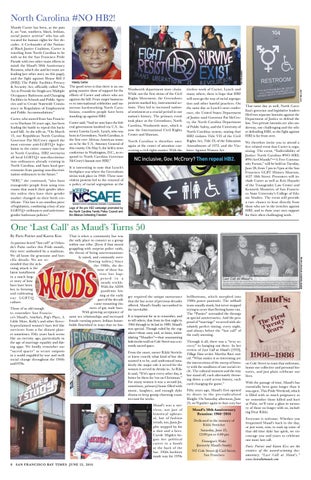
Logo of the pro HB2 campaign promoted by the North Carolina Family Policy Council and the Alliance Defending Freedom
We therefore invite you to attend a free related event that Carter is organizing. The event, “Indivisibility of Justice: North Carolina #NO HB2; #WeAreOrlando”—A Free Community Forum,” will be held on Tuesday, June 28, from 7 pm to 9 pm at the San Francisco GLBT History Museum, 4127 18th Street. Presenters will include Carter as well as Kris Hayashi of the Transgender Law Center and Kenneth Monteiro of San Francisco State University’s College of Ethnic Studies. The event will provide a rare chance to hear directly from those who are in the trenches against HB2, and to show your own support for their often challenging work.
By Paris Poirier and Karen Kiss As patrons heard “last call” at Orlando’s Pulse earlier this Pride month, they were ambushed by a madman. We all know the gruesome and horrif ic details. We are reminded that the sickening attack is the latest installment in a much larger story of how bars have been key to forming and cultivating our LGBTQ culture. Those of us old enough to remember San Francisco’s Maud’s, Amelia’s, Peg’s Place, A Little More, Kelly’s and other fiercely-proclaimed women’s bars feel like survivors from a far distant planet sometimes. Fifty years back seems like an eternity ago, particularly in the age of marriage equality and dating apps. We fondly remember our “sacred spaces” as secure outposts in a world engulfed by war and swift social change throughout the 1960s and1970s.
That is when a community bar was the only place to connect as a group within our tribe. (Even if that meant grappling with surprise police raids, the threat of being unceremoniously outed, and constantly overf lowing toilets.) Since the 1980s, the demise of these havens has happened in a steady trickle. With the AIDS pandemic hitting at the early part of the decade came mounting closures of gay male bars. With growing acceptance of same sex relationships and increased female earning power, lesbian households flourished in ways that no lon-
PHOTOS COURTESY OF MANDY CARTER
One ‘Last Call’ as Maud’s Turns 50
ger required the unique nurturance that the bar scene of previous decades offered. Maud’s finally succumbed to the inevitable. It is important for us to remember, and to tell others, that from its first night in 1966 through to its last in 1989, Maud’s was special. Though ruled by the regulars—those zany and, at times, intimidating “Maudies”—that unassuming hole-in-the-wall on Cole Street was a serenely sacred space. From the onset, owner Rikki Streicher knew exactly what kind of bar she wanted it to be, and understood intuitively the major role it served for the women it served its drinks to. As Rikki said, “If it’s open every other day, it better be there for ‘em on Christmas.” For many women it was a second (or, sometimes, primary) home filled with music, laughter, and enough dyke drama to keep gossip churning coastto-coast for weeks. Maud’s was a surv ivor, not just of historical upheaval, but of fashion trends, too. Janis Joplin stopped by for a shot and a beer. Carole Migden began her pol it ica l career in a booth at the back of the bar. 1960s beehives made way for 1970s
8
SA N F RANCISCO BAY T I ME S J U NE 2 3 , 2 0 1 6
bellbottoms, which morphed into 1980s power pantsuits. The softball team usually stunk, but never stopped trying to score that fleeting home run. The “Pussies” serenaded the throngs at special anniversaries. And the proposal of “marriage” recurred with absolutely perfect timing, every night, and always before the “last call” of the early morning. Through it all, there was a “sexy secrecy” to hanging out there. In her review of Last Call at Maud’s (1993), Village Voice writer Martha Baer noted: “What makes it so interesting are the intersections of the sweep of history with the smallness of one social circle. The cultural moment and the tiny bar stand off, each alternately throwing down a card across history, each card changing the game.” Fifty years ago, Maud’s first opened its doors in the pre-radicalized Haight. On Saturday afternoon, June 25, we’ll gather again in that cozy bar Maud’s 50th Anniversary Reunion: 1966–2016 Dedicated to the memory of Rikki Streicher Saturday, June 25, 12:00 pm to 6:00 pm Finnegan’s Wake (formerly Maud’s Study) 937 Cole Street @ Carl Street, San Francisco
on Cole Street to toast that milestone, honor our collective and personal histories, and just plain celebrate our lives. With the passage of time, Maud’s has essentially been gone longer than it was open. This Pride Weekend, which is filled with so much poignancy as we remember those killed and hurt at Pulse, we’ll raise a glass in memory of those no longer with us, including Dear Rikki. Everyone is welcome. Whether you frequented Maud’s back in the day, or just want, now, to soak up some of that old time dyke bar spirit, we encourage you and yours to celebrate one more last call. Paris Poirier and Karen Kiss are the creators of the award-winning docu m e nt ar y “L a st Call at Maud’s.” www.lastcallatmauds.com
Dykes on Bikes® Fab Forty! Soni Wolf, Secretary
By Vick Germany
Deni M.
“Having ridden with Dykes on Bikes® to start the parade for 38 years, celebrating our 40th anniversary is realizing half of my dream/vision for this group of wonderful women has happened. I am extremely honored to be part of this extraordinary organization.” Mindie Dodson, Director and Registration Chair Vick Germany
This year marks the 40th anniversary of the San Francisco Dykes on Bikes® Women’s Motorcycle Contingent. Forty years ago, a small group of women motorcyclists, who were tired of their bikes overheating because they were riding behind marchers, rode to the front of the parade, and never looked back. There have been many changes since 1976. Three in particular stand out. The first is that a small group of women riders has grown to hundreds! Secondly, the Women’s Motorcycle Contingent ( WMC) now includes the entire LGBTQ spectrum. Homoto (a gay male motorcycle club), BARF (Bay Area Riders Forum), and independent (as in not belonging to a motorcycle club) gay males are fixtures in the contingent. They are not separate from the WMC, as the media often reports, but are an integral part of the contingent. Thirdly, there is the successful trademarking of the phrase Dykes on Bikes® by the San Francisco Dykes on Bikes® WMC in 2008, after a five-year battle that went to the U.S. Supreme Court. For many years, I watched the San Francisco Dykes on Bikes® WMC from the sidelines, and thought, “One of these days.” When I walked into
Soni Wolf
“The 40th anniversary of the club to me is a part of the realization of how far our LGBT community and women have come in fighting for, and gaining, our access to equality. Our club powerfully symbolizes the movement of women from the back seat to the driver’s seat when our engines roar and we lead the San Francisco Pride Parade. I am proud to be openly and publicly part of a group demonstrating the ability of all women to claim their own independence.”
Here is what some others have to say about what this year’s milestone means to them:
how the world may perceive us. Our organization has changed over 40 years, as any organization does. We have become more organized in our efforts to support philanthropic endeavors in the LGBT and women’s motorcycle community at a local, national and international level and gained visibility, in part, through our legal battle to protect the name Dykes on Bikes®. However, at the core we are still a group of women who are not afraid, and indeed insist, on moving to the front of life’s Parade to be seen and heard, with the roar of our engines felt as we ride with Pride in who we are.”
Kate Brown, President
Jen F., Vice President
“Being a Dyke on a Bike® to me means having the freedom and courage to be who we are, regardless of
“I am speechless.”
“I’m very proud and excited to be part of history! I joined the Dykes on Bikes® about a year ago. I have really enjoyed all the fun events, and the people I have had the opportunity to meet along the way.”
Allyson Boyski, Treasurer
Meghan Kelly, Prospect
“Yay!!!”
“As the newest SF Dykes on Bikes® prospect, it is incredibly exciting to be joining during such a momentous year. I have wanted to ride bikes since I popped out of the womb, and rode on the back with family as soon as I could fit up on the seat. Now I am lucky enough to operate a bike, and am thrilled to be volunteering with the club for such a huge accomplishment for our group!”
my first meeting at the Eagle Tavern 16 years ago, I did not imagine being around to celebrate the 40th anniversary of the San Francisco Dykes on Bikes® WMC. For 40 years, we took the word ‘dyke’ from those who used it as an epithet and made it a symbol of pride and dignity, ref lecting our strength as women, as lesbians, as dykes. I am proud to wear a patch on the back of my jacket and another one on a leather vest that says San Francisco Dykes on Bikes® WMC. Happy 40th!
Mindie Dodson
Kate Brown
Deni M., Patch Holder
Come celebrate our 40th anniversary on June 25 at El Rio (3158 Mission St,
SF) from 1–5 pm (which allows plenty of time to head to the Dyke March that starts at 6 pm this year). Alotta Boutté is our emcee and songstress. DJ Lady Ryan will get you dancing. Allison and Q will make sure your leathers look good. There will be cake from Cable Car Cakes and Chocolates. We have awesome auction items! You can also register to ride in the parade and pick up a limited edition 2016 40th anniversary t-shirt, “Hug the Curves.” Check us out at http://www.dykesonbikes.org/ and on Facebook at SanFranciscoDykesOnBikesWMC. Vick Germany is the Co-President of the San Francisco Dykes on Bikes® Women’s Motorcycle Contingent.
Meghan Kelly
S AN F R ANC IS C O BAY T IM ES BAY T IM ES JUNE 23, 2016
9
Taking Inspiration from Diana Nyad
thwart terrorism, eliminate gun violence, and even reexamine our country’s blood donation policies. All of these are important topics that are getting much needed attention as a result of this tragedy. It is an opportunity to make something positive happen out of a soul-shaking hate crime. My hope is we leverage this moment to make real meaningful change in addressing these issues
Do Ask, Do Tell Zoe Dunning Happy Pride Month, everyone! This is a month to celebrate our community, our families and our allies. It is also a month for ref lection on what we have accomplished and what we have left to do. For me, it is also a month for personal ref lection in the wake of our California primary election results. The story of the horrific shooting at the Pulse Nightclub in Orlando has captured the attention of our nation and the world. The worst mass shooting in the history of the United States forever changed the lives of so many that night—the 49 innocent lives lost, the 53 injured (some quite severely), those who were there but managed to escape, and the friends and families of these victims. It has impacted the rest of us as well, as we face renewed concerns for our safety—for our LGBTQ community, for people of color, and for all of us in this day and age of asymmetric threats and terror. This was a hate crime, perpetrated against the LGBTQ and Latino communities, by a Muslim man who claimed to do it in the name of ISIL. This generates multi-layered debates on how we respond to hate crimes, eradicate homophobia, racism and Islamophobia, identify and
10
Beyond the public policy implications, the Pulse shooting has had an emotional impact on all of us. At this past weekend’s California Democratic Party LGBT Caucus meeting, former CA Assembly Speaker John Perez read aloud the name of each person killed in Orlando, as well as their age and a one-sentence description—a life cut short, summarized in one short sentence. I am struck by how young most of the victims were. They were aspiring actors, dancers, students and cooks. Many held entry-level jobs: a retail clerk at a convenience store, a ride operator at a theme park, or a bank teller. Some were locals, many were immigrants from Puerto Rico and elsewhere starting their new lives, others were on vacation visiting friends or family. The descriptions conveyed more than just their jobs or circumstances; many were remembered as sweet, fun, loving, supportive, and joyful. In just one sentence we were able to get a small insight as to who they were and what we lost that night. It was incredibly powerful, and to me, more meaningful than the usual “moment of silence.” It is speaking out, not being silent, that will help us move past this horrific incident and work to prevent this from ever happening again. Public service is one way of speaking out. I became involved in local politics following the successful re(continued on page 26)
SA N FRANCISCO BAY T I ME S J U NE 2 3 , 2 0 1 6
Orlando Ref lections
A San Francisco Kind of Democrat Rafael Mandelman “If a bullet should enter my brain, let that bullet shatter every closet door.” – Harvey Milk Sadly, the bullet that killed Harvey Milk nearly four decades ago has still not shattered every closet door. Had it done so, the horrible killing spree at Pulse nightclub in Orlando would never have happened, and the 49 souls gunned down there would still be among the living. As we all know, Milk’s assassination was not, as some feared at the time, the end of a movement; it was, we can see looking back, just the beginning of a civil rights struggle that has transformed our laws and our culture, bringing LGBT people closer to full legal equality than many could have imagined back on November 27, 1978. But as I have been ref lecting on the Orlando tragedy, it has struck me that for all our progress since Dan White shot and killed Harvey Milk, far too many queer people are still getting beaten up, knifed, shot and killed for their queerness. On June 16, the New York Times reported that LGBT people have surpassed Jews as the most likely group to suffer hate crimes in the United States, with fully a fifth
of all hate crimes reported to the FBI in 2014 targeting people because of their sexual orientation or perceived sexual orientation. In San Francisco, our own LGBT Community Center last year commissioned a study on the experience and impacts of violence in the queer community, finding that more than two-thirds of LGBTQI people had experienced physical violence, and nearly four in five transgender people had experienced physical violence. We may have achieved the right to marry, but too many of us are still vulnerable to the same kind of violence that killed Harvey Milk. All these years later, we remain an especially vulnerable people in a violent and unsafe country. Notwithstanding the NRA’s claims to the contrary, it is clear that easy access to all manner of guns makes us less safe. The statistics on gun violence in this country are horrifying. In a June 16 New York Times op-ed, General Stanley McChrystal observed that between 2001 and 2010, 119,246 Americans were murdered with guns, a number that is 18 times the total American combat deaths in Iraq and Afghanistan. Indeed, horrific as the carnage at Pulse nightclub was, the deaths there represented less than half of the 121 people killed by gun violence in the United States that weekend. Violence is senseless; there is no meaning or higher purpose that can justify or explain the 49 deaths in Orlando any more than the 89 American deaths from gun violence that occur on average every day. But I have to hope that in time we will see that the Pulse victims did not die in vain, and that like Harvey Milk, they will live on through a righteous struggle carried forward in their name and memory, to continue shattering closet doors, of course, but perhaps more
importantly to end the violence that continues to define and circumscribe our queer lives. June 7th Election Recap As I write this column, with ballots still being counted, Jane Kim has pulled ahead of Scott Wiener in San Francisco and has closed his lead to just .3 percent in the District overall. I have to say, I didn’t see this coming. Although I deeply disagree with Wiener on a host of local issues, I have always respected his tireless work ethic, his dogged persistence and his organizational abilities. Starting his campaign months before Kim jumped in, locking up the Democratic Party endorsement early on, and out-fundraising and outspending her by a factor of three-to-one, Wiener seemed to me, up until election night, the prohibitive favorite. I was wrong. As the two candidates turn their attentions to the November election, this is anyone’s race, but momentum is now on Kim’s side, and she should have a significantly easier time raising money. Nonetheless, I think she knows it would be a mistake to underestimate her opponent. Wiener has never lost a campaign yet, and I don’t imagine he intends to start now. A shift in power at the local Democratic County Central Committee was the other big news from the June primary. As of this writing it appears that, notwithstanding the unprecedented amount of money pumped into the campaign by real estate and tech interests—reportedly, well over $1 million—the progressives (i.e., the “Reform Slate”) have won back a narrow majority of the Committee. Bad news for Ron Conway, perhaps; good news for San Francisco. Rafael Mandelman is an attorney for the City of Oakland. He is also President of the City College of San Francisco Board of Trustees.
S AN F R ANC IS C O BAY T IM ES BAY T IM ES JUNE 23, 2016
11
In the News
Compiled by Dennis McMillan Bay Area Cities Honor Victims of Orlando Club Shooting Through vigils, memorials, rainbow flags raised at half-mast and more, cities throughout the Bay Area joined others across the world in honoring the victims of the June12 shooting that killed 49 people and injured 53 others inside the gay nightclub Pulse in Orlando, Florida. The massacre was the deadliest mass shooting by a single gunman in the U.S., and the deadliest incident of violence against LGBT people in the U.S. Shortly after the event occurred, Mayor Ed Lee issued the following statement: “On behalf of the people of San Francisco, I express our deepest sorrow for the people of Orlando and members of our LGBT community after the evil act of terror carried out this morning. Our thoughts and prayers are with the families and friends of those who have lost their lives by yet another mass shooting. San Francisco stands in solidarity with the community of Orlando and the nation in the aftermath of this terrible day. This is a stark reminder of the violence that still threatens our LGBT community. Senseless acts of violence against innocents, fueled by hate and easy access to deadly firearms, have become all-too frequent. We must continue to work each day to reduce gun violence and ensure every community is safe. Profound tragedies and acts of hate again leave us heartbroken, even numb and speechless. But we resolve today, more than ever, that love, strength and unity will always triumph over hate, fear and violence. San Francisco grieves with the people of Orlando, the LGBT community and the nation today.” (For more about the June 12 vigil in San
12
Francisco, see story on page 13.) San Francisco Pride Announces Screening and Bag Checks for 2016 Celebration Attendees There will be security screening and metal detectors at all points of entry for the 2016 San Francisco Pride Celebration and Festival, scheduled for Saturday, June 25, from 12:00 pm to 6:00 pm and Sunday, June 26 from 11:00 am to 6:00 pm at San Francisco’s Civic Center. Bags are highly discouraged, and no bags over 18” x 18” will be admitted. Everyone attending the Celebration must pass through the screening process. All items will be subject to inspection at the entry gates, and there are no lockers for storage of oversized bags. For more information: sfpride.org/celebration-security/ Mayor Lee and Supervisor Scott Wiener Call for Ballot Measure to Increase Neighborhood Safety Mayor Lee and Supervisor Scott Wiener this week submitted the Safe Neighborhoods Ordinance for the November 2016 ballot to require the creation of the Neighborhood Crime Unit within the San Francisco Police Department. The Unit would investigate neighborhood crimes such as home burglaries, automobile breakins and automobile thefts, and would enforce laws to deter neighborhood crimes. By creating one consolidated Unit with dedicated staffing, the proponents say SFPD would be better able to respond to 311 and 911 calls. Supervisor Wiener said, “Our resi-
SA N FRANCISCO BAY T I ME S J U NE 2 3 , 2 0 1 6
dents deserve safe neighborhoods, not the auto break-ins, burglaries, vandalism, bike chop shops, and other crimes that they experience every day. We need police officers out on our streets walking beats and working proactively with the community to address our crime problems. The Safe Neighborhoods initiative will help us to improve quality of life in our neighborhoods and create stronger and safer communities.” Oakland Councilmember Kaplan Reacts to Ongoing Oakland Police Department Scandals As the Oakland Police Department faces 3 chiefs fired in 9 days, sex scandals, and allegations that Oakland officers sent racist texts, openly lesbian Oakland City Councilmember-AtLarge and San Francisco Bay Times columnist Rebecca Kaplan responded. “What a disturbing week in Oakland. Getting the right attitudes, demographics and character into Oakland’s police department has been a long challenge. This week, I submitted a proposal to improve the Oakland Police Department’s hiring and recruitment to address under-representation of women, LGBT people and people of color, and screening out problematic attitudes.” She added, “We need to ensure that we are building the conditions that make it possible to have trust and healing between the community and our law enforcement officials.” Universal ‘All Gender’ Restroom Access Bill Advances in CA Legislature A bill authored by Assemblymember and San Francisco Bay Times columnist Phil Ting (D-San Francisco) to establish the nation’s most inclusive restroom access law among states passed a key vote in the State Senate this
week. Sponsored by Equality California, the Transgender Law Center and California NOW, Assembly Bill (AB) 1732 would require single-occupancy restrooms in California businesses, government buildings and places of public accommodation to be universally accessible and identified as “all gender.” It passed the Senate Committee on Transportation and Housing with a preliminary 8–2 vote and now moves to the Senate Committee on Appropriations for further review. Additional information about AB 1732 is available online: leginfo.ca.gov Dyke March to Take Place on June 25 with Theme #stillherestillqueer The 24th annual Dyke March will start this year at 6:00 pm from 18th & Dolores. Participants will march the original route ending at Castro & Market, where the first official SF Dyke March began in 1993. Event programming will begin beforehand at Dolores Park at the stage in the southeast corner at 1:00 pm. Those who come will hear from local community activists, dance to the grooves of local DJs, sing along with some cool musical artists, and snap along with local poets. New this year is an “Emotional Security Tent,” where individuals can mourn and process the Orlando tragedy together in community. Nicole Richards of the SF Dyke March Committee says, “Every year, our community faces yet another loss; whether it’s a local bar where folx gathered for over a decade, or a home of a queer activist. We’re feeling the displacement of the LGBTQ community down to our core. It lives in our bones, making us ache with grief for what has been lost and what we’ll continue losing if something doesn’t change. Also, after the tragic shooting in Orlando, we as a commu-
nity are grieving. We stand in solidarity with Orlando and want to support our community in any way we can.” Pink Triangle Recruiting Volunteers for Installation on Twin Peaks The Pink Triangle of Twin Peaks in San Francisco is a visible, yet mute, reminder of man’s inhumanity to man, especially the Nazi Holocaust that slaughtered innocent gays. The Pink Triangle, a one-acre display that can be seen for 20 miles, is here to educate others about the hatred of the past to help prevent it from happening again. Installation by volunteers is Saturday June 25, 7 am–10 am. Even an hour of your time is a big help. Coffee, pastries and Pink Triangle t-shirts will be provided to all who help out. The Commemoration Ceremony follows at 10:30 am with various dignitaries including elected officials and some grand marshals— plus the SF Lesbian/Gay Freedom Band and musical theater star Leanne Borghesi. Take-Down is Sunday June 26, 4:30 pm–8 pm after the Parade. Dinner will be provided afterwards at a Thai restaurant for all who have helped. thepinktriangle.com Trans March to Celebrate 50th Anniversary of the Compton’s Cafeteria Riot Trans March 2016 happens tomorrow, June 24, starting at 1 pm. Organizers say, “This year is really special because we will be celebrating the 50th anniversary of the Compton’s Cafeteria Riot, which happened in August, 1966, years before Stonewall. The riot occurred in the Tenderloin, and was one of the first recorded transgender riots in U.S. history. The schedule for this year’s Trans March (subject to change) is as (continued on page 26)
It Is Not OK By Dr. Timothy Seelig (Editor’s note: Dr. Seelig wrote the following piece on June 13, the day after the Orlando shooting.) Today, everyone is processing at their own pace and in their own way. My way is to write–and draw (in the sand).
Today, I am finally angry enough, tired enough, “sick about it” enough and old enough to simply speak my truth and draw a line in the sand. Youngsters, don’t wait 30 years to draw your own line! Most of you know of my very deep Southern Baptist roots. I have countless friends and family deeply ingrained in this and other groups that categorically denigrate and/or deny my very being. Their distaste ranges from “bless his heart,” spoken with smiling lips and clenched teeth, to outright bigotry and hatred spewed from the institutions to which they belong. This is for my family, friends and acquaintances: It’s not OK.
It is not OK to remain part of the organizations referenced above– churches, social groups, political parties–unless you are actively, and loudly, working for change within them and willing to take courageous stands in support of the entire LGBT community. It is not OK to give lip service to “acceptance” or “tolerance” while your very membership silently condones their beliefs and tangentially supports actions that are, at their very root, filled with hate for anyone who is different than you. It is not OK to believe that any person, other than military, needs assault weapons. They need to be banned—as they were under Clinton (the ban allowed to expire under George W. Bush). Gone. No
PHOTO BY PATRICK AND HOSSEIN CARNEY
It is not OK … what happened in Orlando. On that we can all agree. It does remind us that there is so much more that is not OK.
questions asked. Find them. Destroy them. “Bearing arms” in 1791 has nothing to do with carrying an assault weapon down the street in 2016. It is not OK to continue the use of “sexual preference,” “lifestyle,” “lifestyle choice” or any other term that suggests I am anything other than exactly what I am–perfect. There is no preference or choice here. (And while we are at it, could
we also get rid of “love the sinner, hate the sin” for good measure. No, you don’t.) It is not OK to ignore the elephant in the room with family and friends. For years, we have agreed to go our own way, live our own lives, live and let live and just not talk about it. It’s not OK. We will talk about it. Maybe even yell about it. And, most certainly, continue to sing about it.
Life is too short to continue to try to change minds that are closed. Life is too short to accept “less than” from anyone. Life was cut way too short for those precious brothers and sisters who died yesterday … . It’s not OK. Today, I mourn them by saying It’s Not OK. Not for me. Not for any of my LGBT family. It’s Just Not OK. Dr. Timothy Seelig is the Artistic Director of the San Francisco Gay Men’s Chorus.
Thousands Rally for Orlando Massacre Vigil in the Castro
Two Drag Kings known as Momma’s Boyz opened the Castro vigil singing a mournful “Freedom” song to a tearful crowd. But the energy changed to anger and resolve when speakers took the podium. Supervisor Scott Wiener said, “We’re here today to recommit ourselves to the fight, to honor the survivors, to send good energy to the families and friends who have been left behind.” Supervisor David Campos said, “As a gay Latino man, it is not shocking to me that the worst mass shooting in the history of this country would target the queer community.” He added, “We want our leaders to think of queer people of color not just when there’s a massacre, but every single day.” As many of the speakers stated, he emphasized opposition to Islamophobia and xenophobia. “We are all in this together. I know that targeting the Muslim community is simply wrong, and we’re going to speak out against it.” Approximately two-thirds of the Orlando victims were Latino. Lito Sandoval, SF Latino Democratic Club president, noted, “Latino leaders were not contacted [for the vigil]. We had to reach out.” He stressed, “Acts like this don’t make
Among the many Muslims speaking at the rally was a Muslim doctor from San Francisco General Hospital, Suzanne Barakat, M.D. saying, “As a physician, I see these tragedies as symptoms of a deeper illness, a disease of the soul that goes by different names.” Former Assemblyman and former Supervisor Tom Ammiano joked that NRA was an acronym for “National Real A-holes.” He made several fun-loving ribald jokes, but ended seriously, saying, “We are still here. We are still strong. We are still fighting, and we’re not going to live in fear!” “We’ve known gun violence before,” shouted Pa stor Meg a n Rohrer. “Angry people of faith are not the majority. We are queer. We are transgender. We are fabulous, we are faithful. We must stand up. We must vote until everyone is safe in bathrooms, in churches, and in the ... streets.” “There’s a lot of heartache, but we are coming together to create some type of solidarity, not only in San Francisco but also beyond ourselves,” said Dyke March organizer Rosa M. Hernandez. Sister Merry Peter and Sister Roma of The Sisters of Perpetual Indulgence led the crowd in a recitation call and response, asking everyone to lift up their candles and repeat each time, “We shine our light on you!” Mayor Ed Lee spoke through a few boos from the audience, “We’re here in unity so we can stop this violence, and San Francisco must lead
the way. Hatred will not drive out hatred, and darkness will not drive out the dark.” He concluded, “This is a stark reminder that violence still threatens our LGBT community.” Toney Chaplin, Interim Police Chief who was recently appointed after Chief Greg Suhr resigned, said, “The NR A is a powerful group, but I am staring at a more powerful group.” He added, “We need to get this legislation in place to change the gun laws in this country.” He noted that San Francisco Police have increased patrols in the Castro and elsewhere. And they promise to really step up security at the San Francisco Pride Parade and Celebration. Members of the San Francisco Gay Men’s Chorus closed the vigil by singing “We Are a Gentle, Angry People,” with SFGMC Director Dr. Timothy Seelig leading the crowd in the familiar Holly Near protest song. Then they sang “We Shall Overcome” and closed with an old Irish blessing ending with “May God hold you in the palm of His hand.”
PHOTOS BY RINK
Thousands gathered in the streets and on sidewalks near the Harvey Milk Plaza in the Castro in front of a stage on a flatbed truck to respond to the worst mass shooting ever in America’s history, and the worst loss of lives on our soil since 9-11. A total of 49 died and 53 patrons were wounded in the Orlando, Florida gay nightclub, Pulse, during Latin Night.
me want to back down. They make me want to continue to fight.”
PHOTO BY RINK
By Dennis McMillan
Following the rally in the Castro, people marched peacefully but defiantly to City Hall, which was appropriately lit in the rainbow colors. The names of murdered victims were read aloud. After the rally, many left their candles burning on a statue of Abraham Lincoln at City Hall. So appropriate, as Lincoln was murdered for civil rights. To support the victims and their families, please go to gofundme. com/pulsevictimsfund
S AN F R ANC IS C O BAY T IM ES BAY T IM ES JUNE 23, 2016
13
14
SA N FRANCISCO BAY   T I ME S J U NE 2 3 , 2 0 1 6
PHOTO BY MASAHIRO TERADA
PHOTO BY RINK
PHOTO BY RINK
PHOTO BY RINK
PHOTO BY RINK
PHOTO BY RINK
PHOTO BY HOSSEIN CARNEY
PHOTO BY RINK
PHOTO BY RINK
WE ARE ORLANDO
San Francisco Remembers San Francisco’s Castro Street on Sunday, June 12, filled with thousands of LGBT community residents, activists, civic leaders and elected officials in response to the horrific massacre at Pulse, the gay bar in Orlando, Florida. San Francisco Bay Times veteran photographer Rink was at Harvey Milk Plaza, recording images of grief, anger, determination and an occasional smile. Songs by the San Francisco Gay Men’s Chorus and drag kings Momma’s Boies, readings, and speeches expressed sentiments and vows to continue the effort toward achieving full equality, understanding and peace.
PHOTO BY HOSSEIN CARNEY
Memorial flowers, candles and other items were placed on display at the historic “Hibernia Beach” 18th and Castro corner across from Harvey’s bar. Marchers made the familiar journey with a sea of candles moving from the Castro and Market intersection to City Hall – another huge crowd of San Francisians, each finding her or his own way to demonstrate dismay and shock on the day of the largest ever massacre and hate crime in U.S. history.
PHOTO BY RINK
S AN F R ANC IS C O BAY T IM ES BAY T IM ES JUNE 23, 2016
PHOTO BY RINK
PHOTO BY RINK
PHOTO BY RINK
PHOTO BY RINK
PHOTO BY RINK
PHOTO BY RINK
PHOTO BY RINK
On Wednesday, June 15, photographer Curt Janko coordinated a “Kiss-In” at Harvey Milk Plaza where couples kissed in public in response to reports that the Orlando killer had been angered recently after seeing a gay couple kiss in Miami.
15
Page Removed
Page Removed
Page Removed
6 Facts You Might Not Know About Medicare refers to what is now called Part A and Part B.
Money Matters Brandon Miller More than 50 years ago, the federal government established programs designed to help Americans afford health care services, called Medicare and Medicaid. Since both of these programs involve many variables, they can be somewhat complex. To provide insight into how the coverage works, here are six facts you might not know about Medicare: 1. Medicare and Medicaid provide most of the same services, but for different people. Medicare provides services for those age 65 and over and with other qualifying conditions, while Medicaid is a program intended for lower-income Americans based on financial need. The government continues to evolve and expand the programs to match the ever-changing health care environment. 2. Medicare coverage has four parts. Each part covers different categories of medical expenses. As you look into Medicare, you may see the term “original Medicare.” This term
Part A is the hospital insurance portion, which covers inpatient stays in hospitals, skilled nursing facilities, hospice facilities and sometimes also covers home-based health care services. Depending on your situation, you may automatically be enrolled in Parts A and B, or you may need to enroll.Part B covers doctor visits, durable medical equipment, home health services and qualified preventive services, among other related expenses. Part C (Medicare Advantage plans) provides Part A, Part B and usually prescription drug coverage from private insurers. You must be enrolled in Part A and Part B before you can receive Part C coverage.Part D covers outpatient prescription drug coverage from private insurers. You must be enrolled in Part A or Part B before you can receive Part D coverage. 3. Everyone can enroll in Medicare—eventually. There are three different times when you can sign up for Medicare Parts A and B:Initial enrollment period: Once you reach age 65, you may enroll within three months on either side of your birthday month. General enrollment period: If you don’t sign up during your initial enrollment period, you have the option to enroll each subsequent year between January 1 and March 31. Special enrollment period: You may get started with Medicare at any age if you experience a qualifying condition. Qualifying conditions may include disabilities, certain cancers or end-stage diseases. After your initial enrollment period ends, you may have a chance to enroll in Medicare
Muscle Cars with Strength to Inspire GT California Edition and 2017 Volvo V60 Polestar.
during a special enrollment period due to a qualifying event such as moving away from your existing coverage or losing coverage from an employer. 4. Medicare is not free for most of us. While Part A comes with no monthly premium if you have at least a 10-year history of paying Medicare taxes, you will be responsible for deductibles and coinsurance, unless you qualify for help. For example, the deductible for 2016 is $1,288 for each benefit period, with varying coinsurance depending on the length of stay. The Part B premium costs $104.90 per month in 2016. Premiums can be higher for beneficiaries with incomes that exceed specific thresholds. 5. Original Medicare operates w ithout net works and caps. With original Medicare, there are no networks to worry about. You’re free to go to any doctor or hospital that accepts Medicare, including outside of your home state. In addition, original Medicare does not limit your annual costs. Health care bills owed (due to coinsurance) continue to grow all year if you don’t have supplemental insurance to help manage these expenses. This is in contrast to Medicare Advantage plans, which operate around the concept of networks. 6. After you enroll in Medicare, you may need supplemental insurance. While Medicare covers a variety of expenses, there are limitations to its coverage. Therefore, you may need additional coverage depending on your current or future health needs. Carefully review information about what expenses each part covers before enrolling, and be sure to ask other insurance providers (continued on page 26)
Both came in vivid colors that turned heads. And they sounded great, with sport-tuned exhaust notes. Their uniqueness and individuality were clear with each reach for the door handle.
Auto Philip Ruth As you are reading this, you’re probably still adjusting to life after the Orlando massacre; as I’m writing this, so am I. This is a new reality, where one of our safe places was brutally attacked, and where the most vulnerable in our community— the young and Latino and people of color — took the most casualties. So if you’re like me, then you’ve been out of sorts—zoning out, dropping your keys and burn- Mustang GT ing dinner, as you parse out the anger and sadness that rises up in waves.
Besides aesthetics, the appeal of the Mustang GT and V60 Polestar centers on performance. The tested Mustang GT had the V8, which transmitted the tremendous strength of its 435 horses through a slick-shifting, sixspeed manual transmission. This particular Mustang GT was a convertible, and you could feel the weight of its near-two-ton curb as it headed up and down San Francisco’s hills. But the sheer thrust of those eight cylinders were always on call, and it was great to simply squeeze the throttle and feel the power the Mustang GT had just beneath the surface.
As our shock turns to action, it’s more important than ever to be as out and proud as possible. In this sense, the SF Pride cele- Volvo V60 Polestar bration could not have better timing. The Volvo comes from the company’s We could also draw inspiration for our in-house Polestar performance divinext wave of activism from two of my recent test cars, a 2016 Ford Mustang (continued on page 26)
S AN F R ANC IS C O BAY T IM ES BAY T IM ES JUNE 23, 2016
19
Revised Dignity Fund Legislation
Aging in Community Marcy Adelman The Dignity Fund Coalition has revised its proposed legislation for additional revenue for San Francisco’s vulnerable elders and people living with disabilities. According to the current proposal, revenues are to be secured from the General Fund Aggregate Discretionary Revenue (ADR) rather than a set aside percentage of property taxes. (See the May 19 “Aging in Community” column for information about the initial Dignity Fund legislation, http://sf baytimes.com/letsmove-dignity-fund-forward/)
place the Dignity Fund legislation on the November 2016 ballot for a vote. Six of the eleven Supervisors presently support the Dignity Fund: Malia Cohen, Eric Mar, Scott Wiener, Norman Yee, David Campos and John Avalos. Thank you to each of the cosponsoring Supervisors, and thanks to all of you who supported the Dignity Fund with your emails, post cards and calls. If you have not sent a message of support, now is the time to do it. To ensure a winning vote in July, tell the remaining uncommitted Supervisors–Mark Farrell, London Breed and Jane Kim–that funding for existing senior programs has not, and will not, keep pace with San Francisco’s growing elder population without an infusion of financial resources. District 2: Mark.Farrell@sfgov.org District 5: London.Breed@sfgov.org District 6: Jane.Kim@sfgov.org
The current proposal will allow more f lexibility in revenue sourcing and a more gradual implementation period. Funding in the initial years will be at a fixed amount of $7.5 million in the first year and 4 million for the next 9 years. In the tenth year, funding would then increase by tracking with overall general fund growth (ADR).
One out of five San Franciscans is over the age of 65. During the next 15 years, the city’s senior population will increase by an estimated 5 % via an additional 100,000 elders. The Dignity Fund is an exceptional opportunity to ensure that veterans, older adults and seniors living with HIV and other chronic illnesses, isolated LGBT seniors, adults with disabilities, and other vulnerable senior populations receive the services and programs they need to stay in their homes and in their communities.
The current proposal goes to the Board of Supervisors Rules Committee today, June 23, and then on to the full Board of Supervisors in July to
The Dignity Fund legislation is the right thing to do to ensure the health and well-being of San Francisco’s senior citizens.
20
SA N FRANCISCO BAY T I ME S J U NE 2 3 , 2 0 1 6
Go to the Dignity Fund website to receive updates, to volunteer and to donate: www.sfdignityfund.org Partial Coalition List: AIDS Legal Referral Panel, Alzheimer’s Association, Asian Pacific Islander Legal Outreach, Bayview Hunters Point Multi-purpose Senior Services, Canon Kip Senior Center, Catholic Charities San Francisco, Centro Latino de San Francisco, Community Living Campaign, Curry Senior Center, Episcopal Senior Communities, Faith in Action Bay Area, Family Caregiver Alliance, Family Service Agency/Felton Institute, Filipino Community Center, HIV & Aging Work Group, HIV Long Term Survivors, Independent Living Resource Center, Institute on Aging, Jewish Family and Children’s Services, Kimochi Inc., Lighthouse for the Blind, Little Brothers Friend of the Elderly, Meals on Wheels San Francisco, Northern California Presbyterian Homes and Services, On Lok Inc., Openhouse, Pilipino Senior Resource Center, Project Openhand, Richmond Senior Center, San Francisco Village, SelfHelp for the Elderly, Senior & Disability Action, Shanti Project, South of Market Community Action Network, Steppingstone, Swords to Plowshares, The ARC-SF, The Living Room, Veterans Equity Center, Westbay Filipino Center, and YMCA of San Francisco. Marcy Adelman, Ph.D., a clinical psychologist in private practice, is cofounder of the non-profit organization Openhouse and was a leading member of the San Francisco LGBT Aging Policy Task Force.
Jim Obergefell Visits GLBT Historical Society Photos by Paul Margolis
Jim Obergefell’s name is forever ascribed to the Supreme Court case that established marriage equality in all 50 states. San Francisco Bay Times founding editor Randy Alfred and columnist Stuart Gaffney were among those in the audience when Jim discussed his new book Love Wins: The Lovers and Lawyers Who Fought the Landmark Case for Marriage Equality.
S AN F R ANC IS C O BAY T IM ES BAY T IM ES JUNE 23, 2016
21
After One Year of Marriage
Weddings Reverend Elizabeth River Carl Hungerford and Andy Dvorak married June 6–a year ago–during Pride month! I spoke with them then, and again this week to see what’s changed. Rev. Elizabeth River: Has being married changed you in any noticeable way? Carl: Yes, being married reminds me that we are truly committed to each other in a way that we just weren’t before. It’s a great feeling! Andy: Recognizing Carl as my husband, public acknowledgement of our commitment, and legal marriage equality feel so good and right. Looking at my ring, I smile and am grateful for not only finding one another but also for being able to marry–legally. Rev. Elizabeth River: Any thoughts about becoming parents? I bet all the people who know and love you tell you that you’d be wonderful dads!
A ndy: Carl and I share a common interest in being respectful of all people. I switched careers from f light attendant to bus driver and I greet everybody who boards my bus with a “Good morning, how are you?” And when they leave: “Have a nice day!” This isn’t spectacular, but it’s important to me. I’ve seen people from the neglected populations come to tears because they’re not used to kindness, to being acknowledged. Having a conversation with them, I’ve realized that all people are the same whatever their income level, education or housing situation. Recently I’ve been driving a bus that many homeless take to get to the shelter; I always offer help with how to get to the shelter. I love what I do. Rev. Elizabeth River: Oh yes, you are two of the kindest men I know! The Dalai Lama says: “There is no need for temples; no need for complicated philosophy. My own brain, my own heart is the temple; the philosophy kindness.” And Carl, I can’t help but mention that while we worked together in
PHOTOS COURTESY OF ELIZABETH RIVER
Carl: As a hospice nurse–a job I love– I’ve become interested in broader healthcare issues like advance directives, a nd t he f i n a nc i a l struggles many people face as they age. That’s a direction I may move in.
hospice care, I saw with what care and tenderness you treated your hospice patients and their spouses and partners. You communicate with them so clearly and compassionately. You will be a great blessing to elders helping them with financial and health care directives as well! Any comments on love? Carl: Yes. Andy: I love you, Carl. Carl: I love you too, Andy. Reverend Elizabeth River is an ordained interfaith minister and wedding officiant in the North Bay. Please visit www.marincoastweddings.com or on Facebook at https://www.facebook.com/Marin-Coast-Weddings-RevElizabeth-River-Wedding-Officiant841159955975880/?ref=aymt_homepage_panel
Carl: Hmm… .We’ve talked about becoming parents, but haven’t made any definite plans. One barrier is the very high cost of living, especially housing, in the Bay Area. Raising kids could be great, but I think we don’t feel we need kids to feel fulfilled as a couple, either. Andy: Yes, if we do decide to have a family, we will plan rigorously— we’d have the added expense of adoption or surrogacy. Carl and I laugh about my mom’s story about how my parents had to quit a bowling league at $25 a month so they could afford to have me—which in the Bay Area is like two lattes, right? More like the price of two SUVs today!
Dykes on Bikes® contingent in the Pride Parade, 2014 22
SA N FRANCISCO BAY T I ME S J U NE 2 3 , 2 0 1 6
PHOTO BY RINK
PHOTO BY RINK
Rev. Elizabeth River: Outside of your careers, do you have any social concerns, including LGBT issues, where you want to make a difference in the world, things you want to give your time and energy to? Is there anything similar that calls to you both, or do you have separate causes that concern you? How are you responding to them?
S AN F R ANC IS C O BAY T IM ES BAY T IM ES JUNE 23, 2016
23
“The Business of Pride” Celebrates LGBT Leadership in the Bay Area Photos by Rink Roland Schembari and Bill Hartman, Co-Founders Randy Alfred, Founding News Editor 1978 Kim Corsaro Publisher 1981-2011
2261 Market Street, No. 309 San Francisco CA 94114 Phone: 415-601-2113
Hosted by the San Francisco Business Times publisher Mary Huss, at the Four Seasons Hotel’s Veranda Ballroom on Thursday, June 9, The Business of Pride event honored key LGBT leaders in the Bay Area who are making an impact in advancing LGBT equality in business. Honorees included The Clorox Company, Corporate Pride Award; Out & Equal’s Selisse Berry, Legacy Leadership Award. Also honored were Horizons Foundation’s Roger Doughty; Cafe Flore’s Stu Berry; and Larry Hashbarger and the staff of Asia SF. Special congratulations to San Francisco Bay Times advisor Nanette Miller of MARCOM Accountants and Advisors, who was also among the honorees.
525 Bellevue Avenue Oakland CA 94610 E-mail: editor@sfbaytimes.com www.sfbaytimes.com
The Bay Times was the first newspaper in California, and among the first in the world, to be jointly and equally produced by lesbians and gay men. We honor our history and the paper’s ability to build and strengthen unity in our community. The Bay Times is proud to be the only 100% LGBT funded and owned newspaper for the LGBT community in San Francisco. Dr. Betty L. Sullivan Jennifer L. Viegas Co-Publishers & Co-Editors
Abby Zimberg Beth Greene
Design & Production
Kate Laws Business Manager Jennifer Mullen Calendar Editor
Kit Kennedy Poet-In-Residence J.H. Herren Technology Director Jennifer Mullen Web Coordinator
Mario Ordonez Juan Ordonez Distribution
CONTRIBUTORS Writers Rink, Sister Dana Van Iquity, Ann Rostow, Kirsten Kruse, Kate Kendell, Alex Randolph, Heidi Beeler, Gary M. Kramer, Dennis McMillan, Tom Moon, Tim Seelig, Cinder Ernst. John Chen Rafael Mandelman, Kit Kennedy, Phil Ting, Rebecca Kaplan, Leslie Katz, Philip Ruth, Bill Lipsky, Karen Williams, Donna Sachet, Gary Virginia, Zoe Dunning, Marcy Adelman, Stuart Gaffney & John Lewis Brandon Miller, Jamie Leno Zimron Rebecca Kaplan, Thom Watson, Courtney Lake, Michele Karlsberg Photographers Rink, Phyllis Costa, Jane Higgins Paul Margolis, Chloe Jackman, Bill Wilson, Jo-Lynn Otto, Sandy Morris, Abby Zimberg
ADVERTISING Display Advertising Standard Rate Cards are available online at sfbaytimes.com or calling: 415-503-1375 Custom ad sizes are available. Please inquire! The Bay Times reserves the right to reject any advertising at the discretion of the publishers. National Advertising: Contact Bay Times / San Francisco. Represented by Rivendell Media: 908-232-2021 Circulation is verified by an independent agency Reprints by permission only. CALENDAR Event listings for consideration to be included in the Bay Times online or print Calendar section should be sent by e-mail to: calendar@sfbaytimes.com. © 2016 Bay Times Media Company Co-owned by Betty L. Sullivan & Jennifer L. Viegas
24
SA N FRANCISCO BAY T I ME S J U NE 2 3 , 2 0 1 6
S AN F R ANC IS C O BAY T IM ES BAY T IM ES JUNE 23, 2016
25
MILLER (continued from page19)
DUNNING (continued from page 10) ready when you become eligible for Medicare coverage.
The federal government and most states provide resources to help you understand your options and guide you through the Medicare enrollment process. It’s good to be prepared— start learning more today so you’re
Brandon Miller, CFP is a financial consultant at Brio Financial Group, A Private Wealth Advisory Practice of Ameriprise Financial Inc. in San Francisco, specializing in helping LGBT individuals and families plan and achieve their financial goals.
NEWS (continued from page12) follows: Youth & Elder Brunch (hosted by LYRIC & Open House) @ Dolores Park: 11 am-2:30 pm; Stage Performances & Speakers @ Dolores Park: 3–6 pm; Street March from Dolores Park to Taylor & Turk Streets: 6–7:30 pm; 50th Anniversary of the Compton’s Cafateria Riots Rally @ Taylor & Turk Streets: 7:30– 8:30; Official Trans March After Party “Bustin’ Out” a TGIJP Fundraiser @ El Rio bar (21+): 8 pm–2 am. Mayor Lee Announces Appointment of Theresa Sparks as Senior Advisor for Transgender Initiatives Mayor Lee announced the appointment of Theresa Sparks as the Mayor’s Senior Advisor on Transgender Initiatives to work directly with the Mayor and City Administrator on LGBTQ policies and oversee development of new transgender initiatives. San Francisco is the first city in the nation to have a position dedicated to advancing the rights of, and creating policies for, the transgender community. “With 11 states suing the Obama administration over the rights of transgender individuals, and many states on the verge of passing more discriminatory laws, San Francisco must lead the fight against this inequity,” said Mayor Lee. As the Mayor’s Senior Advisor, Sparks will assist in leading the Mayors Against Discrimination (MAD) coalition, which the mayor helped form in the wake of discriminatory laws enacted against LGBT individuals in North Carolina and Mississippi. Her appointment is effective July 1, 2016. sfgov.org Sisters of Perpetual Indulgence Share SF Pride Parade Judge Duty with Community Activists The Sisters of Perpetual Indulgence, who have served as San Francisco Pride Parade judges for nearly a decade, have invited community activists including Edwin Lindo, leader of the Frisco Five Hunger Strike, to serve as parade judges in support of the parade theme “Racial and Economic Justice” and in solidarity with Orlando and victims of violence within our own Bay Area Communities. “As your pride judges, we stand in solidarity with Orlando and dedicate our service to celebrating the joy, resilience and power of our communities,” said Sr. Merry Peter, who has helped organize volunteers for the past five years. “As you pass by our table, we hope you will see your own courage and beauty reflected and amplified in our smiles, cheers and applause,” she continued. thesisters.org Positive Resource Center and Baker Places Announce Merger Positive Resource Center, a San Francisco-based nonprofit whose mission is to assist people living with HIV/AIDS or mental health disabilities, recently announced its agreement to combine with local nonprofit Baker Places, which provides a comprehensive array of residential treatment services to people with mental health, substance abuse and HIV/ AIDS-related issues. PRC also announced that it is exploring a deeper collaboration with AIDS Emergency Fund, an emergency financial assistance provider for lowincome residents disabled by HIV/ 26
AIDS. That could also result in a merger of AEF and PRC. Brett Andrews, PRC’s current executive director, would be CEO of the consolidated organization. See the February 25, 2016, issue of the San Francisco Bay Times for more about Andrews and PRC: https://issuu. com/sfbt/docs/bt_cover1_pp_1-28_ issu AIDS/LifeCycle 2016 Raised Millions for AIDS Charity More than 2,300 bike riders rolled from San Francisco into Los Angeles at the culmination of a 545-mile ride that is the world’s largest annual AIDS fundraiser. This year marked the 15th anniversary of the AIDS/ LifeCycle event. The event also coincided with the 35th anniversary of the Center for Disease Control’s first reported HIV cases. Fundraising for San Francisco AIDS Foundation and the HIV/AIDS services of Los Angeles LGBT Center, AIDS/ Lifecycle raised over $16.1 million for the HIV prevention and care services that serve tens of thousands every year. The top fundraiser, Eric Rozendahl, raised over $64,000. During the seven days of the ride, over 2,300 cyclists and over 600 volunteer roadies pulled off the event. The youngest rider was 18 and the eldest was 83. sfaf.org SoMa’s Gay-Owned Beatbox Nightclub to Close in July, After Pride The five-year-old nightclub Beatbox (314 11th Street) has announced it will shut down for good as of July 3, the weekend following Gay Pride. The gay-oriented nightclub and performance venue had debuted during 2011’s Pride weekend. The announcement was made via a press release by co-owners Brian Kent, Paul Saccone and Andy Zivic. The trio says that the club has been sold— and given its prime location on SF’s club row, 11th Street, it is likely to remain a nightlife venue, though not likely an exclusively gay one. sfist.com Obama Issues Pride Month Proclamation Last year’s landmark Supreme Court decision guaranteeing marriage equality in all 50 states was an historic victory for LGBT Americans, ensuring dignity for same-sex couples and greater equality across State lines. For every partnership that was not previously recognized under the law and for every American who was denied their basic civil rights, this monumental ruling instilled newfound hope, affirming the belief that we are all freer when we are treated as equals, said President Barack Obama. “The fight for dignity and equality for LGBT people is reflected in the tireless dedication of advocates and allies who strive to forge a more inclusive society. They have spurred sweeping progress by changing hearts and minds and by demanding equal treatment—under our laws, from our courts, and in our politics. This month, we recognize all they have done to bring us to this point, and we recommit to bending the arc of our Nation toward justice.” Obama signed an Executive Order in 2014 that prohibits discrimination against Federal employees and contractors on the basis of sexual orientation or gender identity. lgbtqnation.com
SA N FRANCISCO BAY T I ME S J U NE 2 3 , 2 0 1 6
peal of Don’t Ask, Don’t Tell in 2011; I wanted to continue to make a difference in some way. At the encouragement of many, including the then CoChairs of the Alice B. Toklas LGBT Democratic Club, Reese Isbell and Martha Knutzen, I decided to run for the most “entry level” of elected offices, the Democratic County Central Committee. I campaigned hard and was fortunate to run and win by a whisker in 2012. I served for the past four years and appreciated and enjoyed the opportunity to help strengthen the party and have some influence in improving the lives of San Franciscans. Earlier this month I was on the ballot for reelection to the DCCC. Even though it is the most “down ticket” of races, it ballooned into something much bigger. This DCCC campaign season will go down in San Francisco history as one of the most expensive, most competitive and most ruthless elections—sixty candidates, over a million dollars spent, and dozens upon dozens of glossy mailers landing in your mailbox. In the end it became all about name recognition and a demand for change: 17 of the 24 seats went to current and former elected officials, including nine of our eleven sitting Supervisors. On the east side, only one incumbent that was not an elected official retained their seat; six incumbents, including myself, lost our seats. As a result of this record-breaking race, look for some reform mea-
sures to come forward around DCCC campaign funding and certain limitations on allowing elected officials to run for party committee seats. Ref lecting on my experience in this campaign, I recognize that running for office is a contradiction. Most people, (including myself) do it to benefit others, make a difference, help your community, your schools, your city, or your state. It is not for the faint of heart, though. The motivations may be altruistic, but the reality is the process of running for elected office is deeply selfish. To campaign is to make yourself extremely vulnerable, constantly asking friends, families, acquaintances, and strangers to help you. “Please endorse me. Please donate to my campaign. Please volunteer for me. Please like my Facebook page. Please come to my event. Please take this flyer. Please talk to me. Please vote for me.” It leads to complete self-absorption. Your job, your friendships, your family, your health—everything takes a back seat as you devote all your free time running for office. I am extremely grateful for all those who responded and helped. Throughout the campaign, I carried a bag on my shoulder, full of campaign literature, precinct walk lists, water bottles, energy bars and sunscreen. It has the flag of Cuba on it, and is from Cuba. I obtained the bag at a house party four years ago, in exchange for a donation to Diana
Nyad to support her attempt to swim from Cuba to Florida. On her fifth attempt, at the age of 64, after swimming 110 miles over 53 hours in the open ocean, she made it to shore in Key West, exhausted, dehydrated and swollen from hundreds of jellyfish stings. During these past three months, whenever I have been tired, or frustrated, or felt the odds against me were insurmountable, I would look down at this bag, think of Diana, and move forward—knock on one more door, call one more voter, hand out one more piece of lit. It is Diana’s perseverance and her commitment that we must all tap into to fight racism, homophobia, Islamophobia, gun violence and everything Orlando has reminded us requires our constant vigilance. I hope to see you at Pride, as we march forward for those that are no longer with us. Let’s celebrate our accomplishments, and get inspired to continue the work that remains, so we never have another Orlando. Zoe Dunning is a retired Navy Commander and was a lead activist in the repeal of Don’t Ask, Don’t Tell. She served as Co-Chair of the Board of Directors for the Alice B. Toklas LGBT Democratic Club. She currently serves as the First Vice Chair of the San Francisco Democratic Party and as a San Francisco Library Commissioner.
RUTH (continued from page 19) sion, which aims less for muscle-car might and more for balanced performance that can run the long game. At about the same weight as the Mustang GT but with 73 fewer horses from its supercharged and turbocharged four-cylinder engine, the V60 Polestar nevertheless felt nimble enough to spring at your slightest bidding. There’s no manual transmission available, but the eight-speed automatic felt whip-smart in its decision making. Even better was the handling. The V60 is a compact wagon, and so its
trim dimensions made it easier to place in curves than the broader Mustang. That is not to say that the Mustang was cumbersome; it’s just that the V60 could sometimes thread the needle more easily. As noted, both got a lot of attention, and one pedestrian walked right up to me in the Mustang and asked if it was Burnt Orange. (Ford actually calls it Competition Orange.)
rible tragedy in Orlando. It won’t be an easy battle, but in our new reality, we now have no choice but to fight it. This Mustang GT and V60 Polestar show strength and fearlessness, and those are exactly what our community needs as we work to protect ourselves and our own from another Orlando.
That attention brings to mind the awareness we LGBTQs must build to address the issues that caused the ter-
Philip Ruth is a Castro-based automotive photojournalist and consultant at www. gaycarguy.com. Check out his automotive staging service at www.carstaging.com
nonetheless allowed to modify that right within certain parameters.
to hear the appeal of the Connecticut assault weapons ban.
Free speech is a constitutional right, but there are limits, not just for those who would yell fire in a theater, but also for those who would use speech to threaten your life or disrupt certain forums or undermine school safety.
It is infuriating then, to listen to these sanctimonious Republicans fawn over the constitutional due process rights of the hypothetical person who might have accidentally been placed on a terrorist watch list or a no fly list. These lawmakers are the same people who seek to defund Planned Parenthood without a second thought for women who need a safe abortion and can no longer find a local clinic.
ROSTOW (continued from page 7) But what bothers me in the recent discussions is the idea that the slightest restriction on gun control “violates” the Second Amendment. In fact, there are many situations in which constitutional amendments can and should give way, particularly situations when competing rights are in opposition. As a community, for example, we face a version of this conflict when a religious actor refuses to follow a law that protects the larger public from discrimination. When a government has a legitimate public interest in a policy that might trespass on constitutional rights, that policy survives. The right to an abortion has been ruled constitutional. But states are
So why would there not be limits to the Second Amendment? Surely a government has a legitimate, if not compelling, interest in banning military style weapons from the public square. Surely the government has a legitimate interest in keeping a person on a watch list from buying a dangerous gun. Indeed, we just saw the Supreme Court say as much by refusing
They bend over backwards for probable terrorists and undermine women throughout conservative states, all without blinking an eye. arostow@aol.com
Grand Marshal Mia Satya, the Human Rights Commission’s Theresa Sparks, and Grand Marshal Xristina Blioux from “Transcendence” at the annual Rainbow Flag Raising at City Hall, on June 17.
PHOTO BY RINK
how their coverage complements with Medicare.
NAPA REDEFINED ©2016 Napa Cellars, Napa, CA
At Napa Cellars, we’re putting a modern spin on classic Napa wines, combining Napa’s legendary terroir with contemporary sensibilities to create delicious wines that possess all of the character you’ve come to expect from Napa, but with an attitude and price that we think you’ll find rather refreshing. In doing so, we’re redefining what Napa wine can be. Cheers! NapaCellars.com
S AN F R ANC IS C O BAY T IM ES BAY T IM ES JUNE 23, 2016
27
PHOTO BY RINK
From the Coming Up Events Calendar See page 48 Tuesday, June 28 - Queerest Library Ever - Curator Talk - 6:00-7:45 PM. Jim Van Buskirk. Hormel Center, SF Public Library (100 Larkin Street) facebook.com/events/1616948058595334
Thursday, June 30 - Love Unites Us - Bay Area Launch. 7 PM. Kate Kendell and Jennifer Pizer. Laurel Book Store (1423 Broadway, Oakland) laurelbookstore.com/event/love-unitesus-katekendell-and-jennifer-pizer
Welcome to the 46th Annual San Francisco Pride Celebration & Parade!
By Sister Dana Van Iquity of The Sisters of Perpetual Indulgence
PHOTO BY PHYLLIS COSTA
Welcome to San Francisco Pride, where every identity, gender, kink and kind are celebrated! Hundreds of thousands of visitors from outside the Bay Area will attend San Francisco Pride this year. The 46th annual San Francisco LGBT Pride Celebration and Parade takes place June 25 and 26. With over 240 parade contingents, 350 exhibitors, and 20 community-run stages and venues, the two-day SF PC&P is the largest free gathering of LGBTQ people and allies in the nation. For a fun, quick history lesson, check the last two paragraphs of this article. Celebration Location & Times On June 25 and 26, the Civic Center is the location for the Celebration and all the booths and stages. On Saturday, the hours are noon to 6 pm. On Sunday, the hours are 11 am to 6 pm, when you may be asked to make a donation of $10 at the entry gates in support of more than 60 local nonprofit community partners. With over 350 exhibitors and nonprofit booths at the event, San Francisco Pride offers a wide variety of artists, local and national businesses, nonprofits, artisans, food and beverages. SF Pride makes a special effort to make exhibitor booths affordable to local nonprofits that often use their space to educate, raise much needed funds and connect with the community. There’s something at Pride for everyone! Stay Hydrated! Stay Standing! Stay Proud! Throughout the site you’ll find booths selling water, soda, juice and other nonalcoholic beverages. If you choose to purchase alcohol at the event, please drink responsibly and remember to stay hydrated. Civic Center Plaza and UN Plaza are designated as official smokefree spaces. Parade Route & Times The Pride Parade is along Market Street with kickoff at 10:30 am, starting at Beale Street and ending at 8th Street. This year’s theme is “For Racial and Economic Justice.” The social mission is “to educate the world, commemorate our heritage, celebrate our culture, and liberate our people.” We have the obligation to vote and be vigilant. A world leader in the Pride movement, SF Pride is also a grantgiving organization through its Community Partners Program. Since 1997, SF Pride has granted over $2.5 million dollars in proceeds to local nonprofit LGBTQIA organizations and organizations working on issues related to HIV/AIDS, cancer, homelessness, housing rights and animal welfare.
Sister Dana, San Francisco Pride Parade 2012
ral derivatives. Please toss these into the compost bins. Parade Grandstand Tickets and VIP Party There is no fee to watch the Parade (except in the case of Grandstand Seating along the Parade route). They do request a $5–$10 donation at the entry gates to the Celebration area. Grandstand seating is available for the Parade, and SF Pride will host its annual VIP Party at City Hall on Sunday from 2–5 pm. Tickets and info for both are available at sfpride.org Safety & Wellness The Parade’s volunteer Safety Monitors work hard to provide a safer Pride Celebration and Parade. Please make sure that your valuables and effects are secure by not leaving bags or personal items unattended. Report suspicious activity or unattended packages to the nearest member of the Safety Team or at the nearest Information Booth. You are also encouraged to protect yourself and your sexual partners by employing safer sex practices during the weekend and always. Together we can help stop the virus. Getting to Pride SF Pride is one of the largest outdoor events in the nation in the heart of a major metropolitan area. Please do not try to park your car anywhere near the Parade and Celebration site during Parade weekend. San Francisco has an excellent (usually) transportation system! Both the BART and Muni transit systems serve Civic Center station near both the Celebration and Parade, making access to the event easy. Bicycle parking is available. Check out the comprehensive transportation guide at sfpride.org
Facilities & Accessibility Free child-care facilities and a range of services for people with disabilities are available. With special parade-viewing areas and sign language interpretation at all performance stages, the aim is to make the event accessible to everyone. For details about accessibility, log on to the website: sfpride.org/access
Grand Marshals and Honorees in Parade Celebrity Grand Marshals: The Cast of Transcendent; Community Grand Marshals: Larry Yang, Mia Satya, Fresh! White, Janetta Johnson; Lifetime Achievement Grand Marshal: Mike Shriver; Organizational Grand Marshal: Black Lives Matter.
Recycling and Composting In an effort to be environmentally responsible as people continue to pioneer green event practices, San Francisco Pride provides disposal areas for recycling, composting, and trash. All cups, plates, and utensils used at the event are 100% compostable and are made from natu-
Heritage of Pride Honorees: 10 Years of Service Award: Joanie Juster; Community Award: St. James Infirmary; Freedom Award: Sally Miller Gearhart; Creativity Award: Mercedez Munro; and Audrey Joseph Entertainment Award: Deana Dawn. See page 24 of this issue for more info.
Celebration After the Parade After the parade, come down to the Civic Center and spend the afternoon at one of the largest gatherings of the LGBTQ community and allies in the nation. The celebration site doubles in size to 20 Stages and Venues, plus the Main Stage, so there’s something for everyone, including a Youth Space, 60+ Space, Family Garden, Deaf/Hard-of-hearing, accessibility services, and more! On the Main Stage: Peaches hosts Psychic TV; Hector Fonseca; BETTY; BeBe Sweetbriar; Duserock and Friends; CHEER San Francisco; Bluebird and BAAITS. Liam Mayclem and Carnie Asada host: Z LaLa; Mix’d Ingrdnts; Breathless HipHop4Change; San Francisco Dykes on Bikes; Clair Farley and Bishop Yvette Flunder.
to national gay liberation. They fought back. For several days and nights the Stonewall Rebellion raged on, and the so-called sissies beat the men-in-blue in a rather violent uprising (and I don’t mean just with purses). So you see, it was a very abnormal group of “freaky people wearing funny clothes” back then who made it possible for us today to cocktail and cruise undisturbed in the queer bar of our choice. And walk down Market Street holding hands. And for that matter, those nelly fellas paved the way for every one of our civil rights marches. So when you see a drag queen or “freaky person,” give ‘em the thumbs-up and thank ‘em for the legacy that continues. Flame ON, freaky people!!!
Community Stages and Venues: Cheer San Francisco; Deaf & Hard of Hearing Gathering Space; Faerie Freedom Village; Global Village Stage; Club 21/Club BNB International Stage; Queer Youth Space; Soberfest 2016; ESTRELLA TV Latin Stage powered by Club Papi & Steamworks; LGBT Family Garden; Sonic Reducer Stage; Ind ie Oasis Stage; Homo Hip Hop Stage; LEFT Magazine Dance Music Celebration Stage; Sundance Country-Western Dance Corral; Women’s Stage; Tantra Trance; Soul of Pride African Diaspora Stage and Village; Leather Alley; Asian & Pacific Islander Community Pride Stage & Pavilion and Gray Pride: 60+ Space. And Now for A Little History Lesson Every year I read an editorial asking for the “freaks and drag queens” to please step aside and not ruin it for LGBTQ rights. And I need to remind those naysayers that it was drag queens and transgenders, way back at the end of June 1969 in New York City, hanging out at their local gay bar, the Stonewall Inn, who decided they would no longer put up with daily police harassment and arrests that were part of “normal” homosexual life for these people. At that time it was illegal to be gay, so there was no openly gay pride, no openly gay politics, and most certainly no gay parade. On that particular night, the Stonewall patrons initiated local action that was to eventually lead S AN F R ANC IS C O BAY T IM ES BAY T IM ES JUNE 23, 2016
29
MUSIC
San Francisco Gay Men’s Chorus to Become the Ultimate Boy Band Photos courtesy of San Francisco Gay Men’s Chorus
TLC: Tears, Laughs and Conversation Dr. Tim Seelig Generally, boy bands range from three to five members, but this Pride weekend, the San Francisco Gay Men’s Chorus will become the biggest boy band the world has ever seen when they bring over 250 singers to the Nourse Theater stage for “Heartthrobs: Biggest Boy Band Ever.” To say that we are looking forward to this show would be an understatement. The show has been months in the making, so it is a must see even during this very busy Pride season. “Hearthrobs” will feature infectious pop music from yesterday and today. We have had a peek at the set list, and the first act includes hits from every decade since the 1960s, ranging from The Beatles and The Beach Boys to Journey and Boyz II Men, and then continuing to Mumford & Sons, One Direction, Mark Ronson and Bruno Mars. One of our faves, the singing string quartet Well-Strung, will be performing as well. Well-Strung is known for putting a modern twist on universally recognized classical pieces while singing pop music hits from the likes of Taylor Swift, Rihanna, Kelly Clarkson and more. Additionally, the concert will highlight all four of SFGMC’s vocal ensembles: The Lollipop Guild, Vocal Minority, SWAG and HomoPhonics. SFGMC Artistic Director and San Francisco Bay Times columnist Dr. Timothy Seelig took time out of his ultra-hectic schedule this week to speak with us about the show. San Francisco Bay Times: What inspired the theme of “Heartthrobs: Biggest Boy Band Ever”? Dr. Tim Seelig: SFGMC is always on the hunt for new and exciting topics for our concerts/shows. We’ve celebrated the artistic accomplishments and careers of many individuals, such as Elton John last Pride. Our creative team finally slapped themselves on our collective heads and realized we had ignored a huge group of artists who are most like us…boy bands. And what do all boy bands throughout the decades have in common? They have been heartthrobs– for screaming girls and gays all over the world! Boy bands have given young gays an excuse to have posters of young hot men on their bedroom walls instead of “the girls of Bay Watch.” We should incorporate their
San Francisco Gay Men’s Chorus, the biggest “boy band” of them all, at the Nourse Theater, San Francisco
heartthrob factor into a concert–oh, and their music, too. After all, it wasn’t just Barbra and Beyoncé we were lip-synching to in the mirror with a hair brush for a microphone!
Well-Strung
San Francisco Bay Times: Who are some of your own fave boy bands, past and present? Dr. Tim Seelig: There is no way to name a favorite boy band; there are just too many. It depends on your generation and where you were in your life at a specific time—teenager with skin issues or young adult with girl problems! So, we’ll just do them all: from Frankie Valli and the Four Seasons to *NSYNC; from the Beatles to the Backstreet Boys; from The Village People to Boyz II Men. San Francisco Bay Times: We’re big fans of Well-Strung, and have enjoyed their previous performances with SFGMC. How are they being worked into the theme and production? Dr. Tim Seelig: As we began dreaming about putting together a show that featured boy bands that were heartthrobs, we all said, “Duh.” Who is the hottest boy band (literally a boy band) in the world–ok, on the planet. It’s Well-Strung. Not only are they a band. They are a boy band. The play and sing. And just stand there and look gorgeous. What’s not to throb in that heart of yours? We called. They answered. We were ecstatic. So were they. They will be performing on their own, but even more fun, playing with us as we sing everything from “Open Arms” to “Uptown Funk”! San Francisco Bay Times: The scope of the show sounds ex-
traordinary, given that all four of SFGMC’s vocal ensembles will be performing, not to mention the Chorus itself and WellStrung. What is it like to bring such immense talent together, and what do you hope audiences take away from the performances? Dr. Tim Seelig: We are incredibly lucky at SFGMC to have such talent in our midst. Many choruses are lucky to have one ensemble made up of members. We have four–and each one specializing in a different style. They are all boy bands, too, actually. The scope of the show is huge. But we are kind of used to that. Our amazing production staff–mostly volunteers– have this planned to within an inch of its life. It will run like a Swiss watch by the time the curtain goes up. We always want the
audience to be entertained. But more than that, we want every attendee to go away having laughed and, yes, even cried a l it t le. Most of all, we hope t hey go home with sore palms from applauding so much!
Village People
Four Seasons
NSYNC
Beatles Boys II Men
30
SA N FRANCISCO BAY T I ME S J U NE 2 3 , 2 0 1 6
S AN F R ANC IS C O BAY T IM ES BAY T IM ES JUNE 23, 2016
31
San Francisco International LGBTQ Film Festival 40th Anniversary
Features, Shorts and Documentaries Featured in Final Days of Frameline40
Film Gary M. Kramer The 40th Frameline Film Festival ends this weekend, but there are still some great films to catch. Here is a list of four features, four shorts programs, and four documentaries playing between now and the end of the fest. Features Paris 5:59: Theo & Hugo by gay f ilmmakers Olivier Ducastel and Jacques Martineau is a remarkable romance. The film opens with an astonishing, explicit, and nearly wordless 18-minute erotic sequence set in an afterhours Parisian sex club. Theo (Geoffrey Couët) is smitten with Hugo (François Nambot) and manages to connect with Hugo while they are both having sex with other guys. The passionate kiss prompts a highly sexual encounter that is made all the more powerful by their palpable attraction. After climaxing, the guys go off into the night in a state of bliss. However, Hugo kills their post-coital buzz by realizing they had unprotected sex. Hugo discloses he is HIV+. As he urges Theo to get immediate medical attention, the two guys get to learn more about one another, and fall in love in the process. Paris 5:59 is a sweet, serious, and enchanting love story that captures the guys’ nascent romance by following the characters in real time as they bike through the streets, share a meal, and stare at one another, lovingly, on the metro. Both Couët and Nambot have fabulous chemistry together, and they are quite sexy sans clothes. But it is the heart of their relationship that goes from the public to the private that makes this unique film so superb. In the fabulous Front Cover, Ryan (the charming Jake Choi) is an American-born Chinese fashion stylist who is assigned to work with Ning (the sexy James Chen) an actor promoting his new film in New York. The two men are “like fire and water,” with Ning telling Ryan “not to show his homo side.” Of course, as the guys grow closer, an attraction develops that changes both of their perspectives. Front Cover may feature an obvious plot, but it provides valid messages about respect, shame, and reputation. Moreover, while sexuality is at its core, and there is palpable sexual tension between the two appealing leads, issues of nationality and identity are at the story’s forefront. This is what distinguishes filmmaker Ray Yeung’s romantic comedy-drama. Jonathan is a passable German f ilm in which the title character, ( Jannis Niewöhner), is taking care of his dying father, Burkhard (André Hennicke) on their family farm. Jonathan finds some solace when Anka ( Julia Koschitz) arrives to assist with the caregiving, and the two beautiful youths soon become lovers. However, when Ron (Thomas Sarbacher) turns up and reveals himself to 32
be Burkhard’s lover, the family’s secrets and lies predictably come to light. The film doesn’t offer much sympathy for the handsome but selfish Jonathan, who rejects Ron, but there is considerable poignancy in watching Burkhard live out his last weeks with his lover. A scene of the older men having sex in a hospital bed is, indeed, as tender as the youth frolicking naked through the fields. Spa Night is one of the highlights at this year’s Frameline. This complex, quietly powerful drama, written and directed by Andrew Ahn, introduces David ( Joe Seo) in a Korean spa in LA, where he tells his father, Jin ( Youn Ho Cho), “I can’t breathe.” The stif ling hothouse atmosphere of both the spa and David’s family life is palpable throughout this intense film. When Jin loses the family restaurant, his wife Soyoung (Haerry Kim) takes a waitressing job, while David is pressured to go to college. He is given a chance to shadow an old childhood friend, Eddie (Tae Song) as USC, and David’s discomfort is visible behind his poker face. So too is his sexual anxiety; David is twice caught looking at Eddie’s penis. Spa Night meticulously shows the expectations parents have for their children. In addition, the various rituals and traditions the family participates in provide vivid details that inform David’s character. When the shy, closeted David takes a job at the spa, and witnesses various naked male guests behaving inappropriately, his complicit behavior slowly moves him toward independence–but at what price? Spa Night benefits immensely from Seo’s extraordinary performance; he conveys pent up emotion, shame, and desire with just the slightest expression and body language. Spa Night is a minor masterpiece. Shorts The Fun in Boys Shorts program is a collection of nine silly short films, with the emphasis on silly and short. The 2-minute-long opener, T he Weigh In, has two boxers preparing for a bout that ends not unexpectedly for a film playing at Frameline. It’s an amuse bouche before Bittersweet, an adorable animated short about Jason finding–and possibly regretting–his decision to reveal his crush on Armando. Moving on to mating, Spark features an unlikely romance between two strangers who meet by accident, while the sweet and naughty Glory Hole recounts a long term’s couple’s initial coupling in a dirty bookstore. MASK4MASK and MeTube2: August Sings Carmina Burana are inventive shorts that feature dozens of latex-clad bodies. Time Quest offers some amusement as its hero goes back to meet his younger self to save the world. The two best films in the anthology are the extremely clever The Radical Fairy Prince, an endearing silent movie made from footage director Bobby R. Poirior found, and Sauna the Dead, a fairy tale in the guise of a zombie movie. This slight program offers more smiles than laughs, but it mostly fun. Sauna the Dead also screens in the Oh the Horror! Shorts program. Two of these shorts, Tonight, It’s You, and PYOTR495, have online seductions turn sinister, with gay guys exact-
SA N FRANCISCO BAY T I ME S J U NE 2 3 , 2 0 1 6
Front Cover ing revenge on homophobes. Both f ilms are tense and twisted. In contrast, there’s a sweetness to Monster Mash, a Canadian entry about two horror movie-loving guys bonding one night, although one is wary of romance–for (no) good reason? Rounding out the program is B., an animated film featuring bisexual dolls. Worldly Affairs offers four romantic Englishlanguage shorts. Arguably the best is the first entry, You Deserve Everything, about an Australian doctor and an Arabic translator hitting a snag in their clandestine relationship. As they reevaluate what they mean to each other the f ilm builds to an emotionally powerful climax. The wel l-acted t wo-hander No Strings is a tender romantic tale in which a lonely Welsh twentysomething in London has a hook-up with an Irish guy that may turn into something meaningful. Say U Will is a short, but engaging, story about two strangers who meet clubbing on New Year’s Eve and spend the night together; but will they meet again? Closing out the program is the delightful, Iris prize winner, Spoilers, a magical-realist comedy depicting the romance that may develop between two strangers if they would only listen to their hearts, not their heads. The shorts are uniformly strong, and all four are satisfying. Likewise, We Need to Talk is a terrific shorts program in which various gay men grapple with issues of love and (mis)communication. Before Midnight Cowboy has a cuddler and a cudlee displaying some intense emotions as they reach a pivotal point in their relationship. We Could Be Parents shows the extent one guy goes to have children—much to his boyfriend’s chagrin. He justifies his behavior in a striking, unedited video. A couple’s 3-year anniversary is not
Paris 5:59: Theo & Hugo
You Deserve Everything happy when one admits to cheating, despite their open relationship policy in the compelling Raw Footage. The sensitive Norwegian import, Thanks for Dancing, depicts an elderly couple’s relationship after one retires. The program closes with the moving drama, Pick Up, in which a driver longs to connect romantically with a passenger he is crushed on, only to have a roadblock get in the way. Documentaries
gender Legal Defense and Education Fund, takes on the case, a media storm ensues. Growing Up Coy thoughtfully takes a mostly observational approach to showing how Jeremy, Kathryn, Coy, and her siblings deal with the stresses of educating and fighting against discrimination and the negative reactions to sexual identity issues in pre-teens. The subjects all speak from their hearts, which is what makes this documentary so affecting.
Growing Up Coy addresses the topical subject of transgender rights. The film, produced and directed by Eric Juhola, focuses on the landmark case of Coloradan six-year-old, Coy Mathis, who was born male, but identifies as a girl. His parents, Jeremy and Kathryn, legally challenge Coy’s elementary school for denying her the right to use the girls’ bathroom. As Michael Silverman, then Executive Director of the Trans-
Inside the Chinese Closet is a clumsily made, but not uninteresting, documentary about being queer in China. Andy is a bear whose father knows he is gay, but is pressuring him to get married and have children. He attends a fake marriage market and hopes to find a lesbian who will be a close friend and help him achieve this goal. The film’s other subject is Cherry, a lesbian who is being pressured to adopt
a child. Her parents explain that they had Cherry so she will take care of them as they age; they want her to have a child so someone will care for her in her dotage. Inside the Chinese Closet illuminates how men like Andy and women like Cherry navigate their lives with their parents and others, from Cherry’s date (shot in silhouette) with a woman she wants to kiss, to Andy discussing pregnancy and caretaking details with a potential wife. Director Sophia Luvara has compassion for her subjects, but this slight film seems to only scratch the surface of the pressures lesbians and gay men face in China.
The historical documentary Upstairs Inferno chronicles the 1973 fire (determined to be arson) at the Up Stairs Lounge, a New Orleans gay bar, in which 32 people were killed. The film, narrated (albeit a bit stiffly) by gay writer Christopher Rice, establishes the patrons’ happier memories of the bar, a safe space with a homey feel. Director Robert Camina provides a solid, nostalgic picture of what LGBT life was like back in the 1970s as patrons explained that they could not be out at work, and many had been estranged from their families. While the tragedy is horrifically recounted, Upstairs Inferno also documents the homophobia and bigotry that the survivors experienced after the blaze. The film becomes especially interesting in its third act when Roger Dale Nunez is identified as the suspected arsonist, and the socio-cultural factors that may have lead Nunez to have committed
Spa Night PHOTO BY JEREMY ROUSE
Strike a Pose is a poignant documentary that reunites 6 of the 7 backup dancers who performed alongside Madonna on her 1990 “Blonde Ambition” tour and appeared in her film Truth or Dare. The men—all but one of whom are gay— explain in heartfelt, often teary-eyed interviews, the impact the job had on their lives and the impact they had as role models for gay youth. The dancers also eloquently discuss the struggles they had during and after the tour. From having to keep secrets because of fear, to subsequent addictions, lawsuits, and personal disappointments in their lives, each man comes to terms with his success and failure after a moment in the spotlight. Strike a Pose excels at showing the inspiration and humanity of these men who lives were forever changed by their unique experience.
Jonathan the crime are discussed. But it is the forgiveness and resiliency of the men and women appearing in the film that is most vivid. For showtimes and tickets, visit, https://ticketing. frameline.org/festival/index.aspx © 2016 Gary M. Kramer Gary M. Kramer is the author of “Independent Queer Cinema: Reviews and Interviews,” and the co-editor of “Directory of World Cinema: Argentina.” Follow him on Twitter @garymkramer
Strike a Pose
S AN F R ANC IS C O BAY T IM ES BAY T IM ES JUNE 23, 2016
33
HIGHLIGHTS FROM THE DE YOUNG AND LEGION OF HONOR
19th Century Sculpture that Helped End Slavery in U.S. at de Young Now Now on view at the de Young is a two-thirds-scale marble version of the American sculptor Hiram Powers’ iconic masterpiece, Greek Slave (ca. 1873), the most famous sculpture of the 19th century and one that helped bring slavery in America to an end. Drawing inspiration from the renowned Hellenistic marble sculpture of the Venus de’ Medici (1st century BC) in Florence’s Uffizi Gallery, Powers completed his original plaster in 1843. His Florence studio subsequently carved six full-size and three two-thirds-size marble versions for British and American clients. Powers’ subject is a shackled Greek woman taken as a prisoner by Turkish Ottoman forces during the Greek War of Independence (1821–1832) and publicly displayed for sale in a slave market in Constantinople (Istanbul). The young woman’s fringed shawl and hat are placed on the post adjacent to her right hip, as are the discreet locket suggestive of broken familial bonds and a Christian cross symbolic of her faith. While the Venus de’ Medici represents an idealized, mythological subject, Powers’ Greek Slave explicitly depicts a contemporary Greek woman. Greek Slave was one of the first full-length fine-art nude sculptures exhibited publicly in the United States, and it generated enormous controversy as well as popular and critical acclaim. When the second and third full-size marble replicas toured the United States between 1847 and 1851, nearly 100,000 people paid 25
cents each to view the sculpture. While the Presbyterian minister Lyman Beecher—the father of Harriet Beecher Stowe, author of Uncle Tom’s Cabin—declared the statue to be indecent, most viewers took their cue from an explanatory pamphlet published by Powers’ tour manager and embraced her as an exemplar of Christian faith and virtue in the face of great adversity Powers’ primary theme—the modern Greek struggle to re-establish a democracy in the country that created the first democratic republic in the Old World—had particular resonance in the United States, which established the first democracy in the New World. However, numerous commentators also explicitly linked the enslaved status of Powers’ white subject to the contemporaneous enslavement of African Americans. Greek Slave soon was adopted as a potent propaganda symbol by the international abolitionist movement. Early in his career, Powers had opposed the “rabid abolitionists,” but by the mid-1850s, he declared of slavery, “I think it high time to oppose it tooth and nail everywhere.” Embodying both the high ideals of democracy and the harsh realities of slavery, Greek Slave became a beacon and a lightning rod for viewers during the protracted political and social turmoil that culminated in the American Civil War (1861–1865). For information about visiting the de Young, please visit: deyoung.famsf.org
Inspiration on our current experiences and building recognition about how what we do now impacts the lives of real people tomorrow.
Words Michele Karlsberg Michele Karlsberg: What was the spark that ignited your novel? Steven Coulter: I was bored with endless pundits and academics prognosticating about a possible dark future for America as social, political, environmental and economic issues collide. I wanted to make it real, on my terms, through fiction. This kind story had to be physical, v isceral, uncomfortable, exciting, sexual, emotional, disturbing and thought provoking, a tale that could be read from different levels, set forty years after the collapse of the middle class. And it had to be in my town, San Francisco. In the year 2115, sixteen-year-old Spartak Jones tells his own story about the world we made for him, adding my own ideas about where science and fiction meld and trends reshape A mer ica. Spar ta k’s f lesh and blood adventure has a serious political underpinning, set near enough in the future that we have a sense of how it might be based 34
I created a protagonist with pluck and values, a f luid sense of sexuality, loyal to family and friends. He is brutally bullied in an elite high school he attends on scholarship and is bisexual in an age when that is no longer an issue. He survives through cunning, loyalty, raw talent and ruthlessness when there are no other options, becoming a warrior and an icon for a revolution, an America that used to be and might be again. If he can survive. Steven A. Coulter is a San Francisco based novelist using fast-paced speculative fiction to explore a future shaped by today’s reality. L e s l ie L a w r e n c e: “Sparks” in the case of The Death of Fred Astaire— and Other Essays from a Life Outside the Lines. Each essay has its story, but almost all began with a surprise. In the title essay the surprise was at finding myself in a relationship with another woman (this in the early eighties); and surprise that I was now contemplating getting pregnant (somehow!) and raising the child with that woman. In “Becoming Jennie” the surprise was this: “One good bra,” the first item on a packing list I found just after my grandmother died.
SA N FRANCISCO BAY T I ME S J U NE 2 3 , 2 0 1 6
(But weren’t all her bras “good”? And didn’t she call them “brassieres”? Who was this woman I’d now never get to know?) In “My June Wedding” the sur prise was how much I loved that tiny, makeshift affair where the only man present was my 14-year-old son wearing a shirt in serious need of ironing! With surprise comes a humbling, ticklish amusement. And then comes the itch of curiosity. How did it come to this? Why was I so clueless? And so the essays accumulated.
Hiram Powers, Greek Slave, ca. 1873. Marble, 45 ½ x 15 x 12 in. FAMSF, Museum purchase, gift of Mr. and Mrs. John D. Rockefeller 3rd, by exchange, and the Roscoe and Margaret Oakes Income Fund
But they don’t have anyt h ing in common! I protested when someone suggested I make them into a book. But they’re a l l a b out t he s a m e things! I thought after I re-read them. Of course, bot h and neit her are true. Theme and variation—that’s what makes for interest and integrity in music, dance and poetry. I trust you’ll find all of these in The Death of Fred Astaire. Leslie Lawrence—a graduate of Oberlin College, Brown University and Goddard’s M.F.A. program—is a recipient of a National Endowment for the Arts award. Although she’s widely published in journals and anthologies, “The Death of Fred Astaire--and Other Essays from a Life Outside the Lines” is her first book. Michele Karlsberg Marketing and Management specializes in publicity for the LGBT community. This year, Karlsberg celebrates twenty-seven years of successful book campaigns.
We are proud to be nationally recognized by our peers and the media as the first national firm to launch a LGBT practice ‒ we make it our business to understand our clients’ unique needs.
www.marcumllp.com Nanette Lee Miller 415.432.6200 I nanettelee.miller@marcumllp.com International Member of Leading Edge Alliance
ASSURANCE
I
TAX
I
ADVISORY
S AN F R ANC IS C O BAY T IM ES BAY T IM ES JUNE 23, 2016
35
Sister Dana Sez: Words of Wisdumb from a Fun Nun cial guests included the Golden Gate Men’s Chorus, the Oakland-East Bay Gay Men’s Chorus, and small ensembles from the San Francisco Gay Men’s Chorus. I hate to be a downer, but not ALL of this PRIDE Concert evoked pride in me, so I will only review the highlights that I found enjoyable. GOLDEN GATE MEN’S CHORUS gave a riveting “Hosanna” using only the one word, “Hosanna,” over and over, punctuated by periodic loud stomping. Thrilling! And what a treat to hear Freddy Mercury’s “Somebody to Love” sung in brilliant a cappella! THE LOLLIPOP GUILD–in their festive red lollipop tee shirts–sang a Four Seasons medley along with lively choreography with: “Can’t Take My Eyes Off of You,” “Sherry,” “Walk Like a Man,” and “Let’s Hang On.” Fabulous falsetto for days! VOCAL MINORITY–a dozen delightful singers–were certainly not slouches when it came to their choreography of a Chicago medley including classics such as “25 or 6 to 4,” “If You Leave Me Now,” and “Does Anyone Really Know What Time It Is?” HOMOPHONICS, a very gay a cappella group appropriately dressed in yellow raincoats, rain boots, and umbrellas for that disco darling, “It’s Raining Men.” Gay to the tenth power! SWAG (whom I like to call by their acronym, Singers With A Gift) were nine guys who got us clappin’ with “What Is Love” and Bruno Mars’ “Treasure.” And for the finale of the first act, all five of the groups assembled to sing A Boy Band Medley of NSync’s “Bye Bye Bye,” Backstreet Boys’ “I Want It That Way,” Boys II Men’s emotional “I’ll Make Love to You,” and NSync’s “I Want You Back.”
By Sister Dana Van Iquity Sister Dana sez, “In case you have just crawled out from under a rock, let me announce with pride that Sunday is the biggest, queerest, bestest Pride Parade in the entire universe!!!”
PRIDE
LGBTQ CHRONICLED: 1933-2016
SEX AND THE CITY LIVE! is here and queer and dragalicious! Now in its fifth year, the uproarious drag send-up of HBO’s beloved series Sex and the City is back at the Oasis, now through July 2, Thursday–Saturday at 7 pm, with special late-night shows at 9:30 every Thursday – at Oasis, 298 11th Street (on the corner of Folsom). These two new episodes, never before seen on the gay stage, feature four of San Francisco’s most fabulous drag stars: D’Arcy Drollinger (as sexy Samantha), Sue Casa (Carrie), Lady Bear (Miranda) and Steven LeMay (Charlotte) playing homage to Carrie and the gang, while Drag King extraordinaire Leigh Crow guest stars as Mr. Big. Also featuring Jordan Wheeler and Andy Alabran. Adapted and directed by D’Arcy Drollinger, this fantabulous show shows off D’Arcy’s extreme expertise in making this an even better version of the TV show—adding over-the-top directions, broad comedy for these broads, and perfectly placed pop tunes to enhance the ambiance. The play begins with a drag takeoff of the TV’s familiar opening– Carrie (Sue Casa) getting splashed by a passing bus with her photo and name on it, complete with the theme music. Followed by the traditional constant inner monologue by Carrie’s voiceovers. Episode One addresses “critical” issues: the ordeal of shopping for vibrators (er ... I mean ... neck massagers); trying to determine if your date is a gay straight man or a straight gay man; the newest annoying NYC rage of raw foods only at a restaurant; how much stuff can you leave at your boyfriend’s place without seeming too pushy; and the guide to talking dirty in bed. Episode Two is all about SM in the latest trendy NYC restaurant, as well as in a new relationship; shoe/foot fetishism; overtly public sex; and your lover leaving you for a year in Paris. And so much more, but why spoil the fun with spoilers?! Find out yourself at Sex and the City Live! Have a cosmopolitan and cheers, queers! sfoasis.com THE LESBIAN/GAY CHORUS OF SAN FRANCISCO presented the 38TH ANNUAL PRIDE CONCERT at First Unitarian Universalist Church & Center. LGCSF’s spe-
PHOTO BY RINK
Photos are from Saul Bromberger & Sandra Hoover Photography
Harvey Milk Sister Dana, caught mid-sentence, with designer Miguel Guiterrez at Project Open Hand’s Taste of the City soiree at City Hall on May 5. 36
SA N FRANCISCO BAY T I ME S J U NE 2 3 , 2 0 1 6
For the beginning of Act Two, OAKLAND-EAST BAY GAY MEN’S CHORUS conducted by Music Director William Sauerland gave us the Mamas & the Papas’ “California Dreamin”. I especially enjoyed my dear friend Jack Curtis Dobowsky’s composition of “A Bachanalian Song,” a vivacious, bubbly, spirited drinking song whose jubilant music wanted me to jump up and toast the intricate notes of pure joy! Rob Thomas’s “Smooth,” was indeed a smmmoooth and sizzling song. But nothing could top Carly Simon’s award-winning victory anthem, “Let the River Run.” Bold and joyful! They should have stopped there, but instead we had to endure a ten-minute long depressive composition that will go unnamed. But THE LESBIAN/GAY CHORUS OF SAN FRANCISCO saved the day with a traditional spiritual, “Hold On,” encouraging us to, in fact, hold on. Sauerland “changed hats” to direct this chorus and explained the lovely “It’s You I Like” came from the children’s TV show, Mister Roger’s Neighborhood. “Time Is My Friend” was by actress/singer gay icon Julie Andrews, so of course that had to be sung at a pride concert. “One Person” by Jerry Herman was also appropriate in lyrically stating that one person can make a difference. Closing out the evening, the Oakland-East Bay Gay Men’s Chorus joined the Lesbian/Gay Chorus of SF to sing the brilliant Jack Curtis Dubowsky’s second exciting composition, “Was It the Wind?” to poet Ina Coolbrith’s words–calling up wind sounds with a gentle crescendo and piano, then watery sounds of a flowing brook, to the fortissimo of trees firmly rooted and the glorious sunset over Mount Tamalpais, bursting forth with “a sky bright with sudden stars.” A magnificent tone poem and superb music sweet to the ears! CASTRO STREET ARTSAVESLIVES STUDIO AND GALLERY presented ARTISTS (continued on page 50)
S AN F R ANC IS C O BAY T IM ES BAY T IM ES JUNE 23, 2016
37
THEATER
Disney’s Hit Musical Beauty and the Beast Tells Tale as Old as Time About Acceptance We cannot even type Beauty and the Beast without humming Angela Lansbury’s beautifully sung tune of the same name from the animated movie. Just as memorable and powerful–perhaps even more so–is the hit Broadway musical, which is returning to San Francisco’s SHN Orpheum Theatre from June 29–July 10. Based on the Academy Award-winning film, this eye-popping spectacle has won the hearts of over 35 million people worldwide. The classic musical love story is filled with unforgettable characters, lavish sets and costumes, and dazzling production numbers including “Be Our Guest” and the aforementioned beloved title song. It was a treat to recently spend time with David Grindrod, who plays a Townsperson and an “Enchanted Object”(!) in the show. He is incredibly handsome, talented, out & proud, and truly enchanting on and off stage. San Francisco Bay Times: Why do you think the “Beauty and the Beast” tale holds such timeless appeal for not only children but also adult theater goers? David Grindrod: Beauty and the Beast was one of the first shows I saw on Broadway. I was 10 years old and on the edge of my seat entranced by this captivating per formance. At intermission, a tough caramel candy pulled a tooth out and I was bleeding everywhere (don’t worry it was a baby tooth), but I refused to leave! I had to see Act 2! The curtain dropped and I knew I had to be in that show! If Rob Roth, the director, had come up to 10-year-old David and said, “In 15 years, you are going to be in my national tour,” I would have fainted! Walking into rehearsals, I hadn’t seen the show since age 10. I was f loored at how relatable, funny, and important this show’s message was! San Francisco Bay Times: Please share a bit about your role in the show and how you became a part of the company. David Grindrod: My f irst character is the Town Shepherd; thanks to my blonde ponytail and shepherd staff, he goes by Little “Beau” Peep. My pepper shaker is named Cy, short for Cyan Pepper. He spends most of “Be Our Guest” jumping, turning, and kicking! In naming my characters, I forgot about my sweet stone statue. When I was asked his name I panicked. The first thing to jump into my mind was one of the ensem-
ble girls, so my gargoyle is named Jeanette! Getting this job was a lot about being at the right place at the right time. I had just graduated from Pace University, and after various summer jobs, I returned to NYC on a Monday night. Tuesday, I had my first audition as a “real graduated grown up.” The casting director, Bob Cline, asked me if I could come back the next day for a replacement audition for the Beauty and the Beast national tour. So I did! Over the course of 5 hours we danced, sang, and d id scenes from the show. The next day I found out I got it! Three days later I started rehearsal and three weeks later I was on the road!
David Grindrod: I have only been to San Francisco once, and it was lovely! I am very excited to come back! I am excited to eat my way through this wonderful city and, of course, take a touristy picture at the Golden Gate Bridge! I also want to ex plore that jail! All I can think to call it is A zkaban, but I know that’s Harr y Potter. (He pauses to Google the r ight name…) Alcatraz! I have a big sweet tooth, so I will have to make a pit stop at Gh irardelli! Sam Hartley as the Beast and Brooke Quintana
For as long as I can rememb e r, I h av e been singing and dancing! I begged my as Belle in Disney’s Beauty and the Beast. mom to put me in San FrancisPhoto Credit Matthew Murphy dance lessons, but co Bay Times: she told me I had to Like many folklearn how to read first. tales, Beauty and I thought, “Who the Beast presents lesneeds to read when you sons that can educate and can dance?!” I hit the books, inf luence. How do you hope and once my mother thought the show will affect audiences, my reading skills were up and at this particular time? Is to par, I started dancing. I it just great escapist entertainwas really bad, but I loved ment, or do you think that the it. I would have dreams of show holds even more potential being able to leap in a full power? split across a stage! It felt so good! Then I’d wake up and David Grindrod: Musical theatre my hamstrings would quickly inform has always included all kinds of peome it was all a dream. I kept work- ple and celebrated their differencing and my wonderful teachers kept es. In Beauty and the Beast, the Beast pushing me, and eventually I turned thinks he will never be able to overcome his appearance. Acceptance is into a dancer! something all humans want and there San Francisco Bay Times: Any are moments in life where it is noanecdotes to share regarding where to be found. This story encourthe tour so far? ages us that we are good enough and David Grindrod: One of the many being kind is always a good first step. roles the ensemble men play are gar- It also proves that love can overcome goyles. We have to walk like we are anything! This is so important in tomade of stone, so if you step wrong day’s world. and the wood heel hits the wood floor, you are down! As the months go by, we all have our falling gargoyle moments. I just had mine the other night! My fellow gargoyles quietly giggled at me as entering the scene. San Francisco Bay Times: Have you been to San Francisco before? What place are you most looking forward to visiting once you are here?
Beauty and the Beast June 29–July 10 SHN Orpheum Theatre 1192 Market Street, San Francisco For tickets and more info: https:// www.shnsf.com/Online/default.asp?do Work::WScontent::loadArticle=Load& BOparam::WScontent::loadArticle::artic le_id=C3CB2080-F088-4C1E-9536377AC5DE8384
Brooke Quintana as Belle and the cast of Disney’s Beauty and the Beast. Photo Credit Matthew Murphy 38
SA N FRANCISCO BAY T I ME S J U NE 2 3 , 2 0 1 6
S AN F R ANC IS C O BAY T IM ES BAY T IM ES JUNE 23, 2016
39
Photo Exhibition: Pride LGBTQ Chronicled: 1933-2016
Photos by Rink
Not to be missed during Pride season 2016 is the photography exhibit mounted by Dave Christensen and his colleagues at the Harvey Milk Center for the Arts located at 50 Scott Street near Duboce Park. The exhibit includes a selection of images by a diverse group of photographers who have captured scenes in San Francisco’s LGBTQ community dating back to 1933.
At the opening reception on Saturday, June 18, attendees viewed mounted images by the invited photographers, including San Francisco Bay Times noted veteran Rink and “Kiss for the Bay Times” contributor Chloe Jackman. Additional photographers whose works are on display include Saul Bromberger, Sandra Hoover, Dwayne Newton, Rick Gerharter, Patrick Carney and others. Also included are documents and artifacts on loan from the collections of the James C. Hormel LGBTQIA Center at the San Francisco Public Library.
40
SA N FRANCISCO BAY T I ME S J U NE 2 3 , 2 0 1 6
S AN F R ANC IS C O BAY T IM ES BAY T IM ES JUNE 23, 2016
41
Warriors, Thanks for a Great Season!
Fitness SF Trainer Tip of the Month Brian Heminger
Fitness SF Castro Standing Bicep Curl One of the biggest mistakes I see is incorrect form on the Standing Bicep Curl. Shoulders must be back and elbows forward for maximal pump!
Troy Macfarland of Fitness SF provides monthly tips he’s learned from his colleagues who are professional trainers at local gyms. He can be reached at tmacfarland@fitnesssf.com
Steph Curry For information about this and other images by artist Debra Walker, contact Walker at dw@debrawalker.com or visit debrawalker.com © Debra Walker 2016
Fitness, Appreciation and Pride
PHOTO BY BRAD SCHWAB
Inside Out Fitness Cinder Ernst This is a fitness column, but not your usual fitness column! Inside Out Fitness means no shame, no blame; just the next small step so you can have the strength and stamina you need to live the life you want. In each issue we explore the physical and mental skills you need to be successful with fitness. At Inside Out Fitness we are all about increasing your overall well-being instead of focusing on losing weight or body shaping. Appreciate yourself for every accomplishment, no matter how small. Bonus: Self-appreciation creates sweet self-accountability. You can then end up with a result that you can be proud of. Appreciation also makes the journey way more fun. Small steps will lead to pride in your big result. You might even say pride is like puffed up appreciation! We all know that everything begins with an idea. After the idea comes the call to action, where the rubber hits the road. Then you have the journey: all the ups and downs along the way. Say “yes” to everything (well, almost everything!). Find a way to see 42
Take Me Home with You!
all your lessons as beneficial to your expansion. “Enjoy the journey” is a cliché, but a true one. Look back periodically and appreciate all the energy, time, money and more that you invested. You will feel proud! For example, over a year ago I decided that I wanted to up-level my motorcycle riding skills. I had been riding for years, but mostly in the city. When I got out on “the twisties” I always felt lost and scared. A friend introduced me to a premier riding school called California Superbike School. They teach the art of cornering on racetracks all over the country. I couldn’t even believe I was riding on a racetrack! The school approaches their content just like I approach fitness, one step at a time. I thought, “I can do this!” Fast forward one year and 2 months. That’s me in the photo on the lead bike! When I look at that picture I feel tremendous pride. I passed through so many twists and turns to get here; it’s amazing. I had many setbacks and obstacles, but I kept going. I even had cancer in my leg and a brutal sur-
SA N FRANCISCO BAY T I ME S J U NE 2 3 , 2 0 1 6
gery because of it, but I never gave up. I invested thousands of dollars at school. I spent countless hours driving to L.A. for school, practicing my skills at home, and reading and learning. My friends helped me when I was overwhelmed or out of my league. I used my creativity to find the resources I needed to make all of this happen. I did, and still do my rehab exercises every day. I keep my fitness level up so I can ride. Along the way I kept appreciating myself and my efforts. I was always the slowest rider, but I didn’t care. I just kept my eyes on what I wanted, not comparing myself to others. I kept on plugging and appreciating. I had fun. I met wonderful people and made new friends. I never gave up. When I see photos like the one here from my most recent school days, I cannot believe that’s me! I had the bike leaned over and everything. I look like a real rider! And I feel that way too. I’m damn proud! So take a moment and bring to mind something you’re proud of. Feel the pride! Appreciate all you did to get
“Hello there, my name is Mojo! I’m nine years young and I’ve still got some sweet moves. My best tricks include balancing a treat on my Mojo nose and giving a little bark if someone says, “I love you!” My background is a mix of Saint Bernard and Golden Retriever. At 97 pounds some people think I’m a big boy, but is there ever a thing as too much mojo!? Come give me a hug!” Mojo is presented to San Francisco Bay Times readers by Dr. Jennifer Scarlett, the SF SPCA’s Co-President. Our thanks also go to Krista Maloney for helping to get the word out about lovable pets like Mojo. To see Mojo and other pets seeking their forever homes, please visit: San Francisco SPCA Mission Campus 250 Florida St. San Francisco, CA 94103
Dr. Jennifer Scarlett and Pup
415-522-3500 Aside from major holidays, the adoption center is open Mon–Fri: 1–6 pm and Sat–Sun: 10 am–5 pm. Free parking is available for those wishing to adopt! For more info about Mojo: https://www.sfspca.org/adoptions/pet-details/8880596 there. Bask and celebrate your beautiful success. The next time I will address how small steps in exercise are the bomb, and will provide some great examples to get started with.
Cinder Ernst, Medical Exercise Specialist and Life Coach Extraordinaire, helps reluctant exercisers get moving with safe, effective and fun programs. Find out more at http://cinderernst.com
S AN F R ANC IS C O BAY T IM ES BAY T IM ES JUNE 23, 2016
43
Speaking to Your Soul offer a window of opportunity to directly experience the divine. Make room for this and intend to integrate it into your new reality.
Astrology
TAURUS (April 20–May 20) Old wounds might be arising into your awareness as of late. You could find needed support and friendship in groups of like minds who are doing healing work. Be sure you are facing reality and not escaping it.
In the context of sobering and tragic events unfolding in our communities and around the world, the celestial energies prompt us not to look away, yet not to spiral into hopelessness either. Reenvision a more mature faith that supports a sustainable reality, both globally and personally.
GEMINI (May 21–June 20) Looking at a relationship, or relationship patterns, more realistically, can reveal underlying motives related to your career direction as well. At the same time, allow a clear vision to develop for what you really desire in both areas and take actions that support that vision.
ARIES (March 21–April 19) An ideology you once held as truth has been in a process of dissolving. The current weeks
CANCER ( June 21–July 22) The current period encourages you to form habits of daily self-care, and work at bringing order to the details of your
Elisa Quinzi
life so that you may harness your gifts into artistic and/or philosophical expression. A direct perception of universal truth can infuse your daily reality with inspiration.
ble world. Do not be afraid to bring what you see into your conversations with others. You are gaining more depth and awareness as you open to it.
LEO ( July 23–August 22) While Leo is naturally a happy camper, you could be f inding it at times diff icult to have fun lately, though you’ll still go through the motions of trying. If sadness or seriousness are up for you now, dreamwork can be one way of getting to the bottom of it. A portal is open for you to access your intuitive and psychic gifts. Use them with care.
SCORPIO (Oct. 23–Nov. 21) Value yourself enough to make the disciplined effort to bring your artistic gifts into form. Doing so will provide you with necessary healing and allow you access to the joy you so long for.
VIRGO (August 23–Sept. 22) I offer no wiser words for you right now than those of Mizuta Masahide in his wellknown haiku: “Barn’s burnt down – now I can see the moon.” LIBRA (Sept. 23–Oct. 22) Right now is a time you can see the connection between the visible and the invisi-
SAGITTARIUS (Nov. 22–Dec. 21) It’s a very powerful time for you to be rebuilding structures that will support the rest of your life. Most essential is that you clarify a vision that matters to you so the reality that unfolds from here is aligned with your soul purpose. CAPRICORN (Dec. 22–Jan.19) Capricorn is typically uneasy at the crumbling of structures. But one thing is certain– nobody can rebuild like Capricorn. The point now is to tap into a high-
er reality so that inspiration guides even more than ambition. AQUARIUS ( Jan. 20–Feb. 18) A crack in the cerebral armor of Aquarian’s intellect lets the sunlight of the spirit shine in. Something of a mystical nature wants to be lit up now. It will be linked to participation in group energy and/ or group sharing. While you have a tendency to avoid groups, you need them. PISCES (Feb. 19–March 20) It is not a stretch to say you have waited your whole life for this moment. But wait no more. Now is the time to clarify the vision for your life, and make the required effort to act on it. You have a direct link to the creative power of the universe, and it is up to you to harness and utilize that power for your highest good, and the good of all involved.
Elisa Quinzi has been honing the art of astrological counseling since earning professional certification many years ago. In addition to astrological knowledge, she brings a high degree of conscious presence to her work, and creates a safe, easy atmosphere for her client sessions, which come together and unfold organically. Contact her at futureselfnow@gmail.com, 818-530-3366, or visit www.ElisaQuinzi.com
As Heard on the Street . . . What should the nation do to prevent violence such as the tragedy in Orlando? compiled by Rink
Roberta GonzalezGregg “Gun control!”
44
Joe Mac
Joanie Juster
Marko Serpas
Matthew Huyck
“Ban assault weapons”
“The bigger picture is that people need to speak up when they hear hate speech and counteract the gun culture, and find alternatives for young people.”
“Before someone can become a citizen, they should learn inclusiveness and tolerance, like they have to do in Switzerland.”
“It would help a lot if people could learn to accept themselves as queer, and for society to accept differences in people.”
SA N FRANCISCO BAY T I ME S J U NE 2 3 , 2 0 1 6
S AN F R ANC IS C O BAY T IM ES BAY T IM ES JUNE 23, 2016
45
Round About - All Over Town
Photos by RINK
Lamda Literary Awards 2016 - SF Main Library - May 17 A large attentive audience enjoyed readings by 2016 nominees.
Writer Stephanie Gray discussed her book Shorthand and Electric Language.
Writer Willie Wilkinson read from Born on the Edge of Race and Gender: A Voice for Cultural Competency.
Writer Mark S. Luckle presented his book So U.
Writer Julie Blair read from Making a Comeback.
Theatre Rhino’s “Present Laughter” Opening Night - May 27 Cast and staff Ryan Engstrom, Adam Simpson, Adrienne Dolan, Amanda Farbstein, John Fisher, Marvin Rocha, Adrienne Krug, Tina D’Elia, Carlos Barrera, Kathryn Wood and Haley Bertelsen Director John Fisher
Actor Marvin Rocha collecting contributions
SF Pride Grand Marshal Fresh White with actress Tina D’Elia
Academy of Friends (AOF) Beneficiary Check Awards Party - May 19 AOF board officers Matthew Denckla, Gil Padia and Beth Feingold with the checks presented to beneficiaries
Board members John Marino, Amanda Watson and Michael Uson
Positive Resource Center’s Brett Andrews, AIDS Legal Referral Panel’s Bill Hirsh, Project Inform’s Dana Van Gorder and Maitri’s Michael Smithwick representing beneificiaries
PRC’s Brett Andrews with his friend Vishal Thakur
Asian Pacific Islander Wellness Bloom Gala - May 25
API Wellness’ executive director Lance Tomas with SF AIDS Foundation CEO Joe Hollendoner
Guests at the API Wellness’ Bloom Gala
Board member Ben Leon, Miss GAPA Brenda Doug and AT&T’s Jason Chan
Mr GAPA 2015 Dez Kwok and Miss GAPA 2015 D’Lady Ito
Jamie Botello from Sullivan Botello events standing in front of the floral backdrop he created for the event
Imperial Court of San Francisco’s Mr & Miss Gay SF Pagent - June 12
Empress Khmera Rouge, Empress Donna Sachet and Sacramento Emperor Rocky Thomas 46
Mr and Miss Gay SF 2016 pageant winners Angelique Mcgroin and Jethro Patalinghug (center) surrounded by event officials
SA N FRANCISCO BAY T I ME S J U NE 2 3 , 2 0 1 6
Jezebel Patel, Joseph Graham and Patty McGroin at the Pageant held this year at Oasis
Emcees John Weber and Mercedes Munro
Professional Services
LAW OFFICES OF MILES & TORRES 1393 Noe Street, San Francisco, CA 94131 (415) 308-2307 www.milestorreslaw.com
Astrological Counseling speaking to your soul
Elisa Quinzi (818) 530-3366 www.ElisaQuinzi.com futureselfnow@gmail.com
N ewPer spec ti ves Center for Counseling
S AN F R ANC IS C O BAY T IM ES BAY T IM ES JUNE 23, 2016
47
See many more Calendar items @ www.sfbaytimes.com
compiled by Jennifer Mullen
• 23 : T HURSDAY
Lexington Club Presents: Pride Kick Off – Virgil’s Sea Room. $5. 9 am-2 pm. (3152 Mission St.) Jenna Riot and Chelsea Starr, and other former Lexington Club DJs; hosted by Tiana Danger and Lorissa May. facebook.com/ events/1109725492425241/ Mr. and Miss. Safe Latino (25th Anniversary) – Marine’s Memorial Theater. $10-$30. 5 pm. (609 Sutter St.) Miss & Mr. Safe Latino started at Esta Noche, a Latino gay bar in the Mission, in response to the HIV epidemic in the Latino gay community. Extension of Noël Coward’s Present Laughter from Theatre Rhino - Eureka Theater (215 Jackson St.) $15 - $35. 3 pm. Due to popular demand, Present Laughter extended through July 2! Garry Essendine thinks the world of himself as do his girl and boy friends. brownpapertickets.com/ event/2524729 Queer as F*ck – Bindlestiff. (185 6th St.) $12-$25. 7:30 pm. June 23-25. A theatrical engagement of gay proportions. facebook.com/ events/1062279540510239.
• 24 : F RIDAY
Dore Alley Week Kick-Off – The Eagle. 3-6 pm. (398 12th St.) Beer / Soda Bust benefiting the SF Leathermen’s discussion group; hosted by Mr. SF Eagle Leather 2016 Harry Kong. facebook.com/ events/1617767935218400/
AH MER AH SU, the music project of interdisciplinary artist Star Amerasu, who will be performing at El Rio’s official Pride Party on Saturday, June 26, from 3-6 pm. $10 in advance and $13 at the door Barett Foa in TV Misses You, The Live Audience – Feinstein’s at Hotel Nikko. $45-$65. 5:30 pm. (222 Mason St.) Foa, star of NCIS: Los Angeles, returns to his Broadway roots. feinsteinsatthenikko.ticketfly.com/ Gay Pride Sunset Cruise – Pier 40. $40-$60 6-10 pm. (89 King St.) Hosted by BeBe Sweetbriar and others, this cruise will sell out (21 and over) full bar on boat. eventbrite.com/e/sf-gay-pride-sunsetcruise-w-producerdj-barry-harristickets-25294556700
• 25 : S ATURDAY
Maud’s 50th Anniversary Reunion - Finnegan’s Wake. Free. 12-6 pm. (937 Cole St.) Big anniversary occasion! Cash bar and everyone welcome.facebook.com/maudsreunion Bay Area Derby – Pride Home Game – Craneway Pavilion. $25. 4 pm. (1414 Harbor Way South, Richmond). Berkley Resistance versus Oakland Outlaws for game one at 5 pm; second game at 7 pm. Benefits Pacific Center. bayareaderby.com/events/6-25-roller-derbydouble-header Oddizens Meet and Greet – Slap Face Coffee. Free. 6 pm. (37324 Fremont Blvd., Fremont) Meetup group for female and nonbinary Bay Area gamer geeks focusing on roleplaying games, Magic: The Gathering, used bookstore visits, and much more. meetup.com/Oddizens/ “Teens and Queens” - 20th Anniversary of the James C. Hormel LGBTQIA Center Exhibition. Through Aug. 7. facebook.com/ James-C-Hormel-lgbtqia-Center-ofSan-Francisco-PublicLibrary-146487331384/
• 26 : S UNDAY
Academy of Friends & Equinox’s VIP Pride Parade Viewing Party – Equinox Lounge. $50-$800. 11 am. Pride viewing party to benefit Academy of Friends, includes food, bevs, dj music, live entertainment, gift bags, raffles and more. aofandequinoxprideparty.eventbrite.com Gender, Theology and Spirituality Discussions with Pastor Stacy – herchurch. Free. 12:15–1:45 pm. (687 Portola Dr.) Focus: Beyond Magenta: Transgender Teens Speak Out by Susan Kuklin, with six transgender or gender-neutral young adults sharing stories. Candid photos of the teenagers 48
SA N FRANCISCO BAY T I ME S J U NE 2 3 , 2 0 1 6
taken by Kuklin and family photographs. Every fourth Sunday. 40th Annual Dyke March and Rally - Dolores Park. Rally 1 pm to 6 pm. March to the Castro at 6 pm. thedykemarch.com Queerly Beloved - El Rio. $10$13. 3-6 pm. (3158 Mission St.) El Rio’s official Pride party, featuring performers DUBAIS, Ah mer Ah Su, Courtney Trouble, Ancient Wings and DJs Jenna Riot, IZLA, OND4, and for the first time ever, SF legend WORKALOOK! facebook.com/ events/300357660295517
• 27 : M ONDAY
Pride Recovery 2016 – The Lookout Bar. 1 pm. (3600 16th St.) Pollo Del Mar hosts the recovery party. Bar opens at 1 pm and karaoke at 9 pm. facebook.com/ events/1722426991379079 Hey Girl! Bingo – Laszlo Bar. Free. 8:30 pm (2526 Mission St.) Monthly, drag-style bingo, with cocktails and costumes. facebook.com/ events/1729079207364876 Conversation with the Queer Tribe with HR Bremner – Flesh and Spirit Community. 5 pm. (924 Valencia St.) As a therapist, sex educator and community developer, Bremner counsels in sexual development and trauma.qt.fleshandspirit.org/index. php/12-series3/39-h-r-bremner
• 28 : T UESDAY
Queerest Library Ever Curator Talk with Jim Van Buskirk – San Francisco Public Library. Free. 6-7:45 pm. (100 Larkin St.) Join the curator of the exhibition Queerest. Library. Ever for a gallery talk; event starts on the James C. Hormel LGBTQIA Center (3rd Floor). facebook.com/ events/1616948058595334 Queer Youth Meal Night LGBT Center, Rainbow Room. Free.
5–7 pm. (1300 Market St.) Youth Meal Night is a safe space to meet with your LGBTQIA friends, have a free dinner and more. facebook. com/sfcenteryouth?_rdr=p
• 29 : W EDNESDAY AMP Study: The Next Generation of HIV Research panel – ProArts Gallery. Free. 6 pm. (150 Frank H. Ogawa Plaza, Oakland). Bridge HIV community forum panel discussion with food. facebook.com/ events/250996428611551 Floor 21: More and Rudy Present a New Downtown Happy Hour - Starlight Room. Free. 5 pm. (450 Powell St.) Every Wednesday.
• 30 : T HURSDAY
Love Unites Us with Kate Kendall and Jennifer Pizer – Laurel Book Store. 7 pm. Free. Discussion of the history of activists’ passion and persistence in the struggle for marriage rights. laurelbookstore.com/event/love-unitesus-kate-kendell-and-jennifer-pizer Colors of the Tenderloin: Photography by Darwin Bell – Tenderloin Museum. Free. 6:30-9 pm. (398 Eddy St.) Photos record the beauty and changes happening in the Tenderloin. facebook.com/ events/1714795592129027 Literary Pop! – Doc’s Lab. 7 pm. $7. (124 Columbus Ave.) Poets, fiction writers, essayists and storytellers share pop culture obsessions. facebook.com/ events/1580091542282085
• 1 : F RIDAY
Polyglamorous July: Everett Wayne – Oasis. 9 pm. (298 11th St.) Featuring BAAAHS legend Everett Wayne. facebook.com/ events/963814540400364
• 2 : S ATURDAY
Sex Drags & Rock n Roll – Midnight Sun. 9 pm. (4067 18th St.) Join a party featuring the best and brightest SF Faux Queens.facebook.com/ events/995512980556554
PHOTO BY CHARLES MARTIN, 2014.
Dancers We Lost: Honoring Performers Lost to HIV/AIDS Photo Exhibit - GLBT History Museum. $5 donation. 7–9 pm. (4127 18th St.) Photographs and more presented in a dance-history project honoring performers who died due to complications of HIV/ AIDS. dancerswelost.org/exhibit/ Through August 7. facebook.com/ events/570571539782901/
Southland Tales in 35 mm with Richard Kelly – The Roxie. (3117 16th St.) See the follow-up to Donnie Darko with director Richard Kelly in the audience. facebook.com/ events/223496388031744
• 3 : S UNDAY
Red, White, and Blue – Ducal Fundraiser or Tenderloin Tessie – Aunt Charlie’s Lounge. 4pm (133 Turk St.) Annual fundraiser for Grand Duchess 29. facebook.com/ events/237757783272600 Swagger Like Us – El Rio. $12. 12-8 pm. (3158 Mission St.) An afternoon of cocktails, hip hop, cookouts and live performances. SFLGFB at the Yerba Buena Gardens Festival – Yerba Center for the Arts. Free. 1 pm. (701 Mission St.) Join the band for an outdoor picnic and music performance. facebook.com/ events/881085652017623
• 4 : M ONDAY
Second Annual Queer as Fourth - El Rio. 3-8 pm (3158 Mission St.) Fundraiser for MYREM. http://queerasfourth.eventbrite. com Mime Troupe – Dolores Park. Free. 1 pm. Penn alumni afternoon of picnicking and show. facebook. com/events/48026844216403
• 5 : T UESDAY
Rhino in the Castro: Swollen Tongues – The GLBT Historical Society. $20-$100. 7 pm. (4127 18thSt.) Monthly series of play readings reflecting the LGBTQ community and its allies. The Doctor is In: CROI Update - Strut. Free. 6:30-8:30 pm. (470 Castro St.) Twice-monthly opportunities to ask for guidance from HIV specialist Dr. Joanna Eveland and community members. Email pforce@sfaf.org to RSVP. strutsf.org/event/the-doctor-is-incroi-update/?instance_id=5611
• 6 : W EDNESDAY
From Piss to Bliss – The Marsh. $20-$100. 7:30 pm. (1062 Valencia St.) Ady Lady performs her new show – a voyage through San Francisco. Through July 9. Fridays at 5 pm. facebook.com/ events/619507901535347 Paul Dini Signing - Comix Experience. 6-8 pm. (305 Divisadero St.) The Co-creator, producer and writer of the Batman Animated Series celebrates release of his new book. facebook.com/ events/1008958229188725/
S AN F R ANC IS C O BAY T IM ES BAY T IM ES JUNE 23, 2016
49
SF Sketch Randy Coleman Randy Coleman hails from New York, but has lived in San Francisco since 1975. Coleman shares that before moving to the Bay Area, he studied Art History and Architecture at Boston University while working as a resident artist for architectural rendering at a Massachusetts historical society. “All of my life I’ve been an artist,” Coleman says. “To know me is to know that I have a passion for art and architecture. I love this project for the San Francisco Bay Times, and hope that you enjoy my sketches.”
© Randy Coleman, 2016
SISTER DANA (continued from page 36) AND LEATHER/ BEAR DINNER AND SHOW, a benefit for Orlando, with bear and/or leather art displayed at 518 Castro Street and 18th, on display now and all through Pride Month. Hosted by AHF’s Dale Gluth and curated by wellknown artist Thomasina DeMaio, the dinner was created by Memphis Minnies BBQ–offering a dozen delicious different dishes Southern style. As if that weren’t enough, Demaio also produced some fine entertainment, starting with reigning Queen of Hearts Sable Jones killing it with her rendition of “I Love You, I Do.” And as a tribute to the Orlando memorial, the incomparable SOMA DQ Grace Towers performed a poignant contemporary dance to a slightly more mournful version of Beyonce’s “Halo,” dressed from head to toe in black, including a black veil and train–with just a splash of red at the waistband to remind us of all the needless blood that was shed at that monstrous massacre. Among my favorite artists (still available for viewing now through Pride and beyond) are J B Higgins and his gorgeous photo works–one of which he captured in a classic: a daring “gay freak” wearing wings at the 1977 NYC Gay Pride Parade carrying a placard bolding stating, “In a world full of caterpillars, it takes balls to be a butterfly.” Of course there are several stunning leathermen portraits in oils by DeMaio. And do NOT miss the magnificent window display of DeMaio’s incredible dollhouse of miniature queer dolls partying in their miniature home of safe haven. Kevin Harding has some tiny, but no less impressive, sculptures a la erotica with a BD/SM theme. Dale Wittig has painted “Bear Men and Bears,” which are black and white portrayals with bear men enjoying sex while an actual (animal) bear looks on. Bill Bowers, an original Cockette way back in the 70’s, displays his amazing photo art decorated with buttons and beads and jewels. I am pleased to claim that Sister Dana is a proud owner of one of Bower’s creations–a big fabulous purse of photos of nuns and various queens embellished with beads and baubles and feathers! Larry Bruderer has depicted his “Hand and Arm” series in oil on canvas. Frank Pietronigro gives us “Wedding Liberty” as homage to same-sex marriage with two Statue of Liberty “lovers” holding high their torches, and “Equality” showing a gay 50
man holding his rainbow flag proudly in front of the Washington Capitol building—where homophobia lurked in the legislature. Do drop by and enjoy all this awesome art! Jesse Oliver Sanford—Director, SF LGBT Pride Celebration Committee, a longtime Castro resident, LGBTQ activist and software developer–emceed PRIDE IN TECH, a special after work reception and wine tasting with San Francisco Pride in the 14th floor setting of WeWork’s flagship Transbay location. Speakers welcomed SF’s LGBT tech community to this year’s Pride festivities and offered a brief introduction to the work of SF Pride, the organization that makes it happen. Among the speakers was Orkut Buyukkokten, creator of Google’s first social network and one of their early employees, who is a highly successful gay startup entrepreneur. Lee Edwards, VP of Technology of TeeSpring, who identifies as bisexual and is from central Florida, spoke about the Orlando tragedy. Kenzi Connor, a transwoman who owns the web development firm that recently redid Pride’s website, spoke about her team’s philosophy and motivation as a predominantly womangendered tech company. FRAMELINE40 OPENING NIGHT FILM AND GALA at the Castro Theatre showcased KIKI, the much acclaimed biopic about Paris Is Burning-inspired Ballroom danceoffs held these times in NYC and broadcasted in Europe. Board President Michael J. Colaneri opened the show with a moment of silence for Orlando. Then he gave us a brief history of the SF gay film festival– starting way back four years after the Stonewall Rebellion when they showed fewer than 200 attendees at Paige Street some gay films on projectors aimed at a sheet draped on a rope. Senator Mark Leno presented Executive Director Frances Wallace (who has over a decade experience working with Frameline) with a framed Certificate of Recognition. Wallace thanked everyone who helped give a new brand to Frameline—including the logo, slogan, and trailer (diverse dancing queers getting splashed with various rainbow colors of paint and powder). Director of Exhibition & Programming Desiree Buford spoke of the many countries represented during the two-week festival. Appearing at the show live on stage were the two
SA N FRANCISCO BAY T I ME S J U NE 2 3 , 2 0 1 6
filmmakers, Sara Jordenö (Kiki director) and Twiggy Pucci Garçon (Kiki writer/subject), Gia Marie Love, Ivan “Smerk” Mendoza , Chi Chi Mizrahi, and Christopher Waldorf–all “mothers” of their different Houses. But the best was yet to come! At the festive afterparty at NWBLK, the Kiki Commentators shouted out their commentary on all the film’s Kiki dancers with a fierce and fun exhibition, and then convinced Wallace and Buford to kiki on the floor. And then even some of us newbies got to kiki! FIERCE!!! For more info on upcoming films: frameline.org KREWE DE KINQUE held our regular Every Third Saturday fundraiser, SWIMSUIT & UNDERWEAR CONTEST, at The Edge, with the ever lovely BeBe Sweetbriar and myself judging while Gary Virginia asked the “hard” questions of the eight contestants. Reigning King Sergio was our host. Blaine Asbury took home the first prize of $50 and designer underwear. Entertainment was provided by BeBe singing live an emotional reminder of us queers needing a safe place to feel like “Home” (from The Wiz) and how that was suddenly, tragically taken away at the Orlando massacre. Miss Gay SF Piper Angelique McGroin lip synched a countrified version of Janis Joplin’s “Piece of My Heart.” And Marcy Playground rocked the house for the finale. We definitely “Let the Good Times Roll!” THE INTERVENTION is a fantastic feature film at the FRAMELINE40 Film Festival, where a weekend getaway for four couples takes a sharp turn when one of the couples discovers the entire trip was orchestrated to host an intervention on their marriage. Laughter, liquor, and tears abound. Beautifully written and directed by Clea DuVall, in order of appearance, this witty dramedy (with purposeful reference to The Big Chill) stars Melanie Lynskey, Clea DuVall, Cobie Smulders, Natasha Lyonne, Ben Schwartz, Vincent Piazza, and Jason Ritter. Go see this when it comes to theaters or by streaming! It is excellent! WHAT’S UP, SISTER DANA, FOR PRIDE? Sister Dana sez, “These are great events– not to be missed–leading up to the Pride Parade!”
Gary Virginia & Donna Sachet’s Annual PRIDE BRUNCH has grown to be one of the most popular events of Pride weekend. Join them in their 18th year to honor the 2016 SF LGBT Pride Parade Grand Marshals in the historic grandeur of the Hotel Whitcomb as they raise funds for POSITIVE RESOURCE CENTER. The event features rousing musical entertainment by the Dixieland Dykes+3, hosted bars by Tito’s Handmade Vodka & Barefoot Wine & Bubbly, fresh pastries & muffins at each table, an all-you-can-eat brunch buffet, and a dazzling guest list of SF LGBT movers and shakers (more than 300 attend annually!). Festive attire encouraged! Colorful rainbow decor by Tom Taylor. This is a rare opportunity to hear moving remarks from our Grand Marshals while supporting a great cause! Tickets available online at: positiveresource.org/PrideBrunch Dr. Timothy Seelig, Artistic Director of the SAN FRAINCISCO GAY MEN’S CHORUS, will be conducting the final concert of the 2015/2016 season - HEARTTHROBS: BIGGEST BOY BAND EVER at Nourse Theater (275 Hayes Street). (See page 30 for more info.) Guest artists Well-Strung, the singing string quartet, join the Chorus for Heartthrobs. Performances are Friday, June 24 at 8 pm and Saturday, June 25 at 2:30 pm and 8 pm. Tickets at SFGMC.org or by calling City Box Office at 415-392-4400. Generally, boy bands range from three to five members, but this Pride Weekend, the Chorus will become the biggest boy band the world has ever seen when they bring over 250 singers to the Nourse Theater stage for this must-see show. Heartthrobs features infectious pop music from yesterday and today. The show’s first act includes hits from every decade since the 1960s, ranging from The Beatles and The Beach Boys to Journey and Boyz II Men, and then continuing to Mumford & Sons, One Direction, Mark Ronson and Bruno Mars. THE 12TH ANNUAL TRANS MARCH is Friday, June 24 at Dolores Park, 18th & Dolores Streets: 11 am–2:30 pm – Youth & Elder Brunch (hosted by LYRIC & Open House) in Dolores Park; 3–6 pm—Stage Performances & Speakers; 6–7:30 pm— Street March from Dolores Park to Taylor & Turk Streets; 7:30-8:30pm – 50th Anniversary of the Compton’s
Cafeteria Riots Presentation @ Taylor & Turk Streets; 9 pm-2 am—Official Trans March After Party “Bustin’ Out” a TGIJP Fundraiser at El Rio bar (21+). City Hall to be lit in Colors of Transgender Pride Flag. transmarch.org THE 24th ANNUAL DYKE MARCH will take place on Saturday, June 25 at 6 pm from 18th & Dolores Streets. Rally programming will begin at 11:30 am from their stage in Dolores Park on that Saturday. They will march the original route ending at Castro & Market, where the 1st official SF Dyke March began in 1993. thedykemarch.org PINK SATURDAY UNCHAINED is also titled: ESCAPE FROM THE CASTRO. On June 25, across from the SF Eagle (12th & Harrison) a 21 and over party is being hosted 3 to 10 pm by THE SISTERS OF PERPETUAL INDULGENCE with live performances and DJ music, for a $10 donation to charity. The Sisters are teaming up with the SF Eagle to make Pink Saturday great again! There is also talk of a GUERILLA QUEER BAR CRAWL in the SOMA after “Unchained.” thesisters.org CLOSING NIGHT FILM of the FRAMELINE40 series is LOOKING at the Castro Theatre, 7 pm, with After-party at the Oasis, 298 11th Street and Folsom. Rendered in the same radically real style that made the HBO series a watershed in the presentation of ordinary gay lives, LOOKING, the movie, reunites the show’s sexy San Franciscans in a romantic drama that delivers the sweet satisfaction of closure. frameline.org Be sure to drop by the RAINBOW WORLD FUND’s BUS OF HOPE in Jane Warner Plaza in the Castro during San Francisco’s 2016 Pride Celebration. These LGBTQ humanitarians will be collecting school supplies for needy children in Mexico and monetary contributions for their 2017 BUS OF HOPE CARAVAN TO MEXICO. Volunteers are needed to be hosts on the bus on June 26th. Rainbow World Fund office is at 4111 - 18th Street & Castro, Suite 5. rainbowfund.org “Sister Dana sez, “Look for Sister Dana in the Parade as a rainbow nun riding in one of the ‘San Francisco Bay Times’ double-decker cable cars–and wave at him and flash the peace/love sign back!”
S AN F R ANC IS C O BAY T IM ES BAY T IM ES JUNE 23, 2016
51