➞
➞
➞
➞
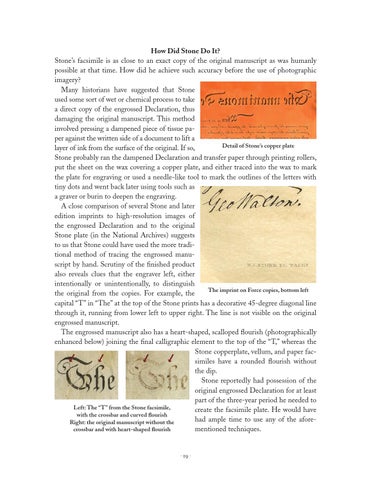
How Did Stone Do It? Stone’s facsimile is as close to an exact copy of the original manuscript as was humanly possible at that time. How did he achieve such accuracy before the use of photographic imagery? Many historians have suggested that Stone used some sort of wet or chemical process to take a direct copy of the engrossed Declaration, thus damaging the original manuscript. This method involved pressing a dampened piece of tissue paper against the written side of a document to lift a Detail of Stone’s copper plate layer of ink from the surface of the original. If so, Stone probably ran the dampened Declaration and transfer paper through printing rollers, put the sheet on the wax covering a copper plate, and either traced into the wax to mark the plate for engraving or used a needle-like tool to mark the outlines of the letters with tiny dots and went back later using tools such as a graver or burin to deepen the engraving. A close comparison of several Stone and later edition imprints to high-resolution images of the engrossed Declaration and to the original Stone plate (in the National Archives) suggests to us that Stone could have used the more traditional method of tracing the engrossed manuscript by hand. Scrutiny of the finished product also reveals clues that the engraver left, either intentionally or unintentionally, to distinguish The imprint on Force copies, bottom left the original from the copies. For example, the capital “T” in “The” at the top of the Stone prints has a decorative 45-degree diagonal line through it, running from lower left to upper right. The line is not visible on the original engrossed manuscript. The engrossed manuscript also has a heart-shaped, scalloped flourish (photographically enhanced below) joining the final calligraphic element to the top of the “T,” whereas the Stone copperplate, vellum, and paper facsimiles have a rounded flourish without the dip. Stone reportedly had possession of the original engrossed Declaration for at least part of the three-year period he needed to Left: The “T” from the Stone facsimile, create the facsimile plate. He would have with the crossbar and curved flourish had ample time to use any of the aforeRight: the original manuscript without the crossbar and with heart-shaped flourish mentioned techniques.