Volume LXI Number 3 • Summer 2020 • $8.00
BLACK LIVES MATTER SETC Pledges to Take Action
THEATRE’S COMEBACK
Producing Shows in a Pandemic
GENEROSITY LEADS TO SUCCESS Advice from 2020 Design Keynotes
NO BUILDING, NO PROBLEM
Texas Tech Mounts Season in Found and Site-Specific Spaces
UNIVERSITY OF WEST GEORGIA
THEATRE COMPANY
2019 2020
SEASON
DARING, DYNAMIC, DEFIANT: YOUR WORLD IS OUR STAGE.
PLAY WEST BACHELOR OF ARTS (BA) IN THEATRE BACHELOR OF FINE ARTS (BFA) IN THEATRE ACTING DESIGN/TECHNOLOGY BACHELOR OF INTERDISCIPLINARY STUDIES (BIS) IN FILM: PERFORMANCE TRACK PRODUCTION DESIGN TRACK
• Access to professional theatre artists • Access to industry standard software in theatrical sound, lighting, costume, and scenic design • Performance and design opportunities starting in freshman year • Design lab, lighting lab, sound recording studio, large scene shop, and new costume shop • Internship programs (local, national, international) • Practical experience in all facets of theatrical production • Student scripts from playwriting course are produced in regular season • Student-directed and designed theatre productions
NAST Accredited Bachelor of Arts Degree in Theatre
• Conference participation and travel opportunities • Strong alumni contacts FOR MORE INFORMATION 678-839-4700 or theatre@westga.edu westga.edu/theatre
MAKE UWG YOUR DESTINATION FOR THEATRE.
Based on the wildly popular Disney Channel Movies the next generation of Villains comes to life on your stage!
DisneyChannelOnstage.com
ŠDisney
NOW AVAILABLE
Photo courtesy of Barrington Stage Company
Contents
Volume LXI Number 3 l Summer 2020 l Southern Theatre – Quarterly Magazine of the Southeastern Theatre Conference
Features
4 Black Lives Matter SETC Pledges to Act
Departments 36 Hot Off the Press New Plays to Make Us Laugh by Zackary Ross
6 Outside the Box: Design/Tech Solutions 3-D Ground Row: Create the Illusion of Depth on a Small Stage by Will Ragland
8 We’re Listening Black Theatre Artists Tell Us What Needs to Change introduction by Marci J. Duncan
12 How Theatre Makes Its Comeback Producing Shows in a Pandemic
Sidebars: 21 3 Questions to Guide You in Reopening 21 10 Reopening Tips: A Stage Manager’s Perspective by Stefanie Maiya Lehmann
22 Generosity Leads to Success Cover Anna Louizos, one of the 2020 SETC design keynotes, designed the set for this world premiere production of Fly, a musical based on J.M. Barrie’s Peter Pan, at the Dallas Theater Center. The set was primarily constructed of bamboo, with four tracking multi-level set pieces that could track on and offstage to create different configurations. Lighting for Fly was designed by Howell Binkley, who was scheduled to serve as the 2020 SETC lighting design keynote before illness forced his cancellation. See story, Page 22, for advice from Louizos and fellow design keynotes Gregg Barnes and Matt Hubbs. (Photo by Anna Louizos; Photoshop work by Garland Gooden; cover design by Deanna Thompson)
Advice from the 2020 SETC Design Keynotes by Jonathon Taylor
28 No Theatre Building? No Problem Texas Tech Presents Entire Season in Found and Site-Specific Locations story compiled by Mark Charney
Summer 2020 x Southern Theatre x 3
#BlackLivesMatter #BlackTheatreMatters As a theatre organization with longstanding roots in the South, the Southeastern Theatre Conference (SETC) mourns the tragic deaths of George Floyd, Tony McDade, Ahmaud Arbery, Breonna Taylor, and countless others. The deaths of Black and Brown people in our country as a result of police brutality have devastatingly become commonplace, and we acknowledge the suffering and longstanding systemic racism that has perpetuated a cycle of violence against the people we serve. As an organization, we are resolved that our anti-racism commitment be reflected in the life and culture of our organization through policies, programs, practices, and partnerships as we continue to learn about racism. We are listening and recognize that we have work to do. We will do the work. Even in these uncertain and challenging times, we are committed to lifting up the voices of those who advocate for positive change, and we pledge to stand beside you. We pledge awareness. We pledge to listen to understand. We pledge to lead with our full hearts and minds. We pledge action. In that spirit of action and accountability, SETC has been working to address our long history as a predominantly white-led organization. We started an Equity, Diversity, Inclusion, and Accessibility initiative this year, and in the last month have formed a Task Force that has been working to address inequities in our organization. We are a place for storytellers, and we are dedicated to working together as one inclusive community to confront 400 years of marginalization, oppression, and bigotry. We are invested in doing the work to become more anti-racist and anti-oppressive, and to the hard work of educating ourselves and listening to our communities. Maegan McNerney Azar, SETC President Susie Prueter, SETC Executive Director SETC Executive Committee, Task Force on EDIA, and Central Office Staff
https://www.setc.org/edia-resources/
Theatre s o u t h e r n
From the SETC President
EDITOR
Deanna Thompson
SETC EXECUTIVE DIRECTOR
Susie Prueter SETC EXECUTIVE DIRECTOR EMERITUS
Betsey Horth ADVERTISING
Clay Thornton, clay@setc.org BUSINESS & ADVERTISING OFFICE
Southeastern Theatre Conference 1175 Revolution Mill Drive, Studio 14 Greensboro, NC 27405 336-272-3645 PUBLICATIONS COMMITTEE
J. K. Curry, Chair, Wake Forest University (NC) Gaye Jeffers, University of Tennessee at Chattanooga Laura King, Gordon State College (GA) Scott Phillips, Auburn University (AL) Derrick Vanmeter, Clayton State University (GA) EDITORIAL BOARD
Tom Alsip, Oklahoma State University Lamont Clegg, Osceola County School for the Arts (FL) Amy Cuomo, University of West Georgia F. Randy deCelle, University of Alabama Kristopher Geddie, Venice Theatre (FL) Bill Gelber, Texas Tech University David Glenn, Samford University (AL) Scott Hayes, Liberty University (VA) Edward Journey, Independent Artist/Consultant (AL) Stefanie Maiya Lehmann, Lincoln Center (NY) Tiffany Dupont Novak, Lexington Children's Theatre (KY) Zackary Ross, Bellarmine University (KY) Richard St. Peter, Northwestern State University (LA) Jonathon Taylor, East Tennessee State University Student Member: Laura Falcione, Liberty University (VA) PROOFREADERS
T
This issue of Southern Theatre takes a look at the two pandemics we are currently living through as theatre artists. The coronavirus pandemic is lingering on and forcing us to approach our art in new and inventive ways. And the pandemic of Black murder by police and systemic racial inequality is forcing us to take a hard look at our complicity as storytellers. What is the theatre world we want to see on the other side?
As part of our commitment to listen and take action, we asked Black theatre
artists to tell us what needs to change in the theatre industry. Their answers are compelling. As Marci J. Duncan writes in the introduction to the story, “It’s time to take inventory of your role in creating space for Black stories and artists. You are either a part of the problem or a part of the solution.”
How will theatre get back on its feet as the coronavirus pandemic rages on?
Organizations are working to answer that question, and a handful of theatres have opened or plan to open this summer. Stefanie Maiya Lehmann shares early guidance from experts and the strategies of theatres planning summer reopenings. Jonathon Taylor provides highlights from the keynote presented by the 2020 distinguished designers, plus additional advice gleaned in interviews with them. The designers also discuss how the COVID-19 pandemic has affected their work in the months since they were at the SETC Convention.
While their new building was under construction, the theatre artists at Texas
Tech University got creative. Mark Charney and his department’s faculty and
Catherine Clifton, Freelance Copy Editor (NC) Denise Halbach, Independent Theatre Artist (MS) Philip G. Hill, Furman University (SC) Clay Thornton, SETC Marketing Manager
staff detail the challenges and opportunities of presenting shows in found and
PRINTING
Clinton Press, Greensboro, NC NOTE ON SUBMISSIONS
Southern Theatre welcomes submissions of articles pertaining to all aspects of theatre. Preference will be given to subject matter linked to theatre activity in the Southeastern United States. Articles are evaluated by the editor and members of the Editorial Board. Criteria for evaluation include: suitability, clarity, significance, depth of treatment and accuracy. Please query the editor via email before sending articles. Stories should not exceed 3,000 words. Color photos (300 dpi in jpeg or tiff format) and a brief identification of the author should accompany all articles. Send queries and stories to: deanna@setc.org. Southern Theatre (ISSNL: 0584-4738) is published quarterly by the Southeastern Theatre Conference, Inc., a nonprofit organization, for its membership and others interested in theatre. Copyright © 2020 by Southeastern Theatre Conference, Inc., 1175 Revolution Mill Drive, Studio 14, Greensboro, NC 27405. All rights reserved. Reproduction in whole or part without permission is prohibited. Subscription rates: $24.50 per year, U.S.; $30.50 per year, Canada; $188 per year, International. Single copies: $8, plus shipping.
site-specific locations outside the theatre building. Their insight may provide inspiration to theatres seeking safe ways to reopen in the pandemic. As we look ahead to the next season, what kinds of plays will audiences be
hungry for? Zackary Ross notes that many will be looking for the release that comes with laughter. He shares a list of newly available comedies in our new plays column, “Hot Off the Press.”
Finally, in this issue’s “Outside the Box” column featuring innovative design/
tech solutions, Will Ragland outlines an inexpensive solution to a common problem: a shallow stage. He describes how he created the illusion of 3-D mountain ranges in a small space.
“Stronger Together” has been a rallying cry since the coronavirus shut down
the country, but I think that rings true for our renewed fight for racial equality, as well. Take heart as we pause for reflection, and take action as we collectively rebuild toward an inclusive theatre industry that is made more brilliant with every color in the rainbow.
Maegan McNerney Azar, SETC President Summer 2020 x Southern Theatre x 5
outside
the box DESIGN/ TECH SOLUTIONS
3-D Ground Row Create the Illusion of Depth on a Small Stage
by Will Ragland
I
f you work on a small, shallow stage like I do, you’ve probably struggled with
how to make it appear to have more depth when a script calls for that. In the past, our solution was often flat ground rows. For a recent production, we decided to take the Courtesy of Clemson University
ground row a step further, adding texture to create a 3-D effect.
The production was the South Carolina
premiere of Bright Star at Mill Town Players in Pelzer, SC, and my design called for the “mother of all ground rows.” Because the Blue Ridge Mountains play such an important role in the story, both informing the location and creating the stunning backdrop for the performance, I wanted our mountains to look as realistic as possible.
The ground row built for the South Carolina premiere of Bright Star at Mill Town Players was also used in this Clemson University production of the show in February 2020.
The only problem was, I had only 3 feet of depth to work with.
1' x 2' Styrofoam blocks. The blocks were
Adding texture with ‘snow’
The plan I developed called for building
a byproduct of their packaging, and they
As I sculpted with the wire brush, I
three sets of lauan mountains and covering
gave them to me for free. I loaded up my
created a lot of Styrofoam “snow” that
them with Styrofoam. The visual illusion
truck with all I could fit, which was enough
went everywhere and clung to everything.
of depth would come from adding three
to build out the mountains for this project.
While I was working on the small mountain
textures to the mountains to give them a
I watched YouTube videos and experi-
range, the one furthest from the audience,
sense of increasing distance. My visual
mented with several adhesive products as I
I realized that I could take advantage
research on mountain ranges showed larger
looked for the best way to adhere the foam
of this snow and use it as texture on the
trees in the foreground, with smaller trees
blocks to each other and to the lauan moun-
mountains. For many years now, I have
and texture as the mountains got farther
tains. I found that Great Stuff insulating
used a “goop” mixture of Elmer’s glue,
away. I had never seen texture used to
foam sealant was the cheapest and most ef-
joint compound and paint to coat surfaces
create this illusion, but it was time to try it.
fective solution. Warning: This project calls
with texture. I tried applying the goop to
Making mountain shapes
for a lot of Great Stuff. No matter how much
the mountains and then adding the foam
My first step was to design the ground
you think is enough, you’ll need more. I
bits on top of it before it dried. After seeing
row as three mountain ranges. The front
bought in bulk as a way to reduce the cost.
poor results from this technique, I found
and middle were 8' sections totaling 24'
After cutting the blocks to the desired thick-
that mixing the snow into the goop was the
across. I placed the back range, which was
ness, I bonded them to create three very
best solution. By tinting the goop with the
8', in the center of the other sections. After
messy Frankenstein-like foam mountain
base coat color of paint, I also was able to
projecting the design onto lauan sheets, I
ranges.
skip a step in the painting process.
traced with a Sharpie and cut them out.
To sculpt the mountains, I used small
Adding texture with foam rubber
My next task was finding a fairly large
hand saws and a hot knife for the initial
For the middle mountain range, I
quantity of Styrofoam. After a few phone
work. For the final detail sculpting, I
researched how model train builders create
calls, I found that a local business which
achieved the best results with a large wire
trees and adopted their technique: creating
sells tow-behind trailers had surplus
brush.
“trees” from small bits of foam rubber,
6 x Southern Theatre x Summer 2020
2
BUILDING THE MOUNTAINS 1. Project, trace and cut lauan for the base design of the ground row for three mountain ranges. 2. Cut Styrofoam blocks to desired size and thickness. Adhere the blocks to the lauan ranges using Great Stuff. 3. Carving the foam will create a large amount of “snow.” Save some for texture. 4. Use Great Stuff to create the trees on the front range. Cover with “goop.” 5. Your mountain ranges are ready to paint: lighter blues in the distance, darker greens in the foreground.
3
4
Process photos by Will Ragland
1
5
chopped up in a blender. Our local Army
decided to completely cover the front of the
project, do your best to conceal the seams
Navy Store custom-cuts foam rubber, and
range with little “bubbled-up” trees formed
between the sections, and be prepared to
they were willing to give me several bags of
out of the Great Stuff. I then covered them
do touch-ups when necessary, as they will
foam scraps for free. I bought a blender for
with the goop, mixed with the chopped-up
be a little fragile. Your audiences will love
$15 from Facebook Marketplace and went
foam rubber and the Styrofoam snow. The
the effect. n
to work. Cutting the foam rubber into small
texture was exactly what was needed to
pieces first, before grinding it in the blender,
add the final layer of illusion to the foam
gave me the best results. After breaking that
mountains.
first blender, I purchased a second one from
Once all the textures were added, the
Walmart. That one broke as well, but I had
mountains were brought to life with scenic
already created enough material to add to
painting and some LED tape that helped to
the goop for the middle mountain range.
up-light the textures on them. The resulting
Just as I had hoped, the texture difference
optical illusion allowed audience members
between the upstage and middle mountain
to feel as though they were staring into a
ranges created the illusion that the distance
vast landscape that extended for many
between the two was considerably greater
miles on the horizon.
than the space that they occupied.
After our production, this ground
Adding texture with Great Stuff
row became a very popular piece in the
With two sections done, it was time
surrounding theatre community. It was
to tackle the largest mountain range,
used in three other productions this season.
the one closest to the audience, which
A 3-D effect today and tomorrow
required an extremely coarse texture. I
Creating these mountains was a time-
had the small Styrofoam snow forming
consuming project, but they can be used
the texture in the back mountain range
over and over again. As with any foam
MATERIALS for a 24' long ground row: Styrofoam blocks Foam rubber Great Stuff insulating foam sealant Blender(s) 7 sheets, lauan Scrap lumber and screws 6 gallons, Elmer’s glue 5 gallons, joint compound 3 gallons, paint (stock) TOTAL:
0 0 150 40 105 0 90 60 0
$445 Will Ragland, executive artistic director of Mill Town Players in Pelzer, SC, has designed sets in upstate South Carolina for the past 15 years.
and the chopped-up foam rubber in the middle, but I struggled to find a solution for this range. The breakthrough came as
Do you have a design/tech solution that would make a great Outside the Box column?
I was gluing the foam blocks together. I noticed that the Great Stuff, when applied in a certain way, looked like small trees. I
Send a brief summary of your idea to Outside the Box Editor David Glenn at djglenn@samford.edu. Summer 2020 x Southern Theatre x 7
We’re listening. Black theatre artists tell us what needs to change.
W
introduction by Marci J. Duncan
With the recent resurgence of the Black Lives Matter movement, everyone is listening. Listening to the cries that have now turned into full-on screams of lamenting for Black lives to matter. Can you imagine, as a human being, asking another human being to simply treat you as though you matter? As theatre artists, we should know better. But, unfortunately, we are guilty. Guilty of closing our eyes and ears and looking the other way. It’s time to take inventory of your role in creating space for Black stories and artists. You are either a part of the problem or a part of the solution. Change happens with people. We are the people, we are the theatre, we are the change. Are you prepared to be part of the change? I hope you will read on to learn what eight Black theatre artists shared when Southern Theatre asked the following question:
Marci J. Duncan Director, BFA Acting Program, University of West Florida; Actor; Director; Professor
From your perspective, what needs to change in the theatre industry? Michael J. Bobbitt Artistic Director, New Repertory Theatre, Watertown, MA
in our operations, HR, finance, marketing,
dismantle every system, structure, practice,
governance and boards (especially boards).
policy and trend in our theatres with an
We have not been creative (which is our
anti-racist lens. Policies that are not anti-
job) in dismantling these parts of our busi-
racist – are racist. Period.
ness. It is not enough to make changes in
My simple answer
programs and engagement initiatives but
the rules and created racism have the power
to the prompt is
still perpetuate white supremacy business
to change the rules and eradicate racism.
EVERYTHING.
models. It is the very reason why we have
Humans have put people on the moon, so
Returning to
barely diversified our base of patronage,
I have hope. It is white American theatre’s
the old way of
donors, loyalty programs, etc.
job to eradicate racism in our spaces.
doing theatre
If you accept that racism is a system,
Use your creativity. I have hope. For the
(post-COVID-19)
structure and institution, then you have to
moment. n
This is a big job. The people who made
would be a failure of the American theatre industry and, frankly, I would be ashamed to be a part of it. Equity, diversity, inclusion, access, anti-racism, dismantling white supremacy,
Bernita Robinson Actors’ Equity Association Stage Manager; Member of AEA Governing Board
anti-oppression or … whatever you want to
Black cast. When we are not hired, it is either because they “aren’t doing a black show, “ or “don’t know any stage managers of color,” or we do not have “enough experience.” As a Black stage manager, at times, I
call it, is an ACT OF LOVE. Showing love
The one change
have had to be better than my white
to groups of people who have NEVER been
I believe needs
counterparts to be considered “better than
loved by this country. Never! Our industry
to happen is an
nothing.” We are asked to have a better
claims to be loving, but is complicit in its
increase in Black
work ethic and do so without ruffling too
exclusion. We, the American theatre, are a
directors and pro-
many feathers for fear of not being hired
racist construct. If we don’t like this, we
ducers in all the-
again, or risk being fired on the spot.
MUST become activists of change. Being
atre venues. This
My hope is that with an increase in
an ally is not enough. Ally-ship is a way to
will in turn, hope-
Black producers, there will be an increase
absolve yourself from action.
fully, increase the
in Black directors who hire Black stage
While the number of BIPOC (Black, In-
hiring of Black stage managers. Too often,
managers. This would also mean Black
digenous, and People of Color) artists get-
Black stage managers are hired to fill a
directors would need to trust that Black
ting work has grown, our business practices
quota, to keep the community quiet, or to
stage managers are just as good as white
continue to perpetuate white supremacy
keep a balance backstage if there is a large
stage managers. n Summer 2020 x Southern Theatre x 9
Christina Ham
General McArthur Hambrick
Charence Higgins
Playwright TV Writer Educator
Associate Professor, School of Theatre and Dance, West Virginia University
MFA Candidate in Acting, University of Illinois at Urbana-Champaign
As a playwright,
In this time of
“The hypothesis
what needs to
protests and
that the needs
change, in my
rhetoric, I have
of Black female
opinion, is that
become more
characters would
Black theatre
aware of hidden
be ignored more
needs to be fund-
biases in race re-
than that of white
ed better.
lations and their
female characters
August Wil-
complexities. An
is upheld.” This
s o n d e l i v e re d
article I read re-
is one of the
this call to action in his 1996 Theatre Com-
cently noted that the number of African
findings of Dr. Sherna Ann Phillips, who
munications Group (TCG) address, “The
American Pulitzer Prize-winning authors
conducted a study examining how often
Ground on Which I Stand.” In this address,
is not represented in the amount of produc-
requests made by Black women were
he iterated that “Black theatre in America
tions on Broadway or in theatres around the
acknowledged and acted upon in plays.
is alive, it is vibrant, it is vital … it just isn’t
country. I often wonder about the process in
If art reflects life, what does this say about
funded.”
which new literary projects, including plays
our voices beyond the script?
Sadly, since Mr. Wilson made this
and musicals, are considered for production
statement, things have not changed very
and how that process possibly evokes an
(if that), theatres are presenting a monolith
much regarding their support. During the
unintentional racial bias.
of the Black experience, thus tokenizing us
years from 1961 to 1982, 600 new African
Several years ago, appearing as a
and limiting their ability to impact their
American theatres were established
guest artist with New Ballet Ensemble
audiences. Tell our stories in totality. This
across the nation. A big part of this was
and the Memphis Symphony, I engaged
Black actor is exhausted from repeatedly
a byproduct of President Johnson’s War
in an enlightening conversation with a
telling Black stories steeped in trauma.
on Poverty programming. Today, there
violinist. I had always been curious about
Produce shows that bask in Black joy.
are only a handful of these theatres left.
their audition process. She explained that
Don’t know these shows? Commission
As the Black Lives Matter movement
musicians are selected blindly, meaning
work from Black playwrights.
is permeating our streets and also some of
they play behind a screen or some other
the institutions inside our communities,
opaque divider so there is no chance of
is personal. My intentionally unusual
it becomes important that if indeed Black
being unfairly judged by their physical
name (pronounced Shuh-rans, rhymes
Lives do matter – then so must our stories.
appearance. That is what I would hope
with dance) embodies the sacrifice and
We need a platform where those stories
for in the theatre and the dance world.
beauty of those before me. Yet, on too many
can be presented and thereby provide a
Certainly, it would be difficult, if not
stages, my name has been pronounced
training ground for a new generation of
impossible, to shield a person in a dance
incorrectly. Honor our families. Honor
Black theatre artists.
or theatrical audition because the visual is
our work. Honor our ancestors. Honor
As W.E.B. Du Bois affirmed, “theatre
such a huge part of our world. However,
our names by saying them as intended.
by us, for us, near us, about us” is even
if those persons in authority – or, as I like
If you are unsure, ask. Don’t guess. I
more important now than ever before as
to say, “behind the table” – measured their
have been blessed to win awards from
African Americans look for ways to heal
biases when making their decisions, it might
brilliant organizations, yet have been
during this seismic time along with their
curb the propensity to worry about taking
carelessly insulted while accepting them.
other theatre peers. As we come out of this
chances financially on something new or
Don’t wait to #SayTheirNames when
period, renewed monetary support for
out of the ordinary and challenge what is
we’re killed unjustly, say the names of the
Black theatre spaces is critical for American
safe. In this period of great uncertainty and
living now, on your stages, correctly.
theatre to be its fullest. n
confusion, it is the time for everyone in the
Acknowledge these requests. Create
arts, especially those in power, to take a
and execute a plan of action. Statements of
step forward and rethink what has been the
support are the bare minimum. n
norm in order to establish a new normal. n 10 x Southern Theatre x Summer 2020
By producing one Black show per season
The quest for anti-racism in the theatre
Herb Parker
Elizabeth Watkins
Steven H. Butler
Professor, Department of Theatre and Dance, East Tennessee State University
Theatre Arts Teacher, Richland One School District (SC); Playwright; Director
Executive Director, Florida Theatre Conference, Inc.; Artistic Director, Actors’ Warehouse
We have come a
As a Black K-12
We are feeling
long way since
teacher and the-
a social tectonic
Actors’ Equity
atre practitioner,
plate shift. It is
Association’s
I have watched
time to decolonize
initiation of the
and
maneu-
and diversify the
Non-Traditional
vered through
performing arts.
Casting Project in
the world of the
Most people in the
the 1970s. A wel-
theatre industry
performing arts
come example of
and found little to
are shackled and
this is African American actress S. Epatha
no support for BIPOC children in the arts
dominated by a colonized psyche and that
Merkerson’s portrayal of Lola in an oth-
world. There is already a socioeconomic
is part of the reason we are feeling this shift.
erwise all-white production of Come Back,
disadvantage that isolates the children’s
History 101: The United States of
Little Sheba on Broadway in 2008.
dream of achievement in America and an
America was colonized by England. One
As we applaud this breakthrough, I
even larger one in the theatre industry.
day the disenchanted subjects awoke to
ask that our casting be ever mindful not
The three points that can change the
the realization they were void of a
only of the color of the actor, but of the
narrative are:
symbiotic relationship. America has
implicit culture that actor’s color brings to
1) To hire more BIPOC playwrights,
been liberated from the Western world
a production. I don’t mean accommodation
directors and actors in major roles and
but remains to be colonized in mind. It
by rewriting the script or changing words –
within the organization’s season.
remains enamored with the Eurocentric
I simply ask that we celebrate every aspect
2) For colleges and universities to
views and practices by which various
of what is brought to the stage when a
reach out to local schools that do not
institutions operate. These views and
role not previously thought of as Black is
have a program (preferably in a rural or
practices are not sympathetic towards
actually played by a person who is Black.
a low-income area) to engage them with
nor created for BIPOC.
For instance, Shakespeare has rightly
workshops and free summer programming
A Call to Action: Decolonize and
been the easiest and most seamless
and provide them with performances and
diversify our performing arts, our
example of this casting. While speaking
scholarships that will give them the same
classrooms and our dance studios. The
the text no matter what one’s race is vital
experience as schools they otherwise could
artists at Momentum Stage want us to
in Shakespeare, let us take care that the
not afford to attend for productions and
realize: “Decolonizing does not simply
casting search does not result in “Black
training.
mean adding in a text by a person of
Anglo-Saxons.” Hamilton has demonstrated
3) Have a better play selection that
color. Decolonizing your classroom is a
wonderfully how an evening of theatre
represents BIPOC.
systematic approach to not only WHAT
can be enriched by the celebration of
Providing the above allows BIPOC
and WHO you teach, but also HOW you
performers of color, fully themselves in
students a chance to develop their love for
teach AND assess. It means acknowledging
song, sound, movement, pace and rhythm,
theatre. Theatre is life. Keep the connections
the systems of oppression and dominance
as well as 18th century costume.
open with low-income schools. Keep their
that exist in our societies, organizations and
Our new day of casting opportunities
hopes and dreams alive. Feed that fire for
classrooms, and working to dismantle them
has presented us with the chance, finally,
creativity within their souls so that they
in order to make our world more just and
to truly be ourselves, which enriches every
know that, even though the world is not
equitable.”
production in which we appear. This is why,
welcoming, they always have a place
for directors willing to take a chance and for
to breathe, and to be creative and free.
represented, and to know there are
actors of color ready to tell the world who
Reinforce that they are just as magical and
opportunities. Therefore, instructors
they are, instead of the term “color-blind
creative as their non-BIPOC counterparts.
and directors should be encouraged and
casting,” I like to say, “color-INCLUSIVE
challenged to assess their programs with a
casting.” n
time you embrace ALL of your children. n
Theatre is the mother of creativity; it is
BIPOC artists desire to see themselves
mission towards equity. n
Summer 2020 x Southern Theatre x 11
HOW THEATRE MAKES ITS COMEBACK Producing Shows in a Pandemic by Stefanie Maiya Lehmann Mainstag
e So
cially D In order istance to d (SD) S policies offer our patron eating w s but out ill be in effect th the safest and of an ab most en ro ug h the 20 undanc joyable Additiona 20 e ex se of cautio lly, we wi ll be takin n, all po ason. Policies perience possib g social will be lic le, th ie s will co To give distancin everyone g measu ntinue un reviewed befo e following res at ou re the fa additiona and exiti til furthe r TBD ou ll show, ng the th r notice l space tdoor ve . while en nue. eatre, w entrance e are cr s for ou eating m tering r patron ◊ Patro Entranc ultiple s: ns with e M ap ticke STREET
BOYD-QU IN MAINSTA SON GE
East/Awni ng Entrance Mezzanin (Rows AA e –GG)
NORTHRUP
will be as ts ked to en in the Front Or the left chestra of our m ter through the (Rows A– ain entra si ◊ Patro nce on Un de door, locate F) ns with d to tickets in ion Stre will be as et. the Rear ked to en Or ches ◊ Patro ter throug ns w h our m tra (Rows G–M ain entra ) will be as ith tickets in th nce. e Mezza ked to en nine (Row awning on the ea ter through the s door un AA–GG) st side of der the the build We stro ing. ngly enco
Side Entrance Front
Main Ent
rance Orchestra ur from thei Rear (Rows A– F) Orchestra Will r phone age patrons to (Rows G– print th Call up Tickets M) eir ticket Tent UNION ST purchase on arrival. Ther RE s ET e at d the da will be a home or • We w y te of se nt set up perform lect an ill be ance will enear the with 2 va removing ever east entr ticket to be sc need to y ot cant seat an visit the ance fo map for s betwee her row of seat r will ca ned fu box offic seats do rther clarificatio n each party (s s ll. S e eating M inside. ee esn’t invo n) so ge ap patro tting lve
close co ns in yo STAGE ur row. ntact w to your • All pa ith othe trons ar r e re further notice. quired to wear Masks w m the thea ill not be asks until tre. supplied • Seat s, arm at touch su rests, counterto rfaces w ps and othe after ea ill be tre r highch perfo ated with rmance • Harry di sinfecta . Clar nt the Ann ke, the Marilyn M Ha perform mpton Callaw aye concert an d ay conc ed withou ORCHES er lines to TRA Ramp Acc bathroom t intermissions t will be Orchestra ess to minim • Ther s. Right e will ize strategi be ample hand c pl sanitizer in the re aces in the lo bby, in th available at strooms. e theatre • Onlin e purc and group, pl hases will be re ease ca ll the bo stricted to grou x office Up two flights of MEZZANINE at 413.23 ps of 2 or 3 co stairs — not acc nsec 6.8888 essible by elevato 122 North for acco utive seats. If r Street, Pi mmodat you are ttsfield, ions. attendin MA 01 gw 11
*Please
17
note: Row
19
A will be
moved forwa
21
rd, so there
will be distan
Section
ce betwe
en A and
Section
6 B
23
12
23
1
19
16 16
101
16 RAMP
21
25
16
114
9
18
101
1
14
LEFT
23
21
12
2
18
CENTER
21
19
RIGHT
19
24
19
20
23
1
101
201 • Ba
20
119
rringtonS
18 16 2
16 24
tageCo.o
ith a larg
rg
er
air
Stairs
2
23
C
Unavail in orde able maintair to n Social Dist anc
14
112
25
25
A
B
Section Wheelch
e
A
As the novel coronavirus pandemic continues to impact the U.S., the majority of theatres across the country remain closed. According to Americans for the Arts’ COVID-19 Impact on the Arts tracking update, nonprofit arts and cultural organizations were estimated to have lost $8.4 billion as of June 29 – and that number has continued to grow. The impact on theatre practitioners is incalculable. Overnight, careers in the entertainment industry disappeared. Of the approximately 21,000 artists and creative people surveyed by Americans for the Arts, 94% have experienced a loss of income as a result of the pandemic and 62% have become fully unemployed. How will theatres recover from this pandemic? What steps must theatres take to open in a way that keeps cast, crew and audiences safe? We share insights and resources from industry leaders below, followed by reports from theatres that have opened or planned to open this summer on the steps they are taking to do so safely. What industry leaders are saying
theatre. There must be collective buy-in and ongoing
With Broadway theatres closed at least through
evaluation and improvement of health and safety
Jan. 3, 2021, shows that were expected to have long
practices.”
runs have chosen to cut their losses and close. Many
large regional companies and producers of major
those principles “are the foundation for our continued
new shows have given up on 2020 and pushed back
work with Dr. Michaels. We intend to build out
openings all the way to mid-year 2021.
protocols that can be used by our employers and all
Looking to the future, unions and other
of our colleagues to insure that everyone who works
organizations are working to develop standards for
in the theatre has the safest workplace possible.”
how workers in all areas can safely return to theatres
of all sizes.
to contact their regional Equity office if they receive
Actors’ Equity Association (Equity) has hired
an offer to work.
epidemiologist and former U.S. Occupational Safety
and Health Administration (OSHA) Administrator
plans for the reopening of two theatres: Barrington
David Michaels to consult on developing health
Stage Company (see Page 14) and Berkshire Theatre
and safety standards that prioritize Equity member
Group. The union also posted guidelines for
safety. In mid-May, Michaels submitted his initial
COVID-19 testing and a pre-production safety sheet at
recommendations to Equity, outlining four core
actorsequity.org/resources/Producers/covid19-info.
principles necessary for safe and healthy theatre
productions to resume. Those recommendations,
International Alliance of Theatrical Stage Employees
shared by Equity in a news release, are:
(IATSE) has hired a team of three epidemiologists to
“1. The epidemic must be under control, with
consult on protocols for a return to work.
effective testing, few new cases in the area and contact
tracing.
as possible, but we need to do it right,” IATSE
2. Individuals who may be infectious can be
International President Matthew D. Loeb stated in
readily identified and isolated, with frequent, regular
a May announcement. “We are working with these
and accurate testing with speedy results.
epidemiologists and employers to create standards
3. The way we audition, rehearse, perform and
that will apply across the board in the U.S. and
stage manage may need to change and the venues
Canada, so no production or worker is left behind.”
we work in may need to undergo changes in order
to reduce the risk.
Repertory Theater (ART), working in conjunction
Equity Executive Director Mary McColl noted that
In the meantime, the union has advised members
In early July, Equity announced it had approved
Moving to protect the safety of its members, the
The theatre reopenings detailed in this story reflect the companies’ plans as Southern Theatre went to press in mid-July. Look for updates at stories.setc.org.
Opposite page: Barrington Stage Company in Massachusetts planned to open its revised season Aug. 5, after removing every other row of seats in its theatre, shown here in its pre-COVID-19 configuration. Inset shows the detailed plan.
“We want everyone to get back to work as soon
Also stepping up to provide guidance is American
4. Efforts to control COVID-19 exposure must be
with researchers from the Healthy Buildings program
collaborative, involving Equity members, employers,
at Harvard University’s T.H. Chan School of Public
the union and all others involved in the production of
Health. The first edition of their joint effort, The Summer 2020 x Southern Theatre x 13
Roadmap to Recovery and Resilience for Theatre, is
posted at americanrepertorytheater.org/roadmap-
that announced plans for a summer season. We asked
Among those leading the way are seven theatres
for-recovery-and-resilience-for-theater.
them to share their strategies. One is an indoor Equity
“At this time, there are more questions than answers,
theatre, another is an indoor non-Equity theatre, four
but we believe that articulating the questions will lead
are outdoor theatres, and one is a dinner theatre.
to preparedness,” the report states. “This ‘First Edition’
As Southern Theatre went to press in July, three
of the roadmap, dated May 27, offers an initial set of
had opened, three were proceeding with plans to
considerations. … We will continue to add content in
open, and one (Kentucky Shakespeare Festival) had
the form of future editions as we develop and test
ultimately decided to postpone its season to 2021. All
protocols in the months ahead.”
of the openings are contingent on COVID-19 orders.
Among the first to release guidelines applicable specifically to theatres and other venues was Event
INDOOR THEATRES
Safety Alliance (ESA), a nonprofit organization dedicated to promoting “life safety first” in all STEVEN A. ADELMAN Vice President, Event Safety Alliance
JULIANNE BOYD Artistic Director, Barrington Stage Company
by more than 300 event industry professionals, the
Barrington Stage Company Pittsfield, MA Planned Opening: Aug. 5, 2020
ESA Reopening Guide aims to help those planning
Barrington Stage Company (BSC) is a regional
to reopen during the pandemic by identifying risks
Equity theatre in the Berkshires known for premiering
and suggesting options for mitigation.
The 25th Annual Putnam County Spelling Bee, which
“Once one is legally allowed to reopen a venue
went on to win two Tony Awards on Broadway. After
or event space, the tougher question that follows is
postponing the originally slated 2020 productions to
how to do that without exposing workers, patrons or
2021, BSC Artistic Director Julianne Boyd planned
artists to an unreasonable risk of exposure to a highly
to open Aug. 5 with a newly developed season
contagious virus for which, in many parts of the
specifically designed for a pandemic recovery.
world, there is neither sufficient testing nor contact
The season was scheduled to begin with a one-
tracing, and no vaccine on the horizon,” writes Steven
person show featuring an actor who has recovered
A. Adelman, vice president of ESA.
from COVID-19 and was slated to arrive three and
ESA estimates that in just the first two weeks
one-half weeks before the first performance. Other
after the Guide was released, more than 100,000
mainstage events are concerts or staged readings with
copies of the document were already circulating
one to two days of rehearsals. Boyd said they “have
worldwide. Download the free Guide here: www.
chosen shows where there will be no physical contact
eventsafetyalliance.org/esa-reopening-guide.
between actors during performances.” For example,
Small theatres lead the way
South Pacific: In Concert will be performed outdoors
It’s clear that Broadway, national tours, large
at a park as an Encores-type presentation with 6-foot
performing arts centers and regional theatres will not
social distancing. Offstage will see the same distancing.
be the first to reopen. Small local theatre companies,
“Our stage manager and sound and lighting
including outdoor theatres, have more flexibility and
technicians have their own areas in the house and
lower operational expenses, which allow them to
can easily remain socially distant from one another,”
think creatively and innovate around the pandemic.
Boyd said.
They will be the trailblazers for the industry.
phases of event production and activation. Sourced
BSC’s 520-seat mainstage theatre has been rescaled
“If small events and venues can reopen without
to adhere to social distancing. Every other row of seats
increasing COVID-19 transmission rates, it will open
has been removed from the theatre. Two seats will be
the door for progressively larger spaces to implement
left vacant between groups. (See detailed plan, Page 12.)
similar measures on a larger scale in the future,” the
ESA Reopening Guide states.
and entering through multiple entrances, there will
But the Guide also warns of unintended
be no tickets exchanging hands or being scanned,”
consequences if those first openings are not done
Boyd said. “Since there will be only 163 people in the
successfully: “If, on the other hand, the first attempt
theatre, we will have patrons’ names on clipboards
at a safe reopening is a failure, that would set back
and slowly admit one group at a time. None of
the entire event industry.”
the shows has an intermission to minimize the
14 x Southern Theatre x Summer 2020
“In addition to all patrons having to wear masks,
usage of bathrooms. Concessions will not be open.”
July 4: “We played to really good houses both nights.”
Numerous sanitizing stations were planned. The
theatre also has installed new filters and made air flow
• Limiting audiences to a maximum of 75% capacity
adjustments to the air conditioning system, Boyd said. Audience response has been positive, with all
in the 435-seat theatre. • Encouraging patrons to use masks and providing
shows selling so well that BSC added an additional concert.
His detailed plans for safely reopening included:
masks at the door for those who need one. • Installing hand sanitizer stations throughout the
“I think theatre is a great healer, a place where
theatre and increasing cleaning efforts.
people meet and have a common experience, where
• Forbidding contact between actors and audiences.
there’s a shared humanity,” Boyd said. ”People can
• Self-quarantining the company, with temperature
forget for a few hours the isolated world we live in
checks and self-assessments required.
and listen to stories that delight them, that move
them, that affect them in new and unexpected ways.”
all rehearsals, builds and events,” Thomson said.
Bigfork Summer Playhouse Bigfork, MT Opened Its Season: July 2, 2020
“We have asked for support from people in town to
Bigfork Summer Playhouse is a non-Equity
isn’t possible with our living facilities, but we can
professional theatre known for “bringing the best of
contain ourselves as a group.”
Broadway to the Rockies” through a season typically
running from early May through August. After
due to the pandemic, that did not prove necessary.
canceling an early season show and pushing back
the start of the main season multiple times, Associate
determined that our company quarantine and the
Producer Brach Thomson reopened Bigfork with
fact that we all live on the same campus made the
Newsies on July 2 and The Hunchback of Notre Dame on
company like a ‘single family’ in the same home.
“We are keeping the company at our facilities for
help pick up groceries and any necessities that the company needs during that time. Individual isolation
BRACH THOMSON Associate Producer, Bigfork Summer Playhouse
Although he originally planned to alter love scenes “We worked with medical professionals, and they
CELEBRATING 92 YEARS OF EXCELLENCE IN ACTOR TRAINING
VISIT US AND LAUNCH YOUR CAREER TODAY. APPLY NOW at NEIGHBORHOODPLAYHOUSE.ORG or Call 212-688-3770
NEIGHBORHOOD PLAYHOUSE
"Be who you are made to be ... "
SCHOOL OF THE THEATRE
- Sanford Meisner ¾
"The most respected acting school in the country and first among all professional training programs." - The Cambridge Guide to Theatre
Summer 2020 x Southern Theatre x 15
So, as a family, we don’t have to distance
lowing a cleaning protocol that includes
audience size is limited to 1,000, 25% of
among ourselves at all – meaning the
sanitizing before the show, after its
the capacity in the 4,000-seat amphitheatre.
love interest scenes can still be close and
start and following intermission, with
Groups are seated with seven empty seats
believable for our audience.”
a volunteer, wearing a protective mask,
between them, a distance of 12 feet, two
Thomson noted that opening was
monitoring supplies and capacity.
times the state requirement, he said. The
important to the community as well as
• Giving patrons the option of receiving
amphitheatre opens 90 minutes before the
the theatre: “We are an integral part of
sanitized chairs and cushions as they
show, so lines are not an issue. However
enter or bringing their own chairs.
6-foot distancing markers are displayed
our town’s economy, bringing people into the restaurants and shops every day.”
• Using ushers to ensure that audience
However, reaction was mixed, he said: “We
members socially distance.
throughout the venue. Handrails, seats and high-touch areas are wiped down before
are getting emails in both directions – some
Online auditions were encouraged, and
the show, with follow-ups once the audi-
that are appalled that we would open our
major roles are being double-cast, “so that,
ence is seated. All staff members wear face
doors, some that are upset that we could
if necessary, cast members can be replaced
coverings/masks, Butler said, and signs are
even consider not opening our doors, some
at any time,” Pruitt said. “Dances, crowd
posted reminding audience members that
upset about wearing a mask.”
scenes and battle scenes will be carefully
the Department of Health encourages the
blocked to limit personal contact when at
use of face coverings/masks and sanitizer.
all possible.” Show characters that must be
The approxi-
in contact were cast with actors who have
mately 150-200
close relationships offstage, Pruitt said.
employees are
Safety precautions for the cast of local
undergoing dai-
OUTDOOR THEATRES From This Day Forward Valdese, NC Planned Opening: July 17, 2020
actors include a daily health screening and
ly health screen-
From This Day Forward is an outdoor
temperature check. Actors also are being
ings. Backstage
drama produced by the Old Colony Play-
required to sign a pledge of “best practices”
areas have been
ers that tells the story of the founders of the
not only for the theatre, but for their every-
spaced out, and
town of Valdese, NC. After delaying the
day lives, she said. Costumes have been
wardrobe rooms
play’s opening, General Manager Edyth
modified, when possible, to allow for face
are limited to 10
Pruitt planned to
coverings. Tents are being used to provide
people. The pro-
begin the season
additional backstage space, and backstage
tective measures
on July 17 and
protocols such as staggered dressing times
don’t end offstage, Butler noted.
run until Aug.
have been adopted.
15. As Southern
“From This Day Forward has been run-
a face covering/mask and only take it off
Theatre went to
ning for 51 consecutive seasons,” Pruitt
for lines,” he said. “Thankfully, headpieces
press, state man-
said. “It is the story of our people and our
were very typical back in Bible days, and
dates due to
community. We do not want to be foolhar-
we have incorporated the look into our
COVID-19 lim-
dy, but if we can continue to tell our story
costumes.”
and have a safe environment for people to
join together to celebrate our story together,
said, making it possible for family units to
amphitheatre to
we will.”
fill roles requiring close contact.
25 people, but Old Colony Players planned
The Great Passion Play Eureka Springs, AR Opened Its Season: May 22, 2020
county had a very low COVID-19 infection
safety precaution document that includes
Butler said. By mid-July, that number had
such steps as:
the story of Jesus’ life in its three-story-
climbed to 225 cases with six deaths.
• Increasing the distance from audiences
high outdoor amphitheatre since 1968. The
show typically opens on Good Friday, but
audiences, Butler said: “Although we’ve not
was delayed this year until the Arkansas
seen attendance return to previous summer
Department of Health approved its plan
levels, we’re seeing better attendance in July
for opening. The play debuted Friday of
than when the season began.”
Memorial Day weekend.
Operations director Kent Butler said
success by attendance numbers but rather
ited attendance in the 500-seat
EDYTH PRUITT General Manager, From This Day Forward
to go ahead with the show.
The theatre has developed a two-page
to the stage to 20 feet. • E ncouraging audience members to purchase tickets in advance. • Installation of touchless card readers; cash sales handled by one individual. • Limiting capacity in restrooms and fol16 x Southern Theatre x Summer 2020
The Great Passion Play has been telling
KENT BUTLER Operations Director, The Great Passion Play
“All cast members are required to wear
The cast includes many families, Butler
When The Great Passion Play opened, the rate – a total of just 17 confirmed cases,
The theatre has had “strong interest” from
The Great Passion Play will not measure
“by how safe we are able to keep our
summer. Executive Director John Russell
cast, crew and audience,” Butler said.
planned to open the season Aug. 14 if the
“People will be slow in returning to travel,
state’s policy limiting outdoor groups to
so attendance is not necessarily the best
25 persons was lifted in time to do so. He
gauge. We are very thankful to donors to
planned to open with Pericles, a revision
our nonprofit and others who have stepped
to the original lineup, followed by the
up to fill the gap.”
remainder of the scheduled season. One
Montford Park Players Asheville, NC Planned Opening: Aug. 14, 2020
show was moved to 2021.
Russell said he is “using the Event Safety
Alliance Reopening Guide as our bible for
Montford Park Players is North
reopening and for risk mitigation.”
Carolina’s longest-running Shakespeare
His plans for safely reopening include:
theatre company, providing free theatre in
• Holding initial rehearsals for local cast (Continued on Page 18)
a 1,000-seat outdoor amphitheatre every
A THEATRE THAT DECIDED NOT TO GO FORWARD Kentucky Shakespeare Festival Louisville, KY Planned Opening (final of four): Aug. 25, 2020 Decision to Postpone Announced: July 13, 2020
Kentucky Shakespeare Festival (KSF) is a nonprofit professional theatre that produces the free Kentucky Shakespeare Festival in Louisville’s Central Park. While waiting for state approval to open, Producing Artistic Director Matt Wallace made extensive preparations for the theatre’s 60th anniversary season. He scaled back the season and delayed the original May 27 opening date four times while remaining hopeful that the show could still go on in its non-ticketed, open-air amphitheatre.
MATT WALLACE Producing Artistic Director, Kentucky Shakespeare Festival
His seven-page working document outlining what a socially distanced season
might look like included employee and volunteer health checks and policies; new cleaning and sanitation procedures; blocking off bench seating in a checkerboard pattern; sneeze guard protections for bar, gift shop and dressing rooms; new registers for contactless transactions; distancing actors from audience and each other; extensive social distancing signage throughout park/amphitheatre; signage for distanced lines; contactless playbill stands; and on-site temperature checks and masks for company members, who would be asked to limit exposure to others outside of the workplace.
However, as coronavirus cases surged in early July, KSF decided those precautions
were not enough. “We started at Plan ‘B,’ and we’ve finally arrived at our final option – Plan ‘T,’ which is to postpone our entire in-person season to 2021 and create a filmed offering for this summer,” Wallace said. “We spent countless hours making plans and adapting, but as the virus continued to evolve and spread, and as we got closer to making these plans a reality, we just simply didn’t feel comfortable.”
KSF extended offers to contracted artists and staff for 2021 and is hiring most of
the company in August to create and film a 60th anniversary production. “We will be able to control the shoot through rehearsing in small groups via Zoom and outdoors, having fewer tech needs, and shooting it in segments – all of which convince us that we’ll be able to do it safely and comfortably for everyone,” Wallace said. Summer 2020 x Southern Theatre x 17
(Continued from Page 17)
patrons have indicated that it’s important
After closing the theatre in March due to
for them to see live theatre, and they’ve
COVID-19, Producing Artistic Director Lee
• Requiring daily temperature checks.
been proactively reaching out to us to find
Buckholz reopened July 7 with an adjusted
• Enforcement of social distancing.
out when we plan to reopen.”
show lineup and an extended schedule.
and crew via Zoom.
• Deep cleaning of the theatre. • Limiting the number of free tickets to the shows.
“We’ve gotten such supportive emails
DINNER THEATRE
from our patrons,” Buckholz said. “COVID numbers in our area remain low, so we
Derby Dinner Playhouse Clarksville, IN Opened Its Season: July 7, 2020
continue to look forward!”
• Designating seating, which includes
Derby Dinner Playhouse is one of the
style of food service: plated food delivered
both rentals and chairs that patrons
oldest and largest continually operating,
covered to tables, requiring increased staff.
bring with them, in specific areas to meet
professional dinner theatres in the nation,
social distancing guidelines.
employing approximately 200 people.
• Removal of tables from the main floor
• Taking patron temperatures on arrival. • P roviding enhanced audience hand washing and sanitizing stations.
A dinner theatre that traditionally served buffets, Derby has moved to a new
Other changes include:
Montford Park Players “has a very loyal
and supportive local audience who are anxious to participate in arts events,” Russell said. “We believe it’s important to provide them with that opportunity in a relaxing and safe environment. If we’re able to retain an average of 50% of our average audience, we’ll consider that a success. Currently we’re
JOHN RUSSELL Executive Director, Montford Park Players
estimating a loss of 75-100% of our out-of-market audience (30% of total) and a 25% drop in the local audience.” Russell planned an intensive social media campaign encouraging patrons to either watch via livestream or return to the theatre, depending on their comfort level. As Southern Theatre went to press, Russell noted that the decision on an Aug. 14 opening would hinge on the state’s COVID-19 numbers – and whether the governor moves to the next phase of reopening the state in time for a summer season. “North Carolina is experiencing a rise in COVID-19 cases, and we’re not certain at this point when we’ll move into Phase 3, where we can reopen to the public,” he said. “The decision may be made for us by state and local authorities.”
But the demand is there, he said: “Our
18 x Southern Theatre x Summer 2020
Derby Dinner Playhouse has reenvisioned its first show of the summer season, Cinderella, as a commedia dell’arte production, with the masks (above) designed to help protect actors and audiences from transmission of the coronavirus. Producing Artistic Director Lee Buckholz noted that fabric and trim were added to the mouth openings: “Then we airbrushed the fabric to blend it into the masks and complete the faces. Some of the masks have sticks (like masquerade masks). This allows actors who have dialogue and are socially distanced from the other actors to remove their masks momentarily, while delivering their lines. Those actors (ensemble) who don’t have lines leave their masks on throughout the show.”
in order to provide more than 10 feet
pictures, Page 18), so that masks could be
from stage to tables, as well as 10 feet
worn by actors and still be conceptually
between tables.
correct. This not only protects the actors,
• Seating people who arrive in a group
Social media and outreach efforts have
with other parties.
found patrons very supportive of reopen-
• Refinishing table surfaces with epoxy
ing, Buckholz said. However, “we aren’t
resin, removing linens and moving to
necessarily looking for a financial profit off
disposable table wear.
the bat,” he said. “We just want to serve our
• Requiring use of gloves/masks by wait staff; suggesting mask use by patrons.
customers and keep them coming back.” Success will be defined by safety
• A sking actors to self-monitor their
A consistent trend across the companies
temperature daily for two weeks prior
daring to reopen this summer: They’re not
to rehearsal.
expecting to make a normal profit. Some
Casts are primarily local, Buckholz said.
have gone so far as to say that they know,
Those from out of town arrive 24 hours
due to the protective measures required,
prior to rehearsal. During the run of shows,
this season cannot be profitable.
actors and crew are being asked to use a va-
riety of protective measures, Buckholz said.
need in their communities. Their donors
“Masks are worn through the blocking
and patrons are hungry for culture and
process and into
connection. Many also feel a sense of duty to
tech,” he said.
their company members and staff who need
“Dressing rooms
the work. They also know that local small
have been altered
businesses rely on their seasons to bring
with plexiglass
in business. A single performance ripples
barriers between
out across many industries, providing
makeup areas.
significant economic impact.
Te m p e r a t u r e s
are taken at the
who are struggling to pay their next
beginning of each day and when returning
LEE BUCKHOLZ Producing Artistic Director, Derby Dinner Playhouse
Nonetheless, these theatres see a great
Artists, technicians and administrators
month’s rent will be watching this first wave of reopenings carefully, with an eye to what works and what doesn’t.
from lunch. All
As more theatres begin to follow their
rehearsal areas are sanitized throughout
lead and plan reopenings, ESA’s Steven
the day and at the end of each rehearsal. We
Adelman emphasizes the importance of
have closed green room areas and are able
proceeding with caution and using reason-
to socially distance seating in our rehearsal
able practices.
hall as well as in our theatre during the
“We’re all eager to get back to work and
technical process.”
play,” Adelman said. “COVID-19 doesn’t
Safety procedures for performances
care about our hopes or impatience. So let’s
include marking floors to facilitate social
be smart about how we reopen in order
distancing, assigning audience arrival times
to minimize the risk of getting workers,
to reduce congregating in lobby areas, and
patrons or artists sick from a deadly virus
extending intermission to allow for use of
for which there is no vaccine.” n
restrooms without crowding.
Buckholz also is being creative in how
he presents shows as part of his effort to protect actors and audiences: “I have reimagined our first production, Cinderella, to reflect a commedia dell’arte approach (see 20 x Southern Theatre x Summer 2020
but also helps protect the patrons.”
together, but not seating small groups
Stefanie Maiya Lehmann is furloughed from her job as business manager of Lincoln Center Concert Halls and Production in New York City. She is a member of the Southern Theatre Editorial Board.
3 Questions to Guide You in Reopening
B 1
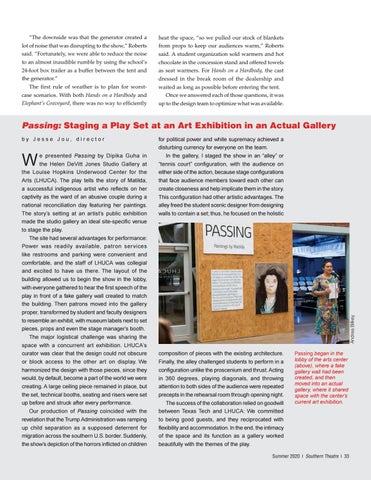
roadly thinking, there are three major questions theatre companies must ask when considering whether or not they are ready to reopen. Each of these big questions raises a multitude of smaller, more specific questions that must be discussed. Will your state/local government permit it? Is your business one of the types permitted to reopen? Some states have announced a phased approach. If yours is one, which phase is your state currently in? Is there a restriction on group size or crowd capacity? Are there sanitation requirements? Are masks required? Are you required to maintain social distancing guidelines? Can you safeguard your staff, cast and crew? Does your area have access to accurate testing? Will you require daily health and temperature checks? Will actors return to potentially contaminated homes or businesses every night? How will your nonlocal company members safely travel to your area? Will they need a 14-day quarantine upon arrival? Is your typical housing acceptable under virus protections? Will they be permitted to leave for errands such as grocery shopping? How will you manage rehearsals? Will you require masks? Can your actors and technicians actually do their jobs while maintaining reasonable social distancing? Are your backstage, pit, dressing rooms, etc., large enough? How will you handle the staging of intimate scenes and dance partnering? Do you have suitable understudies and swings to replace members required to temporarily quarantine due to high temperatures or symptoms? Do you have equipment or supplies that are typically shared (such as headsets, PPE, styling tools)? How will high-contact items such as props or costumes be sanitized and cleaned? How will your employees be protected from potentially ill audience members? Can you safeguard your audiences? Can audiences safely enter and exit your facility while maintaining social distancing? Does your parking lot need to be adjusted for social distancing? What highcontact, high-risk areas can you mitigate – for example, door handles, buttons, ticket taking, brochures, bag check, concessions and restrooms? Will you require temperature and health screenings? Will you require masks and/or gloves? How will you respond to those patrons who will not comply with your protective measures? Do you have enough sanitizing stations? How will you rescale your house to adhere to social distancing? What is your plan for regular cleaning and sanitization? Will your emergency plans be impacted by any of the virus protection measures? If you offer any food or beverage services, can they meet the new safety standards? If an audience member is diagnosed with COVID-19 following their attendance at your venue, how will you respond?
2
3
10 Reopening Tips: A Stage Manager’s Perspective
M
atthew Stern, longtime Broadway stage manager and producer of the Broadway Stage Management Symposium, shared 10 changes that he believes will be necessary for theatre practitioners to safely return to work in the post-COVID era on the symposium’s blog: 1. Create a new position to manage company health issues and concerns. 2. Do temperature checks at the top of every call. 3. Increase understudy and swing coverage. 4. Institute regular testing. 5. Eliminate full company meet-and-greets and parties. 6. Hold only virtual production and design meetings. 7. Move to video submissions for auditions. 8. Stop sharing equipment (headsets, belt packs, mics, etc). 9. Institute new daily reports to include additional health notes. 10. Prepare to invest heavily in hand sanitizer and PPE. To read the full post, visit: www.broadwaysymposium.com/blog. - Stories written by Stefanie Maiya Lehmann Summer 2020 x Southern Theatre x 21
GENEROSITY LEADS TO SUCCESS Advice from the 2020 SETC Design Keynotes b y J o n a t h o n Ta y l o r
Gregg Barnes designed this costume for a female ensemble member in the opening number of Something Rotten on Broadway. “Casey Nicholaw (our esteemed director) wanted to populate the scene with characters that one might see in a Shakespearean comedy,” Barnes said. “I developed designs that might feel reminiscent of established characters from any number of those plays – such as Twelfth Night or The Taming of the Shrew. This was designed for Angie Schworer, who is an amazing (and tall!) Broadway regular – a wench, but with a nod to Phoebe from As You Like It.”
22 x Southern Theatre x Summer 2020
B
Before the world of theatre shut down in response to the COVID-19 pandemic, audiences at the 2020 SETC Convention in Louisville, KY, had the opportunity to hear from three distinguished designers, Gregg Barnes, Anna Louizos and Matt Hubbs, who also served as adjudicators for the annual Design Competition. What follows is their advice for young designers, gleaned from their design keynotes and subsequent interviews. They also share how the pandemic has affected their lives and their livelihoods.
GREGG BARNES on Costume Design Support your community. Gregg Barnes is a Tony Award-winning costume designer who has more than a dozen Broadway credits. In addition to his two Tony wins – for The Drowsy Chaperone in 2006 and Follies in 2012, both of which also garnered him Drama Desk Awards – Barnes has received six Tony nominations and has won or been nominated for five Outer Critics Circle Awards. Barnes, who earned an MFA in design from New with Side Show in 1996. Most recently, he designed Mean Girls, which opened on Broadway in 2018. He said the process of building a career is a mystery to him, but did offer this deceptively simple advice: “I just got up every morning, I put my shoes on, and I went to work, [and] along the way miraculous and terrible things happened.” He shares the following advice for emerging designers:
1
Collaboration is key.
“The first thing I would say is: Be part of the
community, wherever you are based,” Barnes said. Often a person’s spirit of generosity can get lost in the ambition and competition that accompany a successful career as a designer, but having that spirit can actually help ensure success, he noted. “Our mission is to be a good collaborator in a group,” he
Mark Mahan
York University (NYU), began his Broadway career
How has the COVID-19 pandemic affected your work? When the shows and tours all closed down, it was devastating to all of us – the actors, the designers, the crews and, of course, the audiences. For me, it affected projects that are long-running (and the income from those productions) but also the present and future of things that I am currently working on. I took a second and counted up the shows that I had touring and that were running internationally and came up with 11 productions that have either shuttered permanently or are on hiatus – and two Broadway shows that I designed were closed as well.
Gregg Barnes adjudicates a Design Competition entry at the 2020 SETC Convention.
said. “Without that, what are we? There’s no us.”
2
Reach out when you are moved.
“Another thing I think is really important
when you’re young is, if you see something that genuinely touches you or has meaning or inspires, to write a letter, a handwritten letter, just saying, ‘You touched me and inspired me’ without ‘I’d love to meet you. I think I need a job. Would you look at my portfolio?’ ” A handwritten letter makes an impact in the digital age, of course, but the act of taking time to personally thank another theatre artist can open up a fruitful dialogue with potentially career-spanning longevity – as Barnes learned himself. Just after
I have two things I am working on that are slated for next spring, so the enforced studio time has been a blessing in many ways for those projects. I was working on an off-Broadway show that was to have opened in May, so every day I walk around a couple of tutus and about 20 boxes of shoes to get to my drawing table! Looking forward, I am hopeful that this show (and all of the others) will be safely reopened once there is a handle on the virus and its serious health threat. If that takes a month, a year, whatever the reality, I stand strong with the shops and the assistants and the theatre community to do what is right. Of course, the economic struggle is real.
Summer 2020 x Southern Theatre x 23
Barnes’ Broadway debut with Side Show in 1996, he received a letter from producer Hal Prince praising one of his designs and offering to meet with Barnes. That meeting was clearly a formative experience for Barnes, an acknowledgement of his work that the designer never forgot.
3
Find what works and work it.
One of the most important aspects of rendering a design, Barnes said, is finding media and inspiration
that work for you. “You have to find a joyful place to draw and paint from,” Barnes said. “And if you hate [painting], collage. Do something different.” In creating renderings, Barnes uses a mix of traditional and
MORE INFO: setc.org/greggbarnes
nontraditional media, as well as new and old sketches. He works in a very large scale (16 ½" x 22"). He also sketches daily. Barnes says he doesn’t own a television: “I just – at night, I sketch.”
4
Don’t lose sight of the actor while creating the character.
How you handle the fitting matters. Barnes doesn’t believe that showering the actor with praise
throughout the fitting, as some designers do, is the best approach. “It works if the person feels amazing,” he said, but might breed distrust “if they don’t feel amazing and you’re over there shooting off your fireworks.” Barnes tries to take a less effusive approach: “I put myself in the smallest place in the room until I’m invited by their reaction to join the discussion.” Barnes works to shift the performer’s focus from any perceived physical shortcomings to qualities that work well for the performer and the character. “You have to honor the actor’s life journey to get to the character that they’ve been playing,” he said.
5
Be dependable. Be present. Contribute.
For Barnes, attitude, focus and dependability are critical to getting (and keeping) work. Potential
employers “want to trust that you’re going to be able to solve a problem without having a meltdown or getting sick or disappearing,” he said. Other soft skills such as organization, timeliness, determination and flexibility are also important. “Your talent and your excellence are almost to be expected,” he said. “Those are things you develop because you’re an artist. The reason people hire you is that, plus, they want to spend time with you.”
ANNA LOUIZOS on Scenic Design Find a way to do what you love. Scenic designer Anna Louizos started out as an actress, but soon found herself drawn to design. Working with a group of fellow graduates, she embraced the duties of the scenic designer. “I would scrounge around the streets for furniture and dig in dumpsters for pieces that we could put together,” she said. “And that’s when I really started to think maybe I could do this.” She went on to earn an MFA in scenic design at NYU. Since then, she has been nominated for three Tony Awards, four Drama Desk Awards Mark Mahan
and three Lucille Lortel Awards. Her art direction
Anna Louizos studies an entry in the Design Competition at the 2020 SETC Convention.
1
for the Tony Awards earned her a nomination for an Emmy Award in 1993, 10 years before her first major Broadway credit, Avenue Q. She shares the following advice for emerging designers:
Take advantage of the opportunities that come your way.
“There were many times when I offered my services to designers where I knew I wasn’t getting
compensated for my time,” she said. “Or, they would say, ‘I only have this much money to pay you.’ ” Louizos took advantage of assistant opportunities for the experience and for the professional relationships. This strategy provided a basis for the long game – establishing herself first as an assistant with solid skills and later
24 x Southern Theatre x Summer 2020
as a connected and experienced designer. Louizos supported her work onstage through waitressing and eventually restaurant management. “For me, it took many, many years to really get paid to do what I love. In the meantime, I just worked jobs so that I could afford to do the thing I love.” Perhaps because of her own somewhat
twisting career path, Louizos is keenly aware that there’s no one way to succeed – or to meet the challenges of designing a show. “If somebody tells you this is the only way the show can be designed, that’s not true,” she said. “There are many ways to
Anna Louizos
2
There’s no right way to design a set.
design, and there are many interpretations of the same thing.”
3
Never give up your seat in the audience.
I asked Louizos what the key was to creating or
finding an entry point into the world of professional design. She described tiers of work, saying that once a designer achieved a certain amount of success, this tended to breed more work at that level. Designers must put their work out there, she said, while also being aware of the work going on around them. “It’s more about, you know, just being noticed by others in the business,” she said, “and seeing the work of other fellow designers.” Developing an eye for what works is extremely important, too. “Sometimes you get to look at what they’ve done and think, ‘I would have done that differently,’ ” she said.
4
The business has changed over time.
Asked about any differences in the wake of
the #MeToo movement, Louizos said she has noticed a number of changes since she began her career. “There’s a greater mix of female crew members in theatres, and you see more now – and more fellow designers,” she said. She also believes that men’s attitudes have changed “because they see more women in the business.”
5
Find value in your own work.
Emphasizing the importance of self-validation,
Louizos asks why the work that designers do for the stage is seen to hold less cultural and material value than artwork hanging in a museum. She asks, “Why is that more valuable than something someone has created for the stage that has the same kind of thought behind it and craftsmanship?” Louizos urges young theatre artists to be curators of their and others’ theatrical artwork. “We need to step forward and say, ‘This has value,’” she said. “We need to start speaking
How has the COVID-19 pandemic affected your work? It seems like our time at the SETC Convention was from another era altogether, a more innocent time, too, when I think of all the interacting and human contact we had there. Looking toward the future in the midst of this pandemic, I don’t see going back to any kind of normalcy anytime soon for live entertainment until people feel safe enough to congregate in large numbers. Performers and crew alike also have the same concerns.
Anna Louizos created this scenic design for the finale of West Side Story, presented at Tokyo’s 360 Stage Around in Japan in 2019. The design consisted of 10 individual set locations surrounding the audience, which rotated within the space to view each location as the show progressed.
Nearly every project I had lined up for this year has been either cancelled or postponed for at minimum six months, if not longer. So I’m choosing to look at this time as the vacation I NEVER could have planned. (Since I generally work on multiple projects which overlap, I’m lucky if I can squeeze a few weeks off a year.) One thing is certain. Pandemic or not, creative people – artists, performers – all still have the impulse to create, which is why we are seeing an explosion of content online. People are finding ways to connect across the physical barriers in lieu of live performances. It won’t replace the live experience, but it may inspire some new options.
MORE INFO: annalouizos.com
I am hoping something positive will come out of this; it may prompt a reboot in the commercial theatre business and not-for-profit theatres. What kind of theatre will people want to see? Light-hearted comedy, escapist entertainment or more serious, socially significant drama? We don’t know, but it will come back and, hopefully, with a collective realization among all involved parties that we have to find a way to work together or this whole thing falls apart.
of our work as having value.” Summer 2020 x Southern Theatre x 25
MATT HUBBS on Sound Design Tell the ‘Story-with-a-capital-S’ Matt Hubbs has a litany of Broadway, off-Broadway and regional credits. On Broadway, Hubbs designed Time and the Conways and Indecent. He describes his work as “curating an audience experience. The audience is experiencing the story, and we’re trying to curate that experience with deference to the Storywith-a-capital-S.” Hubbs learned his skills on the job, starting his career in Louisville in 2001 after receiving a BA in philosophy from Xavier University. March 2020 not only found Hubbs adjudicating the SETC
Mark Mahan
Design Competition, but also returning to his roots
Matt Hubbs listens to a sound design entry in SETC’s 2020 Design Competition.
1
at Actors Theatre of Louisville, where he was the sound designer for two shows planned for the 2020 Humana Festival of New American Plays. He shares the following advice for emerging designers:
Be open to the colleagues you meet along the way.
Young designers need to be open to the generosity of others as they make their way, Hubbs said,
emphasizing the importance of “being willing to go on the journey” and explore new experiences and collaborations. “I think I would never have met the people I’ve met and done the amazing, weird, beautiful things I have done had I not been open to listening to the collaborators around me and learning from them,” he said.
2
Have faith in yourself.
Hubbs stressed the importance of believing in your own talent. He attributes much of his success to
consciously developing a sense of self, “knowing that I could respond to [challenges] and having faith in myself”
MORE INFO: matthubbs.com
and making that self-affirmation a daily ritual, “part of tying my shoes every morning.”
3
Designers are storytellers.
The essence of making theatre, Hubbs said, is storytelling: “At the core of what we do as designers, not
just as sound designers but as designers, is that we are storytellers and storytelling facilitators.” Hubbs said he works hard “to center myself less in my work and center the work more in my work,” and noted that he always has his eye on the other half of the equation: the audience. “The reason we’re there is the story, and everything I’m doing should be to serve that story,” he said.
4
Embrace solid technical skills.
Hubbs cautions young designers against feeling as if they’re on a necessarily linear path, in which
tools and skills belong at certain levels during one’s career. “If you’re an artist, you’re an artist, and you can embrace that,” he said. “And when you’re designing, you’re a designer. But that doesn’t mean that you can’t then use your other skills to make money, because putting a meal on the table is not easy in this industry.” Hubbs encourages design/tech students entering the field to “embrace all of the tools you have, whether that’s getting a fee for being a designer this month and then the next month, it’s stitching.”
5
Take care of yourself.
Lamenting the romanticizing of the tortured
artist, Hubbs emphasized the need for theatre makers to strike a balance between being committed artists and “being truly devoted to being a human being and making sure that you have a sustainable life.” n
26 x Southern Theatre x Summer 2020
Jonathon Taylor is an assistant professor at East Tennessee State University, where he teaches scenic and costume design, stage management and theatre design basics. He is a member of the Southern Theatre Editorial Board.
How has the COVID-19 pandemic affected your work?
As a freelancer, I am used to having stretches of months with no work booked, but usually with some long-term projects on the horizon. What’s different now is that I’m not sure when it will be safe for theatres to open to the public: I’m imagining not until a vaccine is available and in widespread use, which could be a year or more. And when it is safe for audiences to gather again, I wonder what theatres will still be around to serve those audiences. Being a freelance designer has never been a stable or certain career or lifestyle, but this is uncertainty on a whole new level.
Jonathan Roberts
We had just gotten through one preview of Where the Mountain Meets the Sea during the Humana Festival at Actors Theatre of Louisville when the impact of the pandemic hit. It quickly went from “we canceled a preview” to “there will be no more public performances, but we’ll finish producing these plays and archive them” to “we really have to shut the building down.”
Nathan Hinton, Allan K. Washington and The Bengsons appear in Where the Mountain Meets the Sea by Jeff Augustin, part of the 2020 Humana Festival of New American Plays, with sound design by Matt Hubbs. The show, which had only one public performance before the festival was suspended March 12, was recorded and available for online streaming April 6-27, 2020.
• Hone your craft as an actor • Serious musical theatre “triple-threat” training in acting, voice and dance • Learn the business of the Biz • Sink your teeth into production design and management skills • Enjoy master classes and coaching taught by agents and industry professionals • Production and performance opportunities from day one
FOR MORE INFORMATION: Dean College — School of the Arts 99 Main Street, Franklin, MA 02038 1-877-TRY-DEAN • dean.edu/arts
Summer 2020 x Southern Theatre x 27
NO THEATRE BUILDING? NO PROBLEM Texas Tech Presents Entire Season in Found and Site-Specific Locations story compiled by Mark Charney
Andrea Bilkey
S
Sometimes loss creates opportunity. The School of Theatre and Dance at Texas Tech University discovered this to be true when we faced a semester without access to our theatres due to construction of a new theatre building. Most universities would look to rent other comparable spaces, but we decided to become adventuresome: We agreed to try a season – yep, a full year – of presenting theatre in site-specific and found spaces. If you haven’t heard of either, productions are
season. So, with a few potential plays in mind, our
site-specific when they allow the content of the play
director of marketing, Cory Norman, and I headed
to determine the best site where it would realistically
out into the community to scout locations. Our “go-
occur: hence, the parking lot of the Lubbock Nissan
to” shows, the examples we used when persuading
dealership to tell the story of the musical Hands on a
everyone to consider a site-specific season, were Hands
Hardbody, or the local Equestrian Center to share the
on a Hardbody in the Nissan dealership and Elephant’s
circus-related events of Elephant’s Graveyard. With
Graveyard in the Texas Tech Equestrian Center. So we
found spaces, the site may not be exactly right for the
started there. But we also looked for other sites that
play’s setting, but the location still facilitates the play
just seemed interesting: an art museum, a church,
as well as a theatre might while posing fascinating
even a skating rink. The Christians? Xanadu? The idea
possibilities. We “found” this space; let’s use it to our
was to come back to the season selection committee
advantage.
with a variety of possible locations.
We knew we were facing huge challenges. Our
patrons had to relocate for most of our shows, and
help. Sometimes finances got in the way, but, by and
this meant different seating, sometimes outside under
large, every site was at least interested in partnering.
a tent or the stars, where we were dependent on the
When we visited with the Nissan dealership, the
weather (which “betrayed” us more often than not).
equestrian center, the National Ranching Heritage
Our design teams had to be even more inventive
Center, and yeah, even the owner of a personal
than normal, often transporting set pieces, lighting,
home, we were met with a city that welcomed us,
costumes, props and more under duress and fighting
not only for this season, but possibly in subsequent
with frigid temperatures. Our actors had to learn a
years.
new way of communicating, making sure that their
voices could be heard in a variety of spaces without
the season selection committee with more sites than
theatre acoustics, while directors had to rethink new
we could use. As is the case at most colleges and
ways of telling stories.
universities, we have to choose plays that represent
In this article, we detail the successes and
a wide variety of genres, periods and authors, while
the challenges of dedicating an entire season to
still paying attention to our BFAs, our MFAs, NAST
unconventional spaces. You will hear from our
requirements, our audience and diversity. Hands on
director of marketing, who discusses how he
a Hardbody and Elephant’s Graveyard were approved
persuaded patrons to venture miles away from the
quickly, but it took us months to fit the rest of the sites
spaces they had frequented for 50 years; from our
with the plays that best suited our mission.
head of design, who offers advice based on how
Marketing the season
best to harness the environment; from our technical
Our site-specific and found-space season gave
director, who patiently and expertly coordinated the
us an opportunity to create new relationships with
entire season; and from two directors, who share their
established businesses and organizations all over our
strategies for embracing an equestrian center and an
hometown of Lubbock, TX. Not only did we share
art gallery, respectively, to tell their narratives.
resources with our hosts, we also shared audiences.
Spoiler: We definitely recommend it.
Finding the spaces and choosing the plays
Writing of this story was coordinated by Mark Charney, with content contributed by the Texas Tech faculty and staff members quoted in each section.
Almost every potential site we visited offered to
At the end of our scouting session, we returned to
The locations we chose included:
Opposite page: Bloody Bloody Andrew Jackson, featuring Luke Weber as Andrew Jackson (front), was presented in the 6666 Barn at the National Ranching Heritage Center, a collection of buildings dating to the 1800s.
• Two spaces at the Louise Hopkins Underwood
The entire idea began with a commitment to
Center for the Arts (LHUCA): the Christine Devitt
the community. We figured that we had to have
Icehouse, a large, finished warehouse, for Of Beauty
permission from sites before we could dream up a
Queens and Childhood Dreams; and the Helen Jones Summer 2020 x Southern Theatre x 29
VIEW A GALLERY OF PHOTOS FROM THE SEASON HERE:
Gallery, a small art gallery inside the main LHUCA
popular community venues. Deeper collaboration
building, for Passing.
occurred when coordinating social media posts and
• The Charles Adams Studio Project’s 5&J Gallery,
cross-promoting in our newsletters and those of
an old city police garage converted into a modern
our partners. Because most performances sold out
art gallery, for DanceTech.
well in advance of opening – Bloody Bloody Andrew
• McGavock Nissan’s new car parking lot for Hands on a Hardbody. • An indoor arena at Texas Tech’s Equestrian Center for Elephant’s Graveyard. • The interior of the 6666 Barn at the National
ttusitespecificseason. myportfolio.com
Jackson sold out in late November and opened in early February – we didn’t advertise ticket discounts. “As the season progressed, our patron list grew and shows sold out,” Norman said. “We finished at 90% capacity, and our subscription sales grew by 33%
Ranching Heritage Center, a collection of ranching
the following season.”
buildings from the late 18th to the early 20th
century, for Bloody Bloody Andrew Jackson.
partnerships that would last, but also had increased
At the end of our season, we not only had created
We had a natural overlap of patrons with
our audience and taught our students the value of
organizations like the 5&J Gallery and LHUCA.
flexibility and creative marketing.
Meanwhile, the Texas Tech Equestrian Center, the
Box office and ticketing
National Ranching Heritage Center and the Nissan
dealership – which had a combined email list of
box office. Most of our partners were able to offer
50,000 names – offered opportunities to reach new
us onsite WiFi. For venues without WiFi, our box
audiences: a marketer’s dream!
office staff created sales forms for each transaction.
To simplify the process, we made all of our shows
In developing the season’s artwork, Cory Norman,
We use TIX, an online ticketing software, in our
our director of marketing, saw an opportunity to
general admission.
highlight the partnerships and showcase the venues.
“The front-of-house (FOH) operations for each
”We gathered exterior shots of the buildings for
show varied by location,” said Norman. “Our team
each production, featuring, when possible, the signage
met at the venue the day after load-in, about a week
of each partner, and I built the posters to depict the
prior to opening, to strategize the front-of-house
exterior photograph of the location,” Norman said.
needs of the production.”
“In many cases, the site was immediately recognizable
without the address, which was provided near the
as usual, as parking was near the venue, walk paths
bottom-right corner of each poster.”
were well-lit, and entrances/exits were clearly
Norman’s idea for the season brochure was a
marked. Other venues, such as the equestrian
foldout map, much like the ones distributed at an
center – which was located on the outskirts of town
amusement park. Above the map was a “key” of sorts
and difficult to find in the dark – required greater
for each number, providing the title, author, dates,
preparation, multiple site visits prior to load-in, and
address and synopsis for each show. The opposite
an increased number of volunteers on performance
side of the brochure (shown on Page 31) displayed the
nights. On the whole, we allowed the site to determine
artwork for each show with titles, authors and dates.
the need, but it wasn’t rare to ask FOH staff to guide
Viewed together, the set of posters and the brochure
patrons in with lighted wands.
featured our connection to the community.
Technical challenges
When selling individual shows, we used a
combination of print marketing, social media,
you need to start by answering questions. The three
newsletter exchanges, and radio/TV advertising to
big ones that technical director Jared Roberts faced
highlight our partnerships. We relied on the School
were: One, where are the restrooms? Two, how much
of Theatre and Dance marketing team for the radio/
power is available? Three, what is the weather?
TV ads and print marketing. Our print marketing
was a 4x6 postcard with information/graphics on
needs, but also to provide the cast with dressing
both sides and highlighted our partner venue. The
rooms. In the equestrian center where Elephant’s
small size of the postcards made them easy to hand
Graveyard was performed, one restroom had to be
out at monthly First Friday Art Trail events and leave
shared between the cast and the audience, and it was
behind at the partner organizations, as well as other
far from the audience entrance.
30 x Southern Theatre x Summer 2020
In most locations, the FOH operations functioned
When you have eight shows in unfamiliar settings,
Restrooms needed not only to serve the audiences’
Fall Da nce Fe stival
ch Danc e Facu
Hands
on a H
ber 24 -30,
2018
4
ardbo
Novemb er
Book by Music Doug Wrigh t; Lyric by Tre y Anas s tasio an by Amanda Gr d Aman da Gree een; n
dy
Elepha
15-17, 20
18
7
nt’s G
Februa
raveya rd
By Geor ge Bran
t
ry 28 –
March
RROA
PS/RR ADS
(Raider Red’s One-A Raider ct Red’s Awesom Play Specta cular/ e Danc e Spec tacular )
2 Octobe
r 15-21,
2018
5 Novemb er
29-Dec ember
2, 2018
Blood y Bloo Andre d w Jack y son Music Bo ok by Al and Lyrics
by Mich ex Timbers; ael Fri edman
8 April 1-6 , 2019
Cante
rville
Conceiv ed and
Direct
ed by
Randall
Rapstin
e
3
Octobe
r 29 –
Novemb er
1; Nove
mber 3
–4
6 Februa
ry 4-10 , 2019
9 April 29
FALL DANCE FESTIVAL LOCATION: Creative Movement Studio on the Texas Tech University campus. HOW/WHY LOCATION CHOSEN: Student choreographers were playing with and investigating the environment around the studio building. BIGGEST CHALLENGE: Audience traveled indoors and outdoors. BIGGEST BENEFIT: The location replicated the journey of each piece. ELEPHANT’S GRAVEYARD By George Brant LOCATION: Texas Tech Equestrian Center. HOW/WHY LOCATION CHOSEN: The arena closely resembled a circus environment. BIGGEST CHALLENGE: Hard-tofind location outside of Lubbock, with electrical and patron services challenges. BIGGEST BENEFIT: Replicated the inside of a circus tent, the play’s environment. BLOODY BLOODY ANDREW JACKSON Book by Alex Timbers; music and lyrics by Michael Friedman LOCATION: National Ranching Heritage Center (NRHC). HOW/WHY LOCATION CHOSEN: The NRHC, a collection of ranching buildings from the late 18th to the early 20th century, provided an appropriate setting. BIGGEST CHALLENGE: The small interior of the 6666 Barn reduced both audience size and the playing space for the show.
– May
5, 2019
2, 2019
Schoo l
PASSING By Dipika Guha LOCATION: Helen Jones Gallery, LHUCA. HOW/WHY LOCATION CHOSEN: The story’s setting at an artist’s public exhibition made the studio gallery an ideal site-specific venue to stage the play. BIGGEST CHALLENGE: Sharing the space with a concurrent art exhibition meant we needed to strike the set after each performance. BIGGEST BENEFIT: Appropriate setting for the play, with readily available power and patron services.
Texas Te
lty
Septem
Passin g
HANDS ON A HARDBODY Book by Doug Wright; lyrics by Amanda Green; music by Trey Anastasio and Amanda Green LOCATION: McGavock Nissan. HOW/WHY LOCATION CHOSEN: Play is set at a Nissan dealership. BIGGEST CHALLENGE: No accessible electrical power and exposure to inclement weather. BIGGEST BENEFIT: Huge crosspromotional opportunity and ideal location for the play.
aphy by
1
By Dipik a Guha
OF BEAUTY QUEENS AND CHILDHOOD DREAMS By Michelle Benson LOCATION: Christine DeVitt Icehouse, Louise Hopkins Underwood Center for the Arts (LHUCA). HOW/WHY LOCATION CHOSEN: Open warehouse that closely resembled a sound stage. BIGGEST CHALLENGE: Electrical and grid challenges forced the show into a proscenium configuration (not ideal). BIGGEST BENEFIT: Known location for arts events with ample patron services.
Dance Tech gr
Choreo
of The atre & D a nce
FAST FACTS: THE SEASON
Tex a s T e ch U n i v e r sity
Right: The season brochure displayed the art for each show, including title, author and dates, with a fold-out map on the other side indicating locations of the events.
Of Bea u and C ty Queens hildho od Dre elle Be nson ams
By Mich
BIGGEST BENEFIT: The NRHC is a well-known and easily identifiable location for Lubbock audiences. DANCETECH LOCATION: Charles Adams Studio Project, 5&J Gallery. HOW/WHY LOCATION CHOSEN: The 5&J Gallery is located in an old city police garage, and the dance pieces dealt with divergent/opposing environments. BIGGEST CHALLENGE: The audiences traveled indoors and outdoors, and there was very little power available at performance locations. BIGGEST BENEFIT: The gallery is in a well-known downtown arts location, and the performance coincided with the monthly First Friday Arts Trail. CANTERVILLE Conceived and directed by Randall Rapstine LOCATION: Donor’s home in nearby neighborhood. HOW/WHY LOCATION CHOSEN: The house replicated the richness and the myriad indoor and outdoor spaces in Oscar Wilde’s story. BIGGEST CHALLENGE: Displacing the owner from her residence during rehearsals and performances. BIGGEST BENEFIT: Having many spaces for audiences to traverse to create their own narratives for the story. Summer 2020 x Southern Theatre x 31
“Because the audience had to walk about 100 feet
placed the set (which included a real Nissan Frontier),
from the door to the stage, we used rope light to guide
120 audience seats, lighting, speakers, a six-piece
them through this massive space to their seats and the
band, and the control booth with stage management
restroom,” Roberts said.
and lighting and sound boards. The real challenge
For Hands on a Hardbody, we faced a couple of
came when we needed to power all of the equipment
unique issues. First, there was no venue – just a big
for the show. We solved this by renting a 550kw diesel
empty spot in a parking lot. And second, no electricity
generator. Using it in conjunction with our portable
was available. To solve the first issue, we rented a 40-
dimmers supplied more than enough power for the
foot by 60-foot gable frame tent. Inside this tent we
production.
Elephant’s Graveyard: Creating a Circus Aura in an Equestrian Center by Linda Donahue, director
dealing with this surprise, I had concerns about the soft-packed dirt on the arena floor, good for horses
D
irecting Elephant’s Graveyard was a joy, a
and galloping and doing rope tricks, but challenging
successful site-specific enterprise. What a
for the actors vocally due to the dust in the air. To
challenge, but totally worth the obstacles!
help alleviate our concerns, the equestrian center
We presented the play at the Texas Tech Eques-
agreed to use machines to pack the dirt, which helped
trian Center, the 100-acre home of our university’s
enormously with dust. Another plus: The smaller
equestrian team. It includes a 500-seat indoor arena,
location did not require the use of microphones.
two warm-up arenas and four more large event are-
We found adaptability to be key. We used horse
nas.
stalls as dressing rooms. There was no heat, so we used space heaters to keep the actors warm. The location was hard to find, so our design team placed signs at the various unlighted rural street intersections, indicating the location of the equestrian center. We used twinkling holiday lights to guide the audience from the parking lot to the arena. Our professionals also covered a number of non-ADA potholes to make access easier for our audience. The arena space offered possibilities for strong directorial choices. Because Elephant’s Graveyard replicates a traveling circus, I wanted to stage the
Andrea Bilkey
show in the round, like a three-ring circus, which fostered a presentational style. We dedicated ourselves to exaggerated bold movements and blocking inspired by the text and physical atmosphere of the location. Elephant’s Graveyard was performed at the Texas Tech Equestrian Center in the round like a circus, complete with peanuts and popcorn. Challenges included dust from a soft-packed dirt floor, a lack of dressing rooms, no heat and a location that was hard to find.
It didn’t really sound like a great space for a play.
The play requires an elephant, but obviously not
However, after visiting the huge arena, we continued
a “real” animal. Our decision was to show Mary, the
our commitment to stage George Brant’s circus show
elephant, in a symbolic manner by using electric
Elephant’s Graveyard in the center of the space,
lanterns to represent her elephant essence and
with seating for 120, replicating a Barnum & Bailey
stage presence. This unique convention worked
ambience, with popcorn and peanuts sold from a food
beautifully, as evidenced by the gasps we heard from
stand. The design and production folks were on board
the audience when Mary was disturbingly hanged.
for the accommodations we needed.
About 10 days before our performance, the
and production team for this unique experience in an
equestrian center moved us from the large arena
unusual location. They loved coming into a “circus,”
to a smaller practice arena because the hosts had
and left feeling as if they had experienced a true
booked a rodeo during our play dates. In addition to
three-ring circus event.
32 x Southern Theatre x Summer 2020
The upshot: Our patrons congratulated our students
“The downside was that the generator created a
heat the space, “so we pulled our stock of blankets
lot of noise that was disrupting to the show,” Roberts
from props to keep our audiences warm,” Roberts
said. “Fortunately, we were able to reduce the noise
said. A student organization sold warmers and hot
to an almost inaudible rumble by using the school’s
chocolate in the concession stand and offered towels
24-foot box trailer as a buffer between the tent and
as seat warmers. For Hands on a Hardbody, the cast
the generator.”
dressed in the break room of the dealership and
The first rule of weather is to plan for worst-
waited as long as possible before entering the tent.
case scenarios. With both Hands on a Hardbody and
Elephant’s Graveyard, there was no way to efficiently
up to the design team to optimize what was available.
Once we answered each of those questions, it was
Passing: Staging a Play Set at an Art Exhibition in an Actual Gallery by Jesse Jou, director
for political power and white supremacy achieved a disturbing currency for everyone on the team.
W
e presented Passing by Dipika Guha in
In the gallery, I staged the show in an “alley” or
the Helen DeVitt Jones Studio Gallery at
“tennis court” configuration, with the audience on
the Louise Hopkins Underwood Center for the
either side of the action, because stage configurations
Arts (LHUCA). The play tells the story of Matilda,
that face audience members toward each other can
a successful indigenous artist who reflects on her
create closeness and help implicate them in the story.
captivity as the ward of an abusive couple during a
This configuration had other artistic advantages. The
national reconciliation day featuring her paintings.
alley freed the student scenic designer from designing
The story’s setting at an artist’s public exhibition
walls to contain a set; thus, he focused on the holistic
made the studio gallery an ideal site-specific venue to stage the play.
The site had several advantages for performance:
Power was readily available, patron services like restrooms and parking were convenient and comfortable, and the staff of LHUCA was collegial and excited to have us there. The layout of the building allowed us to begin the show in the lobby, with everyone gathered to hear the first speech of the play in front of a fake gallery wall created to match the building. Then patrons moved into the gallery Andrea Bilkey
proper, transformed by student and faculty designers to resemble an exhibit, with museum labels next to set pieces, props and even the stage manager’s booth. The major logistical challenge was sharing the space with a concurrent art exhibition. LHUCA’s curator was clear that the design could not obscure
composition of pieces with the existing architecture.
or block access to the other art on display. We
Finally, the alley challenged students to perform in a
harmonized the design with those pieces, since they
configuration unlike the proscenium and thrust. Acting
would, by default, become a part of the world we were
in 360 degrees, playing diagonals, and throwing
creating. A large ceiling piece remained in place, but
attention to both sides of the audience were repeated
the set, technical booths, seating and risers were set
precepts in the rehearsal room through opening night.
up before and struck after every performance.
Our production of Passing coincided with the
between Texas Tech and LHUCA: We committed
revelation that the Trump Administration was ramping
to being good guests, and they reciprocated with
up child separation as a supposed deterrent for
flexibility and accommodation. In the end, the intimacy
migration across the southern U.S. border. Suddenly,
of the space and its function as a gallery worked
the show’s depiction of the horrors inflicted on children
beautifully with the themes of the play.
The success of the collaboration relied on goodwill
Passing began in the lobby of the arts center (above), where a fake gallery wall had been created, and then moved into an actual gallery, where it shared space with the center’s current art exhibition.
Summer 2020 x Southern Theatre x 33
34 x Southern Theatre x Summer 2020
Design on the road
couple of trusses, with a few lights shining
Designing for multiple off-site venues
on a central ring, which made it easy to
in one season is a challenge. Our program
imagine being a small-town kid attending
centers around students having major roles
their first traveling circus,” Bilkey said.
in design and technology, which created a
Placing Passing in an art gallery, where
unique learning opportunity, noted Andrea
patrons mingled pre-show in front of an
Bilkey, head of design.
existing exhibit that blended with the
“Not only were we designing the
show’s exhibit, created a way for the
production, oftentimes we were designing
show to naturally signal its start without
the whole environment: starting with the
dramatic lighting.
audience’s approach, moving them through
Two of the venues had skylights, and
the entry, and then on to the event itself,”
while this diminished the stage lighting for
Bilkey said.
matinee performances, it also allowed for
exits to be seen during potential blackouts
To begin, we asked the designers many
guiding questions: How does the audience
without detracting from the impact.
arrive? Is there appropriate accessibility and
“Very few of the spaces had what we
lighting in the parking area, the entrance to
would call houselights for egress, but
the space, and access to the restrooms? Does
many had ambient or focused lighting that
the audience experience anything on the
we used for pre-show, intermission and
approach to the space? Does the venue have
post-show environments, which helped
any controllable lighting for house lights
to reduce the equipment brought in for
or an audio system? How is the natural
lighting,” Bilkey said.
ambient sound? Are there skylights that
may cast unwanted light into the space?
of design challenges: The show took place
What is the opening of the largest door into
both indoors and outdoors. The indoor
the space/what are our clearances? Can
portion, which began the evening, featured
our setup remain in place, or do we need
a large glass wall while the dancers also
to strike it every evening? Is there lockable
performed outdoors over a mixture of dirt,
storage for our equipment? Are drawings
gravel and paving. The site had minimal
of the space available? What, if anything,
power, which needed to be shared among
already exists in the space that might be
audio, lighting, one small central dressing
incorporated into the designs? Then, of
area and restrooms. The audience moved
course, we explored how the answers
throughout the evening to various locations
DanceTech was a production with a blend
informed each design.
around the gallery space.
“As you might imagine, this list of
questions was overwhelming,” Bilkey
centralize lighting and sound, or do we
said. “And sometimes the answers shifted
have one setup for indoors and one for
during the process. Remaining calm and
outdoors?” Bilkey said.
rolling with it was part of the fun.”
Each team performed site visits,
the theatre doesn’t own outdoor-rated
sometimes multiple ones, to find answers.
lighting equipment. The interior portion
For the most part, each of the new venues
had a few truss towers and a handful of
had access to an area for patron parking;
LED fixtures. Lighting and sound were
ingress lighting was more varied. In some
run traditionally. Moving outside, sound
cases, a simple addition was the answer:
was run in a similar fashion, with the booth
some rope light, fairy lights or ushers with
under a central shed area, surrounded
flashlights. The designers had fun figuring
by speakers aiming out into essentially a
out the audience’s approach.
circular performance area. The audience
“For Elephant’s Graveyard, the seating
moved into this space by following rope
platforms were in silhouette against a
light, and the exterior spaces were lit by
“One of the first questions was, do we
The latter made the most sense because
Andrea Bilkey
Hands on a Hardbody was staged on a lot at a Nissan dealership in a large gable frame tent, with a generator providing power.
streetlights, battery-operated lights in
During their season working off-site,
costumes, and rechargeable LED work
students and staff learned new processes
lights, sometimes with gel added, which
and techniques that have carried into the
could be transported from piece to piece
school’s traditional spaces, Roberts said.
by crew members as the audience walked.
“In one piece, the performers even used
he said. “If you lock yourself into one way
their cellular phones to illuminate their
of accomplishing a task, you will never be
faces,” Bilkey said.
able to embrace the environment.”
Using the shop truck and one of
A risk with benefits
the choreographer ’s vehicles, the team
achieved a traditional shin-mid-height
of site-specific and found spaces aligned
sidelight with nontraditional sources.
us. To overcome the problems inherent
“How they caught the dancers, the
in unconventional spaces, our students,
costumes and the dust stirred up by the
faculty and staff began to problem-solve
movement made it raw, gritty, intense and
together. The more risks we took, the more
exciting,” Bilkey said. “Which pretty much
we learned to share stories in a myriad of
summarizes a season off-site.”
ways.
Load-in and load-out
Embracing the opportunity to make
Each show had to be installed in one
theatre using spaces meant for other
day, so the goal was to simplify the process.
things ultimately allowed us to reach new
Creating a system was key to the successful
audiences and learn more about theatre and
setup and take-down of each show.
dance. It was a challenge, sure, but the type
For example, as technical director
our School of Theatre and Dance enjoys,
Roberts planned how to load in the set, he
the type we need if we are to continue to
wanted the crew to use only two tools: “We
train our students to be adaptable while
used 3/8-inch bolts for every connection, so
embracing our community. And while
the crew used a ratchet with a socket and a
our new building may not force us to
combination wrench. Our electricians used
embrace site-specific and found spaces for
only an open-end adjustable wrench.” This
every show, we plan to continue this new
allowed the crew to focus on the work, and
tradition going forward. n
not what tool they needed for each task.
After the run, strike was, at most, four
hours. We were able to fit everything – scenery, props, lighting, sound, costumes, tools and equipment – into one 24-foot box trailer.
“We learned to keep asking questions,”
In spite of all the obstacles, our season
Mark Charney is director of the School of Theatre and Dance at Texas Tech University in Lubbock, TX. He is also the creator of WildWind Performance Lab and the Marfa Intensive. Summer 2020 x Southern Theatre x 35
New Plays to Make Us Laugh by Zackary Ross
W
hen I started planning this column a short time after the coronavirus shut down theatres, my first thought was to include plays that somehow addressed the life-altering realities of COVID-19. I discovered a lot of wonderful plays that spoke to themes of
communities banding together in times of tragedy or moving on after health scares, and even one brilliant comedy about the plague, but when I put these plays next to each other, they just felt … too much. While each of these texts was worth a read, now just felt like the wrong time. I know theatre will come back, that we will all once again gather and marvel at live performance, but when we do, I believe that comedy will be the order of the day. Laughter heals the soul and, after this crisis, we all will need a good dose of it. Here, I offer a handful of comedies published recently by major play publishers. Following each description, you’ll find information about the cast breakdown and a referral to the publisher who holds the rights. The Beverly Hillbillies, The Musical, book
audience on a spiraling romp into the dark
just a statistic and as part of a hashtag
by Amanda Rogers; music and lyrics by
underbelly of illegal gambling.
movement. Goodnight, Tyler is that rare play
Gregg Opelka; based on the television
Cast breakdown: 3 females; 7 males
that successfully combines sociopolitical
show by Paul Henning
Publisher: Dramatists Play Service, Inc.
tragedy, acerbic satire and heartfelt
Based on the classic television series of the
www.dramatists.com
comedy.
1960s, this inventive musical follows the
Cast breakdown: 3 females; 3 males
Clampetts as they find themselves in the
Native Gardens, by Karen Zacarías
Publisher: Concord Theatricals
unfamiliar world of big-city living after
Pablo and Tania are living the American
www.concordtheatricals.com
patriarch Jed strikes it rich and moves his
dream when they buy their dream home.
boisterous, countrified clan away from the
But a disagreement with the neighbors
Talent Show Fail, by Ian McWethy and
Ozarks to Beverly Hills, CA. Ridiculous
over a fence line threatens their little patch
Carrie McWethy (McCrossen)
exploits and clever lyrics imbue this
of bliss, and the resulting war is sure to set
What is a talent show without the talent?
musical with a great deal of charm.
the audience rolling with laughter.
This is the problem facing the citizens of
Cast breakdown: 6 females; 5 males
Cast breakdown: 2 females; 2 males
Holly Springs, who are planning a talent
Publisher: Dramatic Publishing
Publisher: Samuel French, Inc.
show to raise money to fix the local roads.
www.dramaticpublishing.com
www.concordtheatricals.com
The show must go on in this short and
The Nap, by Richard Bean
Goodnight, Tyler, by B. J. Tindal
only people can get their act together.
Principles aren’t a natural fit in the
Tyler Evans returns to haunt his friends
Cast breakdown: 5 females; 5 males
mysterious world of underground
and relatives as they attempt to make
Publisher: Playscripts, Inc.
gambling, and Dylan Spokes is nothing
sense of the Black man’s untimely death
www.playscripts.com
if not principled. When he finds himself
at the hands of a white police officer. He’s
suddenly on the rise in a snooker
visible only to his white, gay roommate
tournament, Dylan must decide how far
Davis, who seems undaunted by Tyler’s
he is willing to compromise himself for the
sudden return from the afterlife. As
win. Full of colorful characters and comic
Tyler watches over those closest to him,
misunderstandings, the play takes the
he struggles to see himself as more than
sweet one-act where stardom awaits, if
36 x Southern Theatre x Summer 2020
Zackary Ross, an assistant professor of theatre at Bellarmine University in Louisville, KY, also works regularly as a director and a dramaturg.
Southeastern Theatre Conference 1175 Revolution Mill Drive, Studio 14 Greensboro, NC 27405 www.setc.org
Non-Profit Org. US Postage Paid Auto Greensboro, NC Permit No. 744
premierdraperycleaning.com O: (910) 794-1664
All the world’s a stage and we’re here to clean it!™ Stage Draperies
•
Acoustical Panels
•
Upholstery
•
Flameproofing
The Southeast’s premier service for on-site cleaning, flame retardant application, and certification