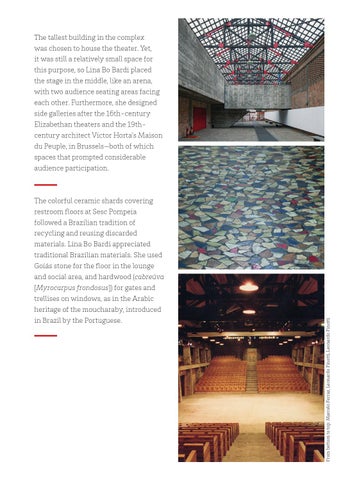
The colorful ceramic shards covering restroom floors at Sesc Pompeia followed a Brazilian tradition of recycling and reusing discarded materials. Lina Bo Bardi appreciated traditional Brazilian materials. She used Goiás stone for the floor in the lounge and social area, and hardwood (cabreúva [Myrocarpus frondosus]) for gates and trellises on windows, as in the Arabic heritage of the moucharaby, introduced in Brazil by the Portuguese.
From bottom to top: Marcelo Ferraz, Leonardo Finotti, Leonardo Finotti
The tallest building in the complex was chosen to house the theater. Yet, it was still a relatively small space for this purpose, so Lina Bo Bardi placed the stage in the middle, like an arena, with two audience seating areas facing each other. Furthermore, she designed side galleries after the 16th-century Elizabethan theaters and the 19thcentury architect Victor Horta’s Maison du Peuple, in Brussels—both of which spaces that prompted considerable audience participation.