36
TRANSITION
every young person should be able to access work experience but that mandating it was not the right way to go: “To put it bluntly, mandating work experience didn’t work for the previous government and wouldn’t work now. Good schools will do the right things for young people as part of their mission”. He announced that the new Careers and Enterprise Company’s priority will be encouraging more employers to offer good quality work placements; part of this will require every school to have an “enterprise adviser” who will liaise directly with their LEP to coordinate work experience.
Making it count Local authorities can play a central part in organising work experience provision because of the data which they collect about learners with SEN. If this data was more comprehensive and listed actual disabilities, it would be easier to match specific career options to individuals. Aside from data collection, local authorities facing millions of pounds worth of cuts are unlikely to be able to widen the net of employers. But there are organisations with increased funding and strong links with local employers, in the form of local enterprise partnerships (LEPs), which have more control over their local economy.
There are high satisfaction rates for employers who take on a disabled learner for work experience As part of their skills strategy, LEPs should be co-ordinating vacancies and making up-to-date labour market information readily available. In Coventry and Warwickshire, the LEP Skills Strategy identifies strategic priorities which outline the need for “future proofing our workforce through closer working between employers, schools, colleges, universities and training providers” and “increasing the use of supported internships to help those with LDD (learning difficulties and disabilities) find and remain in work” (CWLEP, 2014).
Setting the standard The skills strategy recommends that employers adhere to the national Work Experience Quality Standard accreditation, which has been developed by, amongst others, the DfE, Ofsted, MIND and a range of employers. The Work Experience Quality Standard
allows employers and training providers to work towards a set of frameworks, enabling organisations to ensure that comprehensive programmes of work experience, traineeships and apprenticeships are being delivered, helping young people to become more employable. This national initiative could be used alongside The National Institute of Adult Continuing Education’s (NIACE) employer toolkit, produced to demonstrate the simple and costeffective actions that employers can take, including around recruitment and ongoing support, to make their apprenticeship programmes open to disabled apprentices. Again, this resource could be pushed out regionally through LEPs, which the Centre for Social Justice has recommended employ work experience champions (CSJ, 2014). There are high satisfaction rates for employers who do take on a disabled learner for work experience or as an apprentice. In NIACE’s work, for example, employers that took part found they were able to extend the pool of high-quality applicants available to them, engage with the widest possible consumer base, and have a workforce that reflects the diverse range of customers they serve (NIACE, 2014). Ensuring that young people are offered meaningful work placements to help them adjust to the workplace is just as important as engaging employers to overcome any preconceptions which they have about employing a young person with SEN.
Further information
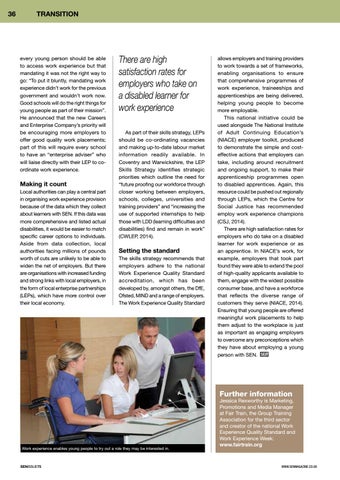
Work experience enables young people to try out a role they may be interested in.
SENISSUE75
Jessica Rexworthy is Marketing, Promotions and Media Manager at Fair Train, the Group Training Association for the third sector and creator of the national Work Experience Quality Standard and Work Experience Week: www.fairtrain.org
WWW.SENMAGAZINE.CO.UK