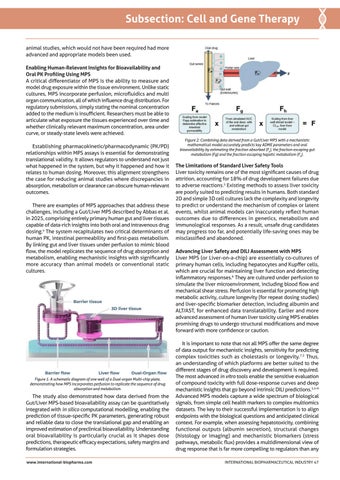
Subsection: Cell and Gene Therapy animal studies, which would not have been required had more advanced and appropriate models been used. Enabling Human-Relevant Insights for Bioavailability and Oral PK Profiling Using MPS A critical differentiator of MPS is the ability to measure and model drug exposure within the tissue environment. Unlike static cultures, MPS incorporate perfusion, microfluidics and multi organ communication, all of which influence drug distribution. For regulatory submissions, simply stating the nominal concentration added to the medium is insufficient. Researchers must be able to articulate what exposure the tissues experienced over time and whether clinically relevant maximum concentration, area under curve, or steady-state levels were achieved. Establishing pharmacokinetic/pharmacodynamic (PK/PD) relationships within MPS assays is essential for demonstrating translational validity. It allows regulators to understand not just what happened in the system, but why it happened and how it relates to human dosing. Moreover, this alignment strengthens the case for reducing animal studies where discrepancies in absorption, metabolism or clearance can obscure human-relevant outcomes. There are examples of MPS approaches that address these challenges, including a Gut/Liver MPS described by Abbas et al. in 2025, comprising entirely primary human gut and liver tissues capable of data-rich insights into both oral and intravenous drug dosing.4 The system recapitulates two critical determinants of human PK, intestinal permeability and first-pass metabolism. By linking gut and liver tissues under perfusion to mimic blood flow, the model replicates the sequence of drug absorption and metabolism, enabling mechanistic insights with significantly more accuracy than animal models or conventional static cultures.
Figure 1. A schematic diagram of one well of a Dual-organ Multi-chip plate, demonstrating how MPS incorporates perfusion to replicate the sequence of drug absorption and metabolism.
The study also demonstrated how data derived from the Gut/Liver MPS-based bioavailability assay can be quantitatively integrated with in silico computational modelling, enabling the prediction of tissue-specific PK parameters, generating robust and reliable data to close the translational gap and enabling an improved estimation of preclinical bioavailability. Understanding oral bioavailability is particularly crucial as it shapes dose predictions, therapeutic efficacy expectations, safety margins and formulation strategies. www.international-biopharma.com
Figure 2. Combining data derived from a Gut/Liver MPS with a mechanistic mathematical model accurately predicts key ADME parameters and oral bioavailability by estimating the fraction absorbed (Fa), the fraction escaping gut metabolism (Fg) and the fraction escaping hepatic metabolism (Fh).
The Limitations of Standard Liver Safety Tools Liver toxicity remains one of the most significant causes of drug attrition, accounting for 18% of drug development failures due to adverse reactions.5 Existing methods to assess liver toxicity are poorly suited to predicting results in humans. Both standard 2D and simple 3D cell cultures lack the complexity and longevity to predict or understand the mechanism of complex or latent events, whilst animal models can inaccurately reflect human outcomes due to differences in genetics, metabolism and immunological responses. As a result, unsafe drug candidates may progress too far, and potentially life-saving ones may be misclassified and abandoned. Advancing Liver Safety and DILI Assessment with MPS Liver MPS (or Liver-on-a-chip) are essentially co-cultures of primary human cells, including hepatocytes and Kupffer cells, which are crucial for maintaining liver function and detecting inflammatory responses.6 They are cultured under perfusion to simulate the liver microenvironment, including blood flow and mechanical shear stress. Perfusion is essential for promoting high metabolic activity, culture longevity (for repeat dosing studies) and liver-specific biomarker detection, including albumin and ALT/AST, for enhanced data translatability. Earlier and more advanced assessment of human liver toxicity using MPS enables promising drugs to undergo structural modifications and move forward with more confidence or caution. It is important to note that not all MPS offer the same degree of data output for mechanistic insights, sensitivity for predicting complex toxicities such as cholestasis or longevity.7,3 Thus, an understanding of which platforms are better suited to the different stages of drug discovery and development is required. The most advanced in vitro tools enable the sensitive evaluation of compound toxicity with full dose-response curves and deep mechanistic insights that go beyond intrinsic DILI predictions.3,5–9 Advanced MPS models capture a wide spectrum of biological signals, from simple cell health markers to complex multiomics datasets. The key to their successful implementation is to align endpoints with the biological questions and anticipated clinical context. For example, when assessing hepatotoxicity, combining functional outputs (albumin secretion), structural changes (histology or imaging) and mechanistic biomarkers (stress pathways, metabolic flux) provides a multidimensional view of drug response that is far more compelling to regulators than any INTERNATIONAL BIOPHARMACEUTICAL INDUSTRY 47