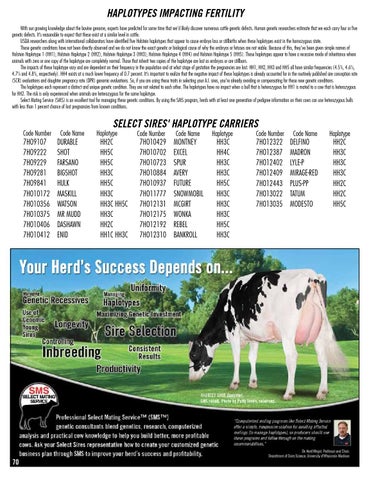
Haplotypes impacting fertility With our growing knowledge about the bovine genome, experts have predicted for some time that we’d likely discover numerous cattle genetic defects. Human genetic researchers estimate that we each carry four or five genetic defects. It’s reasonable to expect that these exist at a similar level in cattle. USDA researchers along with international collaborators have identified five Holstein haplotypes that appear to cause embryo loss or stillbirths when these haplotypes exist in the homozygous state. These genetic conditions have not been directly observed and we do not know the exact genetic or biological cause of why the embryos or fetuses are not viable. Because of this, they’ve been given simple names of Holstein Haplotype 1 (HH1), Holstein Haplotype 2 (HH2), Holstein Haplotype 3 (HH3), Holstein Haplotype 4 (HH4) and Holstein Haplotype 5 (HH5). These haplotypes appear to have a recessive mode of inheritance where animals with zero or one copy of the haplotype are completely normal. Those that inherit two copies of the haplotype are lost as embryos or are stillborn. The impacts of these haplotype vary and are dependent on their frequency in the population and at what stage of gestation the pregnancies are lost. HH1, HH2, HH3 and HH5 all have similar frequencies (4.5%, 4.6%, 4.7% and 4.8%, respectively). HH4 exists at a much lower frequency of 0.7 percent. It’s important to realize that the negative impact of these haplotypes is already accounted for in the routinely published sire conception rate (SCR) evaluations and daughter pregnancy rate (DPR) genomic evaluations. So, if you are using these traits in selecting your A.I. sires, you’re already avoiding or compensating for these new genetic conditions. The haplotypes each represent a distinct and unique genetic condition. They are not related to each other. The haplotypes have no impact when a bull that is heterozygous for HH1 is mated to a cow that is heterozygous for HH2. The risk is only experienced when animals are heterozygous for the same haplotype. Select Mating Service (SMS) is an excellent tool for managing these genetic conditions. By using the SMS program, herds with at least one generation of pedigree information on their cows can use heterozygous bulls with less than 1 percent chance of lost pregnancies from known conditions.
Code Number
Code Name
7HO9107 Durable 7HO9222 Shot 7HO9229 Farsano 7HO9281 Bigshot 7HO9841 Hulk 7HO10172 Maskill 7HO10356 Watson 7HO10375 Mr Mudd 7HO10406 Dashawn 7HO10412 Enid
70
Select Sires' HaplOTYPE Carriers
Haplotype
HH2C HH5C HH5C HH3C HH5C HH3C HH3C HH5C HH3C HH2C HH1C HH3C
Code Number
Code Name
7HO10429 Montney 7HO10702 Excel 7HO10723 Spur 7HO10884 Avery 7HO10937 Future 7HO11777 Snowmobil 7HO12131 Mcgirt 7HO12175 Wonka 7HO12192 Rebel 7HO12310 Bankroll
Haplotype
HH3C HH4C HH3C HH3C HH5C HH3C HH3C HH3C HH5C HH3C
Code Number
Code Name
7HO12322 Delfino 7HO12387 Madron 7HO12402 Lyle-P 7HO12409 Mirage-Red 7HO12443 Plus-PP 7HO13022 Tatum 7HO13035 Modesto
Haplotype
HH2C HH3C HH3C HH3C HH2C HH2C HH5C