Changes in ocean temper changes in aqua By Logan Magad-Weiss, UHM MOP Student
T
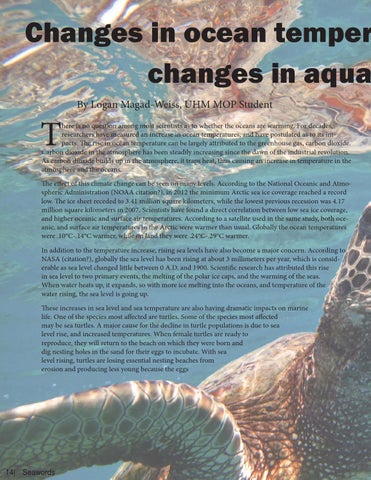
here is no question among most scientists as to whether the oceans are warming. For decades, researchers have measured an increase in ocean temperatures, and have postulated as to its impacts. The rise in ocean temperature can be largely attributed to the greenhouse gas, carbon dioxide. Carbon dioxide in the atmosphere has been steadily increasing since the dawn of the industrial revolution. As carbon dioxide builds up in the atmosphere, it traps heat, thus causing an increase in temperature in the atmosphere and the oceans. The effect of this climate change can be seen on many levels. According to the National Oceanic and Atmospheric Administration (NOAA citation?), in 2012 the minimum Arctic sea ice coverage reached a record low. The ice sheet receded to 3.41 million square kilometers, while the lowest previous recession was 4.17 million square kilometers in 2007. Scientists have found a direct correlation between low sea ice coverage, and higher oceanic and surface air temperatures. According to a satellite used in the same study, both oceanic, and surface air temperatures in the Arctic were warmer than usual. Globally the ocean temperatures were .10째C-.14째C warmer, while on land they were .24째C-.29째C warmer. In addition to the temperature increase, rising sea levels have also become a major concern. According to NASA (citation?), globally the sea level has been rising at about 3 millimeters per year, which is considerable as sea level changed little between 0 A.D. and 1900. Scientific research has attributed this rise in sea level to two primary events, the melting of the polar ice caps, and the warming of the seas. When water heats up, it expands, so with more ice melting into the oceans, and temperature of the water rising, the sea level is going up. These increases in sea level and sea temperature are also having dramatic impacts on marine life. One of the species most affected are turtles. Some of the species most affected may be sea turtles. A major cause for the decline in turtle populations is due to sea level rise, and increased temperatures. When female turtles are ready to reproduce, they will return to the beach on which they were born and dig nesting holes in the sand for their eggs to incubate. With sea level rising, turtles are losing essential nesting beaches from erosion and producing less young because the eggs
14|
Seawords