photo courtesy william h. white
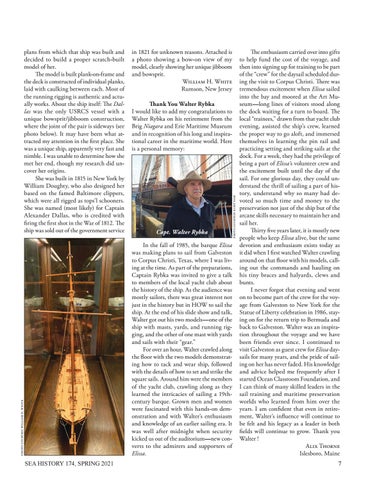
in 1821 for unknown reasons. Attached is a photo showing a bow-on view of my model, clearly showing her unique jibboom and bowsprit. William H. White Rumson, New Jersey Thank You Walter Rybka I would like to add my congratulations to Walter Rybka on his retirement from the Brig Niagara and Erie Maritime Museum and in recognition of his long and inspirational career in the maritime world. Here is a personal memory:
Capt. Walter Rybka
photo courtesy kurt voss
plans from which that ship was built and decided to build a proper scratch-built model of her. The model is built plank-on-frame and the deck is constructed of individual planks, laid with caulking between each. Most of the running rigging is authentic and actually works. About the ship itself: The Dallas was the only USRCS vessel with a unique bowsprit/jibboom construction, where the joint of the pair is sideways (see photo below). It may have been what attracted my attention in the first place. She was a unique ship, apparently very fast and nimble. I was unable to determine how she met her end, though my research did uncover her origins. She was built in 1815 in New York by William Doughty, who also designed her based on the famed Baltimore clippers, which were all rigged as tops’l schooners. She was named (most likely) for Captain Alexander Dallas, who is credited with firing the first shot in the War of 1812. The ship was sold out of the government service
In the fall of 1985, the barque Elissa was making plans to sail from Galveston to Corpus Christi, Texas, where I was living at the time. As part of the preparations, Captain Rybka was invited to give a talk to members of the local yacht club about the history of the ship. As the audience was mostly sailors, there was great interest not just in the history but in HOW to sail the ship. At the end of his slide show and talk, Walter got out his two models—one of the ship with masts, yards, and running rigging, and the other of one mast with yards and sails with their “gear.” For over an hour, Walter crawled along the floor with the two models demonstrating how to tack and wear ship, followed with the details of how to set and strike the square sails. Around him were the members of the yacht club, crawling along as they learned the intricacies of sailing a 19thcentury barque. Grown men and women were fascinated with this hands-on demonstration and with Walter’s enthusiasm and knowledge of an earlier sailing era. It was well after midnight when security kicked us out of the auditorium—new converts to the admirers and supporters of Elissa.
The enthusiasm carried over into gifts to help fund the cost of the voyage, and then into signing up for training to be part of the “crew” for the daysail scheduled during the visit to Corpus Christi. There was tremendous excitement when Elissa sailed into the bay and moored at the Art Museum—long lines of visitors stood along the dock waiting for a turn to board. The local “trainees,” drawn from that yacht club evening, assisted the ship’s crew, learned the proper way to go aloft, and immersed themselves in learning the pin rail and practicing setting and striking sails at the dock. For a week, they had the privilege of being a part of Elissa’s volunteer crew and the excitement built until the day of the sail. For one glorious day, they could understand the thrill of sailing a part of history, understand why so many had devoted so much time and money to the preservation not just of the ship but of the arcane skills necessary to maintain her and sail her. Thirty five years later, it is mostly new people who keep Elissa alive, but the same devotion and enthusiasm exists today as it did when I first watched Walter crawling around on that floor with his models, calling out the commands and hauling on his tiny braces and halyards, clews and bunts. I never forgot that evening and went on to become part of the crew for the voyage from Galveston to New York for the Statue of Liberty celebration in 1986, staying on for the return trip to Bermuda and back to Galveston. Walter was an inspiration throughout the voyage and we have been friends ever since. I continued to visit Galveston as guest crew for Elissa daysails for many years, and the pride of sailing on her has never faded. His knowledge and advice helped me frequently after I started Ocean Classroom Foundation, and I can think of many skilled leaders in the sail training and maritime preservation worlds who learned from him over the years. I am confident that even in retirement, Walter’s influence will continue to be felt and his legacy as a leader in both fields will continue to grow. Thank you Walter ! Alix Thorne Islesboro, Maine
SEA HISTORY 174, SPRING 2021 7