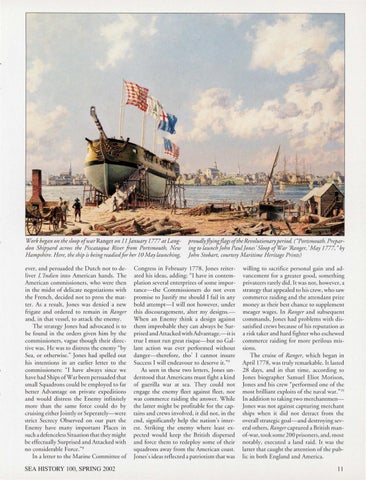
Work began on the sloop ofwar Ranger on 11January 1777 at Langdon Shipyard across the Piscataqua River from Portsmouth, New Hampshire. Here, the ship is being readiedfor her 10 May launching, ever, and persuad ed rhe Durch nor to deliver L 1ndien into American hands. The American co mmissioners, who we re rh en in rhe midsr of delicare negoriarions wir h rhe French, decided nor to press rhe marrer. As a resulr, Jones was denied a new frigare and ordered to remain in Ranger and, in char vessel, to arrack rhe enemy. The srraregy Jones had advocared is ro be found in rhe orders given him by rhe commissioners, vague rhough rheir direcrive was. H e was ro disrress rhe enemy "by Sea, or otherwise." Jones had spelled our his intentions in an earlier letter ro rhe commissioners: "I have always since we have had Ships ofWar been persuaded that small Squadrons could be employed ro far better Advantage on private expeditions and wou ld distress the Enemy infinitely more than the same force co uld do by cruising either Join rly or Seperately-were strict Secrecy Observed on our part the Enemy have many important Places in such a defenceless Situation char they might be effectually Surprised and Attacked with no considerable Force." 8 In a letter ro the Marine Comm ittee of
SEA HISTORY 100, SPRING 2002
proudlyjlyingjlags ofthe Revolutionary period. ("Portsmouth. Preparing to launch John PaulJones' Sloop ofWar 'Ranger,' May 1777, "by John Stobart, courtesy Maritime Heritage Prints)
Congress in February 1778, Jones reiterated his ideas, adding: "I have in contemplation several enterprizes of some importance-the Comm iss ioners do nor even promise to J usrify me should I fail in any bold attempt-I will nor however, under rhis discouragement, alter my designs.When an Enemy chink a design againsr them improbable they can always be Surprised and Attacked wirhAdvanrage.-ir is true I must run great risque-bur no Gallant action was ever performed without danger-therefore, rho' I cannot insure Success I will endeavour ro deserve ir. "9 As seen in these two letters, Jones understood that America ns must fight a kind of guerilla war ar sea. They could not engage the enemy fl eer against fleer, nor was commerce raiding the answer. While the latter might be profitable for the captains and crews involved, it did nor, in the end, significantly help the nation 's interest. Striking the enemy where least expected would keep the British dispersed and force them ro redeploy some of rheir squadrons away from the American coast. Jones's ideas reflected a patriotism rhar was
wi lling ro sacrifice personal gain and advancement for a greater good, so mething privateers rarely did. Ir was nor, however, a strategy that appealed to his crew, who saw commerce raiding and the attendant prize money as their best chance to supplement meager wages . In Ranger and subsequent commands, Jones had problems with dissatisfied crews because of his repu ration as a risk raker and hard fighter who eschewed commerce raiding for more perilous missio ns. The cruise of Ranger, which began in April 1778, was truly remarkable. Ir lasted 28 days, and in that rime, according ro Jones biographer Samuel Eliot Moriso n, Jon es and his crew "performed one of the most brilliant exploirs of rhe naval war. " 10 In addition ro raking two merchantm enJones was nor against capturing merchant ships when it did nor derracr from rhe overal I strategic goal-and desrroyi ng several others, Ranger cap tured a British manof-war, rook so me 200 prisoners, and, most no tably, executed a land raid. Ir was the latter that caught the attention of the public in both England and America.
11