JOHN LYMAN
board of The American Neptune. For a taste of the Lyman method, I suggest examining the famous back-and-forth that he had with Carl C utler in that quarterly over whether the Flying Cloud or the Andrew Jackson (from Cutler's town, Mystic) holds the record around Cape Horn to San Francisco. John Lyman swung in behind Howard Chapelle in Chapelle's contention that the Constellation being restored in Baltimore is the sloop-of-war from the 1850s rather that the frigate from the late 18th century. I contributed a phrase to that one myself: "They are trying to restore a Model A back into a Model T." Lyman, however, brought scholarl y method to the controversy. He contributed (and that is the word; there is no pay for such writing) regularly to Mariner's Mirror, published in London. In 1948, with his wife Mitchell's help, he started cranking out his own publication on a mimeograph machine . This was called Log Chips. Now there is a book-we have had all our mimeographed Log Chips bound into a volume, too. Where else do the three-masted schooners of the East Coast come marching out of mid-century? We march back to meet them in Log Chips, a vessel at a time, starting in 1929 with the Adams built by Storey. They are followed by the three-masted schooners of the West Coast, similarly meticulously arranged . And the barkentines: threemast, four-mast, five-m ast, six-mast. By coast again, East, Gulf, West. And a massive list , running for years, taking the steel and iron sailing ships of the United Kingdom , vessel by vessel, back toward s their beginnin gs. French square-riggers , ship by ship. Danish square-riggers, German sq ua re-riggers, one by one. Then there are the thumb-nail sketches of American shipbuilders, nowhere else to be found between covers: Thoma ston Shipbuilding (Edward O'Brien; Dunn & Elliot; Washburn ; Chapman & Flint and more) , Bath Shipbuilding (Sewall; Houghton; Goss, Sawyer & Packard; Rogers; Minotts; Percy & Small; I. Kelley, Spear), San Francisco Bay Shipbuilders (John G . North ; Matthew Turner), Humboldt Bay Shipbuilders (Murray; Cousins; McWhinney; Matthews; Petersen; Hitchings; Joyce; Bendixsen; Rolph), Coos Bay Shipbuilding (Hans Reed; Asa Simpson; Kruse & Bank s), Port Blakely Shipbuilding (Hall Brothers). This again is just a skimming. John Lyman was the first to pay them all tribute.
*
*
*
SEA HISTORY, FALL 1978
*
There are a number of different responses to the call of the sea. Some build ship models, others read the novels of Conrad. Some contemplate the romance of an old schooner heaving at her moorings. John Lyman found profundities in statistics, and did us all a favor. To the person mooning over the schooner and finding romance there, he says : "There were 123 of those built on the West Coast alone . . . " Think of itwhat you find enchanting can be multiplied by a hundred and twenty three! It is a way of thinking about ships that has always appealed to me. Lyman supplied San Francisco one of its most valuable statistics when he estimated for us one time the number of sailing ship voyages made around Cape Horn to our city-10,000. A figure to conjure with. Another figure that has never been in the books came in a letter last year in a nswer to a request-how many iron and steel sailing ships were built in the British Isles during the last century (really, during the las t half of the century)? Lyman estimated 3,000. There was, for many years, a tendency by even British sea writers to sk ip lightly over this large category and jump from the tea clippers to the age of steam . My last telephone conversation with John Lyman was to ask how many down-Easters (in the sense of New England-built ships and ba rks) were built from the C ivil War to the end of the sailing ship era. He had the sources within reach of hi s telephone; the answer came back in a matter of minutes, 975, give or take a few vessels. For a moment that splendid fleet shone in our eyes at either side of the continent-these were the American merchant ships that set the standard for smartness throughout the world. We deplored the run of books that have been published-the authors dazzled by our two-hundred-odd clipper ships -that purport to be hi stories of our. mercha nt service and which never mention the 975 down-Easters! It was an appropriate and satisfying last conversation. Suddenly, the genius of ship research is no longer there at the other end of the telephone. But he worked hard and quietly in our field and over many years and he has left us a written legacy. John Lyman will always be wit h that part of mankind that mulls the sea and is moved by the wind-moved sh ips once found in numbers on its surface.
.t .t .t Mr. Kortum, chief curator of the Na-
tional Maritime Museum at San Francisco, is a vice president of the National Maritime Historical Society.
Send $1.00 for the next 4 quarterly catalogs. Each has 36 pp. with over 1300 li stings of mostly out¡of ¡print books . ANTHEIL BOOKSELLERS 2177M HS ISABELLE COURT NO . BELLMORE , N.Y.11710
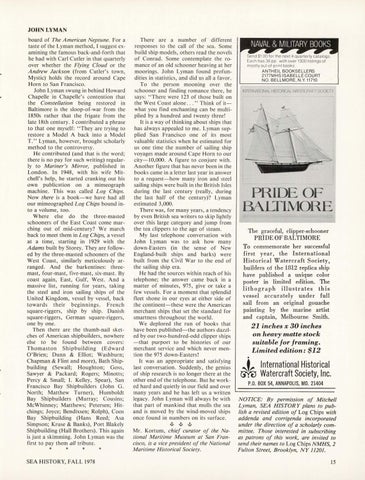
PRIDE OF BALTIMORE The graceful, clipper-schooner
PRIDE OF BALTIMORE To commemorate her successful first year, the International Historical Watercraft Society, builders of the 1812 replica ship have published a unique color poster in limited edition. The lithograph illustrates this vessel accurately under full sail from an original gouache paintin g by the marine artist and captain, Melbourne Smith.
21inchesx30 inches on heavy matte stock suitable for framing. Limited edition: $12
~f~
International Historical
w.c; Watercraft Society, Inc. P.O. BOX 54, ANNAPOLIS, MD. 21404
NOTICE: By permission of Mitchell Lyman, SEA HISTORY plans to publish a revised edition of Log Chips with addenda and corrigenda incorporated under the direction of a scholarly committee. Those interested in subscribing as patrons of this work, are invited to send their names to Log Chips NMHS, 2 Fulton Street, Brooklyn, NY 11201. 15