KAIULANI: DESIGN & CONSTRUCTION
and covered with 3 \14" yellow pine planking. The beams are IO"x 5 \14" T bulbs on 4' -0" centers with a 2 \14" diameter stanchion under each beam at the center. Main deck bulwarks are 5'-0" high of steel with two 3" half round bars at the top edge, and a 3 !12 "x 12" pin rail one foot below, which is swelled out to about 18" in way of the shrouds and belaying pins. She was built to class *3.3.A. l .1. with Bureau Veritas (1899), which is the French equivalent of the American Bureau of Shipping.
Arrangements: In 1899, accommodations although greatly improved from the previous century, still left much to be desired from today's standpoint. The men were housed in the forecastle house, in plain upper and lower berths with a wooden table and benches for dining in the middle of the cabin. A few steps forward under the forecastle, was one open urinal and the luxury of two enclosed toilets! No showers or baths for the crew in those days, but who needed it with the whole ocean and plenty of buckets at hand in good weather! Luxuries were included for the captain, mates and passengers, who had one toilet and one bathtub for only 14 people! In addition, each cabin had a builtin washstand with a stoneware water jug. In contrast to the meager plumbing facilities, these cabins had the look of luxury. They were built with elegant panelled joinerwork and fitted with polished mahogany furniture, curtains and rugs, and a few touches of polished brass hardware . Measured drawings made for the ship's service in the movie "Souls at Sea" give us full detail of these things. A study of the plans will show that the cabins occupied precious little space, the below deck areas being devoted entirely to cargo storage, and being essentially a huge void divided by the lower deck. As befitted a working vessel, the finish outside of the passengers and officers' cabin was quite plain. Painted wood and steel and galvanized iron fittings were the rule.
Rigging: The advantages of steel were obvious by the 1890s, and Kaiulani's rig had one piece steel lower and topmasts, and steel yards for courses and topsails. Only the topgallant masts and topgallant and royal yards were of wood. (These were carried away in a winter gale on her shakedown voyage from New York to
24
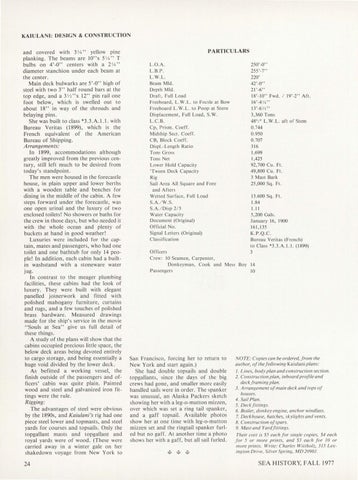
PARTICULARS L.O.A. L.B.P. L.W.L. Beam Mid. Depth Mid. Draft, Full Load Freeboard, L.W.L. to Focsle at Bow Free board L. W. L. to Poop at Stern Displacement, Full Load, S. W. L.C.B. Cp, Prism. Coeff. Midship Sect. Coeff. CB, Block Coeff. Displ.-Length Ratio Tons Gross Tons Net Lower Hold Capacity 'Twee n Deck Capacity Rig Sail Area All Square and Fore and Afters Wetted Surface, Full Load S.A ./W.S. S.A ./ Disp 2/ 3 Water Capac ity Document (Original) Official No. Signal Letters (Original) Classifi cation
250'-0" 255'-7" 220' 42 ' -0" 21 '-6" 18' - 10" Fwd. I 19'-2" Aft. 16'-4!1. .. 13'-6 V2" 3,360 Tons 48°/ 0 L.W.L. aft of Stem 0.744 0.950 0.707 316 1,699 1,425 92,700 Cu. Ft. 49,800 Cu. Ft. 3 Mast Bark 25,000 Sq. Ft. 13.600 Sq. Ft. 1.84 1.11 5,200 Gals. January 16, 1900 161,135 K.P.Q.C. Bureau Veritas (French) to Class *3.3.A.l.I. (1899)
Officers 3 Crew: 10 Seamen, Carpenter, Donkeyman, Cook and Mess Boy 14 Passengers IO
San Francisco, forcing her to return to New York and start again.) She had double topsails and double topgallants, since the days of the big crews had gone, and smaller more easily handled sails were in order. The spanker was unusual, an Alaska Packers sketch showing her with a leg-o-mutton mizzen, over which was set a ring tail spanker, and a gaff topsail. Available photos show her at one time with leg-o-mutton mizzen set and the ringtail spanker furled but no gaff. At another time a photo shows her with a gaff, but all sail furled.
NOTE: Copies can be ordered, from the author, of thefollowing Kaiulani plans: I. Lines, body plan and construction section. 2. Construction plan, inboard profile and deck framing plan. 3. Arrange111ent of main deck and tops of houses. 4. Sail Plan. 5. Deckfirtings. 6. Boiler, donkey engine, anchor windlass. 7. Deckhouse, hatches, skylights and vents. 8. Construction ofspars. 9. Mast and Yard fittings. Their cost is $5 each for single copies, $4 each for 5 or 111ore prints, and $3 each for JO or more prints. Write: Charles Wittholz, 315 Lexing1on Drive, Silver Spring, MD20901.
SEA HISTORY, FALL 1977