record player was wound up and they listened to Christmas carols until out on deck the fo'csle bell was rung loudly four times-it was six o'clock and the port watch wanted their turn at the dinner table. The seamen switched off the record player and came on deck to find the wind had increased so much the other watch had brailed up the fore topgallant and the mainsail. The port watch mounted the main shrouds to
" 'Merry Christmas!' The lonely cry, thinned by the wind and the space of the sea, was heard by the men struggling with the fore topgallant." take in the mainsail while the starboard watch scrambled up to furl the fore topgallant. From the deck where the cook and his mates watched, the men strung out on the yards were like blackbirds sitting on the arms of telephone poles. One of the port watch shouted to the sailors on tne next mast, "Merry Christmas!" The lonely cry, thinned by the wind and the space of the sea, was heard by the men struggling with the fore topgallant. One of them called back, "Merry Christmas." The holiday greeting echoed again and again, from watch to watch, yard to yard, across the void of dusk. Homesickness came wave on wave as Harry beat with callused fists upon the hard canvas of the sail which was wet from the wind-whipped fog. "Merry Christmas ... Merry Christmas ... Merry Christmas." Never before had he been away from those he loved at this time of year. As he climbed with his watchmates down the shrouds of the rolling ship he thought how far he was from his homeland, from where he had grown up and first touched earth. Where as a child he had run through the sun dried fields of grass, his feet stirring dust from the parched earth, until he had come to the Alameda shore of the Oakland Estuary and looked up in surprised wonder at the brightly painted figurehead of a sailing ship. The woman carved of wood beneath the bowsprit of the Mary Dollar had looked down unblinkingly. The old windjammer, rusting and idle and forgotten yet romantic and magnificent with her tall masts and crossed yards, had swept him up in a dream which he had followed to the bottom of the earth on this Christmas Eve fifteen years later.
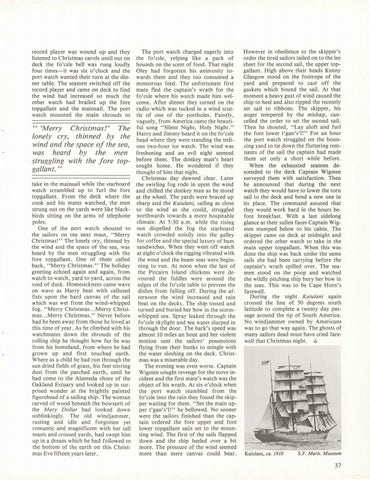
The port watch charged eagerly into the fo'csle, yelping like a pack of hounds on the scent of food. That night Oley had forgotten his animosity towards them and they too consumed a monstrous feed. The unfortunate first mate fled the captain's wrath for the fo'csle where his watch made him welcome. After dinner they turned on the radio which was tucked in a wind scuttle of one of the portholes. Faintly, vaguely, from America came the beautiful song "Silent Night, Holy Night." Harry and Jimmy heard it on the fo'csle head where they were standing the tedious two-hour ice watch. Thi! wind was freshening and an evil night seemed before them. The donkey man's heart sought home. He wondered if they thought of him that night. Christmas day dawned ¡clear. Later the swirling fog rode in upon the wind and chilled the donkey man as he stood at the wheel. The yards were braced up sharp and the Kaiulani, sailing as close to the wind as she could, struggled northwards towards a more hospitable climate. At 5:30 a.m. while the rising sun dispelled the fog the starboard watch crowded noisily into the galley for coffee and the special luxury of ham sandwiches. When they went off watch at eight o'clock the rigging vibrated with the wind and the beam seas were beginning to run. At noon when the last of the Pitcairn Island chickens were devoured the fiddles were around the edges of the fo'csle table to prevent the dishes from falling off. During the afternoon the wind increased and rain beat on the decks. The shjp tossed and turned and buried he!' bow in the stormwhipped sea. Spray leaked through the fo'csle skylight and sea water slurped in through the door. The bark's speed was almost 1O miles an holl{ and her violent motion sent the sailors' possessions flying from their bunks to mingle with the water sloshing on the deck. Christmas was a miserable day. The evening was even worse. Captain Wigsten sought revenge for the stove incident and the first mate's watch was the object of his wrath. At six o'clock when the port watch stumbled from the fo'csle into the rain they found the skipper waiting for them. "Set the main upper t'gan's'l!" he bellowed. No sooner were the sailors finished than the captain ordered the fore upper and fore lower topgallant sails set to the mounting wind. The first of the sails flapped down and the ship heeled over a bit more. The pressure of the wind seemed more than mere canvas could bear.
However in obedience to the skipper's order the tired sailors tailed on to the lee sheet for the second sail, the upper topgallant. High above their heads Kenny Glasgow stood on the footrope of the yard and prepared to cast off the gaskets which bound the sail. At that moment a heavy gust of wind caused the ship to heel and also ripped the recently set sail to ribbons. The skipper, his anger tempered by the mishap, cancelled the order to set the second sail. Then he shouted, "Lay aloft and furl the fore lower t'gan's'l!" For an hour the port watch struggled on the bouncing yard to tie down the fluttering remnants of the sail the captain had made them set only a short while before. When the exhausted seamen descended to the deck Captain Wigsten surveyed them with satisfaction. Then he announced that during the next watch they would have to lower the torn sail to the deck and bend a new one in its place. The command assured that they would work hard in the hours before breakfast. With a last sidelong glance at their sullen faces Captain Wigsten stumped below to his cabin. The skipper came on deck at midnight and ordered the other watch to take in the main upper topgallant. When this was done the ship was back under the same sails she had been carrying before the captain's wrath spilled over. The seamen stood on the poop and watched the wildly pitching ship bury her bow in the seas. This was to be Cape Horn's farewell. During the night Kaiulani again crossed the line of 50 degrees south latitude to complete a twenty day passage around the tip of South America. No windjammer owned by Americans was to go that way again. The ghosts of many sailors dead must have cried farewell that Christmas night. w
-
Kaiulani, ca. 1910
S.F. Marit. Museum
37