
SPRING EDITION 2023 THE OFFICIAL MAGAZINE OF THE STEEL ERECTORS ASSOCIATION OF AMERICA TO TRY Taking You From Planning to Execution 22 Make Safety Proactive 26 Sling Inspection Reminders 35 Membership Directory



OUR
ERECTING DETAILING ESTIMATING FABRICATING DESIGN BUILD PROJECT MANAGEMENT BUILD HELPING YOU A FUTURE STRONGER WWW.COOPERSTEEL.COM NASHVILLE, TN SHELBYVILLE, TN FLORENCE, KY (9 3 1) 6 8 4 - 796 2
SERVICES
CHARLOTTE CONVENTION CENTER | APRIL 12–14, 2023
incorporating World Steel Bridge Symposium | QualityCon | Architecture in Steel | SafetyCon SSRC Annual Stability Conference | NISD Conference on Steel Detailing
250 exhibitors
Earn up to 17 PDHs
Nearly 200 sessions
Mark your calendars for The Steel Conference: THE premier event for everyone involved in the design and construction of steel-framed buildings and bridges.
Steel Fans, Start Your Engines... Registration is NOW OPEN! aisc.org/nascc


c•ntents
FEATURES Management
Making Safety Proactive
Understanding how behavioral safety is different from traditional training.
By Tucker Smith
In the Field
Qualifying Ironworkers for Rigging
Sling inspection reminders for ironworkers includes what to watch for and how to prevent damage.
 By Tracy Bennett
Special Focus Member Directory
Meet the leadership team and find members across the country.

Cover Story
Tech Tools to Try
Six technologies to take you from planning to execution
By Tracy Bennett
On the Cover: CM Labs Simulations provides tools for training crane operators. Lifting steel structures is just one of many steel structures is just one of many training exercises included in their crane training modules.
Above: Illinois steel erector Area Erectors, Inc. regularly uses A1A Software’s 3D Lift Plan for planning and executing lifting tasks on its projects.

seaa.net
ONLINE HIGHLIGHTS
Q New Standard for Self-retracting Devices
Q Wind Hazards on MEWPs
Q SEAA launches SteelPros learning management system and Ironworker Training Videos


Q NCCER partners with Procore Technologies for Workforce Development
Check out our latest social media feeds.

OPT-IN for our e-Newsletters web.seaa.net/publications/subscribe.aspx
DEPARTMENTS
8 Perspective
12 Association News
14 Product Focus
46 Business Operations
50 Topping Out
The Steel Erectors Association of America (SEAA) is dedicated to advancing the common interests and needs of all engaged in building with steel. The Association’s objectives in achieving this goal include the promotion of safety, education and training programs for steel erector trades, development and promotion of standards and cooperation with others in activities which impact the commercial construction business.
Edition March 2023 4 | THE STEEL ERECTORS ASSOCIATION OF AMERICA
Spring
26 35 22
30
IF YOU LIFT, ERECT, HAUL, OR RIG IT: WE INSURE IT.
IF YOU LIFT, ERECT, HAUL, OR RIG IT: WE INSURE IT.


IF YOU LIFT, ERECT, HAUL, OR RIG IT:
M & P S p e c i a l t y I n s u r a n c e p r o v i d e s i n s u r a n c e a n d r i s k m a n a g e m e n t s e r v i c e s f o r h e a v y l i f t i n g a n d m o v i n g i n d u s t r i e s .
N D U S T RY
I N D U S T R Y
S P E C I A L T I E S :
S P E I A LT I E :
S T E E L E R E C T O R S
T E E L E R E C T O R S
H E A V Y H A U L E R S
AV Y A U L E R S
A R E N TA L
C R A N E R E N T A L
R I G G I N G
G G N G
F A B R I C A T O R S
A B R I C AT O R S
S T R U C T U A L M O V E R S
T R U C T U R A L M OV E R S
THE M&P DIFFERENCE
THE M&P DIFFERENCE
THE M&P DIFFERENCE
L i c e n s e d n a t i o n w i d e , M & P S p e c i a l t y I n s u r a n c e o f f e r s c o m p r e h e n s i v e c o v e r a g e , e x c e l l e n t c u s t o m e r s e r v i c e , a n d c o m p e t i t i v e p r e m i u m s U n d e r w r i t t e n b y A + r a t e d c a r r i e r s , o u r t e a m e m p h a s i z e s t h e i m p o r t a n c e o f a l i g n m e n t b e t w e e n i n s u r a n c e p r o d u c t s , c o n t r a c t u a l d e t a i l , a n d r i s k m a n a g e m e n t p r a c t i c e s .
L i c e n s e d n a t i o n w i d e , M & P S p e c i a l t y I n s u r a n c e o f f e r s c o m p r e h e n s i v e c o v e r a g e , e x c e l l e n t c u s t o m e r s e r v i c e , a n d c o m p e t i t i v e p r e m i u m s . U n d e r w r i t t e n b y A + r a t e d c a r r i e r s , o u r t e a m e m p h a s i z e s t h e i m p o r t a n c e o f a l i g n m e n t b e t w e e n i n s u r a n c e p r o d u c t s , c o n t r a c t u a l d e t a i l , a n d r i s k m a n a g e m e n t p r a c t i c e s .
L i c e n s e d n a t i o n w i d e , M & P S p e c i a l t y I n s u r a n c e o f f e r s c o m p r e h e n s i v e c o v e r a g e , e x c e l l e n t c u s t o m e r s e r v i c e , a n d c o m p e t i t i v e p r e m i u m s U n d e r w r i t t e n b y A + r a t e d c a r r i e r s , o u r t e a m e m p h a s i z e s t h e i m p o r t a n c e o f a l i g n m e n t b e t w e e n i n s u r a n c e p r o d u c t s , c o n t r a c t u a l d e t a i l , a n d r i s k m a n a g e m e n t p r a c t i c e s .
M P S P E C I A L T Y . C O M C O N T A C T J A S O N M C E L R A T H T O D A Y 1 1 7 9 S u n s e t B l v d W e s t C o l u m b i a , S C 2 9 1 6 9 | 8 0 3 - 9 3 6 - 1 6 0 1 | J a s o n @ M P S p e c i a l t y c o m
M P S P E C I A L T Y . C O M C O N T A C T J A S O N M C E L R A T H T O D A Y 1 1 7 9 S u n s e t B l v d W e s t C o l u m b i a , S C 2 9 1 6 9 | 8 0 3 - 9 3 6 - 1 6 0 1 | J a s o n @ M P S p e c i a l t y c o m
M P S P E C I A L T Y . C O M
C O N T A C T J A S O N M C E L R A T H T O D A Y 1 1 7 9 S u n s e t B l v d W e s t C o l u m b i a , S C 2 9 1 6 9 | 8 0 3 - 9 3 6 - 1 6 0 1 | J a s o n @ M P S p e c i a l t y c o m
Resources For Your Business Worth 18 X More Than Average Membership Fee
SOLUTIONS
Valued at $24,000
$2,400
$10,000 per member
SteelPros Training Portal

DISCOUNTS TO STRETCH
Savings of $6,500
$2,500 in first year & $1,250 each subsequent year
THE OFFICIAL MAGAZINE OF THE STEEL ERECTORS ASSOCIATION OF AMERICA
SEAA is the only national trade association representing the interests of steel erectors, fabricators, and related service providers. Connector reaches both small and large contractors working in union and open labor markets.

Premium
$1,000+ per year
Workers Comp Program provides opportunity to earn

5% return based on injury performance
BBSI reimburses companies for achieving and maintaining AISC certification
$1,000 per member
SEAA Erector Members receive 50% discount on AISC Membership
Steel Erectors Association of America
353 Jonestown Rd, Suite 207
Winston-Salem, NC 27104 336-294-8880 www.seaa.net
OFFICERS & EXECUTIVE STAFF
David Deem, President
Jack Nix, President Elect
Chris Legnon, Industry Member Vice President
Carrie Gulajan, Associate Member Vice President
Bryan McClure, Secretary
Greg Phillips, Treasurer
R. Pete Gum, Executive Director
PUBLISHING PARTNER
Chris Harrison, Publisher connectorsales@seaa.net
Phone 660-287-7660
Tracy Bennett, Managing Editor editor@seaa.net
Phone 816-536-7903
Macie Murie, Assistant Editor macie@mightymomedia.com
Roger Ridpath, Art Director roger@ridpathcreative.co m 816-792-9669
ADVISORY COMMITTEE
Chris Legnon, Chairman, Cooper Steel
Glen Pisani, Vice Chairman, MAS Building & Bridge
Nathan Bloch, SDS2
Nick Caratelli, Nelson Stud Welding
Oliver Gleize, OTH Rigging
John Hughes, Industrial Training International
Kris McLean, High Plains Steel Services
Jackson Nix, Shelby Erectors
Jim Simonson, Steel Service
Michael Waltman, Group Steel Erectors
Connector™ is published quarterly by the Steel Erectors Association of America 353 Jonestown Rd, Suite 207 Winston-Salem, NC 27104
Copyright 2023 by the Steel Erectors Association of America. No material may be reprinted without permission from the Executive Director. While the information and recommendations contained in this publication have been compiled from sources believed to be reliable, the Steel Erectors Association of America, its affiliates, employees, contributors, writers, editors, designers, photographers, and media advisory committee, makes no guarantee as to, and assumes no responsibility for, the correctness, sufficiency or completeness of such information or recommendations and cannot be held responsible for the outcome of any action or decision based on the information contained in this publication or claims made by advertisers. No part of this publication may be reproduced in any form without prior written permission of the Publisher. Permission is only deemed valid if approval is in writing.

6 | THE STEEL ERECTORS ASSOCIATION OF AMERICA
per year Job Board and Applicant Tracking System
per member Ironworker Craft Training & Assessments Program
per year Workers Comp Insurance Program provides Immediate 10% discount on
$10,000
>$2,000
TO WORKFORCE CHALLENGES
WE ARE STEEL STRONG JOIN TODAY AT SEAA.NET
YOUR INVESTMENT
Average Member Fee $1,640 | Value of Services greater than $30,000 annually SEAA-2/3 page ad for Connector AD 01-25-22-A.indd 1 2/23/23 10:38 AM

5 Issues Facing Steel Construction
As an association we monitor the demographics of our membership, including company size, geographic location, and shifts in the core business makeup. This helps us to evaluate the programs and services that will best meet the needs of the variety of companies who are members of SEAA. As we start a new year, we asked several members of SEAA’s Executive Committee to weigh in on the industry-specific issues that they are following in 2023, which also helps to inform future program development.
Make Hiring a Process not a Game of Darts
Jack Nix, COO, Shelby Erectors, Inc., Florida


Labor shortages have been an issue for so long now that we sound like a broken record. Over the years contractors have responded in predictable ways— with increasing pay, incentives to keep retirement-age workers longer, and being hesitant to lay off workers regardless of the project activity, to name a few.
The real change that needs to happen is to take a hard look at recruiting and hiring processes. For small contractors, this is critical to putting you in a competitive position with larger companies. There is both an art and a science to it. The art part is knowing what your company’s core values are and effectively communicating that in your advertising. The science part is using automated tools like applicant tracking systems to build an efficient hiring process. When you start hiring for quality, not just quantity, the labor shortage issue becomes less acute. Check out great resources on this topic at careerplug.com.
Be Intentional with Developing Field Leaders and Managers
David Deem, President, Deem Structural Services, Texas


Strong craft skills training is foundational to construction operations, but equally important is leadership training for field and company managers. Developing leadership skills is critical to employee retention and to building a pipeline of experienced people in your company. This means knowing how to identify people who are a fit
with your company culture and then assessing what specific skill sets they need to work on. The person might need to work on communication, planning and project management, using technology, dealing with stress or conflict. Some resources to explore include new Fundamentals of Crew leadership curriculum from NCCER or programs from FMI for Emerging Leaders, Field Leaders, or Project Managers.
Have a Plan for Adopting New Technology
Chris Legnon, Vice President, Technology, Cooper Steel, Tennessee
Changing processes, whether that is internal business systems or construction techniques, requires first selecting the right technology for your business. That means thinking outside the box about your current processes and actively researching new products coming to market. Attending tradeshows and subscribing to tech-focused newsletters or podcasts are good ways to stay in the know.
One of the biggest challenges with process improvement is the cultural resistance that comes with change. Successful implementation requires top-down buy-in, communicating to those impacted what the big picture is, and providing training on how to use the new technology. Sometimes a new method might take one person longer to do their job but has huge benefits or time savings for someone further down the line. In addition, improvements may not be realized immediately. Being open about that with the team improves adoption. Finally, inviting feedback from the people familiar with the process along the way is also valuable.
As one project is implemented successfully, the next becomes easier as teams begin to realize that change is not necessarily bad.
The Big 3 in Safety are Fall Prevention, Head Protection, and Mental Health
Bryan McClure, Partner, Trivent Safety Consulting, Colorado
Three things that are top of mind for ironworker safety in 2023 are fall prevention, head protection, and mental health. Fall prevention is nothing new for ironworkers but we never stop thinking about it, evaluating the market for the newest products
8 | THE STEEL ERECTORS ASSOCIATION OF AMERICA PERSPECTIVE By R. Pete Gum
Pete Gum is the Executive Director of SEAA. Contact him at pete@seaa.net.

October 12, 2023
Board Meeting, Peer Group, and Meet & Greet
Raleigh, NC
October 13, 2023
Golf Tournament
Lonnie Poole Golf Course

North Carolina State University
Registration Opens May 1, 2023 at SEAA.net
and looking for better ways to integrate systems and methods on the job. The one piece of news we are watching is the updated ANSI Z359.14 standard for self-retracting devices, which goes into effect August 1.
The debate in safety circles around new hard hats is that OSHA regulations lag newer industry standards, and those standards lag behind the newest technology that provides better protection against rotational forces and falling objects. The problem is also that GCs are starting to require newer safety helmets with chin straps but there is a supply issue limiting availability.
And finally, the elephant in the room is mental health and suicide in construction. It’s a complex problem that does not have a straightforward fix. Tough-Guy culture, the frequency of Opioid prescriptions for injuries, lack of training for how to identify warning signs and how to respond in a work environment, and disconnect between HR, Safety, and Operations in the corporate structure all play parts in improving the situation.
The Effects of Inflation and Supply Chain Woes on Insurance Premiums
Carrie Gulajan, President, Construction Insurance Agency, Virginia

Inflation has a trickle-down impact on everything, including insurance, which makes risk management to control claims ever more critical. Regardless of your safety record, contractors are facing rising premiums. Insurance carriers are seeing increases in claims handling along with direct costs of materials and labor to repair or replace damaged goods, along with longer wait times for such goods. For larger claims, even sending an adjuster onsite increases the claim expense as a result of increased travel costs.
Likewise, contractors need to be prepared for the rising costs associated with doing business after a claim. Finding a replacement for the crane that turned over is harder. Rental companies are strapped because manufacturers’ supply is limited. That might mean you have to get a replacement from further away, increasing logistics expenses. Not to mention the price of fuel.
Cyber security breaches are another example. In addition to the financial loss, the steps associated with breach notification compliance can be lengthy and expensive, so it is best to review the policy. Your best option is to discuss with your insurance agent what policies may be available and obtain risk management assistance and safety consultation. •
10 | THE STEEL ERECTORS ASSOCIATION OF AMERICA
DaveSchulzGolfTournAd-2023-02-09-23-B.indd 1 2/9/23 12:38 PM
“The elephant in the room is mental health and suicide in construction.”


EMPLOYEE OWNED
EVENTS & ACTIVITIES
CONEXPO-CON/AGG
Las Vegas, Nev.
March 14-18, 2023
2023 Convention & Trade Show
St. Augustine, Fla.
March 28-31, 2023
NASCC: The Steel Conference
Charlotte, N.C.
April 12-14, 2023
Summer Board Meeting Meet & Greet
Irving, Texas
July 20, 2023
ASSOCIATION NEWS
■ SEAA partners with GMF Steel Group, Members for Career Event
In January, SEAA held its second Career Fair to spread awareness about the career opportunities available in the steel construction industry. Hosted by member company GMF Steel Group in Lakeland, Fla., the Career Fair brought together approximately 100 students from five local high schools and 70 students from technical colleges.
“As an association, one of our goals is to invest in the future of the steel construction industry. One way we can do that is by working with our member companies to host these types of educational events,” said Pete Gum, SEAA’s Executive Director.
“While it can be difficult to know exactly how many students end up having a career in the steel industry, we are making a difference for members and their local communities by showcasing what the skilled trades have to offer,” said David Deem, President of SEAA and President of Deem Structural Services.
Sporting hard hats, vests, and other PPE provided by sponsor Columbia Safety and Supply, students rotated through 13 stations staffed by SEAA members and equipment suppliers. Florida based contractors who participated were GMF Steel Group, Bowman Steel, Gardner-Watson Decking, Gardner-Watson Studs, and Shelby Erectors.
Students could observe or participate in hands-on demos of welding, steel modeling, rebar tying, surveying, decking, and more. Trivent Safety Consulting led the students in a dynamic stretch routine to highlight the importance of physical health in the skilled trades. Industrial Training International provided a Virtual Reality crane operator simulator experience. Others stations included:

• Certified Slings and Supply, Safety Equipment Station
• GMF Steel Group, Rigging & Surveying and Quality Control
• Hilti, Stand-up Decking Tool Station
• National Center for Construction Education & Research
• Nelson Stud Welding, Stud Welding Station
• Red-D-Arc, Welding Station
• SafeWaze, Fall Protection Station
• SDS2, Steel Modeling Station
The response was positive from both students and teachers in attendance. “This hands-on event helped to reinforce everything we have been telling our students about having a career in the trades,” said Thomas Hoien, a teacher at Fort Meade Construction Academy. “Being able to get them out of the classroom where they can try different tasks, see the technology being used, and ask questions gets them excited for the future.”
Following the career fair, GMF Steel Group received inquiries about its Structural Steel Ironworker Apprenticeship Program. Introduced last year, the program uses the SEAA/NCCER curriculum, which provides nationally recognized credentials. Participation in training is free and all apprentices employed by GMF Steel Group qualify for employee benefits. “We are offering a career path—by teaching a skilled trade and providing the opportunity to work toward many different roles within the company,” said Andy Norman, President of GMF Steel Group.
“From GMF Steel’s commitment to host and coordinate with schools, demo stations executed by many companies, to lunch provided by Gardner-Watson Decking, the support of our member companies doesn’t go unnoticed and the event wouldn’t have been a success without them,” said Gum.
■ Preferred Vendor BBSI Now Offers Discounted Workers’ Comp Insurance for SEAA Members
SEAA announces that it has partnered with BBSI to provide a special insurance program in which SEAA members receive an automatic 10 percent discount on their workers compensation premium, as well as an opportunity to earn back 5 percent based on claims performance.
BBSI is a leading provider of organizational infrastructure solutions that are customized to the unique needs of business owners in all 50 states. Member companies will be assigned to a dedicated team to provide support for loss control, human resources, employee recruiting and retention, payroll and timekeeping. Other benefits include access to group health insurance, 401k, a learning management system, and more. More information can be found at bbsi.com. Contact Tucker Smith at tucker.smith@bbsi.com for more information on the SEAA program. •
12 | THE STEEL ERECTORS ASSOCIATION OF AMERICA
Industrial Training International provided a Virtual Reality crane operator simulator experience.

■ Exhibitors Preview New Products
SEAA’s 2023 trade show, to be held in St. Augustine, Fla., features more than 40 exhibitors. The following vendors announce new products for steel the construction market. Check out the full list of exhibitors online at the Trade Show link on the SEAA Convention & Trade Show page.

■ JLG Introduces Self-Leveling Boom Lift to North America
JLG Industries, Inc., has released the JLG® 670SJ self-leveling boom lift to the North American market. The 670SJ automatically adapts to terrain on slopes up to 10 degrees in any direction, while driving with full functionality at 67-ft platform height.

The 670SJ’s is designed to adjust the boom lift’s chassis to the ground conditions, rather than having to adjust the ground conditions to the machine. This allows the boom lift to navigate uneven terrain while driving at height from one job to the other without lowering the boom, leading to significant productivity gains throughout the workday.
The boom lift allows for 73-ft work height and 57-ft of horizontal reach, with 550-lb unrestricted and 750-lb restricted capacities, and is has three operating modes. Self-leveling mode enables the machine to work at full height on slopes up to 10 degrees. Travel mode can be used when the boom is stowed to move across the job site at a faster speed, and shipping mode allows the entire machine to be lowered once in position on a truck, reducing its travel height.
14 | THE STEEL ERECTORS ASSOCIATION OF AMERICA
PRODUCT FOCUS


336-294-8880 • info@seaa.net MARCH 28 - 31, 2023 World Golf Village Renaissance Resort • St. Augustine, FL 2023 CONVENTION & TRADE SHOW Golf, Fishing & Excursions Panel Discussions Education Sessions on Business, Technical Field Practices, & Safety Trade Show and Live Demos Networking at Receptions & President’s Dinner Connecting Leaders, Creating Community Steel Strong in St. Augustine
■ Unique Anchor System Saves Contractors Time and Money
Hilti North America, a global leader providing innovative tools, technology, software, and services to the commercial construction industry, introduces the Kwik-X Dual Action Anchor system, the first of its kind on the market, combining the high performance of adhesive anchors and installation speed and simplicity of screw anchors.

Reducing multiple steps in the traditional adhesive anchor installation process, Kwik-X reduces costly man hours and jobsite expenses. Kwik-X can reduce installation time by up to 70 percent and save up to 20 percent in total cost of installation when compared to traditional adhesive anchoring systems.

Comprised of the convenient Kwik-X pre-portioned adhesive capsule and Kwik HUS-EZ screw anchor, the system provides the necessary performance for safety-critical applications. It reduces the number of steps in the installation process, such as hole cleaning, curing time, and dispensing – eliminating adhesive waste and the need for accessories like brushes, air compressors, and dispensers.
This simplicity results in increased productivity by reducing the risk of human error. Additional features such as high performance in real jobsite conditions and the capability to remove and reinstall the anchor in the same borehole help cater to the needs of the installer. These factors help save contractors time and money.
■ Exclusive Turn-of-Nut Wrenches Released by GWY
Founded in 1975 as TC Bolt Corporation, GWY, LLC, has grown to be a global leader specializing in the sales, rental, repair, and calibration of industrial installation tools and wrenches. We provide several product lines equipped to handle the most demanding applications and projects from all over the world.
In partnership with TONE, we’ve combined years of bolt fastening experience with quality wrench manufacturing to custom design our exclusive line of turn-of-nut wrenches. Installing hex-head bolts using the turn-of-nut method enhances steel erection by taking the guess work out of each bolt installation.
Compatible with ¾” up to 1-½” bolt diameters, the GPTN turn-of-nut wrench series features LED indication lights, overload protection, and an integrated reverse kit. This series of installation wrenches automatically tightens the bolt assembly to the preset rotation and meets the high state and federal standards for structural fastening without the need for jobsite calibration.
However, calibration is necessary for certain installation wrenches and tools at least once a year to verify that they’re operating accurately and reliably. Our newly upgraded calibration equipment offers in-house calibration of pneumatic, electric, hydraulic, and hand torque wrenches, as well as bolt tension calibrators.
■ New Miller Welding System Designed for Structural Fabrication and Steel Erection
New XMT® 650 ArcReach® Systems from Miller Electric Mfg. LLC are designed to maximize productivity and cost savings while delivering the power needed for structural fabrication and steel erection welding. Point-of-use control lets users weld and gouge with a single system and easily make process changes at the feeder without a control cable. These features improve productivity and deliver cost savings while providing the robust power needed on the jobsite and in the shop.

The system’s two parts are an XMT 650 ArcReach power source and an ArcReach 16 wire feeder. Configurations are available for field and shop applications, with polarity-reversing (PR) and non-polarity-reversing power source models — both compatible with the ArcReach 16 wire feeder. The remote polarity-reversing model lets operators switch polarity at the feeder, so they can quickly change between welding and gouging without having to walk back to the power source.
When it comes to power, XMT 650 ArcReach Systems remove more material per pass when gouging without sacrificing control; the power source is rated for 3/8-inch carbon. The ability to use large-diameter filler metal wires and large wire coils also helps operations improve project timelines and minimize downtime.
16 | THE STEEL ERECTORS ASSOCIATION OF AMERICA
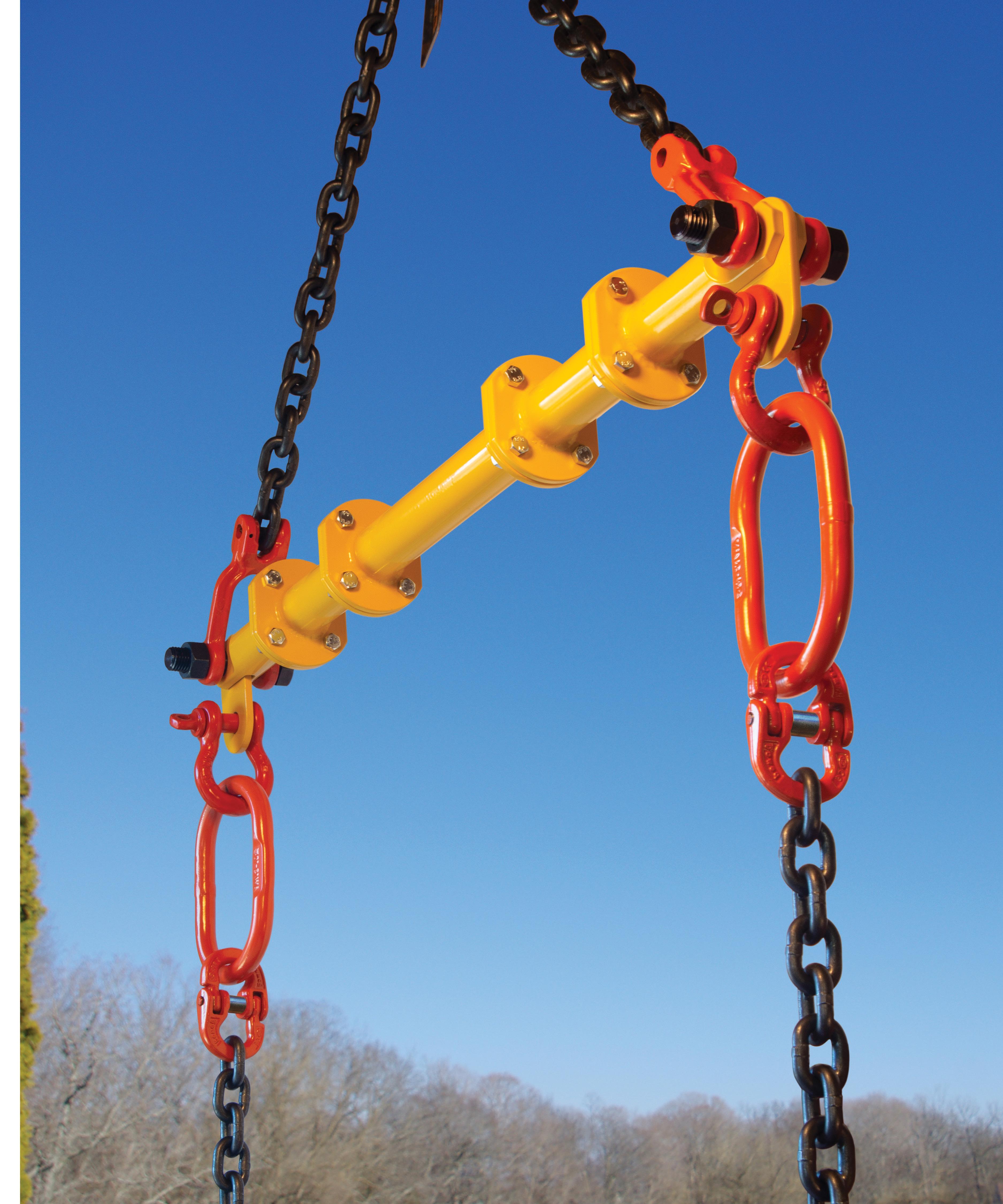

Modulift’s versatile and cost-effective Modular Spreader Beams along with pewag’s state-of-the-art quality lifting chain and components provide the ideal solution to simplify your lift! 800.526.3924 sales@pewagchain.com pewagchain.com
■ Liebherr Debuts LR1400SX Crawler Crane

The New LR 1400 SX Liebherr Lattice Boom Crawler Crane is built for Construction work with a maximum load capacity of 441 tons up to a 16-foot radius. The main boom measures 312 feet, with a Luffing jib providing up to 371 feet of additional lift height. Maximum hoist height is 574 feet, and maximum lift radius is 407’. It has a 603-horsepower diesel engine that allows extra power/ speed for boom and swing while traveling with a load on the hook.
Transport weight for the LR 1400 SX crane is 50 tons, and platform and railings remain attached to the upper carriage during transportation and fold down when at jobsite. The machine totally self-assembles, and it is possible to operate the machine with remote control if so needed.
The four crawler drives enable the LR1400SX crane to maneuver on job sites where space is tight, including track width adjustment that allows access on narrow roads.
■ Deltek ComputerEase Introduces Equipment Center
Deltek ComputerEase is the leading construction software provider of job cost accounting, project management and payroll services. Contractors stay in control from any location, offering affordable tools to proactively manage jobs, inventory, finances and people, mobilizing the office to the field. Deltek’s dedicated team is committed to providing service excellence, product innovation and adapts to the evolving industry and legislation. Thousands of companies have entrusted Deltek ComputerEase for decades to beat the competition, increase profits and earn money back.
Deltek ComputerEase recently introduced the Equipment Center, allowing your information to integrate with job costing, purchasing, and invoicing while providing real-time access so that you will know where you stand on every job—from anywhere, at any time. To better control your equipment expenses, Deltek ComputerEase helps you determine the real cost of ownership and operation, monitoring the overall performance and location of each piece. Not only can Deltek ComputerEase help you manage the internal use of your equipment and tools, but if you have the need to rent them out to third parties, Deltek ComputerEase can handle that too. You can quickly set up pricing and charge accurate rates. Even swap your equipment to and from jobs without affecting billing.

■ Lincoln Electric Maverick 325X
The Maverick® 325X delivers the industry’s next-generation of compact, diesel engine driven welder/generators. The Maverick 325X provides the latest welding technology, including a next-gen display, optimized weld modes, and advance engine monitoring. The machine promotes fuel savings with variable engine RPM and auto start/stop capabilities, and delivers plenty of jobsite power with 400 amps of welding output and 10kW of clean, single-phase auxiliary power. This multi-process machine optimizes performance with specialized stick modes, wire welding capability, and direct-connect spool gun for pulsed aluminum welding. The Maverick 325X offers advanced machine control with 4.6-inch digital display of process setup, maintenance reminders, and PIN authorization. Auto-Stop/Start Technology saves fuel, prevents excessive engine wear and reduces emissions by automatically turning off the engine during idle periods and restarting when welding resumes. The embedded CrossLinc® technology enables voltage control at the arc and improves jobsite safety and efficiency by eliminating the need for extra wires and controls.

18 | THE STEEL ERECTORS ASSOCIATION OF AMERICA

■ Steel Erectors Save Hours with Remote-Controlled Crane Hooks

OTH Pioneer Rigging, Montreal, Quebec, announces new lifting hooks that are remotely controlled to allow workers to release rigging from loads safely from a distance. With unlimited hooks synchronized on the same remote, users can design their own setup. Both models (4,400-lb and 11,600-lb Working Load Limit) work with vertical, basket, or choker setups and any kind of attachment (wire rope, nylon rope, chains, eye bolts, etc.) to lift up to 100,000 lbs. For high cycle tasks such as steel erection the remote-controlled hook can save up to four hours of the time it takes to release loads over the course of the day.
With a range of 200 ft, the remote control is color-coded to coordinate with hooks, which can be opened all at once or one at a time. The shape of the hook is designed for work in harsh environments, and features long-lasting battery life, capable of making more than 100 lifts per day for a full week before recharging is required. More than 400 units are already in use in North America. The hooks are ASME, UL/CSA, and FCC/IC compliant. OTH Pioneer Rigging has permanent customer service with shipping on spare parts and accessories in less than 24 hours, offers annual inspections, and offers new users the opportunity of a oneweek free trial.

■ Red-D-Arc Now Offers Tru-Weld TW6900 Stud Welder
Red-D-Arc offers the Tru-Weld TW6900 Stud Welder, a fully-integrated 3000A single-gun stud welding system, and a dual-gun system, the Tru-Weld TW6902. Designed to perform the most challenging stud welding jobs, this system includes a TW6900 power supply, TWE17000 HD stud gun and all required cables. It’s made in America and has an enhanced duty cycle making it excellent for production environments. The system has an improved user interface that makes setting it up more intuitive with digital controls for time and current, and comes equipped with factory and customizable presets.

It includes PRO-TECH’D technology that protects gun circuitry. Fine tune your stud welding with features that improve weld control, prevent double triggering, save on chuck wear and count studs so you don’t have to keep track while you're working. For more information about the Tru-Weld TW6900 visit reddarc.com or call your Red-D-Arc representative today.
■ New XStep from Skyjack Addresses Problem of Standing on Scissor Rails
Safety has always been at the forefront of Skyjack’s development and the new XStep is no exception. The most recent IPAF Global Safety Report cited falls from the platform to be among the most common type of incidents leading to death – a finding that has remained consistent over the last decade. Paired with the relatively common practice of operators standing on railings to gain more height, it became clear that a tool to allow increased reach in a safe manner was needed. With XStep, working height is maximized and productivity is improved with increased access into and around difficult spaces such as ceiling mounted structures.
XStep provides operators with an additional 19” of jobsite access via the sturdy platform mounted securely on the mid rails. The design and height of the top railing on the XStep, as well as entry and exit via the locking gate, ensures operators have the same degree of security as a conventional platform.
Notably, the XStep can be installed by one person in 5 minutes without the need for special tools. Retrofittable to previous Skyjack DC scissor models, XStep can be conveniently moved from one scissor to another, allowing for increased fleet flexibility. •
20 | THE STEEL ERECTORS ASSOCIATION OF AMERICA
Rigging Designer & SketchPad
NEW STAND-ALONE APP

Rigging Designer App Gives Users A Faster Way To Create Custom Rigging Plans.
• Point, Click, Drag, and Drop. No more X-Y-Z factors needed.
• Import into 3D Lift Plan for use later.
• Build rigging plans for forklifts, gantries, overhead cranes, and other equipment.
• Choose from hundreds of pre-built rigging products, loads, and objects.

SKETCH PAD! ALSO NEW IN THE A1A PRODUCT SUITE
The Same Sketch Pad You Love For Creating Bids, Only Better!
• Sketch preliminary job site data to use for bids and estimates.
• With GPS location services on your device, add a scaled Google Map of the job site location.
• Easily establish crane location, travel path, add 3D objects, job details, and more.

• Print your sketch plan or convert into a 3D Lift Plan.

LIFT PLANNING AND
MANAGEMENT
VISIONARY
RISK
TOOLS FOR CRANE OWNERS
Get It Done Fast In The A1A App!
Rigging Designer
Your Data, Your Way a1asoftware.com | 904-430-0355 Find the A1A Product Suite Online Microsoft • Google Play • Apple App Store
Sketchpad
MANAGEMENT By Tucker Smith
Making Safety Proactive
Steps to Create Behavioral Safety Awareness on the Job
Don’t be an idiot.” It was a response that came when I asked a business owner of a specialized trade company if he had a safety manual. “Yes,” he said bluntly. “It’s one page and it says, ‘Don’t be an idiot.’”
On one hand, it was a remarkably simple edict — direct, easy to communicate, and not hard to understand. Unfortunately, as we know, it put the business totally out of compliance with federal and state law. All contractors — large and small — are required to have a safety manual and communicate its procedures and policies to all employees. It should also be stated that not being an “idiot,” while straightforward, is subjective and wide open to interpretation by the business owner, managers, and frontline workers.
There’s a critical intersection where booksmart and street-smart meet on the jobsite.

Tucker Smith is an Area Manager for BBSI, a leading provider of organizational infrastructure solutions that bring peace of mind to specialized trade companies, including SEAA members. Reach him at Tucker.Smith@bbsi.com.
The company’s ability to serve as a crossing guard, so to speak, has a direct impact on its experience modifier rating used to help insurance carriers price workers’ compensation insurance. The key is more than having a detailed safety manual. It’s about addressing behaviors, and modifying them if needed, so employees have a more refined safety awareness.
Behavioral Safety is not Traditional Training
Behavioral Safety Awareness is a method of managing employee wellbeing by instituting a bottom-up approach that is actively supported by company management. It most often entails one-to-one and group feedback of employees performing routine work tasks, setting goals, monitoring progress, and often, rewarding safe behavior.
Critical to deepening one’s true understanding of behavioral safety awareness is to recognize that it is decidedly different than traditional safety training. The conventional approach to safety is reactionary
and does not change the system; if a root cause analysis is conducted, the usual outcome is to blame the employee rather than reflect on the leading indicators that contributed to the incident. In contrast, behavioral safety focuses on influencing reactions to the environment by using scrutiny to assess job tasks, identify risky behaviors, and encourage safe ones.
Fortunately, creating a culture that values safety awareness isn’t as difficult as it sounds if there is honest buy-in from owners and senior management. One of the exercises we use with customers is a four-step ongoing improvement system called DO IT (Define, Observe, Intervene, Test).
Define
Define expected behavior by pinpointing problematic areas. The key here is to be precise about what people do and define the behaviors of employees, or the results produced by behaviors. You can get there by using an inter-rater reliability test in which two or more observers measure and
22 | THE STEEL ERECTORS ASSOCIATION OF AMERICA
SAFE. PRECISE. ON TIME .
300 Scarlet Blvd.
Oldsmar, FL 34677
813.891.9849
Fax: 813.891.4105
Estimating:
Geoff Kress: 727.463.3074
Jason Kulvinskas: 727.463.3078

Phone:
FL CGC1514810
record the event in complete agreement. Observations must be objective beliefs rather than subjective opinions, attitudes, or abstractions. For example, we might label someone as “lazy” because “they take too many breaks,” but the lack of specificity leaves “too many” open to interpretation. In contrast, pinpointing would be, “They take eight breaks each shift which leads to a lack of consistent availability to co-workers to complete a task.”
The best way to define expected behaviors is to develop a checklist that can be used for performance feedback. Organize your checklist in way that makes it easy to define expectations as well as document observations and results.
• Group behaviors into like categories.
• Make items mutually exclusive of one another.
• Keep it brief.
• Include space to record observation notes.
Observe
Use the team to observe each other in situations where the target behavior is relevant.
Safe and at-risk behaviors are recorded and tracked daily, and the percentage of safe behaviors is calculated and charted each week. This becomes a form of coaching.
For example, a supervisor observes the employee doing something unsafe. The best practice is to immediately stop, pull the employee aside, and review the checklist.
A good way to begin would be, “I see that you’re working hard to complete the task but remember that ‘wet surface’ is on the checklist.” It’s respectful and clear, obviously designed to teach the employee how to avoid injury, help them practice safe behaviors, and conveys that the supervisor is observant.
Intervene
When observations indicate behavior is not improving (or not improving fast enough), management will need to develop an intervention to elicit change. Through group discussion, the situation should be analyzed to determine why at-risk behavior is occurring. The aim is not to find fault.
Sometimes the factor motivating at-risk behavior can be removed or altered, or an activator or consequence can be added. It’s
important to ensure feedback is specific, on time, appropriate, and sincere.
Test
Once intervention is implemented, management moves into the test phase to assess behavior changes. If a target behavior does not improve after several weeks, the situation is analyzed again, and another intervention strategy is developed and implemented.
Why Does This Matter?
A September 2022 survey conducted by Microsoft found that 87% of workers feel they are being productive while at work, but only 12% of leaders agree. That’s a remarkable 75-point spread. The primary reason for the disconnect? A lack of clear, easy-to-digest communication in which expectations are set and reviewed. Fortunately, filling the void isn’t difficult to achieve if you have genuine interest, the right leaders in place, and processes to follow. And given the high cost of injury (see sidebar), instilling the behaviors needed to get your employees home safely at night is not only culturally critical but financially savvy as well. So, as they say, just do it. •
How Much Does an Injury Really Cost?
The Experience Modification Rate (EMR) is a rating factor applied to workers’ compensation policies. It compares your claims against those with similar business operations and can have a great impact on the premium an employer pays. Companies can also be financially rewarded for having a good rating, but it goes beyond insurance costs, as an EMR may impact a company’s ability to bid on certain projects. Here is an overview of some direct and indirect costs associated with having an accident.
Direct Costs
Workers’ compensation insurance covers the cost of treating an injured employee, but the insured could see higher premiums for several years to come in addition to the following factors.
• Medical bills
• Lost-time wages
• Case management expenses
• Disability settlement
Indirect Costs
While not often considered, the man-hours lost when a worker gets injured can have significant ripple effect through the rest of the organization. Consider losing one employee on a 10-person crew.
• Lost productivity: You immediately lose 10% of your output.
• Overtime: The other nine must pick up the slack, and that usually means paying overtime.
• Training: If you find someone to fill in, the new person usually needs to be trained/mentored, and that slows everyone down.
• Hiring: If the injured worker is out for a while, you need to find and recruit new talent.
• Production delays: Unless things go flawlessly, a reduced crew usually results in a delayed delivery, impacting contract language, pricing, and renewals.
• Coworker morale: Seeing or knowing someone got hurt usually has an emotional effect on other employees, resulting in even more lost productivity.
• Incident investigation: Every incident should have a root cause analysis that yields corrective measures; serious incidents usually require state and federal paperwork as well.
• Administrative: To stay in compliance, there’s a sea of paperwork every step of the way.
• Legal: You may be exposed to a negligence liability lawsuit if the injured employee caused an accident and that accident caused damage to other parties.
• Damaged property: If property or equipment were damaged during the injury incident, you will likely have to pay.
• Damaged reputation: Others — customers, general contractors, etc. — almost always hear about injuries, which can cause a perception that you operate an unsafe place to work.
24 | THE STEEL ERECTORS ASSOCIATION OF AMERICA


300 Scarlet Blvd. Oldsmar, FL 34677 Phone: 813.891.9849 Fax: 813.891.4105 Duke Perry, VP of Sales/Operations 404-808-0504 Duke.p@gwstuds.com SAFE. PRECISE. ON TIME. gwstuds.com
By Tracy Bennett
Every Sling, Every Lift
Sling inspection reminders for ironworkers
Rigging suppliers, steel erection operations directors, safety and training personnel agree. When it comes to sling inspections, ironworkers must stay vigilant for every lift, all day long. Steel erection activities are highly repetitive, which means slings are used over and over again each day. “Users can’t rely on once-aday inspection. Because shock loads, severe angles, sharp edges, and excessive heat can quickly cause damage to a lifting sling, the user should inspect the sling prior to each lift,” says Nate Fisher, Account Manager for Mazzella Companies.
The goal of a sling inspection is to evaluate remaining strength in a previously used sling to determine its suitability for continued use. “That means absolutely every time, prior to use, throughout the day,” said Mike Hurst, Erection Operations Manager for High Plains Steel Services, LLC, Windsor, Colo.
Wire rope is the most common type of sling used for lifting steel, followed by synthetic slings or chain slings. “The No. 1 most common slings in steel erection applications are wire rope used in a choker hitch configuration by riggers, because they can tighten and cinch down on themselves. Chain slings can also be used but aren’t preferred
by ironworkers because they’re very heavy compared to equal size and equally rated wire rope slings,” said Fisher. In contrast, synthetic slings are lightweight but require the use of edge protection or to be rigged with other hardware.


“There are times that chain slings may be utilized, but chains and wire mesh slings, do not hold their integrity in the application as well as wire rope or synthetic,” said Guy Callahan, Safety Director, GMF Steel Group, Lakeland, Fla.
The hitch configuration depends on the operation. In steel erection, the choker hitch is the most preferred style because it provides greater load control,” agreed Callahan. For long beams requiring more stability, often two slings are rigged in two-leg bridles. “But depending on the material being lifted, a basket hitch may become preferable given the size and dimensions of the material,” he said. Basket hitches are often used for low level lifts, such as unloading or shaking out material, but because they are less secure than a choker hitch, it’s important to have a plan to prevent the load from slipping from the rigging.
“We choke the iron when lifting. If we are unloading, we choke and basket, and sometimes we will straight pull columns if they are manufactured with a lifting eye on the top,” added Jonathan Mosebach, Safety Director, L.R.
What to Watch For
Warning signs vary depending on the type of sling being used and riggers must be trained to identify damage for each specific type. “Normal wear and tear will affect all slings, no matter the type,” said Callahan. Damage can occur from improper usage, storage, or even improper selections for the application.
26 | THE STEEL ERECTORS ASSOCIATION OF AMERICA
Willlson & Sons, Inc., Gambrills, Md.
IN THE FIELD
Tracy Bennett is Managing Editor of Connector and President of Mighty Mo Media Partners, LLC. Reach her at tbennett@mightymomedia.com.
A competent person shall perform a daily visual inspection of slings and all fastenings and attachments for damage, defects, or deformities.
Credit: Ashley Sling
Small radii on structural steel shapes can cause wire rope slings to kink, an indication to remove from service.
Credit: Mazzella Companies
“Small radii on structural steel shapes often contribute to damage of the sling. I-beams with sharp corners may cause damage as well,” said Sam Socolow, Director of Operations & Training, Ashley Sling, Inc., with locations in Georgia, North Carolina, Mississippi, and Tennessee.

“When a sling is used that is not the correct choice for the lift, it allows for the sling to be pushed past its capacity and limitations,” said Callahan, who offers this brief list of common types of damage. In wire rope slings, frequent damage includes broken wires, distortion, kinks, doglegs, and arc strikes. Synthetic slings are susceptible to tears, cuts, and snags, abrasion, broken or worn stitching, and heat damage. And no matter the type of sling, missing or illegible identification tags is a problem requiring immediate removal from service.
It's a good idea to identify what is causing the damage. “If rigging is being damaged more often during a certain lifting operation, we evaluate to see if we need larger rigging, softeners, or a different lifting method,” said Mosebach. This is also a good time to revisit product options with your rigging supplier.
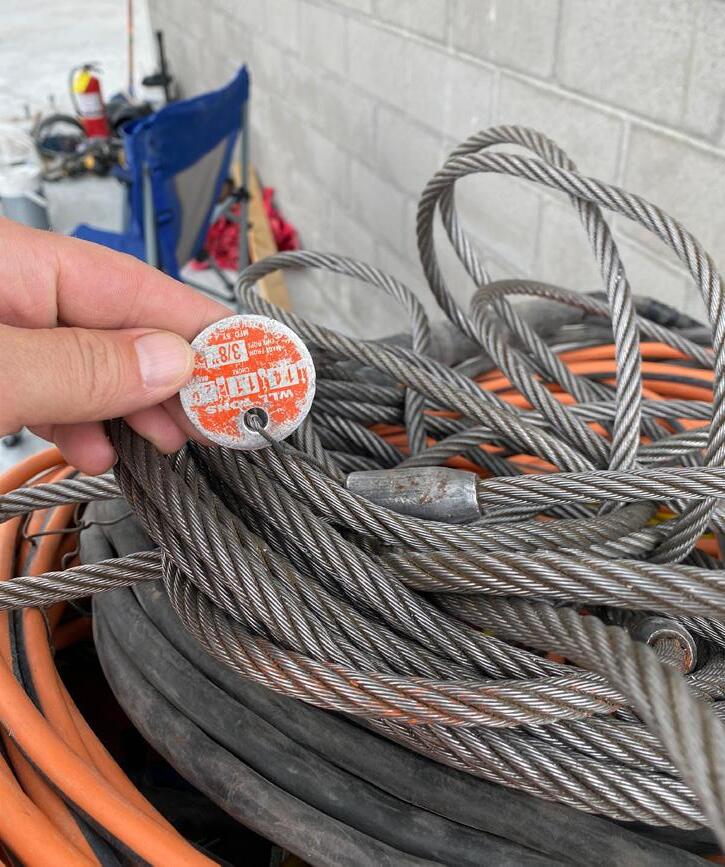
For example, Mazzella offers a patented 7-Part wire rope sling that is “more flexible and resistant to memory and permanent deformations in the wires and strands,” explains Fisher.
Preventing Damage
Slings are frequently abused. They are laid in the dirt, pulled out from under a load by the crane, used without softeners when lifting heavy loads, or straightened by an old-school choker straightener. “Improper storage, leaving slings out in the elements, over time will deteriorate the composition of the sling, no matter the type,” said Callahan. Regular cleaning and lubrication, if applicable to the type of sling, is a good best practice. To extend the life of slings, consider using rigging racks and storing them in a Conex trailer.
Softeners or edge protection are also a good idea. While often recommended for use with synthetic slings, don’t dismiss edge protection for other types. Mosebach of L.R. Willson is affiliated with a local fire service and so has access to old fire hose. “We always have this on hand to use as sling softeners,” he said.
“We offer a variety of sling protection products and sleeves that help with cutting and abrasion resistance. Lifting clamps are sometimes a good solution for helping with
small radii,” said Socolow. The company’s TUFF-ASH product line includes products such as the Sling Armor sleeve made with Dyneema tubing. The sleeve is flexible and resistant to sharp edges and abrasion. Another option distributed by Ashley Sling is DICA’s LiftGuard Magnetic Sling Protector. Made from high-performance cast nylon, grooved sling protectors securely fit the flanges of an I-beam. Magnets allow for easy and secure placement.
Connector | SPRING EDITION March 2023 | 27
When inspecting slings, look for the tag. If it’s missing or illegible, take the sling out of service.
Credit: High Plains Steel Services
An L.R. Willson employee rigs steel to be lifted in a multiple lift or “Christmas Tree” configuration. Credit L.R. Willson
“The No. 1 most common slings in steel erection applications are wire rope used in a choker hitch configuration by riggers, because they can tighten and cinch down on themselves.”
When it comes to removing slings from service Callahan recommends: “When a sling is found to be damaged during the inspection process, it is best to remove it from service and tag it so that it is easily recognized as unsafe.” He also suggests reporting the damage to the supervisor or manager so that it can be further inspected. If necessary, the sling should be either destroyed in a manner that it cannot be used again or discarded properly, in accordance to the waste requirements.
“With no clear industry-wide rules on retiring or destroying damaged or failed slings, permanent disposal is typically left up to the owner or end-user,” said Fisher.
Ready to Inspect?
“A competent person shall perform a daily visual inspection of slings and all fastenings and attachments for damage, defects, or deformities,” cites Fisher. “The inspector should also make sure that the sling and hardware that was selected meets the specific job requirements it’s being used for,” he added. Employers should be familiar with OSHA’s definitions of “competent” and “qualified.”
“Our company does not allow anyone who is not a qualified rigger to rig. Technically a competent person could do the sling inspection with oversight of a master rigger,” said Mosebach.

Ultimately, it’s the responsibility of the employer to determine if an employee is competent, trained, or qualified to perform the job or task at hand,” said Fisher.
There are a variety of resources available to train ironworkers for sling inspection. Both Ashley Sling and Mazzella offer training classes. Recently, SEAA partnered with Industrial Training International to launch the SteelPros Training Portal, where SEAA members have access to free and discounted online rigging inspection training courses. In addition, member companies seeking to integrate ironworker and rigger training and assessment as part of their business model, benefit from becoming SEAA/NCCER accredited and authorized. “Participation means your company can provide nationally recognized credentials to your employees. SEAA members can participate under NCCER’s sponsorship of SEAA, cutting your implementation costs and administrative requirements,” said Pete Gum, Executive Director of SEAA. •

28 | THE STEEL ERECTORS ASSOCIATION OF AMERICA
LiftGuard Sling Protectors prevent damage to slings caused by contact with edges, corners, or protrusions from loads being lifted. They also keep the sling away from other significant contact points during lifting.
Credit: DICA
IRON
CERTIFICATION
WHY IS IT IMPORTANT? WHAT IS IT?
MEET REQUIREMENTS


OSHA’s Subpart CC requires signal person qualification by a third-party qualifier.
MEET DEMAND
While an OSHA letter of interpretation recognizes apprenticeship programs that train and assess riggers and signal persons as third-party qualified evaluators, many contractors, states and municipalities require a Qualified Rigger and Signal Person Certification.
REDUCE COST
Third party certification comes with a hefty price tag without input on testing from subject matter experts, ironworkers and their contractors. The Iron Workers’ certification eleminates the recertification cost of $500 per person.

IMPROVE SAFETY
Ensuring that only trained, skilled and competent ironworkers complete rigging and signaling tasks elevates workplace safety standards and reduces risk.
Iron Workers International Certification Board’s (I.I.C.B.) Rigging & Signalperson Certification Program is accredited by the National Commission for Certifying Agencies (NCCA), the accrediting body of the Institute for Credentialing Excellence. The I.I.C.B. joins an elite group of more than 130 organizations representing over 315 programs that have obtained NCCA accreditation.
HOW IS IT DONE?
6,000 HOURS OF HANDS ON EXPERIENCE
3-PART EXAM
TESTING & RECERTIFICATION EVERY 5 YEARS

IRON WORKERS RIGGING & CRANE COURSE

www.ironworkers.org
The National Commission for Certifying Agencies (NCCA), the accrediting body of the Institute for Credentialing Excellence, has granted accreditation to the Iron Workers International Certification Board’s (I.I.C.B.) Rigging & Signalperson Certification Program.
WORKERS INTERNATIONAL SETS THE STANDARD HIGH WITH ACCREDITED RIGGER & SIGNAL PERSON
6 Technologies to Take You from Planning to Execution
Supply chain constraints, escalating materials costs, and labor shortages are just three factors influencing the adoption of new technologies by contractors. According to the 2023 Engineering & Construction Industry Outlook report by the Deloitte Research Center for Energy and Industrials, most companies in the construction market are utilizing digital technologies “to expand business opportunities and boost profits by reducing costs.”
The industry is just beginning to explore newer tech—like autonomous equipment, robotics, and simulation—and heavily relies on software for construction design, labor tracking, and project management. But even those applications are continuously evolving with expanding applications in construction.

Driving the adoption of new technology is funding managed by the Federal Highway Administration for two initiatives: Advanced Digital Construction Management Systems (ADCMS) and Technology and Innovation Deployment Program (TIDP). More than half
of the Deloitte survey respondents agreed they would likely invest in digital technologies such as artificial intelligence (AI), and contractors are interested in combining digital tech with physical technology that has direct application on the jobsite. Examples include visual intelligence, sensors and Internet of Things (IoT) devices, robotics, immersive collaboration, and drones.
The goal is to increase efficiency, which is critical for meeting project demand while facing ongoing labor shortages. “Technology adoption and innovation could help attract employees with new skills and roles such as data scientists and retain workers by encouraging them to work with cutting-edge tools,” reported Deloitte.
“Our customers are going to be changing mentalities,” said William Nassauer, manager of product strategy for Komatsu America’s autonomous systems, mining technology solutions, in an article from the Association of Equipment Manufacturers. “They’ve got to maintain their site in a different way, use workers in different ways
and transition operators into supervisory roles. There’s a lot of learning involved.”
When evaluating new technologies for your company, Rossouw Nel, Product Marketer for software company ITONICS advises to first assess the costs and workload required to implement it. The expected benefits need to compensate for the costs. He also acknowledges that new technologies come with risks, or the benefit may not be great enough to warrant the investment. Does the new technology give you a competitive advantage? You should also consider the likelihood of adoption by your employees, business partners, or customers.
The following short case studies represent just a few of the possibilities for applying technology from the planning stages to the execution of construction. These companies will exhibit at ConExpo-Con/Agg in March and/or at NASCC: The Steel Conference in April. It’s a chance to explore in person the latest technologies with applications in steel fabrication and steel construction.
30 | THE STEEL ERECTORS ASSOCIATION OF AMERICA
COVER STORY By
Tracy Bennett
Shelby Erectors uses Deltek ComputerEase to track labor hours, distribute payroll stubs and W-2s, and manage and track daily credit card expenses.
Detailing Steel Connections
KMA Steel, a steel detailer in Iowa, and Jeffords Steel and Engineering, a steel fabricator in Pennsylvania, used SDS2 Detailing software for planning the steel connections for two winter sports facilities in Lake Placid, N.Y. The first was the Mt. Van Hoevenberg Mountain Pass Lodger. The three-story, mountainside structure encompasses the United States’ only indoor push-start facility for bobsled and skeleton sled competitions. The second was a reconstruction of an Olympic ski jump, now the only facility in North America equipped for both summer and winter training and competitions.
The projects required dedicated teamwork, elite connection design, and breakneck speed. Here is how KMA and Jeffords Steel worked together before the 2022 Winter Olympics.
SDS2 provides BIM software for steel projects, with solutions for detailing, fabrication, material handling, and site planning. Their flagship product for steel detailing comes with built-in connection design intelligence, providing automated connections with a

Lift Planning, Site Planning
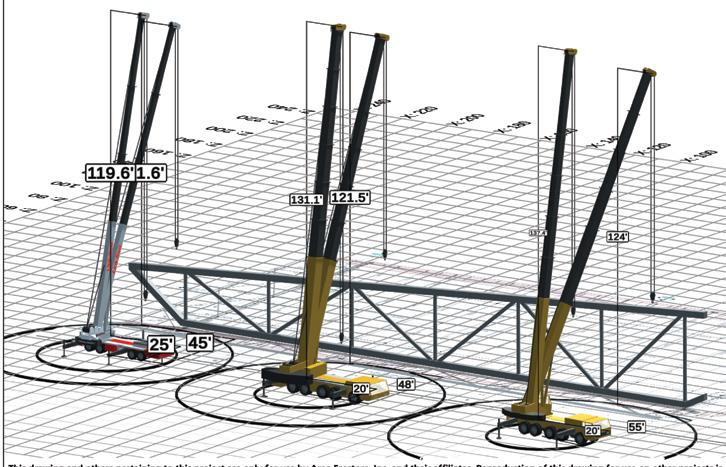
Illinois steel erector Area Erectors, Inc. regularly uses A1A Software’s 3D Lift Plan for planning and executing lifting tasks on its projects. Last year, the company created more than 20 3D Lift Plans for their role on the Pritzker Military Archives Center in Somers, Wis. In all, the company used seven cranes to lift two 40 ft. x 250 ft. long trusses that made up the walls and two 40 ft. x 80 ft. cantilever trusses that became the entrance. Brent Genseke, Project Manager for Area Erectors, shares how their team used 3D Lift Plan from the start of the bidding process through the completion of the project.
“3D Lift Plan was a perfect tool for the job because it’s so versatile. During the bidding process 3D Lift Plan was necessary to convince the General Contractors that our plan to build structural pieces on the ground and then use multi-crane lifts to place, was safer and more efficient than erecting individual steel members,” he said.
“When presenting a plan of this nature it’s much easier to follow when you have that visual support. In the end, the Lift Plan document for lifting one of the trusses was 56 pages long,” he said.
Once the wall trusses were tied into the core of the structure and detailed, it was
360-degree analysis to ensure designs will hold up through fabrication and field fit-up.
A key feature is SDS2 Cloud, which allows multiple users to do live modeling at the same time without fear of data conflicts or lag times. KMA has built its business around this versatile functionality, enabling them to assemble a dream team from around the country. On these projects the team included Brian Thompson, detailing manager, Josh Hawley, head detailer, and Sonny Schroeder, an owner of KMA and project manager— each working from different locations.
To accurately detail the irregular geometry and highly rated axial and compression loads of the steel connections, the detailing and fab teams worked closely with engineering. SDS2 automatically generates connection designs from most engineering calculations, and presents both the graphical and numerical calculations together.
“Jeffords Steel trusts the connections in SDS2 and tries to get the model to do as much as it can,” said Schroeder. Despite the extreme load requirements and irregular
then time to erect the cantilever trusses to create the entrance. During this phase, space constraints presented a challenge for crane placement. “With 3D Lift Plan we could easily show contractors the best placement for the cranes in order to maximize available space on the ground,” said Genseke. “We were able to provide detailed printouts that showed dimensions, crane assembly areas, and crane mats for the machines,” he said.
Area Erectors also utilized 3D Lift Plan to complete smaller scopes of work to show how those lifts would impact other trades working in a tight area. And, in the final phase Genseke was able to reduce time and eliminate the need for crane access roads when placing

framing situations, KMA provided SDS2-generated calculations for around 95 percent of the connections on the lodge project. This was a huge time-saver for Jeffords Steel. Delays were not an option on the project. While construction was underway, high-profile Olympic competitions were already on the schedule. “The contractor and the state of New York were demanding steel on site while we were getting final design drawings,” said Jesse Ringer, Jeffords Steel’s president and connection engineer on the project. “KMA did a very good job of getting details and updated drawings and implementing those the same day or the next.”
bridge structures. Instead, he proposed a plan that would mobilize and demobilize a 550t Liebherr LTM1450 in a shorter time frame than it would have taken to build the crane roads, tear them out when finished, and rework the site to get the final desired result.
Connector | SPRING EDITION March 2023 | 31
Equipment Operator Training
Steel erectors often employ their own crane operators for lifting during construction. This includes using RT and AT mobile cranes, crawler cranes, and even tower cranes. “Contractors must address ongoing training, recruitment, and various levels of operator experience. They also are dealing with inclement weather, multi-site management, and remote locations. Crane simulators can be used to address these factors as well as ongoing recertification, recruitment assessment, employee benchmarking, maintaining skills, and working on advanced training,” said Alan Limoges, CM Labs product manager.
CM Labs Simulations features Smart Training Technology in its crane simulators, which accurately replicates machine stability—providing real-world training opportunities. The simulated machine behavior helps operators gain a better feel for controls, throttle, inertia, boom flex, and other real-world scenarios that affect cycle times or precision placement.
Lifting steel structures is just one of many training exercises built into CM Labs Simulations crane training models. The exercises are designed to help the operator practice techniques for handling long loads, including beams, columns, joists, and sheet bundles. Among the techniques the operator must master is efficient lifting, tilting up and positioning steel beams. Other skills that can be practiced include:
• Maintaining a vertical hoist line while tilting up the load by hoisting and swinging at the same time. Operators can observe the pendulum swing of the load when they do not use proper lifting techniques.
• Placing beams in challenging positions with precision and avoiding any collision.
“Today’s simulators are data- and analytics-driven. This means that training techniques can target specific skills deficiencies for cross-training or advanced skill development. In addition, simulators can present trainees with a variety of increasingly challenging scenarios and conditions (lighting, terrain, weather, exercises) that are not always practical or possible with traditional training methods,” said Limoges. They can also be used for advanced crew training exercises for team learning. This might include a scenario with multiple crane operators for tandem lifts, or signal person and crane operator communications.
For example, the International Union of Operating Engineers Local 14 in New York City successfully implemented CM Labs’ Vortex simulator to replicate a complex procedure for erecting and laying down a 300-foot boom or luffing jib in order to provide training that is not practical without a simulator. According to their training director: “Experiencing the controls, forces, inertia, twisting, and movement of a crane, are critical to understanding the reaction differences between a 200-foot and 300foot boom.”

Job Cost Accounting, Project Management and Payroll
Deltek ComputerEase is the leading construction software provider of job cost accounting, project management and payroll services. The construction-specific solution keeps everything in one location, reducing the use of multiple spreadsheets and the number of human error inputs while also allowing companies to manage their paperless journey through crucial aspects of the business.
Bridge rebar contractor Shelby Erectors has been using Deltek ComputerEase for more than 15 years to track labor hours through the Time Entry app, distribute payroll stubs and W-2s digitally through the EmployeeHub, and manage and track daily credit card expenses with ExpenseEase. They also are able to give their superintendents additional oversight with payroll balancing and project management through FieldEase.
“Deltek ComputerEase makes our work much more efficient. You can do more with less people. It also helps us stay in tune with where the jobs are and really helps us manage our business—it gives us a full view of everything,” said Jack Nix, COO of Shelby Erectors. Ultimately, the software helped Shelby Erectors accomplish its goal of becoming a paperless company.
Deltek ComputerEase also helps companies manage the growth of their business. Rizzo Brothers, a commercial painting contractor, transitioned to cloud services and modernized their company to improve efficiencies and access to information. They went from printing and scanning every document, losing invoices, and having stacks and stacks of folders and papers to creating a paperless culture. Routine tasks were automated. Ultimately, Deltek ComputerEase helped Rizzo Brothers break down silos and improve communication, creating a positive change throughout the organization as a whole.
Contractors choose Deltek ComputerEase because it helps them stay in control from any location, offering affordable tools for managing jobs, inventory, finances, and people. In addition, access to executive dashboards, WIP reporting, drag & drop workflows, and permission-based logic—customizable for each employee— helps contractors proactively plan project profitability.
32 | THE STEEL ERECTORS ASSOCIATION OF AMERICA
A faster cladding connection is finally here.
Install cladding and curtain-wall connections with the new Edge-Tie™ system from Simpson Strong-Tie. This innovative solution utilizes bolts that allow installers to easily position and adjust anchors along a continuous slot. A reusable guardrail also can be bolted to the beam while it’s still on the ground. By eliminating field welding, the Edge-Tie system saves time and labor costs while increasing safety at the jobsite. It’s simply a smarter, faster way to get the job done.

Put all of our structural steel solutions to work on your next project. To learn more, visit go.strongtie.com/edgetiesystem or call (800) 999-5099

Strong-Tie Company Inc. ETS22-F
©2022 Simpson
Keeping Track of Tools
“Tracking small tools—whether in repair status, on location or with employees and the associated costs—is one of the most ineffective parts of accounting and internal controls in a construction company,” said Maria Lumke, CFO of Waterline Industries, a New Hampshire-based civil general contractor. “We have tried many things, including inventorying vans, assigning tools to employees and to jobs – to no avail,” she adds.
A new solution integrates Hilti ON!Track asset management with Trimble Viewpoint Vista, an ERP solution in the Trimble Construction Onesuite.
“Our research shows that each jobsite loses on average one day per month of productivity due to workers searching for tools. In addition, the contractors end up spending up to 90 hours per month tracking tools: in essence, productivity loss for both workers and contractors,” said Michael McGowan, region head and CEO of
Construction Automation
On July 13, 2022, D.T. Read Steel Co., Inc., a rebar contractor in Virginia, and English Construction, a general contractor, set an all-time rod tying record on the Rt. 29 Ward Road bridge project in Lynchburg, Va. Using TyBOT by Advanced Construction Robotics, 17,155 ties were completed during one shift.

TyBOT is a rebar tying robot that self-navigates, self-ties, and does not require programming or BIM plan input from the crew. TyBOT utilizes artificial intelligence to see, think, and self-adapt to unique jobsite designs. It represents the latest class of construction equipment that works alongside existing crews to ensure project timelines are safely met.
The all-time record on the Rt. 29 Ward Road bridge overcomes the previous record of 16,000 ties in a single shift set in February
Hilti North America. “Hilti ON!Track helps eliminate this by tracking tools using field-ready active and passive tags, Bluetooth technology and Gateways.”

The integration helps contractors the track, allocate, bill and estimate for accurate tool and equipment use. Other benefits include theft and loss prevention and reduction of double entry and human error.
“The product Trimble and Hilti have
of 2021. TyBOT shift lengths vary by project. At an active tie-rate of 1,149 ties/hour, TyBOT outworked its standard production estimates of up to 1,100 ties/hour.
TyBOT completed operations on the 12,343 sq. ft. bridge deck in just 5 days, freeing up time and energy for the crew of D.T Read Steel to complete work elsewhere on the project. Total TyBOT ties equaled 37,942 and average tie rate was 1,106 ties/hour. The bridge was part of the Route 29/460 Bridges over Norfolk Southern Railroad project valued at $16.9 Million.
“Production at this level is impressive. TyBOT was a great asset to our crew and we are excited to see it making a real difference on our projects,” said Donnie Read, President, D.T. Read Steel Co. Inc.
TyBOT easily fits within existing bridge construction infrastructure. The unit uses
developed will be a revolutionary step for internal controls and accountability of tools in a construction company,” said Lumke.
Keeley O'Brien, president and CEO of O'Brien Co., an Oregon-based general contractor adds: “It takes mere seconds to transfer tools in the field, eliminating excuses about not having the right tools because no one knows where they are. It’s made it very easy to inventory, track history, and locate tools and equipment.”
the screed rail supports installed for the deck concrete finishing machine, which are required to be in place prior to TyBOT arriving to the jobsite. TyBOT is capable of tying alternating-intersection patterns as well as all-intersection patterns, meeting the specifications of multiple project owners and DOTs.
This year, Advanced Construction Robotics will introduce its second robot. IronBOT is a rebar carrying and placing robot that relieves the burden of heavy lifting by self-placing up to 5,000-pound bundles of both transverse and longitudinal rebar. When used together, IronBOT and TyBOT, will increase productivity by at least 250%, estimates the company.
Shelby Erectors, which is an Integration Partner with Advanced Construction Robotics and an early adopter of TyBOT, plans to implement IronBOT this year. In an interview with Charles Rathmann published on ForConstructionPros.com, Jack Nix, COO, said: “IronBOT is going to be a game changer. The use of this technology eliminates back-breaking [work]. This will allow people to have better, longer careers. We need to keep our infrastructure going, build and rehabilitate what we have. Robots take some of the physicality out of this, which can help us entice some of the next generation into this industry even as we improve construction schedules and lower cost.” •
34 | THE STEEL ERECTORS ASSOCIATION OF AMERICA
In It Together
Members
SEAA invests in our industry by connecting industry leaders and creating a strong network of support, community, and member value. “Our company is where it is today because of the networking through SEAA. For 25 years, SEAA has contributed to my personal growth as a business owner and the overall improvement of our company,” said David Deem, President of Deem Structural Services and President of SEAA (2022-2024).

Membership gives companies access to resources that would cost exponentially more if purchased outright. In some cases, discounts would not even be available to companies on their own. If your company is a member and not taking full advantage of member benefits related to hiring, training, certifications, insurance, and more, contact info@SEAA.net to find out how to get plugged in.

Members can update their online listing in the member directory at any time during the year. Visit the Member Portal at SEAA.net and sign in with your credentials.
Not a member and want to learn more?
Contact Pete Gum at executivedirector@ seaa.net.
ABBREVIATION & ICON KEY
AISC CERTIFICATION PROGRAMS FOR FABRICATORS & ERECTORS:

BU: Certified Building Fabricator (previously noted as acronym "STD")
SBR: Certified Bridge Fabricator - Simple
IBR: Certified Bridge Fabricator - Intermediate (Major)
ABR: Certified Bridge Fabricator - Advanced (Major)
CBR: Major Steel Bridges
CPT: Certified Metal Component Manufacturer
HYD: Certified Metal Hydraulic Fabricator
CSEA: Certified Erector (Advanced)


AISC CERTIFICATION ENDORSEMENTS:
SPE-P1: Sophisticated Paint Endorsement - Enclosed

SPE-P2: Sophisticated Paint Endorsement - Covered
SPE-P3: Sophisticated Paint Endorsement - Exposed
FCE: Fracture Critical
BEE:
SEE:
MEE:
SEAA/NCCER Accredited Training Unit and/or Authorized Assessment Site
UPDATE YOUR LISTING ONLINE:
SEAA Members can update directory listings online at any time during the year. Visit the Member Portal at SEAA.net and sign in with your login credentials.
Connector | SPRING EDITION March 2023 | 35 SEAA MEMBERSHIP DIRECTORY
Endorsement
Bridge Erection Endorsement
Seismic Erection Endorsement
Metal
Erection Endorsement
Deck
SEAA MEMBERSHIP DIRECTORY TABLE OF CONTENTS Board of Directors 36 Erectors $10-up Million 38 Erectors $5-10 Million 39 Erectors $3-5 Million 39 Erectors $0-3 Million 40 Fabricators 42 General Contractors 43 Services 43 Specialty Services 44 Suppliers & Manufacturers 44 Associate Members-Continuing Ed 46 Associate Members-Trade Associations 46
investing in each other, creating business connections • 2-3/8" Diameter x 3" Depth • Hidden Motor Cord • 3 Speed - 250 / 450 / 700 RPM • Use HSS or Carbide Cutters • 100% Hougen Reliability • Available Accessories • Two Year Warranty Pat. Pending Drill All Day, Every Day HMD920 Mag Drill 800-426-7818 SERVICE • INTEGRITY • RELIABILITY HOUGEN.COM Hou-757-SEAA-third.indd 1 2/23/22 8:37 AM
SEAA BOARD MEMBER DIRECTORY EXECUTIVE COMMITTEE
David
Deem President
Deem Structural Services Longview, Texas ddeem@deemstructural.com
David Deem served on the Board of Directors from 1998 to 2004, and again since 2016. He has been active in SEAA since 1995. He is president of Deem Structural Services LLC, an AISC Advanced Certified Steel Erector, founded in 2013. He has more than 30 years of experience, and is a strong advocate for the advancement of industry quality and safety standards via education of personnel, and the promotion of organizations such as SEAA, AISC, and NISD. Among the technical publications he has assisted in writing are Detailing Steel for Value and Safety and Detailing Guide for the Enhancement of Erection Safety


Jack Nix President-Elect
Shelby Erectors, Inc. Reddick, Fla. jacknix@shelbyerectors.com
Jack Nix has been a member of SEAA since 2008 and has served on the Board since 2011. He is currently Chairman of the Membership Committee and President Elect for the term that begins in 2024. In 2018, Jack was the recipient of the SEAA Person of the Year award. He is the COO for Shelby Erectors, Inc., a highway and transportation-focused subcontractor performing bridge rebar and SIP metal deck installation throughout Florida and the southeast. He started his career in 1985 as an ironworker. In 2022, Jack Nix and Shelby Erectors were featured on an episode of Dirty Jobs with Mike Rowe featuring rodbusters, one of many highlights of his career.


Chris Legnon
Vice President, Industry
Cooper Steel Fabricators, Inc. Shelbyville, Tenn. clegnon@coopersteel.com
Chris Legnon joined the Board in 2015. Since then he has also served as Marketing Committee Chair. He started his career as an intern with Cooper Steel in 1999, where he is now VP of Technology. Cooper Steel is an AISC Certified Fabricator and Erector that provides estimating, project management, and detailing services from offices in Tennessee and Kentucky.

Carrie Gulajan Vice President, Associate Member Construction Insurance Agency, Inc. Manassas, Va. carrieg@const-ins.com

Carrie Gulajan joined the Board in 2011 and has served as Events Committee Chair, overseeing and volunteering at Convention and Golf Tournaments for many years. She is also on the Finance Committee. In 2015, she became the first woman to receive SEAA’s Person of the Year award. Construction Insurance Agency provides property and casualty insurance for specialty and artisan contractors, builders risk, bonds, and risk management consulting.
Greg Phillips Treasurer
Titan Steel Erectors, LLC, Memphis, Tenn gphillips@titansteelerectors.com
Greg Phillips has served as Treasurer since 2018, and he is also on the Membership Committee. He is a third-generation steel erector, who started his career working in the field at his father’s company. He started Titan Steel Erectors in 2013, a steel and pre-cast erector serving the Mid-South.

Bryan McClure Secretary
Trivent Safety Consulting
Westminster, CO bryanm@triventsc.com
Bryan McClure is a second-generation ironworker who was introduced to a strong work ethic and the trades by his father. During a 30+ year career, he has worn many hats: Foreman, Crane Operator, Superintendent, Craft Instructor and Training Manager. In 2018, he started Trivent Safety Consulting with two partners. Trivent has offices in Florida, Texas, Wyoming, and Colorado. In 2022, Trivent opened its first training center with an indoor structural steel training tower.
Geoffrey Kress
Immediate Past President
Gardner-Watson Decking, Inc., Oldsmar, Fla. geoff.k@gwdeck.com
Geoff Kress has served on the Board since 2007, and was treasurer for many of those years. In 2011, he was honored as SEAA Person of the Year. Other service includes work on the Canvass Committee that writes the SDI-QA/QC standard for installation of steel deck. He is President of Gardner-Watson Decking, Inc. and Gardner-Watson Studs, which provide full turnkey service for decking and studs throughout the United States.
Stephen Burkholder
Past President
S&R Enterprises, LLC Harrisburg, Pa. sburkholder@srenterprises.com
Stephen Burkholder serves on the Executive Committee as the Past President. He is president of S&R Enterprises, a steel and precast erector operating in the Continental United Sates and Caribbean. The company is based in Harrisburg, Pa., and maintains a secondary office in Cape Canaveral, Fla.

36 | THE STEEL ERECTORS ASSOCIATION OF AMERICA
Drew Heron Director
Empire Steel Erectors, L.P. Humble, Tx. drew@empiresteeltx.com
Drew Heron joined the Board in 2020. He serves on Executive and Events Committees, and is Chairman of the Awards Committee. His career began as an ironworker and welder and spans 18 years of employment at Empire Steel, a leader in Houston and southern Texas. He has worked as a Field Superintendent, QC Manager, and currently is a Project Manager and Director of Business Development. Additionally, he is an AWS Certified Welding Inspector and leads his company’s AISC certifications.
Glen Pisani Director


MAS Building & Bridge, Inc. Norfolk, Ma. gpisani@ masbuildingandbridge.com
Glen Pisani has been an active member of SEAA for more than 20 years, serving on the Board since 2017. He is currently Vice Chair of the Marketing Committee, and sits on the Executive Committee. He has more than 30 years of experience, including 20 years as an owner and the past 12 years as steel division manager at MAS Building and Bridge. He is an advocate for steel erection business in New England.


SEAA BOARD MEMBER DIRECTORY
BOARD OF DIRECTORS
Richard Bostick
2021-2024
Piedmont Structural Company Salisbury, NC rbostick@piedmontstructural. com
Events
Dave Brown
2020-2023
United Rentals Charlotte, N.C. Dbrown2@ur.com
Long Range Planning, Events
Marc Cox
2021-2024
Gardner-Watson Decking Inc. Oldsmar, Fla. marc.c@gwdeck.com
Tom McAleese
2021-2024
Mazzella Indusco Baltimore, MD tmcaleese@ induscogroup.com
Events
Jason McElrath

2022-2025
M & P Specialty Insurance West Columbia, SC jason@mpspecialty.com
Membership
WANT TO GET INVOLVED?
John (Jack) Metcalfe
2020-2023
National Institute of Steel Detailing Livermore, Calif. Metcalfe51@aol.com
Long Range Planning, Safety & Education
Nicholas Morgan
2020-2023
Adaptive Construction Solutions
Houston, Texas nicholas@acstexas.com Long Range Planning
Duke Perry
2021-2024
Gardner-Watson Studs, LLC Oldsmar, Fla. Duke.p@gwdeck.com

Membership, Events, Finance
Tom Schlickbernd
2022-2025
Nucor Charlotte, NC tom.schlickbernd@nucor.com
Events, Membership
Jim Simonson
2020-2023
Steel Service Corp. Jackson, Miss. simonson@steelservice.com Long Range Planning, Marketing
Committees are open to any employee of member companies. Meetings take place via video conferencing once per month or less often, depending on the committee. For more info, visit seaa.net/get-involved.html
Connector | SPRING EDITION March 2023 | 37
SEAA MEMBERSHIP DIRECTORY
ERECTORS $10-UP MILLION
Alliance Riggers & Constructors, Ltd.
Phillip Cordova
1200 Kastrin Street
El Paso, TX 79907
P: 915-591-4513
phil@allianceriggers.com
allianceriggers.com
AISC Certifications: CSE
American Ironworks & Erectors Inc.
Jim Andrews
7620 E Spear Ave
Spokane Valley, WA 99212
P: 509-467-7733
jandrews@americaniw.com
Americaniw.com
AISC Certifications: CSE, MEE
ASPE / ASPE South
Joshua Cilley 590 Hancock Rd
Peterborough, NH 03458
P: 603-547-6311
jcilley@aspe-nh.com
aspe-nh.com
AISC Certifications: CSE, BEE, MEE, SEE
Bowman Steel LLC
John Bowman
6900 US 27 S
Sebring, FL 33876
P: 239-303-9739
jbowman@bowmansteel.com
bowmansteel.com
AISC Certifications: CSE
Bracken Construction Company, Inc.
John Ross McCartney PO Box 9460
Columbus, MS 39705
P: 662-498-1160
john.mccartney@brackenconstruction.com
brackenconstruction.com
AISC Certifications: CSE, SEE, MEE
Bret Steel Corporation
Michael B Rouleau
P.O. Box 1457 Dover, NH 03821
P: 603-234-7293 mrouleau@bretsteel.com bretsteel.com
AISC Certifications: CSE
Coastal Steel Group Inc
Dylan Holmes
P.O. Box 691627 Orlando, FL 32869
P: 407-827-4309 dylanholmes@coastalsteel.com coastalsteel.com
AISC Certifications: CSE, MEE
Cooper Steel
Chris Legnon
P.O. Box 149
Shelbyville, TN 37162
P: 931-684-7962
clegnon@coopersteel.com coopersteel.com
Also provides Fabrication
AISC Certifications: CSE, BU SEAA Training and/or Assessment Site
CSE, Inc.
Tim Austin P.O. Box 1030 Madison Heights, VA 24572
P: 434-845-7536 tim.austin@cseonline.net cseonline.net
AISC Certifications: CSE, MEE
A Deem Structural Services, LLC
David Deem 109 Benny Street Longview, TX 75604
P: 903-236-7800 dss@deemstructural.com deemstructural.com
AISC Certifications: CSE, MEE SEAA Training and/or Assessment Site
Derr & Gruenewald Construction LLC
Ed Valencia 11100 E 108th Ave Brighton CO 80601
P: 720-630-1849 evalencia@dgccsteel.com dgccsteel.com
AISC Certifications: CSE
Empire Steel Erectors, L.P.
Drew Heron
P.O. Box 3653 Humble, TX 77347
P: 281-548-7377 drew@empiresteeltx.com empiresteeltx.com
AISC Certifications: CSE, MEE
Gardner-Watson Decking, Inc.
Geoff Kress 300 Scarlet Boulevard Oldsmar, FL 34677
P: 813-891-9849 geoff.k@gwdeck.com gwdeck.com
A GMF Steel Group
Sarah Vespa 4600 Drane Field Road Lakeland, FL 33811
P: 863-577-0210 sarah.vespa@gmfsteel.com gmfsteel.com
AISC Certifications: CSE, MEE SEAA Training and/or Assessment Site
JPW Erectors, Inc.
Jody Wozniczka 6376 Thompson Road Syracuse, NY 13206
P: 315-432-1111 jodywoz@jpwcompanies.com jpwriggers.com
AISC Certifications: CSE, MEE
Kinsley Steel
Bobby Chenault 3900 East Market Street York, PA 17402
P: 717-757-8761 bchenault@kinsleyconstruction.com kinsleyconstruction.com
AISC Certifications: CSE, SEE, MEE
L.R. Willson & Sons, Inc.
Sherrie Wilkinson
P.O. Box 227 Gambrills, MD 21054
P: 410-987-5414 swilkinson@lrwillsonandsons.com lrwillsonandsons.com
AISC Certifications: CSE, SEE, MEE
Lexicon, Inc.
Viji Kuruvilla 8900 Fourche Dam Pike Little Rock, AR 72206
P: 501-490-2300 vijik@lexicon-inc.com lexicon-inc.com
Also provides Fabrication
AISC Certifications: CSE, SEE, MEE
Mabe Steel, Inc.
Bryan Mabe 1490 Brookford Road Kernersville, NC 27284
P: 336-671-1001 bryanmabe@mabesteel.com mabesteel.com
MAS Building & Bridge, Inc.
Glen Pisani 18 Sharon Avenue Norfolk, MA 02056
P: 508-520-2277 gpisani@masbuildingandbridge.com masbuildingandbridge.com
AISC Certifications: CSE, BEE, SEE, MEE
Mid Cities Erectors, LLC
Scott Brooks
P.O. Box 162984 Fort Worth, TX 76161
P: 817-306-0962 scott@midcitieserectors.com midcitieserectors.com
Peterson Beckner Industries, Inc.
James Byrum 10700 North Freeway, Suite 950 Houston, TX 77037
P: 281-872-7722 jbyrum@pbisteel.com petersonbeckner.com
AISC Certifications: CSE, MEE
Phoenix Steel Erectors, Inc.
Paul Kollman Company Headquarters 13280 University Boulevard Gainesville, VA 20155
P: 571-248-6890 pkollman@phoenixsteel.com phoenixsteel.com
AISC Certifications: CSE
Piedmont Steel Company LLC
Nicki Cole 3480 Friendship Ledford Rd Winston-Salem, NC 27107
P: 336-926-5299 nicki.c@piedmontsteelco.com piedmontsteelco.com
AISC Certifications: CSE, SEE
A Rackley Company, Inc.
Scott Rackley 3772 County Road 99W Orland, CA 95963
P: 530-865-9619 scott@rackleyco.com rackleyco.com
AISC Certifications: CSE
SEAA Training and/or Assessment Site
RMG Erectors & Constructors, LLC
Robert Mesmer 725 SW Higgins Ave St C Missoula, MT 59803
P: 856-777-7641 info@rmgerectors.com
S & R Enterprises, LLC
Stephen Burkholder 4785 Linglestown Rd, Ste 200 Harrisburg, PA 17112
P: 717-652-3080
sburkholder@srenterprises.com srenterprises.com
Also provides Fabrication
AISC Certifications: CSE, BEE, SEE, MEE
A SCW Contracting
Kirt Bjoin 2525 N. Old Highway # 395 Fallbrook, CA 92028
P: 760-728-1308
kbjoin@scwcompanies.com scwcompanies.com
SEAA Training and/or Assessment Site
A Shelby Erectors, Inc.
Jennifer Nix 3975 W Highway 316 Reddick, FL 32686
P: 954-275-3123
jennifernix@shelbyerectors.com shelbyerectors.com
SEAA Training and/or Assessment Site
TGR Erectors LLC
Desarae Bush 250 County Road 4925 Leonard, TX 75452
P: 903-449-8913
desarae@tgrerectors.com tgrerectors.com
Titan Steel Erectors, LLC
Greg Phillips P.O. Box 999 Munford, TN 38058
P: 901-274-4992
gphillips@titansteelerectors.com titansteelerectors.com
AISC Certifications: CSE
United Steel, Inc.
Glen Corneau 164 School Street East Hartford, CT 06108
P: 860-289-2323
gcorneau@unitedsteel.com unitedsteel.com
Also provides Fabrication
AISC Certifications: CSE, SEE, MEE, BU, SBR
38 | THE STEEL ERECTORS ASSOCIATION OF AMERICA
Williams Erection Company
Frank Williams III
P.O. Box 756 Smyrna, GA 30081
P: 770-436-1596
FWilliams3@wmsi.com williamserection.com
AISC Certifications: CSE, BEE, SEE, MEE
Williams Steel Erection Co., Inc.
Art Williams
P.O. Box 1770 Manassas, VA 20108
P: 703-335-7800
awilliams@wmsi.com wmsi.com
AISC Certifications: CSE, BEE, SEE, MEE
ERECTORS $5-10 MILLION
Apex Steel Corporation
Dustin Holder 301 Petfinder Lane Raleigh, NC 27603
P: 919-362-6611 dholder@apexsteelcorp.com apexsteelcorp.com
Also provides Fabrication
AISC Certifications: CSE, BU
Ben Gravett Enterprises/ BG Crane Services
Matt Gravett
11921 Elk Run Road Catlett, VA 20119
P: 540-788-4894 bgent2@netscape.net gravett.wix.com/bgcrane
AISC Certifications: CSE
Building Zone Industries
David Darger
HC 65 Box 340 Kanarraville, UT 84742
P: 888-509-2280 davidd@buildingzone.com buildingzone.com
C.S.E., Inc.
Matthew Labounty 199 Omega Drive Williston, VT 05495
P: 802-864-1812 cseinvt@gmail.com csevt.com
AISC Certifications: CSE, MEE
D & E Steel Services, Inc.
Travis Miller 11084 Leroy Drive Northglenn, CO 80233
P: 303-427-4804 tmiller@desteel.com desteel.com
AISC Certifications: CSE
D&T Steel Fabricators, Inc.
Donna Crumpton 225 Northcutt Road
Pelion, SC 29123
P: 803-894-6005
donna@dtsteelinc.com dtsteelinc.com
D.S. Duggins Welding, Inc.
Zach Burick 195 Altay Drive Winston-Salem, NC 27106
P: 336-924-5484 zach@dugginswelding.com dugginswelding.com
AISC Certifications: CSE, SEE, MEE
DSE Erectors, Inc.
Cody Ellis 315 Lake Street Jackson, TN 38301
P: 731-225-9383 cellis@dsesteel.com
AISC Certifications: CSE, SEE, MEE
Gardner-Watson Studs, LLC
Duke Perry 300 Scarlet Blvd Oldsmar, FL 34677
P: 813-891-9849 duke.p@gwstuds.com gwstuds.com
Garrison Steel Erectors, Inc.
Jason Garrison P.O. Box 626 1122 Industrial Park Drive Pell City, AL 35125
P: 205-884-4766 jasongarrison@garrisonsteel.com garrisonsteel.com
AISC Certifications: CSE, SEE, MEE
Group Steel Erectors, Inc.
Ben Wadlington P.O. Box 61 Dickson, TN 37056
P: 615-441-4934 ben@groupsteel.net
AISC Certifications: CSE, SEE, MEE
Harris Steel Erectors, Inc.
David Harris
615 Old Smithfield Road Goldsboro, NC 27530
P: 919-734-3620 dharris@harrissteelerectors.com harrissteelerectors.com
AISC Certifications: CSE, SEE, MEE
Mechanical Industries Inc.
Jerry Miranda
314 Yampa Street Bakersfield, CA 93307
P: 661-634-9477
jmiranda@mii-us.com mii-us.com
AISC Certifications: BU
Piedmont Structural Company
Richard Bostick
1432 North Lee Street Salisbury, NC 28144
P: 704-738-0060 cgreen@piedmontstructural.com
AISC Certifications: CSE, SEE, MEE
A Pro Steel Erectors II Inc.
Scott Sappington 6714 W. Frier Dr. Ste. 104 Glendale, AZ 85303
P: 623-825-3078 ssappington@prosteelerectors.net prosteelerectors.net
SEAA Training and/or Assessment Site
R&J Steel Erectors, LLC
James (Rusty) Rader 155 Prospect Drive, Suite 101 Huntingtown, MD 20639
P: 410-257-2174 rusty@radersteel.com
AISC Certifications: CSE, MEE
River City Erectors, LLC
Mike Dorsch
P.O. Box 13141 Rossville, TN 38133
P: 901-861-6174 mdorsch@rivercityerectors.com
AISC Certifications: CSE, SEE, MEE
Rochester Rigging & Erectors, Inc.
Kelly Gilligan
7819 State Route 5 and 20 Bloomfield, NY 14469
P: 585-657-7665 kgilligan@rochesterrigging.com rochesterrigging.com
AISC Certifications: BU
A S.L. Chasse Steel
Stephen L. Chasse 8 Christine Drive Hudson, NH 03051
P: 603-886-3436 s.chasse@slchassesteelfab.com slchassesteelfab.com
AISC Certifications: BU
SEAA Training and/or Assessment Site
Saugus Construction Corp
Kerry Fears 1 Farm Lane Georgetown, MA 01833
P: 508-962-6002 kerryf@saugusconstruction.com
AISC Certifications: CSE, BEE
Steel Masters, L.P.
Rudy Limon 2214 Blalock Road Houston, TX 77080 P: 713-464-8652 RLimon@steelmastersinc.com steelmasterslp.com
AISC Certifications: CSE, MEE
V & M Erectors, Inc.
Vern Nix 21005 Taft Street
Pembroke Pines, FL 33029
P: 954-437-9998 vern.nix@vmerectors.com vmerectors.com
ERECTORS $3-5 MILLION
Big C Industries, LLC
Ronda Cross 3339 Washington Way
Longview, WA 98632
P: 360-261-7210
rondac@bigcindustries.com bigcindustries.com
AISC Certifications: BU
Blakeman Steel, Inc.
Billy Blakeman 4200 Broadway Avenue Fort Worth, TX 76117
P: 817-831-2601
bblakeman@blakemansteel.com blakemansteel.com
Canal City Industrial, LLC
Steve Smith 361 Old Forge Rd., BLD. B Kent, OH 44240
P: 330-958-1863 office@canalcityindustrial.com canalcityindustrial.com
Conewago MFG LLC
John Hagarman PO Box 461 Hanover, PA 17331
P: 717-632-7722
jhagarman@conewagomfg.com conewagomfg.com
AISC Certifications: CSE
Cubas Welding Construction Inc
Wilson Cubas 5312 Elcar Drive Charlotte, NC 28214
P: 704-668-4987
wilson.cwcinc@gmail.com
Fast Track Erectors
Alex Valladares
551 S. IH-35, Third Floor Round Rock, TX 78664
P: 512-635-9219 bids@fasterectors.com fasterectors.com Also provides Fabrication
Flex-Erect
Steve Thomas 6417 Toledo St Houston, TX 77008
P: 713-999-8040 sthomas@flex-erect.com flex-erect.com
Fulgent Contracting Corporation
Isabella Sampson P.O. Box 40 Stevensville, MD 21666
P: 410-604-0172
bellesampson@fulgentcontracting.com fulgentcontracting.com
AISC Certifications: CSE, SEE, MEE
Connector | SPRING EDITION March 2023 | 39
SEAA MEMBERSHIP DIRECTORY
Gridiron Steel Inc
Angela Clemens
135 Stoney Run Rd
Dillsburg, PA 17019
P: 717-668-7038
aclemens@gridironsteelinc.com gridironsteelinc.com
AISC Certifications: CSE
Hodges Erectors Inc.
Jorge Amador
11403 NW 122nd Street
Unit 21 Miami, FL 33178
P: 305-234-3467
jorge.amador@hodgeserectors.com hodgeserectors.com
AISC Certifications: CSE, BEE, MEE
Jonquil Steel & Construction
PJ Aikens 140 Veterans Memorial Highway SE
Mableton, GA 30126
P: 770-948-9876
pjaikens@jonquilsteel.com jonquilsteel.com
AISC Certifications: CSE, SEE, MEE
A L & L Construction, Inc.
Brian Schreier
1040 California Road
Quakertown, PA 18951
P: 215-536-9361 bschreier1@comcast.net landlconstructioninc.net
AISC Certifications: CSE, MEE
SEAA Training and/or Assessment Site
Leiser Construction, LLC
Lloyd Leiser 1927 365th Street Madison, KS 66860
P: 620-437-2747
lloyd@leiserconstruction.com
Also provides Fabrication
AISC Certifications: CSE
Lesley Erectors, Inc.
Glenn Williams
500 McNelly Road
Piedmont, SC 29673
P: 864-400-6320 gwilliams.lei@gmail.com
AISC Certifications: CSE, MEE
March-Westin Company, Inc.
Cody Rodeheaver 360 Frontier Street Morgantown, WV 26505
P: 304-599-4880 crodeheaver@marchwestin.com marchwestin.com
AISC Certifications: CSE, MEE
MKE Iron Erectors, Inc.
Barbara Sheedy
1725 Dolphin Drive Waukesha, WI 53186
P: 262-352-8406 barbs@mke-iron.com mke-iron.com
MPS Products Corp
Michael Pimental
453 Newburyport Turnpike Rowley, MA 01969
P: 978-817-2144 pimentalsteel@gmail.com mpsproductscorp.com/
Postel Erection Group, LLC
Oscar Martinez 21966 Adams Street Porter, TX 77365
P: 281-850-3127 omartinez@postelerectiongroup.com
AISC Certifications: CSE
Quality Steel Services, Inc.
Jim Edwards
740 Cleveland Avenue Loveland, CO 80537
P: 970-593-1976 info@qsssteel.com qsssteel.com
AISC Certifications: CSE, MEE
Ramar Steel Erectors, Inc.
William Raetz 432 Portland Avenue Rochester, NY 14605
P: 585-232-7777 bill@ramarsteel.com ramarsteel.com
AISC Certifications: BU
Ranger Steel Erectors, Inc.
Amy Pilcher
602 Grantham Avenue West Monroe, LA 71292
P: 318-387-9882 amy@ranger-steel.com ranger-steel.com
AISC Certifications: CSE, MEE
Sentry Steel Service
Chris Hopper 167 Center Point Road South Hendersonville, TN 37075
P: 615-826-9552 info@sentrysteel.com sentrysteel.com
SSW Engineering & Construction, LLC
Carlos A. Aguayo P.O. Box 602828 Bayamon, PR 00960-2828P ca@sswincpr.com sswincpr.org
AISC Certifications: CSE, MEE
A Steel Fabricators, LLC
Scott Wilson 721 NE 44th Street
Ft. Lauderdale, FL 33334
P: 954-772-0440 swilson@sfab.com sfab.com
SEAA Training and/or Assessment Site
Trinity Steel Erection, Inc.
Beth Belcher P.O. Box 774 Powhatan, VA 23139
P: 804-598-8811 beth@trinitysteelerection.com trinitysteelerection.com
AISC Certifications: CSE, MEE
ERECTORS $0-3 MILLION
360 Structural Services
Ronald Moore
1308 Leander Dr. Ste 703 Leander, TX 79641
P: 512-663-5356 info@360structuralservices.com
All Forms Fabrication, LLC
William Richardson PO BOX 772116 Steamboat Springs, CO 80477 P: 970-631-0087 allformsfab@gmail.com
All Things Metal
Timothy Rock 23724 N Central Avenue, Bldg B Phoenix, AZ 85024
P: 623-582-3900 timothyr@atmphx.com allthingsmetalllc.com
ALW Welding, Inc.
Marina Wood PO Box 365 Chocowinity, NC 27817
P: 225-495-2240 alwwelding@gmail.com
American Aerial Services, Inc.
James Read 33 Allen Avenue Extension Falmouth, ME 04105 P: 207-797-8987 jread@americanaerialservices.com americanaerialservices.com
AISC Certifications: CSE, MEE
Angel Wing Erectors Ltd.
Dawn Dalton 26 Verona Cres Spruce Grove, AB T7X 0J7 Canada
P: 403-998-9866 dawn@angelwingerectors.com angelwingerectors.com
Arrow Building Construction, LLC
Sandra Leiser 8 W 11th Ave Emporia, KS 66801 P: 620-487-2167 sandra@arrowbuildcon.com
Ascending Iron
Stephen Workman P.O. Box 640 Alamance, NC 27201 P: 919-607-0587 stephen@ascendingiron.com
Atlantic Installers
Andrew McCorkle 903 Outer Rd Orlando, FL 32814
P: 407-373-7800 evonne@atlanticinstallers.com mccorkle.com
Atlas Welding & Fabrication, Inc.
Kurt Schmid
728 Grantham Lane New Castle, DE 19720
P: 302-326-1900 atlasfab@gmail.com atlasfab.net
AISC Certifications: CSE, BU
Black Cat LLC
Ryan Lewis 1720 Pacific Avenue
Cheyenne WY 82007
P: 307-637-5266 ryanl@blackcatwyo.com blackcatwyo.com
AISC Certifications: CSE
Bouchard Steel Erectors
Roger Bouchard
P.O. Box 760 North Bennington, VT 05257
P: 802-753-7250 roger@bouchardsteel.net
AISC Certifications: CSE, SEE, MEE
Capitol Steel Structures
Daniela Caro 2188 NW 25th Ave Miami, FL 33142
P: 305-633-5008
info@capitolsteelstructures.com capitolsteelstructures.com
Also provides Fabrication
AISC Certifications: BU
Caprock Building Systems, LLC
Mark Gilbreath
P.O. Box 33162 Amarillo, TX 79106
P: 806-468-8471
markg@caprockbuildings.com caprockbuildings.com
Carolina Structural Welding & Steel Erection, Inc.
Aurelia Chacon
P.O. Box 25463 Charlotte, NC 28229
P: 980-307-1706
Achacon@carolinasw-inc.com
AISC Certifications: CSE
Carrara Steel Erectors, Inc.
Patrick Carrara
1717 Gaskell Avenue
Erie, PA 16503
P: 814-452-4600
pcarrara@amthorsteel.com
AISC Certifications: CSE, MEE
40 | THE STEEL ERECTORS ASSOCIATION OF AMERICA
CAS Steel Erectors, Inc.
Christopher Smith
237 Duncan Hill Road
Hendersonville, NC 28792
P: 828-697-8877
chris@cassteel.com
AISC Certifications: CSE
Citadel Steel Erectors Inc.
Mitchell Stevens
3405 Apex Peakway Apex, NC 27502
P: 919-362-5122
mstevens@citadelcontractors.com citadelcontractors.com
AISC Certifications: CSE
Dixie Erectors
Tony Dichiara
1855 Dickerson Drive
Mableton, GA 30126
P: 404-696-3434 tdichiara@phoenixcrane.com
AISC Certifications: CSE
Eastern Metal Works Inc
Michele Chernesky
20 Higgins Drive Milford, CT 06460
P: 203-878-6995
mchernesky@easternmetalworks.com easternmetalworks.com
Also provides Fabrication
AISC Certifications: CSE, BU
Eastern Steel Erectors, LLC
Ryan Pepin
56 N Harwinton Avenue Terryville, CT 06786
P: 860-585-9016
ryan@easternsteelerectors.com
AISC Certifications: CSE, MEE
Ed Emmons Steel Erectors, Inc
David Emmons
5801 West Nine Mile Road Pensacola, FL 32526
P: 850-944-2017
david@emmons-steel.com
Edmoundson Steel Erection, Inc
Jeffrey Nichols
5517A Wheeler Ave. Fort Smith, AR 72901
P: 479-883-1413
nicholsjeffrey9@gmail.com
edmoundsonsteelerection.com
AISC Certifications: MEE, CPT
Flawless Steel Welding, LLC
Victor Garcia 5353 Joliet Street Denver, CO 80239
P: 720-638-7289
Victor@fsw-denver.com
fsw-denver.com
AISC Certifications: CSE, MEE, BU
FM Steel Construction LLC
Michael Mulsow
2670 E Meadowview Dr Gilbert, AZ 85298
P: 623-882-6183 m.mulsow@fmsteel.net
Foshee Steel Solutions LLC
Ben Foshee PO Box 689 Leesburg, AL 35983
P: 256-601-0711 ben.foshee@fosheesteelsolutionsllc.com
Fresno Fab-Tech, Inc.
Travis Nishi 1035 K. Street Sanger, CA 93657
P: 559-875-9800 tnishi@ffti.us fresnofabtech.com
AISC Certifications: CSE, BU
Georges Welding, LLC
Charles George 3181 Oneida Street Sauquoit, NY 13456
P: 315-737-5131 cgeorgewelding@gmail.com
AISC Certifications: CSE
Glenridge Fabricators Inc.
Kampta Persaud
79-45-77 Avenue Glendale, NY 11385
P: 718-456-2297 seiko@gfisteel.com
AISC Certifications: BU
GOP Ironworks
Karen Porro 637 Wyckoff Ave, Ste 340 Wyckoff, NJ 07481
P: 201-643-6641 Info@gopironworks.com gopironworks.com
High Plains Steel Services, LLC
Kris McLean
2055 Howard Smith Avenue East Windsor, CO 80550
P: 970-685-3941 krism@highplainscompanies.com highplainscompanies.com
AISC Certifications: BU, P1
Intermountain Erectors, Inc.
Mark Shell
1546 North 25th East Idaho Falls, ID 83401
P: 208-528-7544 mary.shell@ieisteel.com ieisteel.com
Also provides Fabrication
AISC Certifications: CSE, SEE, MEE
J & H Erectors Inc
Wayne Jacobson 601 Soo Lane Ste 101 Buffalo, MN 55313
P: 763-684-1962 jandherectors@yahoo.com
AISC Certifications: CSE
Jack Foster Co. Erectors, Inc.
Don Prockish
1119 South Santa Fe Street Wichita, KS 67211
P: 316-263-2901 dep_jackfosterco@sbcglobal.net
Keith’s Welding Service, Inc.
Bryan Shirley P.O. Box 3868 Greenville, SC 29608
P: 864-895-8191 info@kwserectors.com kwserectors.com
AISC Certifications: CSE
Key West Metal Industries Incorporated
Marge Scaduto 13831 S. Kostner Ave. Crestwood, IL 60418
P: 708-371-1470 info@keywestmetal.com keywestmetal.com
Linton's Mechanical, LLC
Patsy Mack 104 Sawgrass Avenue Goose Creek, SC 29445
P: 843-572-0955 pmack@rentallstatecrane.com lintonmechanical.com
Maryland Iron, Inc.
Michael Lagoey 145 8th Ave N.W. Glen Burnie, MD 21061
P: 410-766-1800 mlagoey@me.com marylandiron.com
AISC Certifications: CSE, BU
Master Steel, LLC
Donald Stephens 9769 Speedway Boulevard Hardeeville, SC 29927
P: 843-784-7173 d.stephens@master-steel.net master-steel.net
Merit Erectors, Inc.
Chris Koenig
1046 Delta Avenue #5 Cincinnati, OH 45208
P: 513-533-3761 mei@fuse.net meriterectors.com
AISC Certifications: CSE, MEE
Metrolina Steel Erectors, Inc.
Barry Mitchell 160 Ebenezer Rd. Statesville, NC 28625
P: 704-315-3386 bmitchell@metrolina-inc.com metrolinasteelerectors.com
AISC Certifications: CSE, MEE
Mid Atlantic Steel Erectors, Inc.
Roy Fridley 832 Westwood Pine Court Moseley, VA 23120
P: 804-598-9351 midatlanticsteel@yahoo.com midatlanticsteelerectors.com
AISC Certifications: CSE, MEE
Mitchell Welding & Iron Works, Inc.
Kevin Mitchell 7 Enterprise Drive Cape May Court House, NJ 08210
P: 609-465-7510 kevin@mitchellironworks.com mitchellironworks.com
Oasis Welding LLC
Jorge Alonso 116 Nightshade Lane Garner, NC 27529
P: 919-243-5301
oasisweldingllc@gmail.com
Ogeechee Steel, Inc.
Brandi Perossa
P.O. Drawer 1469 Swainsboro, GA 30401
P: 478-237-2770
bperossa@ogeecheesteel.com ogeecheesteel.com
AISC Certifications: CSE, MEE, BU
Parsons Steel
Joe Parsons 4580 N. Highway Drive Tucson, AZ 85705
P: 520-887-6207
Joe@steelaz.com parsonsbuilders.com
AISC Certifications: CSE, MEE, BU
Peak Steel
David Woodruff 1610 N. Salem Street Apex, NC 27523
P: 919-362-5955 david@peaksteel.com peaksteel.com
Perry & Perry Builders, Inc.
Lin Perry P.O. Box 1048 Rockdale, TX 76567
P: 512-446-2752
lin@ppbrockdale.com ppbrockdale.com
AISC Certifications: CSE, MEE
Pinnacle Precast & Steel Erectors Inc. Jeff Harnish 84 North Street Milford, NH 03055
P: 603-400-7044
jharnish@ppse-nh.com ppse-nh.com
Pinnacle Steel NE, Inc
Troy Noe
P.O. Box 952 Nolensville, TN 37135
P: 615-776-7240
Troy@pinnaclesteelerectors.com pinnaclesteelerectors.com
Pioneer Erectors, Inc.
Warren Potter 550 Kirtland Street, SW Grand Rapids, MI 49507
P: 616-247-6966
warren@pioneerinc.com pioneerinc.com
AISC Certifications: CSE, MEE
Powers Built Structures Inc.
Dave Powers
P.O. Box 479
Hudson, CO 80642
P: 303-536-9335
dave@powersbuilt.com
AISC Certifications: CSE, MEE
Connector | SPRING EDITION March 2023 | 41
SEAA MEMBERSHIP DIRECTORY
Pro Steel, Inc.
Russell Freeman
38805 Myers Road
Yoder, CO 80864
P: 719-478-6040
Jeff@coloradoprosteel.com
prosteelerector.com
Also provides Fabrication
Quinlan Enterprises
John Quinlan
P.O. Box 32
Claxton, GA 30417
P: 912-739-1555
johnhquinlan@yahoo.com
AISC Certifications: CSE, MEE
R.C. Fabricators, Inc.
Bill Sheehan
824 Locust Street Wilmington, DE 19801
P: 302-573-8989
bsheehan@rcfabricators.com
rcfabricators.com
Also provides Fabrication
AISC Certifications: CSE, MEE, BU, SBR, CPT
Raulli & Sons, Inc.
Charles (Chip) Tourot 213 Teall Avenue
Syracuse, NY 13210
P: 315-479-6693
ctourot@raulliandsons.com raulliandsons.com
AISC Certifications: CSE, BU, CPT
RedIron Construction
Ranea White
7515 Jefferson Highway #304 Baton Rouge, LA 70806
P: 225-228-1359 admin@redironconstruction.com redironconstruction.com
RND Contractors Inc
Nancy Sauter
14796 Jurupa Ave A Fontana, CA 92337
P: 909-429-8500 nsauter@rndcontractorsinc.com
AISC Certifications: CSE, BU, IBR, FCE, P2
Roanoke Valley Steel Corporation
Kimberly Jenkins
P.O. Box 661
Weldon, NC 27890
P: 252-538-4137 kjenkins@roanokevalleysteel.com
AISC Certifications: CSE, SEE, MEE
Ropac, Inc.
Patti Davis
3690 Lightwood Road Deatsville, AL 36022
P: 334-569-2893 pdavis@ropacinc.com ropacinc.com
AISC Certifications: CSE, MEE
Rose Steel, Inc.
Mike Guillemette
250 Ocean Road Greenland, NH 03840
P: 603-436-7950 mguillemette@rosesteelinc.com rosesteelinc.com
AISC Certifications: CSE
Schmidt Steel Inc
Max Schmidt
847 S. Randall Road Unit 278 Elgin, IL 60123
P: 630-460-3523 maxssi@live.com
AISC Certifications: CSE, MEE
A Schulz Iron Works, Inc.
Robert Johnson 1620 Wolfpack Lane, Suite 100 Raleigh, NC 27609
P: 919-981-6121 robert@schulzironworks.com
SEAA Training and/or Assessment Site
Senneker Steel Erectors, Inc.
Michael Senneker 4502 Division Street Wayland, MI 49348
P: 616-325-7404 mike@sennekersteel.com sennekersteel.com
Shaw Welding Company, Inc.
Richard Shaw
P.O. Box 435 Billerica, MA 01821
P: 978-667-0197 rick@shawwelding.com shawwelding.com
Skyhook Erecting
Tommy Zitting
18500 E 800th Rd Humansville, MD 65674
P: 417-955-4947 tommy@bountifulenterprises.com bountifulenterprises.com
AISC Certifications: BU
Skyline Decking Corp
Javier Osorio 13688 US HIGHWAY 92 DOVER, FL 33527
P: 813-898-9480
javier.o@skylinedecking.org skylinedeckingcorp.com
AISC Certifications: MEE
Smith Architectural Metals, LLC
Stephen Smith
P.O. Box 16303 Greensboro, NC 27416
P: 336-273-1970 ssmith@smithmetals.net smithmetals.net
Southern Rigging & Erection, Inc.
John Harris P.O. Box 125 Louisburg, NC 27549
P: 919-496-4401 john@southernrigging.net
AISC Certifications: CSE, MEE
Southwest Steel Erectors
Rick Brown
7282 55th Avenue East, Unit 142 Bradenton, FL 34203
P: 941-650-3995 rbrown4644@aol.com
SSW Erectors, LLC
Ben Wein 4808 Randolph Road Morrisville, VT 05661
P: 802-888-2422 ben@sswerectors.com sswofvt.com
AISC Certifications: CSE, SEE, MEE
Steelco Erectors, LLC
Brian Landfried 3818 Fre Mar Road NE Lancaster, OH 43130
P: 614-905-0309 blsteelco@gmail.com
Stokes Welding & Structural Steel Inc
Vickie Stokes 757 Eatmon Road Zebulon, NC 27597
P: 919-625-1322 mvstokes@bellsouth.net
AISC Certifications: CSE
Suburban Steel Erectors, Inc.
Bill Grill
150 Amelia Street Mont Clare, PA 19453
P: 484-459-5057 billgrillsse@gmail.com
Suncoast Industries of Florida
Jonathan L. Dean 6133 Idlewild Street Fort Myers, FL 33966
P: 239-936-7887 jond@suncoastindustries.net
AISC Certifications: BU
Superior Steel Erectors, Inc.
Justin Geddings 1712 Baltimore Annapolis Boulevard Annapolis, MD 21409
P: 410-349-1280 superiorsteelerectors@hotmail.com superiorsteelerectorsinc.com
T&M Decking, Inc.
Michele Mangan 4590 Denny’s Store Road Oxford, NC 27565
P: 336-599-6164 michelemangan@hotmail.com
AISC Certifications: CSE, MEE
Tuscarora Rigging, Inc.
Barry Slusser
11375 Standing Stone Road Huntingdon, PA 16652
P: 814-506-8166 bslusser@tuscarorarigging.com tuscarorarigging.com
Also provides Fabrication
AISC Certifications: CSE, MEE, BU
W.O. Grubb Steel Erection, Inc.
Charles D. Cooke 5120 Jefferson Davis Highway Richmond, VA 23234
P: 804-271-9471
chuckcooke@wogrubb.com wogrubb.com
AISC Certifications: CSE, SEE, MEE
A Wennersten Construction, Inc.
Chase Wennersten 3057 N. Norfolk Mesa, AZ 85215
P: 480-272-9461
chasew@wennerstenconst.com
AISC Certifications: CSE, MEE
SEAA Training and/or Assessment Site
Wescorp, Inc.
Weslie White 8421 Donnaha Road Tobaccoville, NC 27050
P:336-416-6377 wescorpsteel@yahoo.com
FABRICATORS
Banker Steel Company, LLC
Chet McPhatter P.O. Box 10875 Lynchburg, VA 24506
P: 434-847-4575
cmcphatter@bankersteel.com bankersteel.com
AISC Certifications: BU, ABR, CBR, CPT, FCE, P1
Basden Steel Corporation Nat Killpatrick, President P.O. Box 1061 Burleson, TX 76097
P: 817-295-6100 nat@basdensteel.com basdensteel.com
AISC Certifications: BU, P2
BlueScope Conventional Steel Services
Tim McNeely PO Box 419917 Kansas City, MO 64141
P: 816-245-6500 tmcneely@vp.com bluescopecss.com
Building Envelope Systems
Fermin Goitia 20 High Street Plainville, MA 02762
P: 508-381-0429 fermin@teambes.com teambes.com
Canam Group Parinaz Pakniat 270 Ch. du Tremblay Boucherville, QC J4B 5X9 Canada
P: 450-641-4000 parinaz.pakniat@groupecanam.com canam-construction.com
42 | THE STEEL ERECTORS ASSOCIATION OF AMERICA
Capone Iron Corporation
Stephen Capone
20 Turcotte Memorial Drive
Rowley, MA 01969
P: 978-948-8000 s.capone@caponeiron.com caponeiron.com
AISC Certifications: IBR
D&D Welding & Fabrication, LLC
Martine Vaughn
222 SW 21st Terrace
Fort Lauderdale, FL 33312
P: 954-791-3385
martinev@ddwelding.com ddwelding.com
Dave Steel Company, Inc.
Tim Heffner, P.E. 40 Meadow Road
Asheville, NC 28803
P: 828-252-2771 theffner@davesteel.com davesteel.com
AISC Certifications: BU, CCE-1, SBR
Diligent Welding and Fabrication
Hu Montague 2730 NW 1st Avenue
Boca Raton, FL 33431
P: 800-345-4436 bids@mydiligent.com mydiligent.com
E&H Steel Corporation
Robert W. Thomas
P.O. Box 1170
Midland City, AL 36350
P: 334-983-5636 rwthomas@ehsteel.com
ehsteel.com
AISC Certifications: BU, P2
Integrated Structures Corp.
Nicole Mignone
4 Pinehurst Drive Bellport, NY 11713
P: 516-937-9200
nmignone@integratedstructure.com integratedstructure.com
Also provides Erection
AISC Certifications: BU, SBR
L&D Steel USA Inc
Patrick Dunn
13240 Belcher Road Largo, FL 33773
P: 727-538-9917 pat.dunn@ldsteelusa.com ldsteelusa.com
AISC Certifications: BU
Lyndon Steel
Sam Winters
1947 Union Cross Road Winston-Salem, NC 27107
P: 336-785-0848 swinters@lyndonsteel.com lyndonsteel.com
AISC Certifications: BU
MSD Building Corp.
Joshua Hanson
8600 Pineland Road Houston, TX 77044
P: 713-477-8335 josh@msdbuildingcorp.com msdbuildingcorp.com
AISC Certifications: BU
Nucor
Tom Schlickbernd
1915 Rexford Rd Charlotte, NC 28211
P: 607-738-0808 tom.schlickbernd@nucor.com nucor.com | vulcraft.com
AISC Certifications: BU
Owen Steel Company
Jeff Pate
727 Mauney Drive Columbia, SC 29201
P: 803-251-7624 jeff.pate@owensteel.com owensteel.com
AISC Certifications: BU, ABR, CBR, FCE, P1
Rens Welding & Fabricating, Inc.
Rens Hayes 988 Crane Avenue South Taunton, MA 02780
P: 508-828-1702 rens@renswelding.com renswelding.com
AISC Certifications: CSE, MEE, BU, SBR
Padgett, Inc.
RJ Padgett
P.O. Box 1375
New Albany, IN 47150
P: 812-945-1299 rjpadgett@padgett-inc.com padgett-inc.com
AISC Certifications: BU, SBR, CPT, P1
SC Steel, LLC
Gene Miles 114 East Warehouse Court Taylors, SC 29687
P: 864-244-2860 gmiles@scsteel.com scsteel.com
AISC Certifications: BU
A Steel Fab Enterprises, LLC
Kurt Fisher 623 Baumgardner Road Lancaster, PA 17603
P: 717-464-0330 kurt@steelfabenterprises.com steelfabenterprises.com Also provides Erection
AISC Certifications: CSE, BU, MEE SEAA Training and/or Assessment Site
Steel Service Corporation
Jim Simonson
P.O. Box 321425 Jackson, MS 39232
P: 601-939-9222 simonson@steelservice.com steelservice.com
AISC Certifications: BU, SBR, P1
SteelFab
Rob Burlington 5105 Bur Oak Circle, Suite 100 Raleigh, NC 27612
P: 919-828-9545
rburlington@steelfab-inc.com steelfab-inc.com
AISC Certifications: BU, P1
Tri-Steel Fabricators, Inc.
James Werosta P.O. Box 5756 Trenton, NJ 08638
P: 609-392-8660 jrwerosta@tristeelfab.com
AISC Certifications: CSE, MEE, BU
GENERAL CONTRACTORS
Crossland Construction Company
Anthony Brown 833 S East Ave Columbus, KS 66725
P: 620-429-9232 abrown@crossland.com crossland.com
AISC Certifications: CSE, MEE
SERVICES
Alliant Insurance Services, Inc.
David Slatinsky 1125 Sanctuary Parkway Ste 300 Alpharetta, GA 30009
P: 912-660-8103 david.slatinsky@alliant.com alliant.com
BBSI
Tucker Smith 8100 NE Parkway Drive, Suite 200 Vancouver, WA 98662
P: 818-699-2773 tucker.smith@bbsi.com mybbsi.com
Bigge Crane and Rigging Co.
Garrett St. John 10700 Bigge Ave San Leandro, CA 94577
P: 510-277-4747
cranesales@bigge.com bigge.com
Construction Insurance Agency, Inc.
Carrie Gulajan 7896 Donegan Drive Manassas, VA 20109
P: 703-257-7540 carrieG@const-ins.com const-ins.com
CSD Structural Engineers
Thomas Getschman 8989 N. Port Washington Road, Suite 101 Milwaukee, WI 53217
P: 414-351-5588 tgetschman@csd-eng.com csd-eng.com
Deltek ComputerEase
Carley Corona
2291 Wood Oak Drive Herndon, Virginia 20171
P: 800-456-2009 carleycorona@deltek.com deltek.com
A Evolution Safety Resources
Julia Kunlo
3200 Wake Forest Road, Suite 202 Raleigh, NC 27609
P: 919-801-1830
j.kunlo@evolutionsafetyresources.com evolutionsafetyresources.com
SEAA Training and/or Assessment Site
Exceed Safety LLC
Tim Neubauer PO Box 3032 Henderson, NC 27536
P: 919-728-7233 tim@exceedsafetyllc.com exceedsafetyllc.com
Fisher & Phillips LLP
Abby Tasman 220 West Main Street Louisville, KY 40202
P: 502-561-3995 atasman@fisherphillips.com fisherphillips.com
JLG Industries, Inc.
Jeff Ford
13224 Fountainhead Plaza Hagerstown, MD 21742
P: 240-420-8789
jdford@jlg.com http://www.jlg.com/en
Kollman & Saucier, PA
Frank L. Kollman 1823 York Road, Business Law Building Timonium, MD 21093
P: 410-727-4300 fkollman@kollmanlaw.com kollmanlaw.com
M & P Specialty Insurance
Jason McElrath P.O. Box 4119 West Columbia, SC 29171
P: 803-936-1601
jason@mpspecialty.com mpspecialty.com
Safran Law Offices
Stephen Safran P.O. Box 587 Raleigh, NC 27602
P: 919-828-1396
stephen@safranlaw.com safranlaw.com
Stubbs Engineering, Inc.
Lindsey Hoffman 277 E. Amador Ave, Suite 200 Las Cruces, NM 88001
P: 575-993-5228
marketing@stubbseng.com stubbseng.com
Connector | SPRING EDITION March 2023 | 43
SEAA MEMBERSHIP DIRECTORY
A Trivent Safety Consulting
Bryan McClure
1499 W 120th Ave #110 Westminster, CO 80234
P: 800-819-6092
bryanm@triventsc.com triventsc.com
SEAA Training and/or Assessment Site
USI New England
Sean Hood
3 Executive Park Drive, Suite 300 Bedford, NH 03110
P: 603-665-6188 sean.hood@usi.biz usi.biz
U-Vest Financial
Allie Sylvester 9500 Koger Blvd N, Ste 207 St. Petersburg, FL 33702
P: 727-343-4200 allie@u-vestfinancial.com u-vestfinancial.com
Wallace Welch & Willingham
Clay Crum
300 First Ave South, Fifth Floor St Petersburg, FL 33701
P: 727-522-7777 ccrum@w3ins.com w3ins.com
SPECIALTY SERVICES
Buckner Heavylift Cranes, LLC
Doug Williams 4732 NC Hwy 54 East Graham, NC 27253
P: 336-376-8888 dougw@bucknercompanies.com bucknercompanies.com
Elrod Stud Welding
Eric Elrod 1032 Tennessee Blvd. Lebanon, TN 37087
P: 615-443-0779 elrod@studweldfast.com studweldfast.com
Gulf Coast Rebar INC
Michele Adams 3609 A East 10th Ave Tampa, FL 33605
P: 813-247-1200 mike@gulfcoastrebar.com gulfcoastrebar.com
A Guy M. Turner, Inc.
David Johnson
P.O. Box 7776 Greensboro, NC 27417
P: 336-294-4660 djohnson@guymturner.com guymturner.com
SEAA Training and/or Assessment Site
A Hamilton Tree Service Inc.
Grant Hamilton 4949 Pacheco Blvd Martinez, CA 94553
P: 925-228-1010 office@hamiltontree.com hamiltontree.com
SEAA Training and/or Assessment Site
Industrial Training International
Jonah Hobson 9428 Old Pacific Hwy Woodland, WA 98674
P: 360-225-1100 jonah@iti.com iti.com
Superior Cranes, Inc.
Joe Everett P.O. Box 2371 Rockingham, NC 28380 P: 919-997-7700 joeeverett@superiorcranes.com superiorcranes.com
United Crane & Rigging
Gary Hileman 2002 Graves Court Baltimore, MD 21222
P: 410-285-6363 GHileman@UnitedCraneandRigging.com unitedcraneandrigging.com
SUPPLIERS & MANUFACTURERS
Ashley Sling, Inc.
Jim Luckie
P.O. Box 44413 Atlanta, GA 30336
P: 404-691-2604 jiml@ashleysling.com ashleysling.com
Certified Slings, Inc.
Robert Saxon PO BOX 180127
310 W Melody Lane Casselberry, FL 32707 P: 407-331-6677 rsaxon@certifiedslings.com certifiedslings.com
Columbia Safety and Supply Mark Anderson 4720 Robinson Drive SW Atlanta, GA 30336
P: 404-458-7000 mark.anderson@colsafety.com colsafety.com
Connect-Ez, LLC
Terry Tincher
2506 US Route 42 Spring Valley, OH 45370
P: 937-604-3376 terry@theconnect-ez.com theconnect-ez.com
CraneTrader.com
Stephanie Olberding 120 West Harvest Drive Lincoln, NE 68521
P: 844-822-7143 feedback@cranetrader.com cranetrader.com
Crosby
Michael Campbell 2801 Dawson Rd Tulsa, OK 74110
P: 918-832-5217 michael.campbell@thecrosbygroup.com thecrosbygroup.com
Fire Facilities
Kristen Lauback 314 Wilburn Road Sun Prairie, WI 53590
P: 608-327-4138 klauback@trachte.com firefacilities.com
General Equipment & Supply
Rob Hall
P.O. Box 80489 Simpsonville, SC 29680
P: 800-800-6011 rhall@gequip.com gequip.com
Genie - a Terex Brand
Charlotte Larin 6464 NA 185th Street Redmond, WA 98052
P: 800-536-1800 genie-brand-support@terex.com genielift.com
GWY LLC
Don Laro 217 Forest Rd Greenfield, NH 03047
P: 603-547-3800 sales@gwyinc.com gwyinc.com
Hanes Supply, Inc.
Bill Hanes 55 James E. Casey Drive Buffalo, NY 14206
P: 888-426-3755 whanes@hanessupply.com hanessupply.com
Haydon Bolts, Inc.
Rich Giusti, Jr. 1181 Unity Street Philadelphia, PA 19124
P: 215-537-8700 sales@haydonbolts.com haydonbolts.com
Hilti, Inc.
Eric Shea
7250 Dallas Parkway, Legacy Tower, Suite 1000 Plano, TX 75024
P: 800-879-8000 eric.shea@hilti.com hilti.com
LeJeune Bolt Company
Jeff Greene
3500 West Highway 13 Burnsville, MN 55337
P: 952-890-7700
jgreene@lejeunebolt.com lejeunebolt.com
Lincoln Electric Theo Facaros 22801 Saint Clair Avenue Cleveland, OH 44117
P: 216-481-8100 theo_facaros@lincolnelectric.com lincolnelectric.com
Magni Telescopic Handlers
Gary Weisman 616 West 1st Avenue Roselle, NJ 07203
P: 908-280-8899 ext. 110 gary@magniamerica.com magnith.com
Mazzella Companies
Adam Franz 21000 Aerospace Parkway Cleveland, OH 44142
P: 800-362-4601 AFranz@mazzellacompanies.com mazzellacompanies.com
Miller Electric Mfg LLC
Brittany Farrell N720 Communications Drive Appleton, WI 54914 P: 920-379-2989 brittany.farrell@millerwelds.com millerwelds.com
Nelson Stud Welding
Nick Caratelli 7900 West Ridge Road Elyria, OH 44035
P: 804-564-6365 nick.caratelli@sbdinc.com nelsonstudwelding.com
OTH Rigging Jeremy Poste 7240 Waverly Street Montréal, QC H2R 278 Canada
P: 438-506-2250 jeremy@othrigging.com othrigging.com
Pewag Chain
Doug McElravy 600 W Crossroads Parkway Bolingbrook, IL 60440 P: 630-566-1394 sales@pewagchain.com pewag.com
Pneutek, Inc.
Karen Tuthill 17 Friars Drive Hudson, NH 03051
P: 800-431-8665 ktuthill@pneutek.com pneutek.com
44 | THE STEEL ERECTORS ASSOCIATION OF AMERICA
Red-D-Arc Welderentals
Bill King
5324 North Graham St Charlotte, NC 28269
P: 704-309-5939 bill.king@airgas.com red-d-arc.com
RiggingWarehouse.com
Kevin Pitcock
1 Tomsons Rd #100 Saugerties NY 12477
P: 845-338-1325 kpitcock@peaktrading.com riggingwarehouse.com
SDS2 by ALLPLAN
Nathan Bloch
8333 Glynoaks Drive Suite 200 Lincoln, NE 68516
P: 402-326-8300 nbloch@allplan.com sds2.com
Simpson Strong-Tie
Galen Longley
375 North Belvedere Drive Gallatin, TX 37066
P: 888-487-7845 glongley@strongtie.com strongtie.com
Skyjack Malcom Early 55 Campbell Rd Guelph, ON N1H 1B9
P: 519-837-0888 malcolm.early@skyjack.com skyjack.com
St. Louis Screw & Bolt
Joe Howard 2000 Access Blvd Madison, IL 62060
P: 800-237-7059 joeh@slbolt.com slbolt.com
Trimble Solutions USA, Inc./Tekla, Inc.
Don Grigg
1075 Big Shanty Rd NW, Suite 175 Kennesaw, GA 30144
P: 770-426-5105 don.grigg@tekla.com tekla.com/us
United Rentals
Big Dave Brown
10524 Old Nations Ford Road Charlotte, NC 28273
P: 800-704-2829 dbrown2@ur.com unitedrentals.com
Wurth Construction Services
Yamille Soto 144 Industrial Drive Birmingham, AL 35211
P: 561-275-3126 yamille.soto@wurthconstruction.com wurthindustry.com
ASSOCIATE MEMBER-CONTINUING ED
A Adaptive Construction Solutions, Inc.
Nicholas Morgan 11767 Katy Freeway, Suite 690 Houston, TX 77079
P: 832-619-1175 nicholas@acstexas.com goapprenticeship.com
SEAA Training and/or Assessment Site
A Ironworker Skills Institute
Jennifer Baker
1146 Industrial Park Road Pell City, AL 35125
P: 205-814-7159 jennifer@ironworkerskills.com
SEAA Training and/or Assessment Site
A Trident Technical College
Illya L. Cooper CPP
P.O. Box 118067 (CE-M) North Charleston, SC 29423
P: 843.574.6083 illya.cooper@tridenttech.edu tridenttech.edu
SEAA Training and/or Assessment Site
A Wake Technical Community College
Michael Moore Beltline Education Center 3200 Bush Street Room 151A Raleigh, NC 27609
P: 919-335-1043 memoore1@waketech.edu waketech.edu
SEAA Training and/or Assessment Site
ASSOCIATE MEMBER-TRADE ASSOCIATION
AISC
Charles Carter
One East Wacker Drive, Suite 700 Chicago, IL 60601
P: 312-670-2400 carter@aisc.org aisc.org
NISD - National Institute of Steel Detailing
Kerri Olsen
2600 Kitty Hawk Rd., Suite 117 Livermore, CA 94551
P: 925-294-9626 nisd@sbcglobal.net nisd.org
Steel Joist Institute
Ken Charles 140 West Evans Street, Suite 203 Florence, SC 29501
P: 843-407-4091 kcharles@steeljoist.org steeljoist.org
CUSTOMIZE YOUR ONLINE DIRECTORY LISTING
Members are also included in an online Member Directory. You can customize your listing to include company logo, video links, and other company information. For businesses without corporate websites, this is a great way to have an online presence.

1. Log in to your member account at seaa.net.
2. Choose Profile Update and then Edit Profile.
3. Check your General Information for contact name, address, website, etc.
4. Select Directory Listing, where you can add a company description and keywords.
5. Choose Social Media to add direct links to company pages on Facebook, Twitter, LinkedIn, YouTube, and more.
6. In the blue navigation bar, choose Media Update to upload your company logo or certification badges.
7. Other options: Navigate to “add a coupon” to offer member discounts if applicable, or “submit an event” for special programs you offer.
Connector | SPRING EDITION March 2023 | 45
How to Verify Fall Protection Products are Truly ANSI Compliant
Today, hundreds of fall protection products on the market claim to be compliant with safety standards when they haven’t been adequately tested. Your fall protection equipment might be labeled ANSI-compliant, but that doesn’t mean it meets any or all of the standard’s safety requirements. Even if you have a Declaration of Conformity (DOC), which is supposed to guarantee compliance, the document may be missing information required in the DOC, which voids the document, and therefore, strips away the product’s ANSI compliance. Even worse, there aren’t any laws against mislabeling products or creating an unreliable DOC.
Verifying ANSI Compliance
You can verify ANSI compliance through a document called the Declaration of Conformity (DOC). As of 2019, every manufacturer has to provide a readily-available DOC for each piece of equipment. This document confirms that the product has passed all applicable tests, meets every requirement, and has been tested by an accredited lab. Without this document, manufacturers can’t prove their products meet the required ANSI standards, which include requirements for the DOCs themselves. If the document doesn’t meet these requirements, the DOC is void and the product is not ANSI compliant.

Here’s what ANSI says about DOC compliance:
“The manufacturer shall prepare and make available a Declaration of Conformity for each model of product for which a claim of conformity is made, or use a third-party certification organization to prepare and make available a Certificate of Compliance for each model of product. The manufacturer or certification organization shall not claim compliance to portions of a standard, exclude tests or sections of a standard, or provide exceptions. The Declaration of Conformity or Certificate of Compliance shall only be provided when a product passes all applicable tests and includes all markings, labels and instructions required by the product standard.”
If the manufacturer doesn’t have this document or won’t provide it, the equipment is not ANSI-compliant. Any manufacturer whose products actually meet ANSI requirements will be happy to make the DOC available for you.
Once you have the DOC, your work isn’t done. You must carefully vet the document to make sure it includes all of the information ANSI requires. Some companies use incomplete DOCs to misdirect customers who might think any document titled “Declaration of Conformity” means the product meets compliance standards. They may also create the documents without making sure their products meet all of the standard’s requirements, claiming compliance without fully testing or verifying the equipment.
Use the guidelines in the next section to inspect the Declarations of Conformity for your equipment.
How to use a Declaration of Conformity
ANSI requires DOCs to provide specific pieces of information. Though this might be the simplest part of the process, it’s an important indicator of a manufacturer’s reliability and commitment to standards. After all, if they can’t create a simple document correctly, can you trust that they’ve done everything else right? Whether you’re looking to buy new equipment or want to vet your current gear, this document is the best place to start.
1. Unique document number. Each DOC should have its own document number. Review a few of the manufacturer’s DOCs to make sure they’re not reusing the same number.
46 | THE STEEL ERECTORS ASSOCIATION OF AMERICA
BUSINESS OPERATIONS
By Zack Winters
Zack Winters is the Engineering Manager at FallTech, a U.S. manufacturer of fall protection products. He is the Vice Chair of the ANSI Z359.7 subcommittee and sits on the ANSI Z359 SRL, HLL, and Anchorage Connector sub-committees.
Example of an ANSI Compliance label on an SRL.
2. Date of the report. By ANSI standards, manufacturers must test and requalify each product every two to five years. If the date on the DOC is more than five years old, it isn’t compliant. That said, reach out to the manufacturer if you see this issue. New standards are continually released and testing takes time, so they may be in the process of requalifying the equipment to the latest standard.
3. Manufacturer’s name, address, and contact information. Make sure this information is included and that it matches the company you’re buying the product from.
4. Product models listed for the item you’re reviewing. Multiple models of a product can use the same DOC, as long as they’re all included in the document. For example, you may have a full body harness that comes in multiple sizes. Since it’s the same product model, every size will generally be qualified under the same DOC, even though they’re sold as separate products. Make sure the product/model number is listed and that it matches the manufacturer’s product number. Some companies resell products that were manufactured and tested overseas. Though they use their own product numbers to sell the equipment, the testing information may use the original manufacturer’s product number. If the product number doesn’t match what you see on the DOC, this might be why. Reach out to the manufacturer to ask about the discrepancy.
5. Applicable ANSI Z359 product standard number and date. The DOC should reference the Z359 standard that applies to that type of product. Make sure the full standard code is listed. It should also reflect the most recent version of the standard available at the time of the declaration date.
6. Statement attesting to the product’s compliance. Additionally, there
should be a statement from the manufacturer that the product(s) listed conforms with the standard’s requirements.
7. Name/identification of the accredited test lab and accrediting agency. This is the single piece of information that you can use to confirm ANSI compliance. Without this element, the DOC is worthless.

Every piece of ANSI-certified fall protection gear must be tested by a laboratory accredited to the ISO/IEC Standard 17025. The DOC should include the name of the lab, as well as an accreditation mark from the organization that accredited the lab. This mark is the best way to confidently verify that the product has been properly tested. Unlike ANSI, these ISO accreditation companies will legally pursue manufacturers that forge their certification mark or improperly execute testing to the requirements of a standard. If a manufacturer doesn’t provide proper DOC documentation, the accrediting organization may also stop certifying the lab and therefore invaliding all affected test reports until they are in compliance.
For full confidence, or if a DOC lists an accredited laboratory without including an accreditation mark, search for the lab in the accreditation agency’s directory. Here, you can verify the accreditation certificate, as well as the type of testing the laboratory is approved for.
8. References to applicable test reports. This section should include the document numbers for the product’s test reports. You should be able to request this information from the manufacturer to review the results yourself.
Unfortunately, some companies may not offer this information. They may claim that testing information is “proprietary.” FallTech thinks differently. We believe customers deserve transparency. There’s no good reason to hide information about the products you’re trusting
Connector | SPRING EDITION March 2023 | 47
your life to. We include these reports with our DOCs so you can easily see how the product performed and have full confidence in the equipment you use.
9. Authorized signature with printed name and title. After checking the DOC to make sure the product is compliant, an authorized person within the company will sign the document. This person’s name and title, as well as the date of signing, should also be included.
Finally, it is important to understand the difference between a Declaration of Conformity versus a Certificate of Compliance. If the manufacturer tests and certifies the product itself in its own lab or a third-party lab, it will produce a Declaration of Conformity for the equipment. ANSI also allows companies to hire third-party accredited labs to certify products rather than doing it themselves. In this case, the third-party organization will issue a Certificate of Compliance (COC).
Though the documents are different, they both certify ANSI compliance. COCs are not common in the market today but can be verified using the same steps above.
Is “ANSI-compliant” the same as Meeting all Safety Requirements?

No. And here’s why. The Occupational Safety and Health Administration (OSHA) regulates and monitors safety on behalf of the federal government. Businesses that fail to comply with its standards, or say that they do when they don’t, can face maximum fines ranging between $14,502 to $145,027, depending on the violation. OSHA actively enforces its regulations, encouraging businesses to maintain safe workplaces to avoid these fines.

The American National Standards Institute (ANSI), however, isn’t
part of the federal government and doesn’t enforce its guidelines. Instead, it offers voluntary consensus standards. Manufacturers can choose to follow these standards, but they don’t have to. There aren’t any fines or penalties for non-compliance or for falsely labeling products as compliant.
Unfortunately, most buyers don’t realize that ANSI works on the honor system. They think that if ANSI has certified the product as compliant, as the label says, it must perform as predicted. For too many fall protection products, however, that’s simply not true.


For example, think about the seatbelts and airbags in a car. You wouldn’t even think to question what the manufacturer says about their performance. They’re offered as a certified safety feature, so you assume they’ll protect you in an accident. But what if they don’t? What if the seat belt isn’t made with the right webbing material or the airbag fails to meet minimum deployment thresholds? What if the National Highway Traffic Safety Administration (NHTSA), which sets these safety standards, didn’t enforce its regulations? You would only find out after the safety device fails, when it’s too late for the person relying on the equipment.

Misleading compliance claims in fall protection are more common than you would think. You can find products that may have


48 | THE STEEL ERECTORS ASSOCIATION OF AMERICA
Every piece of ANSI-certified fall protection gear must be tested by a laboratory accredited to the ISO/IEC Standard 17025.
1-866-733-3272
failed ANSI-required testing, been improperly tested, been certified without meeting all the requirements in the standard, have only been tested for some of the requirements in the standard, or been tested by overseas manufacturers but not to U.S. safety standards.
The most common, and most dangerous, problem you’ll see is mislabeled products. Fall protection SRLs are the most expensive to test. To avoid the cost, some companies will use insufficient testing or manipulate testing results.
For example, you can buy leading edge lifelines that will immediately fail during a fall because the material can’t withstand contact with the edge. There may be products available that have never been tested against fall arrest forces and may subject your workers to unsafe forces during a fall.
Given the depth of this issue on the market, you should never buy an ANSI-compliant fall protection product without first verifying the information given in its DOC.
Why ANSI Z359 Compliance Matters
The ANSI Z359 standard, which covers fall protection equipment, is comprehensive and detailed. Compliance with this standard is the only way to know that a lifeline with a leading-edge rating can withstand contact with a sharp edge or that a horizontal lifeline will safely arrest a fall. Additionally, it isn’t just compliance that matters, but the standard itself.
In the U.S., OSHA and ANSI are the only two organizations that offer guidelines for fall protection workplace safety. Though both organizations promote safety, OSHA’s requirements set the regulatory minimums. ANSI’s standards are far more comprehensive, stricter,

and thus, safer.
For example, consider the difference in the standards for self-retracting lifelines (SRLs). OSHA offers a single-sentence standard, written in 1998, that requires SRLs to limit free fall distance to two feet and sustain a minimum tensile load of 3,000 pounds. As long as a manufacturer meets these requirements, OSHA considers the product safe and won’t cite the company for violations.
An ANSI-compliant SRL, on the other hand, has to meet a full 60-page standard that covers design, testing, product labeling, and user instruction requirements. It also has to be requalified every five years, or when the standards are updated, to remain compliant.
The ANSI-compliant label should mean that a product has been tested properly and performs as predicted. Unfortunately, many of the products that boast ANSI compliance don’t actually meet the organization’s high standards. If you don’t verify these claims for yourself, you may be risking your workers’ safety every time they use that product.
Vetting fall protection products and manufacturers can be confusing. It also requires a lot of work. With your insurance, EMR rating, and more depending on your gear’s ANSI compliance, FallTech offers DOCs and testing reports for all of our ANSI-compliant products on our website. With a single click, you can see that the equipment performs as it's supposed to during a fall. In addition to the Class 1 and Class 2 standard labels, all Class 2 SRLs must include a full fall clearance table or diagram as part of the physical product and the user instruction manual. This provides critical clearance information directly on the product, where it is most easily accessible by the end-user or Competent Person at the place and time of use. •
Connector | SPRING EDITION March 2023 | 49
Excerpted from, Safety Challenges of UAV Integration in the Construction Industry: Focusing on Workers at Height by Idris Jeelani, Ph.D., and Masoud Gheisari, Ph.D.
Are Drones Distracting to Workers?
Research from The Center for Construction Research and Training (CPWR) released in October 2022, sought to determine how much of distraction drones are to workers. Working near drones did cause distraction and reduced attention to the task, but not enough to be statistically significant. However, UAVs working further away from workers (12 to 15 feet) were more distracting than those in close proximity (1.5 to 5 feet).
Technology to Improve Worker Safety
Smart Market Report, Safety Management in the Construction Industry 2021 by Dodge Data & Analytics/The Blue Network, looks at how technology may contribute to the future of construction safety management. Its findings demonstrate that the industry is in the early stages of having a truly data-driven safety approach.
Several of the technologies seen as the most likely to improve safety are currently used by only a small share of contractors, but many of those users deploy them frequently and a relatively high percentage of non-users expect to adopt them in the near future.

View the full report at construction.com/toolkit.
Top Technologies That Contractors Believe Will Positively Impact Worker Health and Safety
Jason Farris Named Chairman of the Safety & Education Committee

SEAA welcomes Jason Farris, Vice President of Safety Compliance at Cooper Steel, as the new Chairman of the Safety & Education Committee.
“I have worked with Cooper Steel for 18 years and I am pleased to share my industry experience with the rest of the committee and the association as a whole,” said Farris.
The Safety & Education Committee oversees the training, education, and communication, related to safe work practices in steel erection activities.
Check out the Member Directory at SEAA.net
D&T Steel Fabricators, Inc., Pelion, S.C., is a national supplier of precision metal fabrications and machine work, specializing in custom machining, metal fabrication, and laser cutting.
MSD Building Corp, Houston, Texas, a structural steel fabrication and erection company specializing in commercial, educational and institutional projects.
Diligent Welding & Fabrication, Boca Raton, Fla., a full-service structural steel and miscellaneous metals fabrication company serving contractors and developers.
RMG Erectors & Constructors, Missoula, Mont., is the nation's largest and most proficient Pre-Engineered Metal Building (PEMB) erector in the country.
U-Vest Financial, St. Petersburg, Fla., helps individuals and businesses invest, plan, and manage their wealth by providing customizable and diverse products and services through LPL Financial.
SUMMER EDITION: June 2023
Ad Deadline: May 26, 2022
ConnectorSales@seaa.net
50 | THE STEEL ERECTORS ASSOCIATION OF AMERICA
Project of the Year Winners
Planning
Wellness
UP NEXT
Pre-Erection
Health &
Insurance
Meet New Members
TOPPING OUT
“The results show that is no significant difference observed, indicating that there is not enough evidence to support the hypothesis that the distance of UAVs from users impacts the positive or negative emotional states of workers.”
34% 32% 28% 26% 25% 23% Wearable Sensors Virtual Reality for Training Predictive Analytics Remotely Controlled Equipment Visual Monitoring With AI Building Information Modeling SOURCE: Dodge Data & Analytics, 2021
VULCRAFT FLUSH FRAME CONNECTIONS
MORE OPTIONS. LESS VIBRATION.
Vulcraft’s flush frame connections are modernizing steel joist floor systems. Designed to reduce floor-to-floor heights, simplify MEP installation, and accelerate deck installation, studies have shown that our flush frame connections also significantly mitigate floor vibration.*


Long recognized as a leader in innovation, versatility, and cost efficiency, Vulcraft’s steel joist floor systems provide more options and less vibration.


measured by finite element analysis and manual calculation methods.
*As
VISIT VULCRAFT.COM/FLUSHFRAME TO LEARN MORE POWERFUL PARTNERSHIPS. POWERFUL RESULTS.

