OCTOBER 14 / NOVEMBER 18, 2020
REDSTONE • REVIEW
PAGE 7
INSIGHT Rescuing a Great Horned Owl By John Gierach Redstone Review LYONS – I’d gone outside to do something and, once again, noticed the limbs that came down in that September snowstorm. I’d Gierach been intending to haul them to my existing burn pile, which by now has grown to a couple of cubic yards, but you know how that is: It’s a small chore that’ll only take ten minutes, so you keep putting it off until it ends up taking a month. So, I dragged the biggest elm limb over to the pile, but when I tossed it on, something grayish brown and vaguely dogsized exploded out the other side. What the hell was that? Hawk? Bobcat? Coyote? I only caught a glimpse of whatever it was. When I walked around to the back of the pile, I found an adult great horned owl, facing away from me with his wings outspread and touching the ground, glaring at me over his shoulder in that disconcerting way owls have of seeming to turn their heads completely around like Linda Blair in The Exorcist. It was strange for an owl to be out in mid-morning and also to be on the ground, but I thought maybe he had a rabbit that he was trying to protect by hunching over the kill the way raptors do. I gave him half an hour to sort things out before checking on him again, but when I did he was perched back on the burn pile with no sign of a carcass around and he didn’t fly as I walked up to him. Owls don’t let you just walk up to within a few feet like that, so something clearly wasn’t right. I called Greenwood Wildlife Rehabilitation Center, but they said they weren’t licensed to deal with birds of prey and referred me to an outfit called just that, the Birds of Prey Foundation. A woman at Birds of Prey asked me to email a couple of photos, which I did. She called back in a few minutes to say something was askew with the bird’s right wing and it clearly couldn’t fly. Then she explained how I should capture it. I’d cut air holes in a large cardboard box, then simply throw a towel over the bird, put it in the box and drive it down to their facility near Broomfield. Simply? I almost asked if she’d ever seen the beak and talons on a two-foottall great horned owl, but she volunteers at a place called Birds of Prey, so of course she had and probably bears the scars to prove it. I’m not ashamed to admit that I wasn’t eager to wrestle with a great horned owl. I didn’t want to further injure the bird, I didn’t want to get injured myself and I’m not sure which was foremost in my mind. I understood that I’d have to grab the bird tightly enough to keep him from peeling my face off, but not so tightly that I’d injure him and I couldn’t picture myself getting it right on the first try.
After several more calls that came to nothing, Susan reached out to our friend Rene Haip, whose two sons are ornithology students. The boys were out of town, but she put us in touch with Donna Nespoli, founder of Colorado Native Bird Care and Conservation, and her husband Brent Daniel, who’ve tackled this kind of thing before and were no doubt more adept at it than Susan and I would be. As luck would
him while Brent moved in slowly and, at the moment when the bird seemed most confused about his next move, netted him with one quick stroke. Then they peeled him out of the mesh of the net and put him in the cage. The cage then went in the bed of my pickup covered with a blanket to keep the owl quiet. The whole time the bird loudly snapped his beak. It’s a defensive display designed to show what will happen to you if you don’t back off, but “You can’t hesitate,” Brent said, “You just have to do it.”
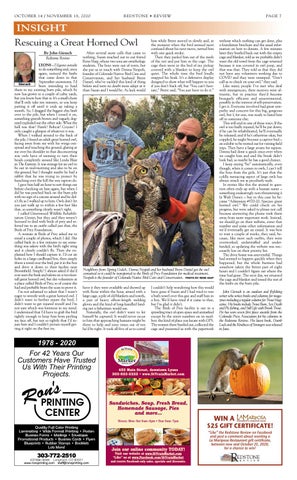
Neighbors from Spring Gulch, Donna Nespoli and her husband Brent Daniel got the owl contained so it could be transported to the Birds of Prey Foundation for medical treatment. Nespoli is the founder of Colorado Native Bird Care and Conservation. PHOTO BY RENE HAIP have it they were available and showed up with Rene within the hour, armed with a large cage, a pile of old blankets and towels, a pair of heavy elbow-length welding gloves and the kind of long-handled landing net a fisherman would use. Naturally, the owl didn’t want to let himself be captured. It would never occur to him that approaching humans might be there to help and nine times out of ten he’d be right. It took all five of us to corral
I couldn’t help wondering how this would have gone if Susan and I had tried to toss a bath towel over this guy and stuff him in a box. We’d have tried if it came to that, but I’m glad it didn’t. The Birds of Prey facility is out in a sprawling tract of open space and unmarked except by the street numbers on its mailbox: the kind of place you locate with GPS. The women there bustled out, collected the cage and presented us with the paperwork
455 Main Street, downtown Lyons 303-823-5225 • www.StVrainMarket.com
Sandwiches, Soup, Fresh Bread, Homemade Sausage, Pies and more… Hours: Mon-Sat 8am-8pm • Sun 8am-7pm
Join our online community TODAY! Visit our website at www.StVrainMarket.com “Like” us at www.Facebook.com/StVrainMarket and receive Facebook-only sales, specials and discounts.
without which nothing can get done, plus a foundation brochure and the usual information on how to donate. A few minutes later they bustled back out with the empty cage and blanket, told us we probably didn’t want the old towel from the cage returned because it was covered in owl poop, and that was that. They told us that they did not have any volunteers working due to COVID and they were swamped. “Don’t call us to check on your owl,” they said. Like many people I’ve met who deal with emergencies, their motives were altruistic, but in practice they’d become brusquely efficient and unsentimental, possibly in the interest of self-preservation. I get it. Everyone involved had great sympathy and concern for this big, gorgeous owl, but I, for one, was ready to hand him off to someone else. This will end in one of three ways. If the owl is too badly injured, he’ll be put down; if he can be rehabilitated, he’ll eventually be released; and if he’s otherwise okay, but crippled, he might become a captive bird – an exhibit to be trotted out for visiting field trips. They have a large aviary for raptors. Donna had done a quick once-over when we caught him and said the break didn’t look bad, so maybe he has a good chance. I keep saying “he” automatically, even though, when it comes to owls, I can’t tell the boys from the girls. It’s just that the coldly menacing aspect of large owls has always struck me as peculiarly male. In stories like this the animal in question often ends up with a human name – something endearingly non-threatening à la Walt Disney – but in this case he became “Admission #570-20, Species: great horned owl.” We could check on his progress, but were asked to please not call because answering the phone took them away from more important work. Instead, we should go on their website, enter that number and some other information and we’d eventually get an email. It was best to wait a couple of weeks, they said, because, like most such outfits, they were overworked, understaffed and underfunded, so updating the website was necessarily low on their priority list. The drive home was uneventful. Things had seemed to happen quickly when they happened, but the whole business had somehow taken the better part of eight hours and I couldn’t figure out where the time had gone. The next day, we returned the cage and blanket and tossed the rest of the limbs on the burn pile. John Gierach is an outdoor and flyfishing writer who writes books and columns for magazines including a regular column for Trout Magazine. His books include Trout Bum, Sex Death and Fly fishing, and Still Life with Brook Trout. He has won seven first place awards from the Colorado Press Association for his columns in the Redstone Review. His latest book, Dumb Luck and the Kindness of Strangers was released in June.