MAY 16 / JUNE 13, 2018
REDSTONE • REVIEW
PAGE 5
OPTIONS Pterodactyls in our midst By Greg Lowell Redstone Review LYONS – Like most kids, I was fascinated with dinosaurs and impossibly longed to see a real one. But then one day I did. I was in a canoe and slipped into a quiet cove and there it was, a prehistoric apparition with a pterosaurian wingspan rising up from the shore. I thought I’d gone to dino heaven. Alas, my flying reptile was but a great blue heron, a bird whose in-flight profile – neck tucked back, long bill jutting forward, legs trailing like a tail – harkens back its long-extinct relative. Among the most ubiquitous of North America’s wading birds, the great blue heron can be found in nearly every state from freshwater ponds and rivers to seacoast marshes and beaches. A full-grown great blue heron is four feet tall and has a seven-foot wingspan. They are solitary birds, except when they pair up and nest every spring. Here in Boulder County you can see blue herons every month of the year, standing sentinel along the St. Vrain River in a snow shower or impaling a bluegill at Pella Ponds in the summer heat. While herons have always been in Colorado, the creation of ponds and reservoirs here along the Front Range has created an ideal environment for them and their numbers have increased. The birds are generally nonmigratory, although they will come down to lower elevations in the winter. Communal rookeries At this time of the year, great blue herons are most noticeable as they gather at traditional treetop nesting sites called rookeries. Rookeries are a congregation of large, roughly built nests of sticks where the herons incubate their eggs and raise their young. The nesting sites can’t be missed. The trees – generally large cottonwoods – are denuded from the constant rain of heron droppings, the ground underneath smells like week-old fish, and the cries of the young birds have you looking for troops of monkeys. In Colorado, great blue herons usually lay one clutch of three to five eggs, which are incubated by both adults. The eggs hatch in 25 to 30 days. For the next two months, the adults feed the young by regurgitation.
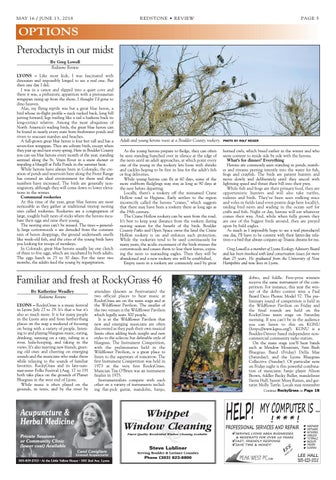
Adult and young herons roost at a Boulder County rookery.
PHOTO BY ROLF REISER
As the young herons prepare to fledge, they can often be seen standing hunched over in silence at the edge of the nests until an adult approaches, at which point every one of the young in the rookery lets loose with shrieks and cackles hoping to be first in line for the adult’s fish or frog deliveries. While young herons can fly at 60 days, some of the more stubborn fledglings may stay as long as 90 days at the nest before departing. Locally, there’s a rookery off the misnamed Crane Hollow road in Hygiene. Early settlers to the region incorrectly called the herons “cranes,” which suggests that there may have been a rookery there as long ago as the 19th century. The Crane Hollow rookery can be seen from the road. It’s best to keep your distance from the rookery during nesting season for the benefit of the birds. Boulder County Parks and Open Space owns the land the Crane Hollow rookery is on and enforces such protection. While the rookeries tend to be used continuously for many years, the acidic excrement of the birds stresses the cottonwoods and causes them to lose their leaves, exposing the nests to marauding eagles. Then they will be abandoned and a new rookery site will be established. Empty nests in a rookery are commonly used by great
horned owls, which breed earlier in the winter and who seem content to reside side by side with the herons. What’s for dinner? Everything Herons are commonly seen standing in ponds, marshes and streams peering intently into the water for fish, frogs and crayfish. The birds are patient hunters and move slowly and deliberately until they uncoil with lightning speed and thrust their bill into their prey. While fish and frogs are their primary food, they are opportunistic hunters and will also take turtles, rodents and birds. They’ve been seen stalking mice and voles in fields (and even prairie dogs here locally), raiding bird nests and wading in the ocean surf for crabs and fish. Night or day, herons will eat whatever comes their way. And, while when fully grown they are one of the biggest birds around, they are preyed upon by bald eagles. As much as I impossibly hope to see a real pterodactyl one day, I’ll have to be content with their latter-day relatives – a bird that always conjures up Triassic dreams for me.
Familiar and fresh at RockyGrass 46 By Katherine Weadley Redstone Review LYONS – RockyGrass is a music festival in Lyons July 27 to 29. It’s that – but it’s also so much more. It is for many people in the Lyons area and from further-flung places on the map a weekend of focusing on being with a variety of people, listening to and playing bluegrass music, eating, drinking, sunning on a tarp, tubing in a river, hula-hooping, and taking in the views. It’s also meeting new friends, greeting old ones and cheering on emerging sounds and the musicians who make them while relaxing to the sounds of familiar favorites. RockyGrass and its late-summer-sister Folks Festival (Aug. 17 to 19) both take place on the grounds of Planet Bluegrass in the west end of Lyons. While music is often played on the grounds, in tents, and by the river by
attendees (known as Festivarians) the two official places to hear music at RockyGrass are on the main stage and at the Wildflower Pavilion. The smaller of the two venues is the Wildflower Pavilion which legally seats 300 people. It is at the Wildflower Pavilion that new and emerging musicians are often discovered as they push their own musical limits often adding fresh insight and new styles to the eclectic but definable style of bluegrass. The Instrument Competition, with the preliminaries held in the Wildflower Pavilion, is a great place to listen to the superstars of tomorrow. The first Instrument Competition was held in 1973 at the very first RockyGrass. Musician Tim O’Brien was an instrument finalist in 1975. Instrumentalists compete with each other on a variety of instruments including flat-pick guitar, mandolin, banjo,
Acupuncture & Herbal Medicine
Whippet Window Cleaning Finest Quality Residential Window Cleaning Available
Private Sessions or Community Clinic (lower cost) Available Carol Conigliaro Licensed Acupuncturist 303-819-2713 • At the Little Yellow House • 503 2nd Ave, Lyons
Steve Lubliner Serving Boulder & Larimer Counties
Phone (303) 823-8800
Greg Lowell is a member of Lyons Ecology Advisory Board and has been involved with land conservation issues for more than 25 years. He graduated from the University of New Hampshire and now lives in Lyons.
dobro, and fiddle. First-prize winners receive the same instrument of the competition. For instance, this year the winner of the dobro contest wins a Paul Beard Deco Phonic Model 57. The preliminary round of competition is held in the Wildflower Pavilion on Friday and the final rounds are held on the RockyGrass main stage on Saturday morning. If you can’t be in the audience you can listen to this on KGNU (https://www.kgnu.org/). KGNU is a Boulder-Denver based independent noncommercial community radio station. On the main stage you’ll hear bands such as Meadow Mountain, Sam Bush Bluegrass Band (Friday) Della Mae (Saturday), and the Lyons Bluegrass Collective (Sunday). Of particular note on Friday night is this powerful combination of musicians: banjo player Alison Brown, fiddler Becky Buller, mandolinist Sierra Hull, bassist Missy Raines, and guitarist Molly Tuttle. Locals may remember Continue RockyGrass on Page 18