BOOsTiNg THe NUMBeRs O F N U R s i N g FAc U lT y
s
outhern will offer the second doctoral program in its history this fall when it launches an Ed.D. in nursing education — an initiative designed to help address the state and national shortage of nurses and nursing faculty.
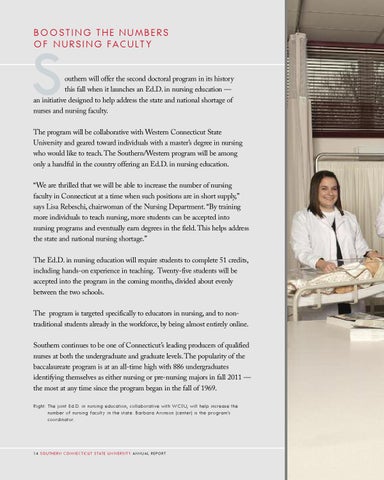
The program will be collaborative with Western Connecticut State University and geared toward individuals with a master’s degree in nursing who would like to teach. The Southern/Western program will be among only a handful in the country offering an Ed.D. in nursing education. “We are thrilled that we will be able to increase the number of nursing faculty in Connecticut at a time when such positions are in short supply,” says Lisa Rebeschi, chairwoman of the Nursing Department. “By training more individuals to teach nursing, more students can be accepted into nursing programs and eventually earn degrees in the field. This helps address the state and national nursing shortage.” The Ed.D. in nursing education will require students to complete 51 credits, including hands-on experience in teaching. Twenty-five students will be accepted into the program in the coming months, divided about evenly between the two schools. The program is targeted specifically to educators in nursing, and to nontraditional students already in the workforce, by being almost entirely online. Southern continues to be one of Connecticut’s leading producers of qualified nurses at both the undergraduate and graduate levels. The popularity of the baccalaureate program is at an all-time high with 886 undergraduates identifying themselves as either nursing or pre-nursing majors in fall 2011 — the most at any time since the program began in the fall of 1969. Right: The joint ed.D. in nursing education, collaborative with wcsU, will help increase the number of nursing faculty in the state. Barbara Aronson (center) is the program’s coordinator.
1 4 s O U T H e R N c O N N e c T i c U T s TAT e U N i v e R s i T y A N N U A l R e p O R T