The Southern Cross, July 4 to July 10, 2018
FAITH
9
Abbey Rote: How Benedictines live What is life like for a Benedictine today, 1 500 years after the order was founded by St Benedict, whose feast day is on July 11? Br BASIL TSuBAne OSB writes about his abbey in Polokwane.
S
INCE its foundations in the 1920s and its official opening on the Palm Sunday of 1981, St Benedict’s Abbey in Polokwane has described itself as a pastoral community and it has sought to balance the daily demands of monastic observances and those of pastoral work. It is one of two Benedictine abbeys in South Africa; the other is Inkamana Abey in northern KwaZulu-Natal. The Belgian Benedictine monks who founded the Polokwane abbey came to South Africa in 1910 as missionaries. The monastery was a territorial abbey, or an “abbey nullius”, which meant that the abbot was the superior of both the monastery and the surrounding territory. So Abbots Osterrath (1939-52) and Van Hoek (1954-74) also were the bishops of Pietersburg diocese, now called Polokwane. Elected in 1974, Abbot Fulgence Le Roy eventually managed to separate the monastery and the diocese, and in 1988 became the first bishop of the diocese (his successors, Bishops Paul Mogale Nkumishe and Jeremiah Masela, have been diocesan priests). This separation allowed the monastery to focus on its monastic observances more than it was doing when it was fully involved in the pastoral activities in the diocese of Polokwane.
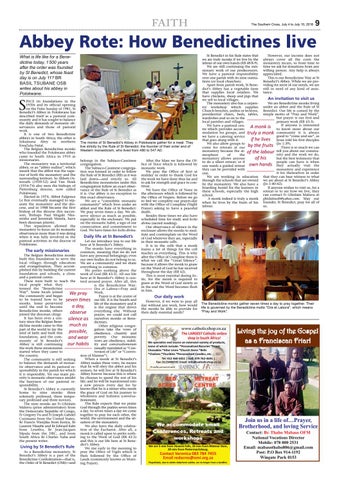
The monks of St Benedict’s Abbey in Polokwane gather for a meal. They live strictly by the rule of St Benedict, the founder of their order and of Western monasticism, who lived from 480 to 547 AD. belongs in the Subiaco-Cassinese congregation. The Subiaco-Cassinese congregation was formed in order to follow the Rule of St Benedict (RB) as it was laid down—and strictly so. All Benedictine monasteries under this congregation follow an exact observance of the Rule of St Benedict as it is. Our abbey is no exception to this exact observance. We are a “coenobitic monastic community” which lives under an abbot and the Rule of St Benedict: We pray seven times a day. We observe silence as much as possible, especially in the enclosure. We put on the monastic habit, a sign of our consecration and commitment to God. We have times for lectio divina.
Daily life at St Benedict’s
Let me introduce you to our life here at St Benedict’s Abbey. The monks have everything in The early missionaries common, meaning that we do not The Belgian Benedictine monks have any personal belongings; even built this foundation to serve the our own bodies do not belong to us. local villages through education We are a community and we share and evangelisation. They accom- everything in common. plished this by building the current We prefer nothing above the foundation and schools, a clinic work of God (RB 43:3). All our life and a pastoral centre. here at St Benedict’s Abbey is cenThese were built to teach the tred around prayer. After all, this local people what they is the Benedictine Way: termed the “Benedictine Ora et Labora—Pray and Way”. Some locals joined We pray Work. the community and began Prayer is at the centre of to be trained how to be seven times our life. It is the breath and monks. Some persevered life of the monastery and it a day, until the end to become is the engine that drives Benedictine monks, others everything else. Without observe joined the diocesan clergy. prayer, we could not call It has been over a censilence as ourselves monks or Benetury since the Belgian Benedictines. much as dictine monks came to this Other religious congrepart of the world to lay the gation take the vows of possible, obedience, chastity and seed of faith and built this foundation, and the comand wear poverty. Our monastic munity of St Benedict’s vows are obedience, stabilAbbey is still continuing our habits ity and conversatiomorum the work these missionaries (usually translated as “Conversion of Life” or “Converstarted when they came to sion of Manner”). the country. When a monk at St Benedict’s The community is still seeking to balance the demands of monas- Abbey makes these vows, he means tic observance and its pastoral re- that he will obey the abbot and his sponsibility in the parish for which seniors; he will live at St Benedict’s it is responsible. Yet our main pri- Abbey forever because this is where ority is monastic observance amidst he chooses to spend the rest of his the busyness of our pastoral re- life; and he will be transformed into a new person every day for he sponsibility. St Benedict’s Abbey is currently knows that he is a sinner who needs home to nine monks: three the grace of God on his journey to solemnly professed, three tempo- wholeness and holiness (conversatiomorum). rary professed and three novices. The Rule expects that we praise The nine monks are Fr Ghislain Maluvu (prior administrator) from God through the psalms seven times the Democratic Republic of Congo, a day. So seven times a day we come Fr Gregory Vu and Fr Joseph Gabriel together to pray for each other, the Cusimano from the United States, world, the environment and the sitBr Francis Wanjiku from Kenya, Br uation of the monastery. We also have the daily celebraLaurent Nkuebe and Br Edward Kabi from Lesotho, Br Jean-Jacques tion of the Eucharist. After all, a Mpula from the DRC, and from monk is called upon to prefer nothSouth Africa Br Charles Xaba and ing to the Work of God (RB 43:3) and this is our life here at St Benethe present writer. dict’s Abbey. Living by St Benedict’s Rule We rise early in the morning to As a Benedictine monastery, St pray the Office of Vigils which is Benedict’s Abbey is a part of the then followed by the Office of Benedictine Confederation—that is, Lauds (commonly known as Mornthe Order of St Benedict (OSB)—and ing Prayer).
After the Mass we have the Office of Terce which is followed by monastic work. We pray the Office of Sext at midday in order to thank God for the work we have done thus far and to ask for strength and grace to continue. We have the Office of None in the afternoon which is followed by the Office of Vespers. Before we go to bed we complete our prayer-day with the Office of Compline (Night Prayer) asking to have a peaceful death. Besides these times we also have scheduled time for study and lectio divina (sacred reading). Our observance of silence in the enclosure allows the monks to meditate and contemplate on the Word of God wherever they are, especially in their monastic cells. It is in the cells that a monk learns a lot of things for the cell teaches us everything. This is why after the Office of Compline there is what we call the “Great Silence”, because it allows the monk to gnaw on the Word of God he has received throughout the day (RB 42). This is most essential during lectio, for the monk is required to gnaw at the Word of God slowly so in the end the Word becomes flesh in him.
Our daily work However, if we were to pray all day without any work, how would the monks be able to provide for their daily essential needs?
St Benedict in his Rule states that However, our income does not we are truly monks if we live by the always cover all the costs the labour of our own hands (RB 48:8-9). monastery incurs, so from time to We are still continuing the mis- time we ask for donations from any sionary work of our predecessors. willing person. Any help is always We have a pastoral responsibility appreciated. over one parish with its nine outstaThis is our Benedictine Way at St tions (or local churches). Benedict’s Abbey. While we are proApart from parish work, St Bene- viding for most of our needs, we are dict’s Abbey has a vegetable farm still in need of any kind of assisthat supplies local retailers. We tance. have chickens, sheep and pigs that An invitation to visit us we sell to local villages. We are Benedictine monks living The monastery also has a carpentry workshop which supplies under an abbot and the Rule of St Church benches, ambos or lecterns, Benedict. Our life is coined by the presidential chairs, beds, tables, simple motto of “Pray and Work”, but prayer is our first and wardrobes and so on to the primary work (RB 43:3). local parishes and villages. If anyone is interested We have a pastoral cenA monk is to know more about our tre which provides accommodation for groups, and truly a monk community it is always good to “come and see”, as we have a catering service if he lives Jesus told his first disciples that goes along with it. (Jn 1:39). We also allow groups to There is so much we can come for retreats at our by the fruits monastery because the at- of the labour tell you about our community and the work we do, mosphere of the but the best testimony that monastery allows anyone of his people can have is when to do a silent retreat; or if one needs a guided retreat own hands they actually visit the monastery and experience they can be provided with it for themselves in order one. We are working in education that they can bear witness to what through the schools that are owned we are about at St Benedict’s Abbey by the monastery. We also have a (Jn 1:40-42). If anyone wishes to visit us, for a boarding hostel for the learners in these schools, especially the high retreat or to see how we live, they can contact Fr Ghislain Maluvu at school. A monk indeed is truly a monk ghislainosb@yahoo.com. May our when he lives by the fruits of his founder, St Benedict, pray for all of us. labour.
The Benedictine monks gather seven times a day to pray together. Their life is governed by the Benedictine motto “Ora et Labora”, which means “Pray and Work”.
The lARgeST Catholic online shop in South Africa!
"
We specialise and source an extensive variety of products, some of which include: *Personalised Rosaries *Priest Chasubles *Altar linen *Church Items *Bells *Chalices *Thuribles *Personalised Candles, etc. Tel: 012 460-5011 | Cell: 079 762-4691 | Fax: 0123498592 email: info@catholicshop.co.za
Living the joy of the Gospel as a Franciscan Friar!
2øæ¸Ø "ı̇øߺ̋ø̋¸"¬Æß̶" "
We accommodate small Conferences, Retreats and workshops
We are 5 min from Howick Falls, 10 min from midmar Dam, 20 min from Pietermaritzburg.
Contact Veronica 083 784 7455 email redacres@omi.org.za
Regrettably, due to stolen telephone cables, we no longer have a landline.
Join us in a life of…Prayer, Brotherhood, and loving Service Contact: Br. Thabo Mabaso OFM National Vocations Director Mobile: 078 000 2531 Email: mabasothabo806@gmail.com Post: P.O Box 914-1192 Wingate Park 0153