BENEDICT DASWA
The Southern Cross, September 9 to September 15, 2015
9
The day a martyr was born In the second of two edited excerpts from his new biography of Benedict Daswa, HUGH SLATTERY MSC, the retired bishop of Tzaneen, recalls the events leading up to the killing of South Africa’s first recognised martyr.
T
WO qualities in particular stand out in Benedict’s life: his great moral courage and his total commitment to the truth. At first glance, what strikes one most about Benedict Daswa is how ordinary he was. He came from a family that was poor but not destitute. Like many boys in rural South Africa, at a young age he became a herdboy before going to school. Eventually he became a teacher and then school principal. He married, had a large family and was murdered on February 2, 1990 because of his opposition to the practice of witchcraft. He was in the prime of life, just a few months short of his 44th birthday. On the surface, everything about Benedict was ordinary—even his death, since he was just one of many victims of witchcraft-related violence at that time in Venda. Last week’s article discussed how Benedict had converted to Catholicism in 1963. As his Catholic faith was growing all the time, so also was the opposition to him at the Headman’s Council and among people in the village. His stance against witchcraft was not a popular one, since he was opposing something ingrained very deeply in the local culture. There were others who, like Benedict, saw the world of witchcraft as one of evil, fear, mistrust, enmity, injustice and violence which the people should abandon and put behind them. However, these, among them ministers of religion, kept quiet out of fear of reprisal. Everyone knew about Benedict’s principled stance against the use of muti to bring success to the Mbahe Eleven Computers soccer team. Some spread the rumour that Benedict himself was dabbling in witchcraft by having zombies help him in his fertile garden. There was a lot of jealousy and resentment against Benedict. This was not only on account of his opposition to witchcraft but also because of his success in life. He was a respected man with a nice wife, a lovely family and a beautiful home. He was a good school principal and a leader in the Transvaal United African Teachers’ Association. He was active in the Church and in the Headman’s Council. Moreover, he
was a close friend of the headman. On January 25 1990, during a heavy unseasonal thunderstorm, several thatched rondavels were struck by lightning. On the following Sunday, January 28, the headman called a meeting of his council to deal with the matter.
B
enedict had not yet arrived when the issue was discussed and a decision taken. In his absence the decision was predictable: some members of the community would go to a certain sangoma and get him to “sniff out” the witch who had sent the lightning. But they would first have to collect some money to give to the sangoma. It was agreed that each family would have to give five rand. When Benedict arrived, he immediately tried to have the decision reversed. He pointed out that lightning strikes are a purely natural occurrence and couldn’t possibly be caused by human beings. But uppermost in the people’s minds was the usual question as to why particular houses were struck by lightning, but not the others. They did not accept that this was just by chance. They believed that there was a human agent behind all this—a witch—who wanted to harm some people but not the others. As the Vendas say, “A huna tshi no da nga tshothe,” which means “nothing simply happens by itself”. Benedict pointed out that the decision would lead to some innocent person being killed. Still, the meeting stuck by their decision and Benedict said that he would never contribute the five rand for the sangoma. His cousin Samuel Daswa tells us that the people saw things differently: “They thought he was making himself a big guy, refusing to take part in what the community wanted to do.” During the following days, Benedict’s murder was carefully planned and carried out quickly. His enemies got a group of youth and young adults to carry out their plan to kill Benedict.
Friday, 2 February 1990, the feast of the Presentation of the Lord in the Temple, became the birthday of Benedict Daswa into heaven. Very much in keeping with his daily Christian living, he performed three acts of charity during his last day on earth. In the morning he delivered some vegetables from his garden to his parish priest, Fr John Finn MSC, in Thohoyandou. He took his sisterin-law, Alice Daswa, and her sick baby to the doctor in Makwarela about 15km away. On his way there he gave a lift to a young man with a bag of mealie meal and went out of his way to drop him off at his home. As Benedict was nearing his house, it was already getting dark. Suddenly he found his way blocked by a tree trunk and large stones placed across the road. As he got out to remove them, he was attacked from both sides by a mob of young people throwing stones at him.
The Requiem Mass for Benedict Daswa on September 10, 1990, with (from left) the late Fr Doney McCarthy MSC, Deacon Jonas Letlalo, Fr John Finn MSC, Fr Phillemon Thobela and Fr Jim Stubbs MSC.
I
njured and bleeding, Benedict ran to a nearby shebeen, hoping to get some protection and help. The mob followed in hot pursuit. Ejected from the shebeen, he sought refuge in a house but had to come out when the mob threatened to burn it down. He pleaded for his life—but all in vain. He then asked to be allowed to kneel down and pray. As he prayed aloud, a young man raised his knobkerrie and struck Benedict a violent blow on the back of the head, crushing his skull. Then another one fetched boiling water from a nearby stove and poured it over the dying man’s head. On Saturday, February 10, the funeral service of Benedict Daswa took place at Nweli’s church of the Assumption of Our Lady into Heaven, which he had helped to build some years earlier. It was estimated that between 400 and 500 people attended, including a large number of teachers. Fr Finn was the main celebrant assisted by Frs Philemon Thobela, Doney McCarthy MSC, Jimmy Stubbs MSC and Deacon Jonas Letlalo. The priests wore red vestments to show their belief that Benedict had died as a martyr for the faith. At the graveside, Fr McCarthy pointed to Benedict and said: “This is my brother who died for his faith.” He predicted that Benedict would in time be recognised by the Church as “one of the first black martyrs because he died for his faith”. I am sure neither he, nor anyone else could imagine that this would happen so quickly and that in the space of 25 years he would become Blessed Benedict Daswa. Bishop Hugh Slattery’s book, Blessed Benedict Daswa: South Africa’s First Martyr, is published by Paulines Publications Africa.
How
Th e
Benedict’s damaged bakkie and the soccer field on which he was killed. Benedict’s mother Ida and Sr Claudette Hiosan enter the church of Our Lady of the Assumption at Nweli, which Benedict helped build and where his body is now kept.
Benedict with pupils at a school braai at Lupepe.
Souther n Cross covered Daswa
A small collection of our many pages on Benedict Daswa over the past years. See our archive of Daswa features at www.scross.co.za/category/benedict-daswa
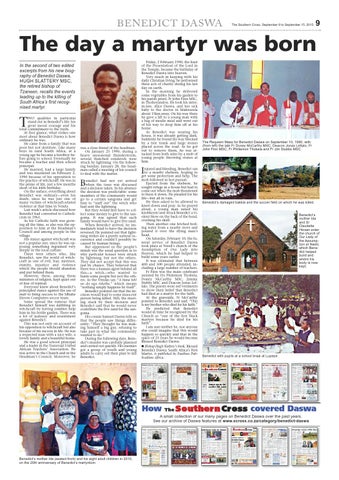
Benedict’s mother Ida (seated front) and his eight adult children in 2010, on the 20th anniversary of Benedict’s martyrdom