The Southern Cross, April 9 to April 15, 2014
PERSPECTIVES
Work signs of wonder this Holy Week T Raymond Perrier HERE was a time in history when the Catholic Church was genius at using symbols to communicate. Now it seems that pop stars and advertisers are the masters of imagery and the Church instead uses longer and longer words and people no longer understand or feel the deeper underlying meaning. The “palm cross” that you are clutching as you go home from church this Sunday shows what happens when our symbols become so frozen that we lose sight of what they are symbolising. Perhaps you even wave the little palm crosses as the procession comes in—but do you stop to notice how odd it looks? Of course, we are re-enacting the way that the crowd welcomed Jesus into Jerusalem. But we don’t do it as they did with branches from nearby trees; instead we used dried up thin bits of leaf made into a “holy” shape. To me this is one of many missed opportunities during Holy Week. This period of our liturgical year is filled with wonderful symbols to help us to feel what it was like to accompany Jesus during his last week. And yet too often our way of symbolising has become so ritualised that we feel nothing. We are comforted by the familiarity of the actions and elements that we return to each year—but the very familiarity robs them of their ability to stop us in our tracks and take notice. Pope Francis—following the master of grand gestures, Bl John Paul II—showed us in last year’s Holy Week what happens when you take the symbolising seriously and use it, as it should be used, to draw attention to the underlying meaning. The washing of feet on Holy Thursday night is of course a re-enactment of what Jesus did to the Apostles. Now Rome is rather grand and feet are a bit smelly so it had become customary that the Pope would pour water from a golden jug over the feet of 12 specially chosen priests— all
men, all dressed in vestments, all probably with their feet nicely pedicured beforehand. But then a few weeks after his election it was Francis’ turn. He chose to wash the feet not of princes of the Church but of young people, not just of young people but of young men and women, not just of young men and women but of young offenders, and not just of Catholics but even of Muslim.
I
f you are the sort of person who cares for the rubrics you probably want to cry out: but the Pope is the Vicar of Christ, and the equivalent of the 12 apostles would be 12 priests, and they must all be good Christian men because so were the apostles! But the Apostles also were married, bearded, olive-skinned and circumcised, so we have to be careful where literal re-enactment might lead us. What matters is the underlying meaning: the act of washing feet was an act of abasement—Jesus lowering himself to the level of a slave to show what he meant by service. Which of the TV pictures of papal footwashings has been the more effective one
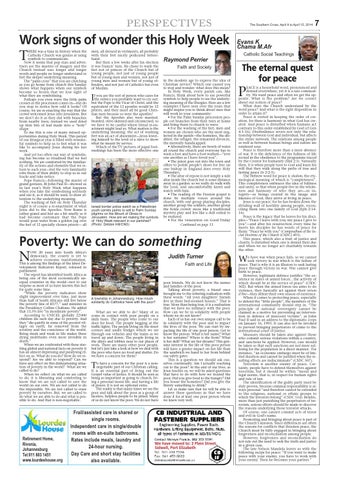
israeli border police watch as a Palestinian youth carries palms to sell to Palm Sunday pilgrims on the Mount of Olives in Jerusalem. How are we making the symbols of Holy Week relevant in our parishes? (Photo: Debbie Hill/CNS)
Faith and Society
in the modern age to express the idea of Christian service? Which one caused you to stop and wonder: what does this mean? In Holy Week, every parish can, like Francis, think about how to use powerful symbols to help people to see the underlying meaning of the liturgies. Here are a few examples I have seen over the years that might inspire you to think about ones that will work in your community: • For the Palm Sunday procession people cut branches from their trees at home and bring them to church to wave. • For the washing of the feet, men and women are chosen who are the most neglected in the parish—the homeless, the disabled, the refugee, the remarried divorcee, the mentally handicapped. • Alternatively, there are bowls of water all round the church and everyone has to wash a foot and have a foot washed—“love one another as I have loved you”. • The priest goes out into the town and offers to polish people’s shoes for free (as one bishop in England does every Holy Thursday). • The altar of repose is not simply a side altar inside the church but is some distance away in a garden: so we really do walk with the Lord, and uncomfortably kneel and watch with him. • The reading of the Passion gospel is done by multiple voices around the church, with one group playing disciples, another group the soldiers, another group the fickle crowd: more like a traditional mystery play and less like a dull ordeal to be endured. • For the veneration on Good Friday Continued on page 11
Poverty: We can do something Judith Turner N OW 20 years into South Africa’s democracy, the county is yet to achieve economic transformation. This is among the findings of the latest Development Indicators Report, released in parliament. The report has identified South Africa as being one of the most economically unequal countries in the world—not to our surprise as most of us have known this fact for quite some time. “While the poverty indicators show slight improvement over time, just more than half of South Africans still live below the poverty line of R577,” said minister in the Presidency Collins Chabane. He added that 13,3% live “in inordinate poverty”. According to UNICEF, globally 22 000 children die each day due to poverty. And they “die quietly in some of the poorest villages on earth, far removed from the scrutiny and the conscience of the world. Being meek and weak in life makes these dying multitudes even more invisible in death.” When we are confronted with these startling global and national facts on poverty it has an almost depressing and paralysing effect on us. What do you do? How do we respond? Are we able to respond? Can we have any effect on this disheartening situation of poverty in the world? What are we called to do? When we reflect on what we are called to do, it is liberating and comforting to know that we are not called to save the world on our own. We are not called to do the impossible. We are not called to erase poverty by ourselves. But, we are called to do what we are able to do and what is possible to do. And that is non-negotiable.
Retirement Home, Rivonia, Johannesburg Tel:011 803 1451 www.lourdeshouse.org
Faith and life
A township in Johannesburg. How miuch solidarity do Catholics have with the poor? What are we able to do? Many of us come in contact with poor people on a daily basis. The people who come to our door for food. The people begging at the traffic lights. The people living on the street corners and under bridges which we see through our vehicles and the trains as we travel up and down. The people living in the alleys and lobbies near to our places of work. There are many other poor people, but let’s just take a look at how we deal with the poor who have no food and shelter. Do we have a concern for them?
T
o have a concern for the poor is a nonnegotiable part of our Christian calling. It is an essential part of living out the Gospel value of justice. It should be seen as being as important as going to church, living a personal moral life, and having a life of prayer. It is not an optional extra. The reality is that many times we see the poor and talk about the poor as a group of faceless, helpless people to be pitied. Many of us do not know the poor. We do not have
Frail/assisted care in shared or single rooms. Independent care in single/double rooms with en-suite bathrooms. Rates include meals, laundry and 24-hour nursing. Day Care and short stay facilities also available.
poor friends. We do not know the names and families of the poor. Talking about poverty, a friend once brought me to the sobering realisation with these words: “All your daughters’ friends live in three bed-roomed houses.” That is true. More than being true, it is a realisation that we have no intimacy with the poor. How can we be in solidarity with people whom we do not know? Each of us has our own unique call to be in solidarity with the poor and to impact the lives of the poor. We can start by impacting the life of one poor person. Get to know the person. What is her name? What is her surname? Where is she from? What is her skill? What are her dreams? This genuine interest in the life of this poor person will have a greater impact on her life than the sandwich we hand to her from behind our safety gates. This is a question we should ask ourselves continually. Am I actually reaching out to the poor? At the end of our lives, as Jesus teaches us, we will be asked questions that have to do with how we treated the poor. Did you give food to the hungry? Did you house the homeless? Did you give the thirsty something to drink? Let us make sure that we will be able to answer these questions in that we have done it for at least one poor person whom we knew very well.
We have moved to: 2 Plein Street, Sidwell, Port Elizabeth
Evans K Chama M.Afr
7
Catholic Social Teachings
The eternal quest for peace
P
EACE is a household word, pronounced and desired everywhere, yet it is a rare commodity. We want peace and often we get the opposite. What is the problem? Are we correct about our notion of peace? What does the Church understand by the word peace? And what is the right disposition in order to attain it? Peace is rooted in keeping the order of creation, for there is harmony in what God has created. And peace is disturbed when humans act contrary to this order established by God (cf Gen 4:1-16). Disobedience severs not only the relationship between God and individual, but affects the entire network. The relations among people as well as between human beings and nature are rendered sour. Peace is therefore more than a mere absence of war. It is the deficiency of the fullness of life rooted in the obedience to the programme traced by the Creator for humanity (Mal 2:5). Naturally then, it is when people turn to God and learn his will that they walk along the paths of true and lasting peace (Is 2:2-5). The Hebrew word for peace is shalom, the etymological meaning of which is “completeness”. This completeness embraces the idea of fullness and unity, so that when people live in the wholeness and harmony of who they are—in integrity—as beings created in the image and likeness of God, they arrive at living in peace. Jesus is our peace, for he has broken down the dividing wall of hostility among people, reconciling them into one family of God (Eph 2:1416). Peace is the legacy that he leaves for his disciples—“Peace I leave with you; my peace I give to you”—and after his resurrection every time he meets his disciples he has words of peace for them: “Peace be with you” (Compendium of the Social Doctrine of the Church (CSDC] 491). This peace, which also a fruit of justice and charity, is disturbed when one is denied their due and when we no longer act charitably towards the other.
W
e have war when peace fails, so we cannot seek victory in war which is the failure of peace. That is why it is an illusion to seek lasting peace through victory in war. War cannot give birth to peace. However, legitimate defence justifies “the existence in states of armed forces…the activity of which should be at the service of peace” (CSDC 502). But when the armed forces use arms to do violence, they basically act against their raison d'être—they defeat their own reason of existence. When it comes to protecting peace, especially to defend the “little people”, the members of the international community should step in. “The principle of national sovereignty cannot be claimed as a motive for preventing an intervention in defence of innocent victims”, as John Paul II said in an address to the diplomatic corps on January 16, 1993. It can also not be invoked to prevent bringing perpetrators of crime to the international court of Justice. Measures should be taken also against those who commit serious violations within a country, and sanctions be applied. However, care should be taken so that such sanctions are not mere suffering for the population in a direct manner. For instance, “an economic embargo must be of limited duration and cannot be justified when the resulting effects are indiscriminate” (CSDC 507). Terrorism is another enemy of peace. Certainly, people have to defend themselves against terrorism, but it should be within “moral and legal norms, that is, in respect for human rights and rule of law. The identification of the guilty party must be duly proven, because criminal responsibility is always personal “and therefore cannot be extended to the religious, national or ethnic groups to which the terrorists belong” (CSDC 514). Besides, more than just punishing the perpetrators of terrorism, serious efforts should be made to discover the reasons underlying those terrorist attacks. Of course, one cannot commit acts of terror and evil in God’s name. Promoting and bringing about peace is part of the Church’s mission. Since differences are often the reasons for conflicts that threaten peace, the Church must be fully engaged in bringing about forgiveness and reconciliation among people. However, forgiveness and reconciliation do not rule out the need to seek the truth and justice in a given case. The late Nelson Mandela leaves us with the following recipe for peace: “If you want to make peace with your enemy, you have to work with your enemy. Then he becomes your partner.”