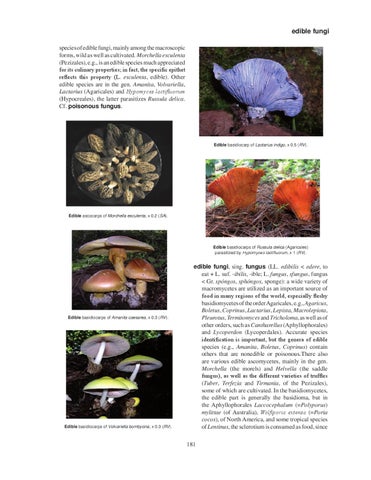
edible fungi species of edible fungi, mainly among the macroscopic forms, wild as well as cultivated. Morchella esculenta (Pezizales), e.g., is an edible species much appreciated for its culinary properties; in fact, the specific epithet reflects this property (L. esculenta, edible). Other edible species are in the gen. Amanita, Volvariella, Lactarius (Agaricales) and Hypomyces lactifluorum (Hypocreales), the latter parasitizes Russula delica. Cf. poisonous fungus.
Edible basidiocarp of Lactarius indigo, x 0.5 (RV).
Edible ascocarps of Morchella esculenta, x 0.2 (SA).
Edible basidiocarps of Russula delica (Agaricales) parasitized by Hypomyces lactifluorum, x 1 (RV).
Edible basidiocarps of Amanita caesarea, x 0.3 (RV).
Edible basidiocarps of Volvariella bombycina, x 0.3 (RV).
edible fungi, sing. fungus (LL. edibilis < edere, to eat + L. suf. -ibilis, -ible; L. fungus, sfungus, fungus < Gr. sp贸ngos, sph贸ngos, sponge): a wide variety of macromycetes are utilized as an important source of food in many regions of the world, especially fleshy basidiomycetes of the order Agaricales, e.g., Agaricus, Boletus, Coprinus, Lactarius, Lepista, Macrolepiota, Pleurotus, Termitomyces and Tricholoma, as well as of other orders, such as Cantharellus (Aphyllophorales) and Lycoperdon (Lycoperdales). Accurate species identification is important, but the genera of edible species (e.g., Amanita, Boletus, Coprinus) contain others that are nonedible or poisonous.There also are various edible ascomycetes, mainly in the gen. Morchella (the morels) and Helvella (the saddle fungus), as well as the different varieties of truffles (Tuber, Terfezia and Tirmania, of the Pezizales), some of which are cultivated. In the basidiomycetes, the edible part is generally the basidioma, but in the Aphyllophorales Laccocephalum (=Polyporus) mylittae (of Australia), Wolfiporia extensa (=Poria cocos), of North America, and some tropical species of Lentinus, the sclerotium is consumed as food, since 181