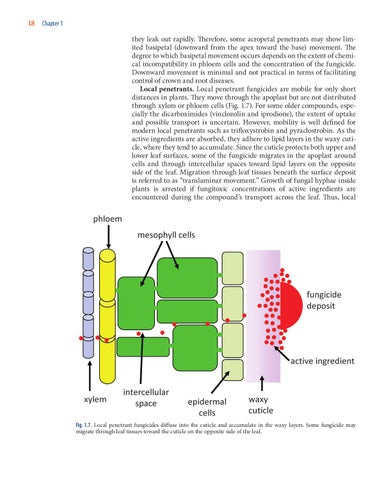
18 Chapter 1 they leak out rapidly. Therefore, some acropetal penetrants may show limited basipetal (downward from the apex toward the base) movement. The degree to which basipetal movement occurs depends on the extent of chemical incompatibility in phloem cells and the concentration of the fungicide. Downward movement is minimal and not practical in terms of facilitating control of crown and root diseases. Local penetrants. Local penetrant fungicides are mobile for only short distances in plants. They move through the apoplast but are not distributed through xylem or phloem cells (Fig. 1.7). For some older compounds, especially the dicarboximides (vinclozolin and iprodione), the extent of uptake and possible transport is uncertain. However, mobility is well defined for modern local penetrants such as trifloxystrobin and pyraclostrobin. As the active ingredients are absorbed, they adhere to lipid layers in the waxy cuticle, where they tend to accumulate. Since the cuticle protects both upper and lower leaf surfaces, some of the fungicide migrates in the apoplast around cells and through intercellular spaces toward lipid layers on the opposite side of the leaf. Migration through leaf tissues beneath the surface deposit is referred to as “translaminar movement.” Growth of fungal hyphae inside plants is arrested if fungitoxic concentrations of active ingredients are encountered during the compound’s transport across the leaf. Thus, local
Fig. 1.7. Local penetrant fungicides diffuse into the cuticle and accumulate in the waxy layers. Some fungicide may migrate through leaf tissues toward the cuticle on the opposite side of the leaf.