12 ▶ CHAPTER 1 CASE STUDY APPLE SCAB Biotroph or Necrotroph? The apple scab fungus, Venturia inaequalis, is a necrotroph. It is a parasitic fungus that predominantly invades the superficial tissues of leaves, flowers, and fruit, causing necrosis and inducing a defensive reaction in which the plant forms cork cells in affected tissue. Later, the fungus survives the winter as a saprophyte in fallen leaves.
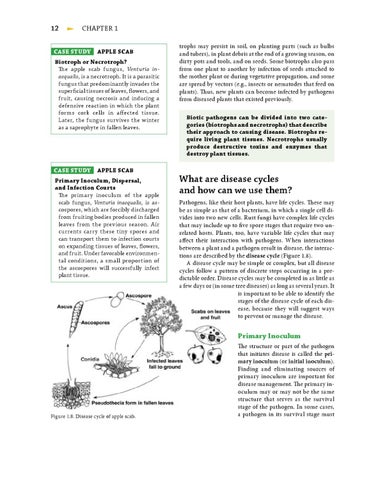
CASE STUDY APPLE SCAB Primary Inoculum, Dispersal, and Infection Courts The primary inoculum of the apple scab fungus, Venturia inaequalis, is ascospores, which are forcibly discharged from fruiting bodies produced in fallen leaves from the previous season. Air currents carry these tiny spores and can transport them to infection courts on expanding tissues of leaves, flowers, and fruit. Under favorable environmental conditions, a small proportion of the ascospores will successfully infect plant tissue.
trophs may persist in soil, on planting parts (such as bulbs and tubers), in plant debris at the end of a growing season, on dirty pots and tools, and on seeds. Some biotrophs also pass from one plant to another by infection of seeds attached to the mother plant or during vegetative propagation, and some are spread by vectors (e.g., insects or nematodes that feed on plants). Thus, new plants can become infected by pathogens from diseased plants that existed previously. Biotic pathogens can be divided into two categories (biotrophs and necrotrophs) that describe their approach to causing disease. Biotrophs require living plant tissues. Necrotrophs usually produce destructive toxins and enzymes that destroy plant tissues.
What are disease cycles and how can we use them? Pathogens, like their host plants, have life cycles. These may be as simple as that of a bacterium, in which a single cell divides into two new cells. Rust fungi have complex life cycles that may include up to five spore stages that require two unrelated hosts. Plants, too, have variable life cycles that may affect their interaction with pathogens. When interactions between a plant and a pathogen result in disease, the interactions are described by the disease cycle (Figure 1.8). A disease cycle may be simple or complex, but all disease cycles follow a pattern of discrete steps occurring in a predictable order. Disease cycles may be completed in as little as a few days or (in some tree diseases) as long as several years. It is important to be able to identify the stages of the disease cycle of each disease, because they will suggest ways to prevent or manage the disease.
Primary Inoculum
Figure 1.8. Disease cycle of apple scab.
The structure or part of the pathogen that initiates disease is called the primary inoculum (or initial inoculum). Finding and eliminating sources of primary inoculum are important for disease management. The primary inoculum may or may not be the same structure that serves as the survival stage of the pathogen. In some cases, a pathogen in its survival stage must