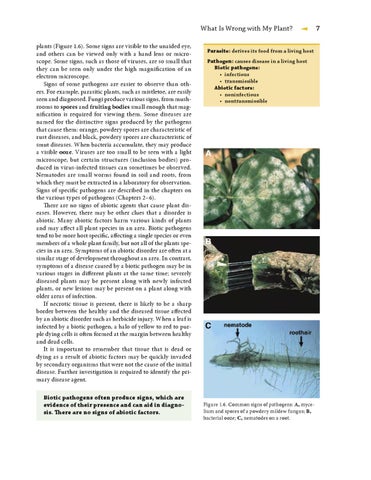
What Is Wrong with My Plant? ◀ 7 plants (Figure 1.6). Some signs are visible to the unaided eye, and others can be viewed only with a hand lens or microscope. Some signs, such as those of viruses, are so small that they can be seen only under the high magnification of an electron microscope. Signs of some pathogens are easier to observe than others. For example, parasitic plants, such as mistletoe, are easily seen and diagnosed. Fungi produce various signs, from mushrooms to spores and fruiting bodies small enough that magnification is required for viewing them. Some diseases are named for the distinctive signs produced by the pathogens that cause them: orange, powdery spores are characteristic of rust diseases, and black, powdery spores are characteristic of smut diseases. When bacteria accumulate, they may produce a visible ooze. Viruses are too small to be seen with a light microscope, but certain structures (inclusion bodies) produced in virus-infected tissues can sometimes be observed. Nematodes are small worms found in soil and roots, from which they must be extracted in a laboratory for observation. Signs of specific pathogens are described in the chapters on the various types of pathogens (Chapters 2–6). There are no signs of abiotic agents that cause plant diseases. However, there may be other clues that a disorder is abiotic. Many abiotic factors harm various kinds of plants and may affect all plant species in an area. Biotic pathogens tend to be more host specific, affecting a single species or even members of a whole plant family, but not all of the plants species in an area. Symptoms of an abiotic disorder are often at a similar stage of development throughout an area. In contrast, symptoms of a disease caused by a biotic pathogen may be in various stages in different plants at the same time; severely diseased plants may be present along with newly infected plants, or new lesions may be present on a plant along with older areas of infection. If necrotic tissue is present, there is likely to be a sharp border between the healthy and the diseased tissue affected by an abiotic disorder such as herbicide injury. When a leaf is infected by a biotic pathogen, a halo of yellow to red to purple dying cells is often formed at the margin between healthy and dead cells. It is important to remember that tissue that is dead or dying as a result of abiotic factors may be quickly invaded by secondary organisms that were not the cause of the initial disease. Further investigation is required to identify the primary disease agent. Biotic pathogens often produce signs, which are evidence of their presence and can aid in diagnosis. There are no signs of abiotic factors.
Parasite: derives its food from a living host Pathogen: causes disease in a living host Biotic pathogens: • infectious • transmissible Abiotic factors: • noninfectious • nontransmissible
A
B
C
Figure 1.6. Common signs of pathogens: A, mycelium and spores of a powdery mildew fungus; B, bacterial ooze; C, nematodes on a root.