12
Todd: How does it work?
The printer spreads out a very fine layer of dry ingredients of the recipe, and then it jets the wet ingredients and food coloring onto that dry layer. Whatever it moistens becomes part of the final model. The process repeats over and over and builds up the entire 3-dimensional piece, layer by layer. Kyle: This process is sometimes called bin-to-bin translation. For a couple decades, it has been an open-format way of experimenting with new materials. The technology and the platform itself was well poised to be adapted to a culinary context. Liz: Printers are often developed to work well within specific material ranges. This is no exception. Our work involves a lot of trial and error tinkering both on the culinary side as well as on the hardware side. Kyle: Over the last year we’ve been working in close collaboration with top chefs. They’ve been highly influential in helping us expand the repertoire of what we do at the culinary lab. With Mei Lin, winner of Top Chef in 2015, we 3D printed a quail egg out of wasabi with quail yolk jam filling. These sorts of collaborations take us beyond printing beautiful objects to making sophisticated dishes.
Todd: The two of you have moved far outside the discipline of architecture, but it seems that there’s still quite a bit of architectural thinking going on. How does your architectural background inform what you’re doing now?
Liz: I am very lucky to have design play such a large role in my professional life. I prefer the timeframe of 3D printing to that of architecture. We can design something and see it that day. We can iterate immediately rather than over years or decades. Working with chefs, who are artists in their own right and also very sophisticated scientists, is extremely gratifying. It allows us to bring formal and geometric design aspects to the table. Kyle: SCI-Arc prepared us for this endeavor in a lot of ways. with 3DS culinary lab, we are taking a critical architectural approach to another discipline. We wanted to change the way that chefs, and the public, looked at sugar. As a food, sugar has a history and a legacy. As a form, it is often associated with decoration and tends to be very soft and organic. Very much in the way we learned to approach projects at SCIArc, we challenged ourselves to make sugar look very different. We wanted it to be mathematically precise, to be very sculptural, to have right angles… all thing that pastry chefs aren’t used to or couldn’t quite do. We wanted to produce really striking images that would help us stand out among other small businesses.
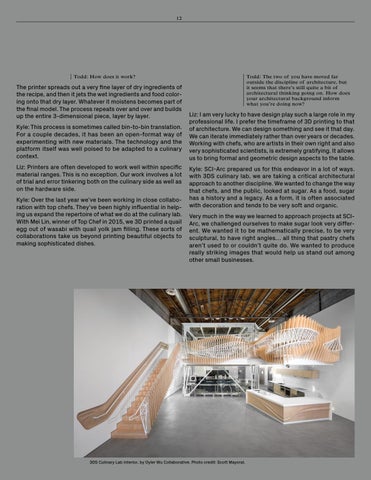
3DS Culinary Lab interior, by Oyler Wu Collaborative. Photo credit: Scott Mayoral.