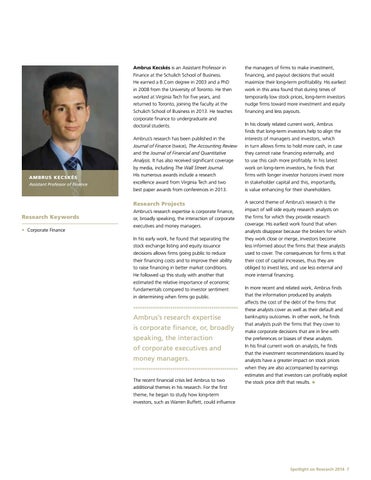
Ambrus Kecskés is an Assistant Professor in Finance at the Schulich School of Business. He earned a B.Com degree in 2003 and a PhD in 2008 from the University of Toronto. He then worked at Virginia Tech for five years, and returned to Toronto, joining the faculty at the Schulich School of Business in 2013. He teaches corporate finance to undergraduate and doctoral students.
Ambrus Kecskés Assistant Professor of Finance
Ambrus’s research has been published in the Journal of Finance (twice), The Accounting Review and the Journal of Financial and Quantitative Analysis. It has also received significant coverage by media, including The Wall Street Journal. His numerous awards include a research excellence award from Virginia Tech and two best paper awards from conferences in 2013.
Research Projects Research Keywords • Corporate Finance
Ambrus’s research expertise is corporate finance, or, broadly speaking, the interaction of corporate executives and money managers. In his early work, he found that separating the stock exchange listing and equity issuance decisions allows firms going public to reduce their financing costs and to improve their ability to raise financing in better market conditions. He followed up this study with another that estimated the relative importance of economic fundamentals compared to investor sentiment in determining when firms go public.
Ambrus’s research expertise is corporate finance, or, broadly speaking, the interaction of corporate executives and money managers. The recent financial crisis led Ambrus to two additional themes in his research. For the first theme, he began to study how long-term investors, such as Warren Buffett, could influence
the managers of firms to make investment, financing, and payout decisions that would maximize their long-term profitability. His earliest work in this area found that during times of temporarily low stock prices, long-term investors nudge firms toward more investment and equity financing and less payouts. In his closely related current work, Ambrus finds that long-term investors help to align the interests of managers and investors, which in turn allows firms to hold more cash, in case they cannot raise financing externally, and to use this cash more profitably. In his latest work on long-term investors, he finds that firms with longer investor horizons invest more in stakeholder capital and this, importantly, is value enhancing for their shareholders. A second theme of Ambrus’s research is the impact of sell side equity research analysts on the firms for which they provide research coverage. His earliest work found that when analysts disappear because the brokers for which they work close or merge, investors become less informed about the firms that these analysts used to cover. The consequences for firms is that their cost of capital increases, thus they are obliged to invest less, and use less external and more internal financing. In more recent and related work, Ambrus finds that the information produced by analysts affects the cost of the debt of the firms that these analysts cover as well as their default and bankruptcy outcomes. In other work, he finds that analysts push the firms that they cover to make corporate decisions that are in line with the preferences or biases of these analysts. In his final current work on analysts, he finds that the investment recommendations issued by analysts have a greater impact on stock prices when they are also accompanied by earnings estimates and that investors can profitably exploit the stock price drift that results. ◆
Spotlight on Research 2014 7