Issue 74 | May 2019
DAVI D
GARRETT THE VIOLIN PRODIGY IS BACK
PLUS
TIMELESS GARDEN DESIGN GERMANY’S BEAUTY EXPERTS VIENNA’S SECRETS DESIGN, TRAVEL, BUSINESS & MORE
T H E M AG A Z I N E P R O M OT I N G G E R M A N Y, S W I T Z E R L A N D & A U ST R I A
Discover Germany | Contents
Contents MAY 2019
62 Photo: © Christoph Köstlin
COVER FEATURE 62
David Garrett The German violin star David Garrett recently returned with his new album Unlimited (Greatest Hits). As May marks the beginning of his latest tour, Discover Germany decided to speak to the violinist about his latest album, his tour and more.
SPECIAL THEMES 18
42
84
102 Photo: © PK Fotografie
132 Driving Successful Brands In today’s interconnected world, market research and consumer science are becoming increasingly important. In this special theme, we speak to some of Germany’s experts in market research and consumer science to find out more about how they can help companies.
FEATURES 66
Timeless Design For Your Garden and Home Spring is finally here: and what better way to celebrate the beginning of this season than with whipping our gardens 76 into shape? We take a look at some gorgeous designs and decorative ideas for your gardens. The Beauty Experts – Germany’s Specialists for Cosmetic Surgery 2019 In this special theme, we take a look at why Germany is currently considered the go-to country when it comes to cosmetic surgery. A Spotlight on Germany’s Top Boarding Schools Germany has many top educational programmes and institutions on offer – this month, we take a look at some of the country’s top boarding schools.
106 Vienna’s Secrets – Discover Austria’s Historical Capital Ever wanted to go to Vienna? In this special theme, we give you inspiring insider tips for your next city trip to the Austrian capital!
78
97
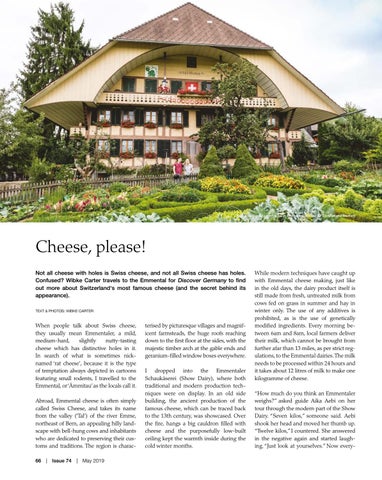
Cheese, Please! Not all cheese with holes is Swiss cheese and not all Swiss cheese has holes. Confused? Discover Germany travels to the Emmental to find out more about Switzerland’s most famous cheese. Vienna’s Biggest Culinary Festival The GenussFestival in Vienna brings tradition and innovation from all over Austria together in one place. Discover Germany finds out more. Star Interview: Ronald Zehrfeld Three-time Grimme award-winner Ronald Zehrfeld gives us an insight into his passion for acting, talks about his latest film The End of Truth and much more. Hotel of the Month, Germany & Austria Our Hotels of the Month are the German Steigenberger Grandhotel Petersberg and the Austrian Hotel Rosenhof. Find out why in our special features.
102 Leipzig: A Year of Festivities 2019 holds several important anniversaries for Leipzig. That is why Discover Germany has travelled to the city in Saxony and found out more about what visitors can expect this year.
REGULARS & COLUMNS 6
Dedicated to Design Whether you are searching for some ‘Neo Mint’ interior inspo, trendy fashion for men, inspiring interior designers or lifestyle trends for men, be sure to take a look at our Design section.
66
Wine & Dine Our Wine & Dine section is filled with great restaurants, tasty products and gourmet hotspots from Switzerland this month.
78
Culture For great boarding schools, innovative universities and Germany’s most exclusive event locations, read the Culture section.
114 Business Our Business section is filled with great architects, exclusive businesses from the DACH region, innovative creative agencies, experts in UX/UI, and more. Furthermore, our columnist Gregor Kleinknecht discusses the omnipresent topic of Brexit. 144 The Delights of the German Vocabulary In our monthly column, British author Adam Jacot de Boinod explores the weird and wonderful world of German vocabulary and finds some rather interesting terms. 146 Culture Calendar Discover Germany’s Culture Calendar is your perfect guide to what not to miss in May. 150 Barbara Geier Column This month, Barbara Geier speaks about her love for the Bauhaus movement, which celebrates its 100th anniversary this year.
Issue 74 | May 2019 | 3
Dear Reader,
Discover Germany Issue 74, May 2019
Published by Scan Group
Elisabeth Doehne Gregor Kleinknecht Hannah Krolle Ina Frank Jessica Holzhausen Silke Henkele Sonja Irani Wibke Carter
Print Uniprint
Cover Photo © Christoph Köstlin
Executive Editor Thomas Winther
Sales & Key Account Managers Emma Fabritius Nørregaard Melanie von der Kammer Sophie Blecha Katrin Virtbauer Tanja Meier Julia Freisinger
Published 05.2019 ISSN 2051-7718
Creative Director Mads E. Petersen Editor Nane Steinhoff Assistant Editor Marilena Stracke Copy-Editor Karl Batterbee Graphic Designer Audrey Beullier Contributors Adam Jacot de Boinod Barbara Geier Cornelia Brelowski
Publisher: SCAN GROUP Scan Magazine Ltd. 15B Bell Yard Mews Bermondsey Street London SE1 3YT United Kingdom Phone: +44 207 407 1937 Email: info@discovergermany.com For further information please visit www.discovergermany.com
May is a wonderful month to travel to Germany, Austria or Switzerland. While the weather is usually quite warm and sunny, the summer crowds haven’t yet arrived, which means that the prices for accommodation and attractions will still be relatively low. And, on top of that, many interesting festivals and events are held throughout this month. For example, 1 May marks the ‘Tag der Arbeit’ or Labour Day throughout Germany. It is a public holiday that commemorates the labourers’ and working class’ fight for more rights. The day’s origin can be traced back to the US American labour movement which called for better wages and working conditions in 1886. A bloody strike with bomb explosions eventually led to the implementation of the eight-hour work day and 1 May became a symbolic day for the workers’ struggle – also in Europe. Today, some regions in Germany still hold demonstrations and fight for labour rights, while others put emphasis on neighbourhood-wide festivals and picnics in the park. Another staple of May in the DACH region is white asparagus, which is an obsession here. The ‘king of vegetables’ appears on every menu and in every grocery shop from April until June. So, be sure to try this delicious dish! Another culinary offering to try is Switzerland’s most famous cheese from the Emmental. Our writer Wibke Carter headed to the region to find out more about the secret behind the cheese’s special appearance. Other topics covered in our May issue are more gourmet hotspots from Switzerland, cosmetic surgery specialists, timeless design for gardens, great architects, travel tips for Vienna and Leipzig and much more. And, on top of all these exciting reads, we feature interviews with actor Ronald Zehrfeld and violin prodigy David Garrett. After taking a break from touring after suffering from a herniated disc, the German violin star recently reported back with his new album Unlimited (Greatest Hits). Discover Germany spoke to the violinist about his latest album, what fans can look forward to on his latest tour, and more. Sit back, relax and thanks for reading.
© All rights reserved. Material contained in this publication may not be reproduced, in whole or in part, without prior permission of Scan Group – a trading name of Scan Magazine Ltd. This magazine contains advertorials/promotional articles.
4 | Issue 74 | May 2019
Nane Steinhoff, Editor
Discover Germany | Design | Fashion Finds
Fashion Finds Spring is here and summer is near! So, it’s about time to give your wardrobe a much-needed overhaul with fresh styles and airy fabrics. We have handpicked some stylish items for men that like to spend most of the spring and summer days outside, while exploring the great outdoors. Whether in the woods, out on the water or on the beach – we have got you covered! EDITOR’S PICKS I PRESS IMAGES
The long-standing German brand BOGNER is well-known for their luxury lifestyle clothing lines, as can be seen in this stylish, yet comfortable outfit. £POA. www.bogner.com
Need new sports sunglasses that won’t fall off your face? This pair doesn’t only promise the highest quality, but also looks absolutely stylish so it can be worn on multiple occasions. £88. www.bolle.com
Pack everything needed in this gorgeous, yet spacious backpack, which also poses as the perfect hand-luggage item for flights. £101. www.hedgren.com
6 | Issue 74 | May 2019
Discover Germany | Design | Fashion Finds
This set-up – also by BOGNER – is not only great for sailing. Airy fabrics will keep you cool in higher temperatures and, in the evenings, simply keep warm with the stylish green jacket. Jacket £540, trainers £229. www.bogner.com
The German brand CINQUE has stood for casual lifestylewear since its foundation. This blue jumper is timeless, functional and good-looking. What else do you need? £70. www.cinque.de
Bring some colour to your outfit and prepare for warmer temperatures with these shorts by CINQUE. £61. www.cinque.de
Issue 74 | May 2019 | 7
Discover Germany | Design | Dedicated to Design
Dedicated to Design… According to the trend forecasting company WGSN, ‘Neo Mint’ is going to be big news in 2020 and we will begin to see it trickling through in 2019. The cool-toned colour has a futuristic, technological and scientific feel, while its fusion with green represents nature and plant life. Find a round-up of this emerging trend below. BY: NANE STEINHOFF I PRESS IMAGES
1
1. A stylish way to serve your favourite hot beverage in the morning is in these mugs. Featuring a fabulous gold handle and textured design, they are available in three gorgeous colours – including in ‘neo mint’. £15. www.audenza.com 2. Give your living room a fresh touch with this gorgeous sofa in a pastel mint nuance. Designed by Tom Tailor, it impresses with a modern design and high-quality materials. £873. www.otto.de 3. This beautiful nappy-changing pad will make the tedious task of changing nappies a tiny bit nicer. Sporting the new ‘neo mint’ trend colour, it will fit perfectly into any room. £44. www.takatomo.de 4. Bring some order into your home with this cute basket by Tom Tailor. It is available in three different sizes and is produced under fair conditions. From £9. www.takatomo.de 5. This enchanting ‘Judy’ typewriter comes with a new mint-green varnish. The Adler Junior 1 typewriter is a reliable classic from the ‘60s which is experiencing a charming comeback at the moment. It is ready for use and is also a great eye-catcher. £184. www.etsy.com
2
3
4 5
8 | Issue 74 | May 2019
TEXT: JESSICA HOLZHAUSEN I PHOTOS: BOARD GAME BOX
Whether an uptight marshall or a ruthless bandit: board gamers are set to become legends of the Wild West
Ob rechtschaffender Marshall oder ruchloser Bandit: Brettspieler werden zu Wild-West-Legenden
With Western Legends, the Swiss board-game publisher Board Game Box brings a diverse, open-world sandbox game without any complicated rules to the German speaking market. As the title suggests, the players take on the roles of historical figures from the Wild West.
Mit Western Legends bringt der Schweizer Spieleverlag Board Game Box ein vielseitiges Open-World-Sandbox-Spiel ohne überbordendes Regelwerk auf den deutschsprachigen Markt. Die Spieler schlüpfen in die Rolle historischer Figuren aus der Zeit des Wilden Westen.
To become truly legendary within the game, players can chose very different tactics: as outlaws, by gambling and committing bank robbery, or in an honest way, by herding cattle through the prairie, searching for gold or arresting lawless co-players. Depending on whether players choose a criminal career or a righteous path, they collect the appropriate points. The last round is reached when one player has gained 15, 20 or 25 points – according to the chosen length of the game. After that round, all points are counted.
Legendären Status können sich Spieler auf ganz unterschiedliche Art erwerben: Als Gesetzloser durch Glücksspiel und Bankraub oder auf ganz ehrliche Art, indem der Spieler Viehherden durch die Prärie treibt, nach Gold sucht oder die gesetzlosen Mitspieler verhaftet. Je nachdem, ob sich der Spieler für den rechtschaffenden Weg oder die kriminelle Laufbahn entscheidet, sammelt er die entsprechenden Punkte. Die letzte Runde ist eingeläutet, wenn der erste Spieler 15, 20 oder 25 Punkte erreicht hat – abhängig von der gewählten Spieldauer. Nach der Runde werden Punkte gezählt.
The two board-game reviewers Hunter & Cron have awarded Western Legends the label ‘particularly recommendable’, and have emphasised, among other things, that the game perfectly translates the topic with a great sense for history. It is also a real musthave for poker fans, as the combat system is based on poker cards.
Die zwei Brettspielrezensenten Hunter & Cron haben Western Legends bereits als besonders empfehlenswert ausgezeichnet und heben unter anderem hervor, dass das Spiel das Thema mit Gespür für die Historie perfekt umsetzt. Und es sei ein Muss für jeden Poker-Fan, denn das Kampfsystem basiert auf Pokerkarten.
Western Legends was originally invented by Hervè Lemaître. The game, published in German by Board Game Box, will be released in autumn. Various expansions are under development and will be published in German one by one.
Western Legends stammt ursprünglich aus der Feder von Hervè Lemaître. Das Grundspiel erscheint im Herbst auf Deutsch bei Board Game Box. Verschiedene Erweiterungen sind in der Entwicklung und werden nach und nach auf Deutsch erscheinen. www.boardgamebox.life
Discover Germany | Design | Interior Designer of the Month
Ana Hartwich.
INTE RIOR DESI GNER OF TH E MON T H TEXT: JESSICA HOLZHAUSEN I PHOTOS: ANA HARTWICH
Turning simple walls into decorative design pieces
Einfache Wände in dekorative Designstücke verwandeln
With her work, the Vienna-based painter Ana Hartwich finds herself at the border between art and interior design: she creates unique and individual wall paintings that reflect the space, the colour scheme and the owner’s personality and taste.
Mit ihrer Arbeit bewegt sich die Wiener Malerin Ana Hartwich an der Grenze zwischen Kunst und Innendesign: Sie schafft einzigartige und individuelle Wandgemälde die den Raum, das Farbschema, die Persönlichkeit und den Geschmack des Besitzers wiederspiegeln.
Ana Hartwich trained as an artist and even though her main focus is on painting, she has also worked with different mediums like textiles or gesso. Her second career path led her into interior design. “Working as an interior designer and painter, I discovered that there is an opportunity to link both in wall decorations,” she says. Today, she creates unique wall designs that exclusively fit the space. “I can paint in different styles and adapt to the interior.” A restaurant in a large industrial space needs a different wall design than a 19th-century apartment with stucco ceiling or an inviting hotel lobby.
Ana Hartwich ist studierte Künstlerin und auch wenn ihr Hauptfokus auf der Malerei liegt, hat sie mit verschiedenen Medien wie Textilien oder Gips gearbeitet. Ihr zweiter Karriereweg führte sie in den Bereich Innendesign. „Durch meine Arbeit als Innendesignerin und Malerin habe ich festgestellt, dass beides zusammen bei Wanddekorationen ganz neue Möglichkeiten bietet“, sagt sie. Heute schafft sie einzigartige Wanddesigns inspiriert von Raum und Architektur. „Ich kann in verschiedenen Stilen malen und mich an das jeweilige Innendesign anpassen.“ Ein Restaurant in einem Industriegebäude braucht einen anderen Stil als ein Apartment aus dem 19. Jahrhundert oder eine einladende Hotellobby.
The idea was born when the artist was looking for a backsplash for her own kitchen and could only find expensive or boring tiles or glass: so she painted and coated the wall instead. Kitchens and bathrooms are a challenge, admittedly, because surfaces do need to be water resistant and easy to clean.
Die Idee entstand, als die Künstlerin einen Spritzschutz für die eigene Küche suchte und nur langweilige und teure Fließen oder Glas fand. Stattdessen bemalte und versiegelte sie die Wand. Küchen und Bäder sind eine Herausforderung, da es wasserabweisender und einfach zu reinigender Oberflächen bedarf.
With her versatile artistic talent and in cooperation with interior designers, Ana Hartwich creates personalised decorations that give interior spaces the ACCENTWALL they need.
Mit ihrem vielseitigen Talent und in Zusammenarbeit mit Innendesignern kreiert Ana Hartwich personalisierte Dekorationen, die Innenräumen die ACCENTWALL geben, die sie brauchen. www.anahartwich.com www.ahaflip.com
10 | Issue 74 | May 2019
Bringing industries together and turning messages into experiences For over 20 years, the agency, Advanced Productions & Support AG (short: APS), has been shaping Swiss live communication: from the very beginning and up to today, it continues to develop new event formats. Their aim? To turn messages, brands and products into memories and experiences. The team at APS connects different industries and companies and has built an impressive network over the years.
Fabian Vollrath, who joined APS as a third partner, believes that live communication is still highly relevant in the automotive sector. “You have to turn information into an experience and communicate it emotionally,” Vollrath claims. “I can research thousands of facts online, but ultimately,
TEXT: MARILENA STRACKE I PHOTOS: APS ADVANCED PRODUCTIONS & SUPPORT AG
In 1995, Mirco Dalla Lana and Patrick Allmann founded APS with the goal of bringing messages, brands and products to life. Together, they wanted to run events differently and create new formats. They quickly succeeded: in the automotive industry, they launched the first Swiss 12 | Issue 74 | May 2019
national road shows with test drivers as well as the format of condensed driving training, which was unknown back then. Big brands such as Mercedes-Benz, Smart, Renault, Maserati and Ferrari have been continuously working with APS ever since. In the field of live communication, APS is therefore a true pioneer
Partners Mirco Dalla Lana, Fabian Vollrath and Patrick Allmann.
Discover Germany | Design | Design That Makes Brands and Products Perceptible
Branchen zusammenbringen und Messages erlebbar machen Seit über 20 Jahren prägt die Agentur Advanced Productions & Support AG, kurz APS, die Schweizer Live-Kommunikation und entwickelt laufend neue Event-Formate. Ihr Ziel: Botschaften, Marken und Produkte gedächtniswirksam erlebbar zu machen. Das Team von APS verbindet unterschiedliche Branchen und Firmen, und hat über die Jahre ein beeindruckendes Netzwerk aufgebaut. Seit 1995 ist es das erklärte Ziel der beiden APS-Gründer, Mirco Dalla Lana und Patrick Allmann, Botschaften, Marken und Produkte erlebbar zu machen. Zusammen wollten sie Events anders aufbauen und neue Formate schaffen. Und das gelang ihnen schnell: Im Automobilbereich lancierten sie die ersten Schweizer Testfahr-Roadshows und das bisher unbekannte Format der Kompaktfahrtrainings. Große Marken wie Mercedes-Benz, Smart, Renault, Maserati und Ferrari arbeiten seither mit APS zusammen. Im Bereich LiveKommunikation ist APS also ein Vorreiter..
Fabian Vollrath kam als dritter Partner zu APS und erklärt, dass die LiveKommunikation in der Automobilbranche immer noch hoch aktuell ist. „Man muss die Information erlebbar machen und emotional behaften“, so Vollrath. „Ich kann mich im Internet über tausend Fakten schlau machen, aber im Endeffekt will ich ein Produkt, wie ein Auto, selber erleben.“
Die Geburtsstunde der Giardina In diesem Sinne setzte das APS-Team bereits zwei Jahre nach seiner Gründung einen Meilenstein: Dalla Lana und Allmann konzipierten die erste Giardina in Basel, eine Messe
für die Schweizer Gartenkultur und führten sie in Zusammenarbeit mit der damaligen Messe Basel durch. Der Anlass schlug ein wie eine Bombe. Mitte der Neunzigerjahre war das klassische Event Management bekannt, aber es gab keine Messen, die selber zum Happening wurden. Eine Messe war bis dato eine Halle voller Stände, aber das Format der Messe selbst wurde nicht, oder nur selten, als emotionales Transportmedium genutzt. Mit der ersten Giardina zeigte die APS souverän, dass es auch anders geht. Die Veranstaltung setzte in den 90ern neue Maßstäbe und entwickelte sich zu einem gekonnten Mix aus Ausstellung, Messe und Event. Heute ist die Giardina eine Trendplattform und eine der renommiertesten IndoorGartenveranstaltungen der Welt. Nach wie vor steht das Team von APS in enger Zusammenarbeit mit dem Veranstalter MCH
Issue 74 | May 2019 | 13
Discover Germany | Design | Design That Makes Brands and Products Perceptible
I want to experience a product like a car for myself.” The birth of Giardina A major milestone event happened already two years after APS was founded: Dalla Lana and Allmann designed the first Giardina in Basel, a trade fair for Switzerland’s garden culture, which they executed together with the former Messe Basel. It was a huge success. During the mid-1990s, people knew about classic event management but there were no trade fairs as we know them today. Up until then, a ‘trade fair’ had simply been a big hall with stalls, but the format itself was never or only rarely used as a medium to communicate emotions. With the first Giardina, APS confidently showed that things can be done differently. The event set new standards and became a sophisticated mix of exhibition, trade fair and event. Today, Giardina is a trend platform and one of the world’s most renowned gardening events. The team at APS is still behind the successful concept and runs it in close partnership with the organiser MCH Messe Schweiz AG. “Giardina is firmly established as an annual event,” Vollrath says. “It is an integral part of the Swiss event sector and a real happening,
14 | Issue 74 | May 2019
where around 65,000 visitors come to be inspired each spring.” The premium event shows in an impressive way how inspiration can be perfectly combined with sales. According to Vollrath, both aspects work hand in hand: “Visitors enjoy the wonderfully designed exhibition and find inspiration for their own gardens and terraces. At the same time, they talk to garden experts and buy or order their favourite pieces right there.” Giardina keeps reinventing itself within the sector because trends are not only set here, they are also incorporated. Various innovative developments and products are launched during the event. A major theme at the last Giardina was the dig-
itisation of the green industries. In that regard, APS-employees function as competent companions, who know the most important associations have their backs. An example: the world of building information modelling, BIM, offers many new possibilities for construction, from visualisation and surveying technology to smart garden watering systems. In order to explore the subject in depth and, above all, to examine it interactively, APS is organising the convention netzwerk_G, which will be taking place on 12 and 13 September 2019 in Zurich. “We build bridges.” Just as the convention’s name suggests, APS sees itself as a network agency and, indeed, it connects entire industries. But
Discover Germany | Design | Design That Makes Brands and Products Perceptible
Messe Schweiz AG hinter dem erfolgreichen Konzept. „Die Giardina hat sich als jährliches Event etabliert“, sagt Vollrath. „Sie ist ein fester Bestandteil der schweizerischen Eventbranche und ein echtes Happening, an dem sich die rund 65.000 Besucherinnen und Besucher jedes Frühjahr inspirieren lassen.“
tion wunderbar mit Verkauf verbinden lässt, denn laut Vollrath geht beides Hand in Hand: „Die Besucher genießen die traumhaft schöne Ausstellung und finden Gestaltungsideen für ihre Gärten und Terrassen. Gleichzeitig tauschen sie sich mit den Garten-Profis aus und kaufen oder bestellen ihre Lieblingsstücke gleich vor Ort.“
Die Premiumveranstaltung Giardina zeigt auf eindrucksvolle Weise wie sich Inspira-
Die Giardina erfindet sich immer wieder über die Branche neu, da Trends zwar durch
die Giardina gesetzt, aber gleichzeitig auch von ihr aufgenommen werden. Viele innovative Entwicklungen und Produkte werden hier lanciert. Ein großes Thema der letzten Giardina etwa ist die Digitalisierung der Grünbranche. Hier fungieren die APSMitarbeiter als kompetenter Begleiter und mit den wichtigsten Verbänden im Rücken. Ein Beispiel: Die Welt des Building Information Modelling, kurz BIM, bringt viele neue Möglichkeiten beim Bauen mit sich - von der Visualisierung und Vermessungstechnik bis zur intelligenten Gartenbewässerung. Um das ganze Thema intensiv und vor allem interaktiv zu beleuchten, organsiert APS den Fachkongress netzwerk_G, der am 12. und 13. September 2019 in Zürich stattfindet.
„Wir sind Brückenbauer.“ Wie schon der Name dieses Kongresses verrät, sieht APS sich als Netzwerkagentur und vernetzt tatsächlich ganze Branchen. Mit der Netzwerkarbeit ist allerdings nicht gemeint, dass man sich zum Glas Sekt trifft. APS will für alle Beteiligten einen echten Mehrwert schaffen und Resultate erzielen. „Wir sind Brückenbauer“, ergänzt Vollrath. Issue 74 | May 2019 | 15
Discover Germany | Design | Design That Makes Brands and Products Perceptible
networking doesn’t just mean meeting up for a glass of bubbly: APS wants to create added value for all participants and achieve results. “We build bridges,” Vollrath adds.
within the field of strategic marketing communication. And although the team does have a lot of experience in finance, their perspective is certainly different.
Clients who want to break new ground, who seek an unbiased outside perspective or who want to think about their challenges afresh are in the right place at APS. “The answer could be related to live communication and that can indeed be an event, but it doesn’t necessarily have to be,” Vollrath explains. “We do a lot of strategic work and think about the bigger picture.”
It’s obvious that networking is not only a major part of the work at APS, but is also deeply embedded in their corporate philosophy. “Often, problems can only be solved together, and we can be the connecting element. I see this sense of togetherness as a great benefit and asset. Sadly, it’s still not used enough,”Vollrath says.
Although this sounds a little like consulting, APS positions itself consciously
Bringing people together
A significant example is the project, ZÄMEGOLAUFE (LETS GET WALKING). Here, APS is part of the ‘Netzwerk
für Bewegung und Begegnung’ (network for movement and encounter). People, who are over 60 years old, meet up and go for a walk together. “This project goes far beyond the health aspect of physical activity. People organising themselves and supporting each other lies at the core of it,”Vollrath explains. “On the one hand that’s good from a psychological perspective because one becomes part of a community which is active together, but on the other hand, it’s also about practical things, where the elderly help each other with their everyday needs.” He continues: “We believe this project to have such gravitas and potential, so we are in talks with various partners, who want to realise it nationally as quickly as possible. Not to make money with it, as the entire project is free of charge for senior citizens, but to enhance the quality of life of the elderly and to push prevention and health promotion forward through empowering people.” APS loves to work from behind the scenes, takes on pioneering positions and passionately develops new ideas from scratch. Aside from great know-how, the agency convinces with its down-to-earth mentality and philanthropic side.
www.apsag.ch 16 | Issue 74 | May 2019
Discover Germany | Design | Design That Makes Brands and Products Perceptible
Kunden, die neue Wege gehen wollen, Kunden, die den ungetrübten Blick von außen suchen oder ganz einfach ihre Herausforderungen neu denken wollen, sind bei APS genau richtig. „Die Antwort kann in der LiveKommunikation liegen und das kann durchaus ein Event sein, aber das ist nicht zwingend so“, fügt Vollrath hinzu. „Wir machen viel Strategiearbeit, wobei wir uns überlegen, wie das Big Picture aussieht.“ Auch wenn dies durchaus an Unternehmungsberatung erinnert, positioniert sich APS ganz bewusst in der strategischen Marketingkommunikation. Zwar besitzt das Team viel Erfahrung im Finanzbereich, aber die Perspektive ist definitiv eine andere.
Dass der Netzwerkaspekt nicht nur ein großer Schwerpunkt der APS ist, sondern auch Teil der Firmenphilosophie, wird schnell klar. „Meist lassen sich Probleme nur gemeinsam lösen und da können wir verbindendes Element sein. Dieses Gemeinsame sehe ich als ganz großen Benefit und Asset, was heutzutage leider noch viel zu wenig genutzt wird“, erklärt Vollrath.
über 60 Jahre zum gemeinsamen Spazieren. „Dieses Projekt geht weit über den gesundheitlichen Aspekt der Bewegung hinaus. Zentral ist, dass sich die Leute selber organisieren und gegenseitig unterstützen“, sagt Vollrath. „Das ist einerseits gut aus psychologischer Perspektive, denn man ist Teil einer Gemeinschaft, die gemeinsam aktiv wird, aber es geht aber auch um ganz praktische Dinge, bei denen sich ältere Leute durch ihren Alltag helfen.“
Ein aussagekräftiges Beispiel ist ein Projekt, ZÄMEGOLAUFE, mit dem sich APS an einem ‚Netzwerk für Bewegung und Begegnung‘ beteiligt. Hier treffen sich Menschen
Er fährt fort: „Das Projekt hat aus unserer Sicht ein dermaßen großes Gewicht und Potential, dass wir in Verhandlungen mit mehreren Partnern sind, die es schnellstmöglich
Menschen zusammenbringen
national umsetzen möchten. Nicht, um damit Geld zu verdienen, denn das ganze Projekt ist für die Senioren kostenlos, sondern um die Lebensqualität der Senioren zu steigern und im Gesundheitsbereich die Prävention und Gesundheitsförderung durch Empowerment der Menschen voranzutreiben.“ APS agiert mit Vorliebe im Hintergrund, übernimmt gerne Pionierrollen und entwickelt mit Leidenschaft Neues aus dem Nichts. Nebst viel Know-how zeichnet die Agentur Bodenständigkeit und Menschlichkeit aus.
www.apsag.ch
Issue 74 | May 2019 | 17
SPECIAL THEME: TIMELESS DESIGN FOR YOUR GARDEN AND HOME
Embellish your green spaces Spring is finally here: and what better way to celebrate the beginning of the warm and friendly season than with whipping our gardens into shape? We take a look at this year’s top garden trends to give you some inspiration. TEXT: NANE STEINHOFF I PHOTOS: PIXABAY
18 | Issue 74 | May 2019
Discover Germany | Special Theme | Timeless Design For Your Garden and Home
One of the core trends this year seems to be ‘climate change gardens’. This trend leans towards more ecological gardens which are able to cope with the extreme weather conditions that have been experienced all over Europe and the rest of the world in recent years. The advice for this kind of garden is clear: plant the right plants for the individual conditions of each garden and think about which plants best store water and which best collect excess water before it dissipates through the soil. All in all, opt for plants which can fend for themselves and might even be drought-resistant. With this, the need for excessive watering is eliminated – which is great for the environment! Wildflower meadows Also going hand in hand with the ecological trend are wildflower meadows.
The news of the undeniable decline in the number of honeybees has urged many people to re-think their relationship with nature and their gardens. Equipping your green spaces with colourful wildflowers does not only look great, but also results in the introduction of an important refuge to the much-needed honeybee. The good news is that you don’t necessarily need a large plot to incorporate them, so creating a small- to medium-sized meadow will already make a huge difference. Log walls and metalwork At the moment, designers are really obsessed with log walls which can give garden spaces a much-needed overhaul. Acting as a boundary, a log wall can provide necessary habitat for many insects and wildlife. Metal – think metal arches or pergolas – is also said to be appearing
more and more in gardens all over Europe now, as it’s such a versatile and gorgeous material. Bold colours Another gardening trend that has grabbed our attention is bold colours. Garden designers predict the arrival of bold prints, clashing colours and the inclusion of largeleaved plants. When choosing your next outdoor plants, why not therefore opt for some brightly coloured Dahlia Pompons? They won’t only be an eye-catcher, they will also be sure to give your garden spaces a much-needed overhaul.
In the following special theme, we take a look at some gorgeous designs and decorative ideas for your gardens. Get inspired!
Issue 74 | May 2019 | 19
Discover Germany | Special Theme | Timeless Design For Your Garden and Home
Modell Longolino.
Modell Cornet.
Produktpalette.
Der clevere Blumentopf für Balkon, Terrasse und Garten Einen Blumentopf zu finden, der beste Wachstumsbedingungen für Pflanzen bietet und gleichzeitig noch stylisch ausschaut, ist nicht einfach. Die TEXPOT GmbH aus der Schweiz schafft mit seinen textilen Blumentöpfen made in Switzerland dafür Abhilfe. TEXT: NANE STEINHOFF I FOTOS: FOTOCOSMOS
„Die Idee eines textilen Pflanzentopfes hat uns fasziniert und zugleich begeistert“, lächelt Ursi Heizmann, Inhaberin und Geschäftsführerin von TEXPOT. Nachdem das TEXPOT Team einige Jahre an Ideen und Designs feilte, war das innovative Angebot fertiggestellt. Heute sieht der TEXPOT Planzentopf, der ausschliesslich im Glarnerland hergestellt wird, im Außenbereich super aus, sondern hat es auch wirklich in sich. „Unsere Töpfe sind dank des geringen Eigengewichtes und der flexiblen Verstaubarkeit nämlich nicht nur praktisch veranlagt, sondern bestehen zudem aus hochwertigem Qualitätsmaterial“, sagt Heizmann. Das Besondere an dem textilen TEXPOT Pflanzentopf ist, dass alle Modelle mit ei20 | Issue 74 | May 2019
nem intelligenten Wasserspeicher ergänzt werden, der überschüssiges Giesswasser auffängt und es der Pflanze bei Bedarf wieder zur Verfügung stellt. „Denn Wasser ist wertvoll und wir sind bestrebt, dank der innovativen Funktion des Wasserspeichers lediglich einen geringen Verlust an Wasser zu gewährleisten“, erklärt Heizmann. Desweiteren werden alle Töpfe aus Batyline gefertigt. Dieses durchgefärbte, strapazierfähige Polyestergeflecht ist UVbeständig und winterhart, weist Algen und Schimmelpilze ab und ist viel durchlässiger für Feuchtigkeit und Luft als jeder andere Pflanzentopf. „Das ist natürlich ideal für die Pflanzenwelt, da Fäulnis durch Staunässe oder Kondensation vermieden wird“, sagt Heizmann. Der Verdunstungs-
effekt auf der Oberfläche reguliert die Temperatur im Planzentopf und sorgt für ein optimales Wurzelklima. „Außerdem ist Batyline für seine Robustheit bekannt, weshalb unsere Töpfe auch hart im Nehmen sind und jeder Witterung standhalten“, fügt Heizmann hinzu. Auch die Pflege und Wartung eines TEXPOT Pflanzentopfes ist ganz einfach. Während des ganzen Jahres kann der Topf der Witterung auf der Terrasse, Balkon oder im Garten ausgesetzt werden. Falls Witterungsspuren entstehen, muss der Topf nicht ausgeleert werden, da einfach eine Bürste oder ein Kärcher benutzt werden kann, um den Topf zu säubern. Noch besser: alle runden und ovalen Töpfe können sogar in der Waschmaschine gewaschen werden. Der TEXPOT Topf ist in verschiedenen Farben und Größen erhältlich und kann auf der folgenden Webseite bestellt werden. www.texpot-blumentopf.ch
Discover Germany | Special Theme | Timeless Design For Your Garden and Home
Die hängenden Gärten von Marqueyssac - magische, von Hand geformte Buchsskulpturen hoch über dem Tal der Dordogne.
Simone Quast und Gianni Bombèn wissen, was Reisende suchen: Die beiden Autoren testen jede Adresse selbst.
Tafelfreuden und Genusskultur gehören zum lebendigen französischen Kulturerbe.
Die zauberhaften Gartenparadiese im Périgord können regelmässig besucht werden.
Eine literarisch-photographische Reise zu den schönsten Gärten Europas Seit 2007 entführt das vierteljährlich erscheinende Buchmagazin Herbarella seine Leser zu den eindrucksvollsten Gärten auf dem europäischen Kontinent. Die Gründer, Fotograf Gianni Bombèn und Redakteurin Simone Quast, testen dabei persönlich die verschiedenen Ecken und Winkel internationaler Gartenkultur – inklusive Tipps für Restaurants, Museen und individuelle Unterkünfte. TEXT: JESSICA HOLZHAUSEN I FOTOS: GIANNI BOMBÈN, HERBARELLA MAGAZIN
Herbarella ist das ideale Magazin für alle, die auf individuelles und nachhaltiges Reisen Wert legen: Gartengestaltung, Kunst- und Architekturgeschichte, Design, Kunsthandwerk, Kochkultur und Literatur gehen meist Hand in Hand – und das wissen auch die Leser von Herbarella. „Sie schätzen die schönen Dinge, leben bewusst und sind reisefreudig“, sagt Redaktionsleiterin Simone Quast. Das Interesse der Leser und der beiden Autoren spiegelt sich in den Themen, die für Männer und Frauen gleichermaßen spannend und interessant zu lesen sind. „Unsere Kernbotschaft ist ein Ankerpunkt in einer sich immer schneller drehenden Welt“, sagt Quast. Jede Ausgabe widmet sich dabei einer bestimmten Gartenregion.
Ende Juni beispielsweise erscheint die nächste Herbarella-Ausgabe mit Themenschwerpunkt Piemont. „Das Königshaus Savoyen schmückte seine Schlösser mit fantastischen Gärten und begründete so die Gartenliebe einer ganzen Region. Außergewöhnliche Unterkünfte, berühmte Weine und eine vorzügliche Küche lassen das Genießerherz höher schlagen.“ In den 12 Jahren seit der Gründung hat sich Herbarella zu einem individuellen Magazin für europäische Gartenkultur, Reisen, Kochkultur und Lebensart entwickelt. „Dieser Themenmix ist im deutschsprachigen Raum einzigartig“, sagt Quast. Neben eindrücklichen Texten, setzt Herbarella auf hochqualitative Fotos,
die die Leser mitnehmen auf eine Entdeckungsreise im Kopf. Neben den Gärten thematisiert das Heft auch Unterkünfte und Restaurants, Künstlerateliers und Ausflugsziele. Die Autoren habe diese stets persönlich besucht und getestet. Und nur die, die einer kritischen Beurteilung standhalten, finden auch den Weg ins Heft. „Viele Leser schätzen diese Kuratorenarbeit und verwenden Herbarella als Tool zur individuellen Reiseplanung“, sagt Simone Quast über den Gegentrend zu Pauschalreisen und Massentourismus. Das Team um Simone Quast und Gianni Bombèn pflegt ein ungewöhnlich enges Verhältnis zu seinen Lesern. Die vertrauen auf das Urteil der Autoren. Während Simone Quast besonders zu Pflanzenthemen, Gartenkultur und historischen Gärten schreibt, fokussiert Gianni Bombèn auf brillante Fotostrecken ebenso wie auf Beiträge zur regionalen Küche, Museen und Künstlern. www.herbarella.ch Issue 74 | May 2019 | 21
Discover Germany | Special Theme | Timeless Design For Your Garden and Home Beate Hoyer, Andreas Reichlin. Photo: © Guenter Standl
Fire and water. Photo: © Buero Nord
Refined construction.
Refined construction.
Feuerring Tulip.
Around the fire.
TEXT: CORNELIA BRELOWSKI I PHOTOS: DENNIS SAVINI, FEUERRING
Sharing the fire
Das Feuer in uns
New Zealand, Northern Europe, the Congo: these regions don’t seem to have much in common at first – except that the Swiss Feuerring has now travelled to all of them.
Neuseeland, Nord-Europa, der Kongo: diese Regionen mögen zunächst nicht besonders viel gemeinsam haben – mit der Ausnahme, dass der Schweizer Feuerring mittlerweile überall dort zuhause ist.
The grill sculpture, created by artist Andreas Reichlin, may have been copied and imitated multiple times, but there is a reason why clients cherish the original so much.
Die kraftvolle Grillskulptur von Andreas Reichlin wurde zwar schon oft kopiert, doch es gibt gute Gründe, warum Kunden das Original schätzen.
The Feuerring’s origins go back as far as the creator’s childhood. Whenever the Reichlin boys were confronted with a problem, their father would give them, say, a week to solve it. Faced with the initial problem of creating a grill which allows for a healthy, gentle cooking process, however, Andreas Reichlin this time stretched the proverbial problem-solving ‘week’ into four years - and on finally receiving the patent, the Feuerrwing GmbH was founded in 2009. A refined construction process, sustainability and a social component through which the idea of ‘men at the grill, women in the kitchen’ is upended, are core aspects of the Feuerring design, which offers more than just a conventional barbecue. The fire, though ‘open’, is safely encased in the steel bowl and the food placed on the broad rim. The business proposal summary that partner Beate Hoyer expressed to the artist was simple: ‘We want to spread the joy’. Andreas Reichlin explains how passion often yields the best result: “For a lot of people, business is business – for us, it means sharing a certain force which lives in the steel sculpture of the Feuerring.” 22 | Issue 74 | May 2019
Der Ursprung geht zurück bis in die Kindheit. Sobald die Reichlin-Jungs sich mit einem Problem konfrontiert sahen, gab der Vater ihnen kurzerhand eine Woche Zeit, um einen patenten Lösungsansatz zu erarbeiten. Als Andreas Reichlin sich der Aufgabe stellte, eine stählerne Grillskulptur zu erfinden, die einen sanften und gesunden Grillprozess ermöglicht und zudem Generationen überdauert, wuchs diese ‚Woche‘ zu vier Jahren an, bis 2009 mit dem Erhalt des Patentes die Firma Feuerring GmbH gegründet wurde. Exakte Konstruktion, Langlebigkeit und eine ganzheitliche soziale Komponente welche unter anderem die Separierung ‚Männer am Grill, Frauen in der Küche‘ aufhebt, sind jeweils Kernaspekte des Feuerrings, der mehr bietet als ein Grill. Das offene Feuer im Stahlbecken gart die Delikatessen, die auf dem breiten Rand platziert werden, in einem sanften, indirekten Prozess. Partnerin Beate Hoyer hatte die wohl überzeugendste Idee zum Geschäftsmodell: ‚Wir möchten die Freude weitergeben‘. Der Künstler erklärt, warum Leidenschaft oft die besten Ergebnisse erwirkt: ‚Für viele bedeutet Geschäft einfach nur Geschäft – für uns bedeutet es das selbst leben und Weitergeben einer ursprünglichen Kraft.‘ www.feuerring.ch
Discover Germany | Special Theme | Timeless Design For Your Garden and Home
Restaurant Tropengarten.
Das grüne Wunder in den Alpen Am Fuss der Berner Hochalpen gibt es ein Paradies zu entdecken: das Tropenhaus Frutigen, wo Gross und Klein das grüne Wunder erleben können! Seit zehn Jahren lädt hier nämlich das tolle Gesamterlebnis mit interaktiver Erlebnisausstellung, innovativem Energiekonzept, Fischzucht, Tropengarten und einem speziellen Restaurant zum Mitmachen, Entdecken und Geniessen ein. TEXT: NANE STEINHOFF I FOTOS: TROPENHAUS FRUTIGEN
Über dem Eisenbahn-Basistunnel durch den Lötschberg thronen die Schneegipfel des Doldenhornmassivs. Hier strömen seit langer Zeit das Regen- und Schmelzwasser durch die Kalkschichten des Berges in die Tiefe und werden dabei durch den Gesteinsdruck erwärmt. Bei Frutigen tritt das klare Wasser dann als warmer Bergbach mit einer durchschnittlichen Temperatur von 18 Grad aus. Wenn das warme Wasser direkt aus dem Tunnel in die Gewässer geleitet werden würde, 24 | Issue 74 | May 2019
würden die einheimischen Fischbestände gefährdet werden. So stellte sich vor zehn Jahren die Frage: wohin mit dieser Wärme? Die Idee, den Wärmeüberschuss für die Zucht von wärmeliebenden Fischen und Pflanzen zu verwenden, war geboren – und somit auch das Tropenhaus Frutigen! So wurde eine teure und energieintensive Abkühlung des Tunnelwassers vermieden und eine nachhaltige Nutzung der Wärme-
energie sichergestellt. „Wir verwenden 18 Grad warmes Bergquellwasser für unsere Fischbecken. Danach wird das Wasser in einer Wärmepumpe circa sechs Grad abgekühlt und kann dann abgeleitet werden. Die erhaltene Wärme nutzen wir für den Tropengarten, das Restaurant und die Ausstellung“, erklärt Beate Makowsky, stellvertretende Geschäftsführerin und Leiterin der Marketing- und Kommunikationsabteilung des Tropenhauses. Heute ist die Kombination aus tropischem Ambiente, Aquakultur und alpiner Umgebung weltweit einzigartig. Zehn Jahre Tropenhaus Da es nun schon zehn Jahre her ist, dass das Tropenhaus Frutigen seine Türen öffnete, wird das Jubiläumsjahr 2019 mit vielen tollen Aktivitäten und der Son-
Discover Germany | Special Theme | Timeless Design For Your Garden and Home
derausstellung Die Rückkehr der Störe gebührend gefeiert. „Wir sind stolz, dass wir diese besondere Wanderausstellung zum Jubiläumsjahr für das Tropenhaus gewinnen konnten“, freut sich Makowsky. Die Ausstellung vermittelt über anschauliche Objekte, wie beispielsweise einer riesigen Störhaut, und verschiedenen Fokusthemen viel Wissenswertes über den Stör. Weitere Jubiläums-Events, Angebote und Sonderausstellungen werden selbstverständlich das ganze Jahr angeboten. Zum Beispiel werden von Oktober bis Dezember Besucher mit besonderen Eintrittspreisen und Aktionen überrascht. Am 21. November ist ausserdem der Jubiläumstag als Tag der offenen Tür mit anschliessender Jubiläumsparty geplant. Neue Führungsangebote und eine Reihe an spannenden ErlebnisFührungen, wie die Gewürz-Führung im Tropengarten mit Herstellung eines eigenen Gewürzsalzes, runden das Angebot in 2019 ab. Staunen, lernen, lachen und geniessen Mit tropischem Urwald, sibirischem Stör und interaktiven Ausstellungen ist das Tropenhaus Frutigen immer wieder eine Reise wert. Auf spielerische Weise können grosse und kleine Abenteurer hier beim Erkunden allerlei Wissenswertes zu
Tropenhaus.
aktuellen Themen sammeln. Makowsky sagt: „Besonders viel machen wir dieses Jahr auch wieder für Familien mit vielen interaktiven Spielen im Garten, Entdeckertouren mit Lili für Kids ab vier, diversen Kinderevents und möglichen Kindergeburtstagen.“ Der grosszügige Tropengarten, zum Beispiel, ist ein grosses Highlight für Jung und Alt. In den Gewächshäusern werden in verschiedenen Themenwelten wie Kaffee, Banane, Gewürze und ab Herbst auch Kakao, viele exotische Früchte geerntet – genauer gesagt, zwei Tonnen pro Jahr! Alle Früchte werden im haus-
eigenen Restaurant verarbeitet und im Tropenhaus-Shop angeboten. Besuchern wird ausserdem auf verschiedenen Themenwegen Wissenswertes über einzelne Pflanzen vermittelt. Zum Beispiel erfahren sie auf dem Kaffeepfad mehr über verschiedene Kaffeesorten, auf dem Bananenpfad stossen sie auf allerhand Anekdoten über die beliebteste Frucht der Schweizer und der Orchideenpfad bietet eine farbenprächtige Augenweide mit über 300 Pflanzen. Die interaktive Dauerausstellung Wie der Fisch auf den Berg kam ist ein weiteres Highlight im Tropenhaus Frutigen.
Fischzucht.
Issue 74 | May 2019 | 25
Discover Germany | Special Theme | Timeless Design For Your Garden and Home
Der Oona Kaviar.
Besucher werden hier auf eine überraschende Entdeckungstour mitgenommen und erfahren in fünf Themenwelten (Prolog, Zeittunnel, Unterwasserwelt, Labor und Berg) mit über 80 Elementen alle Besonderheiten um das Tropenhaus Frutigen. Informativ, spielerisch oder virtuell und mit vielen Aktivitäten, die zum Experimentieren einladen, vermittelt sie den Gästen viel Wissenswertes und auch einiges Kurioses und bietet ein interak-
tives Gesamterlebnis. Hier erfahren Besucher nicht nur, wie der Fisch auf den Berg kam, sondern auch allerhand Wissenswertes über die Herstellung von Kaviar und die clevere Nutzung natürlicher Energiequellen. Fischfans sollten sich unbedingt die zahlreichen Aussen- und Innenbecken der Fischzucht anschauen und die grossen Fenster des Aquariums bestaunen. Hier
gibt es nämlich 12 verschiedene Fischarten zu entdecken! Speisen unter Papayabäumen Wenn nach einem spannenden Aufenthalt in den Ausstellungen oder im Tropengarten der Magen knurrt, ist es Zeit für einen Besuch im preisgekrönten Restaurant Tropengarten. Inmitten tropischer Pflanzen und einem angenehmen Klima können hier Leckereien aus eigener Produktion und regionale Spezialitäten mit tropischem Touch genossen werden. Wie wäre es zum Beispiel mit Filets vom Stör, Egli und Zander aus eigener nachhaltiger Produktion, der Tropenhaus Schweinsbratwurst mit Feigensenf oder dem Apfel-MascarponeKuchen mit Mango-Ingwer-Creme? Kein Wunder, dass das Restaurant schon mit 14 Gault Millau Punkten ausgezeichnet wurde und vier von fünf Sternen im Certificate of Excellence des Vinum Europe’s Wine Magazine erhielt. Rein, natürlich, nachhaltig
Sibirischer Stör.
26 | Issue 74 | May 2019
Kulinarisch Hochwertiges gibt es aber nicht nur im Restaurant Tropengarten.
Discover Germany | Special Theme | Timeless Design For Your Garden and Home
2011 eröffnete das Tropenhaus Frutigen ein weiteres Kapitel in der Geschichte Schweizer Delikatessen: feinster Kaviar aus dem Kandertal von sibirischen Stören, die in Schweizer Bergquellwasser aufwachsen. Der Kaviar trägt den eigens dafür ausgesuchten Markennamen ‚Oona‘, was im Keltischen ‚das Einzige, das Aussergewöhnliche‘ bedeutet. Besser könnte der Namen nicht passen - in feinster Handarbeit im Tropenhaus produziert, tritt der Kaviar natürlich und nachhaltig auf. Optimale und modernste Haltungsbedingungen, sowie der Verzicht auf jegliche Medikamente oder Antibiotika, sind der garantierte Exklusivitätsanspruch dieser Fischzucht. Das Ergebnis sind frische, authentische und kurz gelagerte KaviarProdukte, die ohne jegliche Zusätze und Konservierungsstoffe auskommen und mit einem nussigen Aroma und einem unverkennbaren Charakter beeindrucken. Für die Kaviar- und Fischfiletproduktion zieht das Tropenhaus Frutigen zwei Störarten auf, sodass verschiedene Kaviarsorten angeboten werden können: der Oona Caviar von sibirischen Stören
(N°101 – limité mit einem intensiven, frischen Geschmack, N°102 – jeune, der Frische pur verspricht, N°103 - traditionnel mit einem nussigen, charaktervollen Aroma), der Oona Osietra Carat von russischen Stören, der mit einer feinen, trockenen Körnung überzeugt und der glänzend schwarze ‚Oona Caviar Millésime‘ mit einem intensiven, knackigen Geschmack. Insgesamt zieht das Tropenhaus rund 80.000 Störe und mehrere Millionen barschartige Fische auf, die ausschliesslich in reinem, natürlich warmem Bergwasser schwimmen. „Als einer der wenigen Kaviarproduzenten, die auf den Zusatzstoff Borax verzichten, produzieren wir Kaviar mit filigraner Haut, präsentem Korn, angenehm zarter Konsistenz und feinem Schmelz“, sagt Makowsky und fügt hinzu: „Die neue Manufaktur für die Veredelung von zartem Störfleisch ermöglicht es ausserdem, weitere Delikatessen aus der hauseigenen Produktion, wie zum Beispiel frische oder geräucherte Störfilets, zu entdecken.“ Der Oona Kaviar ist vor Ort im Tropenhaus Frutigen, in den hauseige-
nen Restaurants, sowie im Online Shop (www.oona-caviar.ch/shop) erhältlich. Desweiteren wird der Kaviar in ausgesuchten Delikatessgeschäften und Restaurants angeboten. Ob Sie sich für eine Besichtigung der Kaviar-Produktionsstätte entscheiden, mehr über Gewürze erfahren wollen oder lieber eine der interaktiven Dauerausstellungen besuchen, ist Ihnen überlassen. Eins ist sicher: das Tropenhaus Frutigen zählt zu den attraktivsten Ausflugszielen der Schweiz und hat so einiges zu bieten! www.tropenhaus-frutigen.ch Angebot für Discover Germany Leser: Profitieren Sie von einem exklusiven Leserangebot – erhalten Sie bei Ihrer Bestellung des Oona Echten Schweizer Alpen Kaviars 20 Prozent auf den neuen Osietra Carat, ab einer Dosengrösse von 100 g. Bestellen Sie direkt unter sales@oona-caviar.ch oder +41 33 672 11 47 mit dem Bestellcode: Discover Leseangebot (Angebot gültig bis 31. Mai 2019)
Unterwasserwelt Ausstellung.
Issue 74 | May 2019 | 27
Discover Germany | Special Theme | Timeless Design For Your Garden and Home
BeeHome Stadtbalkon.
Gehörnte Mauerbiene (Osmia cornuta) auf Apfelblüte.
BeeHome Observer.
Wildbienen-Patenschaft und nachhaltiges BeeHome Hätten Sie gedacht, dass Sie einfach so Wildbienen-Pate werden könnten? Die Rote Mauerbiene ist Insekt des Jahres 2019 – und das aus gutem Grund. Diese kleinen Wildtiere sind immens wichtig für uns Menschen, da sie leise - aber fleißig - im Hintergrund arbeiten und ihr natürliches Umfeld bestäuben. TEXT: ELISABETH DOEHNE I FOTOS: WILDBIENE + PARTNER AG
Egal ob Sie auf dem Land oder in der Großstadt leben, mit dem innovativen BeeHome können Sie die genügsamen Mauerbienen überall vermehren. Erleben Sie, wie die Tiere schlüpfen, fleißig Pollen sammeln – so die Pflanzen bestäuben – und für ihren Nachwuchs sorgen. Das Gute daran: Mauerbienen stechen nicht und stören auch nicht beim Essen.
Die Wildbiene + Partner AG wurde 2013 in Zürich gegründet und hat seitdem mit über 25.000 Kunden zusammengearbeitet. Neben der Schweiz arbeitet das Unternehmen neu auch mit Kunden in Deutschland und Frankreich. Das Bestellen und Liefern des Wildbienen-Häuschens BeeHome inklusive Mauerbienen erfolgt problemlos über den Online Handel.
Die Wildbienen-Partnerschaft ist ein nachhaltiges und umweltfreundliches Konzept, das wissenschaftsbasiert ist und eine ganzheitliche Strategie für eine Zukunft mit Wildbienen verfolgt: „Ohne Bienen kein Essen – sichere Bestäubung unserer Nahrungsmittel dank Wildbienen. In der Schweiz vollbringen über 600 Wildbienenarten täglich Höchstleistungen in der Bestäubung unserer Nahrungsmittel und sorgen dafür, dass unsere Ökosysteme im Gleichgewicht bleiben“, erklärt Mitgründer und Biologe Dr. Claudio Sedivy.
Neben der aktiven Vermehrung von Mauerbienen durch die Bevölkerung fördert das Konzept auch deren Aufklärung und Sensibilisierung für das Thema Wildbienen. Das Unternehmen engagiert sich auch, diverse Wildbienen-Gärten anzulegen und damit die Biodiversität vor allen in Siedlungsräumen zu verbessern. Momentan gibt es schon vierzehn Wildbienenparadiese mit einer Gesamtfläche von 8.000 Quadratmetern.
28 | Issue 74 | May 2019
Wie also funktioniert die WildbienenPatenschaft? Die Patenschaft beginnt mit
dem Kauf eines Wildbienen-Häuschens BeeHome inklusive Mauerbienen. In den nächsten Monaten vermehren sich die fleissigen Mauerbienen in den Schilfröhrchen des BeeHomes und bestäuben ihre Umgebung. Dank der einmaligen Wildbienen-Pflege können Sie im Herbst Ihr BeeHome inklusive der sich darin befindenden Mauerbienen der nächsten Generation zur Überwinterung an Wildbiene + Partner zurückschicken. Sie befinden sich dabei im Winterschlaf und können problemlos versendet werden. Im folgenden Frühjahr erhält man dann eine neue Startpopulation mit gesunden Mauerbienen und der Kreislauf beginnt von neuem. Am besten funktioniert dieser Zyklus natürlich wenn auch noch einheimische Wildpflanzen gepflanzt werden, die den Wildbienen als Nahrungsgrundlage dienen. Schweiz: www.wildbieneundpartner.ch Deutschland und Frankreich: www.beehome.net Mauerbiene auf Hand.
Discover Germany | Special Theme | Timeless Design For Your Garden and Home
Ein Möbelhaus, in das man am Liebsten gleich einziehen möchte Spectroom heißt das Möbelhaus der ganz besonderen Art im Schweizer Meilen. Auf einer Fläche von 900 Quadratmetern zeigt das Familienunternehmen mit viel Liebe zum Detail wie man am Schönsten wohnt und lebt - im Haus sowie im Garten. Individuelle Einrichtung für Liebhaber der Ästhetik ist hier täglich Programm.
Individualisten schwach werden. „Der Charme des alten Holzes macht aus jedem einzelnen Möbel etwas ganz Spezielles und Einzigartiges“, so Michael Werner.
TEXT: MARILENA STRACKE I FOTOS: SPECTROOM
Spectroom entwickelte sich im Jahr 2006 aus der ursprünglichen Firma Herzlich, welche die Familie um Susanna Gasche und ihre zwei Söhne Sandro und Michael Werner bereits seit 1999 erfolgreich führte. „Durch die bestehenden Kontakte zu diversen Lieferanten und die langjährige Erfahrung, konnten wir den 900 Quadratmeter großen Showroom in der alten Fabrik in Meilen zu einem Möbelgeschäft der besonderen Art umgestalten“, erinnert sich Michael Werner. „Ich als damaliger Banker habe meine Zukunft in einem kreativen Bereich gesehen. Mit der Eröffnung von Spectroom habe ich meine Passion fürs Einrichten gefunden.“ Diese Leidenschaft spürt man im Spectroom sofort, denn das Angebot
ist alles andere als alltäglich. Eine große Portion Flexibilität zeichnet das Möbelhaus aus und viele Möbelstücke und Accessoires können problemlos nach Maß hergestellt oder eingefärbt werden. Dank eines hauseigenen Schreiners sind spezielle Kundenwünsche hier überhaupt kein Problem. Michael Werner fügt hinzu: „Viele Artikel lassen wir extra für Spectroom herstellen und bieten so ganz persönliche und nicht vergleichbare Produkte an.“ Area Kissen mit verschiedenen Ortschaften und deren Koordinaten können zum Beispiel nach Wunsch bestickt werden. Auch die Bordeaux Kollektion, die aus verschiedenen Kommoden besteht und speziell für Spectroom aus Ulmenholz hergestellt wird, lässt Design-
Diesen Sommer liegen wie bereits im letzten Jahr die klassischen Teak Gartenmöbel im Trend und auch die Aluminium Möbel mit Gurten finden wieder großen Anklang. Die Auswahl wird laut Michael Werner daher größer und wie er schmunzelnd hinzufügt dementsprechend auch schwieriger. Zum Glück steht das Spectroom-Team mit Rat und Tat zur Seite, so dass nicht ganz allein entschieden werden muss. Der Kundenstamm von Spectroom ist breit gefächert. Kunden kommen nicht nur um ihr Zuhause individuell einzurichten, sondern oft geht es auch um die Inneneinrichtung von Läden, Restaurants und Hotels. Wer nach dem speziellen Etwas sucht, wird hier garantiert fündig. www.spectroom.ch Issue 74 | May 2019 | 29
Discover Germany | Special Theme | Timeless Design For Your Garden and Home
Nostalgia, Bronze, 45 x 39 x 30 cm.
Torso fragment, Bronze, 60 x 34 x 24 cm.
Capturing emotions Swiss sculptress Daniela Ferdani creates stunning art, which captures the true essence of us humans: emotions. Her sculptures are a powerful celebration of the beauty and perfection of each individual body and succeed in communicating Ferdani’s own deep passion for the human figure. TEXT: MARILENA STRACKE I PHOTOS: PHOTOART.CH
As a 20-year-old studying French in Paris, Daniela Ferdani experienced her true calling when she visited the legendary Museé Rodin. “It was love at first sight,” she remembers today. “The sculptures by Auguste Rodin and Camille Claudel touched me deeply.” It would take a few more years until Ferdani actually gave in and dedicated her entire life to the art of sculpting. After many nude modelling courses across the whole of Europe, she finally went to Florence, Italy, and studied sculpture for three years. “The human body with its beauty and power is fascinating to me,” she says. “With my sculptures I try and express 30 | Issue 74 | May 2019
emotions through body posture and gesture. I believe in the psychology of forms.” Ferdani’s inspiration comes from constantly observing the people around her and she admits with a smile: “Sometimes I catch myself staring at someone for a little too long again, and I feel guilty.” But it’s not just the faces she passes that inspire her. Sources for inspiration can be found in many places. An exciting performance of expressive dance, for example, or nature itself, and even psychology continue to inspire Ferdani’s work. “I often look for female models who inspire me. It’s not uncommon for me to ask a stranger in the street,” she adds. “Together with the model, I figure out
the authentic pose and gesture in order to capture the emotion and make a feeling visible.” Following Rodin, who once said ‘Life means movement’, Ferdani also carefully adds motion to her sculptures, which brings them to life. This is, in fact, a feature which Ferdani’s creations are frequently praised for. The faces of her sculptures are also often stylised, allowing the viewer to identify more. Ferdani’s art opens our hearts and dives deep into the nature of human psychology. It explores genuine emotions and celebrates not just the human body itself, but also the human soul with all its beautiful flaws. www.danielaferdani.com
Dream Chiara, Bronze, 96 x 48 x 22 cm.
S P E C I A L T H E M E : M E N ’ S A F FA I R S – I N D U L G E N C E A N D L I F E S T Y L E
Everything for the man Shopping isn’t a favoured pursuit for many men? In the following special theme, we try to smash this stereotype with gorgeous goods, top-class drinks and many more products that will be sure to make men’s hearts beat that little bit faster. PHOTOS: PIXABAY
32 | Issue 74 | May 2019
Discover Germany | Special Theme | Men’s Affairs – Indulgence and Lifestyle
Espresso cup.
A coffee so strong, it wakes up the dead For over a year now, a small group of entrepreneurs in the Rhine Valley have been producing one of the strongest coffees in the world: the brand name DEAD OR ALIVE speaks for itself. With more than 440 milligrammes of caffeine in each cup, the coffee not only has a rich flavour, but also gives a natural energy kick.
ple who are notoriously grumpy and sleepy in the morning, and hate getting up: it gives them a perfect start to the day. DEAD OR ALIVE is a return to traditional coffee culture that celebrates classic black coffee.
TEXT: JESSICA HOLZHAUSEN I PHOTOS: LUKAS HÄMMERLE
“I was on a motorbike trip through the United States when I got the idea,” says founder Mike Feurstein. First, there was the brand name, then the idea for the coffee. “Coffee is a very old and functional beverage. I wanted to make coffee with a benefit.” In short: a coffee that is special, and a coffee with a purpose. DEAD OR ALIVE is made from three different beans of the highest quality. For months, the team experimented with different beans and roasting processes. “Our aim was to produce a coffee you would actually not want to live without.”The result was a blend of Arabica and Robusto beans in a harmonic mixture. Today, large gunnysacks with green coffee beans from all over the world and the
smell of freshly roasted coffee shape the atmosphere in the roasting house. Here, the team prepares the coffee with great passion. “The secret of our coffee is its blend. Maybe, there are stronger coffees in the world, but you won’t drink them twice. They taste like dirt,” says Feurstein. DEAD OR ALIVE coffee, on the other hand, has a nutty and chocolaty taste and makes people happy, according to the coffee aficionados themselves.
“I think everyone should have DEAD OR ALIVE coffee at home,” says Feurstein. It might not be for every occasion, or even every day, but when an extra level of energy is needed, the coffee makers have no doubt that their beverage is the best choice: “It simply gives you a different outlook to the day!” www.deadoralivecoffee.com Mike Feurstein, CEO and founder.
The coffee dares to be different – as its logo and design already show: a scull and the slogan ‘Fuck sleep’ – and is aimed at people who aspire to achieve maximum performance and need an extra push of energy. Plus, it never fails to wake up all those peoIssue 74 | May 2019 | 33
Rollschleifer in der Anwendung.
Die Revolution am Schneidebrett Kochsendungen, Ernährungsratgeber, wechselnde Ernährungstrends... gesunde Ernährung spielt im Bewusstsein der Verbraucher eine immer größere Rolle. Auch das Werkzeug, mit dem wir unsere Nahrung verarbeiten, rückt damit immer mehr in den Mittelpunkt des Alltags. TEXT: SILKE HENKELE I FOTOS: HORL-1993
Was, wenn nicht Messer sind in der Küche absolut unerläßlich? Oft allerdings kümmern wir uns nicht um deren Schärfe. Zugegeben, bisher war das Schleifen auch immer eine mühsame Angelegenheit, die zudem nicht immer von Erfolg gekrönt war. Und Messerschleifer gibt es längst nicht mehr in jeder Stadt. So kauft sich der Verbraucher oft lieber neue Messer, als alte, stumpfgewordene Schneidwerkzeuge selbst zu schleifen bzw. schleifen zu lassen. Aus Freiburg im Schwarzwald kommt nun aber eine Er34 | Issue 74 | May 2019
findung, mit deren Hilfe stumpfe Messer ab sofort der Vergangenheit angehören. HORL-1993 - vom Kellerkind zum erfolgreichen Geschäftsmodell „Die erste Idee zu unserem Rollschleifer hatte mein Vater bereits in den 1990er Jahren. Der Prototyp schlummerte dann aber ca. 20 Jahre in unserem Keller, bis ich ihn zufällig entdeckte. Mein erster Gedanke war ‚Endlich einmal eine echte Erfindung, die ein echtes Problem löst‘“, erinnert sich Timo Horl, Geschäftsfüh-
rer und Inhaber des Freiburger Unternehmens HORL-1993. Solchermaßen aus seinem Dornröschenschlaf geweckt, wurde der wiederentdeckte Prototyp zum Startschuss einer echten Erfolgsgeschichte. Im November 2016 war es nämlich endlich soweit, und HORL-1993 legte einen echten Raketenstart hin. „Bereits im ersten vollen Geschäftsjahr verkauften wir 14.000 Einheiten unserer Rollschleifer - wir hatten mit unserem Produkt offenbar voll ins Schwarze getroffen und den Kundenbedarf richtig eingeschätzt“, freut sich Horl. Wie bitte? Rollschleifer? Bei den Rollschleifern von HORL-1993 handelt es sich um denkbar einfach zu bedienende Messerschärfer in attraktivem, modernem Design, die mit wenig
Discover Germany | Special Theme | Men’s Affairs – Indulgence and Lifestyle
Aufwand absolute Profiergebnisse erzielen und Messer damit nachhaltig schärfen bzw. scharf halten. Horl beschreibt die Schleifproblematik wie folgt: „Das große Problem bei den meisten Messerschärfern wie beispielsweise herkömmlichen Wetz- bzw. Schleifstäben oder ‚Durchziehgeräten‘, ist zum einen das konstante Einhalten des Schleifwinkels, zum anderen die punktuelle Belastung beim Schleifvorgang. Bei einem klassischen Schleifstein beispielsweise kann der Winkel meist nicht 100 Prozent korrekt eingehalten, geschweige denn reproduziert werden. Unterschiedliche Schleifwinkel haben allerdings zur Folge, dass bei jedem Schleifvorgang ein leicht anderer Winkel in das Messer eingeschliffen wird. Dadurch wird das Messer oft nicht scharf bzw. das Schärfen dauert extrem lange. Gerade für hochwertige Messer stellt sich damit das Problem, dass immer mehr Material abgetragen wird, als eigentlich nötig. Das Messer kann so sehr schnell Schaden nehmen und/oder die Klingengeometrie unförmig
werden - womit das Messer mittelfristig gesehen unbrauchbar wird und über kurz oder lang ersetzt werden muss.“
nisse ein absolutes Profiergebnis erzielen - bei minimalem Materialabtrag!“
Die attraktiven Schleifgeräte von HORL1993 nehmen sich dieser Problematik an und liefern auch gleich die passende Antwort. „Mit dem Rollschleifer schleift man tatsächlich nur das ab, was wirklich an der Schärfe hindert. Zuverlässig und nachhaltig. Wirklich jeder kann mit unserem Rollschleifer auch ohne Vorkennt-
Die Funktionsweise ist hierbei denkbar genial einfach: „Mit dem Rollschleifer wird das Messer durch die MagnetSchleiflehre immer im perfekten Schleifwinkel von 15° gehalten. Hierbei haben wir darauf geachtet, dass die Schleiflehre auch für kleinere Messer geeignet ist. Ist das Messer durch den Magnet fixiert,
Und wie funktioniert das?
Issue 74 | May 2019 | 35
Discover Germany | Special Theme | Men’s Affairs – Indulgence and Lifestyle
te für langlebige Schärfe. „Die diamantbeschichtete Schleifseite ist sehr abtragsfreudig und ermöglicht damit das präzise Schleifen der Messerklingen. Vor allem die feine Körnung der äußerst beständigen Diamantbeschichtung sorgt dafür, dass innerhalb kurzer Zeit eine glatte, scharfe Schneide mit langlebiger Schnitthaltigkeit entsteht“, erklärt Horl.
wird der Rollschleifer an seiner frei gelagerten Griffrolle gehalten und mit der Diamantschleifseite an der fixierten Klinge entlanggefahren. Die Fixierung mittels starker Neodym-Magnete stellt sicher, dass der Winkel bei jedem Schleifvorgang exakt reproduziert wird. Auf diese Weise werden Messer um einiges schonender geschliffen; zudem sind sie auch noch wesentlich schneller scharf, als das bei herkömmlichen Schleifme-
Vater und Sohn - Otmar & Timo Horl.
36 | Issue 74 | May 2019
thoden der Fall wäre. Nutzer können mit unseren Rollschleifern auf diese Weise auch sehr edle Messer selbst schärfen, ohne Angst haben zu müssen, die Klinge zu beschädigen, zu zerkratzen oder die Schärfe des Messers nachhaltig zu beeinträchtigen.“ Garantiert die Magnet-Schleiflehre die exakte Einhaltung des Schleifwinkels, so sorgt die hochwertige Diamantschleifsei-
Wem jedoch das Schleifergebnis mit der diamantbeschichteten Seite noch nicht genügt, oder als Fan von Wassersteinen nicht auf hochfeine Körnungen verzichten möchte, der findet in der Schleifscheibe aus Edelkorund mit #3000er bzw. #6000er Körnung die perfekte Erweiterung für seinen Rollschleifer von HORL-1993. „Selbstverständlich können die Schleifscheiben unserer Rollschleifer ausgetauscht werden. Die Edelkorundscheibe ist beispielsweise dazu gedacht, den Schliff der Diamantseite des Rollschleifers noch weiter zu verfeinern. Mit den hochfeinen Steinkörnungen können Nutzer ihre Messer weit über eine normale Gebrauchsschärfe hinaus noch schneidefreudiger schleifen“, ergänzt Horl. Abgeschlossen wird der Schleifprozess mit der Abziehseite aus Edelstahl. „Die
Discover Germany | Special Theme | Men’s Affairs – Indulgence and Lifestyle
Exakter Schleifwinkel von 15° dank starker Neodym-Magnete.
gerillte Abziehseite aus hochwertigem Edelstahl glättet die frisch geschärfte Schneide und entfernt den Grat, also die beim Schleifen angelösten Partikel. Auch dieser Vorgang ist denkbar einfach, und es genügen schon einige wenige Rollbewegungen, um den Schleifvorgang abzuschließen.“ Wie verhält es sich jetzt aber mit der Verwendbarkeit der HORL-1993 Rollschleifer? Sind sie wirklich für jedes Messer geeignet? „Aber natürlich!“, betont Horl. „Die aufwendige Diamantierung der Schleiffläche ermöglicht das professionelle Schärfen unterschiedlichster Messerformen und Materialien - selbst jenseits der 60 HRC Härtegrat, wie beispielsweise bei vielen japanischen Damastmessern. Unsere Rollschleifer schleifen somit sowohl kleine Gemüsemesser als auch Kochmesser in allen Größen.“ Schleifprofis zum Anfassen Als echte Profis steht das Vater-SohnGespann Otmar und Timo Horl in engem Kundenkontakt. „Wir sind zu 100 Prozent von unserem Produkt überzeugt und stehen voll hinter seiner Funktionalität,
Qualität und dem Design. Damit wollen wir es selbstverständlich soviel Menschen wie möglich nahebringen. Mein Vater und ich sind daher sehr viel auf Messen unterwegs - letztes Jahr waren es tatsächlich über 40 Stück im gesamten Bundesgebiet - da wir den persönlichen Kontakt zu den Kunden sehr schätzen und wir durch ihn oft wichtigen Input zu unseren Rollschleifer bekommen.“ Standbesucher können die Rollschleifer auf Herz und Nieren zu prüfen und sich so selbst von deren Alltagstauglichkeit zu überzeugen. „Außerdem haben wir einige Kurzclips gedreht, die man sich auf unserer Homepage oder bei Youtube anschauen kann. Sie veranschaulichen, wie einfach und effektiv unsere Rollschleifer sind.“ Klingt gut. Und wie geht es weiter? Neben der ausgefeilten Funktionalität legt das Team rund um Timo Horl großen Wert auf die hochwertige Qualität und die Herkunft seiner Produkte. „Rollschleifer von HORL-1993 werden in Freiburg montiert, die hierzu benötigen Einzelteile wie beispielsweise die Griffrolle, die Magnet-Schleiflehre oder die Metallteile kommen aus der Umgebung. Auch
die die Qualitätskontrolle jedes einzelnen Schleifers findet bei uns in Freiburg statt.“ Auf dem bisher erreichten möchten sich das Vater-Sohn-Team Horl aber nicht ausruhen: „Wie ich ja bereits erklärt habe, haben wir unseren Rollschleifer mit der Edelkorundscheibe erweitert. Im Zuge dieser Entwicklung haben wir für ein noch besseres Schleifergebnis ein effektives Abziehleder in unser Sortiment aufgenommen. Wir haben da so einige Ideen, teilweise von Vorschlägen unserer Kunden initiiert. Daher werden wir unser Sortiment in Zukunft Stück um Stück erweitern.“ Die Rollschleifer von HORL-1993 sind nicht nur in Deutschland erhältlich bzw. über Internet zu beziehen, sondern seit kurzem auch über eine Generalvertretung in der Schweiz erhätlich. Rollschleifer von HORL-1993: Der Beginn einer Revolution der Koch-, BBQ und Messerszene! www.horl-1993.de Issue 74 | May 2019 | 37
Discover Germany | Special Theme | Men’s Affairs – Indulgence and Lifestyle
Craftsmanship, quality and responsibility: Men’s fashion 100 per cent made in Italy The Italian brand KA/NOA was born in the Piedmont region and celebrates classic and timeless fashion for men, but with a sustainable approach: all raw materials – from yarn to buttons – are regionally sourced in Italy. Named after the co-founders’ two children, Kaia and Noah, the company embodies the tradition of Italian fashion and visionary innovation. In early 2019, actor Patrick Dempsey became KA/NOA business partner. TEXT: JESSICA HOLZHAUSEN I PHOTOS: DAVID CARLIER FOR KA/NOA
KA/NOA luxury fashion for men is not just made in Italy in the sense that many other brands claim, which actually only add the finishing touches there but otherwise buy from international suppliers: KA/NOA is 100 per cent made in Italy – from the yarn to the fabrics, buttons or labels. “At the beginning, I had to convince our suppliers to work with an unknown brand and unknown people who had this crazy mission to produce 100 per cent in Italy. Most of 38 | Issue 74 | May 2019
them told me I was crazy, but I followed my dream,” says KA/NOA co-founder Bruno Grande, who inherited his passion from his father – a tailor, upholsterer and decorator.
of clothes that are at the same time very practical. KA/NOA symbolises the thread of life that links generation to generation, and traces fashion and people back to their roots. Against the international and superficial fast fashion trend, Bruno Grande wanted to create timeless wardrobe staples that last. He created something many did not believe was possible. But, with his enthusiasm, Bruno Grande convinced suppli-
Inspired by Italian craftsmanship and the origins of fashion As a true aesthete, Bruno Grande followed his dream to establish a timeless and elegant fashion brand for men with the opportunity for endless mix-matching
Patrick Dempsey and Bruno Grande in Florence. Photo: © Ilaria Costanzo
Discover Germany | Special Theme | Men’s Affairs – Indulgence and Lifestyle
ers, and many of them have today become his friends. KA/NOA is a tribute to their traditional craftsmanship. “They are ordinary people doing extraordinary things and with this project we want to preserve their know-how and celebrate their work,” says Grande. “When we say ordinary, we actually mean human, people that have huge passion for what they do, people who want to produce quality and beautiful products.” Bruno Grande originally had the idea because he had to travel a lot, and often on short notice. “That’s why I was always trying to find comfortable, understated, super-quality products that are easy to match and mix, from formal to casual looks just by changing one piece. I quickly realised that it was a mission impossible,” he says. Thinking of his father and remembering the smell and feel of fabrics he had often touched as a child, he decided to create that perfect wardrobe himself. A private idea turned into a business adventure. Comfortable pieces with style His no-nonsense approach influences every piece he designs. CONRAD, the KA/NOA exclusive collar shirt, is a signature shirt and emblematic piece of the collection – and one of Bruno Grande’s favourite pieces. The collar has a special design – larger on the back and thinner in the front – and the shirt is made of ultrafine cotton popeline. The collar allows for
wearing it under a pullover with a crew neck, says Grande. “Normal collars flip over or under the crew neck, not this one. Either you love it or you hate it, but it never leaves a customer feeling indifferent.” According to KA/NOA, 99 per cent try it – and buy it. Unique designs like this, quality and craftsmanship, also convinced actor Patrick Dempsey, perhaps best known for his role as Derek Shepherd in the television series Grey’s Anatomy: in early 2019, he became a KA/NOA business partner.“I was captivated by KA/NOA’s approach and brand values from the moment I made my first order online and was amazed by the quality and the attention to details,” he commented on the alliance. A family project for a better fashion future KA/NOA does not simply follow trends, but has a sustainable, ‘slowear’ approach: “Our pieces are timeless and of the utmost
quality. It means that you buy less but you buy better. We need to have respect for the clothes and for the people who make them. We cannot buy cheap, wear cheap and throw away. Mentalities in fashion have to change and move towards a more sustainable model,” says Bruno Grande. KA/NOA, for example, does not put pieces on sale, because the clothes actually cost what they are worth. KA/NOA is Bruno Grande’s and his family’s contribution to a more sustainable, respectful and qualitative future: “Respect and quality are at our core and we want to show that things can be done with love and passion.” And that reflects in every piece and garment. KA/NOA has three standalone boutiques in Lausanne, Zurich and Crans Montana, and also sells online at www.therake.com and the company’s own online shop. www.kanoaitalia.com
Issue 74 | May 2019 | 39
Discover Germany | Special Theme | Men’s Affairs – Indulgence and Lifestyle
Bettina Zannier. Foto: © Sylvia M Huber
Whisky Shop. Foto: © Acla da Fans
Was das Herz des Whisky-Lovers begehrt Einkaufscenter sind nicht nur für Frauen – das beweist das zollfreie Einkaufscenter Acla da Fans. Hier gibt es nämlich nicht nur 10.921 Schnäppchen an sieben Tagen, sondern auch diverse Köstlichkeiten, tolle Beauty-Produkte und so manches für den Mann. Highlights sind die leckeren Single Malt Wkiskys. TEXT: NANE STEINHOFF
Im Einkaufscenter Acla da Fans in der zollfreien Zone im schweizerischen Samnaun gibt es an 362 Tagen im Jahr trendige Mode, regionale Spezialitäten und edle Accessoires der angesagtesten Brands. Besonders Whisky-Liebhaber kommen in der Acla da Fans auf ihre Kosten. Vor über 20 Jahren hat sich die Acla da Fans nämlich auf Single Malt Whiskys spezialisiert. „Wo bei anderen die Regale fertig sind, fangen unsere erst richtig an“, lächelt Bettina Zannier, Geschäftsführerin der Acla da Fans. Im Ladengeschäft und im umfassenden Online-Shop werden mittlerweile über 660 Single Malt Abfüllungen angeboten – von rauchig bis fruchtig, von gradlinig bis komplex, vom Klassiker bis zur Vintage-Rarität und von Schottland bis Irland und Taiwan. „Unseren Grundstock 40 | Issue 74 | May 2019
aus dem Travel Retail Segment haben wir mit diversen Spezialitäten von unabhängigen Abfüllern ergänzt. Man findet bei uns grosse Namen, aber auch kleinere, interessante Abfüller und diverse Raritäten“, sagt Zannier. Das war den Whisky-Begeisterten von Acla da Fans aber noch nicht genug: seit einigen Jahren hat sich die Acla da Fans als unabhängige Whisky-Abfüllerin mit eigenen limitierten Abfüllungen, Serien und Labels einen Namen gemacht, die regelmässig Top-Rankings erreichen. Wo gibt es die Whiskys? Beinahe Kult-Status haben die regelmässigen Acla-Tastings in Wallisellen im Restaurant Doktorhaus. „Sie sind eine tolle Möglichkeit, um sich in geselliger Runde,
seinem Lieblingsthema zu widmen“, freut sich Zannier. Auch auf allen grossen Whiskymessen der Schweiz, wie zum Beispiel dem Whiskyschiff Luzern oder der Man’s World Zürich, sind die speziellen Produkte von Acla da Fans zu bestaunen. Viele Abfüllungen können ausserdem direkt vor Ort in der Acla da Fans probiert werden – engagierte Beratung inklusive. Wer lieber alleine stöbern will, sollte den elektronischen ‚Whiskyfinder‘ ausprobieren. Und für diejenigen, welche die Acla da Fans nicht so einfach erreichen können, ist der umfassende Online-Shop da. Hier kann man nicht nur die leckeren Whiskys bestellen, sondern findet auch alle nächsten Whisky-Tasting Events. „Wir haben uns einem Thema verschrieben und wollten da zu den Besten gehören. Das haben wir geschafft – mit unserem Feuer und unserer Begeisterung für den Single Malt Whisky“, schliesst Zannier ab. www.acla-da-fans.ch
Discover Germany | Special Theme | Men’s Affairs – Indulgence and Lifestyle
TEXT: MARILENA STRACKE I PHOTOS: ICAROS
Virtual Reality conquers the world of fitness: A workout revolution
Virtual Reality erobert die Fitnesswelt: Eine Workout-Revolution
Workouts which are extremely effective, fun and during which you almost forget that you are exercising? ICAROS makes exactly that possible and combines training with gaming thanks to VR headsets. While you are virtually making your dream of flying come true, you are exercising almost without noticing it. ICAROS has developed a highly effective, exciting workout that you will not be able to get enough of.
Workouts, die extrem effektiv sind, Spaß machen und bei denen man die Anstrengung fast ganz vergisst? ICAROS macht genau das möglich und verbindet dank VR-Headsets Training mit Gaming. Während man sich virtuell den Wunsch vom Fliegen erfüllt, trainiert man quasi ganz nebenbei. So entsteht ein hoch effektives, spannendes Workout, von dem man gar nicht genug bekommt.
ICAROS founders Michael Schmidt and Johannes Scholl have always been enthusiastic about technology and sports. Hence, they developed a training concept, which connects the two. The equipment itself is based on the classic plank exercise and particularly strengthens the abdominal muscles as well as the lower back and shoulder area. With the help of virtual reality, you figuratively fly across different worlds while the physical exercise fades into the background.
Die ICAROS Gründer Michael Schmidt und Johannes Scholl waren schon immer technologie- und sportbegeistert und so entwickelten sie ein Trainings-Konzept, welches beides verbindet. Die Geräte selbst basieren auf der klassischen ‚Plank‘-Übung und stärken besonders die Bauchmuskulatur, sowie den unteren Rücken und die Schulterpartie. Dank Virtual Reality fliegt man beim Training buchstäblich durch eine andere Welt, so dass die eigentliche Anstrengung des Trainings in den Hintergrund tritt.
Johannes Scholl adds: “Whether you have a live race with other ‘pilots’ across the world, dive deep into an underwater world or fly over snowy mountains, each training session with ICAROS systems offers a unique experience.” The award-winning systems are popular in both the professional and home sector. They manage to fascinate all age groups and it’s safe to say that ICAROS has succeeded in creating motivating exercise equipment, which is truly suited to the 21st century.
Johannes Scholl fügt hinzu: „Ob im Multiplayer gemeinsam mit anderen ‚Piloten‘ auf der ganzen Welt live Rennen geflogen, die virtuelle Unterwasserwelt ertaucht, oder die schneebedeckten Alpen überflogen werden: Trainingssessions auf ICAROS Systemen liefern jedes Mal einzigartige Erlebnisse.“ Die mehrfach preisgekrönten Systeme finden im professionellen, sowie im privaten Bereich großen Anklang und schaffen es tatsächlich alle Altersgruppen zu begeistern. ICAROS hat es geschafft ein motivierendes Trainingsgerät zu entwickeln, welches dem 21. Jahrhundert würdig ist. www.icaros.com Issue 74 | May 2019 | 41
SPECIAL THEME: THE BEAUTY EXPERTS – GERMANY’S SPECIALISTS FOR COSMETIC SURGERY 2019
Masters of perfection The aesthetic medicine and cosmetic surgery industry is booming and offers almost unlimited possibilities. Each year, new treatment methods receive marketing approval and more and more men and women make ample use of the possibilities on offer. TEXT: NANE STEINHOFF I PHOTOS: PIXABAY
42 | Issue 74 | May 2019
Discover Germany | Special Theme | The Beauty Experts – Germany’s Specialists for Cosmetic Surgery 2019
According to recent research, the European cosmetic surgery and procedure market is still expected to continue growing. The most popular destinations for the European market include Germany, France, the United Kingdom, Italy and Spain. While Italy and France have been ranked among the top ten countries in major cosmetic surgeries procedures, Germany currently holds the biggest market in the European region due to the high number of breast, lip and eyelid surgeries performed in the country. Trends in the cosmetic surgery industry clearly lean towards minimally invasive medical aesthetic procedures. The reasons for this are that these procedures impress
prospective patients with lower costs, less invasiveness, reduced stigma and fewer barriers to entry. After all, injectables, lasers and skin-resurfacing procedures can be quick procedures that more often than not will demonstrate immediate, visible results and come with limited downtime. Research from the American Academy of Facial Plastic and Reconstructive Surgery (AAFPRS) even revealed that injectables like Botox and fillers have indeed become so mainstream, that four-fifths of all treatments that have been conducted by facial plastic surgeons in 2018 were cosmetic, non-surgical procedures. Other trends, according to industry leaders, are that cosmetic surgery has become more
inclusive and increasingly attracts men, and that less-obvious plastic surgery and cosmetic procedures are on the rise. Therefore, disproportionate breast enhancements and overfilled lips are slowly losing their appeal, while natural results are being favoured. Last but not least, niche treatments are also on the rise, according to experts. These include small, hyper-specific procedures which are ‘micro-optimisations’. For example, the unorthodox use of filler in the earlobe would be one of these niche treatments when used to tighten a stretched piercing from a heavy earring. Another example is that more and more patients get their ‘Cupid’s bow’ – the space between one’s nose and lip – lifted. It is a small surgical procedure with a surpringly big effect.
In the following special theme, find out why Germany is currently considered the go-to country when it comes to cosmetic surgery.
Issue 74 | May 2019 | 43
Discover Germany | Special Theme | The Beauty Experts – Germany’s Specialists for Cosmetic Surgery 2019
The modern practice in Berlin.
Dr. Eichhorn-Sens during consultation.
Treatment room.
TEXT: ELISABETH DOEHNE I PHOTOS: DR. MED. J. EICHHORN-SENS
BerlinAesthetics by Dr. Eichhorn-Sens
BerlinÄsthetik by Dr. Eichhorn-Sens
Dr. Eichhorn-Sens is an experienced and internationally recognised specialist in aesthetic rhinoplasty.
Dr. Eichhorn-Sens ist eine erfahrene und international anerkannte Spezialistin auf dem Gebiet der ästhetischen Nasenkorrektur.
Especially through social media, more and more value is currently being placed on the attractiveness of the face. If you are considering a nose job, however, it is always advised that you should consult a specialist who has the training, the skills and the experience to achieve an aesthetic and natural result.
Gerade durch Social Media wird immer größerer Wert auf die Attraktivität des Gesichtes gelegt. Wenn Sie über eine Nasenkorrektur nachdenken, sollten Sie einen Spezialisten konsultieren, der über die Ausbildung, Fähigkeiten und Erfahrungen verfügt, um ein ästhetisches und natürliches Ergebnis zu erzielen.
“The beauty of a face is based on the harmony of the individual facial proportions. It is important for me to understand the individuality of my patients and not to build standard noses,” says Dr. Eichhorn-Sens. She takes a lot of time to understand the wishes of her patients. “Only if I understand the expectation of the ‘new nose’, am I able to implement this in the operating room.”
„Die Schönheit eines Gesichtes beruht auf der Harmonie der individuellen Gesichtsproportionen. Mir ist wichtig, die Individualität meiner Patienten zu verstehen und keine Standard-Nasen zu machen“, sagt Dr. Eichhorn-Sens. Während des Beratungsgespräches erfolgt eine exakte Gesichtsanalyse und Dr. Eichhorn-Sens nimmt sich viel Zeit, um die Wünsche ihrer Patienten/ Innen nachzuvollziehen. „Nur wenn ich die Vorstellung von der ‚neuen Nase‘ verstehe, bin ich in der Lage, dies im OP-Saal umzusetzen.“
A nose job makes an enormous impact to the face and the cheapest offer is usually not the best. By choosing the right surgeon, complex and costly post-corrections can be avoided right from the start.
Eine Nasenoperation ist ein Eingriff mitten im Gesicht und das billigste Angebot meist nicht das Beste. Durch die Wahl des richtigen Operateurs können komplexe und kostspielige Nachkorrekturen von Anfang an vermieden werden.
Dr. Eichhorn-Sens lectures internationally on nasal surgery, has published numerous specialist publications and is a board member of the Association of German Aesthetic Plastic Surgeons (VDÄPC). In Berlin, she and her highly qualified team take care of about 500 patients per year.
Dr. Eichhorn-Sens hat als Chirurgin für Nasenoperationen einen exzellenten Ruf. Sie hält international Vorträge zum Thema Nasenchirurgie, hat zahlreiche Fachpublikationen veröffentlicht und ist Vorstandsmitglied der Vereinigung der Deutschen Ästhetisch-Plastischen Chirurgen (VDÄPC). In Berlin betreut sie mit ihrem hochqualifizierten Team etwa 500 Patienten pro Jahr. www.berlinästhetik.de www.dr-eichhorn-sens.de
44 | Issue 74 | May 2019
46 | Issue 74 | May 2019
Discover Germany | Special Theme | The Beauty Experts – Germany’s Specialists for Cosmetic Surgery 2019
Competent, cordial and authentic: Dr. Svenja Giessler.
Reliable expertise in natural beauty ‘The problem with beauty is that it‘s like being born rich and getting poorer’, actress Joan Collins is quoted to have said. What if she is wrong, however? And beauty could be preserved? TEXT: SILKE HENKELE I PHOTOS: CHRISTIAN VOGEL
“Don’t we all want self-confidence and a radiant look? And an aesthetically pleasing, well-formed body? I help my patients to get as close as possible to their individual ideal of beauty,” says Dr. Svenja Giessler, owner of Munich-based Practice for Plastic and Aesthetic Surgery. The practice is a place where patients can feel totally at ease, as Dr. Giessler underlines: “We have only recently moved to the new premises in centrally located Widenmayerstraße. The great location between Isar and Englischer Garten is
discrete but easily accessible. And also sports a magnificent view. The old building’s spacious and light rooms exude the ideal ambiance for my patients who may expect a genuine feel-good atmosphere and the warm, all-round care of my team.” Dr. Giessler’s methods of treatment include smaller outpatient surgery such as eyelid lifting, intimate surgery for women, body-shaping treatments such as liposuction or cryolipolysis, but also treatments to reduce signs of aging with botox, fillers or laser.
While Dr. Giessler covers the whole range of modern plastic aesthetic treatments, her special focus is on the female breast: “It’s simply easier to talk from woman to woman. I am authentic and therefore very openly discuss the expected results with my patients and whether these are realistically attainable. Particularly after pregnancies or heavy weight loss, many women want a breast correction. Other women want to fulfill their long-fostered dream of larger breasts. For breast reductions, as one of few physicians in Germany, I apply the Hall-Findlaymethod that results in minimal scar formation while achieving optimal results.” With Dr. Giessler and her team, patients are in good hands: not only before or during, but also after surgery. “We want our Issue 74 | May 2019 | 47
Discover Germany | Special Theme | The Beauty Experts – Germany’s Specialists for Cosmetic Surgery 2019 The waiting room: the practice, with its warm ambiance, is centrally located and easy to reach.
In the competent hands of Dr. Svenja Giessler and assistant doctor Dr. Anna-Chi Schreyer.
The treatment room: competent and honest advice.
patients to feel relaxed and well-cared for. I am aware of my responsibility as a surgeon and thus always have an in-depth pre-surgery talk with my patients where I explain in detail the advantages but also the disadvantages of the envisioned procedure. After the operation, I give my
patients my emergency number which they can call at any time of the day or night.” The cosmetic studio on the practice’s premises has only recently opened and is a valuable addition to her broad spectrum
of treatments, as Dr. Giessler points out: “We work with high-quality, highly effective products from SkinCeuticals and also use the HydraFacialTM method. And we are able to achieve incredible results.” www.plastische-chirurgie-giessler.de
Zuverlässige Kompetenz in Sachen natürlicher Schönheit ‚Das Problem mit der Schönheit ist, dass man reich geboren wird und nach und nach verarmt‘, so die berühmte Schauspielerin Joan Collins. Was, wenn sie unrecht hätte? Und man Schönheit erhalten könnte? „Wer hätte das nicht gerne: mehr Selbstbewusstsein und ein strahlendes Aussehen. Oder einen ästhetischen, wohlgeformten Körper? Ich helfe meinen PatientInnen, ihrem individuellen Schönheitsideal so nah wie möglich zu kommen“, so Dr. Svenja Giessler, Inhaberin der Praxis für Plastische und Ästhetische Chirurgie in München. In der zentral gelegenen Praxis können sich PatientInnen rundherum wohlfühlen, wie Dr. Giessler unterstreicht. „Wir sind erst vor kurzem in die neuen Räume in der Widenmayerstraße umgezogen. Mit ihrer attraktiven Lage zwischen Isar und Englischer Garten, ist die 48 | Issue 74 | May 2019
Praxis diskret gelegen, aber sehr gut erreichbar. Und überzeugt zudem noch mit einer tollen Aussicht. Die großzügig geschnittenen, weitläufigen und hellen Räume des Altbaus sind ideal für meine PatientInnen, die hier ein echtes Wohlfühlambiente mit herzlicher Rundumbetreuung erwartet.“ Das Leistungsspektrum der Praxis Dr. Giesslers umfasst kleinere ambulante Eingriffe wie Lidstraffungen, Intimchirurgie für Frauen, körperformende Eingriffe wie Fettabsaugungen oder Kryolipolyse, aber auch Behandlungen zur Verminderung von Alterungserscheinungen mit Botox, Fillern oder Laser.
Während die Ärztin die ganze Bandbreite moderner plastisch-ästhetischer Behandlungsmethoden abdeckt, gilt ihr besonderer Augenmerk der weiblichen Brust: „Von Frau zu Frau redet es sich einfach leichter. Ich bin authentisch, und so bespreche ich mit meinen Patientinnen sehr offen und ehrlich, welches Ergebnis sie sich wünschen und ob bzw. wie dieses realistisch erreichbar ist. Nach Schwangerschaften oder nach extremen Gewichtsverlusten beispielsweise wünschen sich manche Frauen eine Anpassung der Brust. Manche Frauen erfüllen sich auch mit meiner Hilfe einen jahrelang gehegten Wunsch nach einer größeren Brust. Bei der Brustverkleinerung wende ich als eine der wenigen Ärztinnen in Deutschland die besonders narbensparende Hall-FindlayMethode an, die optimale Ergebnisse erzielt.“
Discover Germany | Special Theme | The Beauty Experts – Germany’s Specialists for Cosmetic Surgery 2019
PatientInnen sind nicht nur vor oder während eines Eingriffs gut bei Dr. Giessler und ihrem Team aufgehoben, auch nach dem Eingriff können sie sich voll auf die Hilfe der Ärztin verlassen: „Wir möchten, dass sich unserer PatientInnen bei uns wohlfühlen und gut aufgehoben wissen. Als verantwortungsbewußte Ärztin führe ich somit vor jedem Eingriff ein ausführliches Beratungsgespräch mit meinen PatientInnen, um diesen sowohl die Vor- als auch die Nachteile des anvisierten Eingriffs detailliert zu erklären. Nach dem Eingriff bekommen die PatientInnen eine Notfallnummer, unter der wir zu jeder Tages- oder Nachtzeit erreichbar sind.“ Das erst vor kurzem eröffnete Kosmetikstudio ihrer Praxis ist eine wertvolle Ergänzung zu ihrem umfangreichen Behandlungsspektrum, wie Dr. Giessler betont. „Wir arbeiten im Kosmetikstudio mit den hochwertigen, hochwirksamen Produkten von SkinCeuticals und wenden die HydraFacialTM-Methode an. Und erzielen so unglaubliche Ergebnisse.” www.plastische-chirurgie-giessler.de
Der Empfangsbereich: Herzlich Willkommen in Dr. Giessler’s Praxis für plastische und ästhetische Chirurgie.
Das Team der Praxis Dr. Giessler (v.l.n.r): Dr. Svenja Giessler, Kornelia Klemm (Arzthelferin), Iris Wagner (Praxismanagerin), Diana Mitziritska (Kosmetikerin).
Issue 74 | May 2019 | 49
Discover Germany | Special Theme | The Beauty Experts – Germany’s Specialists for Cosmetic Surgery 2019
Dr. von Gregory - expert for plastic, aesthetic and reconstructive nose and face surgery.
About the harmony of a face Picasso often painted crooked noses so that viewers were forced to look at them. In real life, however, most people prefer to appear with an aesthetically pleasing, harmonious and discreet nose. TEXT: SILKE HENKELE I PHOTOS: DR. MED. HENNING FRHR. V. GREGORY
“It requires a long time to be able to read a face, to understand its individual symmetries and asymmetries,“ says Dr. Henning von Gregory, owner of BERLIN SPECIALIST PRACTICE FOR PLASTIC, AESTHETIC AND RECONSTRUCTIVE NOSE AND FACE SURGERY, thereby underlining his many years of experience as a highly specialised surgeon. Amongst other areas, Dr. von Gregory focuses on nose surgery and reconstruction, of all levels of difficulty. This includes secondary operations as well as the correction of congenital malformations such as cleft lips and cleft palates. The sensitive face area, the most visible part of our body, however, needs to be handled with an extra amount of care, as Dr. von Gregory stresses: “As I restore or reconstruct the harmony of a face, I pay a lot of attention to its unique visual appearance.“ 50 | Issue 74 | May 2019
The fast-growing and fast-moving beauty industry does not always follow this same principle. However, experience, time and empathy is undoubtedly required to reach the desired aim and the optimal result. Here, the patients’ psychological wellbeing is just as important as the individual harmony and appearance of a face, as Dr. von Gregory elaborates: “As a reputable surgeon, my major concern is of course my patients’ well-being and health. I therefore take a lot of time for detailed discussions prior to possible operations in order to understand the respective patient’s motivation for the procedure. And, I also take the liberty of refusing surgery when I feel that a patient is approaching me with unfulfillable expectations.” Dr. von Gregory counts amongst the most renowned surgeons in Germany in the field of plastic, aesthetic and recon-
structive nasal surgery. As his practice is a partner of the University Charité Berlin, he also supports very complex facial operations such as the correction of cleft lips, cleft palates and cleft noses or congenital malformations. “Thanks to technological advancement and special instruments such as ultrasonic tools, nasal surgery has become more and more gentle. Still, or precisely because of this, patients should always take sufficient time to take a close look at the physician to whom they entrust their health and appearance.” Dr. von Gregory’s practice also focuses on eyelid corrections, wrinkle treatments, lifting operations and skin tumour surgery. www.drvongregory.de
Every detail counts for the harmony of the face.
Discover Germany | Special Theme | The Beauty Experts – Germany’s Specialists for Cosmetic Surgery 2019
Über die Harmonie des Gesichts Picasso malte Nasen schief, damit Betrachter gezwungen werden, diese anzusehen. Im wahren Leben möchten die meisten Menschen lieber mit einer ästhetisch ansprechenden, harmonischen und zurückhaltenden Nase in Erscheinung treten. „Es braucht lange, um ein Gesicht lesen zu können, um seine individuelle Form, Symmetrien und Asymmetrien zu verstehen“, so Dr. med. Henning Frhr. von Gregory, Inhaber der BERLINER FACHARZTPRAXIS FÜR PLASTISCHE, ÄSTHETISCHE UND REKONSTRUKTIVE NASEN- UND GESICHTSCHIRURGIE, der damit auf seine langjährige Erfahrung als hochspezialisierter Facharzt verweist. Dr. von Gregorys Schwerpunkt sind vor allem auch Nasenoperationen und -rekonstruktionen aller Schwierigkeitsgrade, inklusive Nachoperationen und die Korrektur angeborener Fehlbildungen wie bei Lippen-Kiefer-Gaumenspalten. Der sensible Bereich Gesicht, der sichtbarste Teil unseres Körpers, bedarf eines ganz besonderen Fingerspitzengefühls, wie Dr. von Gregory betont: „Mir ist die einzigartige Optik eines jeden Gesichts wichtig, denn letztendlich soll ja mit
Sprechzimmer.
Hilfe meines Eingriffs die Harmonie des Gesichts erhalten bzw. wiederhergestellt werden.“ Diesem Grundsatz folgt die schnellwachsende Beautybranche nicht immer; Erfahrung, Zeit und Empathie sind jedoch erforderlich, um letztlich das gewünschte Ziel und das bestmögliche Ergebnis zu erreichen. Für den Mediziner spielt jedoch nicht nur die individuelle Harmonie, die Optik eines Gesichts, sondern auch das psychische Wohl der Patienten eine große Rolle. „Als seriöser Chirurg gilt mein Hauptanliegen selbstverständlich dem Wohlbefinden und der Gesundheit meiner Patienten. Ich nehme mir daher viel Zeit für eingehende Gespräche im Vorfeld einer möglichen Operation, um die Motivation des jeweiligen Patienten für den Eingriff zu verstehen. Ich nehme mir damit aber auch die Freiheit, Eingriffe abzulehnen, wenn ich das Gefühl habe, dass ein Patient mit unerfüllbaren Erwartungen an mich herantritt.“
Auf dem Gebiet der plastischen, ästhetischen und rekonstruktiven Nasenchirurgie zählt Dr. von Gregory zu einem der renommiertesten Ärzte Deutschlands. Als Partnerpraxis der Universität Charité Berlin begleitet er komplexeste Gesichtsoperationen, wie die Korrektur von Lippen-Kiefer-Gaumen-Spaltnasen und angeborene Fehlbildungen. „Die Nasen- und Gesichtschirurgie wird durch technische Weiterentwicklungen und spezielle Instrumente, wie z.B. Ultraschallwerkzeuge immer schonender. Trotzdem, oder gerade deswegen, sollten Patienten sich genügend Zeit nehmen, sich den Arzt, dem sie ihr zukünftiges Aussehen und Ihre Gesundheit anvertrauen, genau anzusehen.” Weitere Schwerpunkte der Praxis Dr. von Gregory sind Augenlidkorrekturen, Faltenbehandlungen, Liftingoperationen und die Hauttumorchirurgie.
www.drvongregory.de
Empfang.
Issue 74 | May 2019 | 51
Discover Germany | Special Theme | The Beauty Experts – Germany’s Specialists for Cosmetic Surgery 2019
Photo: © Shutterstock
A safer way towards individual beauty: Aesthetic surgery at the highest level in Hannover With more than 30 years‘ experience in plastic and aesthetic surgery, Dr Werner Meyer-Gattermann has successfully performed thousands of surgeries and has helped patients gain new confidence. Patients’ safety, individual care and modern treatment methods are the basis for a new, natural beauty. TEXT: JESSICA HOLZHAUSEN
Especially sensitive aesthetic surgeries, like breast enhancements or reductions and body lifting, should only be done 52 | Issue 74 | May 2019
by experienced experts. With Dr Werner Meyer-Gattermann, patients are in good hands: “I offer my patients great expertise,
based on experience, methods that take new findings in medical research into consideration and surgical skills at the highest level,” says Dr Werner Meyer-Gattermann. He and his senior physician, Dr Kerstin Zindel, always treat patients themselves – from a first consultation, to the treatment and surgery, the aftercare in hospital and the final check-up. “I accompany my patients from A to Z, so to speak, and at any
Discover Germany | Special Theme | The Beauty Experts – Germany’s Specialists for Cosmetic Surgery 2019
point guarantee the best possible result,” says Dr Meyer-Gattermann. Even during the first consultation, the physicians take a lot of time and create a relaxed atmosphere to truly understand their patients’ questions and wishes. “The intensive conversation and profound anamnesis are the basis for a trustful doctorpatient relationship,” says Dr Werner Meyer-Gattermann. Only after this will they create a made-to-measure treatment plan.“This is not as simple as getting someone to look younger, but to give people beauty and attractiveness in different stages of life.” For breast surgery, the team offers a 4D-simulation with CRISALIX. The software simulates surgery results in advance, so that patients get a feeling of how they will look with different breast implants. For the seventh year in a row, the German magazine FOCUS named Dr Meyer-Gattermann among the top breast surgeons. It is this time-intensive and individual care out of one hand that makes the clinic so
different compared to others. “Furthermore we make no compromise when we choose materials, no matter if it comes to implants, hyaluronic acid products or Botox. We only ever use premium products,” the surgeon says. With two high-class surgeons to choose from, patients can decide if they would rather be treated by a man or woman.“Especially when it comes to intimate surgeries, women often prefer a female doctor. Men who suffer under gynecomastia, on the other hand, often trust a male doctor.
Waiting area. Photo: © Christian Wyrwa
We are very happy to be able to give patients this choice.” Since 2017, all surgeries are now done in the newly-built Sophienklinik in Hannover, one of the largest and most modern clinics for private practitioners in northern Germany, which also offers intensive care so that the level of safety for patients is even larger than in normal private practices. In an emergency, patients will be looked after in intensive care around the clock. www.meyer-gattermann.de
Reception area. Photo: © Christian Wyrwa
Ein sicherer Weg zu individueller Schönheit: Ästhetische Chirurgie auf höchstem Niveau in Hannover Mit über 30 Jahren Erfahrung in Plastischer und Ästhetischer Chirurgie hat Dr. med. Werner Meyer-Gattermann erfolgreich tausende von Operationen durchgeführt und Patienten zu neuem Selbstwertgefühl verholfen. Patientensicherheit, individuelle Betreuung und modernste Behandlungsmethoden sind die Basis für eine neue, natürliche Schönheit. Gerade sensible ästhetische Operationen wie Brustvergrößerung oder -verkleinerung und Körperstraffungen gehören in die Hände erfahrener Chirurgen für Plastische und Ästhetische Chirurgie. Bei Dr. Werner Meyer-Gattermann sind Patienten sicher aufgehoben: „Ich biete meinen Patientinnen und Patienten eine große Expertise, fundiert durch viel Erfahrung, Operationsmethoden, die aktuellen Erkenntnissen der Wissenschaft Rechnung tragen, und operativhandwerklichem Geschick auf hohem Niveau“, sagt Dr. Meyer-Gattermann. Er und seine Oberärztin Dr. Kerstin Zindel behan-
deln Patienten und Patientinnen stets selbst – von der ersten Beratung, über den Eingriff an sich bis hin zur stationären Nachbetreuung und letzten Nachkontrolle. „Ich begleite meine Patienten also von A-Z und stelle so zu jedem Zeitpunkt das bestmögliche Ergebnis sicher“, sagt Meyer-Gattermann. Bereits bei der Beratung nehmen sich die Mediziner viel Zeit und schaffen eine entspannte Atmosphäre, um Fragen und Wünsche der Patienten und Patientinnen richtig zu verstehen. „Die intensiven Gespräche mit profunder Anamnese bilden die Grundlage zum Auf-
bau einer vertrauensvollen Arzt-PatientenBeziehung“, sagt Dr. Werner Meyer-Gattermann. Erst danach folgt ein maßgeschneiderter Behandlungsplan. „Dabei gilt es nicht einfach nur, jemanden jünger aussehen zu lassen, sondern Schönheit und Attraktivität in den verschiedenen Lebensabschnitten zu schenken.“ Bei Brustoperationen bieten die Ärzte eine 4D-Simulation mit CRISALIX an. Die Software erlaubt es, das Resultat einer Operation vorab am Computer zu simulieren,
Dr. med. Kerstin Zindel und Dr. med. W. MeyerGattermann. Foto: © Praxis Dr. Meyer-Gattermann
Issue 74 | May 2019 | 53
Discover Germany | Special Theme | The Beauty Experts – Germany’s Specialists for Cosmetic Surgery 2019
so dass Patienten ein besseres Gefühl dafür bekommen, wie sie beispielsweise mit unterschiedlichen Implantaten aussehen würden. Bereits das siebte Jahr in Folge wurde Dr. Meyer-Gattermann vom Magazin FOCUS mit dem Siegel TOP-Mediziner Brustchirurgie ausgezeichnet. Es ist genau diese individuelle und zeitintensive Betreuung und Behandlung aus einer Hand, die die Praxis von anderen unterscheidet. „Außerdem machen wir keine Kompromisse in der Wahl der zu verwendenden Materialien, seien es Implantate, Hyaluronsäureprodukte oder Botox. Wir verwenden ausschließlich Premium-Produkte“, sagt der Mediziner. Mit zwei herausragenden Ärzten können Patienten selbst entscheiden, ob sie lieber von einem Mann oder einer Frau behandelt wer-
Dr. med. Kerstin Zindel und Dr. med. W. Meyer-Gattermann. Foto: © Philipp Gehrke
den möchten. „So mögen Frauen bei intimchirurgischen Veränderungswünschen oft lieber die Beratung und Untersuchung durch eine Ärztin. Männer, die unter einer Gynäkomastie (Männerbrust) leiden, vertrauen sich hingegen gerne einem Arzt an. Wir sind sehr froh, diese Wahl anbieten zu können.“ Seit 2017 finden alle Operationen in der neu errichteten Sophienklinik in Hannover statt. Sie ist eine der größten und modernsten Belegarztkliniken Norddeutschlands, die auch intensiv-medizinische Betreuung bietet, so dass das Sicherheitsniveau weit über die Möglichkeit normaler Privatkliniken hinausgeht. Im Fall der Fälle können Patienten so rund um die Uhr auch intensivmedizinisch betreut werden. www.meyer-gattermann.de
Neues Rathaus Hannover. Foto: © HMTG/Lars Gerhardts
Praxis Dr. med. W. Meyer-Gattermann Luisenstr. 10/11 30159 Hannover
Foto: © Shutterstock
54 | Issue 74 | May 2019
Tel.: +49 511 899 54 24 FAX: +49 511 899 54 25 E-Mail: info@meyer-gattermann.de
Issue 74 | May 2019 | 55
Discover Germany | Special Theme | The Beauty Experts – Germany’s Specialists for Cosmetic Surgery 2019
A master of his craft Dr. med. Jens Kauczok specialises in aesthetic, plastic and reconstructive surgery. Based on his long-standing experience and extensive training at leading institutions, he can cover the whole range of plastic and aesthetic surgery, including problem solving for previously operated-on patients. TEXT & PHOTOS: DR. MED. JENS KAUCZOK, TRANSLATION: BARBARA GEIER
Jens has been running his own surgery ‘Praxis für Plastische und Ästhetische Chirurgie’ in his hometown of Würzburg since April 2014. Asked about his work, he says: “I not only specialise in conventional aesthetic procedures but – mostly on the recommendation of colleagues – also take care of complex cases when a previous operation hasn’t been satisfactory.” Breast enlargements with silicone implants are still very popular, and as the risks of such a procedure are currently under discussion, we ask the expert for his advice: “When choosing a surgeon, it is important to consider their experience and, if in doubt, get another opinion. With regards to the surgical method used, it is key to factor-in the anatomic characteris56 | Issue 74 | May 2019
tics of each individual patient. There are no standard solutions – everything needs to be customised.” And which implants would he recommend? “In general, the safety and quality of implants has increased considerably in recent years. During your consultation, ask about the type of implants used, where they come from and how much they cost. Using specially coated implants creates naturally shaped breasts, while at the same time, reducing risk,” explains Jens. He also highlights the alternatives to silicone implants: “Regenerative medicine can lead to impressive operation results in aesthetic surgery. Given the right tech-
nique and experience, fat-transfer breast augmentation, i.e. taking fat from other parts of your body to inject it into your breast, can produce stable long-term results. The previous problem of durability has been solved by optimising the removal technique so that we can now offer fat transfer as a viable alternative to silicone.” www.kauczok.de
Dr. Kauczok is a qualified German ‘Facharzt’ (specialist) for plastic and aesthetic surgery, a Fellow of the European Board of Plastic Reconstructive and Aesthetic Surgery, as well as a ‘Facharzt’ for surgery and hand surgery. He is a member of the German Society of Plastic, Reconstructive and Aesthetic Surgeons (DGPRAEC), the German Society of Surgery (DGCH), the German Senology Society (DGS), the German Hernia Society (DHG), the Professional Association of German Surgeons (BDC) and the European Board of Plastic Reconstructive and Aesthetic Surgery (EBOPRAS).
Discover Germany | Special Theme | The Beauty Experts – Germany’s Specialists for Cosmetic Surgery 2019
Handwerk vom Feinsten Dr. med. Jens Kauczok ist Spezialist auf dem Gebiet der Ästhetischen, Plastischen und Rekonstruktiven Chirurgie. Auf Grund seiner langjährigen Erfahrung und fundierten Ausbildung an international renommierten Zentren beherrscht Dr. Kauczok das gesamte Spektrum der Plastischen und Ästhetischen Chirurgie und kann auch Problemlösungen für voroperierte Patienten anbieten. Seit April 2014 leitet Dr. Jens Kauczok die Praxis für Plastische und Ästhetische Chirurgie in der Julius-Echter-Galerie in Würzburg, seiner Heimat. „In meiner Praxis habe ich mich nicht nur auf klassische ästhetische Eingriffe spezialisiert, sondern übernehme, hauptsächlich auf Empfehlung von Kollegen, auch schwierigere Fälle, in denen beispielsweise das vorherige Operationsergebnis wenig zufriedenstellend war“, antwortet Dr. med. Jens Kauczok auf die Frage, welche Eingriffe er hautpsätzlich durchführe. Brustvergrößerungen mit Silikonimplantaten sind immer noch ein beliebter Trend bei vielen. Da aktuell die Risiken dieses Eingriffs wieder im Gespräch sind, wollen wir wissen, ob Dr. med. Jens Kauczok eine Empfehlung hat. Er sagt: „Wichtig ist bei der Wahl des Operateurs auf dessen Erfahrung zu achten und sich bei Zweifeln auf eine weitere Mei-
nung einzuholen. Bei der Operationsmethode ist es entscheidend auf die anatomischen Besonderheiten der einzelnen Patientin individuell einzugehen. Hier gibt es keine Standardlösung – das ist alles Maßarbeit.“ Und welche Implantate empfiehlt er? „Hier hat sich in den letzten Jahren in der Entwicklung viel getan, vor allem was die Sicherheit und Qualität der Implantate betrifft. Fragen Sie beim Beratungsgespräch unbedingt nach den verwendeten Implantaten, deren Herkunft und Kosten. Der Einsatz von speziell beschichteten Implantaten ermöglicht eine natürliche Form der Brust bei gleichzeitiger Reduktion der Risiken“, erklärt Dr. med. Jens Kauczok. Auf die Frage, ob es inzwischen Alternativen zum Silikonimplantat gibt, sagt Dr. med. Jens Kauczok: „Auch die Regenerative Medizin
ermöglicht in der Ästhetischen Chirurgie beeindruckende Operationsergebnisse. Mit der richtigen Technik und Erfahrung lassen sich auch mit dem Transfer von Eigenfett in die Brust stabile Langzeitergebnisse erzielen. Das Problem der Haltbarkeit ist inzwischen durch eine Optimierung der Entnahmetechnik gelöst und so können wir den Fetttransfer als ernsthafte Alternative zum Silikon anbieten.“ www.kauczok.de Dr. Kauczok ist Facharzt für Plastische und Ästhetische Chirurgie – Fellow of the European Board of Plastic, Reconstructive and Aesthetic Surgery, sowie Facharzt für Chirurgie und Handchirurgie. Er ist Mitglied der Deutschen Gesellschaft der Plastischen, Rekonstruktiven und Ästhetischen Chirurgen (DGPRAEC), der Deutschen Gesellschaft für Chirurgie (DGCH), der Deutschen Gesellschaft für Senologie (DGS), der Deutschen Herniengesellschaft (DHG), im Berufsverband der Deutschen Chirurgen (BDC) und des European Board of Plastic Reconstructive and Aesthetic Surgery (EBOPRAS).
Issue 74 | May 2019 | 57
Discover Germany | Special Theme | The Beauty Experts – Germany’s Specialists for Cosmetic Surgery 2019
TEXT: MARILENA STRACKE I PHOTOS: ÄSTHETIK AM AMMERSEE
Aesthetics at Ammersee: Naturalness and harmony At the practice for plastic surgery Aesthetics at Ammersee, great importance is placed not only on a natural end-look, but also on a long-lasting result too. The two surgeons and facelift experts Dr. Levy and Dr. Schrank caution against procedures advertised as minimal and quick. Instead, they offer the face and neck lift with SMAS – according to science, the most successful method with which to reconstruct a natural and youthful appearance. Many of us long for a fresh, younger appearance. But often, we are too scared that the face will become a mask, looking anything but natural. The so-called ‘Beverly Hills look’ is the nightmare result for many. The experienced specialist team Dr. med. Yoram Levy und Dr. med. Christian Schrank share that opinion too. The plastic surgeons and leading experts in the field of facelifts place utmost importance on the aesthetic harmony of a patient’s overall appearance and they under58 | Issue 74 | May 2019
stand how essential a trusting relationship between patient and surgeon is. “If you have treated burn injuries or children malformations for many years like we have, then you know how important it should be that a patient’s wishes, if they make sense, are answered,” Dr. Schrank and Dr. Levy explain.“At the end, a patient needs to look natural and non-operated. That is the most important part. They cannot be stigmatised. A tightened looking
face is unacceptable, for example. And a breast should not be made to look huge or tiny, but rather it should be a perfect match for the rest of the body.” The empathetic approach to the individual’s wishes, and the personal touch, is second nature to Dr. Levy, who also wrote the book Become Beautiful, Be Beautiful, Remain Beautiful, and ensures that he and his colleague Dr. Schrank, are not only frequently recommended due to their convincing results, but also because they appreciate humanity. “With thousands of procedures to our name, we have certainly one of the highest numbers of facelifts carried out in Europe,” the surgeons explain. “In approximately
Discover Germany | Special Theme | The Beauty Experts – Germany’s Specialists for Cosmetic Surgery 2019
Ästhetik am Ammersee: Natürlichkeit und Harmonie In der Praxis für Plastische Chirurgie Ästhetik am Ammersee wird nicht nur größter Wert auf ein natürliches, sondern auch ein lang anhaltendes Resultat gelegt. Die beiden Chirurgen und Face Lift Experten Dr. Levy und Dr. Schrank warnen vor als minimal angepriesenen Eingriffen. Sie bieten stattdessen das Face-Neck Lift mit SMAS an – laut Wissenschaft die erfolgreichste Methode für die Wiederherstellung eines natürlichen und jugendlichen Aussehens. Ein frisches, jüngeres Aussehen wünschen sich viele von uns und oft stoppt uns die Angst davor, dass das Gesicht hinterher zur Maske erstarrt bleibt und alles andere als natürlich wirkt. Der sogenannte ‚Beverly Hills-Look‘ ist für viele ein Alptraum. So auch für das erfahrene Facharzt-Team Dr. med. Yoram Levy und Dr. med. Christian Schrank. Die plastischen Chirurgen und führenden Experten auf dem Face Lift Gebiet legen höchsten Wert auf die ästhetische Harmonie des Gesamtbildes eines Menschen und verstehen wie wichtig eine gute und vertrauensvolle Beziehung zwischen Patient und Chirurg ist. „Wenn man, wie wir, lange Jahre Brandverletzungen oder Kindermissbildungen behandelt
hat, dann weiß man wie wichtig es sein sollte, dass der betreffende Patient seine Ansichten und Vorstellungen, wenn sie denn vernünftig sind, auch beantwortet bekommt“, erläutern Dr. Schrank und Dr. Levy, der ebenfalls Autor des Buches Schön werden, sein, bleiben ist. „Am Ende muss der Patient natürlich und unoperiert aussehen. Das ist das Wichtigste von allem. Er darf nicht stigmatisiert sein. Ein gestrafft aussehendes Gesicht ist unakzeptabel. Eine Brust darf zum Beispiel nicht riesig oder winzig sein, sondern sie muss natürlich passend zur restlichen Körperform aussehen.“ Das verständnisvolle Eingehen auf die individuellen Wünsche und die persönliche Note, ist für Dr. Levy völlig selbstverständlich
und sorgt dafür, dass er und sein Kollege Dr. Schrank nicht nur wegen der überzeugenden optischen Resultate gern weiterempfohlen werden, sondern eben auch weil hier das Menschliche wertgeschätzt wird. „Wir haben mit mehreren Tausend sicherlich eine der höchsten Zahlen von durchgeführten Face Lifts in Europa“, erzählen Dr. Schrank und Dr. Levy. „Dabei kombinieren wir in ca. 75 Prozent der Fälle das Face Lift mit einem Stirn-Brauen-Lift, weil das ‚Sagging‘, also das Absacken durch die Erschlaffung des Gewebes, durch die Hautalterung und vor allem auch die Erschlaffung der Muskulatur, die sich unter der Haut befindet, eben nicht nur im Gesicht, sondern auch im Stirnbereich stattfindet.“ Die Chirurgen erklären, dass dabei eben auch die Augenbrauen absacken und sich in dem Moment ein Pseudohautüberschuß im Oberlidbereich vorschiebt. Dieser wird häufig fälschlicherweise mit einer Oberlidstraffung
Patientenporträt nach Face-Lift.
Issue 74 | May 2019 | 59
Discover Germany | Special Theme | The Beauty Experts – Germany’s Specialists for Cosmetic Surgery 2019
75 per cent of the cases, we combine the facelift with a forehead-brow lift, because the ageing-related sagging of the tissue and the sagging of the musculature underneath the skin, happens not just for the face but also the forehead.” The surgeons state that eyebrows also sag this way and push pseudo excess skin forward onto the upper eyelid area. Often, this is wrongly removed with an upper eyelid lift. But if you lift the forehead like Dr. Levy and Dr. Schrank do, then the eyebrow area is lifted too and opens the gaze naturally. However, Dr. Schrank knows the patients’ dilemma well, because a small eyelid lift is viewed as a minimal procedure. In the case of the facelifts carried out by Dr. Schrank and Dr. Levy, it is a bigger operation, also due to it being one of the world’s most modern and sophisticated methods. Dr. Schrank warns about the false promise that other surgeouns might give, of the same result through a minimally invasive procedure.
“Patients are often misled. Of course, they tend to do a smaller procedure with less risk, but you simply cannot achieve the desired results that way,” says Dr. Schrank. Around 35 per cent of the patients have already been operated on when they consult Dr. Levy and Dr.Schrank. “Blatant offers such as ‘thread lift in five minutes’ or ‘weekend lift’ lead to many patients being sent home with a disappointing or even disfiguring result. It personally matters to me to help accurately inform all patients, not just my own, because those offers cause a lot of pain and unhappiness,” Dr. Schrank adds. At the clinic at Ammersee, it is clear that an ideal result can only be achieved through an individually tailored procedure. A fresh, lifted and equally non-operated looking appearance, just as though the patient had returned from a good holiday, for example, requires bigger effort.
“Our method involves the essential SMAS muscular layer underneath the skin. You can imagine it like a trampoline which you jump on for 50 years,”explains Dr. Schrank. “The springs are worn-out and the tarpaulin sags. We can shorten or lift the springs (muscular layer) and bring back that former dynamic. This results in a fresh inner corset which can hold the facelift. At the end of the surgery, I don’t even have to stretch the skin, I just smooth it out and remove the excess. This method has actually been a breakthrough in facelift surgery.” Dr. Levy adds: “Facelift surgery is one of the most difficult operations if it is executed at the highest standard. And again, it is always about the individual aesthetic harmony. For example, it makes no sense to lift the neck but not the cheeks.” Dr. Levy and Dr. Schrank reconstruct natural beauty and give patients back their outer charisma to match their inner personality.
Dr. Schrank and Dr. Levy.
Dr. Schrank and Dr. Levy.
60 | Issue 74 | May 2019
Dr. Schrank.
Dr. Schrank.
Discover Germany | Special Theme | The Beauty Experts – Germany’s Specialists for Cosmetic Surgery 2019
beseitigt. Wenn man aber, wie es bei Dr. Levy und Dr. Schrank üblich ist, die Stirn strafft, hebt sich die Augenbrauenpartie und das Auge beziehungsweise der Blick öffnet sich ganz natürlich. Allerdings kennt Dr. Schrank das Dilemma der Patienten gut, denn eine kleine Oberlidstraffung wird von den Patienten als vergleichsweise minimaler Eingriff gesehen. Gerade das Face Lift von Dr. Schrank und Dr. Levy ist eine größere Operation, auch weil es die modernste und ausgefeilteste Methode der Welt ist. Dr. Schrank warnt vor dem Versprechen eines minimal invasiven Eingriffes mit gleichem Resultat. „Die Patienten werden da oft fehlgeleitet, denn natürlich tendieren sie zu einem kleineren Eingriff, der dementsprechend nach weniger Risiko klingt, allerdings kann man dabei nicht das gewünschte Resultat erzielen“, sagt Dr. Schrank.
Patientenporträt nach Face-Lift.
Patientenporträt nach Face-Lift.
Patientenporträt nach Face-Lift. Foto: © Markus Gmeiner
Patientenporträt nach Face-Lift.
Circa 35 Prozent der Patienten sind bereits voroperiert wenn sie Dr. Levy und Dr. Schrank aufsuchen. „Durch marktschreierische Angebote wie ‚Faden Lift in fünf Minuten‘ oder ‚Weekend Lift‘ werden viele Patienten mit einem enttäuschenden oder sogar verunstaltenden Resultat nach Hause geschickt. Mir liegt es sehr am Herzen alle Patienten, nicht nur meine eigenen, genau zu informieren, weil durch diese Angebote viel Leid oder Unzufriedenheit geschaffen wird“, fügt Dr. Schrank hinzu. In der Klinik am Ammersee ist völlig klar, dass ein optimales Ergebnis nur durch einen individuell angepassten Eingriff gewährleistet werden kann. Ein frisches, gestrafftes und gleichzeitig nicht-operiertes Aussehen, so als käme der Patient direkt aus dem Urlaub erfordert größeren Aufwand. „Unsere Methode involviert die sehr essentielle SMAS-Muskelschicht, die unter der Haut liegt. Man kann sich diese gut wie ein Trampolin vorstellen, auf welcher man 50 Jahre lang herumspringt“, erklärt Dr. Schrank. „Dann sind die Federn ausgeleiert und die Plane hängt durch. Diese Federn (Muskelschicht) können wir kürzen oder anheben und so wieder Spannung und Dynamik reinbringen. Dadurch ergibt sich ein frisches, inneres Korsett, welches das Face Lift
von innen tragen kann. Am Ende der Operation muss ich die Haut gar nicht ziehen, sondern streiche sie nur aus und entferne den Überschuss. Diese Methode ist tatsächlich der Durchbruch der Face Lift Chirurgie gewesen.“ Dr. Levy fügt hinzu: „Die Face Lift Chirurgie ist eine der diffizilsten Operationen, die es gibt, wenn man sie auf höchstem Niveau durchführt und auch dabei geht es immer um die individuelle ästhetische Harmonie. Es macht keinen Sinn, wenn man zum Beispiel den Hals strafft, aber die Wangen nicht.“
Dr. Levy und Dr. Schrank geht es darum, die natürliche Schönheit wiederherzustellen und Menschen ihre äußere Ausstrahlung zurückzugeben, die dem inneren Befinden jedes Einzelnen entspricht. www.levy-schrank.com www.dr-schrank.de Ästhetik am Ammersee Seestrasse 43 82211 Herrsching am Ammersee Phone: +49 (0) 8152 29150
Issue 74 | May 2019 | 61
62 | Issue 74 | May 2019
Discover Germany | Cover Feature | David Garrett
David Garrett
The violin prodigy is back After taking a break from touring due to suffering from a herniated disc, the German violin star David Garrett returned with his new album Unlimited (Greatest Hits) at the end of 2018. Unlimited marked his ten-year crossover-stage anniversary, a celebration which he will continue in May with the accompanying Unlimited Greatest Hits Live tour. Discover Germany spoke to the violinist about his latest album, what fans can look forward to at the tour and more. TEXT: NANE STEINHOFF I PHOTOS: CHRISTOPH KÖSTLIN
The cliché that classical music is solely for music snobs or the older generation has luckily been buried in the past – not least due to the efforts of the German pop and crossover violin prodigy and recording artist David Garrett. Born in Aachen to an American mother and a German father, the musician soon knew what he wanted and exhibited his passion for music from very early on. Learning to play the violin at the young age of four, Garrett had his first public performance with the Hamburg Philharmonic at the age of ten. At 13, he became the youngest artist signed by the Deutsche Grammophon Gesellschaft music label, which was followed by the recording of his first CDs and his first TV appearances. Working together with the legendary Polish violinist Ida Haendel in 1992 shaped and influenced the development of his personal music style. He says: “As I started at
a very early age, I’ve never seen music as a profession, but rather as a personal passion which luckily ended up being my job.” At the age of 17, Garrett joined the famous Juilliard School of Music in New York to study composition and musicology. “I was able to gain my general music knowledge at the Juilliard School and, at the same time, it was a great honour to study with Itzhak Perlman there. The school has extremely broadened my musical horizon through the many diverse interactions with excellent young artists and talents. The time at Juilliard was so formative that my career developed out of it,” he recalls. “I didn’t expect the huge success” Today, Garrett has evolved into one of the world’s best violinists of his generation and has become one of the most popular
classical crossover and pop violin artists in the world. He manages to attract many different demographics and new audiences to his music thanks to his special style which fuses pop, rock and classical music. Over the years, Garrett has recorded core classical pieces, as well as rock fusions and his very own brand of crossover. “I simply followed my musical instincts and did what I love. I didn’t expect the huge success of my crossover music and still can’t really believe it. But as an artist and composer, I’m incredibly happy about the fact that people love my music as much as I do, of course,” explains Garrett. Between 2007 and 2017, Garrett released ten albums, each selling millionfold all over the globe and achieving either multiplatinum or gold status. 2018, therefore, marked Garrett’s ten-year crossover anniversary. He says: “The biggest highlight of the past ten years is definitely that I was able to bring classical music closer to an entirely new audience through my crossover projects.” That’s why the anniversary is celebrated with the release of his latest album, called Unlimited (Greatest Hits). “Unlimited combines some of my favourite songs from the past ten years of crossover Issue 74 | May 2019 | 63
Discover Germany | Cover Feature | David Garrett
concerts and is a big ‘thank you’ to all my fans who have supported me so much. Unlimited also means, however, that you can achieve everything in life if you’re willing to work hard enough and believe in yourself,” says Garrett, and adds: “Due to the fact that no musical borders ever existed for me and music is simply unlimited, Unlimited is also the perfect title for my anniversary album.” The album consists of new and rearranged songs and comes in a standard version with 21 songs and a deluxe version with 37 songs. With Unlimited, the former Guinness World Record honoree (fastest violin player between 2008 and 2011), five-time ECHOKlassik and three-time ECHO-Pop winner, looks back on some of his biggest hits of the past ten years, while sporting six brandnew songs and four new acoustic versions of some of Garrett’s most successful pieces. “I can’t wait to reveal it” If you want to see Garrett live, you’ve got the chance to do so in May, as the violinist will tour Germany, Austria and Switzerland with his new programme, Unlimited (Greatest Hits). Those who have been able to see him live before will know that he conveys an unbelievable energy and atmosphere on stage, with which he virtually 64 | Issue 74 | May 2019
electrifies entire arenas. In these very moments, the songs also unfold their very own, entirely new characters.“It’s especially important to me to convey the love for music to my fans during my concerts. I want to take them on a wonderful musical journey and share the joy of celebrating this anniversary together with them,”smiles Garrett. And what can fans look forward to with the new tour? Garrett reveals: “For us, Unlimited is the tour with the most elaborate concept so far. For months, we have worked with a team of specialists to implement our ideas and are really amazed about what we were able to actually realise. I don’t really want to reveal too much, but it will be a really exciting concept and I can’t wait to reveal it to my fans.” “I really hope that I can further perfect this balance” At such a young age, Garrett has already achieved a lot and looks back on an unrivalled career. “My career has allowed me to travel the world, meeting different people and encountering various cultures. Of course, these experiences make you grow – in a musical sense and as a person,” the violinist smiles. Even though Garrett has already achieved so much, he doesn’t think about slowing down just yet. After the
Unlimited tour in Germany, Austria and Switzerland, Garrett also plans an international tour and has already started work“on many new and very exciting projects on the side”. Garrett smiles and concludes: “But it has remained one of my main objectives to spend as much time as possible with my family and friends next to my profession. This has always been my main priority. I really hope that I can further perfect this balance between professional engagement and my personal life.” Unlimited (Greatest Hits) – live 2019: - 4 May: Chemnitz, Arena - 5 May: Erfurt, Messehalle - 7 May: Berlin, Mercedes-Benz Arena - 10 May: Dortmund, Westfalenhalle - 11 May: Oberhausen, König-Pilsener-Arena - 12 May: Cologne, LANXESS arena - 14 May: CH - Zürich, Hallenstadion - 15 May: Stuttgart, Schleyer-Halle - 17 May: Hannover, TUI-Arena - 18 May: Braunschweig, Volkswagen Halle - 19 May: Leipzig, Arena - 21 May: Bremen, ÖVB Arena - 22 May: Schwerin, Sport- and Congress Hall - 24 May: Kiel, Sparkassen Arena - 25 May: Hamburg, Barclaycard-Arena - 27 May: Mannheim, SAP-Arena - 28 May: Frankfurt, Festhalle - 29 May: Munich, Olympiahalle - 31 May: A - Vienna, Stadthalle
Photo: © Pedro Becerra
Issue 74 | May 2019 | 65
Traditional farmhouse in Emmental. Photo: © Switzerland Tourism
Cheese, please! Not all cheese with holes is Swiss cheese, and not all Swiss cheese has holes. Confused? Wibke Carter travels to the Emmental for Discover Germany to find out more about Switzerland‘s most famous cheese (and the secret behind its appearance). TEXT & PHOTOS: WIBKE CARTER
When people talk about Swiss cheese, they usually mean Emmentaler, a mild, medium-hard, slightly nutty-tasting cheese which has distinctive holes in it. In search of what is sometimes nicknamed ‘rat cheese’, because it is the type of temptation always depicted in cartoons featuring small rodents, I travelled to the Emmental, or ‘Ämmitau’ as the locals call it. Abroad, Emmental cheese is often simply called Swiss Cheese, and takes its name from the valley (‘Tal’) of the river Emme, northeast of Bern, an appealing hilly landscape with bell-hung cows and inhabitants who are dedicated to preserving their customs and traditions. The region is charac66 | Issue 74 | May 2019
terised by picturesque villages and magnificent farmsteads, the huge roofs reaching down to the first floor at the sides, with the majestic timber arch at the gable ends and geranium-filled window boxes everywhere. I dropped into the Emmentaler Schaukäserei (Show Dairy), where both traditional and modern production techniques were on display. In an old side building, the ancient production of the famous cheese, which can be traced back to the 13th century, was showcased. Over the fire, hangs a big cauldron filled with cheese and the purposefully low-built ceiling kept the warmth inside during the cold winter months.
While modern techniques have caught up with Emmental cheese making, just like in the old days, the dairy product itself is still made from fresh, untreated milk from cows fed on grass in summer and hay in winter only. The use of any additives is prohibited, as is the use of genetically modified ingredients. Every morning between 6am and 8am, local farmers deliver their milk, which cannot be brought from further afar than 13 miles, as per strict regulations, to the Emmental dairies. The milk needs to be processed within 24 hours and it takes about 12 litres of milk to make one kilogramme of cheese. “How much do you think an Emmentaler weighs?” asked guide Aika Aebi on her tour through the modern part of the Show Dairy. “Seven kilos,” someone said. Aebi shook her head and moved her thumb up. “Twelve kilos,” I countered. She answered in the negative again and started laughing. “Just look at yourselves.” Now every-
Discover Germany | Wine & Dine Feature | Cheese, Please!
Emmental Show Dairy - cow bells.
Emmental cheese raclette with potatoes.
one was grinning but nobody wanted to confess their weight. “Each cheese weighs between 75 and 100 kilogrammes,” revealed Aebi. No wonder, then, with this size, tradition and outstanding quality, Emmental cheese is known as the ‘King of Swiss Cheese’ throughout the world. And what about those holes?“They appear during the fermentation process, and vary in size from that of a cherry to that of a walnut,” Aebi explained. “A skilled cheesemaker can tell from knocking on the cheese wheels how many holes are inside and what maturation stage the cheese is at.” A young Emmentaler AOP, aged for at least four months, tastes mild with hints of hazelnut. When fully aged after 12
Emmental Show Dairy - cheese for sale.
Emmental landscape. Photo: © Switzerland Tourism
months or more, it is strong to full-flavoured. Of highest quality is the Emmentaler Switzerland Premier Cru aged for 14 months in humid caves. It was the first cheese from Switzerland to win the title World Champion at the Wisconsin Cheese World Championships, among over 1,700 competitors. Once, there were around 500 dairies in the Emmental, but today, only around 130 are left. Only authentic cheese from the valley has the Emmentaler AOP mark as well as the reference number of the cheese dairy stamped on the side of the wheel.
es in the Käserei 1950. Over the span of an hour, I learned the differences between soft cheese and hard cheese, how Emmentaler has developed over the past 300 years and that recently, a cheesemaker from the Philipines settled in the valley. While we talked all things cheese, Remund showed me how to stir the milk with a ladle, then use a ‘cheese harp’ when it gets thicker, and at the end, pour the semi-liquid milk/ cheese into a heart-shaped form. What is the secret to a good cheese, I asked him. “I don’t actually have one, but I believe that making cheese is a bit like playing the piano. It comes out a bit different every time.”
One of the many skilled Emmental cheesemakers is Hans Remund, who offers class-
www.emmental.ch www.emmentaler-schaukaeserei.ch/en
Cheese making Hans Remund explains the use of a cheese harp.
Issue 74 | May 2019 | 67
Discover Germany | Wine & Dine | Indulgence and Lifestyle – Made in Switzerland
TEXT: SILKE HENKELE | PHOTOS: TSÜRI GROUP GMBH
Spice up your life! – With TSÜRI-sauces
Spice up your life – Mit Pep durch’s Leben
Barbecue sauces by Zurich gastronome Christian Heusser stand out via regionality, taste and quality. But what exactly is behind them?
Die Barbecue-Saucen des Zürcher Gastronomen Christian Heusser überzeugen durch Regionalität, Geschmack und Qualität. Was steckt dahinter?
“Our TSÜRI-sauces are entirely handmade,” explains Heusser, founder and manager of TSÜRI Group GmbH. “They are lovingly and carefully created and produced by real human beings.”
„Unsere TSÜRI-Saucen sind von A-Z handgemacht“, erklärt Heusser, der Gründer und Geschäftsführer der TSÜRI Group GmbH. „Hinter den Saucen stehen Menschen, die die Saucen mit viel Liebe und Sorgfalt herstellen.“
While TSÜRI-sauces’ concepts are exceptionally well-balanced, they owe their existence to sheer coincidence. “The popularity of our sauces or even their existence was never planned,”stresses Heusser. “I was looking for a handmade barbecue sauce and eventually became creative myself − and thus produced my first own TSÜRI-sauce.” Next to the careful handwork and the creative ideas, it is the regionality of their ingredients, which make TSÜRI-sauces a most exciting taste sensation. The sauces now come in three yummy flavours and, thanks to the newly opened online shop, are now available all over Switzerland.“In and around Zurich, we deliver by bike courier in cooperation with Züriwerk, an institution that supports people with handicaps,” explains Heusser. All in all, the upcoming months have a lot in store for Christian Heusser and his team: “We are really excited that TSÜRI-sauces are going to be stored by Globus-stores in the whole of Switzerland. Plus, I am also working on the expansion of the brand, as well as on new tastes.”
Ist das Konzept auch wohl durchdacht, so war es doch der Zufall, der Heusser seine TSÜRI-Saucen kreieren ließ: „Da, wo wir jetzt mit unseren Saucen stehen, das war wirklich nicht geplant“, betont er. „Ich war auf der Suche nach einer handgemachten Barbecue-Sauce und fing an, selbst kreativ zu werden - und produzierte so die erste TSÜRI-Sauce.“ Neben der liebevollen Handarbeit und den kreativen Ideen sind es die regionalen Produkte, die die TSÜRI-Saucen zu einem außergewöhnlichen Geschmackserlebnis machen. Mittlerweile gibt es die TSÜRI-Saucen in drei leckeren Geschmacksvarianten, die dank des neu eröffneten Onlineshops in der ganzen Schweiz erhältlich sind. „In Raum Zürich liefern wir die Bestellungen per Fahrradkurier aus. Hier arbeiten wir mit dem Züriwerk zusammen, einer Institution, die sich für Menschen mit Beeinträchtigungen einsetzt“, führt Heusser aus. Insgesamt liegen vielversprechende Monate vor Christian Heusser und seinem Team: „Wir freuen uns sehr darüber, dass die TSÜRI-Saucen noch in diesem Jahr in allen Globus-Filialen zu finden sein werden. Außerdem arbeite ich an einer Erweiterung der Marke und der Produktpalette.“ www.tsürisauce.ch
68 | Issue 74 | May 2019
Discover Germany | Wine & Dine | Culinary Hotspot Berchtesgaden
Main room. Photo: © Esszimmer
Photo: © Esszimmer
Photo: © Plenkverlag
Kitchen tables. Photo: © Esszimmer
Photo: © Plenkverlag
The hosts. Photo: © Die Salzburgerin
C UL INARY HOTSPOT BERCH TESGA DEN TEXT: MARILENA STRACKE
Quality through regionality Qualität durch Regionalität Welcome to Esszimmer (‘dining room’) by Maximilian Kühbeck. The small restaurant in Berchtesgaden offers haute cuisine in an intimate atmosphere. Kühbeck places great importance on regional ingredients and turns them into traditional dishes with his very own signature and always with a new twist.
Willkommen im Esszimmer von Maximilian Kühbeck. Gehobene Küche serviert in einem intimen Ambiente - das bietet das kleine, aber feine Restaurant in Berchtesgaden. Dabei legt Kühbeck großen Wert auf regionale Zutaten, aus denen er mit seiner ganz persönlichen Handschrift traditionelle Gerichte neu auf den Teller zaubert.
Chef Maximilian Kühbeck has always dreamed of opening his own innovative restaurant. Similarly, he always wanted it to have a personal and casual vibe, just like if you were to dine at his home. With his restaurant Esszimmer, Kühbeck managed to create exactly that atmosphere.
Es war schon immer ein Traum von Koch Maximilian Kühbeck sein eigenes innovatives Restaurant zu haben. Es sollte allerdings persönlich und locker bleiben, so als sei man direkt bei ihm zuhause zum Essen. Genau das ist Kühbeck mit seinem Restaurant Esszimmer geglückt.
Regionality plays a crucial role for Kühbeck. Guests can look forward to traditional dishes with regional ingredients and a modern twist. Another of Kühbeck’s specialities is the preparation of pieces of meat which are not used often, such as offal. “In spring, we always get a whole lamb from our butcher,” the young chef explains. “And we do process almost all of it. We also pick mushrooms and herbs ourselves.” Esszimmer offers fine dining, which can either be enjoyed in the main space with room for up to 16 people, or you can even sit right at the centre of the action, at the kitchen table. Bon Appetit!
Regionalität spielt für Kühbeck dabei eine ganz besondere Rolle. Gäste dürfen sich auf traditionelle Gerichte aus regionalen Zutaten mit modernem Twist freuen. Eine weitere Spezialität von Kühbeck ist die Zubereitung von Fleischteilen, die es sonst eher selten gibt, wie zum Beispiel Innereien. „Im Frühling bekommen wir von unserem Metzger immer ein ganzes Lamm“, erklärt der junge Koch. „Und davon verarbeiten wir tatsächlich fast alles. Zudem sammeln wir auch Pilze und Kräuter selbst.“ Das Esszimmer bietet gehobene Küche, die man entweder im kleinen Esszimmer mit Platz für maximal 16 Personen genießt, oder direkt inmitten des Geschehens am Kitchen Table. Guten Appetit. www.esszimmer-berchtesgaden.com Issue 74 | May 2019 | 69
PRODU C T OF THE MON TH
ICEFACTUM artisan ice cream: crafted with perfection Smooth, delicious, and traditionally crafted with superior organic ingredients: ICEFACTUM ice cream is marked by a superior quality that is steeped in attention to detail, craftsmanship and a whole lot of time.
“And we serve our product in a multidesign, pastel-coloured, disposable cup that is fully biodegradable.”
TEXT: ELISABETH DOEHNE I PHOTOS: TÖLLE STUDIOS
In addition to the team’s attention to detail and craftsmanship, the uniqueness of their ice creams is further maintained by their continuous creation of new flavors.
Vanilla, chocolate, hazelnut, pistachio, mango, raspberry and lime are among the decadent flavours on offer to consumers. “Ice cream is my passion. Lovers of artisan ice cream will enjoy the traditional and novel flavors and toppings that the brand offers. ICEFACTUM is an organic ice cream manufactory that feels equally committed to tradition and innovation,” explains ICEFACTUM founder Martin Schrodt. Translated literally, ICEFACTUM means ’making ice cream’, and the brand is a European-wide registered trademark.
names in the catering industry to offer custom delights and handmade creations that complement the most perfect of celebrations, special events, cultural evenings, dinners and banquets, buffets, or family and corporate festivities.
The organic ice cream manufactory, located in Hemer in the southern part of Westphalia, develops and produces exclusively for top caterers, events and the event industry. Since 2018, the brand has worked with Germany’s most respected
“We create individual, high-quality icecream flavours that are exclusively crafted with organic ingredients. We prepare the ice cream as single-serve portions in an environmentally-friendly cup with a spoon inside the lid,” describes Schrodt.
70 | Issue 74 | May 2019
Schrodt, a certified ice-cream maker, was trained at Koch’s Ice School in Germany and then perfected this knowledge with practical work with the most experienced Maestri del Gelato at the CARPIGIANI GELATO UNIVERSITY near Bologna in Italy.
With regards to social responsibility, ICEFACTUM supports the WWF’s polar bear sponsorship efforts, and they also produce with methods that result in climate-neutrality, with 100 per cent green electricity used. The brand’s creativity and commitment to excellence has recently been recognised with a number of prestigious awards, including the A’Design Award and Competition 2018, the German Design Award 2019, the iF Design award 2019 and the the icda Award 2019.
www.icefactum.com Facebook: icefactum
Discover Germany | Wine & Dine | Product of the Month
ICEFACTUM Bio-Eismanufaktur:
Mit Perfektion gefertigt
Cremig, lecker und traditionell hergestellt aus erstklassigen Bio-Zutaten. ICEFACTUM-Eiscreme zeichnet sich durch ihre erstklassige Qualität aus, da das Eis mit viel Liebe zum Detail, handwerklichem Können und viel Zeit hergestellt wurde. Vanille, Schokolade, Haselnuss, Pistazie, Mango, Himbeere und Limette gehören zu den köstlichen Geschmackssorten. Liebhaber von besonderem und handgemachtem Eis werden die traditionellen und kreativen Aromen und Toppings der Marke genießen. „Eiscreme ist meine Leidenschaft. ICEFACTUM ist eine Bio-Eiscreme-Manufaktur, die sich Tradition und Innovation gleichermaßen verpflichtet fühlt“, erklärt ICEFACTUM-Gründer Martin Schrodt. Wörtlich übersetzt bedeutet ICEFACTUM: ,Eis gemacht‘. Der Name ist eine europaweit eingetragene Marke. Die Bio-EiscremeManufaktur im südwestfälischen Hemer entwickelt und produziert ausschließlich für Top-Caterer, Events oder die Eventbranche. Seit 2018 arbeitet die Marke mit TopCaterern in Deutschland zusammen, um individuelle Köstlichkeiten und handgefertigte
Kreationen anzubieten, die eine perfekte Feier, kulturelle Veranstaltungen, Abendessen, Buffets, Familien- oder Firmenfeiern komplementieren. Schrodt ist zertifizierter Eismacher und wurde an Koch´s Eisfachschule in Deutschland ausgebildet. Im Anschluss perfektionierte er dieses Wissen durch praktische Arbeit mit den erfahrensten Maestri del Gelato an der CARPIGIANI GELATO UNIVERSITY in der Nähe von Bologna in Italien. „Wir kreieren individuelle, hochwertige Eiscremearomen, die ausschließlich mit biologischen Zutaten hergestellt werden. Wir bereiten das Eis als Einzelportionen in einer umweltschonenden Verpackung mit Löffel im Deckel vor“, beschreibt Schrodt. „Unser Produkt servieren wir in einem pastellfarbenen Einwegbecher mit mehreren Designs, der
Schokolade mit Topping.
vollständig biologisch abbaubar ist.“ Neben der Liebe zum Detail und zum handwerklichen Können wird die Einzigartigkeit jeder Eissorte auch dadurch unterstrichen, dass für Eventzwecke immer neue und besondere Geschmacksrichtungen entwickelt werden. Im Hinblick auf die Social Responsibility unterstützt ICEFACTUM die Eisbärenpatenschaften des WWF, der Eisbären in kältere Gegenden umsiedelt und versucht, diesen Lebensraum zu erhalten. Des Weiteren produziert die Marke auch klimaneutral mit 100 Prozent Ökostrom. Die Kreativität und das Engagement von ICEFACTUM wurden mit einer Reihe renommierter Auszeichnungen honoriert, darunter mit dem A‘Design Award and Competition 2018, dem German Design Award 2019, dem iF Design Award 2019 und dem icda Award 2019. www.icefactum.com Facebook: icefactum
Himbeer mit Topping.
Haselnuss mit Topping.
ICEFACTUM-Gründer Martin Schrodt.
Issue 74 | May 2019 | 71
SPECIAL THEME: GOURMET GUIDE SWITZERLAND 2019
Experience Switzerland’s culinary side Switzerland is commonly known for tasty treats like cheese fondue or chocolate, but there are many more culinary treats and splendid restaurants to discover in the country. Discover Germany finds out more in the following special theme. PHOTOS: PIXABAY
72 | Issue 74 | May 2019
Discover Germany | Special Theme | Gourmet Guide Switzerland 2019
TEXT: JESSICA HOLZHAUSEN I PHOTOS: NICOLAS GYSIN
An oasis for creative cuisine and cultural diversity
Eine Oase für kreative Kochkunst und kulturelle Vielfalt
For a long time, the Clarastraße in Basel had somewhat of a less favourable image, until in winter 2016, a group of creative people took on the challenge. Barely a year later, the restaurant and bar KLARA opened its doors in a former clothing discounter – with a bar, nine kitchens and various cultural events being put on regularly.
Lange litt die Baseler Clarastraße unter einem schlechten Image, bis sich im Winter 2016 eine Gruppe kreativer Macher des Problems annahm: Knapp ein Jahr später eröffnete das Lokal KLARA in einem ehemaligen Kleiderdiscounter – mit Bar, neun Küchen und reichlich Kultur.
The team behind KLARA is as diverse as the concept itself – spanning from urban developers and lawyers to restaurant owners. “Our idea was to create a space where diverse cultural events and culinary experiences intertwine. We have been inspired by the neighbourhood to create a hub where international guests and locals feel at home,” says co-founder Neda Schön.
Das Team hinter KLARA ist eine ebenso bunte Mischung, wie das Konzept selbst – von Stadtentwicklern und Juristen bis zu Gastronomen. „Unsere Grundidee war es, ein Mischkonzept zwischen vielfältiger Kultur und kulinarischem Erlebnis zu schaffen. Dabei haben wir uns von dem Quartier inspirieren lassen, um einen Knotenpunkt zu kreieren, wo sich sowohl internationale Gäste als auch unsere Nachbarn wohlfühlen“, sagt Mitgründerin Neda Schön.
KLARA offers a variety of culinary treats. Its main focus lies on local and regional products. “We want to set an example,” says Schön. KLARA uses meat from Switzerland exclusively, the bar serves Swiss beer and soft drinks, while wine and spirits originate from Switzerland and its four neighbouring countries.
KLARA bietet eine Vielzahl von Geschmackswelten. Dabei wird großer Wert auf lokale und regionale Produkte gelegt. „Wir möchten mit unserem Angebot ein Zeichen setzen“, sagt Schön. So verwendet KLARA nur Schweizer Fleisch, die Bar setzt auf heimisches Bier und Softgetränke, sowie Weine und Spirituosen aus der Schweiz und ihren vier Nachbarländern.
KLARA is not only a restaurant, but also offers a comprehensive cultural programme – and that reflects in the atmosphere: cosy in the morning, ideal for an after-work-meeting in the afternoon and perfect for long nights out with drinks and live music on weekends.
KLARA ist kein reiner Gastronomiebetrieb, sondern bietet auch ein umfassendes Kulturprogramm – und das spiegelt sich in der Atmosphäre: Gemütlich am Morgen, ideal für ein Treffen nach der Arbeit oder für lange Nächte mit Drinks und Live Musik am Wochenende. www.klarabasel.ch Issue 74 | May 2019 | 73
Discover Germany | Special Theme | Gourmet Guide Switzerland 2019
TEXT: MARILENA STRACKE I PHOTOS: KUUHL
A mountain hut in the heart of Basel? Alphütten-Feeling im Herzen von Basel? kuuhl makes it possible… Das gibt es tatsächlich… The restaurant kuuhl offers traditional Swiss cuisine in a cosy cabin atmosphere. Indulging in rösti and spätzle, guests can enjoy some serious relaxation there. Almost as if you’ve come straight from the ski slope, only you are in the centre of Basel.
Das Restaurant kuuhl bietet traditionelle schweizerische Küche in gemütlichem Berghütten-Ambiente. Hier kann man bei Rösti und Spätzle so richtig entspannen. Genauso, als sei man gerade vom Ski-Fahren gekommen, allerdings direkt in Basel.
kuuhl serves quality food in a unique atmosphere. The parent company, GASTRAG, is behind the trendy concept. Its team consists of passionate skiers and therefore it made sense to open a restaurant, which brings exactly that beloved Alpine feeling straight to Basel.
Das kuuhl setzt auf ein einzigartiges Ambiente und hochwertige Leckereien. Hinter dem trendigen Konzept steht das Mutterhaus GASTRAG. Das Team dort besteht aus leidenschaftlichen Skifahrern und somit lag es nah ein Restaurant zu schaffen, welches genau dieses einzigartige Berghütten-Ambiente direkt nach Basel bringt.
“Everyone who has been skiing before knows the great feeling afterwards when you come to the warm, cosy mountain restaurant and order some delicious comfort food at the buffet,” GASTRAG’s Denise Engler enthuses, adding: “We want to bring exactly that experience to our guests.”
„Jeder, der schon mal im Skiurlaub war, kennt das tolle Gefühl nach einigen rasanten Abfahrten in die gemütliche Berghütte zu kommen und sich erstmal am Buffet etwas Leckeres - richtig Gutbürgerliches - zum Essen zu bestellen”, fügt Denise Engler von GASTRAG hinzu. „Genau dieses Erlebnis möchten wir unseren Gästen vermitteln.”
And they do! Of course, Swiss classics such as rösti, spätzle and älplermagronen can be found on the menu, but pizza, healthy salads and delicious deserts are also available. Just like in the standard Alpine restaurant, kuuhl has self-service. There are over 100 seats to choose from and even a gondola invites you to unwind: or, you can choose take-away.
Und das gelingt ihnen wunderbar. Schweizerische Klassiker wie Rösti, Spätzle und Älplermagronen sind natürlich auf der Karte vertreten, aber auch Pizza, gesunde Salate und feine Desserts fehlen nicht. Genau wie auf der Almhütte gilt auch im kuuhl Selbstbedienung. Über 100 Sitzplätze und sogar eine Gondel, in der man essen kann, laden zum Verweilen ein oder man entscheidet sich für Take Away.
In a nutshell: this is Swiss Alpine restaurant quality in the heart of Basel. Enjoy!
Kurz: Schweizer Bergrestaurant-Qualität mitten in Basel. Guten Appetit! www.kuuhl.ch
74 | Issue 74 | May 2019
Discover Germany | Special Theme | Gourmet Guide Switzerland 2019 Didier Bitsch, chef de cuisine and Norbert Kocsis, restaurant manager.
Octopus with fennel and mojo rojo.
Private room in Restaurant Oliv.
Restaurant Oliv.
Small vegetables on pea purée.
TEXT: SILKE HENKELE I PHOTOS: RESTAURANT OLIV 4054 BASEL
Mediterranean cuisine with a hint of Asia
Mediterrane Küche mit einem Hauch Asien
Excellent cuisine is always in style: and even more so if it is creatively interpreted.
Gute Küche wird geschätzt. Umso mehr, wenn sie phantasievoll interpretiert wird.
“‘Asia lies on the Mediterranean’ perfectly sums up our culinary focus,” says Gregory Holzmann, owner of Basel-based Restaurant Oliv. “For, since the beginning of this year,” he continues, “selected Asian dishes now complement our culinary offer of light Mediterranean cuisine. A perfect combination that perfectly mirrors our restaurant’s cosmopolitan concept.”
„‚Asien liegt am Mittelmeer’, so kann man unseren kulinarischen Fokus am besten beschreiben. Denn“, so Gregory Holzmann, Inhaber des Basler Restaurants Oliv, „seit Anfang diesen Jahres ergänzen ausgesuchte asiatische Gerichte unser Speiseangebot an leichter mediterraner Küche. Eine, wie wir finden, gelungene Kombination, die das weltoffene Konzept unseres Restaurants kulinarisch genau auf den Punkt bringt.“
With a total of 16 Gault-Millau points, centrally located Gourmet Restaurant Oliv is one of Switzerland’s top restaurants that also stands out by its exquisite ambiance and reasonable prices.“We are proud of our prize-winning cuisine. The stylish setting, the inviting ambiance, and the warm, attentive service complete the overall picture. This combination makes the restaurant a great place to share our passion for innovative cuisine with our guests. A visit to Restaurant Oliv, therefore, is always an inspiring occasion – not only from a culinary, but also from an aesthetic viewpoint,” enthuses Holzmann.
Mit insgesamt 16 Gault-Millau Punkten gehört das Gourmetrestaurant Oliv zu den Schweizer Top Restaurants, das außerdem mit einem erlesenen Ambiente und vernünftigen Preisen auf sich aufmerksam macht: „Wir sind nicht nur stolz auf unsere preisgekrönte Küche. Der stilvolle Rahmen, das einladende Ambiente, der herzliche, aufmerksame Service komplettieren das Gesamtbild und machen das Restaurant zu einem Ort, an dem wir unsere Leidenschaft für innovative Küche mit unseren Gästen teilen. Ein Besuch im Restaurant Oliv ist damit nicht nur kulinarisch, sondern auch ästhetisch immer wieder ein inspirierendes Erlebnis“, schwärmt Holzmann.
Restaurant Oliv awaits you with exquisite cuisine, excellent service and a wonderful ambiance – welcome to culinary indulgences at their finest.
Im Restaurant Oliv erwartet Sie exquisite Küche, ausgezeichneter Service und ein schönes Ambiente – freuen Sie sich auf Genuss der feinsten Art. www.restaurantoliv.ch Issue 74 | May 2019 | 75
Vienna’s biggest culinary festival The GenussFestival in Vienna brings tradition and innovation from all over Austria together in one place. Now in its 12th edition, the culinary festival will showcase delicious treats from 190 carefully selected manufactories and rural producers, all against the scenic backdrop of the blooming Viennese City Park.
a giant culinary market ‘Made in Austria’ and is perfect for anyone who appreciates great food. From gourmets, families,
TEXT: MARILENA STRACKE I PHOTOS: SEBASTIAN TOTH
The GenussFestival will be held over the weekend of 10 to 12 May and it promises to be a true culinary journey across Austria. This year’s motto is ‘Culinary variety of the regions’ and it’s certain that the organisers, Kuratorium Kulinarisches Erbe Österreich and stadt wien marketing, will once again deliver. 76 | Issue 74 | May 2019
Over the past few years, the culinary festival has managed to become bigger and bigger. Today, it is one of the leading gourmet events in Austria and known far beyond the country’s borders. Regional delicacies are offered in pagoda marquees and at lovingly decorated stalls. The event turns the beautiful City Park Vienna into
Photo: © PID-Votava
Discover Germany | Wine & Dine Feature | Vienna’s Biggest Culinary Festival Photo: © RGE Rainer Gregor Eckharter
food experts and tourists of all ages, the GenussFestival is a delightful weekend for everyone. The culinary treats on offer range from traditional to innovative creations. Why not try something new this year? Visitors can look forward to classics such as Carinthian reindling, Nockberger zirbenwürste and Innviertler surspeck, but also plenty of new tasty creations such as Champagne rye bread from the Forest Quarter, Alpine caviar, sea buckthorn jam, cranberry black pudding and much more. A glass of bubbly or various
beer specialities from Vienna complete the gourmet adventure. Aside from trying the food, visitors can also get to know the people behind it. They can learn about the different traditional production methods and really understand the passion and history behind each dish. The vendors, who often also dress in traditional clothing, are happy to tell their stories. That kind of authenticity is a fundamental aspect of the GenussFestival.
tend, as well as the Austrian Association of Chefs, which will prepare a great range of warm dishes from Tyrolen Gröstl and Voralberg Käsknöpfle to Krautstrudel from Burgenland. With such copious amounts of food and drink, it’s best to sample small portions to make the most of this Austrian culinary walking tour. Luckily, visitors can also buy food to stock up and eat at home. Has all of this made you hungry yet?
Aside from the small manufactories, restaurateurs from all over Austria will at-
www.genuss-festival.at
Photo: © Klaus Ranger
Issue 74 | May 2019 | 77
78 | Issue 74 | May 2019
Discover Germany | Star Interview | Ronald Zehrfeld
Ronald Zehrfeld
“I am really lucky“ Three-time Grimme award-winner, award-winner of the Lola, the Deutscher Schauspielerpreis and the German Television Award for his exceptional performances as an actor, Ronald Zehrfeld gives us an insight into his passion for acting, explains about solidarity amongst colleagues and also talks about his latest film, The End of Truth. TEXT: SILKE HENKELE I PHOTO: STEFAN KLÜTER
Mr. Zehrfeld, why did you choose to become an actor? R. Zehrfeld: During the 1990s, some of my friends took me to see a couple of performances of incredibly innovative theatre groups. I was spellbound by the plays and the creative atmosphere, and kind of stuck with the subject. Being an actor is the profession of my dreams! I couldn’t do anything else, I guess. What do you find so fascinating about your profession? R. Zehrfeld: Well, I think that there is no other profession that enables you to get to know yourself and others in quite the same, intense and thorough way. As an actor, you may, lawfully, sound out your own abysses. You may act out your ‘dark side’. If you are lucky, you get the chance to steadily broaden the spectrum of your art. Quite frankly, performing is one of the best feelings, one of the grandest experiences I can think of. How do you choose your roles? R. Zehrfeld: I go with my gut feeling. There aren’t certain characteristics I am aiming for in a script. When I read a script I ask myself ‘What does it do with me? Does it speak to me? What’s in it? Who is my character? Does it give me creative ideas about the character’s development?’. I also need to be interested in the story. And I want to know the names of the director and co-actors. Is the chemistry right? What kind of experiences do I have from possible previous collaborations? The choice is a mixture of many
aspects, but, yes, in the end, it’s my gut that decides. Speaking of directors, you have repeatedly worked with top directors like Lars Kraume, Dominik Graf of Philipp Leinemann. How would you describe these collaborations? R. Zehrfeld: I have worked six times with Dominik, five times with Lars, and twice with Philipp. All three of them are brilliant directors who are extremely patient with their actors and who give them the opportunity to grow and develop. They saw more in me than the prototypical ‘big but sensitive bear’ I used to be cast as when I started my career. Over the course of time, I have developed a deep friendship with them. Is there any film or play that strikes out immediately when you think back on your work so far? R. Zehrfeld: Yes! Definitely. There is In The Face of Crime. I remember it vividly for the enormous complexity of the script. Then there is Barbara, starring my incredible colleague Nina Hoss. Never before have I explored the highs and lows of a character to such a degree as in this film. Third, The People vs. Fritz Bauer, which was equally as demanding as the other two films I have mentioned. Let’s talk a little bit about your upcoming film Das Ende der Wahrheit (The End of Truth), which is due to come out on 9 May 2019. R.Zehrfeld: Without saying too much
about the movie or its content, I can say that its topic is hot off the press. It deals with the political and economical complexities of our world and the Federal Intelligence Service’s role in it. It is a very dense film that ultimately puts personal responsibilities up for discussion. What does it mean to make decisions and to live with the consequences? When do we question our opinions and attitudes? You and your co-actors waived a considerable amount of your fees. Why is that? R. Zehrfeld: Being part of a movie like that makes you really proud. The whole cast was aware of the huge responsibility we would take on when starring in this film. With budgets for films like that being always small, we decided to waive a good part of our fees. We wanted the film to get made! It was overwhelming to experience that kind of solidarity amongst my colleagues. You star in the third series of awardwinning, internationally acclaimed series Babylon Berlin. Can you tell us a little bit more about that? R. Zehrfeld: Yes, you are right. I star in one of the new leading roles. We will be filming until May, but apart from that, I’m afraid I can’t tell you more. The third series will be as grand and remarkable as the first two. That much I do promise. One last question: What are your wishes for the future? R. Zehrfeld: Well, I want to keep on developing; on a personal and professional level. I want to stay open to all kinds of projects. I want to stay motivated to always give my best. And I want to continue working with exceptional people. All this, however, becomes relatively small against the backdrop of my biggest wish: to remain healthy. Issue 74 | May 2019 | 79
Modern architecture on campus. Photo: © Boanet
E DU C ATIO N OF TH E MONTH
Austria’s only business and economics university The world needs more young people who are willing and able to take on responsibility in business and society. A degree from the renowned Vienna University of Economics and Business (WU) helps to transform today’s business students into tomorrow’s decision-makers. TEXT: NANE STEINHOFF
WU was founded on 1 October 1898, over 100 years ago, and innovation has been a tradition there ever since. Today, WU is Austria’s only business and economics university, giving it a very important role. With its future-orientated expertise and a focus on responsibility and sustainability, the university prepares its students for important roles in economics and society. “WU’s diverse programme portfolio is characterised by high-quality teaching, internationality, and close ties to the 80 | Issue 74 | May 2019
business community,” explains Edeltraud Hanappi-Egger, WU’s rector. Future-orientated education WU offers an excellent, diversified business education, and its programmes prepare students for the requirements of today’s and tomorrow’s labour market. A survey of around 1,347 bachelor’s and master’s graduates revealed that one of the most important things they learned at WU, besides acquiring expertise in
economic sciences, is the ability to work independently. Respondents also praised the technical skills and soft skills like time management, team work, critical thinking, and intercultural skills that they took away from their programmes. These skills perfectly equip graduates for the labour market. “WU graduates are in great demand in Austria and abroad and work in many different sectors. Companies often tell us that WU graduates make ideal additions to their organisations because they are well educated and have excellent critical thinking skills,” says Hanappi-Egger. Innovative programmes A faculty of 1,500 researchers and teachers ensure academic diversity at WU. Disciplines range from business man-
Discover Germany | Culture | Education of the Month
Die einzige Wirtschaftsuniversität Österreichs Die Welt benötigt immer mehr junge Menschen, die verantwortungsvolle Aufgaben in Wirtschaft und Gesellschaft übernehmen wollen – und können. Ein Studium an der renommierten Wirtschaftsuniversität Wien (WU) hilft dabei, die Wirtschaftsstudierenden von heute in die Entscheiderinnen und Entscheider von morgen zu verwandeln! Vor über 100 Jahren, am 1. Oktober 1898, wurde die WU gegründet - seitdem hat Innovation hier Tradition. Heute ist die WU die einzige Wirtschaftsuniversität in Österreich und hat damit eine bedeutende Rolle. Durch zukunftsfähige Expertise und verantwortungsvolles wirtschaftliches Handeln, bereitet die Universität seine Studierenden auf wichtige Aufgaben in Wirtschaft und Gesellschaft vor. „Das Studium an der WU zeichnet sich durch eine große Bandbreite und Qualität des Ausbildungsgebotes, Internationalität und einen lebendigen Bezug zur Praxis aus“, erklärt Edeltraud HanappiEgger, Rektorin der WU.
Zukunftsorientierte Bildung Da die WU eine hervorragende, breit gefächerte Wirtschaftsausbildung bietet, qualifiziert ein Studium an der WU für die Anforderungen des heutigen Arbeitsmarktes und die Praxis von morgen. Befragungen unter knapp 1.347 Bachelor- und MasterabsolventInnen der WU zeigen, dass neben dem Erwerb von Fachwissen in Wirtschaftswissenschaften eine der wichtigsten erlernten
Kompetenzen an der WU die Fähigkeit zum selbstständigen und eigenverantwortlichen Arbeiten ist. Ebenfalls sehr positiv hervorgehoben wurden technische Kompetenzen und Soft Skills wie Zeitmanagement, Arbeiten im Team, kritisches Denken oder interkulturelle Kompetenz. Mit diesen Fertigkeiten sind AbsolventInnen genau richtig für den Arbeitsmarkt ausgestattet. „WU-Absolventen und Absolventinnen sind im In- und Ausland in der Wirtschaft sehr gefragt und in unterschiedlichen Branchen tätig. Unternehmen melden uns regelmäßig zurück, dass WU-Absolventinnen und -Absolventen vor allem aufgrund ihrer Intellektualität und ihrer Fähigkeit, kritisch zu denken ideale Ergänzungen in Organisationen sind“, so die Rektorin Hanappi-Egger.
schaften reicht. Die Studierenden erhalten in den Bachelorprogrammen eine profunde wirtschaftswissenschaftliche Grundausbildung und haben die Möglichkeit, ihr Wissen durch eine Vielzahl an Wahl- und Spezialisierungsmöglichkeiten zu vertiefen. Da das Studienangebot sehr international ausgelegt ist, wundert es nicht, dass von den drei Bachelorstudien, Wirtschafts- und Sozialwissenschaften, Business and Economics (BBE) sowie Wirtschaftsrecht, BBE englischsprachig ist.
Innovative Program
Insgesamt werden 15 Masterprogramme angeboten, die die Kenntnisse vertiefen und von denen sieben in deutscher und acht in englischer Sprache geführt werden. Die dritte Ausbildungsstufe stellen Doktoratsstudien und PhD-Programm dar und die WU Executive Academy ist ein weiteres Angebot der Universität, in dem die WU ihr Programmportfolio im Bereich ‚Executive Education‘ bündelt. Zu diesem zählen MBA und Master of Law Programme, das Universitätsstudium Diplom BetriebswirtIn, Universitätslehrgänge, Custom Programs und Kurzprogramme.
Knapp 1,500 Forscher und Forscherinnen sowie lehrende und wissenschaftliche Mitarbeiter und Mitarbeiterinnen sorgen an der WU für wissenschaftliche Vielfalt, die von Betriebs- und Volkswirtschaft bis zu Formal-, Recht-, Sozial- und Sprachwissen-
Des Weiteren unterstützen vielfältige Services und Programme, wie Mentoring@WU, WU4You oder die WU Top League Studierende beim optimalen Studienverlauf. Zum Beispiel begleitet das Mentoring-Programm
WU-Rektorin Edeltraud Hanappi-Egger. Foto: © Klaus Vyhnalek
Imposanter Treppenaufgang im Bibliotheksgebäude. Foto: © Boanet
Issue 74 | May 2019 | 81
Discover Germany | Culture | Education of the Month
agement, economics, formal sciences and law, to social sciences and linguistics. Students gain a profound basic education in business and economics at the bachelor’s level, and have the opportunity to focus on specific interests in a variety of majors and specialisations. The programme portfolio is very international, and offers three bachelor’s programmes: business, economics and social sciences, business law, and business and economics (BBE). The BBE programme is taught entirely in English. A total of 15 master’s programmes are available, seven offered in German and eight taught in English. Doctoral and PhD programmes make up the postgraduate level, and the WU Executive Academy provides high-quality postexperience continuing education for professionals. This includes MBA and Master of Laws programmes, a part-time BBA programme (Diplom BetriebswirtIn), university certificate programmes, custom programmes for corporate partners, and short programmes. A wide range of support services and honour programmes are there to ensure students get the most out of their time at WU, including Mentoring@WU, WU4You, or the WU Top League programme. The mentoring programme Mentoring@WU, for example, accom-
There are 1,500 student workstations inside the Library and Learning Center. Photo: © Boanet
panies small groups of new students through their first semester. Numerous extra-curricular workshops on a variety of different skills round-off the educational portfolio available to WU’s students. WU’s triple accreditation from the three most important international accreditation agencies for business schools, EQUIS, AACSB, and AMBA, confirms the university’s high quality standards: fewer than one per cent of all universities worldwide can claim this distinction. Consistently excellent performance in international rankings like the Financial Times, the QS, and the U-Multirank further strengthen WU’s reputation as a top international university. Focus on internationality WU also sees itself as an important hub for worldwide exchange, making internationality especially important. WU’s excellent reputation around the world is apparent all over campus: 27 per cent of WU’s 22,000 students come from outside Austria. Over 110 nations are represented among WU’s student body. Furthermore, a network of 240 international partner universities worldwide gives WU’s students a wide range of opportunities to study abroad for one or two semesters. One-of-a-kind atmosphere
WU has over 20,000 students. Photo: © Raimo Rudi Rumpler
82 | Issue 74 | May 2019
In addition to its internationality and the high quality of its programmes, WU also has a modern campus with stateof-the-art teaching and learning spaces
and many technological innovations. Approximately 3,000 student workstations offer students the perfect learning environment for any situation, and the WU Library is Austria’s largest business and economics library. The campus’ architecture is no less impressive. In 2013, a unique new campus with around 100,000 square metres of floor space was planned and designed by the renowned Zaha Hadid Architects and other international star architects. The campus has received many awards for its prominent architecture and also features an impressive and innovative sustainability concept: as of 2019, WU is now Austria’s first climate-neutral university, making an important contribution for future generations. “WU is a responsible university. That’s why offsetting our unavoidable carbon emissions is also very important to us. We are very proud to have achieved this 100 per cent,” says Hanappi-Egger. www.wu.ac.at
Visit WU: The event series ‘WU matters. WU talks.‘ wants to openly discuss economically relevant topics: www.wu.ac.at/wumatters Summer party of WU – 13 June 2019, from 3pm: www.wu.ac.at/wu-sommerfest-2019 100 Years of Research – The public can ask WU scientists questions through a public platform: www.100jahreforschung.at
Discover Germany | Culture | Education of the Month
eine kleine Gruppe an Erstsemestrigen durch ein ganzes Semester. Zahlreiche Workshops zu unterschiedlichen Kompetenzen abseits des klassischen Lehrveranstaltungsangebots runden das Angebot der WU ab. Eine Dreifach-Akkreditierung, bestehend aus EQUIS, AACSB und AMBA (den international wichtigsten Akkreditierungen für Wirtschaftsuniversitäten) zeigt, dass die WU die höchsten Qualitätsstandards verfolgt. Weniger als ein Prozent aller Hochschulen weltweit dürfen diese Gütesiegel der drei renommiertesten Akkreditierungsagenturen tragen. Die regelmäßigen Top-Platzierungen in internationalen Rankings, wie beispielsweise den Rankings der Financial Times, QS und U-Multirank, festigen den Ruf der WU als internationale Spitzenuniversität noch weiter.
Hörsaalzentrum und Library Center im Hintergrund. Foto: © Boanet
Fokus auf Internationalität Da sich die WU auch als wichtige Drehscheibe für den weltweiten Austausch versteht, wird Internationalität an der WU großgeschrieben. Daher macht sich der gute Ruf der WU im Ausland auch überall auf dem Campus bemerkbar: 27 Prozent der 22.000 Studentinnen und Studenten sind international. Mit 240 internationalen Partneruniversitäten verfügt die WU außerdem über ein großes Netzwerk und bietet ihren Studierenden aus über 110 Nationen vielfältige Möglichkeiten, um ein bis zwei Semester im Ausland zu studieren.
Ambiente der Extraklasse Neben der Internationalität und dem hochqualitativen Bildungsangebot, beeindruckt die WU mit einem top-modernen Campus mit modern ausgestatteten Lehr- und Lernräumen und vielen technischen Neuheiten. Mit rund 3.000 Lernplätzen bietet die WU für jede Lernsituation die passende Umgebung und die Bibliothek der WU ist die größte wirtschaftswissenschaftliche Bibliothek in Österreich. Die Architektur des Campus ist nicht weniger beeindruckend. 2013 entstand ein einzigartiger Universitätsneubau mit rund 100.000 Quadratmeter Nutzfläche, der von den renommierten Zaha Hadid Architects und anderen internationalen StararchitektInnen geplant und entworfen wurde. Der Campus WU erhielt für seine herausragende
Das mulitfunktionale Hörsaalzentrum bietet 5.000 Personen Platz. Foto: © Boanet
Architektur bereits mehre Preise und beeindruckt des Weiteren mit seinem innovativen Nachhaltigkeitsgedanken. Seit 2019 ist die WU nämlich die erste klimaneutrale Universität Österreichs und leistet dadurch einen Beitrag für zukünftige Generationen. „Die WU ist eine verantwortungsvoll handelnde Universität. Daher ist es uns auch sehr wichtig, unsere unvermeidbaren Kohlenstoffemissionen zu kompensieren. Dass uns dies zu 100 Prozent gelingt, macht uns stolz“, sagt Hanappi-Egger. www.wu.ac.at
Besuchen Sie die WU: Die Veranstaltungsreihe ‚WU matters. WU talks.‘ will gesellschaftlich und wirtschaftlich relevante Themen in das öffentliche Licht rücken: www.wu.ac.at/wumatters Sommerfest der WU – 13. Juni 2019, ab 15 Uhr: www.wu.ac.at/wu-sommerfest-2019 100 Jahre Forschung - Auf einer eigenen Plattform hat die Öffentlichkeit die Möglichkeit, WU-Wissenschaftlerinnen und Wissenschaftlern Fragen zu stellen: www.100jahreforschung.at
Issue 74 | May 2019 | 83
SPECIAL THEME: A SPOTLIGHT ON GERMANY’S TOP BOARDING SCHOOLS
Preparing students for the future Germany has many top educational programmes and institutions on offer – whether universities, schools or kindergartens. In the following special theme, we take a look at some of the country’s top boarding schools to find out more about how they prepare their students for the future. PHOTOS: PIXABAY
84 | Issue 74 | May 2019
Discover Germany | Special Theme | A Spotlight on Germany’s Top Boarding Schools
Natur pur und viel Gemeinschaft Versteckt in idyllischer Lage bietet das Internat Schloss Schwarzenberg ein familiäres Miteinander in historischem Ambiente. Kleine Schulen sorgen für ein Lernerlebnis mit ganz persönlicher Betreuung. Spannende Jahre für die SchülerInnen und ein ruhiges Gewissen für die Eltern. TEXT: MARILENA STRACKE I FOTOS: ARNO KAESBERG
Zwischen Würzburg und Nürnberg im südlichen Steigerwald befindet sich das Internat Schloss Schwarzenberg. Der Trägerverein Mathilde-Zimmer-Stiftung e.V., der schon seit 1886 Internate betreibt, übernahm das Landschulheim im Jahr 1968 und begleitet seitdem junge Menschen von 9-20 Jahren auf dem Weg in die Berufsfindung. „Unser Motto ‚Erziehung zum Gemeinsinn – gelebtes Miteinander‘ steht für das Zusammenleben in Schule und Internat, aber auch für den engen Kontakt zu den Eltern“, erklärt Angelika Köhler aus der Internatsleitung. „Die Vermittlung von Grundwerten wie Höflichkeit, Mitmenschlichkeit, Hilfsbereitschaft, Vertrauen und Verlässlichkeit sind Basis unserer täglichen Arbeit.“ Neu restaurierte Bungalows bieten Platz für jeweils 12-15 Schüler, die getrennt nach Geschlecht zusammen mit einem/r
Bezugserzieher/in wohnen und in Einzel- und Doppelzimmern untergebracht werden. Neben dem angrenzenden Sportgelände für Tennis, Basketball, Fußball und Volleyball, gibt es in den Bungalows Freizeiträume zum Beispiel mit Billard, FitnessEquipment und Kreativworkshop. Die Bildungsstadt Scheinfeld bietet von der Grund- über die Mittelschule, von der Realschule über das Gymnasium, bis hin zur Fachoberschule oder dem Berufsschulzentrum ein sehr breites Spektrum, so dass kein Schüler zu kurz kommt. „Die kleinen Schulen mit überschaubaren Klassenstärken von 13 – 24 Schülern gewährleisten eine enge Betreuung abseits der Anonymität großer Schulen“, erläutert Arno Kaesberg aus der Gesamtleitung. „Wir pflegen den engen Kontakt zu den LehrerInnen aller Schulen im Ort, um den uns anvertrauten Mädchen und Jungen
die nötige Hilfe und Unterstützung geben zu können, die sie brauchen, um ihre Ziele zu erreichen.“ Scheinfeld bietet mit Hallen- und Freibad, sowie vielfältigen Möglichkeiten im Reitsport und Turn- und Sportverein auch viel in Sachen Freizeit. In den Schulen gibt es ein breites musikalisches Angebot und wie Kaesberg verrät finden vor allem die Tanz- und Theatergruppe regen Zuspruch. Das Internat Schloss Schwarzenberg ist ideal für Familien, welche die Bildungsarbeit der Kinder während der Woche mit einem Internatsaufenthalt verknüpfen möchten, um dann am Wochenende und in den Ferien das Familienleben stressfreier zu genießen. Auf Wunsch können aber auch alle Wochenenden während der Schulphasen und der einwöchigen Ferien im Internat verbracht werden. „Immer wieder schön ist es, dass viele Schüler auch nach Jahren gerne den Weg zurück auf Schloss Schwarzenberg finden“, lächeln beide und das ist sicherlich der beste Beweis für den Erfolg des Internats. www.schloss-schwarzenberg.de Issue 74 | May 2019 | 85
Discover Germany | Special Theme | A Spotlight on Germany’s Top Boarding Schools
Potential erkennen und ausbilden Im Internat Schloss Rohlstorf in Schleswig-Holstein wird jedes Kind individuell gefördert und entsprechend seiner Stärken betreut. Dies bereitet die Schülerinnen und Schüler optimal auf die Herausforderungen des Lebens vor. TEXT: HANNAH KROLLE I FOTOS: INTERNAT SCHLOSS ROHLSTORF
Seit 2003 beherbergt das geschichtsträchtige Gebäude östlich von Bad Segeberg ein pädagogisches Zentrum mit eigenem Lernkonzept. Nachdem drei Jahre lang Sommercamps für Hochbegabte angeboten wurden, bietet ein Internat nun individuelle Förderung für jedes Kind. Zwei Lehrkräfte pro Klasse ermöglichen, individuelle Begabung zu erkennen und auszubauen.
führende Schulform erst nach Vollendung des mittleren Schulabschlusses getroffen. Dank langjähriger Kooperation mit der Industrie- und Handelskammer ist der Übergang in einen Lehrberuf leicht. Um die Jugendlichen bestmöglich auszubilden, haben sie auch die Möglichkeit, an der Kooperationsschule, dem Schulzentrum Bad Segeberg, ihr Abitur abzulegen.
In Projektarbeiten lernen die Internatsschüler disziplinübergreifend und langfristig. Die idyllische Lage am See lädt dazu ein, Naturwissenschaften in der Praxis zu erleben und Wassersport zu betreiben. Das ganzheitliche Konzept ist Alleinstellungsmerkmal der Schule und eine optimale Vorbereitung auf den Beruf.
Das Internat beherbergt 72 Schüler. Auch Externe sind herzlich willkommen, am Un-
Am Internat Schloss Rohlstorf sind mehrere Schulabschlüsse möglich. Entgegen vieler anderer Bildungseinrichtungen wird die Entscheidung über die weiter86 | Issue 74 | May 2019
terrichtsangebot teilzunehmen. Ein verantwortungsvoller Umgang mit Medien, Ruhezeiten sowie Ansprechpartner rund um die Uhr bieten den Kindern Geborgenheit und Sicherheit. Liebevoll zubereitete Mahlzeiten und ein vielfältiges Freizeitangebot runden den Aufenthalt ab. Schloss Rohlstorf ist der ideale Ort, um die Stärken jedes Kindes zu erkennen, dank kleiner Lerngruppen optimal zu fördern und ihnen alle Türen für die weitere Ausbildung zu eröffnen. wp.schloss-rohlstorf.de
Discover Germany | Special Theme | A Spotlight on Germany’s Top Boarding Schools
Gemeinschaft erleben und Zukunft gestalten Spätestens seit Harry Potter kann sich so mancher vorstellen, selbst ein Internat zu besuchen - und dort Gemeinschaft und sich selbst auf ganz neue Art und Weise zu erleben. TEXT: SILKE HENKELE I FOTOS: JUGENDSOZIALWERK NORDHAUSEN E.V.
„Unser pädagogisches Konzept spricht vor allem die Eltern an, die für ihr Kind eine ausgewogene Alternative zu der Pädagogik staatlicher Schulen suchen“, so Maike Schipke, die Leiterin des Fröbel-Internats in Rudolstadt. „Bei der Erziehung muss man etwas aus dem Menschen heraus bringen und nicht in ihn hinein“, so der Pädagoge Friedrich Fröbel, der Mitte des 19. Jahrhunderts als einer der ersten die Bedeutung der frühen Kindheit für die Entwicklung der Persönlichkeit eines Individuums erkannte. Dieser Erkenntnis fühlt sich das Fröbel-Internat verpflichtet. „Für uns steht das Kind und die Frage im Vordergrund, wie dieses bestmöglich in seiner Entwicklung unterstützt und begleitet werden kann. Die Förderung geschieht daher individuell und auf das Leistungsvermögen des Einzelnen ausgerichtet. Wir sehen die Kinder und Jugendlichen, die unser Internat besuchen, als Akteure ihrer Entwicklung. Unsere Aufga-
be besteht darin, sie darin zu unterstützten und ihre Eigenaktivität zu motivieren. Dazu gehört selbstverständlich auch, dass wir individuelle Stärken erkennen und fördern.“ Idyllisch gelegen inmitten von Wäldern, bietet das Fröbel-Internat mit seiner auf das Individuum ausgelegten Pädagogik die idealen Voraussetzungen für ruhiges und inspiriertes Lernen. „Wir sind ein kleines Internat und das Leben auf dem Campus und in unserer Gemeinschaft ist dementsprechend familiär geprägt. Hier möchten wir den Kindern und Jugendlichen individuelle Perspektiven geben, Begeisterung für das Lernen anregen und fördern und die Neugier auf Neues erwecken. Hierzu“, so Schipke, „bieten wir den Jugendlichen die Möglichkeit einer sehr guten Berufsorientierung, bei dem wir Wissensvermittlung mit handelndem Tun verbinden.“
Internat treffen, entstand schon früh ein Ort, an dem sich Visionäre der Pädagogik zu Hause fühlten. „Wir fühlen uns dieser Geschichte verpflichtet. Unsere pädagogische und institutionelle Qualität zeichnet sich daher auch durch stetige Weiterentwicklung aus.“ Zu dem holistischen, menschenzentrierten Ansatz der Fröbelpädagogik gehören auch Projekte, in denen diese Pädagogik gelebt wird - beispielsweise bei einer gemeinsamen Alpenüberquerung oder beim traditionellen Spielfest für die ganze Familie, das Fröbels Idee von Beschäftigung und Spiel in die Tat umsetzt. www.froebel-internat.de
Auf dem Fröbelcampus, auf dem sich die Freie Fröbelschule und das FröbelIssue 74 | May 2019 | 87
Discover Germany | Special Theme | A Spotlight on Germany’s Top Boarding Schools
Tradition meets modernity. Campus with modern glass building and medieval monastery architecture.
Mind. Heart. Character. A good upbringing and general education count amongst the most important things we can give our children. It is above all, the intellectual, cultural and social impulses that provide excellent opportunities for their future. In this sense, Collegium Augustinianum Gaesdonck wants to be more than just an exceptionally good school. TEXT: SILKE HENKELE I PHOTOS: COLLEGIUM AUGUSTINIANUM GAESDONCK
“Our boarding school has existed since 1849 and follows the tradition of the former monastery, Gaesdonck. Our selfconception is still based on Christian values,” says Dr. Markus Oberdörster, director of the boarding school in Goch on the German-Dutch border. “The triad of ‘Mind. Heart. Character.’ illustrates our claim to our students’ scientific quality and their behaviour in society,” underlines Oberdörster. “Therefore, Gaesdonck is more than just a good grammar school. Gaesdonck is a living environment and a value-orientated community. 88 | Issue 74 | May 2019
A caring atmosphere, clear structures with connecting rituals and rules, as well as mutual respect, can all be experienced at Gaesdonck to a great extent. Graduates therefore take much more with them than their Abitur. They leave us as responsible, mature personalities – well prepared for family and professional life as well as for their life in greater society.” Gaesdonck’s educational offering exceeds any typical curriculum of a Gymnasium by far. The school’s music practice rooms, art studios, adjoining riding hall, pool, two gyms, a chalet in Switzerland and much
more, complement Gaesdonck’s academic offering. Above all, the ‘Advanced Classes’, the upper school’s courses of excellence, are exceptional, and in many aspects, unique in Germany. At the level of an academic proseminar, they offer, even before graduation, an intensive preparation for studies or a career in the fields of architecture, design, art, economics and medicine, for example. Last but not least, it is the highly qualified and motivated teachers and pedagogues who help contribute to the friendly and open atmosphere on the Gaesdonck campus and who motivate the pupils to grow both academically as well as personally. Curious? Pay Gaesdonck a visit on their Open Day on 15 June 2019. Trial stays are possible at any time and can be organised easily. www.gaesdonck.de
Discover Germany | Special Theme | A Spotlight on Germany’s Top Boarding Schools
Kopf. Herz. Charakter. Zu den wichtigsten Dingen, die wir unseren Kindern für ihre Zukunft mitgeben können, gehört nicht nur eine gute Allgemeinbildung. Es sind vor allem die intellektuellen, kulturellen und sozialen Impulse, die für gute Zukunftschancen sorgen. Das Collegium Augustinianum Gaesdonck will in diesem Sinne mehr sein, als nur eine außergewöhnlich gute Schule.
„Bereits seit 1849 besteht unser Internatsgymnasium in der Tradition des früheren Klosters Gaesdonck, und unser Selbstverständnis orientiert sich nach wie vor an christlichen Werten“, so Dr. Markus Oberdörster, Direktor des Internatsgymnasiums in Goch an der deutsch-niederländischen Grenze. „Der Dreiklang aus ‚Kopf. Herz. Charakter.‘ verdeutlicht unseren Anspruch an die wissenschaftliche Qualität unserer Schüler und an deren Verhalten in der Gesellschaft“, betont Oberdörster. „Daher ist die Gaesdonck mehr als ein gutes Gymnasium, sie ist Lebenswelt und werteorientierte Gemeinschaft. Fürsorgliche Geborgenheit, klare Strukturen mit verbindenden Ritualen und Regeln und
Ausgleich. Neben einer Reithalle, Tennis-, Beachvolleyball- und natürlich Fußballplätzen gehört auch eine eigene Schwimmhalle zum Freizeit-Angebot.
ein respektvolles Miteinander werden an der Gaesdonck in besonderem Maß erlebbar. So nehmen Absolventinnen und Absolventen der Gaesdonck viel mehr mit als das Abitur. Sie verlassen uns als verantwortungsbewusste. gereifte Persönlichkeiten - bestens vorbereitet auf ein Leben in Familie, Gesellschaft und Berufsleben.“ Das Bildungsangebot der Gaesdonck geht weit über das normale gymnasiale Curriculum hinaus. Hauseigene Musikübungsräume, Kunstateliers, eine angegliederte Reithalle, eine Schwimmhalle, zwei Sporthallen, eine eigene Berghütte in der Schweiz und vieles mehr ergänzen das schulische Angebot des Internatsgymnasiums. Vor allem die ‚Advanced
Europäische Geschichte: Die Klosterbibliothek des Collegiums Augustinianum hütet Schätze bis zurück ins 14. Jahrhundert.
Classes‘, die Exzellenz-Kurse in der Oberstufe, sind besondere - und in vielen Aspekten bundesweit einmalige - Angebote: Auf akademischem Proseminar-Niveau bieten sie bereits vor dem Abitur eine intensive Vorbereitung auf ein Studium oder eine Berufslaufbahn in den Bereichen Architektur, Design, Kunst, Ökonomie und Medizin. Nicht zuletzt sind es die überdurchschnittlich qualifizierten und motivierten Lehrer und Pädagogen, die zu der freundlichen und offenen Atmosphäre auf dem Campus der Gaesdonck beitragen und die die SchülerInnen zu schulischer und persönlicher Entwicklung motivieren. Neugierig geworden? Schauen Sie am Tag des offenen Internats am 15. Juni 2019 vorbei. Darüber hinaus ist ein Probewohnen im Internat jederzeit möglich und kann unkompliziert organisiert werden. www.gaesdonck.de
Freundlich. Der offene und respektvolle Umgang zwischen Schülern und Lehrern prägt die Atmosphäre auf der Gaesdonck.
Erfolg. Die Abiturergebnisse der Gaesdonck sind seit Jahren deutlich besser als der Landesdurchschnitt.
Moderner Unterricht in bestens ausgestatteten Fachräumen.
Breites Sport- und Freizeitangebot auf dem Campus.
Issue 74 | May 2019 | 89
90 | Issue 74 | May 2019
SP E C IAL THE M E: THE EVENT EXPERTS – GE R M A N Y’ S M O S T E XCL U S IVE E VE N T L O CAT I ONS
The perfect setting Need help with planning an event or looking for the perfect location for your next event? Look no further and simply take a look at the following special theme, where we have collected some great event locations in Germany. PHOTOS: PIXABAY
Issue 74 | May 2019 | 91
Discover Germany | Special Theme | The Event Experts – Germany’s Most Exclusive Event Locations
Markus Hebicht.
Eventlocation mit Spitzenküche Markus Herbichts Schmelzwerk im szenigen Berlin Kreuzberg begeistert seine Gäste durch eine exzellente Küche, kompetente Betreuung und einen charmanten Service. Die moderne Eventlocation bietet Platz für 199 Personen und ist damit ein idealer Ort für Abendveranstaltungen, Firmenevents, private Feiern und Empfänge. TEXT: HANNAH KROLLE I FOTOS: SCHMELZWERK
Wo vor 120 Jahren die Schokoladenmanufaktur Sarotti ihre Kakao-Spezialitäten fertigte, kocht heute der mehrfach ausgezeichnete Top-Gastronom mit Leidenschaft und hohem Anspruch. „Spitzenqualität ist kein Zufall, sondern Pflicht.”lautet das Credo, das Herbicht an seine Hauptstadtküche – made in Berlin stellt. Dieser kulinarischen Herausforderung stellt sich das Team bei jedem Event neu – sei es für ein innovatives Fingerfood, regionales Buffet, Flying-Menu oder exklusives Galadinner. Auch wenn die Zutaten grundätzlich aus der Region stammen, nimmt sich Herbicht die Freiheit, internationale Aromen in seine Kreationen einfließen zu lassen. 92 | Issue 74 | May 2019
Aus gutem Grund, denn der Lebensweg des 50-Jährigen führte um die Welt. In der thailändischen Hauptstadt Bangkok kam er durch seine Tätigkeit mit der Königsfamilie in Kontakt, im spanischen Marbella bekochte er die Reichen und Schönen und bei Gerd Käfer in München traf er auf internationale Filmstars. Die feine Sterneküche lernte er bei Johann Lafer und Rolf Schmidt. So prägen internationale Einflüsse und die Leidenschaft für das Produkt den Spitzengastronom bis heute. Die Räumlichkeiten Großzügige Fenster, Parkett und Kronleuchter unterstreichen den Charme des Festsaals. Historische Industriearchitektur trifft auf die Werke des in Saint-Tropez be-
heimateten Künstlers Stefan Szczesny und bilden eine gelungene Symbiose aus Sinnlichkeit und Funktionalität. Die großzügige Bar bietet Platz für den Empfang und Ausklang des Abends. Eine weitläufige, begrünte Terrasse im Innenhof mit direktem Zugang zum Saal kann individuell bestuhlt und als Eventlandschaft gestaltet werden. Während bei einem gesetzten Dinner 150 Gäste Platz finden, sind Empfänge, ggf. mit Flying Buffet, oder Sommerfeste für bis zu 199 Personen möglich. An Tagungen steht eine Theaterbestuhlung mit 150 Plätzen zur Verfügung. Ob Empfänge, elegante Abendveranstaltungen, private Familienfeiern oder Get Together – das Schmelzwerk verbindet Berlins Hauptstadtflair mit dem kulinarischen Können und der langjährigen Erfahrung Herbichts und macht jedes Event zu einem Erlebnis, an das sich Gäste gerne erinnern. www.markus-herbicht.de
Issue 74 | May 2019 | 93
Discover Germany | Special Theme | The Event Experts – Germany’s Most Exclusive Event Locations
Historic wine tavern.
Wine and socialising for almost 500 years Auerbachs Keller is famous around the world. It’s not only a highly appreciated restaurant but also a place full of history. Closely linked to Goethe, Auerbachs Keller is, in fact, the only explicitly named setting in Faust. Today, guests can enjoy traditional Saxonian food and, of course, plenty of wine, as well as theatre events, shows and Fasskeller ceremonies.
annual kick-off events or to indulge in traditional Saxonian cuisine after a long day at the Leipzig Trade Fair. Every evening from 9pm, live music brings night owls to the Mephisto-Bar.”
TEXT: MARILENA STRACKE I PHOTOS: KUNSTMANN
To keep history alive, there are plenty of cultural events. Every Thursday at 8.30pm, guests can enjoy an appearance of the ‘in-house devil’ at Großer Keller. Various other entertaining arrangements with other cultural organisations such as the cabaret ‘Krystallpalast’ and the Zoo Leipzig frequently take place also. Since 2013, Auerbachs Keller has also been an official stop along the historic Luther Trail and is visited by international pilgrims.
Guests come from far and wide to Auerbachs Keller in Leipzig and they have been doing so for centuries. The legendary tavern was indeed famous long before Goethe appeared. In 1525, Dr. med. Heinrich Stromer von Auerbach opened a wine bar in his cellar for his students. As a physician he focused on the plague, and aside from a lot of valuable advice on how to protect oneself, he also believed the consumption of wine and beer to be very healthy. When Goethe started his studies in Leipzig in 1765, Auerbachs Keller was already a popular location and known far beyond the city. No wonder Goethe spent 94 | Issue 74 | May 2019
so much time here and was ultimately inspired by two old Faust pictures to write his world-famous Faust composition. Today, Auerbachs Keller spreads over four levels with 92 rooms on 2,685 square metres and has almost 90 employees. It’s not only a top address to unwind at, but it’s also perfect for events. “We have over 650 seats located across the restaurants Großer Keller, Historische Weinstube and our Mephisto-Bar,” says managing director René Stoffregen. “These spaces are suitable for annual conventions of federal associations, conference dinners, trade fair evening events,
Stoffregen adds: “After almost 500 years, these ancient vaults are still a place where rich history and modern socialising harmonise perfectly.”
www.auerbachs-keller-leipzig.de
Discover Germany | Special Theme | The Event Experts – Germany’s Most Exclusive Event Locations
Wein und Geselligkeit seit fast 500 Jahren Auerbachs Keller ist auf der ganzen Welt bekannt. Es ist nicht nur eine hochgeschätzte Gaststätte, sondern eben auch ein Ort voller Geschichte. Eng mit Goethe verbunden, ist Auerbachs Keller der einzige Handlungsort, der in Faust explizit erwähnt wird. Heute darf man hier nicht nur gute sächsische Küche und natürlich viel Wein genießen, sondern auch Theaterabende, Shows und Fasskellerzeremonien. Von nah und fern kommen die Gäste zu Auerbachs Keller in Leipzig und das schon seit Jahrhunderten. Denn berühmt war die legendäre Gaststätte schon weit vor Goethes Zeiten. Im Jahr 1525 richtet Dr. med. Heinrich Stromer von Auerbach im Weinkeller seines Hauses einen Ausschank für seine Studenten ein. Als Arzt war sein großes Thema die Pest und neben vielen wertvollen Ratschlägen wie man sich schützen könne, sah er auch den Konsum von Wein und Bier als sehr gesund an. 1765 als Goethe sein Studium in Leipzig begann, war die Gaststätte mittlerweile sehr beliebt und auch über die Grenzen der Stadt bekannt. Kein Wunder also, dass Goethe hier
viel Zeit verbrachte und sich von zwei alten Faust-Bildern zu seiner weltbekannten Dichtung inspirieren ließ. Heute verteilt sich Auerbachs Keller auf vier Etagen mit 92 Räumen auf 2.685 Quadratmetern und hat fast 90 Mitarbeiter. Nicht nur zum Verweilen, sondern auch für Events ist es eine Top-Adresse. „Unser Restaurant verfügt über 650 Plätze, welche sich auf die Restaurants Großer Keller, Historische Weinstuben und unsere Mephisto-Bar verteilen“, so Geschäftsführer René Stoffregen. „Geeignet sind diese Räume für Jahrestagungen von Bundesverbänden, KonferenzDinnern, Messe-Abende, Jahresauftaktveran-
staltungen oder um nach einem langen Tag auf der Leipziger Messe die gute sächsische Küche zu genießen. Tägliche Livemusik ab 21 Uhr in der Mephisto-Bar lassen auch Nachtschwärmer auf ihre Kosten kommen.“ Damit die Geschichte dieses Ortes lebendig bleibt, gibt es viele kulturelle Veranstaltungen. Jeden Donnerstag kann man ab 20:30 zum Beispiel den ‚hauseigenen Teufel‘ im Großen Keller live erleben. Auch Arrangements mit anderen Kulturstätten wie dem Kabarett Krystallpalast oder dem Leipziger Zoo finden regelmäßig statt. Seit 2013 ist Auerbachs Keller außerdem auch offizielle Lutherwegstation und wird von internationalen Pilgern besucht. Stoffregen fügt hinzu: „Nach fast 500 Jahren ist das uralte Gewölbe immer noch ein Ort, an dem der Atem der Geschichte und zeitgemäße Geselligkeit eine glückliche Verbindung eingegangen sind.“ www.auerbachs-keller-leipzig.de Großer Keller.
Faßritt.
Fasskellermeister.
Blick ins Goethezimmer.
Weihnachtsmusical. Foto: © Media Headz
Mädler Passage.
Issue 74 | May 2019 | 95
Discover Germany | Travel | Hotel of the Month, Germany The 112 refurbished rooms and suites are elegant and luxurious and can be booked with views either over the park or the Rhine valley.
The Vinothek Wine & Champagne.
Charles Bistro & Café’s terrace.
H O TE L O F THE MONTH , GERMA N Y
An elegant lobby, luxurious rooms and exclusive restaurants give new life to an old jewel Now that the renovation is nearly complete, the Steigenberger Grandhotel Petersberg, former guesthouse of the Federal Republic of Germany, shines in new splendour. As a historic monument, it was important to keep the original features and charm while creating the modern comfort that guests expect from a hotel of this class. TEXT: JESSICA HOLZHAUSEN I PHOTOS: STEIGENBERGER GRANDHOTEL PETERSBERG
The historic Steigenberger Grandhotel Petersberg has been a prestige object of the Steigenberger Hotels AG for 28 years now. From the top of the Petersberg, guests have a perfect view over the villages of Königswinter, Oberdollendorf, Bonn, towards the Drachenfels and the Rhine river valley. For a long time, the building has been in the centre of international politics: many famous politicians, royals, stars and starlets have stayed here over the years. The hotel has therefore always been in the public eye and guests’ expectations are accordingly high. Therefore, the Bundesanstalt für Immobilienaufgaben (BimA), who took over the building in 2013, invested no less than 35 million euros into the refurbishment.
The room capacity was extended from 99 to 112 rooms: among them are 102 double rooms, nine suites and the president’s suite made up of 230 square metres. All rooms now have a modern interior and the restaurants and public areas have been refurbished as well. The lobby, for example, features fine woods and fabrics as well as elegant carpets – appropriate for a grand hotel. Art enthusiasts will be inspired by the artworks of Bernd Schwarzer, Horst Kordes, Markus Tollmann and Rudolf Hürth. In the hotel’s kitchen, head chef Dennis Gulden creates light and creative menus and puts great emphasis on quality and regional products. Guests will find space
to dine in Bill’s Restaurant & Grill, named after Bill Clinton, and in Charles Bistro & Café, which convinces diners with French and local specialities. The name of the Bistro honours the French president Charles de Gaulle, who in 1962, dined on the Petersberg. Ferdinand Wine & Dine surprises guests with dishes from wine regions all over the world, and in summer, the terrace convinces with a Mediterranean flair. For a quick aperitif, a snack and hors d’oeuvres, the Vinothek Wine & Champagne offers the ideal surroundings. The culinary experience is completed by the Davidoff Smokers Lounge, the Salon ‘Konrad Adenauer’ and the Nelson’s Bar & Lounge, serving cocktails, spirits and international coffee specialities. The bar is named after Nelson Mandela, who visited the Petersberg in 1996.
www.grandhotel-petersberg.steigenberger.de Issue 74 | May 2019 | 97
Discover Germany | Travel | Hotel of the Month, Austria
HOTE L O F TH E MONTH , A USTRI A TEXT: SILKE HENKELE I PHOTOS: ROSENHOF - HUGGER-HEIM GES.M.B.H & CO.KG
The carefree joys of being together
Die Freude am unbeschwerten Miteinander
Is there anything truly better than finally having time for your family? And being able to enjoy every single minute of it?
Was gibt es schöneres, als endlich einmal Zeit für die Familie zu haben? Und jede Minute dieser wertvollen Zeit in vollen Zügen genießen zu können?
Families are the focus of Hotel Rosenhof in Austrian Kleinwalsertal. “Our rooms and services have been designed with the requirements of families in mind,” underlines Patricia Wachter, the hotel’s chef de réception.
Familien stehen beim Team des Hotel Rosenhofs im Kleinwalsertal im Mittelpunkt. „Nicht nur unsere Zimmer, auch unsere Angebote sind auf die Ansprüche von Familien zugeschnitten“, betont Patricia Wachter, chef de réception des Hotels.
‘Gnome Bartli’, Hotel Rosenhof’s mascot, has reserved an entire floor for children between the ages of about three and 13. “Our trained pedagogues make sure that the children spend a lot of their time outdoors. Some children build a snowman for the very first time here, or experience the joys of a yummy barbecue by the stream in summer,” enthuses Wachter.
‚Zwärg-Bartli‘, das Hotelmaskottchen, hat eine ganze Etage für Kinder im Alter zwischen ca. drei und 13 Jahren reserviert. „Die ausgebildeten Betreuer legen sehr großen Wert darauf, dass die Kinder viel Zeit in der Natur verbringen. So bauen manche Kinder zum ersten Mal einen Schneemann. Oder erleben, wie schön es sein kann, im Sommer am Bach zu grillen“, schwärmt Wachter.
Yet, as she points out, the hotel also takes great care of the needs of the grown-ups: “We offer relaxing SPA treatments. And our outdoor pool with its breathtaking view of the Alps is an exceptional highlight.”
Auch an das Wohlbefinden der Erwachsenen ist gedacht, wie Wachter ausführt: „Für die Erwachsenen bieten wir entspannende SPA-Anwendungen an. Der Außenpool mit Blick auf das atemberaubend Bergpanorama ist ein besonderes Highlight.”
Precious time spent together as a family is rated highly at family hotel Rosenhof. “We organise guided tours such as the ‘Herb Walk’, for example, where we collect herbs which we later process into sweets. We think that everyone should have beautiful memories of family time spent at hotel Rosenhof in Kleinwalsertal.”
Gemeinsam erlebte Zeit kommt im Familienhotel Rosenhof ebenfalls nicht zu kurz. „Wir bieten geführte Wanderungen wie beispielsweise die ‘Kräuterwanderung’ an. Gemeinsam sammeln wir Kräuter, aus denen wir später z. B. Bonbons herstellen. So haben alle eine schöne Erinnerung an die Familienferien im Kleinwalsertaler Rosenhof.“ www.rosenhof.com
98 | Issue 74 | May 2019
Issue 74 | May 2019 | 99
The hotel’s entrance.
L UXURY HOTEL OF THE MON TH
Luxury and class enjoyed since 1863 A stay at the Excelsior Hotel Ernst Cologne always means that, upon waking up, one of the first things that can be seen is the view of the Cologne Cathedral. Since 1863, the family-run hotel has welcomed guests right into the heart of the city to enjoy sights like these. TEXT: INA FRANK I PHOTOS: EXCELSIOR HOTEL ERNST
137 rooms and suites in different categories combine the tradition of a grand hotel with contemporary interior design. The bathrooms are made of marble or natural stone, guests can choose from many different kinds of pillows, and there are numerous sitting and living areas around the hotel inviting you to relax. And if you prefer an alternative method of relaxation, the fitness and sauna area within the hotel invites guests to work out and regenerate. In the suites, luxury always comes first: separate bedrooms and living rooms, 100 | Issue 74 | May 2019
walk-in wardrobes, and bathrooms with Jacuzzis are just a few components that make guests feel like they are experiencing the best of the best. The Suite Experiences include even more special elements on offer: guests are picked up at the airport of Cologne or Dusseldorf; they can check-in directly at the suite; and if they would like to go shopping at Cologne’s exclusive boutiques, the hotel will collect their purchases and bring them back to the suite, to name just a few of the many amenities and services that can be taken advantage of.
Culinary delights are offered up in the Hanse Stube, the piano bar and at the restaurant ‘taku’, where guests can enjoy East-Asian cuisine. The ‘taku’ has repeatedly been distinguished with a star in the Michelin Guide. And if one would like to learn more about what happens behind the scenes of a restaurant kitchen, it is possible to visit the exclusive kitchen parties at the ‘taku’ or the Hanse Stube, which are regularly arranged. There are many more culinary highlights to come throughout spring and summer, too. Well-known personalities like Andy Warhol, Karl May and Sir Winston Churchill are just some of the names who have already enjoyed a stay at the Excelsior Hotel Ernst. Perhaps you’d like to be next! www.excelsiorhotelernst.com
Discover Germany | Travel | Luxury Hotel of the Month
Stilvolle Aufenthalte seit 1863 Wenn morgens nach dem Aufwachen der erste Blick der Gäste auf den Dom fällt, dann genießen sie einen Aufenthalt im Excelsior Hotel Ernst Köln. Bereits seit 1863 empfängt das familiengeführte Hotel seine Gäste im Herzen der Stadt. 137 Zimmer und Suiten in verschiedenen Kategorien verbinden die Tradition eines Grand Hotel mit zeitgenössischer Ausstattung. Die Bäder sind aus Marmor oder Naturstein gestaltet, ein Menü aus unterschiedlichen Kissen steht zur Auswahl, Sitzecken laden zum Ausruhen ein. Zum Trainieren und Regenieren lädt außerdem der Saunaund Fitness-Bereich des Hotels ein.
sind nur einige der Aspekte, die dafür sorgen, dass sich Gäste wie zu Hause fühlen. Besondere Angebote hält die Suite Experience bereit: Die Gäste werden am Flughafen Köln-Bonn oder Düsseldorf abgeholt, können auf der Suite einchecken und genießen einen persönlichen Abholservice ihrer Einkäufe in exklusiven Kölner Boutiquen, um nur einige der Annehmlichkeiten zu nennen.
In den Suiten steht Luxus an erster Stelle: Getrennte Wohn- und Schlafbereiche, begehbare Kleiderschränke oder Bäder mit Jacuzzi
Kulinarische Köstlichkeiten werden in der Hanse Stube, der Piano Bar sowie dem Restaurant ‚taku‘ angeboten. Im ‚taku‘ genießen
die Gäste ostasiatische Küche, die mehrfach in Folge mit einem Stern im Michelin Guide ausgezeichnet wurde. Wer einen Blick hinter die Kulissen werfen möchte, kann eine der exklusiven Küchenpartys im ‚taku‘ oder in der Hanse Stube besuchen. Viele weitere kulinarische Höhepunkte erwarten die Gäste im Frühjahr und Sommer. Das Excelsior Hotel Ernst durfte bereits bekannte Persönlichkeiten wie Andy Warhol, Karl May und Sir Winston Churchill willkommen heißen. Vielleicht auch Sie in naher Zukunft?
www.excelsiorhotelernst.com
Das Restaurant ‚taku‘ mit ostasiatischer Küche.
Suite.
Vordach mit Blick auf den Dom.
Das Restaurant Hanse Stube.
Suite mit Domblick.
Issue 74 | May 2019 | 101
Leipzig: A year of festivities 2019 holds several important anniversaries for Leipzig in Saxony. For example, 2019 marks the 30th anniversary of the Monday Demonstrations, which led to the fall of the Berlin wall, as well as the 200th birthday of composer Clara Schumann, who was born in Leipzig. Last but not least, the city celebrates the 100th anniversary of Bauhaus. Visitors can therefore look forward to plenty of special exhibitions and festivities of the special kind. TEXT: NANE STEINHOFF I PHOTOS: PK FOTOGRAFIE
Hardly any other German city can boast as great and vibrant a cultural history as Leipzig. In 2019, the city will celebrate important anniversaries of events that had significant effects on the development of Germany. Let’s take a look at some of the year’s highlights. History up close In 2019, Leipzig will celebrate the 30th anniversary of the Peaceful Revolution which eventually led to the fall of the Berlin wall. The decisive non-violent Monday demonstration on 9 October 102 | Issue 74 | May 2019
1989 attracted more than 70,000 people who protested for freedom and democracy in Leipzig. The Festival of Lights is held annually to commemorate the events of autumn 1989. This year, the event will be the emotional highlight of the many commemorative events held in the historic locations. 200 years of Clara Schumann 2019 will also celebrate the 200th birthday of Clara Schumann, Leipzig’s most famous female composer and celebrated pianist who spent the first 25 years of her
life in the city. All year long, the city will celebrate the composer with the project CLARA19. For example, visitors to the city will be able to walk in Clara’s footsteps at original locations, including the Schumann House where she used to live. Furthermore, compositions will be performed at special music venues. A highlight of the year will be the Schumann Festival Week from 12 to 29 September, which coincides with the musician’s birthday and wedding day. In the ‘Great Concert’, the pianist Lauma Skride and the Gewandhaus orchestra will perform Schumann’s Piano Concerto Op. 7. 100 years of Bauhaus Leipzig has another special event in 2019: celebrating 100 years of the founding of the Bauhaus school of architecture, which significantly shaped German architecture. In Leipzig, many architectural masterpieces of the 1920s and 1930s can be
Discover Germany | Travel Feature | Leipzig: A Year of Festivities
found, such as the ‘Versöhnungskirche’ or the ‘Nibelungensiedlung’. Visitors should take a look at these special buildings, while attending various exhibitions, like the Bauhaus_Sachsen exhibition, from 18 April to 29 September at the GRASSI Museum of Applied Arts. Celebrating Johann Sebastian Bach The Bachfest Leipzig will also bring the composer to life under the motto ‘Bach, Court Compositeur’ in Leipzig in 2019. The annual event will be held from 14 to 23 June this year and will stage a varied programme in the very places he once used to work at. Bach’s work at various royal courts motivated him to write many and, above all, varied compositions. He created glorious festive music, virtuosic instrumental works in different styles and genres, and innovative church music. The works of Bach as ‘Court Compositeur’ stand out because of their extremely broad spectrum of forms. Johann Sebastian Bach was not only the cantor at St. Thomas’ Church in Leipzig, repeatedly creating immortal works to the glory of God and the city, he also spent 15 years of his career working at various courts. More highlights Last but not least, two new exhibitions at the Kunstkraftwerk and the Panometer will offer stunning presentations of artists of the High Renaissance and views of a microcosm garden. Head to the Kunst-
kraftwerk to marvel at Michelangelo’s frescoes from the Sistine Chapel, stand before da Vinci’s The Last Supper, and view Raphael’s Madonnas up close. Shown for the first time in Germany from 19 January 2019, Giants of the Renaissance. Leonardo da Vinci – Raphael – Michelangelo is an innovative video and sound installation which delivers a captivating portrayal of the most important works and places of these three polymaths of the High Renaissance, offering a completely new perspective on the Old Masters across 7,000 square metres. Audiences can immerse themselves digitally and interactively in the world-famous works of art. Families should also head to the Panometer this year. The exhibition, Carola’s Garden – A Paradise on Earth, will showcase the mysterious and largely hidden world of the very smallest organisms. Visitors can, for example, observe a bee 20 metres in size as it pollinates the blossom, and get to know the diversity of the region’s fauna and flora. All in all, the exhibition will put its small and large guests’ view of the world into perspective and open their eyes to the smaller beauties of life.
Photo: © Philipp Kirschner
Photo: © Philipp Kirschner
Many more events and highlights are held throughout the year. Find out more on the following websites. www.leipzig.travel www.bauhaus100.de www.clara19.leipzig.de
Issue 74 | May 2019 | 103
Tree Museum Rapperswil-Jona.
Nature as habitat The Tree Museum designed by Enzo Enea, founder and CEO of Enea landscape architecture, promotes a vital exchange between nature and humanity.
the design process: “In the end, we create habitats.”
TEXT: CORNELIA BRELOWSKI I PHOTOS: ENEA
The work on the Tree museum has prompted an equally challenging project for Enea this year: ‘For Forest’, an Austrian project by Littman Kulturprojekte, for which Enea will feature the recreation of a mixed forest at the Klagenfurt soccer stadium – as a statement against the threats of climate change and the alienation of humans from nature.
Being the only one of its kind worldwide, the Enea Tree museum demonstrates how landscape, architecture, art and design can be combined integrally, without becoming merely decorative. With a total number of 50 trees, some of which are more than 100 years old, the majority of the 25 species stem from the region and were saved from cutting. Sculptures by international artists complete the unique environment and the open air museum, blending harmoniously with the surrounding Alpine foothills, has a positive impact on the microclimate. “It gives me joy to see visitors from all over the world as well as long-term employees and families from the region roam the park to contemplate nature and their own part in it," explains Enzo Enea. The landscape architect recalls that he was nudged towards his future profession early in life. As a child, he had already 104 | Issue 74 | May 2019
learned to cherish the natural habitat by working in the family garden in Italy, which granted him a carefree, childlike attitude towards nature – and this helped form his idea of happiness. An experience Enzo now passes on to his clients with creating natural habitats. Together with a team of professional specialists Enea designs, plans, and builds gardens, parks, hotel facilities and terraces worldwide, supported by his offices in New York and Miami. Clients appreciate the respect for nature that the award-winning office shows with every project. The team believes in an integrative design approach to which every location is unique and will be regarded as such. Furthermore, the lifestyle of the clients and how they want to experience their garden, be it by playing and celebrating with their children and grandchildren or reading a book in a peaceful atmosphere, also has a strong impact on
www.enea.ch Enea Tree Museum Buechstrasse 12 8645 Rapperswil-Jona Switzerland +41 (0)55 225 55 55 March through October: Mon – Fri 9:00 - 18:00 | Sat 10:00 – 17:00 November through February: Mon – Fri 9:00 – 17:30 | Sat 10:00 – 16:00 Closed on Sundays/public holidays as well as 24 December – 31 January Entrance fee Tree Museum: adults: CHF 15.00 groups (from 10 people) and students: CHF 12.00 guided tours on request
Discover Germany | Travel | Focus on Zurich – The City’s Highlight of 2019
Natur als Lebensraum Das Baummuseum, entworfen von Enzo Enea, Gründer und CEO von Enea Landscape Architecture, fördert den lebenswichtigen Austausch zwischen Mensch und Natur. Als das weltweit einzige Museum seiner Art zeigt es, wie Landschaft, Architektur, Kunst und Design integrativ miteinander verbunden werden können – ohne dabei dekorativ zu wirken. Die 50 Bäume aus 25 Spezies, manche davon über 100 Jahre alt, wurden zum größten Teil von Baustellen gerettet, wo sie gefällt worden wären. Das Freiluft-Museum wird durch Skulpturen von internationalen Künstlern bereichert und hat, eingebettet in das voralpine Umfeld, eine positive Wirkung auf das Mikroklima. „Ich genieße es, wenn ich sehe, dass Besucher aus der ganzen Welt aber auch langjährige Mitarbeitende und Familien aus der Region immer wieder durch den Park streifen und einen kontemplativen Blick auf die Natur und ihre Stellung darin werfen“, erklärt Enzo Enea. Der Landschaftsarchitekt erinnert sich, wie Erlebnisse seiner Kindheit bereits früh auf den späteren Beruf hindeuteten. Bei der Arbeit im
Familien-Garten in Italien erlaubte ihm der Kontakt mit der Natur ein kindlich-sorgloses Gefühl der Anbindung und formte seine Vorstellung von Glück. Diese Erfahrung gibt Enzo Enea mit seinen Gärten an seine Kunden weiter. Mit seinem Team von Spezialisten gestaltet, plant und baut Enea weltweit Gärten, Parks, Hotelanlagen und Terrassen. Unterstützt wird der Hauptsitz dabei von den Niederlassungen in New York und Miami. Auftraggeber und Kunden schätzen den respektvollen Umgang mit der Natur, den die preisgekrönten Projekte des Büros widerspiegeln. Das Team verfolgt einen integrativen Prozess, für den jeder Ort als einzigartig wahrgenommen und behandelt wird. Außerdem spielt das zukünftige Leben des Klienten im Garten eine große Rolle, sei dies nun in Gestalt von Familienfesten oder einer friedvollen Umgebung zum Lesen. „Schlussendlich schaffen wir Lebensräume“, so Enzo Enea, „und um diese zu schaffen, muss ich das Leben der Menschen, die dort leben, verstehen.“
Privatgarten, Schweiz.
Weingut Davaz, Schweiz.
Enzo Enea.
Bulgari Hotel, Beijing, China.
Das Baummuseum hat auch Auswirkungen auf zukünftige Projekte: ,For Forest' ist ein Projekt von Littmann Kulturprojekte in Österreich für welches Enea einen Mischwald im Klagenfurter Fußballstadion nachbauen wird – als ein Zeichen gegen den drohenden Klimawandel und die Entfremdung des Menschen von der Natur. www.enea.ch Enea Baummuseum Buechstrasse 12 8645 Rapperswil-Jona Schweiz +41 (0)55 225 55 55 März bis Oktober: Mo – Fr 9 Uhr bis 18 Uhr | Sa 10 Uhr bis 17 Uhr November bis Februar: Mo – Fr 9 Uhr bis 17.30 Uhr | Sa 10 Uhr bis 16 Uhr Geschlossen an Sonn- und Feiertagen sowie vom 24. Dezember bis 31. Januar Eintritt Baummuseum Erwachsene: CHF 15.00 Gruppen (ab 10 Personen) und Studenten: CHF 12.00 Führungen auf Anfrage
Baummuseum Rapperswil-Jona.
Hotel Lanserhof, Deutschland.
Oceana Bal Harbour, Miami.
Issue 74 | May 2019 | 105
View of the Volksgarten. Photo: © Wien Tourismus, Christian Stemper
S P E C I A L T H E M E : V I E N N A’ S S E C R E T S – D I S C O V E R A U S T R I A’ S H I S T O R I C A L C A P I TA L
Where past and present meet Vienna is always worth a visit. Whether you want to dive deeper into Austria’s historical past while exploring its imperial palaces and Baroque streetscapes, or immerse yourself into a hip European city with a vibrant music, artist and design scene, Vienna offers it all. TEXT: NANE STEINHOFF
View from Praterturm. Photo: © Wien Tourismus, Paul Bauer
106 | Issue 74 | May 2019
Discover Germany | Special Theme | Vienna’s Secrets – Discover Austria’s Historical Capital
At the Leopold Museum Wien. Photo: © Wien Tourismus, Peter Rigaud
The Austrian capital of Vienna is located in the centre of Europe, east on the Danube river. With around 1.9 million inhabitants, it is also Austria’s largest city, followed by Graz. The city’s artistic and intellectual legacy was coined by famous residents such as Mozart, Beethoven and Sigmund Freud. Today, the city is known for its Baroque streetscapes, imperial palaces, including the Habsburg’s summer residence of Schönbrunn, the MuseumsQuartier district, as well as many historic and contemporary buildings by famous architects Egon Schiele, Gustav Klimt and many others. But not only historians have their fun here, as Vienna sports a variety of great museums and art galleries. Whether you want to check out some contemporary art, photography exhibitions or the National
Salonplafond at the MAK. Photo: © Wien Tourismus, Peter Rigaud
History Museum, Austria’s capital has a lot on offer for culture enthusiasts too. And, if you’re into wine, we suggest you visit the city’s immediate surroundings. After all, you can find many small, familyowned wineries in the hills surrounding Vienna. In summer, you can take a little hike through the hills while stopping at some of the small ‘Heuriger’, which is the name for the taverns at which the local winemakers serve their wines during the growing season. Not only is it a very special atmosphere to try these local wines at the family-owned wineries, but you’re almost guaranteed to enjoy a gorgeous view across Vienna! If you are looking for some alternative tips away from the tourist traps, be sure to check out Vienna’s sixth district of
Belvedere. Photo: © Wien Tourismus, Christian Stempe
Mariahilf, which was recently ranked in the top 15 coolest neighbourhoods in Europe by the British website TravelSupermarket. Another really cool area is the Leopoldstadt neighbourhood in the second district. Not only one of Vienna’s most diverse areas, Leopoldstadt also impresses with a local market that puts emphasis on regional and organic produce, many hip restaurants, cafes and bars, as well as with the gorgeous Augarten. It is the city’s oldest Baroque park which invites visitors for extensive strolls and is the location for an open-air cinema event in the summer.
Read our special theme on Vienna to find out more about some interesting insider tips for the Austrian capital.
Underground station ‘Alte Donau‘. Photo: © Wien Tourismus, Paul Bauer
Issue 74 | May 2019 | 107
Photo: © Daniel Zupanc
A new home for tropical sea animals A piece of the ocean can be found right in the heart of Vienna. The aqua terra zoo Haus des Meeres is home to over 10,000 animals over 11 floors. From sharks and rays to crocodiles and little monkeys, there is plenty to explore. Since the beginning of the year, the brand-new department for tropical sea animals has taken visitors into the world of coral reefs – including baby reef shark ‘Jacek’. TEXT: MARILENA STRACKE
It took eight months to complete building on the new section of the Haus des Meeres and one can say it was truly worth it. A beautiful coral reef captivates visitors and shows them a completely different world. The new department includes 14 connected aquariums, which hold between 200 and 25,000 litres and are dedicated to different habitats and subjects. The largest aquarium allows a panoramic view of an artificial coral reef that is almost three metres deep. Reef fish such as the humphead wrasse, the blue spot stingray, the clownfish and the palette surgeonfish all live here. But the undis108 | Issue 74 | May 2019
puted star is the baby reef shark ‘Jacek’. It’s the first offspring of the black tip reef sharks and the Haus des Meeres can most certainly be more than a little proud of this very rare breeding success. One of the main purposes of the new department on the third floor is to not only show the stunning beauty of the tropical sea, but also to highlight the need for the protection of this vulnerable part of our world. Coral reefs are indeed some of our planet’s most endangered habitats and it’s important to raise awareness of that. And how better to do that than to let people enjoy the vibrant colours
of the tropical reef fish with their very own eyes. Of course, there are many more highlights at the Haus des Meeres, such as the two-storey shark tank, the reef with impressive sea surge or the crocodile park, Krokipark. Quite a unique attraction also, is what is possibly the longest ants trail in the world, measuring approximately 70 metres and spreading over two floors. The tropical house promises a wonderful jungle adventure with cheeky marmoset monkeys jumping around and tropical birds chirping away. To unwind a little, visitors can have a break at the café and event location ocean’sky, and enjoy the view over Vienna from the terrace. A tropical sea adventure right in Vienna? What more could you need for a spectacular day out? www.haus-des-meeres.at
Discover Germany | Travel | Vienna’s Secrets – Discover Austria’s Historical Capital
Eine neue Abteilung für tropische Meerestiere Direkt im Herzen Wiens kann man tatsächlich ein kleines Stückchen Ozean finden. Das Haus des Meeres Aqua Terra Zoo beherbergt auf 11 Stockwerken insgesamt über 10.000 Tiere. Von Haien über Rochen bis zu Krokodilen und kleinen Äffchen, gibt es hier viel zu entdecken. Seit Anfang des Jahres ist die neue Abteilung für tropische Meerestiere eröffnet und nimmt Besucher mit in die Welt der Korallenriffe - inklusive Riffhaibaby ‚Jacek‘. Acht Monate dauerte der lang geplante Umbau für die neue Abteilung und man kann sagen, es hat sich wirklich gelohnt. Ein traumhaftes Korallenriff entführt Besucher in eine ganz andere, wunderschöne Welt. Die neue Meeresabteilung besteht aus vierzehn miteinander verbundenen Aquarien, die zwischen 200 und 25.000 Liter fassen und verschiedenen Biotopen und Themen gewidmet sind. Das größte Aquarium erlaubt eine Rundumsicht in ein beinahe drei Meter tiefes künstliches Korallenriff. Es wird von Riff-Fischen, wie zum Bespiel dem Napoleon-Lippfisch, Blaupunkt-Stachelrochen, Clownfisch und
Paletten-Doktorfischen bewohnt. Der eindeutige Star ist jedoch das Riffhaibaby ,Jacek‘. Es ist der erste Nachwuchs der SchwarzspitzenRiffhaie und das Haus des Meeres darf in der Tat ein bisschen stolz auf diesen sonst sehr seltenen Nachzuchterfolg sein. Einer der Hauptzwecke für die neue Abteilung im dritten Stock ist es, den Besuchern nicht nur die atemberaubende Schönheit der tropischen Meere, sondern eben auch deren Schutzbedürftigkeit näher zu bringen. Korallenriffe zählen zu den gefährdetsten Biotopen unserer Erde und es wichtig, dafür ein Bewusstsein zu schaffen. Und wie geht das bes-
ser, als die schillernden Farben der tropischen Korallenfische mit eigenen Augen zu sehen. Natürlich gibt es im Haus des Meeres viele weitere Highlights wie zum Beispiel das zweistöckige Haibecken, das Brandungsriff mit beeindruckender Meeresbrandung oder der Krokodilpark Krokipark. Etwas ausgefallener ist die möglicherweise längste Ameisenstraße der Welt. Sie verläuft über zwei Stockwerke und ist 70 Meter lang. Ein echtes DschungelAbenteuer gibt es im Tropenhaus, denn dort turnen freche Springtamarin Äffchen neben tropischen Vögeln. Für eine entspannte Pause kehrt man in die Café- und Eventlocation ocean’sky ein und genießt von der Terrasse aus den Blick über Wien. Ein tropisches Meereserlebnis direkt im Herzen Wiens? Was will man mehr. www.haus-des-meeres.at
Foto: © Daniel Zupanc
Palettendoktorfisch. Foto: © Hans Novak
Steinkorallenbecken. Foto: © Guenther Hulla
Anemonenfischschwarm. Foto: © Michael Mitic
Fangschreckenkrebs. Foto: © Guenther Hulla
Schwarzspitzen-Riffhai. Foto: © Hans Novak
Issue 74 | May 2019 | 109
Discover Germany | Travel | Vienna’s Secrets – Discover Austria’s Historical Capital
Photo: © Mozarthaus Vienna / Eva Kelety / Gesellschaft der Musikfreunde in Wien
Photo: © Mozarthaus Vienna / David Peters
TEXT: MARILENA STRACKE
Welcome to Mozart’s home Willkommen bei Mozart Mozarthaus Vienna presents the life and work of Wolfgang Amadé Mozart in an exceptional way. Nowhere else did Mozart compose more music than in his apartment at Domgasse 5, where he lived in grand style from 1784 to 1787. Visitors can dive deep into the life of the legendary musical genius and experience Mozart’s only remaining Viennese apartment near St. Stephen’s Cathedral.
Das Mozarthaus Vienna präsentiert auf einzigartige Weise das Leben und Werk von Wolfgang Amadé Mozart. An keinem anderen Ort komponierte Mozart mehr Musik als in seiner Wohnung in der Domgasse 5, wo er von 1784 bis 1787 geradezu herrschaftlich lebte. Besucher können hier tief ins Leben des legendären Musikgenies eintauchen und nur unweit des Stephansdoms die einzige bis heute erhaltene Wiener Wohnung Mozarts erleben.
Mozarthaus Vienna, a museum of Wien Holding, presents three exhibition levels focusing on Mozart’s life and work in this former apartment. The exhibition looks at the years Mozart spent in Vienna when he was at the highpoint of his creativity. Mozarthaus Vienna has an extensive event programme ranging from concerts to book presentations and symposiums, held in the Bösendorfer Hall at Mozarthaus Vienna, a concert and event room in cooperation with Klaviermanufaktur Bösendorfer.
Im Mittelpunkt stehen Mozarts Wiener Jahre, die den Höhepunkt seines Schaffens darstellen. Das Mozarthaus Vienna gibt nicht nur einen historischen Einblick in die damalige Zeit und das tägliche Leben Mozarts, sondern beherbergt auch eine umfassende Präsentation seiner wichtigsten Werke. Ebenfalls zum Haus gehört ein Konzert- und Veranstaltungssaal, welcher in Kooperation mit der berühmten Klaviermanufaktur Bösendorfer als ‚Bösendorfer-Saal im Mozarthaus Vienna‘ bespielt wird.
The new special exhibition Mozart: Traveller across Europe brings the archive of the Gesellschaft der Musikfreunde in Wien to Mozarthaus Vienna. No other composer of his time travelled as much as Mozart did. He got to know essential parts of Europe and their music scenes. The new special exhibition addresses the composer’s experiences in Europe for the first time and visitors can enjoy it until 26 January 2020, at Mozarthaus Vienna.
Mit der neuen Sonderausstellung Mozart: Reisender in Europa ist das Archiv der Gesellschaft der Musikfreunde in Wien zu Gast im Mozarthaus Vienna, einem Museum der Wien Holding. Kein anderer Komponist seiner Zeit ist so viel gereist wie Mozart. Er hat wesentliche Teile Europas und dessen Musikszene gekannt. Die neue Sonderausstellung thematisiert erstmals die künstlerischen Erfahrungen des Komponisten in Europa und ist noch bis zum 26. Januar 2020 im Mozarthaus Vienna zu sehen. www.mozarthausvienna.at
110 | Issue 74 | May 2019
Rooftoop bar Aurora.
A new gem of a hotel in Vienna Andaz Vienna Am Belvedere: it is the Hyatt Group’s latest coup and the second location in the German-speaking region. Just opened in April 2019, Andaz Vienna Am Belvedere is a special meeting point for lifestyle aficionados from far and wide. The boutique hotel does not only convince guests with its unique architecture and perfect central location, but also with its personal style.
manager Michael Fortner adds: “Past traditions and modern zeitgeist harmonise in all areas of the restaurant to give guests an insight into how Prince Eugen would live and dine in the 21st century.”
TEXT: MARILENA STRACKE I PHOTOS: ANDAZ VIENNA AM BELVEDERE
The iconic restaurant Cyclist convinces with healthy, so-called ‘flexitarian’ food. It follows the motto ‘Better food for a better self’. Inspired by bike culture, there are plenty of bicycle elements integrated into the design as well.
Andaz Vienna Am Belvedere leaves nothing to be desired. Sophisticated guests, who appreciate contemporary architecture, art, fashion and cuisine, will have come to the right place at Arsenalstraße 10. “Andaz hotels are the rock stars of the Hyatt Group. ‘Andaz’ is Hindi and means ‘personal style’. Indeed, it is not just our guests but also our staff who bring their own personal style to the hotel every day,” says Gözde Eren, general manager of the new hotel. Aside from personal style, great importance is also placed on the stylistic dialogue with the surroundings. Belvedere Palace is within walking distance and the hotel’s design integrates this royal aspect 112 | Issue 74 | May 2019
perfectly. One can find the legendary fishbone parquet flooring not only in the 700-square-metre ballroom, but also in each of the 303 guestrooms. It is a marvellous testimony to traditional craftsmanship. Prince Eugen von Savoyen was widely known for his passion for art, and a great range of different event spaces at Andaz reflect this. Across 2,200 square metres, indoors as well as outdoors, art is beautifully combined with the latest conference technology. Regarding the culinary side of things, Andaz offers several highlights. Eugen21 is a modern Austrian inn, which masters the interplay of old and new. General
To fully unwind, guests should visit the rooftop bar Aurora on the 16th floor, where bar manager Marcus Philipp takes his guests on a journey to Scandinavia. In an inviting atmosphere with an open fireplace and a generously-sized roof terrace, he serves unusual cocktail creations. A central location and individual service in addition to unparalleled style and competence have turned Andaz Vienna Am Belvedere into Vienna’s new place to be. www.andazviennaambelvedere.com
Discover Germany | Travel | Vienna’s Secrets – Discover Austria’s Historical Capital
Ein neues Hotel-Juwel in Wien Andaz Vienna Am Belvedere – das ist der neueste Coup der Hyatt Gruppe und zweiter Standort der Marke Andaz im deutschsprachigen Raum. Frisch eröffnet im April 2019, ist das Hotel Andaz ein ganz besonderer Ort der Begegnung für urbane Lifestyle-Liebhaber von nah und fern. Das Boutique Hotel besticht nicht nur mit einzigartiger Architektur und perfekt zentraler Lage, sondern auch durch persönlichen Stil. Das Andaz Vienna Am Belvedere lässt keine Wünsche offen. Anspruchsvolle Gäste, die zeitgenössische Architektur, Kunst, Mode und Kulinarik zu schätzen wissen, sind in der Arsenalstraße 10 genau richtig.
pekt wunderbar. Nicht nur im 700 Quadratmeter großen Ballsaal, sondern auch in allen 303 Zimmern findet man zum Beispiel den legendären Fischgrät Parkettboden, ein Zeugnis traditioneller Handwerkskunst.
„Die Andaz Hotels sind die Rockstars der Hyatt Gruppe. ‚Andaz‘ ist Hindi und bedeutet ‚persönlicher Stil‘; und tatsächlich bringen nicht nur die Gäste, sondern auch die Mitarbeiter des Hauses ihren persönlichen Stil jeden Tag mit ins Hotel“, so Gözde Eren, General Managerin des neuen Hotels.
Prinz Eugen von Savoyen war bekannt für seine hohe Affinität zur Kunst. Eine ganze Reihe verschiedener Eventräumlichkeiten auf 2.200 Quadratmetern im Innen- sowie Außenbereich, spiegeln dies wider und verbinden Kunst mit modernster Konferenztechnologie.
Neben dem persönlichen Stil wird auch auf das stilistische Zwischenspiel mit der Umgebung großen Wert gelegt. Nur einen Steinwurf vom Schloss Belvedere entfernt, integriert das Hotel und dessen Design diesen royalen As-
Kulinarisch bietet das Andaz gleich mehrere Highlights. Das ‚Eugen21‘, ein modernes österreichisches Wirtshaus, meistert gekonnt das Zusammenspiel aus Alt und Neu. General Manager Michael Fortner fügt hinzu: „Vergangene Traditionen und ein moderner
Zeitgeist fügen sich in allen Bereichen des Restaurants harmonisch zusammen und geben dem Gast einen Einblick, wie Prinz Eugen im 21. Jahrhundert leben und speisen würde.“ Das kultige Lokal ‚Cyclist‘ bietet hingegen gesunde ‚flexitarische Speisen‘ nach dem Motto ‚Better food for a better self‘. Inspiriert von der Velo-Kultur, finden sich auch Fahrradelemente im Design wieder. Zum endgültigen Abschalten besucht man am besten die Rooftop Bar ‚Aurora‘ im 16. Stock. Dort nimmt Bar Manager Marcus Philipp seine Gäste mit auf eine Reise nach Skandinavien. Er serviert im einladend warmen Ambiente mit offener Feuerstelle und großzügiger Dachterrasse außergewöhnliche Cocktail-Kreationen. Zentrale Lage, individueller Service und eine unschlagbare Stilsicherheit machen das Andaz Vienna rundum zu Wiens neuer Top-Adresse. www.andazviennaambelvedere.at
Restaurant Eugen21.
Rooftoop Bar Aurora.
Issue 74 | May 2019 | 113
Private residence Mallorca.
ARC HITE C T OF THE MON TH
The whole story Based in Innsbruck, Austria, the architecture firm SISSIBAY offers worldwide structural engineering, interior design and landscape architecture. Company founder, Cornelia Kollmann, explains why it is so important to see the “room as a whole” in this context. TEXT: SONJA IRANI I PHOTOS: CORNELIA KOLLMANN, SISSIBAY
“I love to create an overall concept with a common theme because this is the only way to create something that’s overall harmonious,” explains Kollmann. “I do not differentiate between architecture, interior design, design and landscape architecture. My goal is to create a symbiosis of all of these.”
founded the architecture firm in 2007. The idea for the name came when she spent her holiday on the island of Kreta and discovered a bay near the town of Sissi. “I always wanted a name which sounds like a holiday, so just positive and very untypical for an architecture and design firm,” the SISSIBAY founder remembers.
Regarding structural engineering, Kollmann and her colleagues are specialised in private mansions, hotels and upscale living. “When it comes to interior design, we concentrate on hotel conversions, private living, shops and listed buildings,” explains the Austrian, who
Today, individuality and sustainable construction are of utmost priority for the creative designer who will also launch her own bed collection in autumn 2019. “I create something unique for every individual client: from the building exterior to unique lighting, a dining table or a bed. This is
114 | Issue 74 | May 2019
where I see myself as a designer and creator, which is a lot of fun. Regarding sustainable construction, it’s about both the materials and energy-economic construction as well as sustainable flexibility of a room: for example, when there are different demands as people get older. That’s why I work with preventive and flexible solutions.” In this context, Kollmann sees a current trend for so-called ‘living space downsizing’.“I assume that because of the constant overstimulation and the ever-increasing speed of our lives, many people are looking for new energy within their own private retreat,” she explains. “That’s why this area should be as reduced as possible. However, the quality of living does not depend on the size, because with creativity, even small apartments can be converted into a super comfortable place.” www.sissibay.at
Discover Germany | Business | Architect of the Month
Das große Ganze Das in Innsbruck, Österreich ansässige Architektenbüro & Designstudio SISSIBAY konzipiert weltweit Projekte aus den Bereichen Hochbau, Interior Design und Landschaftsarchitektur. Firmengründerin Cornelia Kollmann erklärt, warum es dabei so wichtig ist, den „Raum als großes Ganzes“ zu sehen. „Ich liebe es, ein Gesamtkonzept, mit einem roten Faden zu erschaffen, denn nur so wird alles stimmig“, erklärt Kollmann. „Die Differenzierung zwischen den einzelnen Sparten, also Architektur, Innenarchitektur, Design und Landschaftsarchitektur sehe ich dabei nicht. Mein Ziel ist es vor allem, eine Symbiose dieser Gebiete zu schaffen.“ Im Hochbau hat sich Kollmann und ihr Team auf private Villen und Hotels sowie gehobenes Wohnen spezialisiert. „Im Interiorbereich konzentrieren wir uns auf Hotelumbauten, privates Wohnen, Shops, und auch denkmalgeschützte Gebäude,“ erklärt die Österreicherin, die das Architektenbüro im Jahr 2007 gegründet hat. Auf den Namen kam sie, als sie ihren Urlaub auf der Insel
Kreta verbrachte und dort an einem Ort namens Sissi eine schöne Bucht (engl. ‚Bay‘) entdeckte. „Ich wollte immer, dass der Name des Büros nach Urlaub klingt, einfach positiv und untypisch für ein Architekturbüro und Designstudio“, erinnert sich die SISSIBAY Gründerin. Heute haben Individualität und nachhaltiges Bauen für die kreative Designerin, die im Herbst 2019 auch eine eigene Bettenkollektion auf den Markt bringen wird, oberste Priorität: „So wie jeder Bauherr oder Klient individuell ist, kreiere ich für jeden ein Unikat: von der Außenansicht der Gebäude bis hin zur einzigartigen Leuchte, Esstisch oder Bett. Hier sehe ich mich als Designer und Creator, was großen Spaß macht. Beim nachhaltigen
Hotel Aurelio in Lech. Foto: © Patrick Schwienbacher
Privatresidenz. Foto: © Hannes Senfter
Cornelia Kollmann.
Privatresidenz in Bardolino.
Bauen geht es sowohl um die Materialien und Energie-ökonomisches Bauen als auch um die nachhaltige Flexibilität des Raumes, z. B. wenn sich Wünsche und Anforderungen im Lebensalter verändern. Hierfür arbeite ich präventiv mit flexiblen Gebäude- und Raumlösungen.“ In dieser Hinsicht sieht Kollmann einen aktuellen Trend im sogenannten ‚Downsizing‘ des eigenen Wohnraums. „Ich vermute durch die permanente Reizüberflutung und der ständig steigenden Geschwindigkeit unseres Lebens wünschen sich viele Menschen in ihren eigenen privaten Retreat neue Energie zu tanken“, erklärt sie. „Daher soll dieser Bereich möglichst reduziert sein. Hierbei ist die Qualität des Lebensraums aber definitiv keine Reflexion der Quadratmeterzahl, denn mit Kreativität kann man auch im Kleinen wahre Wohlfühlpaläste schaffen.“ www.sissibay.at
Hotelprojekt in Österreich.
Issue 74 | May 2019 | 115
Ist das wirklich Arbeit? Ja, nach dem Führungskräftetraining auf Mallorca wird Teambuilding groß geschrieben!
Lebst Du schon oder arbeitest Du noch? Kostenloses Frühstück? Kinderbetreuung und Kinotage? Workshops auf Mallorca? gevekom zeigt nicht nur, dass Mitarbeiterzufriedenheit über Gehalt hinaus geht, sondern ist gleichzeitig Beweis, dass es sich lohnt in das Herzstück der Firma zu investieren: Die Menschen vor Ort. TEXT: MARILENA STRACKE I FOTOS: GEVEKOM GMBH
Die gevekom ist vieles, nur kein klassisches Call-Center. Es ist eine DialogManufaktur, die im Kundenservice arbeitet. Von Kommunikation bis Vertrieb, alles was Auftraggeber im Bereich Kundenservice bieten, wird gerne in die vertrauensvollen Hände der gevekom abgegeben.
neun Jahren sieht man deutlich, dass sein Konzept funktioniert, denn heute hat gevekom knapp 900 Mitarbeitern mit sechs Standorten und 23 Millionen Jahresumsatz.
Als Roman Molch die Firma mit rund 85 Mitarbeitern übernahm, war für ihn klar: sein Team sollte Spaß am Job haben. Nach
Der Tag beginnt für gevekom-Mitarbeiter nicht bloß mit einem ‚Guten Morgen‘, sondern mit einem kostenlosen
116 | Issue 74 | May 2019
Italienisches Frühstück statt stickiger Büros
Frühstück. Die Feel Good Managerin Samanta, eine Italienerin aus Mailand, kocht jeden Morgen mit viel Liebe ein frisches Frühstück. „So starten wir alle gemeinsam in den Tag“, sagt Molch lächelnd. „Das Frühstück ist schon Kult bei uns und etwas ganz Besonderes.“ Das Unternehmen wurde außerdem von der Stadt Dresden zu Recht als familienfreundlichstes Unternehmen ausgezeichnet. Im Head Office wird beispielsweise kostenlose Kinderbetreuung angeboten und jährlich findet das gevekom Sommer-Camp für die Kids der Mitarbeiter statt. An den Kindertagen, wie zum Beispiel dem internationalen Kindertag am 1. Juni 2019, werden an jedem Stand-
Discover Germany | Business | Excellence in Sales and Customer Management
ort Aktivitäten für Kinder und Familie veranstaltet. Vom Konzertsommer bis zu Kinotagen, es ist für jeden Geschmack etwas dabei. „Bei uns kann man auch während der Arbeitszeit kostenlos ins Fitnessstudio gehen. Wir haben dafür eine Kooperation mit McFit/ John Reed. Zudem kochen wir viel zusammen, machen Terrassenparties und organisieren Sport-Events für die Sportskanonen im Unternehmen. Das Paket wird immer runder und verrückter.“ Neben den Feel-Good-Themen spielen Raumkonzepte an den Standorten genauso eine große Rolle, wie die musikalische Untermalung mit Loungemusik. Was man sonst vielleicht eher von einem Spa-Besuch kennt, wird bei gevekom täglich gelebt. Eine Investition, die von Herzen kommt Molch ist ein echtes Naturtalent, wenn es darum geht seine Leute zu motivieren und aufrichtig ins Unternehmen einzubeziehen, legt aber auch die Fakten auf den Tisch: „Mitarbeiterzufriedenheit kostet. Sie kommt nicht von alleine. Geschäftsführer und Inhaber müssen beschließen in diesen Bereich zu investieren und das tun die Meisten einfach nicht. Viele wollen Mitarbeiterzufriedenheit und denken sie machen ein paar Umfragen, stellen Obstkörbe hin und damit ist es erledigt. Aber genau das ist es eben nicht.“
Roman Molch, Geschäftsführer der gevekom.
Auch bei der Auswahl der Aufträge wird der Wohlfühlfaktor mit einbezogen. So kann es vorkommen, dass die gevekom Aufträge ablehnt, bei denen klar ist, dass die Mitarbeiter und Führungskräfte keinen Spaß daran hätten. Trotzdem ist man sich durchaus bewusst, dass Dienstleistungen erbracht werden müssen, aber man wählt gekonnt die passenden aus. Da die gevekom inhabergeführt und nicht von Stake Holdern abhängig ist, muss dieses Konzept nicht immer wieder neu durchgeboxt werden. Molch legt Wert darauf freundliche, liebevolle und glückliche Mitarbeiter an Bord zu haben. Alles andere ist zweitrangig. Die Dialogmanufaktur kommt nach Palma de Mallorca Wenn Molch über Mallorca redet, strahlt er: „Die Insel entschleunigt so herrlich.“ Verliebt hat sich der gevekom-Chef in die spanische Insel während eines fast schon verrückten Crew Castings letztes Jahr. gevekom flog 20 der besten Bewerber für drei Tage in eine Finca nach Palma ein. „Unsere Botschaft ist nirgendwo in Leitsätzen verankert, sondern steckt in den Persönlichkeiten. Wir wollten herausfinden, ob die Persönlichkeiten der Bewerber zu uns passen. Wenn man drei Tage zusammen am Strand, in Workshops und beim gemeinsamen Kochen verbringt, lernt man die Bewerber unheimlich gut kennen“, erklärt Molch das ausgefallene Recruitment-Konzept. „Am Ende haben
Feel-Good-Managerin Samanta beim täglichen Frühstück in Dresden.
wir uns für vier sehr gute Kandidaten entschieden, die auch heute noch hier sind und teilweise zu tragenden Säulen bei der weiteren Unternehmensentwicklung geworden sind.“ Diese Form von Crew Casting wird nun alle zwei Jahre stattfinden. Außerdem hat gevekom auf Mallorca ein Führungskräftetraining veranstaltet, welches sich zukünftig mit dem Crew Casting abwechseln wird. „Beim Führungskräftetraining machen wir morgens, wenn es noch nicht so heiß ist, eine Art Bootcamp und nachmittags gehen wir an den Strand oder unternehmen eine Catamarantour, um besser zusammenzuwachsen. Für mich sind das Events mit sehr viel Bedeutung und Gewicht, die einfach die Zukunft des Unternehmens stärken.“ Nach diesen positiven Erfahrungen hat Molch sich entschieden im Juni einen Standort mit 200 neuen Mitarbeitern in Palma zu eröffnen. „Diese Internationalisierung ist ein ganz wichtiger Schritt für uns um zu zeigen, dass wir nicht nur auf Deutschland gebranded sind, sondern auch auf andere Sprachen und Kulturen“, so Molch. Mitarbeiter haben dann die Möglichkeit ein paar Monate in Palma zu arbeiten: „Sie können auch rotieren – ein bisschen wie ein Auslandssemester in Palma.“
www.gevekom.de
Das neue Flagship-Center in Chemnitz.
Issue 74 | May 2019 | 117
Discover Germany | Business | Industry 4.0 – Germany’s Top Innovator in Industry & Digital Solutions
Fehlerfreie Produkte durch digitale Anwendungen Fehler in der Produktion auszuschalten, bevor sie zu einem Problem werden, ist das Ziel von ZERO defects, einem Startup der Pickert & Partner GmbH. Das Unternehmen bietet plattformgestützte und cloudbasierte Apps, die es ermöglichen Prozesse komplett gegen Fehler abzusichern. TEXT: JESSICA HOLZHAUSEN | FOTOS: PICKERT & PARTNER GMBH
Fehler passieren ständig: Autos werden zurückgerufen, weil es Probleme mit dem Gurt gibt. Oder Handys haben eine viel zu kurze Akkulaufzeit. Komplett fehlerfreie Produkte sind aber nicht nur eine Vision, sondern auch machbar, sagen die Experten von ZERO defects. „Wir helfen unseren Kunden, bekannte Fehler von vorneherein zu verhindern und neue, unbekannte Fehler so früh wie möglich zu entdecken. Diese neuen Fehler werden systematisch analysiert und so zu bekannten Fehlern gemacht, die zukünftig auch wieder verhindert werden können“, sagt Geschäftsführer Sven O. Rimmelspacher. „Das tun wir, indem wir das gesamte Wissen des Unternehmens
118 | Issue 74 | May 2019
an einer Stelle zusammenführen und damit alle Prozesse absichern.“ ZERO defects bietet dafür plattformgestützte und cloudbasierte Apps. Diese Anwendungen funktionieren auf jedem Gerät und Betriebssystem und durch einen modularen Aufbau lassen sich ZERO defects Apps an Unternehmen und Abläufe mit ganz unterschiedlichem Bedarf anpassen. „Mit der Digitalisierung wird es möglich, das verteilte Wissen im Unternehmen zu sammeln, zu systematisieren und zu kategorisieren. Auf diese Weise wird aus dem Unternehmen eine lernende Organisation.“ Der ZERO defects Designer zum Beispiel ist ein Prozessplanungs-Tool:
Daten über Anforderungen, Einflussgrößen und Parameter werden dabei genutzt, um die einzelnen Prozessschritte zu planen und abzusichern. Der Designer interagiert dabei mit anderen ZERO defects Apps, wie dem Executor, um so auch neu entdeckte Fehler zukünftig zu vermeiden. www.zerodefects.com
Mit dem ZERO defects Dashboard alle Informationen immer im Blick.
Der Weg zur Null-Fehler-Produktion mit dem ZERO defects Prozessdesigner.
S P E C I A L T H E M E : G E R M A N Y ’ S T O P C R E AT I V E A G E N C I E S
How to maximise the impact of your branding From clever ideas to entire marketing strategies and product design, creative agencies are the undisputed branding experts. On the following pages, we introduce you to the best creative agencies that Germany has to offer. PHOTOS: PIXABAY
Issue 74 | May 2019 | 119
Discover Germany | Special Theme | Germany’s Top Creative Agencies
Bosse & Partner: Marketing strategies that will last Looking for a marketing strategy that will still work long into the future? Bosse & Partner offer individual, long-term solutions and accompany their clients from the first step to success. In 2018, after one year of successful trialling, Tim Otte’s and Arne Bosse’s vision of a coaching business became reality. Today, their success is based on what they have narrowed down to three pillars. Bosse & Partner’s marketing concepts are based on long-term cooperation. This enables clients to react flexibly on market trends, to stay modern and to constantly develop their business. To create an individual, authentic concept, the coaches design the most efficient solution with each client. That means offering an analysis of the target group, concrete measurements, as well as an action plan. Before working in the coaching industry, most of the coaches have gained years of experience in being self-employed.
120 | Issue 74 | May 2019
Their passion to develop new solutions and to improve them constantly directly benefits their customers. This personal, intense contact allows for exclusive results – one of the reasons why Bosse & Partner only accept a limited number of clients annually. To offer the best service possible, the agency possesses a huge partner network.
TEXT: HANNAH KROLLE | PHOTOS: SHUTTERSTOCK
While the founders have specialised in coaching, advertisement and online marketing, the company has built up contracts with high-professional partners in film production, event management, photography and corporate design. With Bosse & Partner, each client gets an individual solution that will be implemented step by step – with the help of a passionate, experienced team.
www.bossepartner.com
Discover Germany | Special Theme | Germany’s Top Creative Agencies
Kadir Su. Innovation centre Aalen.
TEXT: SILKE HENKELE | PHOTOS: PEAKCONCEPTS GMBH
Cross-platforms with innovative marketing concepts in a timeless design
Cross-Plattformen mit innovativen Vermarktungskonzepten in zeitlosem Design
Ideally, the interaction between websites and their corresponding apps runs smoothly: but how can this best be achieved?
Im günstigsten Fall arbeiten Webseiten und deren korrespondierende Apps problemlos zusammen. Wie kann das am besten gelingen?
As a successful agency based in Munich and Aalen, PEAKCONCEPTS has specialised in the design of apps with a focus on innovative, uniform overall systems. “Here,” says Kadir Su, who founded the enterprise together with his brother Melik in 2014, “we always design entire online companies consisting of apps, the website and a panel for monitoring and analysing the KPIs.”
PEAKCONCEPTS hat sich als erfolgreiche Agentur mit Standort München und Aalen auf die Entwicklung von Apps mit dem Schwerpunkt innovative einheitliche Gesamtsysteme spezialisiert. „Dabei“, so Kadir Su, der das Unternehmen zusammen mit seinem Bruder Melik im Jahr 2014 gründete, „entwickeln wir immer komplette Onlinefirmen, die aus den Apps, der Webseite und dem Panel zur Überwachung und Auswertung der KPIs bestehen.“
PEAKCONCEPTS’ designs always focus on the exact fit of design and functionality, as Melik Su stresses: “By basing our solutions on the latest technology and by always keeping individual client requirements in mind, our designs become usercentric and hence as unique as our clients themselves.”
Bei den von ihnen entwickelten Produkten legt das Team von PEAKCONCEPTS großen Wert auf maßgeschneidertes Design und passgenaue Funktionalität, wie Melik Su betont: „Unsere Lösungen basieren auf den neuesten Technologien und haben die individuellen Kundenanforderungen im Blick. Damit sind unsere Entwicklungen immer nutzerzentriert und genauso individuell, wie unsere Auftraggeber.”
Timeless design and modern functionality: BODYBASE and ALL-IN, the latest fitness apps from PEAKCONCEPTS, once Zeitloses Design, moderne Funktionalität - BODYBASE und ALL-IN, more serve as proof of the know-how and vision of the design die neuesten Fitness- Apps aus dem Hause PEAKCONCEPTS, stellen professionals around the Su brothers. We are already looking einmal mehr das Können und die Vision der Entwicklungsprofis rund um forward to more innovative ideas and designs from the agen- die Brüder Su unter Beweis. Wir freuen uns auf weitere innovative Ideen und Designs, wie beispielsweise das bald online gehende cy, such as, for example, one upcoming online Projekt, in das mehrere Topstars der deutschen Medienproject involving several of the top stars of the PEAKCONCEPTS GmbH Leopoldstraße 206 landschaft involviert sind. German media landscape. 80804 München +49 (0)89 95457511
www.peakconcepts.de Issue 74 | May 2019 | 121
Creative stuff by very nice people Understanding brands and products and the feeling for subtle but important differences are necessary prerequisites for efficient marketing concepts – concepts that may be a little bit different. TEXT: SILKE HENKELE I PHOTOS: SIXROOMS GMBH
“We do things that others dare not do,” says Cia Kleffman, managing director of Munich-based marketing agency SIXROOMS. SIXROOMS, the agency that has made the exceptional and the provocative its mission, covers a broad but fine range of services. The team likes creating campaigns, graphic and corporate design just as much as it does designing online presences and viral campaigns, or, on a large scale, animated brand presentations such as image or viral films. The instinct for subtle but decisive differences is the trademark of concepts by SIXROOMS. With a keen sense for the extraordinary and for aesthetics, the team creates irresistible ideas of high creative excellence and high communicative standards. 122 | Issue 74 | May 2019
SIXROOMS’ designs stand out by their courage to think outside the box – and are therefore not necessarily appreciated by all types of clients. SIXROOMS’ client portfolio hence lists the names of clients with a similar sense for understatement rather than large, blue chip companies. You can therefore expect everything from SIXROOMS – apart from creative mediocrity. The team consists of specialists with a huge know-how of national and international brands. They know how brands and products work and – equally as important – how to turn that knowledge into innovative, provocative designs. Designs that adhere to aesthetics and always focus on strengthening brands and consolidating their impres-
sion in a way that attracts a maximum of attention. Designs by SIXROOMS leave a long-lasting impression and are therefore a pleasant change from existing designs that the client may have been used to. The challenges of creating these designs are motivation for the professionals from SIXROOMS to always strive to become even better. The more difficult and complex the task, the more fun, the larger the creative space, and ultimately, the larger their ideas. The fondness for challenges and provocative designs, competent analytical advice and charming customer care – these are the ingredients for the concepts that make SIXROOMS’ designs so special and imitable. “Our solutions are eccentric, userorientated, effective and different. Anything else,” concludes Kleffmann, “would be a waste of energy.”
www.sixrooms.de
Discover Germany | Special Theme | Germany’s Top Creative Agencies
Creative stuff by very nice people Nur, wer Marken und Produkte versteht und ein Gespür für feine aber entscheidende Unterschiede hat, kann effiziente Marketingkonzepte erstellen die dann auch gerne anders sein dürfen. „Wir machen Sachen, die andere sich nicht trauen!“, so Cia Kleffmann, Geschäftsführerin der Münchner Werbeagentur SIXROOMS. SIXROOMS, die Agentur, die sich das Andere, das Provokante auf die Fahnen geschrieben hat, deckt ein breites, feines Leistungsportfolio ab. Sie kümmert sich um Kampagnen, Grafik- und Corporate Design genauso gerne wie um Onlineauftritte und virale Kampagnen oder, im großen Stil, um bewegte Markenpräsentationen wie bspw. Image- oder virale Filme. Die Konzepte der Agentur SIXROOMS zeichnet der Instinkt für feine, aber entscheidende Unterschiede aus. Mit viel Gespür für das Außergewöhnliche und für Ästhetik kreiert das Team unwiderstehliche Ideen von hoher gestalterischer Exzellenz und mit hohem kommunikativen Anspruch.
Mut zum Außergewöhnlichen, er ist es, der die Designs von SIXROOMS ausmacht und die damit nicht von allen Kunden verstanden und gemocht werden. Daher wird man Kunden, die das Understatement genauso lieben, wie SIXROOMS eher im Kundenportfolio der Münchner Agentur finden, als große Blue-Chip-Unternehmen. Man darf von SIXROOMS damit alles erwarten, aber bitte kein kreatives Mittelmaß. Das Team besteht aus Spezialisten, die enorm viel Kenntnis nationaler und internationaler Marken mitbringen. Sie wissen genau, wie Marken und Produkte funktionieren, und, genauso wichtig, wie sie dieses Wissen optimal nutzen und in innovative, polarisierende Designs umsetzen. Designs, die - bei aller Ästhetik! - immer darauf fokussieren, Marken so zu stärken und ihren Eindruck so zu
verfestigen, dass sie maximale Aufmerksamkeit auf sich zieht. Designs by SIXROOMS verankern sich nachhaltig im Gedächtnis und heben sich damit gezielt und wohltuend von der Konkurrenz ab. Die Herausforderungen dieses kreativen Prozesses sind für die Profis von SIXROOMS Ansporn, noch besser zu werden! Je schwieriger und komplexer die Aufgabe, umso mehr Spaß hat das Team. Je größer der kreative Freiraum, umso besser. Denn dann werden auch die Ideen größer. Spaß an Herausforderungen und besonderen Designs, kompetente analytische Beratung und äußerst charmante Betreuung - das sind die Zutaten für die Konzepte, die SIXROOMS so speziell und unnachahmlich machen. „Unsere Lösungen sind exzentrisch, nutzerorientiert effektiv und anders. Alles andere“, so Kleffmann abschließend, „wäre verschwendete Leidenschaft.“
www.sixrooms.de
Issue 74 | May 2019 | 123
S P E C I A L T H E M E : CREATING BRAND EXPERIENCES – GERMAN DIGITAL AND UX/UI AGENCIES
Engaging customers across platforms From clever ideas to entire marketing strategies and product design, creative agencies are the undisputed branding experts. On the following pages, we introduce you to the best creative agencies that Germany has to offer. PHOTOS: PIXABAY
Issue 74 | May 2019 | 125
Concept coordination of a screen flow.
AG E NC Y O F THE MON TH
Developing the best for users and companies with UX design When it comes to the implementation of innovative UX concepts, our agency of the month is an excellent choice. We had a talk with the founders. TEXT: SILKE HENKELE I PHOTOS: FORWERTS INTERACTIVE GMBH
“If you asked me what is so special about our company, I would have to admit that our uniqueness isn’t based on one single attribute,” says Julian Schwarz, partner and founder of UX agency forwerts/, located in Heilbronn and Frankfurt/ Main. “What makes us special,” Schwarz continues, “is rather a mixture of diverse qualities.” forwerts/ designs digital processes, advises on all aspects of design in digital contexts and specialises in complex challenges, especially those of larger companies. Dennis Belzner, founder and partner, explains why: “We primarily work with bigger companies such as Deutsche Bahn or 1&1, who we both count amongst our clients. Firstly, because we have ourselves 126 | Issue 74 | May 2019
worked in larger companies and have thus a lot of experience with their particular processes.” Another reason, says Belzner, is also grounded in forwerts/’ own expectations of their clients.“forwerts/ is committed to its own code of conduct, which promotes respectful, open and honest cooperation at eye level.” forwerts/’ designs are focused on the end user and on feasibility. “We don’t proceed according to the motto ‘It should look good and work somehow’. Together with our clients, we determine the target audience and its expectations of the respective system. For this purpose, we enter into close communication with the
commissioning client. This may be quite irritating on the one hand. On the other hand, however, this approach serves the end user and thereby, ultimately, the (financial) success and the acceptance of the end product.” ‘We think in terms of visions. We experiment, break rules and have fun creating great digital products with clients and partners’ is forwerts/’ motto. “It’s really fun to work with us, because we can move a lot together,” underlines Schwarz. “Working in our crew model, we act within conscientious structures in which strengths and weaknesses are known. And where everyone has room for development. This is how we are and remain open: this is reflected in the daily interaction of the team, but also in contact with our business partners who profit from our extensive expert knowledge.” www.forwerts.com
Discover Germany | Special Theme | Agency of the Month
Mit UX-Design das Beste für Nutzer und Unternehmen entwickeln Wenn es um die Umsetzung innovativer UX-Konzepte geht, macht unserer Agentur des Monats so leicht niemand etwas vor. Wir haben uns mit den Gründern unterhalten. „Wenn Sie mich fragen, was unsere Firma ausmacht, muss ich zugeben, dass unser Alleinstellungsmerkmal nicht an einem einzigen Attribut festzumachen ist“, betont Julian Schwarz, Partner und Gründer der UX-Agentur forwerts/ mit Sitz in Heilbronn und Frankfurt am Main. „Was uns ausmacht“, so Schwarz, „ist vielmehr eine Mischung unterschiedlicher Qualitäten.” forwerts/ gestaltet digitale Prozesse, berät rund um das Thema Design im digitalen Kontext und ist auf komplexe Herausforderungen primär größerer Unternehmen spezialisiert. Dennis Belzner, Gründer und Partner, erklärt, warum: „Wir arbeiten primär mit größeren Unternehmen, wie beispielsweise der Deutschen Bahn oder 1&1, die wir beide zu unseren Kunden zählen dürfen. Zum einen deswegen, weil wir selbst lange in großen Unternehmen gearbeitet haben und viel Erfahrung mit deren ganz eigenen Prozessen haben.“
Ein weiterer Grund, so Belzner, läge aber auch in den eigenen Erwartungen an die Kunden begründet. „forwerts/ verpflichtet sich zu einem eigenen code of conduct, der ein respektvolles, offenes und ehrliches Miteinander, eine Kooperation auf Augenhöhe propagiert.“ Seine Entwicklungen fokussiert das Team von forwerts/ auf den Endnutzer und das Machbare. „Wir gehen nicht nach dem Motto ‚Es soll irgendwie funktionieren und gut aussehen’ vor. Zusammen mit unseren Kunden eruieren wir die Zielgruppe und deren Erwartungen an das jeweilige System. Dafür treten wir in enge Kommunikation mit den beauftragenden Unternehmen. Das mag auf der einen Seite irritieren, auf der anderen Seite dient diese Vorgehensweise dem Endkunden und damit letztendlich dem (finanziellen) Erfolg und der Akzeptanz des fertigen Produkts.“
ßergewöhnliche digitale Lösungen mit unseren Kunden und Partnern zu entwickeln‘, so das Motto von forwerts/. „Es macht wirklich Spaß mit uns zu arbeiten, weil wir gemeinsam viel bewegen können“, betont Schwarz. „In unserem Crewmodell arbeiten wir in verantwortungsbewussten Strukturen, in denen Stärken und Schwächen bekannt sind, und jeder Raum zur Entwicklung hat. So sind und bleiben wir offen - dies spiegelt sich nicht nur im täglichen Miteinander des Teams, sondern im Kontakt mit unseren Geschäftspartnern, die von unserem großem Expertenwissen profitieren.“ www.forwerts.com
‚Wir denken in Visionen, experimentieren, brechen Regeln und haben Spaß daran, au-
Abstimmung zu UX Strategie im digitalen Designkontext.
Detailabstimmung zur Atomic Design Entwicklung für ein System der Deutschen Bahn.
Design-Detailabstimmung von digitalen Markenelementen im digitalen Liquid-Design.
forwerts/: flexible Teamarbeitsflächen. Auswahl an forwerts/-Projekten zum Thema User Experience Design.
Issue 74 | May 2019 | 127
Discover Germany | Special Theme | Creating Brand Experiences – German Digital and UX/UI Agencies
Christian Kuhn, owner of NUISOL.
TEXT: MARILENA STRACKE I PHOTOS: NUISOL E.K.
Bringing people and technology Weltweit Menschen und together, worldwide Technologien zusammenbringen New technologies continue to shape customers’ behaviour and expectations. NUISOL offers individual digital solutions to help companies stay ahead in the world of marketing and communication. The international team regularly flies across the globe to teach leaders and employees everything they need to know when it comes to digitisation and transformation.
Neue Technologien verändern kontinuierlich das Verhalten und die Erwartungen der Kunden. Damit man als Unternehmen strategisch und marketingtechnisch vorn bleibt, bietet NUISOL individuelle digitale Lösungen. Das internationale Team fliegt rund um den Globus, um durch exzellente Workshops Führungskräfte und Mitarbeiter in Sachen Digitalisierung und Transformationen fit zu machen.
Technologies such as A.I., V.R./A.R. and voice assistants are changing entire industries and customer behaviour. Christian Kuhn’s Frankfurt-based company NUISOL, with a second office in Portugal, helps businesses to navigate the digital world of marketing and communications not only confidently, but also effectively.
Technologien wie K.I., V.R./A.R. und Sprachassistenten verändern komplette Industrien und das Kundenverhalten. Christian Kuhns Frankfurter Unternehmen NUISOL, mit weiterem Standort in Portugal, hilft Firmen, die digitale Welt des Marketings und der Kommunikation nicht nur sicher zu navigieren, sondern auch das Potential voll zu nutzen.
“We live in a wonderfully exciting time,” enthuses Kuhn. “But many people are overwhelmed by these new possibilities or aren’t engaged in the right way. That’s why we focus on coaching companies with their brands and products to thrive in the digital world.” Based on customer experience, NUISOL’s services include anything from strategy and production to development, innovations and transfer of knowledge. The team comes with its mobile lab and comprehensively illustrates relevant technology in workshops, seminars and lectures. NUISOL plays in the international league effortlessly, thanks to its expertise. With passion and joy, it shows that technological progress is, in fact, exactly that: progress. 128 | Issue 74 | May 2019
„Wir leben in einer wunderbar aufregenden Zeit“, sagt Kuhn begeistert. „Jedoch sind viele Menschen mit den neuen Möglichkeiten überfordert oder werden nicht entsprechend abgeholt. Deshalb sind wir darauf fokussiert Unternehmen, mit ihren Marken und Produkten, digital fit zu machen.“ Basierend auf Customer Experience erstreckt sich NUISOLs Leistungsangebot von der Strategie über Produktion und Entwicklung bis hin zur Innovation und zum Wissenstransfer. Das Team kommt mitsamt seinem mobilen Labor, um durch kreative Workshops, Seminare und Vorträge entsprechende Technik anschaulich verständlich zu machen. Mit Leidenschaft und Spaß bewegt sich NUISOL mühelos auf internationaler Ebene und zeigt, dass technologischer Fortschritt eben genau das ist: Fortschritt. nuisol.com
Issue 74 | May 2019 | 129
The social intranet as a motor for digital transformation The digital transformation is a big challenge for companies and organisations. Often enough, new digital and sleek products and businesses are the main focus. But one big step is indeed a company’s own intranet, as UEBERBIT shows. The company is an expert for digital platforms and workspaces and develops individual and innovative solutions.
intranet to share information, so that all employees always have the same level of knowledge. For smaller companies, the focus on the other hand might lie on project work and collaborating independently from sites or time zones.
TEXT: JESSICA HOLZHAUSEN I PHOTOS: UEBERBIT
“The intranet shows, relatively clearly, how well prepared a company is for the digitalisation,” says Dr Boris Stepanow, who founded the Mannheim-based company in 1996 together with Daniel Bönisch, with whom he heads the company still today. Naturally, the digitalisation in companies is initially connected with technological topics and mainly challenges IT planners and strategists. But to just count on technology, neglects the communicative component: The digital transformation is always connected with a social and communicative change in companies. “Less top-down, a different flow of information and a bigger focus on collaboration,” says Stepanow. “At the core of companies, many things have started moving – and that has to be carried by all 130 | Issue 74 | May 2019
employees to work on a long-term basis.” Here, the social intranet comes into play. For many companies today, it functions as main medium for internal communication – expanded by the social components of modern collaborative functions: sharing, commenting, uploading files and interacting. Employees already know these from social networks. The social intranet uses the same functions, without simply copying social networks. “It lives through the participation of employees.” How exactly the social intranet looks, depends on companies’ individual needs: “As different as they are themselves, are the requirements for their intranet,” says Stepanow. Big, decentralised companies with offices in different cities use the
Standard solutions cannot fulfil these demands. UEBERBIT therefore uses an individual approach: during the conception phase it first has to become clear what the requirements are and how the new intranet interacts with legacy systems. Future users also have to be included. ‘User centered design’ is the key term here. It has been shown that individual solutions not only work better, but because of their usability and efficiency also gain a higher acceptance. “If the introduction of the social intranet is accompanied by a good change support, a big step towards cultural change has already been made. And so the intranet can be become a driver for the digital transformation in companies,” concludes Stepanow. www.ueberbit.de
Discover Germany | Special Theme | Creating Brand Experiences – German Digital and UX/UI Agencies
Das Social Intranet als Treiber der digitalen Transformation Die digitale Transformation ist eine Herausforderung für Unternehmen und Organisationen. Oft geht es dabei um neue, digitale und schlanke Produkte oder Geschäftsmodelle. Ein wichtiger Schritt ist aber das eigene Intranet, wie die Agentur UEBERBIT zeigt. Das Unternehmen ist ein Experte für digitale Plattformen und Arbeitsräume und liefert individuelle und innovative Lösungen. „Am Intranet zeigt sich relativ deutlich, wie gut ein Unternehmen auf die Digitalisierung vorbereitet ist“, sagt Dr. Boris Stepanow, der das Mannheimer Unternehmen 1996 gemeinsam mit Daniel Bönisch gegründet hat und bis heute mit ihm leitet. Naturgemäß ist die Digitalisierung in Unternehmen zunächst stark mit Technologiethemen verknüpft und fordert vor allem IT-Planer und Strategen heraus. Allein auf die Technologie zu setzen, vernachlässigt aber die kommunikative Komponente: Die digitale Transformation ist auch immer verbunden mit einem sozialen und kommunikativen Wandel im Unternehmen. „Weniger Top-Down, ein anderer Informationsfluss und stärker auf Kollaboration ausgerichtet“, sagt Stepanow. „Im Kern von Unternehmen gerät vieles in Bewegung – was von der gesamten Belegschaft mitgetragen werden muss, um langfristig zu funktionieren.“
Und genau hier kommt das ‚soziale‘ Intranet ins Spiel. Vielen Unternehmen dient es heute als Leitmedium für die interne Kommunikation – erweitert um die soziale Komponente moderner Kollaborationsfunktionen: Teilen, kommentieren, Dateien hochladen, interagieren. All das ist Mitarbeitern bereits aus sozialen Netzwerken bekannt. Das Social Intranet nutzt dieselben Funktionen, ohne einfach soziale Netzwerke nachzubauen. „Es lebt von der Beteiligung der Mitarbeiter.“ Wie genau das Social Intranet ausschaut, hängt mit den individuellen Bedürfnissen von Unternehmen zusammen: „So unterschiedlich die Unternehmen sind, so unterschiedlich sind auch ihre Anforderungen an ihr Intranet“, sagt Stepanow. Große, dezentrale Unternehmen mit Niederlassungen in mehreren Städten nutzen das Intranet, um Informationen zu verteilen, so dass alle Mit-
arbeiter auf dem gleichen Wissenstand sind. Für kleinere Unternehmen steht vielleicht die Projektarbeit und standort- und zeitzonenunabhängige Kollaboration im Fokus. Standardlösungen werden diesen Ansprüchen nicht gerecht. UEBERBIT setzt deshalb auf einen individuellen Ansatz: In einer Konzeptionsphase geht es zunächst darum, die Bedürfnisse zu klären und wie das neue Intranet mit älteren Legacy-Systemen interagiert. Auch künftige Anwender werden in dieser Phase mit einbezogen. ‚User centered design‘ ist hier das Schlagwort. Erfahrungen haben gezeigt, dass individuelle Lösungen nicht nur besser funktionieren, sondern durch Benutzerfreundlichkeit und Effizienz auch eine höhere Akzeptanz erfahren. „Wenn dann noch eine gute Change-Begleitung bei der Einführung des Social Intranets erfolgt, ist bereits ein bedeutsamer Schritt in Sachen Kulturwandel bewältigt. Und so kann das Intranet zum Treiber der digitalen Transformation im Unternehmen werden“, sagt Stepanow abschließend. www.ueberbit.de
Dr. Boris Stepanow und Daniel Bönisch (v. l.).
Issue 74 | May 2019 | 131
SPECIAL THEME: DRIVING SUCCESSFUL BRANDS – GERMANY’S EXPERTS IN MARKET RESEARCH AND CONSUMER SCIENCE
Understanding an ever-changing world In today’s interconnected world, market research and consumer science are becoming increasingly important. Both fields can help companies to prosper substantially. That’s why it’s important to be up to date in both areas when owning or managing a company. TEXT: NANE STEINHOFF I PHOTOS: PIXABAY
132 | Issue 74 | May 2019
Discover Germany | Special Theme | Driving Successful Brands – Germany’s Experts in Market Research and Consumer Science
Companies, governments and research institutions all over the world need people that understand how consumers operate in their economic and social contexts, while also considering ongoing digitisation. Understanding one’s industry’s social, cultural and economic frameworks is essential for success. After all, it is vital to know about one’s customers, the area in which one is selling and about one’s competitors too.
Consumer science and market research companies, therefore, help companies to understand their customers, markets, products and competitors better, giving them an important advantage in everyday business. They provide important information while identifying and analysing the needs of the market, the market size and the competition through a variety of interesting tools and data skills so that businesses better understand their customers.
Before launching new ideas, research needs to be conducted to check whether it’s actually a good idea in the first place. By studying competitors and investigating consumers’ changing needs, companies can therefore be sure that their ideas are relevant to the market and that it makes sense to launch them.
Further advantages are that market research and consumer science ensure relevancy. After all, in order to remain successful in today’s fast-changing world, all businesses need to be able to react to change. By researching consumer needs, businesses can thus secure longevity and relevancy. And, last but not least, market research can
grow one’s business as research is the best tool for any type of product development, launch or business expansion. All in all, by knowing more about the nature of one’s market, business expansion and growth can be anticipated. However, the area of market research and consumer science can be a bit overwhelming at first, for many business owners. That’s why it’s a great idea to get help from experts in the respective field. All across Germany, in almost any city, many of these already exist and are ready to help businesses out. In the following special theme, we speak to some of Germany’s experts in market research and consumer science to find out more about how they can help companies, as well as other topics.
Issue 74 | May 2019 | 133
Discover Germany | Special Theme | Driving Successful Brands – Germany’s Experts in Market Research and Consumer Science
TEXT: MARILENA STRACKE I PHOTOS: KIZY TRACKING SA
At the touch of a button: real-time tracking, worldwide
Real-time Tracking weltweit - per Knopfdruck
Kizy is a unique live tracking solution, which is specially designed for companies dealing with complex and global supply chains. More autonomy, indoor coverage, lower pricing – these are just a few of the advantages of Kizy compared to traditional GPS solutions. Kizy is the ideal tracking system for goods around the globe.
Kizy ist eine einzigartige Live Tracking Technologie, die für jedes Unternehmen mit komplexen und sogar globalen Lieferketten hoch relevant ist. Günstiger, besser einsetzbar und energieeffizienter als herkömmliche GPS Lösungen, bietet Kizy das ideale Tracking-System.
From logistics to manufacturing, automotive and pharmaceutical – Kizy offers the perfect tracking solution for companies of various industries. Especially when the supply chain involves different countries and logistics partners, complete transparency is indispensable for delivery management, quality monitoring and process optimisation to ensure that everything runs as smoothly as it should.
Von Logistik über Manufacturing, Automotive und Pharma - Kizy bietet die perfekte Tracking-Lösung für Firmen unterschiedlichster Industrien. Gerade wenn sich die Supply Chain über mehrere Länder und Logistikpartner zieht, ist eine komplette Transparenz für Delivery Management, Qualitätsmonitoring und Prozessoptimierung, z.B. zur Gewährleistung von Just-in-Time-Manufacturing, unabdingbar.
“Thanks to Kizy, it’s possible to view the current location of shipments, parcels, containers, and vehicles at the touch of a button and to analyse delays directly,” CEO Niels Delater adds.
„Mit Kizy ist es auf Knopfdruck möglich, global die aktuellen Standorte von Warensendungen, Paketen, Containern und Fahrzeugen anzuzeigen und Abweichungen und Verzögerungen direkt zu analysieren”, fügt CEO Niels Delater hinzu.
Not only do the trackers deliver data regarding location and movement, but you can also add sensors, which send information on light, humidity and temperature.
Dabei liefern die Tracker nicht nur Positions- und Bewegungsdaten, sondern sind durch Sensoren erweiterbar, um Informationen zu Licht, Feuchtigkeit und Temperatur zu senden.
The trackers are usable worldwide and send real-time data based on globally available mobile networks and local Wi-Fi, meaning customers don’t have to invest in infrastructure. Unlike GPS, the credit card-sized trackers work indoors and outdoors and are much lower priced. They have a runtime of up to one year and a global coverage in almost all countries of the world – without a doubt the ideal tracking solution.
Weltweit einsetzbar und ohne dass Investitionen in Infrastruktur notwendig sind, senden die Tracker Echtzeitdaten auf Basis bestehender Mobilfunknetze und WiFi. Im Gegensatz zu GPS funktionieren die Tracker in Kreditkartengröße sowohl im Innen- als auch im Außenbereich und sind weitaus günstiger. Mit einer Laufzeit von bis zu einem Jahr und einer globalen Abdeckung von 98 Prozent sind sie einfach die ideale Tracking-Lösung. www.kizytracking.com
134 | Issue 74 | May 2019
Discover Germany | Special Theme | Driving Successful Brands – Germany’s Experts in Market Research and Consumer Science
Better farming through digitalisation and the use of representative data With more than 25 years of experience, the German Kleffmann Group is a worldleading provider of agricultural market research services. Key areas are seed, crop protection, livestock and animal health, machinery and professional gardening. Drawing from more than 200,000 expert interviews each year, the group provides in-depth data for local and global decision makers. TEXT: JESSICA HOLZHAUSEN I PHOTOS: KLEFFMANN GROUP
CEO Burkhard Kleffmann himself was born and raised on a farm, but because his father was still young when he graduated, he started working for a market analysis company part-time. “I did interviews for them, but soon realised that their questions had nothing to do with real farming practises,” says Burkhard Kleffmann. And so the idea was born to do market research in the agricultural sector differently. Today, 29 years later, the Kleffmann Group has specialised in the agricultural sector and companies operating in this field, including financial services and insurance companies. Kleffmann Group is one of only two global specialists in this sector and focuses on big export markets like the US, Canada, Brazil, Argentina, Russia and Ukraine. As in many other sectors, digitalisation plays an important role, even though dig-
italisation in agriculture has already advanced further than in many other industries. This not only touches processes in market research, but also the use of data in combination with other factors, like forecasting potential yields. Kleffmann’s amis® farmer panel survey collects farmer-based information for crops worldwide, including seeds used and measures taken to protect crops. “For us, data protection is our main focus, all data is anonymous and the servers are directly at our headquarters,” explains CEO Burkhard Kleffmann.
analysis and use,” says Kleffmann. The Kleffmann Group is an independent specialist in processing, analysing and evaluating agricultural data and is the only expert which combines multispectral and radar data with farm-based interviews and expert insights. The detailed results that have already been gathered provide area measurements of the main crops worldwide with an accuracy of up to 98 per cent. The data and analysis help companies to efficiently compare different cultivated areas taking into account which crops are grown and on how many hectares – and that on a national, regional and local level. www.kleffmann.com CEO Burkhard Kleffmann.
“Above that, we process satellite data with the means of artificial intelligence and machine learning to monitor the development of crop areas worldwide. The collected data is available for further Issue 74 | May 2019 | 135
Market research has impact.
Smart market research, more impact It is not new insight that the world is moving faster and faster and that life in all its facets is constantly changing thanks to digitalisation and technological progress. What this means for customer needs, however, is still not that clear. Interrogare helps companies to securely navigate these unknown waters.
be optimised to mobile and need to be short. The types of questions have to be adjusted to smaller screens and provide a fun experience. Extremely long questionnaires are in the wrong place here.
TEXT: JESSICA HOLZHAUSEN I PHOTOS: ADOBE STOCK
The modern world poses new challenges for market research, because in times of change, market research is capable of delivering the insights companies need for decision-making – no matter if it concerns brand orientation, communication, product design, prices or guaranteeing customer satisfaction. Interrogare shows how modern market research works and which new possibilities this offers. Modern market research is agile and has impact “Digitalisation allows for working faster and more efficiently. This is why we – as far as it is possible – automate and digitalise processes,” says Walter Freese, responsible for business development. This makes projects agile and interactive, so that it is possible to work closely to cus136 | Issue 74 | May 2019
tomer requirements and make short-term adjustments. Above that, results can be followed in real-time. The times of large and inflexible projects are over. In contrast to the wish for automation and standardisation stands the wish for intensive and direct confrontation with challenges, questions, customers and data. This is the only way to generate relevant, action-orientated insights. Rigid frameworks no longer work. Modern market research is mobile and implicit “For successful market research it is necessary to pick up participants who are actually willing to participate. And today, in most cases, this means mobile,” explains Freese. This is why interviews have to
Often enough, people are not willing or able to give a clear answer. This is why modern market research has to work with smart methods like projective and indirect approaches. One example is the Emotional Branding Monitor that measures response times and is used for brand positioning and brand image studies. Here, participants are shown different pictures and terms and have to decide in seconds if these are fitting the brand or not. This reveals unconscious brand perceptions. Direct surveys will simply not reach that purpose. Whatever the challenge: with smart market research and relevant insights, Interrogare unerringly supports companies.
www.interrogare.de
Discover Germany | Special Theme | Driving Successful Brands – Germany’s Experts in Market Research and Consumer Science
Smartere Marktforschung, mehr Impact Die Erkenntnis, dass sich die Welt immer schneller dreht, sich Dank Digitalisierung und technischem Fortschritt das Leben in all seinen Facetten immer stärker verändert, ist nicht neu. Was dies für die veränderten Kundenbedürfnisse heißt, ist hingegen weitaus unklarer. Interrogare hilft Unternehmen dabei, hier zielsicher zu navigieren. Die moderne Welt stellt auch die Marktforschung vor neue Herausforderungen: Denn diese ist in der Lage, Unternehmen in Zeiten großer Veränderungen genau die Insights zu liefern, die sie für wesentliche Entscheidungen brauchen – sei es hinsichtlich Markenausrichtung, Kommunikation, Produkt- und Preisgestaltung oder auch Gewährleistung von Kundenzufriedenheit. Interrogare zeigt wie moderne Marktforschung aussieht und welche Möglichkeiten sie bietet.
Moderne Marktforschung ist agil und hat Impact „Die Digitalisierung ermöglicht es, schneller und effizienter zu arbeiten. Daher werden bei uns Prozesse so weit wie möglich digitalisiert und automatisiert“, sagt Walter Freese, zuständig für Business Development. Dies wiederum gestaltet Projekte agil und iterativ, um so ganz nah an den Kundenanforderungen zu arbeiten und kurzfristige Anpassungen vornehmen zu
können. Zudem können Ergebnisse in Echtzeit mitverfolgt werden. Die Zeiten großer und unflexibler Projekte sind vorbei. Dem Wunsch nach Automatisierung und Standardisierung gegenüber steht zeitgleich der Wunsch nach intensiver und direkter Auseinandersetzung mit den Herausforderungen, den Fragestellungen, den Kunden und den Daten. Denn nur so können wirklich relevante, handlungsorientierte Insights generiert werden. Hier haben starre Rahmen nichts verloren.
Moderne Marktforschung ist mobil und implizit „Um erfolgreiche Marktforschung zu betreiben, müssen die Befragten dort abgeholt werden, wo sie auch bereit sind an Befragungen teilzunehmen. Und das bedeutet heute in aller Regel: mobil“, erklärt Freese. Daher müssen Befragungen mobil optimiert sein und eine kürzere Dauer haben. Die Fragenarten müssen
auf kleinere Bildschirme angepasst sein und insgesamt ein gutes, kurzweiliges Forschungserlebnis bieten. Extrem lange Fragebögen sind fehl am Platz. Oftmals sind Menschen vom Grunde her weder in der Lage noch gewillt eine klare Antwort zu geben, daher muss die moderne Marktforschung mit smarten Methoden wie projektiven und indirekten Ansätzen arbeiten. Ein Beispiel hierfür ist der Emotional Branding Monitor, der mit Reaktionszeitmessung arbeitet und z.B. für Markenpositionierung- oder Markenimagestudien genutzt werden kann. Dabei werden zu einer Marke verschiedene Begriffe und Bilder eingeblendet, und der Befragte muss in Bruchteilen von Sekunden entscheiden, ob sie zur Marke passen oder nicht. So wird die echte und damit unterbewusste Wahrnehmung der Marke aufgedeckt. Rein direkte Befragungen führen hier einfach nicht zum Ziel. Was auch die Herausforderung sein mag: Durch smarte Marktforschung und relevante Insights unterstützt Interrogare Unternehmen zielsicher. www.interrogare.de
Moderne Marktforschung ist implizit.
Moderne Marktforschung ist agil.
Ihr Ansprechpartner für moderne Marktforschung: Walter Freese. Foto: © Interrogare
Issue 74 | May 2019 | 137
Discover Germany | Special Theme | Driving Successful Brands – Germany’s Experts in Market Research and Consumer Science
Shareholder of IFF Research Services Tom Abele, managing director Christine Albrecht and deputy managing director Baschir Karanouh (from left to right).
Reception area of IFF Research Services in Frankfurt.
Interview centre of IFF Research Services in Frankfurt.
TEXT & PHOTOS: IFF RESEARCH SERVICES
Good research:
Marktforschung:
The foundation for success
Die Basis des Erfolgs
The motives for market research are as broad as the industries commissioning them: customer surveys, competitive analyses and analyses of market positioning are key for all companies. Whether it be the automotive sector, finance sector or energy suppliers, or whether surveys are conducted in the B2B or B2C segment, all are designed to analyse intragroup chances and opportunities.
Die Beweggründe für Marktforschungsstudien sind so umfangreich wie die Branchen der Unternehmen, die diese durchführen: Kundenbefragungen, Wettbewerbsanalysen und Analysen der eigenen Marktpositionierung sind für alle Unternehmen unabdingbar. Ob Automobilbranche, Finanzsektor oder Energieversorger, ob durch B2B- oder B2C-Befragungen, alle sind sie auf die Analyse unternehmensinterner Chancen ausgelegt.
This is where IFF Research Services comes into play: conducting telephone interviews, online surveys and social media targeting, IFF assists clients of all sectors in collecting relevant data for corporate decisions. CubeSurvey, an IFF product, optimises costs and accessibility of survey respondents by effectively recruiting participants, even within hard to reach target groups, via social networks.
Hier kommt die IFF Research Services ins Spiel, die durch telefonische Befragungen, Online-Befragungen und Social Media Targeting Unternehmen aller Sektoren dabei unterstützt, relevante Informationen für ihre unternehmerischen Maßnahmeentscheidungen zu erfassen. CubeSurvey, ein Produkt der IFF, optimiert durch die effektive Rekrutierung von Befragten über soziale Netzwerke sowohl die Kostenpolitik als auch die Erreichbarkeit der Studienteilnehmer, auch für schwer zu erreichende Zielgruppen.
Founded in 2009, the IFF Group offices in Frankfurt, Palermo and London conduct approximately 300 market research projects annually. Though IFF is specialised in quantitative market research, quality comes first. IFF Research Services is certified according to the ISO 9001 norm (Quality Management) and the ISO 20252 norm (Market Research Institutes). Recruitment of interviewers of numerous different languages and cultural backgrounds is possible through the location in Frankfurt, a stronghold of multicultural population.
2009 gegründet, führt die IFF Group aus den Standorten Frankfurt, Palermo und London jährlich rund 300 Marktforschungsprojekte durch. Auch wenn sich die IFF Research Services auf quantitative Studien spezialisiert, wird Qualität hier groß geschrieben, was die Zertifizierungen durch die ISO Normen 9001 (Qualitätsmanagement) und 20252 (Marktforschungsinstitute) unterstreichen. Das Büro in Frankfurt a.M. bietet dank seiner multikulturellen Bevölkerung den idealen Standort für die Rekrutierung von Interviewern unterschiedlichster Sprachen und kultureller Hintergründe.
You can contact Christine Albrecht, managing director of IFF Research Services, if you wish to receive further information.
Als Managing Director der IFF Research Services GmbH steht Ihnen Christine Albrecht für Fragen jederzeit zur Verfügung. c.albrecht@iff-international.com +49 (0)69 247 563 900 www.iff-international.com
138 | Issue 74 | May 2019
Issue 74 | May 2019 | 139
Better digital products for satisfied users thanks to crowd and cloud With the motto ‘Testing Reality – Real Users. Real Devices. Real Time.’, the Munich-based company Testbirds offers different types of tests to optimise the usability and functionality of digital products. Next to a ‘Device Cloud’, Testbirds counts on a network of professional testers and real end-users. TEXT: JESSICA HOLZHAUSEN I PHOTOS: TESTBIRDS
Testbirds is a young, successful company: in 2011, the three founders and today’s managers, Philipp Benkler, Georg Hansbauer and Markus Steinhauser, came together to help companies to enhance their digital products. From the very beginning, the company trusted the power of the crowd and combined crowdsourcing, for example, the internet community’s swarm intelligence, with software tests. The ‘crowdtesting’ approach convinced clients and investors, such is its reliability. Today, Testbirds has grown to more than 100 employees and, next to its main office in Munich, now has branches in Amsterdam, London and Stockholm. Certified experts and real end-users – an unbeatable test combination The main focus lies on quality assurance and the usability of digital products 140 | Issue 74 | May 2019
– no matter if apps, websites, or Internetof-Things-Applications (IoT). Crowtesting relies on unbiased real users, who are chosen according to target and user groups. That way, companies get feedback from those they actually want to reach and do not have to rely on laboratory experiments alone. Using their own devices, test-users search for bugs and usability problems and companies get detailed descriptions of problems, as well as clear recommendations for actions. While the first testers originated from the DACH-region, today, the test community includes more than 350,000 registered users from 193 countries. That makes Testbirds one of the worldwide leading crowdtesting companies. Thanks to crowdtesting, more than 550,000 different devices are available for tests – from desktop computers to mo-
bile or IoT devices. They use very different operating systems and browsers, making sure that companies gain a comprehensive picture of functionalities and user friendliness. It does not matter whether this involves apps, wearables, classic software or an intelligent hover: all data collected can be utilised. Self-developed tests executed by using the Device Cloud Next to crowdtesting, Testbirds also offers an innovative cloud technology that allows clients to easily and independently run self-developed tests: they can check their software manually or automatically using virtual machines, emulators or real devices (Android & iOS). The possibilities are nearly unlimited, because the ‘Device Cloud’ allows millions of different combinations of devices, operating systems and browser constellations. Companies have parallel access to several devices and can therefore develop new applications much quicker. In short: tests, that once took hours, can now be done in only a few minutes. www.testbirds.com
Discover Germany | Special Theme | Driving Successful Brands – Germany’s Experts in Market Research and Consumer Science
Bessere digitale Produkte für zufriedene Nutzer – Dank Crowd und Cloud Unter dem Motto ‘Testing Reality – Real Users. Real Devices. Real Time.‘ bietet das Münchner Unternehmen Testbirds verschiedenste Testarten, um die Benutzerfreundlichkeit und Funktionalität von digitalen Produkten zu optimieren. Neben einer ‚Device Cloud‘, setzt Testbirds auf ein Netzwerk von professionellen Testern und echten Endverbrauchern weltweit. Testbirds ist ein junges Münchner Erfolgsunternehmen: 2011 schlossen sich die drei Firmengründer und heutigen Unternehmensleiter Philipp Benkler, Georg Hansbauer und Markus Steinhauser zusammen, um Firmen dabei zu helfen, ihre digitalen Produkte zu verbessern. Von Beginn an nutzte das Unternehmen dabei die Macht der Crowd und verband die Idee des Crowdsourcing, also den Einsatz der Schwarmintelligenz der weltweiten Internetgemeinde, mit dem Testen von Software. Der Ansatz des ‚Crowdtesting‘ überzeugte Kunden und Investoren. Inzwischen zählt Testbirds mehr als 100 feste Mitarbeiter und unterhält neben dem Hauptsitz in München weitere Büros in Amsterdam, London und Stockholm.
Zertifizierte Experten und echte Endverbraucher – eine unschlagbare Test-Kombination Der Schwerpunkt liegt auf Qualitätssicherung sowie der Nutzerfreundlichkeit digitaler Produkte – seien es Apps, Webseiten
oder Internet-of-Things-Anwendungen (IoT). Crowdtesting setzt hier auf das unvoreingenommene Urteil echter Nutzer, die genau der gewünschten Ziel- und Nutzergruppe entsprechen. So erhalten Unternehmen direktes Feedback von denjenigen, die sie ansprechen wollen und müssen sich nicht auf reine LaborSituationen verlassen. Tester suchen unter realen Bedingungen mit den eigenen Endgeräten nach Bugs und Usability-Problemen und Unternehmen erhalten eine detaillierte Beschreibung des Problems, sowie klare Handlungsempfehlungen. Stammten die ersten Tester zunächst vor allem aus der DACH-Region, zählt die TestCommunity heute mehr als 350.000 registrierte Nutzer aus 193 Ländern. Damit zählt Testbirds zu den weltweit führenden Crowdtesting Anbietern. Durch die Crowd stehen mehr als 550.000 unterschiedliche Geräte für Tests zur Verfügung – von DesktopComputern und Mobilgeräten bis hin zu IoT-
Geräten. Diese nutzen ganz unterschiedliche Betriebssysteme und Browser, so dass Unternehmen ein umfassendes Bild über die Funktionalität und Nutzerfreundlichkeit ihrer Software erhalten. Ganz egal, ob es sich dabei um Apps, Wearables, klassische Software oder intelligente Staubsauger handelt.
Selbst entwickelte Tests mittels Device Cloud ausführen Neben dem Crowdtesting bietet Testbirds eine innovative Cloud-Technologie mit der Kunden einfach und schnell selbst entwickelte Tests ausführen können: So können sie ihre Software manuell oder ganz automatisch auf virtuellen Maschinen, Emulatoren oder echten Endgeräten testen (Android & iOS). Die Möglichkeiten sind dabei nahezu unbegrenzt, da die ,Device Cloud‘ Millionen unterschiedlicher Kombinationen aus Geräten, verschiedenen Betriebssystemen und Browserkonstellationen erlaubt. Unternehmen erhalten dabei Zugriff auf mehrere Endgeräte gleichzeitig und können dadurch noch schneller neue Anwendungen entwickeln. Kurz gesagt: Tests, die bisher Stunden gedauert haben, sind in nur wenigen Minuten abgeschlossen. www.testbirds.de
Markus Steinhauser, Philipp Benkler und Georg Hansbauer (von links).
Issue 74 | May 2019 | 141
Discover Germany | Business | Solicitor Column
Trick or treat? TEXT & PHOTO: GREGOR KLEINKNECHT
I had intended to take stock of Brexit in this month’s column but I am not sure that anything much has actually changed since I last gazed at the crystal ball in issue 71. Granted, we have learned some more new words, such as Second Regretferendum, Brextra Time, Brextension, and Flextension. The political dialogue has become more acrimonious, with Remainers morphing from Remoaners to Remaniacs and Brexiteers to Brextremists in their opponents’ view, and everybody who dares to disagree with another’s own view now being accused of treason. But let’s start by looking on the bright side: 29 March has come and gone, and as of the early morning of 11 April, the UK is still a member of the EU; I suppose it is helpful to know that with less than 48 hours to spare before a threatened no-deal exit. Ironically, we owe this good news to the ERG grouping of Conservative politicians and their rejection of the Brexit deal; thank you, guys. A new Brexit deadline has now been set for 31 October with the option for the UK to leave earlier if it can get its act together. The EU heads of government clearly have kept a sense of humour, choosing Halloween as the new Brexit date. Maybe Brexoween will now become the latest addition to the dictionary. Trick or treat? A further delay to Brexit is not in itself a solution. Neither for the EU, nor for the UK. Yes, it avoids the cliff edge for now, which is a good thing. This is the treat bit. But, from the EU’s perspective, a salami slicing approach to repeated extensions without clear objective or plan, risks paralysing EU institutions, dragging the EU into the Brexit political chaos, and simply 142 | Issue 74 | May 2019
extending the uncertainty. In the next few months, the EU has to hold European parliamentary elections, choose a new president of the European Commission, pass a new budget, and has much other important business to get on with, as the current EU-China summit demonstrates. On the other side of the Channel, the UK will be ill-served by a blinkered prime minister still trying to drag a horse across the line that has long since been flogged to death by three votes in parliament (at the risk of mixing up my metaphors rather badly here). Delay simply risks prolonging the uncertainty here, too, without necessarily bringing the country any closer to a solution. It is far from inconceivable that the UK will find itself back in the same place again by 31 October and further extensions are already being mooted. In the meantime, fairly little will happen to resolve national issues such as the state of education and the health service, knife crime, housing shortages, and yet further declines in productivity (none of which are, incidentally, anything the EU can be blamed for). This is the trick bit. Is there a plan? For now, the discussions between the government and Labour opposition are still ongoing, allegedly constructively and in good faith; let’s hope that they manage to create political consensus, drag the discussion back to a more moderate centre ground, and produce as close a future relationship with the EU as possible. But in a sense, the focus on the future relationship between the UK and EU misses the point that what is needed at this stage is approval of the Brexit deal which the EU has said it will not re-open. Anything else comes later.
A practical implication of the further delay will be that the UK now has to schedule European elections for May. It will be interesting to see what manifestos the two main parties will manage to adopt, but I am half minded to stand as an independent candidate to see whether common sense and pragmatism still have a chance. Importantly, the further delay also prolongs the uncertainty for businesses, who are still none the wiser about the rules under which they will be importing and exporting goods and services in six months’ time, and will in case of doubt defer investment in the future yet further. As Donald Tusk rightly warned us: “Please do not waste this time”. Gregor Kleinknecht LLM MCIArb is a German Rechtsanwalt and English solicitor, and a partner at Hunters, a leading law firm in Central London. Hunters Law LLP, 9 New Square, Lincoln’s Inn, London WC2A 3QN, E-mail: gregor.kleinknecht@hunterslaw.com, www.hunters-solicitors.co.uk
Issue 74 | May 2019 | 143
Discover Germany | Culture | Language Column
TEXT: ADAM JACOT DE BOINOD | PHOTO: DREAMSTIME
On some rather interesting terms
The delights of the German, French and Italian vocabulary In this column, author Adam Jacot de Boinod explores the weird and wonderful world of German, French and Italian vocabulary, and discovers some rather interesting terms. Let us take a look at what he has found. In English, we can be green with envy, see red, or feel a bit blue and colours also have a strong symbolic force in German idioms: - Nachts sind alle Katzen grau: it makes no difference (under certain circumstances) (literally, at night, all cats are grey) - sich eine goldene Nase verdienen: to make a fortune (literally, to earn yourself a golden nose) - bekannt wie ein kunterbunter Hund: well-known (literally, known like a colourful dog) - sich grün und blau ärgern: to be really mad (literally, to become green and blue from anger) - jemanden grün und blau schlagen: to beat someone up violently (literally, to beat someone green and blue) - auf der roten Liste stehen: to be endangered (literally, to stand on the red list) - Heute rot, morgen tot: here today, gone tomorrow (literally, today red, tomorrow dead) 144 | Issue 74 | May 2019
- Lieber tot als rot: an anti-communist slogan (literally, better dead than red) French is highly imaginative in her adoption of phrases from their literal definition to be given a whole new metaphorical sense: - avoir les atomes crochus: to really hit it off (literally, to have hooked atoms) - un mouton enrage: an angry person who is usually calm (literally, a maddened sheep) - faire des pattes d’araignée: to touch lightly with the fingertips (literally, to make spider feet) - voir la feuille a l’envers: to have sex under a tree (literally, to see the leaf from underneath) - avoir un oeil qui joue au billard et l’autre qui compte les points: someone who is cross-eyed (literally, to have one eye that’s playing billiards while the other is off counting the points)
- recevoir son morceau de sucre: to be applauded the moment one first appears on stage (literally, to receive one’s piece of sugar) Those who learn other languages than their own will sometimes come across words that mean very different things from what they do in ours. Here are some Italian ‘false friends’ that may raise an English eyebrow: - monaco: a monk - ape: a bee - rumore: a noise - alone: a halo - morbido: soft, tender - spider: a convertible car - estate: summer - male: bad, wicked
Adam Jacot de Boinod worked on the first series of the BBC panel game QI for Stephen Fry. He is a British author having written three books about unusual words with Penguin Press.
Discover Germany | Culture | Culture Calendar
Dance festival Zürich Tanzt: Vertical Dance Company Delrevés. Photo: © Frank Díaz
Culture Calendar Endless blue skies, blossoming trees everywhere and plenty to do. This month is absolutely packed with a great range of colourful dance events, fantastic culture gigs and a wonderful selection of culinary highlights for everyone.
Dance festival Zürich Tanzt, Zurich (3 – 5 May) Around 175 dance events will take place during these three jam-packed festival days across Zurich. More than 15,000 enthusiastic visitors attend the vast range of courses, performances, movies and parties all centred around the art of dance. Pack your dancing shoes. www.zuerichtanzt.ch
Open Air Gallery, Berlin (5 May) During this event, the distinctive bridge Osterbaumbrücke, between Kreuzberg and Friedrichshain, becomes a true art mile. More than a hundred artists showcase paintings, 146 | Issue 74 | May 2019
sculptures and photography during the Open Air Gallery. Both professionals and new talent are presenting their works of art. www.openairgallery.berlin
Media Convention Re:publica, Berlin (6 – 8 May) This event started as a small blogger meeting in 2007 but over the years it has become one of the world’s largest conferences on digital culture. At this convention, international media professionals, entrepreneurs and academics share their knowledge and discuss the future of the information society. An absolute must for anyone who is media-savvy or those wanting to learn more about it. https://19.re-publica.com
TEXT: MARILENA STRACKE
Pictoplasma Conference & Festival Berlin (8 – 12 May) From award-winning animation, graphic design, illustration and avant-garde urban art to viral internet phenomena: this year’s Pictoplasma festival presents true virtuosos of contemporary character design and art. The artists challenge visitors to change their point of view and way of thinking when it comes to facial patterns. Pictoplasma demonstrates the power of character at its finest and is held at various venues across the city. www.conference.pictoplasma.com
Dance festival Zürich Tanzt. Photo: © Zürich Tanzt
Discover Germany | Culture | Culture Calendar
Dance festival Zürich Tanzt. Photo: © Zürich Tanzt
Food Zurich. Photo: © David Biedert
Carnival of Cultures: Furiosa. Photo: © Frank Löhmer, Furiosa
70 years of the Berlin Airlift Festival, Berlin (12 May) More than 50,000 people are expected to join the celebrations at Tempelhof Airport. The Berlin blockade imposed by the Soviet Union on 24 June 1948 ended 70 years ago on 12 May 1949. West Berlin could again be supplied by land, and the legendary airlift of the Americans, British and French, among others, became unnecessary. Berlin celebrates this historical event and has lined up a great programme for the entire family. www.berlin.de/events
Genuss Festival, Vienna (10 – 12 May) The Genuss Festival comes to Vienna city park each May and brings a marvellous selection of culinary specialities from Austria. This includes Viennese wine and escargots, poppy seed oil from the Waldviertel, Carinthian honey, saffron from the Wachau or spicy cheese from Vorarlberg. It will certainly be an absolute highlight for your taste buds. www.genuss-festival.at
Food Zurich (16 May – 26 June) Traditional Swiss cuisine meets global culinary trends at the Food Zurich festival. Whether you are a foodie, a gourmet chef or simply an amateur cook, there is no better place to be. Fabulous food and amazing chefs can be experienced throughout. www.foodzurich.com
Carnival of Cultures, Berlin (18 – 21 May) Berlin turns into a big party celebrating cultural diversity across Germany’s vibrant capital during the four days around Pentecost. The celebrations finish with the grand finale: a street parade in Kreuzberg on Pentecost Sunday with thousands of dancers and musicians, and plenty of people partying with them. www.karneval-berlin.de
International Museums Day, Germany (19 May) This is a worldwide event that aims to raise awareness of museums’ contribution to our society and culture. Many museums across Germany open their doors and Berlin, with its
many different museums, is a particularly good place to make the most of this day. There will be plenty of guided tours and special events so there is the right option available for everyone. www.museumstag.de
Storytelling Festival, Graz (24 - 25 May) This year, Folke Tegetthoff’s ‘International Storytelling Festival’ returns and celebrates its 32nd anniversary with lots of storytelling magic. It should come as no surprise that it has turned into one of the world’s most important storytelling festivals and today it is the largest of its kind in Europe – as well as the only one in Austria. www.storytellingfestival.at
Genuss Festival Vienna. Photo: © Genuss Festival, Kulinarisches Erbe Österreich
Issue 74 | May 2019 | 147
Discover Germany | Culture | Culture Calendar Formula E Race – Berlin ePrix 2018 (25 May) Yet again, Berlin hosts the all-electric Formula E Championship, this year for the tenth time. The race will take place at the former Tempelhof Airport and 22 new Gen2 cars will be competing during the 12 rounds. Get ready Berlin: Formula E is back! www.fiaformulae.com
Klangfrühling, Schlaining (25 May – 2 June) This is an annual music festival offering a range of different classical music events merged with culinary highlights. This year’s motto is ‘Fly with me to the moon’. Grand music and fabulous food: what more could we want? www.klangfruehling.at
Berlin Museum. Photo: © Pixabay
16th Festival for Short Film, Animation & Music Videos, Vienna (28 May – 2 June) The VIS is Austria’s biggest short-film festival and a must for any short-film buff. It is a great platform for showcasing international short films with a maximum length of 30 minutes, as well as seeing works from newcomers and local talent. www.viennashorts.com Food Zurich. Photo: © nomnom
Food Zurich. Photo: © David Biedert
Open Air Gallery Berlin. Photo: © Open Air Gallery
148 | Issue 74 | May 2019
Carnival of Cultures: Sri Lanka Associations. Photo: © Frank Löhmer, Sri Lanka Association
Discover Germany | Culture | Culture Calendar
Issue 74 | May 2019 | 149
Discover Germany | Culture | Barbara Geier Column
Bauhaus: 100 years old and more relevant than ever TEXT & PHOTO: BARBARA GEIER
My love for the Bauhaus kicked-in exactly ten years ago, when the design school celebrated the 90th anniversary of its foundation in Weimar. Until then, my knowledge about it had been fairly superficial and I mainly associated it with architecture and its founder Walter Gropius. Then, a Bauhaus exhibition came to London’s Barbican from Germany and a whole new Bauhaus world opened up to me. One that encompasses so much more than architecture. I still remember the moment I caught a glimpse of a gorgeous, colourful wall hanging by textile artist Gunta Stölzl, one of the few Bauhaus women who managed to step out of the shadow of the roster of mighty Bauhaus men to achieve international acclaim, and I knew ‘this one is for me’. Another lasting memory from that exhibition is not a Bauhaus art and design object but a black and white picture of a group of young laughing Bauhäusler: joyful, mucking about, clearly having fun. It perfectly captured the spirit of that particular moment in time, that notion of not just doing things differently in art and design – Bauhaus was also about another way of living. 150 | Issue 74 | May 2019
Ever since, I think that the Bauhaus is the coolest thing to have come out of Germany. I’m fascinated by how modern it was 100 years ago and how timeless it remains. Its style and ideas of ‘form follows function’ have travelled round the world and from Apple to Ikea, our daily design lives wouldn’t be the same without it. And I somehow feel that the approach of the Bauhaus founders, teachers and artists, of tearing down boundaries that existed between disciplines, establishing a whole new approach to art and design that has collaboration and knowledge-sharing at its heart, is more relevant than ever in our age of the digital transformation, where boundaries are blurred and things are forever changing. The international take-up of this year’s Bauhaus centenary is quite amazing, and almost no day goes by that I don’t read about a Bauhaus-related exhibition, book or project somewhere in the world. I guess I’m not the only one then who has a bit of a soft spot for it. Very high on my personal Bauhaus list of things to see is the new Bauhaus Museum Weimar in the central German state of Thuringia
that just opened on 6 April. It sits at the centre of a new ‘Modernism Quarter’ in town and houses the world’s oldest Bauhaus collection. And if someone then also got me one of those Gunta Stölzl wall hangings, I’d really be chuffed to bits… Barbara Geier is a London-based freelance writer, translator and communications consultant. She is also the face behind www.germanyiswunderbar.com, a German travel and tourism guide and blog that was set up together with UK travel writer Andrew Eames in 2010.
Issue 74 | May 2019 | 151
152 | Issue 74 | May 2019