I S S U E 33 | S E P T E M B E R 2016
VIRGINIE
EFIRA
A COMPLEX COMEDY QUEEN P ROMOTI NG B ELGI U M,
THE
PLUS
SHOPPING IN THE NINE STREETS HIGHLIGHTS OF THE HAGUE TOP BELGIAN CREATIVE & DIGITAL AGENCIES DESIGN, CULTURE AND TOURISM
NETHERLANDS
AND
LUXEMBOURG
la qualité avant tout
BRASSERIE GUILLAUME
L’ O S T E R I A
12-14 Place Guillaume II L-1648 Luxembourg
8 Place Guillaume II L-1648 Luxembourg
www.brasserieguillaume.lu Tél. : 26 20 20 20
www.losteria.lu Tél. : 27 47 81 25
Discover Benelux | Contents
Contents SEPTEMBER 2016
30
34
COVER INTERVIEW 30 Virginie Efira The summer of 2016 undoubtedly belonged to Virginie Efira. The Belgian actress received rave reviews for her leading role in French ‘rom com’ In Bed with Victoria, which kicked off Critics’ Week at the Cannes Film Festival in May. We caught up with the comedy queen, who revealed her surprisingly serious side.
THEMES 9
Top Belgian Architecture & Design Check out the contemporary firms continuing Belgium’s reputation as a creative hub for architecture and design.
54
Top Belgian Creative & Digital Agencies
The creative and digital sector in Belgium is booming. Looking for an agency to enhance your brand experience? Be sure to check out our comprehensive guide.
84 Aesthetics & Beauty Whether you are considering cosmetic surgery or are just looking for a relaxing spa treatment, have a read of our aesthetics and beauty profiles.
FEATURES 94 Benelux Beats
14
17 Jordaan Highlights We present our highlights of Jordaan, Amsterdam’s most picturesque and quintessentially Dutch neighbourhood.
Read our interview with Dutch musician Suus de Groot, frontwoman of Sue the Night, about conquering the Netherlands note by note.
DON’T MISS 24 The Nine Streets Highlights In need of some retail therapy? Find out where to go for a shopping spree with our guide to the charming Nine Streets district.
6 Fashion Picks | 8 Desirable Designs 88 Out & About | 93 Columns
34 The Hague Special
54
As the third-largest city in the Netherlands, The Hague is well worth a visit with its regal mansions, verdant parks and thriving food scene. Meanwhile, discover the seaside suburb of Scheveningen and its beautiful beach.
Issue 33 | September 2016 | 3
Discover Benelux | Editor’s Note
Dear Reader,
Print Liquid Graphic Ltd
Juliën L’Ortye Koen Guiking Lidija Liegis Matt Antoniak Michiel Stol Sofie Couwenbergh Steve Flinders Stian Sangvig Stuart Forster Thessa Lageman Xandra Boersma
Executive Editor Thomas Winther
Cover Photo Fred Meylan
Creative Director Mads E. Petersen
Sales & Key Account Managers Mette Tonnessen Kirsten Schoon Katia Sfihi Micha Cornelisse
Discover Benelux Issue 33, September 2016 Published 09.2016 ISSN 2054-7218 Published by Scan Group
Editor Anna Villeleger Assistant Editor Charlotte van Hek Copy-editor Isa Hemphrey Graphic Designer Mercedes Moulia Contributors Berthe van den Hurk Bettina Guirkinger Ella Put Frank van Lieshout Hamida Zéd
Publisher: Scan Group 15B Bell Yard Mews Bermondsey Street London SE1 3YT United Kingdom Phone: +44 (0)870 933 0423 Fax: +44 (0)870 933 0421 Email: info@discoverbenelux.com www.discoverbenelux.com
We are a media you can trust. The print circulation of Discover Benelux is audited by the Audit Bureau of Circulation (ABC), which is the UK body for media measurement.
© All rights reserved. Material contained in this publication may not be reproduced, in whole or in part, without prior permission of Scan Group – a trading name of Scan Magazine Ltd. This magazine contains advertorials/promotional articles.
4 | Issue 33 | September 2016
The notion of September as a turning point of the year is one that stays with us long after we leave school. We may no longer be embarking on a new academic term, but this month always symbolises new beginnings and fresh starts. With that in mind, our September issue is bursting with new ideas. If you are looking to invigorate your business, our pick of Belgium’s top creative and digital agencies is a must-read; while if it is inspiration for your new season’s wardrobe that you seek, head to our shopping guide to Amsterdam’s Nine Streets district. On the subject of new beginnings, Belgian actress Virginie Efira could not be a better fit for this month’s cover feature. The Brussels-born star made a name for herself as a television host and it has taken her a long time to shake off the reductive presenter-turned-actress label. Now approaching her 40th birthday, Efira wowed critics with her leading role in this summer’s romantic comedies In Bed with Victoria and Up for Love and has secured her place as the darling of French cinema. Meanwhile, this month we bring the first edition of our new regular feature: Benelux Beats. The music scene in the Benelux is thriving, so we decided it was time to profile some of the artists helping to shape the region’s cultural scene. First up is Dutch musician Suus de Groot, frontwoman of Sue the Night. If you were lucky enough to enjoy live music this summer, you may well have already seen them: the band have been busy on the festival circuit with appearances at Indian Summer Festival and Zandstock Festival among others. The festival season may be coming to a close now but, as our packed Out & About calendar shows, there are still plenty of cultural events to keep you entertained in the Benelux. And if you still have not had the chance for a break, our pick of The Hague’s highlights will undoubtedly put you in a holiday mood.
Anna Villeleger, Editor
Private Banking.
Sometimes 3 letters make all the difference Because you shouldn’t have to compromise to achieve excellence, ING Luxembourg offers you a full experience in Private Banking. Our experts in asset management, lending solutions, wealth analysis and planning keep up-to-date to offer you the most relevant advice regarding your overall situation.
www.ing.lu/privatebanking
ING Luxembourg, Société Anonyme – 52, route d’Esch, L-2965 Luxembourg – R.C.S. Luxembourg B.6041
Discover Benelux | Design | Fashion Picks
SEPTEMBER FASHION PICKS
Indian summer Those last rays of sunshine are the most precious ones. Be ensured of a stylish season transition with these timeless items in warm colours and light, yet luxurious, materials. TEXT: CHARLOTTE VAN HEK | PRESS PHOTOS
FOR HIM
Coat coolness At Suit Supply it is all about details and the perfect fit. This brown Vicenza overcoat makes an elegant and easily adaptable addition to any seasonal ensemble, making it the perfect item of clothing for this time of the year. Approx. €410 www.suitsupply.com
Get down to work Not just for him! With this timeless and unisex leather workbag from Fred de la Bretonière you will be the office’s bestaccessorised person.
€299.95 www.freddelabretoniere.com
A fashionable investment Some items never go out of style. The classic shirt is a must-have in every gentleman’s closet! With its warm colour and perfect fit, you do not need much else when wearing this timeless piece by G-Star Raw. €69.95 G-Star Raw via www.zalando.nl 6 | Issue 33 | September 2016
If the shoe fits The Dutch brand Van Lier has been a household name in high-quality men’s shoes since 1815. These classic and luxurious Chelsea boots, made from black Italian calf leather, are made to show off in every possible setting. €209.90 www.vanlier.nl
Discover Benelux | Design | Fashion Picks
FOR HER
One in a million This luscious hand-made dress is a one-in-a-million piece, suitable to wear as a stunning evening item, or even as wedding dress. Many of Anna Heylen’s items can be ordered à la carte, completely adjustable in terms of colours, fabrics, and model. Price on request. www.annaheylen.be
Oh la lingerie! The Netherlands’ most beloved lingerie designer Marlies Dekkers combines the perfect fit with the season’s hottest trends and influences. This luxurious set will make you feel beautiful from head to toe. Space Odyssey Chilipepper set: Bra €69.95 Thong €34.95 www.marliesdekkers.com/nl-nl/lingerie
Photo: Sophie Rata
Oh so retro Inspired on the progressive women of 1940s and ‘50s, these high-waisted trousers are made from a supple, beige linen blend and finished off with chic pleats at the front. Retro at its best! € 69.95 Hell Bunny via www.topvintage.net
Spotlight on you A unique showstopper of a ring can turn an average outfit into a fashion statement. This strikingly bold, classic piece of jewellery from Belgian designer Saskia Shutt will make your entire outfit. Twist tourmaline peridot ring, €990 www.saskiashutt.com Issue 33 | September 2016 | 7
Discover Benelux | Design | Desirable Designs
DESIRABLE DESIGNS
Back to the office After a long and well-deserved holiday, it is time for working life to resume. These modern designs will give your working space an inspiring update. TEXT: ELLA PUT | PRESS PHOTOS
1.
2. The tile clock The minimalistic features of this clock, such as the absence of dials and the bamboo hands, make this tile clock the perfect accessory for any office space. Made by Dutch industrial product designer Robert Bronwasser, it is an alluring and unique design object. €150 www.robertbronwasser.com
2.
3. 1. Floating countertop
3. 3D retro-style
Make your office a little bit more exciting. Designed by Wim Segers, a multifunctional floating countertop could liven up one of your office’s communal rooms. Starting at €120 www.studiosegers.be
Belgian 3D artist Peter Donders definitely knows how to draw attention to himself. This nature-inspired retro-style cabinet is the successful follow up to his 3D jewellery collection. A must-have in every design lover’s collection. Price on request www.peterdonders.com
4. 5.
5. Desirable desk 4. Dutch design whiteboard This whiteboard by Dutch Design Brand is not actually white, but that does not mean it is not functional for office use. The colourful design makes it stylish and ready to lighten up any working space. €15 www.dutchdesignbrand.com 8 | Issue 33 | September 2016
We spend more hours behind our desk than we like to admit. So why not invest in a unique, witty desk that is fully equipped and will help us stay organised? This dynamic desk, designed by Bram Boo, will help you bring order to your chaos and start afresh after a long summer. €6,610 (excl. taxes) www.bulo.com
Discover Benelux | Design | Top Belgian Architecture & Design
For a greener and more sustainable future TEXT: BETTINA GUIRKINGER
A goldmine of information on the use of wood in small and large-scale construction, Hout Info Bois has taken on the mission to change the way we look at building sustainably. The Belgian platform is a unique resource for architects and members of the general public to find both inspiration and technical information for their next project. “There are many reasons why we should encourage the use of wood in construction and a key one is sustainability,” says Hout Info Bois director Hugues Frère. Indeed, its production, extraction, transformation and usage mean it scores very highly in the range of renewable materials. Contrary to popular belief, relying on European-grown wood does not go against environmental ethics as the tight label laws ensure that our forests are managed
sustainably and extraction levels do not exceed growth rates. The platform Hout Info Bois provides a breadth of information on this topic as well as resources on which wood to use for which ends and what the advantages of this noble material are. It showcases a variety of completed projects for inspiration. On top of this, the team are happy to provide tips and assistance where needed and organise regular courses, workshops and training to make the use of wood accessible to everyone. Frère tells us: “Wood has become increasingly present in Belgium in large-scale construction such as schools, train stations, sport halls…We aim to see more of this happening in the future and therefore do our best to provide people with all the information they need.”
Photo: © Mouffe
www.houtinfobois.be
Photo: © Sette Schroeyers
1
3
4
6
Photo: © Hout Info Bois
2
5
1
7
8
9
10
1. Arch. Simon | 2. Maarten De Ceulaer | 3. HoutInfoBois | 4. B-architecten – photo/foto © Jeroen Verrecht | 5. Arch. Dutilleux – bureau artau | 6. Arch. Norrenberg | 7. Steven Peeters Architecten | 8. Arch. Verplanken – Bureau Buda | 9. Goossens & Partners architecten en ingenieurs | 10. Arch. Dethier et associés – photo/foto © Serge Brison
Toutes vos questions sur le bois ont une réponse ! contactez gratuitement Hout Info Bois +32 (0)2 219 27 43 – info@houtinfobois.be
Een antwoord op alle vragen over HOUT ! Contacteer Hout Info Bois gratis op: +32 (0)2 219 27 43 – info@houtinfobois.be www.stereotype.be
www.houtinfobois.be
Discover Benelux | Design | Top Belgian Architecture & Design
Hotel de Police.
Maison de Quartier Saint-Antoine (Forest, Brussels).
Energy saving house.
Eco-friendly architects paving the way for innovation TEXT: LIDIJA LIEGIS | PHOTOS: FP ARCHITECTURE
Founded in 1999 by partners Stéphane Faidherbe and Luis Miguel Pinto Gonçalves, FP Architecture is recognised as an innovative, clientfocused firm renowned for its roster of eco-friendly projects. The full-service practice offers clients assistance from a project’s conception, down to the technical aspects, and the execution stage. FP Architecture’s work focuses primarily on impressive large-scale public projects, as well as private-client work. “In the early 2000s we took part in international and European competitions, and won our first public projects,” says Faidherbe. The firm has handled projects of varying sizes, including residential developments, tertiary buildings (offices, shops, hospitals), sports facilities, and educational and cultural centres, as well as individual houses. The firm consists of two partners, Faidherbe and Pinto Gonçalves, and three other architects. Their ethos, explains Faidherbe, is to create architecture that best meets us10 | Issue 33 | September 2016
ers’ needs. “We pay particular attention to the people using the space.” FP Architects also stands out for its eco-friendly designs. A key consideration is that the buildings are very low on energy consumption, and that the designs are respectful of the environment. Sites are researched meticulously, as are the materials used. While the bulk of FP Architecture’s work is in Brussels and Wallonia, the firm has realised projects in France and is currently working on a project in Western France. In 2006 the firm was shortlisted by the French Ministry of Culture for the Album des Jeunes Architectes et Paysagistes, a European competition recognising architects and landscapists under age 35. Faidherbe is most proud of recently completed project the Maison de Quartier Saint-Antoine in the Brussels district of Forest. The Maison is a social support group providing help for parents, including activities for children. “We’re particularly proud of this project because it blends in with the urban landscape, with its
gilded design. It responds entirely to its social status in an area which has many challenges, and meets the highest energyperformance demands.” Other notable projects include a cultural centre for the commune of Beauvechain in the Belgian region of Walloon Brabant, built in 2014; the building is recognised as a standout work of eco-renovation. In Ittre, also in Walloon Brabant, the firm is working on a sports centre that it hopes will rejuvenate the entire region. Currently the firm is working on a highly anticipated police headquarters for the city of Ans in the Liegeois region. www.fp-architecture.com
Multi-purpose sports centre.
Invest in breathtaking apartments
a real breath of fresh air Living with all the advantages of the city while benefiting from a real breath of fresh air? Oxygen, situated right in the heart of Auderghem, offers a life of perfect harmony between the green countryside and the city of Brussels. Oxygen’s promise: 90 apartments and studios with 1, 2 or 3 bedrooms, an own parking space and terrace. All this, of course, with the most modern, sustainable features including very low energy consumption. A true feeling of being at home with all the facilities next door!
Info & Sales:
02 3 18 18 08
Pro je c t deve l o p e d by:
02 777 19 14
www.oxygen-brussels.be
Discover Benelux | Gastronomy | Culinary Profile
Healthy liquor in a historical atmosphere TEXT: ELLA PUT | PHOTO: IMPROVISIO
If you are looking for undiscovered treasures in the city of Leuven, Improvisio is the place to go. Just a stone’s throw away from the dazzling city centre, you will find a beautifully renovated 18th century guesthouse where you can enjoy delicious yet affordable mouth-watering dishes in a peaceful and historical atmosphere. “Me and my wife renovated this monumental building in 2002,” says Improvisio’s owner, Fabian Deckers. “We tried to combine the atmosphere of the monumental estate with the cosiness of a bistro.” To say that their mission was a success is an understatement. Improvisio’s interiors perfectly marry a modern vibe with subtle details dating back to 1735. The bistro has become the perfect place for a delicious meal in a relaxed ambiance. In one of the three romantic courtyards overlooking the old Roman Chapel and its monastery, guests can enjoy a glass of 12 | Issue 33 | September 2016
organic wine or locally brewed beer on a long summer’s night. The bistro also offers its historical venue as a place to organise parties. Furthermore, the restaurant hosts live music and improvisation theatre from time to time in an aim to exceed the guests’ expectations. Whether you come in for a quick bite to eat or a three-course dinner, Improvisio’s friendly team will be more than willing to help you choose one of the healthy, delicious delights on their menu, including the Mechelse Koekoek, which can be described as top-quality chicken served with brown shrimp and a puffpastry patty. “We live in a society where we don’t seem to know what kind of food makes our bodies truly happy,” says Deckers. “Quality and health are key values for Improvisio. Therefore, we have chosen to select organic vegetables, fruit, fish and meat from local suppliers. It comes in fresh every day and contributes to a very healthy yet affordable menu.”
But to save the best for last, Improvisio’s pride and Leuven’s showpiece is the liquor named Musa Lova. This local drink is made from bananas, which might come as a surprise at first but it is a delicious delicacy. Part of the proceeds from this local specialty go to a development project in Congo, where bananas have a strong position as a staple food. Try this tasty local delicacy and do some good, while eating healthy food and enjoying your stay at Improvisio in Leuven. www.improvisio.net www.musalova.be
Sixty Four0 Bar
gn ifiqu e a M s i e f Li ou rg! in Luxem b
au ra n t o Res t t n e g r A Or o e
nt u ra a t s e li R tü b S Le
Ha van a Lou nge
Vivez 4 expériences différentes dans l’atrium.
Enjoy 4 differents experiences in the atrium.
ORO E ARGENTO au coeur de la gastronomie italienne
ORO E ARGENTO at the heart of italian gastronomy
STÜBLI convivialité et authenticité dans un décor typique
STÜBLI conviviality and authenticity in a traditional atmosphere
HAVANA LOUNGE l’endroit idéal pour un moment de détente SIXTYFOUR° un bar à bonne température
HAVANA LOUNGE a unique environment SIXTYFOUR° a bar at ideal temperature
www.sofitel.com
Photo: © Merijn Roubroeks
AMSTERDAM SPECIAL
See the city in style Jordaan & The Nine Streets Nowhere feels more quintessentially Dutch than Amsterdam’s Jordaan neighbourhood with its canal-lined streets and pretty inner courtyards. In need of some retail therapy? Then the charming Nine Streets shopping district awaits… TEXT: ANNA VILLELEGER | PHOTOS: NBTC AND AMSTERDAM MARKETING
Photo: © Cleo Campert
14 | Issue 33 | September 2016
Discover Benelux | Amsterdam Special | Jordaan & The Nine Streets Westerkerk Photo: © Amo Pleumeekers
Westerkerk Photo: © Amo Pleumeekers
Photo: © Koen Smilde
Picturesque Jordaan Read more from page 17 Bordered by Brouwersgracht, Prinsengracht, Leidsegracht and Lijnbaansgracht, the Jordaan district was traditionally defined as the area in which you could hear the bells of the impressive Westerkerk. This Renaissance-style church boasts the highest church tower in Amsterdam and was mentioned many times in the diary of
Anne Frank, who described the chiming of the bells as a source of solace. A memorial statue of the diarist can be found outside at Westermarkt.
Attractive for artists Originally a working class neighbourhood, Jordaan was created to cater to the vast expansion of Amsterdam in the early 17th century. Many creatives were
attracted to the area thanks to the low rent. Dutch master Rembrandt van Rijn had a studio on the Bloemgracht and unbelievably ended up being buried in a poor man’s grave in the Westerkerk. A memorial shield was subsequently installed inside the church. Other former residents inspired by Jordaan include Dutch writer Joost van den Vondel and George Hendrik Breitner, a key figure in Issue 33 | September 2016 | 15
Discover Benelux | Amsterdam Special | Jordaan & The Nine Streets
Photo: © Cleo Campert
Westerkerk Photo: © Koen Smilde
Amsterdam Impressionism. The area is still a hub for creativity today and home to many artist’s studios. You can easily spend a day exploring all the galleries, with highlights including Gallery Vassie and Rockarchive.
is the Lindengracht market, arguably the best food market in the capital, with fresh fish, superb cheeses and high-quality vegetable stalls lining the streets well into the afternoon.
Shopping heaven on the Nine Streets Shop like a local Do not miss the chance to shop like a local at one of this neighbourhood’s many markets. The Monday morning flea market at Noordermarkt square is perfect for treasure hunting, while on Saturdays you can find excellent organic produce at the farmer’s market. Also on a Saturday 16 | Issue 33 | September 2016
Read more from page 24 Situated just a stone’s throw from Dam square, the charming Nine Streets area offers a unique shopping experience. Constructed in the first half of the 17th century, this lively area has a long trade legacy. Many street names evoke the area’s past as a hub for the leather
industry, and you can still find plenty of leather on sale here today. Whether you are looking for vintage accessories, retro furniture or the latest designer must-haves, you will find it here. As well as offering the city’s best shopping, the area is worth a visit for its impressive architecture, pretty side streets, cute cafés and excellent restaurants. For a full list of shops visit the official Nine Streets website: www.de9straatjes.nl/ en/shops
Noorderkerk Photo: © Edwin van Eis
Westertoren
The Jordaan district With its narrow streets and floral-lined canals, Jordaan deserves its reputation as the Dutch capital’s most picturesque and charming neighbourhood. Here, you will find wonderful restaurants, quaint boutiques and many artists’ studios. TEXT: ANNA VILLELEGER | PHOTOS: NBTC AND AMSTERDAM MARKETING
DO NOT MISS: Westerkerk - Famous Dutch artists including Rembrandt are buried at this impressive 17th-century Protestant church, which was mentioned several times in the diary of Anne Frank. There is a huge organ dating from 1686, while the nave is the largest in the Netherlands. Look out for the church’s popular classical music concerts. www.westerkerk.nl Noorderkerk - This attractive 16th-century church is one of the city’s best-loved event venues. Thanks to the excellent acoustics it hosts frequent concerts, with upcoming performers including the musical groups Fuse and Aristos Quartet, as well as American violists Jennifer Stumm and Sarah Kapustin. For details visit www.noorderkerkconcerten.nl Noordermarkt - The square in front of the Noorderkerk has been home to regular markets for centuries. Every Saturday there is a farmer’s market selling superb organic produce, while the Monday morning flea market is perfect for treasure hunting.
Noordermarkt
Issue 33 | September 2016 | 17
Discover Benelux | Amsterdam Special | Jordaan Highlights
‘The first stop is pancakes!’ TEXT: XANDRA BOERSMA | PHOTOS: PANCAKES AMSTERDAM
Who does not love pancakes? Surely everybody adores them. They may not typically be the first dish that comes to mind when going out for lunch or dinner, but at Pancakes Amsterdam they certainly are. Here, pancakes are a hip, hot and happening kind of food. There are two places where you can enjoy the creations of Pancakes Amsterdam: in the cosy Berenstraat, part of the ‘9 Straatjes’ or near Amsterdam’s central station. That first one will celebrate its tenth anniversary next year. “It’s going
to be a party year,” owner Nicolette Bosschieter says. “Hopefully even more so, if we can open a third establishment as well next year.” That only shows how successful this modern pancake restaurant is. No wonder, because their pancakes are something else. “We’ve experimented with the recipe a lot. All our pancakes are made out of a pan, because that tastes best,” Nicolette explains. “The flour gets grinded especially for us, a combination of white and whole wheat flour. The meat, eggs and milk we use are organic and the rest are local, seasonal products.”
There is something not so local about the menu though: foreign pancakes. “Every month we have another pancake specialty from around the world such as caramel crepes or Russian blinis - even pancakes from Ghana and Japan. Our American Pancake month was such a success; those now have a regular place on the menu.” No wonder guests keep coming back here. As they say: “The first stop is pancakes!” www.pancakes.amsterdam
PURE SIMPLICITY. ELEGANCE. SEUREN TABLES.
www.seuren-tafels.nl
Discover Benelux | Amsterdam Special | Jordaan Highlights
Theatre of fish TEXT: FRANK VAN LIESHOUT | PHOTOS: PESCA
Forget old-fashioned fish restaurants with sterile interiors and wildly inflated prices. New kids on the block Pesca offer a truly novel fish dining experience with great produce, low prices, a relaxed atmosphere and fun customer participation. The scene is set the moment you walk through Pesca’s doors and enter its Theatre of Fish on Amsterdam’s Rozengracht. Under a rig of spotlights, beautifully displayed on ice, the catch of the day seduces you with fresh smells and silky textures. Fishmongers help you choose your fish and sides from what is available on the day, with prices lit up on a vintage display board on the wall. Next, Pesca’s sommeliers will advise you on a matching wine, Cava or beer from a wide variety of distinct flavours before you take your seat in the hip, intimate dining area at the back.
New concept “The whole concept is designed to be completely different from the white linen, silver service approach most people associate with fish restaurants,” says owner Sven Sallaerts. “Fish is a fantastic product, but for many there’s a real barrier to actually going out dining in fish restaurants – they’re often very expensive and overly formal, and that’s a real shame. We’d like to make fish more accessible again. To inspire our customers to discover fish and offer them an enjoyable experience in a friendly setting.” “And at friendly prices,” Sallaerts’ business partner Jos de Jong adds. “As well as familiar species such as sea bass, tuna or tiger prawns, we also serve varieties most people might never have heard of and which tend to be cheaper. You can leave it to our chefs to turn them into beautiful, exciting dishes – like
huss with beetroot, hibiscus and salted almond, turbot with fennel and oranges or gurnard with peppers.”
Sustainability Pesca’s low prices go hand in hand with their drive for sustainability. Not just by offering lesser-known species and serving only what is available in season, but also by using dynamic pricing. “If a fish is not selling well on the night, we will lower the price,” Sven explains. “This means we will reduce our waste. And for our customers it means they can enjoy a sizeable portion of beautifully prepared quality fish with sides and a glass of wine for well under 30 euros – which is not bad for a delicious meal and a great night out!” www.pesca-amsterdam.nl www.facebook.com/PescaAmsterdam
Issue 33 | September 2016 | 19
Discover Benelux | Amsterdam Special | Jordaan Highlights
Teaming up with Caulil’s Delicatessen, the delicacy store of Bourgondisch Lifestyle has now settled in Amsterdam as well.
The best of two delicacy worlds TEXT: JULIËN L’ORTYE | PHOTOS: BOURGONDISCH LIFESTYLE
Nowadays, every self-respecting and larger-than-average city has at least one top-notch delicacy store. Because who knows what will happen when the city’s connoisseurs have to miss out on the best cheese, sausages and wines of the moment. We went to discover one of Amsterdam’s best-known delicatessens: Bourgondisch Lifestyle. Already running two successful shops in Haarlem and Beverwijk, they are now teaming up with Caulil’s Delicatessen to turn it into a Bourgondisch Lifestyle store as well. According to the owner, René Koelman, they wanted to do something different at Caulil’s. “A couple of months ago, Maarten van Caulil, the owner of Caulil’s, contacted me about his desire to change things up.” Bourgondisch Lifestyle mostly offers an enormous variety of cheeses and Koelman 20 | Issue 33 | September 2016
and his partner Latif Elmessoussi are masters in the maturation of this product. This is partially being done at a unique location, Fort Zuidwijkermeer, a building that is included on the UNESCO World Heritage list. Caulil’s, in his turn, has a wider assortment, with many different sausages and meats from all over Europe and a varied choice of wines and special beers. Now, the best of both worlds meet. In the words of Koelman: “We want to bring something from Bourgondisch Lifestyle into Caulil’s and the other way around as well, of course.” Caulil’s rose to fame when they developed the ‘perfect grilled cheese sandwich’, that consists of white sourdough bread, two different cheeses – the so-called Wilde Weide Cheese and an Etivaz d’Alpage– plus a mixture of finely chopped spring onions, red onions and leek. Sounds pretty perfect, if you ask us.
Running a successful delicacy store is all about knowing what you sell, according to Koelman: “We don’t sell brands, but we sell flavours. Elegance and refreshment are two important footholds for us. And of course, exclusivity. Once one of our products is being sold by the grocers a few blocks away, we will be looking for something else to replace it straight away.” Bourgondisch Lifestyle is not only for the local gourmets, as they are planning on organising cheese tastings for tourists as well, so every foreigner can be introduced to all the wonderful cheeses Holland and its surrounding countries have to offer. Our advice? Bring an extra suitcase, so you can take some cheese back home with you. www.bourgondischlifestyle.nl www.caulils.com
Discover Benelux | Amsterdam Special | Jordaan Highlights
Stellar steak and salads TEXT: SOFIE COUWENBERGH | PHOTOS: BLACK AND BLUE
Looking for a quality Black Angus steak and salad restaurant in Amsterdam’s famous Jordaan district? BLACK and BLUE is the place. A tender piece of biological Black Angus steak is grilled above charcoal in BLACK and BLUE’s special Josper grill barbecue oven before it is brought to the table on a rustic looking wooden plank. It is accompanied by homemade sauce and freshly cut fries. The guest who ordered it looks content and takes a sip from his matching wine. “We strive to create a relaxed ambiance,” manager Anna Nessen says. This is accomplished by combining comfortable chairs and tables with the tougher elements a steakhouse’s interior needs. But personnel play an equally important role in setting the mood. The accommodating waitresses make guests feel right at home and the kitchen is
happy to adapt its famous salads to cater to vegetarians, even though the menu also offers some meatless meals. There are no strict rules at BLACK and BLUE. Service is flexible and aimed at giving customers the experience they are looking for, whether that is sitting at the table in the corner for a quick and quiet meal, or sharing the table by the window with friends for a birthday party. “This flexible attitude allows us to cater to a highly diverse audience,” Nessen continues. The steakhouse’s late opening hours (the BLACK and BLUE serves dinner until 11pm) and its reasonable prices also play a role. Not to mention the great food. With treats like tender, biological, 100 per cent Black Angus burger on the menu and the special flavours created by grilling in the Josper oven, you would be crazy not to give this place a go. www.steakrestaurantamsterdam.nl
French cuisine with a modern twist TEXT: SOFIE COUWENBERGH | PHOTOS: BLEU AMSTERDAM
At bistro BLEU, travellers and locals alike enjoy classic French cuisine with a modern twist in a cosy ambiance. Bistro BLEU opened its doors in 2016 to welcome guests for a tasty lunch or dinner. “It’s really important to us that people feel at home,” manager Nicki van der Wagt says. Whether it is businessmen dropping by for a quick meal, groups coming to celebrate an event or couples on a special night out, BLEU makes sure to listen to their needs and provide a personalised service. “We’ll always adapt our
dishes to cater to people with allergies,” Van der Wagt gives as an example. “And we’ll gladly take into account if you’re in a hurry or want to spend your evening at the dinner table.” Such flexible service is often hard to find in a tourist city like Amsterdam, as are places that serve dinner until 10.30pm, like BLEU does. “We frequently get calls from hotels that have guests who checked in late and are looking for a place to eat,” Van der Wagt says. “We are that place.” Aside from the excellent service, BLEU also offers quality food. Both the lunch and the dinner menu consist of French classics
that come presented in a modern way, with variations of the usual ingredients or prepared with a fresh twist. Particularly special is the Josper grill oven, a closed barbecue in which all meat and fish dishes are prepared above charcoal. It is not because you are visiting a tourist town that you should pay tourist prices and settle for tourist quality. BLEU combines good food with good service at a reasonable price. Give it a try next time you are in town. www.restaurantbleu.amsterdam
Issue 33 | September 2016 | 21
Discover Benelux | Amsterdam Special | Jordaan Highlights
The world of Van Puffelen: café and restaurant heaven TEXT: BERTHE VAN DEN HURK | PHOTO: RESTAURANT VAN PUFFELEN
There is one Amsterdam café-restaurant with fame that extends far beyond the city. Even though it all started in the early 1980s, it feels like Restaurant van Puffelen has been there since the foundation of Amsterdam itself. Throughout the years Restaurant van Puffelen has evolved from a classic Amsterdam brown pub into the bustling hotspot at the city centre of Amsterdam. The original café was four times smaller than Van Puffelen is nowadays, yet the atmosphere and homely feeling never disappeared. Some people say they never want to leave because there is always another corner to discover. “Everyone is welcome,” says Laurenze Walet, operator of Van Puffelen. “We notice that everybody, from all walks of life, feels right at home here.” Restaurant van Puffelen never loses its comfortable, stylish and intimate atmosphere partly due to the layout
of the rooms, this way it is suitable for smaller groups as well as larger ones of up to 150 people. Walet: “Van Puffelen has always been very steady in quality and service. The food is innovative and of high quality, but the typical Dutch ‘bitterbal’ is also still available.” When it is for a business meal or a get together with friends or family, anything is possible.
Visiting Van Puffelen is like stepping into a different world, even if it is just for a coffee or a glass of one of the many beers or wines they serve. It is a world where anyone is welcome, and everybody can have a great time. Maybe it is what heaven could be like. www.restaurantvanpuffelen.com
Chilling at Mazzo, from dusk till dawn TEXT: XANDRA BOERSMA | PHOTOS: EWOUT HUIBERS
If you have ever walked or driven through Amsterdam’s Rozengracht, you cannot have missed Mazzo. Their big, bright lettering made out of various light bulbs shows you where you have to be; and you do have to be there. Because a trip to Mazzo feels like coming home, the Italian way. Back in the day, this was a club. But there is not much left from that loud, disco environment. The only aspect is that big bright sign. “Just a little hint,” smiles PR manager Jade Lew. “Furthermore, it’s been completely redesigned by the architects at Concrete.” Together with owner Bert van der Leden they turned this beautiful space into a comfortable Italian-style restaurant. What you notice right away is the relaxed atmosphere that surrounds you when opening Mazzo’s doors. Like walking into your own ideal living room, with those Chesterfield couches you have always wanted. Everybody is relaxed, 22 | Issue 33 | September 2016
whether they are in a business meeting, enjoying a cup of coffee on their own or having a big dinner with friends and family. “Mazzo is open from early in the morning till late, so you can come here whenever you want to do whatever you want.” So what about the food? Well, that is where another Italian element emerges. “All the chefs originate from different regions of Italy, so they
bring different dishes to the menu.” You can choose from an extensive menu and share antipasto, pizzas or pasta. The ingredients are seasonal and delicacies like dried meats are imported from Italy. You do not need any more convincing, right? Just go find that big shiny sign already! www.mazzoamsterdam.nl
Discover Benelux | Amsterdam Special | Jordaan Highlights
A piece of Italy in picturesque Amsterdam TEXT: BERTHE VAN DEN HURK | PHOTOS: LUCCA DUE
Every now and then everyone gets a great hankering for Italian food, simply because their cuisine delivers the perfect ‘haute cuisine comfort food’. Restaurant Lucca Due is located in the Dutch capital of Amsterdam, and serves this perfect piece of Italy on a plate. Lucca Due serves all types of specialties of real Italian cuisine. The ingredients they use are the best, always fresh and seasonal, with regional vegetables used as much as possible. Obviously, some elements do come from Italy.
“Many toppings are imported from Italy,” says Nurdan Adsan, managing director of Lucca Due. “We use a very special flour mix which is made especially for us in Italy and not available anywhere else. And of course the chef is a real Italian.” Chef Giusepe Sentalla teaches all the other chefs the ins and outs of Italian cuisine, this way each guest can experience the real Italy right in the Amsterdam neighbourhood De Jordaan. As the name suggests, Lucca Due is the second ‘Lucca’ restaurant. Restaurant Lucca opened its doors in November 2014.
It became such a success that they opened Lucca Due in March of this year - only a few blocks away from the original. Both restaurants want to create a piece of Italy while staying in Amsterdam. Guests can enjoy a great glass of Italian wine, while eating antipasti, pizza (in an authentic stone oven), fresh pasta or fish and meat dishes. The menu is diverse and has something for everyone. Vegetarian or gluten free, this Italian cuisine excludes no one. www.luccadue.nl www.restaurantlucca.nl
A delicious, Burgundian experience in the centre of Amsterdam TEXT: ELLA PUT | PHOTOS: RESTAURANT LIEVE
There is an undiscovered pearl in Amsterdam: with its large range of delicious Belgian beers and Flemish cuisine, Belgian restaurant Lieve promises a hearty, bonvivant experience in a cosy atmosphere. Situated on the Herengracht, one of the most beautiful locations of the capital’s centre, guests can experience real Belgian traditions at Lieve. Upon entering the recently renovated restaurant, guests are welcomed by Belgian hostess Céline Jonckheere. “Jan, the founder of Lieve and a real Burgundian at heart, was missing a restaurant in Amsterdam offering the real southern Burgundian experience,” Céline explains. “So he founded what he was missing: a place where guests can stay as long as they want to and eat as much as they like.” No rush, good food and delicious beers in a wonderful
atmosphere. The venue perfectly combines historical baroque with a modern twist. Over the past 25 years, guests have enjoyed their wonderful Belgian cuisine with different ambiances to choose from. For example, ‘Belgian Baroque’ allows guests to share several dishes with one another. After all, sharing is caring. There is the fancier ‘Madame Champoepel’ menu, where guests can enjoy a four-course dinner with Belgian classics such as ‘beer chicken’. Furthermore, there is ‘Mom’s Kitchentable’, a lovely three-course meal for only 20 euros. And what would a Belgian restaurant be without delicious beer? “We always try to work with breweries with a special story. Whether it’s a story about a monk that stole a beer recipe or a Dutch company moving to Belgium just to call the beer ‘Belgian’, it’s about making it special for our guests.”
Herengracht 88, 1015 BS Amsterdam +31 (0) 20 624 96 35 www.lieve-amsterdam.nl www.facebook.com/BelgischRestaurantLieve www.instagram.com/restaurant_lieve_ amsterdam
Issue 33 | September 2016 | 23
Photo: © Merijn Roubroeks
The Nine Streets: a shopper’s paradise Known to locals as ‘De Negen Straatjes’ (The Nine Streets), this attractive area is the best place to shop in style. TEXT: ANNA VILLELEGER | PHOTO: AMSTERDAM MARKETING
DO NOT MISS: Marlies Dekkers: Shop for iconic lingerie creations by Dutch lingerie designer Marlies Dekkers, famed for pioneering the ‘innerwear as outerwear’ trend.
Scotch & Soda: Amsterdam-based global fashion brand Scotch & Soda seeks inspiration from across the globe for their high-quality and fashion pieces, rich in detail.
Berenstraat 18 - 1016GH
Huidenstraat 3 - 1016ER
Otentic Perfumes: Looking for a new fragrance? Stand out from the crowd with this innovative boutique’s new generation of perfumes.
Filippa K: For clean, contemporary fashion, make sure you check out this hip and environmentally friendly Scandinavian fashion brand.
Keizersgracht 233 - 1016EA
Wolvenstraat 6 - 1016EP
24 | Issue 33 | September 2016
From vintage boutiques and gift shops to up-and-coming designers and wellestablished fashion brands, you will find it all amid these nine cobbled side streets connecting the city’s main canals between Leidsegracht and Raadhuisstraat. Art lovers will delight in this area’s fantastic galleries, while foodies will be spoiled for choice with great places to eat and drink.
Discover Benelux | Amsterdam Special | The Nine Streets Highlights
‘Because I am a feminist’ TEXT: THESSA LAGEMAN | PHOTOS: MARLIES DEKKERS
“All my work as a feminist designer is inspired by muses, powerful female icons from past and present,” says cult Dutch underwear artist Marlies Dekkers. “Although women have been marginalised for centuries, archetypes of female power have always been there. Through my designs, I bring them to you. To help us shape the world of modern-day feminism.” Marlies Dekkers was born in 1965 and graduated from the Academy of Art with a distinction in 1991. She launched her ‘Undressed’ lingerie collection two years later with the help of a grant. With her modern vision on lingerie, she started a small lingerie revolution in the Netherlands and later throughout the rest of the world. Numerous A-list celebrities and powerful female role models have been spotted wearing her lingerie and swimwear. Marlies Dekkers designs from her own vision of life and aims
to accentuate a woman’s self-confidence. Her motto is “dare to dream, dare to grow, dare to be”. She considers the woman’s body as her canvas and embraces its beautiful parts with the modern straps in her designs. Her store in the Nine Streets is open daily, on Sunday 12pm – 5pm, Monday 1pm - 6pm and the rest of the week 11am - 6pm. If you are interested in attending a VIP evening by Marlies Dekkers with bubbles, bites and lingerie together with a group of your friends or colleagues, you can send an email to mdstoreamsterdam-bs@marliesdekkers.com
Berenstraat 18, Amsterdam | +31 20 421 19 00 Facebook.com/marliesdekkersofficial Instagram.com/marliesdekkersofficial Twitter.com/marliesdekkers www.marliesdekkers.com
Exploring your signature scent TEXT: CHARLOTTE VAN HEK | PHOTOS: OTENTIC
Your signature scent is as unique as your fingerprint. It is your personality blended into a sensory adventure. Otentic Perfumes craft fragrances that are an extension of oneself, showing who you are, not just whom you want to be. “People often buy a certain perfume after seeing a big campaign by a certain brand, showing a certain celebrity,” manager of communication and marketing at Otentic Perfumes Heleen Beukers-Parson explains. “At Otentic we take someone on a journey within our collection of unique perfumes, together discovering the perfume that really reflects their personality.” Otentic is the child of perfume expert couple Myriam Nussbaum and Ivo Jacobs, and extraordinary perfumer Jean-Denis Saisse. By blending Myriam and Ivo’s passion for pure fragrances, and Saisse’s nose of excellence (formed by eight generations of perfume makers), Otentic perfumes was born.
Otentic perfumes are divided into eight distinctive scent genres, each with its own character: think fresh like the ocean, sweet like fruit, or smoky like the night. Each genre is then again split up, resulting in 64 unique fragrances. “Additionally people can opt for our ‘Pure’ line – with one main ingredient like lavender or citrus prevailing – or our Anno 1785 perfume, containing ancient and forgotten, yet precious, ingredients,” says Beukers-Parson. Sounds like an impossible fragrance match journey? Think again. Qualified experts and interactive screens with information about ingredients will make sure you find your perfect
match. Perfumes are displayed in unique flasks, retaining the very essence of a fragrance. “The flasks ensure any overbearing ingredients like alcohol will disappear, allowing you to experience the perfume how it would smell after wearing it for a couple of hours,” Beukers-Parson explains. www.otenticperfumes.com Otentic’s Pure collection launches in late September. Otentic has two shops in Belgium and one in Amsterdam. Otentic Perfumes Amsterdam, Keizersgracht 233, 1016EA, Amsterdam
Issue 33 | September 2016 | 25
Discover Benelux | Amsterdam Special | The Nine Streets Highlights
Inside the design studio.
Global fashion with an Amsterdam twist TEXT: ANNA VILLELEGER | PHOTOS: SCOTCH & SODA
For decades fashion brand Scotch & Soda has been synonymous with Amsterdam, home to its first ever store in 2008. The company’s design headquarters are still based in the capital, but these days Scotch & Soda is a global player. There are 160 Scotch & Soda stores worldwide, with this number expanding daily. The brand is also available at 8,000 retailers, including the world’s best department stores and independent boutiques. The label evokes Amsterdam’s liberal, free-thinking spirit, but it is also international – in its geographical presence and the way its designers ‘treasure hunt’ for unexpected sources of inspiration across the globe. “We get inspiration everywhere, but we bring it back to Amsterdam,” explains Scotch & Soda’s chief marketing officer Adam Kakembo. “Our designers and 26 | Issue 33 | September 2016
creative director go to far flung areas of the world to find inspiration. While it is not uncommon for creatives to find inspiration abroad, what makes Scotch & Soda unique is that our designers can find inspiration in a poem, a vintage fabric, a ruin, an artefact. They bring all these pieces back to Amsterdam and it’s here where we blend that magic together.”
Expect the unexpected Having started life as a menswear brand, Scotch & Soda now creates collections for men (Scotch), women (Maison), boys (Shrunk) and girls (R’Belle), as well as having its own denim line (Amsterdams Blauw). The magic is made at the label’s canal-side design studio Number 22, housed in an 18th-century church. Creative director Marlou van Engelen and her team craft and create collections with a distinct Scotch & Soda aesthetic.
As Kakembo explains, the creations are “pieces of art translated into collection items”. What makes them recognisably Scotch & Soda is hard to define, but expect the unexpected. A trench coat could feature a surprising detail, such as a kimono wrap silhouette.
From Amsterdam, From Everywhere The unique way that Scotch & Soda crafts and creates collections is represented by its first global brand campaign for Fall/ Winter 2016. Entitled ‘From Amsterdam, From Everywhere’, it stars top models including Amsterdam-born model-of-themoment Imaan Hammam. With Moroccan and Egyptian roots, she was a perfect fit for the Scotch & Soda family.
New York Fashion Week Launching its first global brand campaign has not been Scotch & Soda’s only big
Discover Benelux | Amsterdam Special | The Nine Streets Highlights
move in 2016. In February the label made its inaugural appearance at New York Fashion Week. “We wanted a global platform to start showing our collections to the world and we felt that New York was the best stage for us to do that. There, we could show our men’s and our women’s collections together - which was very important to us,” explains Kakembo. Rather than the usual runway show or presentation, for their Fall/Winter 16 showcase the brand opted for something in between what they call a ‘dynamic presentation’ to help bring the brand to life in the best possible way. It was a big success and on 11 September Scotch & Soda will return to the fashion capital as part of the 2016 Official Fashion Week Schedule to unveil their Spring/Summer 17 collection. They have found the perfect setting: a stunning 19th-century synagogue in Lower East Side Manhattan. Details are under wraps, although expect another intriguing live presentation, which
will be live streamed for fashion fans across the world.
Intimate and personal You will find at least one Scotch & Soda store in every city in the Netherlands, while in the capital the flagship store is in Heiligeweg. There is another smaller boutique in the Nine Streets, as well as a kids’ store and a boutique selling Amsterdams Blauw. The latest addition to the Amsterdam family is a concept store dedicated to the label’s denim line. Called The Blauw Kitchen, it is located in the trendy De Pijp neighbourhood. “When you walk past you feel as if it’s been in that area ages. It’s a really intimate and personal place. It’s our take on how we would like to see denim presented,” says Kakembo.
A global brand You will find a Scotch & Soda in every place within the world that you would expect a global brand to be, and the expansion is rapid. However, do not expect generic stores. While they share the same Scotch &
Soda DNA, every branch is unique. “We like to draw on the heritage of the destination whenever we can. A local architectural quirk is a gift to us. We’ll always embrace them in our bespoke store designs,” says Kakembo. Store hosts and stylists are there to give customers advice rather than trying to sell clothes. Kakembo: “What trend forecasters are talking about now is this move towards small, boutique-style individual stores. That is what we’ve always done.” This is unsurprising, as Scotch & Soda has always been ahead of the curve, unafraid to stand out from the crowd. “If you think of fashion as an archipelago, with each island consisting of brands such as luxury French or Italian, or American sportswear. Scotch & Soda can’t be placed on one of those islands. We are on our own individual island,” concludes Kakembo. www.scotch-soda.com
The Fall/Winter 2016 global brand campaign.
The Blauw Kitchen.
The flagship Heiligeweg store.
The New York Fashion Week dynamic presentation.
Issue 33 | September 2016 | 27
Discover Benelux | Amsterdam Special | The Nine Streets Highlights
A global leading brand in long-lasting sustainable fashion TEXT: XANDRA BOERSMA | PHOTOS: FILIPPA K
They are a little unusual in the world of retail. Filippa K only uses 100 per cent sustainable fabrics for their collections. Each piece of fashion is made in an environmental and humanfriendly way. This makes them a perfect fit in Amsterdam’s Nine Streets. “Did you know that no store in the Nine Streets will ever sell fur?” Filippa K’s business manager Cor de Haan says. “It is one of the reasons we feel so at home in this street. It is filled with love and passion.” Filippa K, known for their timeless classics, was founded at a kitchen table in Stockholm. So what about their perfect black T-shirt? “This is still our signature piece. But of course the collection grew. And still 28 | Issue 33 | September 2016
does. Recently we released a soft sports collection. We want to offer a complete wardrobe. For business trips, fancy dinners and a yoga class.”
dress you donated to us will be a part of the blazer you buy next year! That is why we believe, live, and are passionate about circular fashion.”
Everything is as nature friendly as possible. No plastic, but dried nuts for example. “Farmers pick those up after they have fallen out of trees, we turn them into buttons. A perfect example of how we treat our products. People need to stop buying so much and think about what they need: a few quality basics that come back every season.”
www.filippa-k.com
If you buy a piece at Filippa K and are done wearing it, you can return it to the store and they will compensate you for the effort. “We recycle. Maybe a piece of that
Serviced apartments in Luxembourg City, short and long term. Designed as a home away from home, our wide selection of apartments in Luxembourg City offers a wonderful environment for business or leisure. With key locations, sublime comfort and elegant fittings, we welcome you to the ultimate city living while enjoying the services of a hotel.
info@mghotels.lu
(+352) 26 97 62 88
Discover Benelux | Cover Feature | Virginie Efira
VIRGINIE EFIRA
A complex comedy queen For a long time, Virginie Efira was referred to as a presenter-turned-actress thanks to her origins as a TV host in her native Belgium, as well as on France’s Canal+ network. But it is fair to say 2016 has been the year she has left all that behind to secure her place as the darling of French cinema. She received rave reviews for her leading roles in two of the summer’s biggest romantic comedies: In Bed with Victoria, which kicked off Critics’ Week at the Cannes Film Festival in May, and Up for Love alongside Oscar winner Jean Dujardin. As her 40th birthday approaches, we caught up with the comedy queen who revealed a surprisingly serious side. TEXT: ANNA VILLELEGER | PHOTO: FRED MEYLAN
In Laurent Tirard’s Up for Love, Efira plays lawyer and divorcee Diane, who finds herself challenging her own prejudices when she falls for Alexandre (played by Dujardin), a man who is less than five feet tall. “Being ashamed of someone you love, the idea to me was both pathetic and very funny,” explains Efira, who has a young daughter with her partner, the director Mabrouk el Mechri. “When I read the script it sounded more reasonable to me,” she explains. “What I really liked about the film is that it says ‘of course there are horrible things in today’s world, but it is for us to choose to not be a part of them’. “We can choose our own paths of resistance. Worrying about appearances is normal, but to what extent?”
Looks can be deceiving Does the beautiful Efira, who frequently graces the covers of glossy women’s magazines, ever worry about how she looks? Not a fan of social media herself, she admits that in today’s connected society, it can be hard to not get swept up in the quest for physical perfection. 30 | Issue 33 | September 2016
“It’s not very easy when the world of advertising rules, telling us to remain youthful, to lose weight because it’s summer,” she begins. “It is society as a whole. Since the dawn of time people have been concerned about their appearance. That seems logical to me. But now in our era of Twitter and social networks, people’s narcissism is highlighted. You know, ’oh look at my super flat stomach’. “I don’t think people nowadays are more conceited, but we have more ways of displaying our vanity. Even I tell myself how awful all of this is, but at times I surprise myself by saying ‘oh I need to lose weight or ‘oh no, I have a wrinkle’.
Molière (2007) and Astérix and Obélix: God Save Britannia (2012). “He directs comedies which have style and are thought provoking,” explains Efira. It was also the chance to play a complex female role that appealed to her. “I found Diane appealing, it is her that carries the film. We follow her reasoning, the way she can be stuck in her conventional views. It wasn’t just a token female role.”
Stopping stereotypes It is her decision to steer clear of clichéd female parts that has driven many of Efira’s film choices. It is also one of the reasons you will not see her heading for the Hollywood hills anytime soon.
“But I tell myself that before saying society is terrible, look at yourself and realise you do not have to be a victim. You can keep your distance from that kind of thing.”
“I’m happy to be in Europe and have the system that allows France to make very different films and to be able to portray different versions of a woman,” she asserts.
Efira was attracted to Up for Love not only for the opportunity to work with Dujardin, but also because she had long been a fan of director Tirard, whose credits include Little Nicholas (2009),
“I think the representation of women [in Hollywood] can be quite simplified. Youth is worshipped and there is an image of the female accompanying the man, either as the mother or the sex object.”
Discover Benelux | Cover Feature | Virginie Efira
Issue 33 | September 2016 | 31
Discover Benelux | Cover Feature | Virginie Efira
ABOVE AND OPPOSITE PAGE: Scenes from Laurent Tirard’s romantic comedy Up for Love starring Virginie Efira and Jean Dujardin. Photos: © 2016 VVZ PRODUCTIONGAUMONT-M6 FILMS
32 | Issue 33 | September 2016
Discover Benelux | Cover Feature | Virginie Efira
Does Efira has a dream role, a woman whose story she would really love to tell? “I often read books and I think ‘I would really like to play this woman’, but it is not at all well-known people,” she starts. She then considers the German-born Jew and political theorist Hannah Arendt, who escaped Europe during the Holocaust. “I find her fascinating – but I look nothing like her.”
Showing her serious side Efira’s choice of Hannah Arendt is an interesting one. It certainly challenges any misconceptions about the reality TV presenter turned comedy actress. She admits herself that people might initially associate her with more lighthearted roles. “In fact, as I started in television we did really funny things. I have chubby cheeks, I’m quite comical,” she concedes, before explaining that she sometimes finds comedy is not challenging enough. “I love comedy, but what I really love is when comedies manage to not be too conventional. In France, conventional comedies are the ones which are easiest to receive funding for, and are the ones which people go to watch the most. It’s a shame because in those types of films the characters are less complex.” Complexity is something that In Bed with Victoria certainly does not lack. Efira plays the title character, a sharp and cynical 30-something divorcee raising
her two daughters. Efira was attracted to the Justine Triet directed film thanks to its dark side, which is in the vein of English comedies. “There is humour, but the character is also extremely melancholy sometimes. There are individuals. That is what English comedy does very well. There aren’t prototype characters. You can laugh at things that are really dark.”
Making a melodrama With her excellent comic timing, there is no chance of Efira ever turning her back on her comedic roots. But she is keen to branch out, and argues that diversity is key to a successful career. “I am only just starting to make more dramatic films but I love that. As an actor, it is good to play different types of parts,” she asserts, adding that there is one genre in particular she is keen to try. “I would love to star in a melodrama, I have never done that. Getting fully immersed in a character’s feelings is something that I find appealing.” When asked how she feels about the large numbers of remakes and prequels/ sequels dominating the box office these days, she says the trend does not sit well with her. Although there are parts she has always dreamt of playing, she sees no point in reviving movies for the sake of it. “I struggle with the idea of remakes, which to me seems to represent a lack of
ideas. Sometimes it is worthwhile to tell a story in another way, but if it is just to say ‘that worked, so maybe the people who saw this film the first time can go and see it with their children’ – meh. I don’t really see the point,” she says. “When I was 12 years old, if someone said to me ‘you can star in a remake of Dirty Dancing’ I would have said ‘sure’. But that would have been my fantasy as a 12-year-old. There are films that I found wonderful and I have no desire to see them remade.”
Behind the camera Efira is very keen to stress that despite being one of her country’s greatest cinematic exports, she is wary of heralding herself as a Belgian icon. “I do not say I represent Belgium. I do not feel this way…” she explains. That being said, she is extremely proud of her nation’s film legacy and provides a long list of Belgian directors that she is longing to work with. “I really like Bouli Lanners, Joachim Lafosse, Michaël R. Roskam. Definitely the Dardenne brothers [JeanPierre and Luc]. ” Finally, we wondered whether Efira, who has already turned her hand to writing and has a co-writing credit on the 2013 romantic comedy It Boy, would ever consider getting behind the camera herself? “Not necessarily at this stage,” she thinks. “Maybe when I’m 60 years old. But we’re not there yet…” Issue 33 | September 2016 | 33
The Binnenhof
THE HAGUE
The cosmopolitan city by the sea The Hague is a royal city in every respect. This third-largest city in the Netherlands blends its governmental prowess with a thriving art scene and welcoming cafĂŠ culture. Combine that with the seaside suburb of Scheveningen, regal mansions and green parks, and you have found the perfect city trip destination. TEXT: CHARLOTTE VAN HEK | PHOTOS: DEN HAAG MARKETING & NBTC
34 | Issue 33 | September 2016
Discover Benelux | The Hague | The Cosmopolitan City by the Sea
Lange Voorhout
The city centre (Read more from page 37) There is a reason for The Hague’s regal allure: in 1815 Prince Willem Frederik of Oranje-Nassau proclaimed himself the first king of the Kingdom of the Netherlands and established residency in the city. And the royalty never left. Two of the three official palaces of the Dutch royal family are located in The Hague: Noordeinde Palace has been serving as a ‘working palace’ for King WillemAlexander since 2013 and Huis ten Bosch Palace will be the future home of the royal family. The Hague is the political heart of the Netherlands, boasting several important national and international bodies such as the Dutch parliament, countless
Gemeentemuseum
embassies, the International Criminal court, and the International Court of Justice. The historical Binnenhof (Inner Court) is the oldest House of Parliament in the world still being used. The King even delivers the so-called Troonrede (King’s Speech) at the Hall of Knights in the Binnenhof every year in September, after a procession of the royal golden coach through the city centre. The Hague is home to some of the most important cultural treasures in the world. Johannes Vermeer’s Girl with a Pearl Earring is housed in the Mauritshuis, an art museum also showing Rembrandt and Jan Steen. If you are up for somewhat more modern, visit the Gemeentemuseum, which displays many works of Piet Mondrian.
Want something a bit more fancyfree? With its countless cafés, galleries, world-class stores, restaurants and cosy squares, The Hague suits all tastes. The city has a lively Chinatown, which is located right next to the Spui, one of the city’s busiest and most lively areas. When you are done with the city’s crowds, head to the Haagse Bos (The Hague’s forest), a true green oasis that perfectly lends itself for lazing around in the grass, admiring the deer, or watching the kids play next to the beautiful large pond.
Close to the city centre (Read more from page 48) Situated on the North Sea coast, The Hague has something most large cities miss: a beach. Scheveningen is by far the most popular seaside destination in the Issue 33 | September 2016 | 35
Discover Benelux | The Hague | The Cosmopolitan City by the Sea
Mauritshuis
Netherlands, with a lively boulevard and waves made for surfing. The imposing Kurhaus hotel and the sculpture garden Beelden aan Zee (Sculptures at the Sea) are just one of the many things adorning this charming seaside resort. Often (unfairly) overshadowed by Scheveningen is The Hague’s second seaside resort Kijkduin. Being much smaller than its bigger beach brother,
36 | Issue 33 | September 2016
this is the ideal spot for a quieter beach day. Do not forget to visit Fort Kijkduin, a fortress immersed in interesting history and commissioned by Napoleon himself. Not a fan of the beach? There is a lot more to explore just outside of The Hague’s city centre. Neighbourhoods like the Zeeheldenkwartier, Duinoord and the Haagse Hout are all a stone’s throw away from each other, and all boast their
own atmosphere and charming cafés and restaurants. The Scheveningse Bosjes (The Scheveningen Woods) is a big wooded park area built into the dunes between The Hague and Scheveningen, and perfect for some much needed quietness after a day at the city centre. Another park not to miss is the Westbroek Park. Its colourful rose garden and romantic tearoom make this city park a popular spot for youngsters and families.
Discover Benelux | The Hague | City Centre Highlights
Dutch Parliament
The city centre The Hague’s city centre effortlessly combines laid-back with regal, and historic sites with modern architecture. Stroll through the streets of the Netherlands’ democratic heart, discover the royal and cultural pearls and spoil yourself with some excellent culinary treats. TEXT: CHARLOTTE VAN HEK | PHOTOS: DEN HAAG MARKETING & NBTC
DO NOT MISS: Prinsjesfestival – This free festival offers several festivities and a large market in honour of Prinsjesdag: a political event held every third Tuesday of September whereby King Willem Alexander delivers his king’s speech about the parliament’s plans for the coming year. 17 September Just Peace Festival – During this weekend The Hague will celebrate the UN-declared International Day of Peace, boasting a number of festivities such as concerts, running events, and exhibitions. 18 – 21 September Rrrollend Den Haag – A free food festival with dozens of food trucks, music and
exquisite bites, all combined in an open air restaurant on the scenic Lange Voorhout street in the old centre. 23 September The Hague walking tour (via Viator) – You discover all the historical highlights and cultural treasures of The Hague in this three-hour private walking tour (including a visit to the Hall of Knights). Oktoberfest – The Dutch love their beer! Dig out your Lederhosen or Dirndl to enjoy countless performances, great beer, and traditional sausages at the Oktoberfest, held on the Grote Markt in the city centre. 1 October Little Prince’s Day
Issue 33 | September 2016 | 37
In the museum, this wall is pasted with the picture of the school of Escher and the iconic stairs that inspired him.
The infinite world of M.C. Escher TEXT & PHOTOS: HAMIDA ZÉD
You might not know his name, but you will recognise his work. The prints by Dutch graphic artist M.C. Escher are known throughout the world and are admired for their mathematic geometry and manipulation of reality. From infinite staircases, impossible waterfalls and birds in the sky seamlessly transforming into fish in the water, Escher’s eye for the beautifully surreal is beyond reproach. It is in The Hague where we delve into the infinite universe of Maurits Cornelis Escher. On my first visit to The Hague, I discover a new world. Or, more accurately, I experience our world in a new way – through the eyes of Escher. The Hague is a very picturesque town and presents an interesting mix of modernity and tradition, revealing itself to me, offering more 38 | Issue 33 | September 2016
secrets and wonders to discover than the number of bicycles on the roads. From the cobblestones leading you around the old houses, to the modern skyscrapers and the ancient Binnenhof complex, it is all up for grabs for the tourist. For me, it is also the chance visit the Dutch Masters at the Mauritshuis including Vermeer’s masterpiece Girl with a Pearl Earring. And, of course, I am here to see Escher’s intricate prints and drawings at the Escher in het Paleis, a museum dedicated to his work.
Perfecting the surreal Born in 1898, Escher was highly influential as a graphic artist during his lifetime and beyond, particularly from the mid-20th century. While growing up, he was hampered by illnesses and did
not perform well at school, but was still able to follow a degree at the Haarlem College of Architecture and Decorative Arts. His parents wanted him to become an architect but, fuelled by his passion for drawing, Escher switched to graphics a week into his course. Here, he was guided by his mentor and professor Samuel Jessurun de Mesquita. After his student years, Escher went on several long journeys mainly through Italy and Spain gaining a wealth of inspiration. As I find at Escher in het Paleis, themes from his travels often found their way to his work. For example, the town of Atrani, on the southern Italian coast, features in several prints. Also his visit to the Alhambra mosque in Granada, with its Moorish geometric tessellations, gave him a different perspective.
Discover Benelux | The Hague | City Centre Highlights
Working mainly with woodcuts and lithography, Escher printed his works in series ranging between 30 and 650 copies. At Escher in het Paleis these, as well as many rare pre-studies and one-off coloured prints, are on display. The museum takes me through the life of Escher with every room displaying a different theme, showing how he developed and perfected his style.
To infinity In the 1920s and 1930s Escher was already experimenting with fantastic worlds, interlocking figures and impossible perspectives. When he settled down in Baarn, the Netherlands, during the Second World War, he made a great number of regular divisions of the plane, creating uneven shapes and figures that interlock to completely cover a surface. Many of these intricate, mathematical figurines are on display at the museum, from horsemen to fish and birds.
Around this time, his prints became increasingly surreal. Through his work, he invites us to his bizarre and incongruous world of the convoluted spaces with unnatural, yet familiar, scenes. At Escher in het Paleis many famous examples are shown including Drawing Hands, where two hands draw each other and come away from the paper in three dimensions. Another well-known piece is Relativity, a lithography from 1953 that depicts an impossible world of rooms and stairs. No laws of gravity apply as the architectural structure goes in different directions; the scene appears to be out of space and time. Between the stairs, a typical family life environment unfolds, but as the beholder of the picture you instantly lose yourself between the different perspectives.
Continuous transformations The never-ending Penrose staircase in Ascending and Descending is another
captivating image. It even became an inspiration to film directors, most notably in the film Inception. Infinite cycles repeatedly occur in Escher’s work and they also find their paroxysm in the series of wood cuts called Metamorphosis. The first dates from 1937 and features only shapes shifting from one another in black and white. On the left is Atrani, which morphs a cartoon-like figure in Asian attire on the right by going through cubical objects, geometrical shapes and tessellated patterns. In his second rendition, Metamorphosis II gains colour and grandeur by becoming longer and infinite: it starts and ends at the same point. This concept culminates in the final version, Metamorphosis III, in 1968 – an expanded six-metre-long cycle. It includes Atrani once again, but new imagery as well: bees morphing into butterflies, fish into triangles and into doves. At Escher in het Paleis these
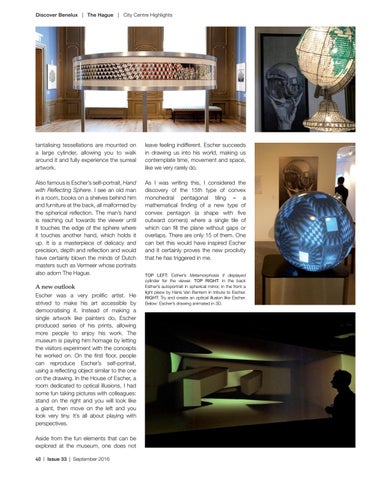
TOP: Pictures of tiles from the Alhambra mosque in Grenada which were a big inspiration in Escher’s tessellation work. ABOVE: Chandeliers inspired by Stars by Escher. RIGHT: Visitors to the The Hague can discover more of the Dutch masters at the Mauritshuis.
Issue 33 | September 2016 | 39
Discover Benelux | The Hague | City Centre Highlights
tantalising tessellations are mounted on a large cylinder, allowing you to walk around it and fully experience the surreal artwork.
leave feeling indifferent. Escher succeeds in drawing us into his world, making us contemplate time, movement and space, like we very rarely do.
Also famous is Escher’s self-portrait, Hand with Reflecting Sphere. I see an old man in a room, books on a shelves behind him and furniture at the back, all malformed by the spherical reflection. The man’s hand is reaching out towards the viewer until it touches the edge of the sphere where it touches another hand, which holds it up. It is a masterpiece of delicacy and precision, depth and reflection and would have certainly blown the minds of Dutch masters such as Vermeer whose portraits also adorn The Hague.
As I was writing this, I considered the discovery of the 15th type of convex monohedral pentagonal tiling – a mathematical finding of a new type of convex pentagon (a shape with five outward corners) where a single tile of which can fill the plane without gaps or overlaps. There are only 15 of them. One can bet this would have inspired Escher and it certainly proves the new proclivity that he has triggered in me.
A new outlook Escher was a very prolific artist. He strived to make his art accessible by democratising it. Instead of making a single artwork like painters do, Escher produced series of his prints, allowing more people to enjoy his work. The museum is paying him homage by letting the visitors experiment with the concepts he worked on. On the first floor, people can reproduce Escher’s self-portrait, using a reflecting object similar to the one on the drawing. In the House of Escher, a room dedicated to optical illusions, I had some fun taking pictures with colleagues: stand on the right and you will look like a giant, then move on the left and you look very tiny. It’s all about playing with perspectives. Aside from the fun elements that can be explored at the museum, one does not 40 | Issue 33 | September 2016
TOP LEFT: Esther’s Metamorphosis II displayed cylinder for the viewer. TOP RIGHT: in the back Esther’s autoportrait in spherical mirror, in the front a light piece by Hans Van Bentern in tribute to Escher. RIGHT: Try and create an optical illusion like Escher. Below: Escher’s drawing animated in 3D.
Discover Benelux | The Hague | City Centre Highlights
Passion for delicious food TEXT: THESSA LAGEMAN | PHOTOS: RESTAURANT LA PASSIONE
At La Passione you can eat a wide range of traditional and modern Italian dishes made from seasonal and organic products. “Our strength is that we offer extremely good food and fresh quality for a surprisingly reasonable price,” owner D. Muca says. Together with his two Italian cooks, Muca welcomes you in his restaurant that he calls his ‘passion’, which explains the name. He is proud that members of the Italian Academy of Cuisine chose to visit the restaurant earlier this year and awarded it with an 8.1 out of 10. The restaurant is located in the centre of The Hague, in the beautiful Noordeinde street with many galleries, nice little shops and even Noordeinde Palace.
It is not far from Central Station and on the way to Scheveningen beach. The interior can be described as modern classical. “We have created a romantic, but serene atmosphere,” the owner says, adding that when they change the menu every few months, they also change the interior. One of the most popular dishes is the risotto. Cook Claudio Cuko, who is from Lombardije, explains: “We prepare a different type of risotto every day.” He also prepares fresh pastas every day, like tagliatelle. Muca adds that the truffles are picked in the morning in Toscane and are on the guests’ plates in the evening. “We know exactly where to find the best ones, for example from our cook Charlotte Bellè’s family.” Serving fresh food is important for La Passione. “I buy the fish every morning from the Scheveningen harbour,” says the owner. The restaurant also serves famous wines from all over Italy.
Owner D. Muca
www.restaurantlapassione.nl
Lively meeting place opposite the parliament TEXT: THESSA LAGEMAN | PHOTOS: CAFÉ BRASSERIE DUDOK
Dudok is a real city brasserie in the heart of The Hague. Young and old come here to have breakfast, lunch, dinner or just a drink within the characteristic industrial interior and pleasant atmosphere. The brasserie is located in a historic bank building, right between the Dutch parliament and the bustling shopping streets. It is named after Willem Marinus Dudok, a famous Dutch modernist architect. Manager Eva Biesheuvel: “The interior, made in the style of the architect, has an industrial look with robust pillars. The space is large and light with high ceilings.” At the back there is a courtyard with a sunny terrace. Dudok has a diverse menu with typical brasserie dishes that have a contemporary twist. The cooks are inspired by the seasons and specialties and products from the region. Many people like to order the 12 o’clock lunch that consists of a ‘kroket’, a Dutch deep-fried
ragout-filled snack coated in bread crumbs, homemade soup, egg salad and bread. “Our apple pie from our own bakery is very famous too,” Biesheuvel says, adding that people from around the world ask for it. Also available are many other types of fresh pies and cakes, made from 100 per cent natural ingredients. The customers are very diverse, ranging from members of parliament to tourists, The Hague inhabitants and people from other parts of the country. “Everyone feels welcome,” the manager says. “That’s why there is such a nice mix of people here any time of the day.” www.dudok.nl
Issue 33 | September 2016 | 41
Discover Benelux | The Hague | City Centre Highlights
Home of Thai excellence TEXT: CHARLOTTE VAN HEK | PHOTOS: GABRIEL/PIM CHIRA
Take plentiful exquisite food, one unique concept and a gifted family, and you have found the secret recipe for Orchids restaurant. Their authentic Thai cuisine topped with a high-end, modern touch has made this gem a beloved spot in the heart of The Hague. Taking a glance at the menu, the Wagyu ribeye with whisky sauce, mushrooms and potatoes does not seem traditionally Thai, yet immediately arouses the taste buds. Just like the king prawns with lemongrass, lemon leaf and sushi rice. “We serve authentic Thai food with a modern touch, by adding culinary treasures from all over the world,” Bee Wiangthong enthuses. Together with her brother Keng Wiangthong she helms the 42 | Issue 33 | September 2016
restaurant: he is in the kitchen, she is the hostess.
Culinary and creative excellence Having worked with French, Chinese, and Italian cuisine, Chef Keng knows which culinary influences best complement his native Thai cuisine. All the dishes at Orchids are star dishes, combining those addictive factors of Thai kitchen with a high-end touch from worldly cuisines. “A beautiful dish starts with a good base: quality meat, fresh vegetables, a delicious sauce,” Chef Keng explains. “It is an art to bring dishes to life with colours, spices, and overall presentation.” Orchid’s dishes look like artistic plate settings, with colourful combinations and
flavoursome scents spoiling all senses from the moment the plate reaches your table. From the vegetarian starter with silken tofu, avocado, pineapple, apple and tomatoes, to the Kung salad, which contains beautifully fresh grilled shrimps and baby spinach – Orchids’ starters immediately immerse you with the culinary specialties of this South East Asian country: a perfect balance of freshness, sweetness, healthy ingredients, and subtle aromatics. Loaded with great expectations, the main courses are just as spectacular. The well-balanced veal entrecôte with pepper sauce, celery and zucchini perfectly combines authentic Thai flavours with global classics. Also mouthwatering is
Discover Benelux | The Hague | City Centre Highlights
the red curry with duck breast. Prepared with coconut milk, pineapple and lychee, the dish is a perfect example of the delicate touch of Thai cuisine that Orchids earned its stripes with. Tastefully different is Orchids’ menu. Chef Keng focuses on a handful of outstanding dishes within a seasonal menu that changes every three to four months. “Creating a new menu means cooking, tasting, cooking, and tasting once more. The whole staff helps to create a new menu. Do we ever have squabbles? Definitely - especially me and my sister!” Even when you are full, be sure not to forget dessert. A highlight is Orchids’ homemade coconut mini pancakes: an authentic Thai dessert, softer and more flavourful than pancakes. Or try the traditional mango with sticky rice and sweet coconut milk, a popular dessert that is still widely sold and eaten in Thailand.
Wining, dining, and service All dishes contain one secret ingredient: impeccable service. Despite opening only
two years ago, the restaurant has grown into a hotspot in no time. With Bee’s and Chef Keng’s personal touch that is no wonder. Just like the food, Bee and Chef Keng’s service seamlessly reflects what their guests want: a welcoming atmosphere and a staff who are as knowledgeable as they are friendly. From the moment you come in until you step out of the door: guests receive nothing less than an excellent culinary experience. Orchids puts a great focus on quality wines. “People do not normally expect that from a Thai restaurant, but good wine can fantastically complement a meal,” says Bee. Together with Chef Keng she took several wine courses to delve into the world of wine. Serving a light Pinot Gris to a dark Primitivo, Bee tries out all wines together with her brother. “One of the best parts of the job,” she laughs.
Mum knows best The love for food has always been a family affair. “Food has always been a major element in our family,” enthuses Bee. “Our mother, Wanna Sriwanna, used to be a
chef.” Chef Keng inherited the feeling for cooking from his mother, and currently has 20 years of culinary experience under his belt. Bee: “Cooking runs through my brother’s blood. With his love for our cuisine it is no surprise Orchids is beloved by so many.” Bee feels more comfortable outside of the kitchen. “I love food – but cannot cook at all,” she laughs. Wanna Sriwanna never lost the love for sharing her cooking. She and team Orchids frequently go to dinner together, and at the restaurants she still provides her children with a critical eye and the guests with her homemade amuse-bouches and desserts. “Our mother has so much knowledge about the authentic – almost forgotten – Thai cuisine,” Chef Keng explains. “Our gilthead bream with paeza sauce, bok choy and temu kunci root for example, one of our star dishes, would not have been such a success without her input.” Chef Keng’s own dish of choice? “My mother’s food, naturally!” Noordeinde 90, The Hague www.OrchidsCuisine.nl
Issue 33 | September 2016 | 43
Discover Benelux | The Hague | City Centre Highlights
Being spoiled in the elegant Hofkwartier TEXT: JULIËN L’ORTYE | PHOTOS: BACÁN BED&BREAKFAST
After travelling around the world for work purposes, Marc Horsten and his partner decided that they were not done with meeting new people yet, which was the main reason for them to start Bacán bed&breakfast: “When we returned to Holland, we were really looking for a way to continue that; we didn’t want to stop discovering all kinds of nationalities and cultures.” The house they bought appeared to be suited for receiving guests, so they simply turned the first floor into a guesthouse. That is how they jumped into a new adventure, just about a year ago. “Looking at all the reviews, it seems that we are doing a pretty good job,” Marc says. When asked what they find important in running a bed and breakfast hotel, he answers: “As we are relatively small in scale, with only two rooms, the focus is on giving our guests a lot of personal attention.” What does that attention look like? Imagine drinking a quality cup of coffee or tea with 44 | Issue 33 | September 2016
Marc upon your arrival, while he tells you everything about The Hague’s hotspots – if you wish, of course. After spending your afternoon in the city, you return to Bacán where you are greeted with a drink. Then, he will probably have some suggestions on how to spend your evening and on where to go to for a wonderful dinner. In other words: everything will be done to make sure that you will be completely satisfied when you dive into your perfectly made bed. Not to mention the extensive breakfast that will be served when you wake up. The guesthouse is located in the so-called ‘Hofkwartier’, which is one of The Hague’s most elegant areas, with the Noordeinde Palace just around the corner. In the words of Marc, Bacán attracts quite a mixed crowd: “We have got a really broad target audience, that varies from couples who want to visit The Hague for a getaway weekend, to foreign guests that are staying for a couple of days or business travellers who prefer staying here instead
of at a hotel.” ‘Bacán’ is Spanish for ‘terrific’; and when you listen to their story and see the wonderful interior, this makes sense immediately. www.bacan.nl
Discover Benelux | The Hague | City Centre Highlights
Hosting your own night out TEXT: JULIËN L’ORTYE | PHOTOS: PAVLOV DEN HAAG
When Stuart Stretton took over the Pavlov eatery in 2005, there was actually “nothing wrong” with the place. Nonetheless, he saw some room for improvement. Little more than a decade later, the eatery turned into one of The Hague’s most indispensable restaurants. This was reason enough for Discover Benelux to have a chat with the owner. After becoming one of the most appreciated establishments of the city, how do you maintain that position? Listening to Stretton, it sounds pretty simple: “It’s a combination of offering very qualitative products, in an environment that is attractive to our target group, mainly expats and business men.”
Creating that environment is just a matter of giving the guests the impression that they are in their own living room and are hosting their own evening, according to Stretton. That sounds more difficult than it is: “It comes pretty naturally. Our guests don’t want someone at their table that gives them a lengthy explanation about what’s on the menu.” In other words, you will not have to worry about being interrupted while networking with your colleagues or spending time with friends. But Pavlov has more to offer than just a casual atmosphere. Outside the summer season, the restaurant organises jazz performances every Sunday. There is a residential group of international jazz musicians, which invites wellknown guest artists such as Benjamin Herman and Phil Harper. It is safe to say that Pavlov has all the ingredients for an enjoyable and tasty night out. www.pavlov-denhaag.nl
A dynasty of Cantonese flavours TEXT: CHARLOTTE VAN HEK | PHOTOS: FULL MOON CITY
An ambiance to resemble that of Hong Kong, subtlety mixed with pure, fresh ingredients: Full Moon City honours beloved Cantonese cuisine, perfectly mastering its hallmarks. Cantonese is considered to be the finest of China’s regional cuisines. Originating from the southern province of Guangdong, the kitchen has elevated the perfect balance of flavours and senses, creating a culinary yin-yang. Full Moon City serves typical grilled meat dishes like soy chicken, Peking duck, and roast suckling pig, alongside traditional Cantonese seafood such as lobster, sea bass and turbot. An absolute specialty is dim sum. Full Moon City serves over 80 kinds of these bite-sized delicacies per day – all freshly prepared to an authentic recipe. With every dish you order: Full Moon City perfectly follows the golden rules of Cantonese cuisine, omitting any spices or influences that are too overbearing, treasuring
the original flavours of the fresh ingredients. “Cantonese cuisine uses subtle herbs, and a little salt, sugar, and oil,” proprietor Albert Kwok explains. “We let our ingredients taste like the best possible version of themselves.” The restaurant boasts world-class Chinese chefs, each mastering their own specialty. Dim sum, grilled meat, seafood; they all have (and deserve) their own chef. Located on the borders of The Hague’s bustling Chinatown, Full Moon City opened its doors in 2014, being a proud child of Kwok’s other two restaurants Full Moon and Full Moon Express. Guests are a mix of tourists and locals, including people of Asian heritage. “We get a lot of Chinese families. Our shared-dining concept is something you find a lot in China, where eating is a particularly social occasion. Needless to say the restaurant can get very busy and loud sometimes!” www.fullmooncity.nl Issue 33 | September 2016 | 45
Flanders is a top-class golfing destination where there are 54 golf clubs who are happy to welcome you for a lovely round of golf or a challenging workout of your swing!
To book a tee time or plan your holiday, visit www.golfinflanders.com
Discover Benelux | The Hague | City Centre Highlights
Healthy pistachio prettiness TEXT: XANDRA BOERSMA | PHOTOS: MAXIM KUIJPER
Picture this: you are on the corner of the beautiful palace gardens, overlooking the canals of The Hague, while enjoying a healthy breakfast in the sun. Sound like paradise? Better check out Pistache Café. A couple of months ago, this green-coloured café opened in the cosiest district of The Hague. There are many hip concept stores and cute boutiques around, but if you feel like taking a break during your shopping spree then Pistache Café is the way to go. The café gets its name from the colour “that was already there”, according to owner Laura-Lee Savoia. Savoia started this healthy lunchroom after travelling to the other side of the world. “It’s inspired by Australia, where they have a lot of similar places. You can spot the Australian inspiration in the interior.” As well as on the menu, which is mostly filled with healthy dishes such as acaï bowls, homemade granola and sandwiches with avocado and hummus. “It’s like an all-day breakfast. And we
make everything ourselves, from the hummus to the dressing.” Located on the edge of the palace gardens and the canal, Savoia came up with another great idea - picnic baskets. “They’re biodegradable. People can pick one up and take it into the gardens or on the boat, that happens quite a lot. Just take a blanket and enjoy our signature cake, sandwiches, granola with fresh fruit, coffee, tea and orange juice. A complete package!” Sounds like all you need this autumn is a little sunshine and Pistache Café. www.pistachecafe.nl
Dutch sculpture on display in The Hague TEXT: XANDRA BOERSMA | PHOTOS: SANDER FOEDERER, COURTESY STROOM DEN HAAG James Turrell, Hemels Gewelf in Kijkduin, The Hague Photo: Gerrit Schreurs, courtesy Stroom Den Haag
‘Make the city streets something special’: That is the motto of Stroom Den Haag, the centre of sculpture art and architecture. How do they do this? With beautiful sculptures. You might go to The Hague for shopping, to check out the palaces or visit the nearby beach. Not many people go to the city for art. “Shame,” says Vincent de Boer, advisor at Stroom Den Haag, the local institute responsible for art in public space. “It is a very important part of the city.” And a beautiful one. Take the ‘Beeldengalerij’ sculpture gallery. 40 sculptures placed on pedestals covering the two most important
streets in The Hague: Marktstraat and Spui. “Every year we added two sculptures,” De Boer explains. “Now they’re all taken, but we’re not done. There’s a new one scheduled to be revealed in October. It’ll be spectacular.” Each sculpture is made by a different Dutch artist, such as Andre Kruysen, Karel Appel and Thom Puckey. The sculptures trade places, so each time you pass by you might get a different view. “To keep you surprised!” These 40 masterpieces are part of more than 500 works of art you will find in public spaces in The Hague. And if you feel like leaving the city for a bit: check out the work of James Turrell, called Hemels Gewelf, celestial vault. “My favourite! It’s the form of a crater in the dunes of Kijkduin. If you lay down on a couch and watch the sky, you see an optical effect. A beautiful work of colour.” A true icon of The Hague indeed.
De Beeldengalerij: Folkert de Jong, Dutch Mechanisms, 2016
De Beeldengalerij: Hans van Bentem, Space Duck Racer, 2011
www.stroom.nl Issue 33 | September 2016 | 47
Scheveningen
Westbroek Park
Close to the city centre The Hague proves that a scenic coastline and urban coolness are a perfect match. Visit one of the charming neighbourhoods surrounding the centre for some authentic shopping spots and peaceful parks or head off to Scheveningen and Kijkduin to take a stroll through the scenic dunes and take in that fresh sea-breeze. TEXT: CHARLOTTE VAN HEK | PHOTOS: DEN HAAG MARKETING & NBTC
DO NOT MISS: Food Truck Festival TREK – Held at the city park Westbroekpark, this open-air food festival is filled with food trucks, live music, and theatre. Admission is free. 8 September Festival Jazz in the Harbour – Set at the Netherlands’ most lively harbour, this live jazz music festival combines a perfect seaside view with jazz music and food trucks for some delicious bites. 16 – 17 September Open Ateliers Duinoord and surroundings – During Open Ateliers, 40 artists based in and around the neighbourhood of
48 | Issue 33 | September 2016
Duinoord will open up their studios to the public, allowing people to watch the artists working, join a workshop, or buy art. 17 – 18 September International Kite Festival Scheveningen – Dozens of kite enthusiasts from all around the globe come to Scheveningen for this event, making the most of the wind. 24 September Tourist Tram The Hague – Travelling in style! This historic tram dates back to the 1950s and runs every 30 minutes from The Hague’s city centre to Scheveningen beach, passing many tourist attractions on its way.
Discover Benelux | The Hague | Close to the City Centre Highlights
Authentic and affordable Thai food TEXT: KOEN GUIKING | PHOTOS: MALI THAI KITCHEN
A lovely small Thai restaurant has recently opened its doors in The Hague: Mali Thai Kitchen on Laan van Meerdervoort 494a. The food is delicious and very affordable. “Because we are new, we keep our prices low to get as many customers as possible,” says the restaurant’s owner Suphawadee Paddenburg Neekrathok. She reveals that the prices will have to go up in the near future, but for now people can taste tremendously flavoursome Thai meals for a great price. Mali Thai Kitchen, open from Tuesday till Sunday, serves quintessential Thai food prepared by Thai chefs. “But we know how to adjust it to the Dutch palate,” says Paddenburg Neekrathok. “Both our chefs have worked at Thai restaurants in the Netherlands before, so they are very aware that some customers prefer their food a bit milder. However, if you
want your food exactly the way it is made in Thailand, then they can certainly prepare that as well,” the owner says. To create the authentic flavours, Mali Thai Kitchen uses fresh ingredients imported from Thailand. And the variety of dishes on the menu is really impressive. “Food is an important part of Thai culture. I want my customers to taste the diversity,” says Paddenburg Neekrathok. She is passionate about introducing Thai culture to Dutch people and vice versa. “I also teach Thai to Dutch people and Dutch to people in the Thai community in The Hague. And we have a spa – Mali Mini Spa – in Zoetermeer, where you can get a Thai massage.” More information: www.malithaikitchen.com www.maliminispa.com
The best of both worlds: centrally located luxurious apartments with hotel services TEXT: ELLA PUT | PHOTOS: B-APARTHOTEL KENNEDY
B-aparthotel Kennedy has found the missing link between the luxurious touch of a hotel visit and the homely feeling of an Airbnb: modern rental apartments in the city centre of The Hague with the extra services of a four or five-star hotel. There is no place like home. Even if your home is only temporary, it is always a good idea to invest in your personal safe haven. In this case, that haven is called B-aparthotel Kennedy and it combines the best of both worlds in the Dutch ‘city of courts’, The Hague.
This unique and innovative concept allows expats and long-term guests to rent spacious, centrally located apartments, each with their own kitchen including dishwasher and other luxurious comforts such as super-fast internet and a bathtub. Guests can even choose to combine two apartments, creating a wonderful family home. On the other hand, B-aparthotel Kennedy also offers the services of a luxurious hotel such as a laundry service, a gym and an extensive breakfast buffet. Bike rental is also available, as well as a grocery service. Last but
not least, guests can even rent a PlayStation. Furthermore, the friendly staff are more than happy to help you with your first steps into the Netherlands, such as connecting you to real estate agents. With its top service and unique location in The Hague, the B-aparthotels group is expanding. Opening up a new location in Amsterdam next year, the future is looking bright. There may be no place like home, but there is definitely no place like a B-aparthotel. www.b-aparthotels.com
Issue 33 | September 2016 | 49
Discover Benelux | The Hague | Close to the City Centre Highlights
Fresh organic meals at the beach TEXT: THESSA LAGEMAN | PHOTOS: BEACH PAVILION DE KWARTEL
This is not an ordinary beach restaurant. It is a sustainable oasis in a quiet part of Scheveningen beach. Here you can enjoy delicious organic dishes from the charcoal oven, drink a tasty cappuccino or choose from over 150 wines while enjoying a spectacular view of the sunset and clear blue sea. A short walk through dunes in the beautiful Westduinpark brings you to Beach Pavilion De Kwartel. Here you can taste affordable, highquality food that is served with a smile. It is no surprise that the southern part of the beach, where this restaurant is located, is often called the Stille Strand - the ‘silent beach’. Open daily from 9am till 12pm, come here for a good breakfast, a tasty lunch or a very special dinner. “People love the flavours of our organic meat from Spain and the freshly caught fish,” says owner Ed de Block. He adds that their fresh vegetables come straight from
Europe’s largest city farm UrbanFarmers on the rooftop of a building in The Hague. The beach pavilion has the largest wine selection on the coast. “Some of our wines are more than 40 years old,” the owner enthuses. In addition, 25 special beers are served. Not only is the food sustainable, the building is as well. It is decorated with natural materials, such as wood, and there are solar panels on the roof. “We are proud to be an official Green Key location, the international quality mark for sustainable businesses,” smiles De Block. www.dekwartel.nl/en
The Hague is best enjoyed with a Kompaan TEXT: KOEN GUIKING AND CHARLOTTE VAN HEK | PHOTOS: KOMPAAN BIER
Microbrewery Kompaan from The Hague was founded by two friends: Jasper Langbroek and Jeroen van Ditmarsch. All their beers have names that refer to different types of pals, buddies, companions, comrades; you get the idea. “Our bestseller is the Bondgenoot (ally). That is a blonde beer with lots of hops. With 5.2 per cent alcohol it is lighter than our other beers, which means you can drink more of it. That is probably why we sell it the most,” brewer Jasper Langbroek says with a smile. Each beer is aptly named after its characteristics. For instance, Bloedbroeder (blood brother) has a bit of red port running through its veins. 50 | Issue 33 | September 2016
“This stout with nine per cent alcohol is a reliable but temperamental fellow,” Langbroek proclaims. Handlanger (accomplice), on the other hand, is a dangerous chap. “It contains 8.2 per cent alcohol but doesn’t taste that way, which makes it easy to get carried away.” All of Kompaan’s brews, from the regulars to the special editions these craftsmen frequently come up with, are excellent. Over a hundred bars in The Hague stock Kompaan beer, but the best place to enjoy this brand is at the brewery. Kompaan’s beer bar, with 20 craft beers on tap and excellent slow-cooked barbecue meals, is open from Thursday to Sunday. The terrace is on the quay, so many customers dock their boats here. The Bloedbroeder festival with BIG beers from Imperial Stouts Barrel aged to Sours and Tripel IPA’s is planned for 22 October, accompanied by all-night music by local bands. www.kompaanbier.nl
Discover Benelux | The Hague | Close to the City Centre Highlights
Healthy dishes in a friendly brasserie The Clipper team
TEXT: THESSA LAGEMAN | PHOTOS: JERNEY DE JONG AND JOS SEITS
The Clipper is a famous restaurant in The Hague that has been open for 40 years. Recently, a new owner took over the business with her two children. They welcome you in their nicely decorated brasserie where they serve delicious, fresh and healthy dishes. In the middle of the chic neighbourhood of Benoordenhout you will find this lovely brasserie. It has been a favourite for local people including the city’s mayors and employees of the nearby International Criminal Court for years. Owner Jos Seits, along with her son and daughter, are proud of the restaurant, which they recently completely restyled while still retaining all the character of the old brasserie. The wooden tables and comfortable leather couches create a modern and warm atmosphere. You can also sit on the large, sunny terrace. “Of course the dishes that have been popular with guests for a long time, like veal liver and small sole fish, are still on the menu,” Jos says,
adding: “Our menu is characterised by healthy food. We love working with fresh vegetables and fruit, such as avocado, green asparagus and papaya.” For example, you can order one of the salads, appetisers, a sandwich, or a mouthwatering main dish – either meat, fish or vegetarian – all prepared by chef Dave Pennings. The restaurant is located on a little square next to a few shops. It is easily accessible by public transport and there is a car park nearby too. Close by is Scheveningen beach and Wassenaar, an affluent suburb of The Hague. Willem Royaardsplein 8 2597 GS The Hague www.theclipper.nl
Home-cooked food with a cosy feel TEXT: STIAN SANGVIG | PHOTOS: MONICA BRACCINI
Ristorante Da Braccini can be found in the authentic Royal Quarter of The Hague. Having been nominated ‘restaurant of the year’ by readers of Italie Magazine, it offers a relaxed and cosy atmosphere. It serves traditional pasta dishes, popular amongst regular guests, and innovative cooking, all of which is based on fresh and seasonal ingredients delivered daily. Owner and chef Monica Braccini explains what enables her restaurant to deliver the feeling of home. “In order for guests to feel
relaxed enjoying delicious food and drink, I want my staff to enjoy their job in a stressfree environment,” she says. The daughter of restaurant owners, and an experienced restaurant and catering business owner for many years, Braccini believes she has found an ideal balance, which produces great food in a relaxed and family-friendly environment. Regarding the menu, emphasis is on fresh and seasonal vegetables, fish, game and meat. “Another way to make your staff happy is to allow creative input in the decision-making process,” Braccini explains. Together with sommelier Thecla and Italian sous chef Bianca, they combine innovative cuisine with wine. Currently open four days a week, Braccini has time to analyse trends and travel to Italy (and elsewhere) to gain for inspiration and develop the restaurant. Ristorante Da Braccini offers a takeaway service with a ten per cent discount, as well as a catering service for private and corporate functions. For home-cooked Italian food in a
homely atmosphere, Ristorante Da Braccini is the place to be when in The Hague. For more information, please visit: www.dabraccini.nl
Issue 33 | September 2016 | 51
Discover Benelux | The Hague | Close to the City Centre Highlights
A multidisciplinary museum with international allure TEXT: JULIËN L’ORTYE | PHOTOS: MUSEON
Being one of the most international cities of Europe, it is no wonder that The Hague houses a very internationally oriented museum. The Museon can be described as a social hub, which facilitates a connection between the worldwide allure of the city and its citizens.
pollution and refugees. As this has probably stirred up your curiosity, here is some good news: the exhibition will be opened to the public from 15 October. Two weeks later on 29 October, there will be all kinds of activities taking place in the museum for the One Planet Festival, as well as during The Hague’s Museum Night.
Their latest project is the (permanent) exhibition One Planet, which they are currently working on. Being eminently aware of all the conditions that are needed for a peaceful world, the museum is designing an interactive display to educate its visitors. For instance, about the acceptance of cultural diversity or about the fair and stable access to basic needs. It will be based on the 17 so-called Sustainable Development Goals that have been spearheaded by the United Nations on subjects such as overfishing, water
But there is more. As of 1 September, the Museon will be hosting a photo exhibition in collaboration with National Geographic, which goes by the name Iconen van National Geographic (National Geographic’s Icons). Amongst all 70 photographs (from ten different artists) is Steve McCurry’s famous portrait of Sharbat Gula, the Afghan girl he photographed in a Pakistan refugee camp, so you can imagine how intense and impressive this exhibition will be. Of course the Museon renews their excellent programme from
52 | Issue 33 | September 2016
time to time, so there is always something interesting to look out for. www.museon.nl
The photographic portrait Afghan Girl by journalist Steve McCurry.
Meetings
Incentives
Congresses
Events
ORGANISE YOUR EVENT IN ONE OF THE MOST BEAUTIFUL CONFERENCE ROOMS IN EUROPE A world class venue
Easy and fast access to the venue
2 plenary rooms from 146 to 800 participants
A comprehensive range of leading technology equipment
1 amphitheatre with 646 seats
Ideally located in the immediate vicinity of the business district and the European institutions Many 4*/5* hotels at walking distance
8 meeting rooms from 50 to 380 participants 30 breakout rooms up to 50 participants
For more information and reservation, please visit: www.luxcongress.lu or contact Luxembourg Congrès via Email : info@luxcongress.lu or by phone : +352 430 257 751
Discover Benelux | Creating Brand Experiences | Top Belgian Creative & Digital Agencies
C R E AT I N G B R A N D E X P E R I E N C E S : T O P B E L G I A N C R E AT I V E & D I G I TA L A G E N C I E S
Building your brand Belgium has a long tradition of creativity and innovation. Across the country, its vibrant cities such as Antwerp and Ghent are becoming hubs for the marketing sector, even more so thanks to the digital evolution of recent years. TEXT: ANNA VILLELEGER | PHOTO: DREAMSTIME.COM
An effective marketing strategy is at the core of business growth. Your brand image captures the heart of your business, summarising what you do and why you are significant. In the ever-advancing age of digitised media, digital content is becoming an increasingly important part of that strategy. However, there are so many tasks involved it can be difficult to know where to begin. For example, many 54 | Issue 33 | September 2016
businesses focus on their visual identity when creating a marketing strategy, but perhaps you would like to come up with a new sound to reflect your company? Meanwhile, animated videos can be a good way of explaining your product and attracting new customers. But would you know what kind of animation would work for your brand?
From 3D animation to logo and brochure design or video marketing to website optimisation, there are an array of expert creative and digital agencies operating out of Belgium that can help your business create the ultimate brand experience. Read on for our comprehensive guide and decide how you will ensure your brand becomes the best it can be.
Discover Benelux | Creating Brand Experiences | Top Belgian Creative & Digital Agencies
ACTIONABLE INSIGHTS
MARKETING AUTOMATION
Discover actionable insights and make data driven decisions. We help you to ACTIONABLE INSIGHTS MARKETING AUTOMATION UDIT SOLUTION DESIGN engineer success. Discover actionable insights ment is Design a technical framework With marketing automation we and make data driven efine the and select the proper tools. are essentially streamlining all d the path decisions. We help you to We are vendor independant your marketing efforts based on the insights you’ve acquired. tal strategy. engineer success. and solution driven.
TING
5 36
6
MONETIZE
MONETIZE 4 7 MEASURE
8
With marketing automation we are essentially streamlining all your marketing efforts based on ACTIONABLE INSIGHTS the insights you’ve acquired. Discover actionable insights and make data driven decisions. We help you to engineer success.
7
SEGMENTATION
With marketing automation w are essentially streamlining al your marketing efforts based o the insights you’ve acquired.
8 5
stom reporting Real-time segmentation Buro Imagin ds that are the MultiMinds allows for correct targeting nt of analysis which is essential an SEGMENTATION KPIHeadquartered WORKSHOP REPORTING Buro Imagin isCONVERSION anforagency based in Melle, in Aalst, Belgium, mization efforts. effective marketing strategy. Real-time segmentation Create custom reporting By optimizing your We help you to define close to Ghent, specialised in strategy and MultiMinds is a dynamic digital analytics allows for correct targeting conversion rate we success and discover your dashboards that are the which is essential an focal pointboth increase your return online and offline marketing. Their agency with a mission to for enhance key performance indicators of analysis on investment. during hands-on workshops. effective marketing strategy. and optimization efforts.
the efficiency and improve results within the management, measurement and optimisation of its clients’ digital marketing activities. Read more on page 56
MARKETING AUTOMAT
services range from conducting strategic analysis to creating full-blown marketing plans, SEO to web design, and from logo design to social media. Read more on page 58
6
MONETIZE
CONVERSION
7
8
By optimizing your Bright Square conversion rate we increase your return SEGMENTATION Bright Square is a full-service communion investment. cation agencyReal-time with asegmentation portfolio of clients allows for correct targeting including the energy drink Red which is essential for an Bull, the effective strategy. City of Antwerp, G4Smarketing and the Canadian
Dominion Diamond Corporation. They assist businesses through the branding and marketing process from start to finish. Read more on page 59
Would you like to come up with a new sound to reflect your company? Or perhaps a new logo? Whatever it is that you are looking for, these Belgian-based agencies all offer something unique to help boost your brand.
Duval Branding This Antwerp-based agency helps organisations to build their brand and reputation. Established in 2012, Duval Branding already has clients around the globe and has won a prestigious awards such as the Red Dot Design Award and a Bronze Effie Award. Read more on page 60
Roundhouse Based in Ghent, the sound agency Roundhouse specialises in something different. While many firms focus on their visual identity when coming up with a marketing strategy, Roundhouse helps businesses find out what they sound like. Read more on page 62
LDV United LDV is an Antwerp-based boutique agency with a mission to ‘Create Fans for Brands’. Whether for print, on the radio or online, they ensure their clients’ brand campaigns communicate a clear message. Read more on page 64
Issue 33 | September 2016 | 55
C
By co in on
Discover Benelux | Creating Brand Experiences | Top Belgian Creative & Digital Agencies
MATURITY AUDIT
SOLUTION DESIGN
A maturity assessment is an excercise to define the starting point and the path forward to a digital strategy.
1
MANAGE
2
Design a technical framework and select the proper tools. We are vendor independant and solution driven.
3
4
MEASURE
KPI WORKSHOP
REPORTING
We help you to define success and discover your key performance indicators during hands-on workshops.
Create custom reporting dashboards that are the focal point of analysis and optimization efforts.
‘It is all about the data’ TEXT: MICHIEL STOL | PHOTO: INFOGRAPHIC MADE BY MULTIMINDS
Do you know if your digital campaign is a success? Does your website reach the right audience? There are companies that will map that out for you. But MultiMinds works to find out what is successful, by analysing data together with you. In their words: “We want to share our knowledge about data with you.”
two decades in the IT industry. “We are an agency that assists with the digital marketing of a company. We do not create campaigns or build websites for our clients, but together with them we measure their effect by analysing the data,” explains Philippe. “We become a partner for them, helping analyse data and getting the most out of that data.”
Founded over two years ago, Siegert Dierickx and Philippe Vlaemminck run MultiMinds from their offices in Aalst, Belgium, where they have nine employees. “Number ten, with a doctorate in Big Data, starts this month,” says Philippe. “These days it is all about the data.”
Three steps
Siegert has over 15 years of experience in marketing and Philippe more than 56 | Issue 33 | September 2016
MultiMinds works with a three-step model: ‘Manage, Measure and Monetize’. Siegert: “Most companies are very eager to get to that third step. But in order to get to that point, the first two steps are as equally important. That’s why we always start with ‘Manage’. We want our clients to know what they want. So together with them, we define ‘success’ and find out
what it is they want to achieve, followed by setting key performance indicators [KPI] to reach these goals.” Based on the KPI, MultiMinds gives the client advice on what to measure and what measurement tools there are available that can help them. “What tools we recommend depends on the client’s wishes and how tech-savvy the management is,” tells Philippe. “We are independent, so we recommend any tool, as long as we feel it fits the needs of our client. That is why they hire us: to come to the right decisions together with them, based on what they need and what we know.” “We also organise RFPs to allow our customers to compare different tools, and challenge these solutions and
Discover Benelux | Creating Brand Experiences | Top Belgian Creative & Digital Agencies
ACTIONABLE INSIGHTS
MARKETING AUTOMATION
Discover actionable insights and make data driven decisions. We help you to engineer success.
5
6
MONETIZE
With marketing automation we are essentially streamlining all your marketing efforts based on the insights you’ve acquired.
7
8
SEGMENTATION
CONVERSION
Real-time segmentation allows for correct targeting which is essential for an effective marketing strategy.
vendors with the business needs of the stakeholders.” MultiMinds is Googlecertified, has partnerships with Adobe and Tealium, to name a few, and has a great network of freelancers who know about every tool out there.
Monetize At step two, MultiMinds works with the client to measure and monitor the data. Siegert: “We do not write the code that is necessary for the tools. We instruct our clients, so that they can do it themselves. That way, the client is part of it and can work out its return of investment, for instance. Together we analyse the data, teach them how to read it so they can adjust a campaign or a website and help to better monetise their digital efforts.” After measuring the data, the client’s campaign or website can make revenue. Yet different trends and regulations can have an impact on that too. Philippe: “We constantly follow trends and discuss with
our clients the impact those trends can have on their sales. But we also have a lawyer working with us, who knows all about the rules and regulations regarding data privacy, collecting and sharing. It is very important to know what kind of data you can send to your cloud solution and what data you cannot, and who has ownership and responsibility.”
Training When the client starts measuring its data, most of the time they do not know a great deal about how to analyse it. That is why MultiMinds keeps helping them. Siegert: “It is a process. We want our clients to develop their knowledge. We do that at their offices, with their own data. Or we give them training at our office here in Aalst. Training can be for people who have never analysed any data whatsoever, but also for people who are more advanced.” At least once a month there is a class where there are employees from different clients, who are working together. “It is really great
By optimizing your conversion rate we increase your return on investment.
to see those different companies together. And we learn from them as well! “For instance, a newspaper publisher approached us. Together we created a plan from an e-commerce perspective, where we viewed their news articles on the website as products, like a web shop. We got the idea after implementing a full e-commerce site for another client. That is how much our clients trust us and see us as a partner. Because we are doing everything with them, not just for them,” tells Philippe.
Sharing knowledge “MultiMinds is there to work with you to analyse your data; how you can measure it and use that knowledge to best monetise your digital efforts,” reiterates Philippe. “We love to share that knowledge with you and to be challenged to get the best results for our clients!” www.multiminds.eu Issue 33 | September 2016 | 57
Discover Benelux | Creating Brand Experiences | Top Belgian Creative & Digital Agencies
Photo: © Between Brix
Photo: © Scania
Building your business TEXT: CHARLOTTE VAN HEK | PHOTOS: BURO IMAGIN
Effective marketing lies at the heart of business growth. Buro Imagin helps companies thrive by creating a full strategy of success and translating it into the right building blocks of online and offline marketing and sales.
marketing means, we conduct an in-depth talk with the company. Who are they? What is their budget? What do they want to achieve? Some companies have very targeted results in mind, others need more guidance.”
Buro Imagin is an agency based in Melle, near Ghent, specialised in strategy and both online and offline marketing. “We cover every step of the marketing way, always with the aim in mind to boost growth,” founder of Buro Imagin Kenny Braeckman, explains. Buro Imagin’s services vary from conducting strategic analysis to creating full-blown marketing plans, SEO (search engine optimisation) to web design, and from logo design to social media – always provided through a pair of marketing glasses that achieve targeted results.
Being a certified Google partner, Buro Imagin’s experts are always up to date with the latest knowledge about any Google products, ranging from Google Analytics, to Google Shopping, to Google Export. In addition, Buro Imagin builds (mobile) websites, has expertise in SEO and SEA and creates targeted e-mail campaigns. Every online strategy is based on an extensive web analysis, researching a company’s customer base, competitors, and thus its opportunities and challenges. And Buro Imagin’s expertise does not stop in the digital universe. A memorable logo and outstanding corporate identity ensure a strong concept makes it into the offline world as well. Think original posters, clear brochures, and appealing direct mailings.
Everything starts with a strong strategy. “A clear mission and goal are the foundations of a successful strategy,” according to Braeckman. “Before we decide on any 58 | Issue 33 | September 2016
The adrenaline of a sale is one thing that drives Buro Imagin. With their commercial insight and years of experience, they assist companies in every step of the sales process. “That sometimes even results in joining our client’s conversations with their clients, providing a critical eye towards communication and sales tools,” Braeckman says. All projects are executed with the eye on long-term commitment. “Companies often look for an external party that can advise them in an objective way on their marketing activities. Some of our collaborations last for years. That applies to maintaining a website or keeping the social media up to date, but it also means we follow a company’s journey from beginning to end, together watching their development and growth.” www.buro-imagin.be
From branding to marketing: the total package TEXT: SOFIE COUWENBERGH | PHOTOS: BRIGHT SQUARE
Creating marketing strategies, designing a unique logo or brochure, optimising a website to rank highly on Google. There are plenty of tasks that take a company’s attention away from actually running its business. But it does not have to be that way. Bright Square is a full-service communication agency that takes care of it all.
communication needs, under the same rooftop,” fellow co-founder and manager Kevin Gevers continues. Thanks to this combination of expertise, Bright Square has built up an impressive and diverse portfolio of clients, including energy drink producer Red Bull, the City of Antwerp, G4S and the Canadian Dominion Diamond Corporation.
“Companies often lose a lot of time contacting different agencies for different parts of their marketing,” co-founder and manager Jonathan Tolleneer explains. “We save them both time and money by doing everything in-house.” Bright Square has its own marketer, graphic designers, programmer, photographer and videographer, all of whom assist each business through the branding and marketing process from start to finish.
Both online and offline, the agency prides itself in standing by its clients 24/7. “We’re not just a 9-to-5 service,” Kevin says. “When a customer has an emergency at 11 in the evening, we’ll be there to take care of it.” Even when the final product has been delivered – whether that be a brochure, a new website or a complete branding package – Bright Square maintains a relationship with its clients and reaches out whenever it sees an opportunity for improvement. “It’s not rare that someone comes in to have a logo designed and ends up handing over the entire branding process to us,” Jonathan notes.
“Because everyone on our team has a specialty, we’re able to offer customers the best service possible for all their
On top of that, Bright Square follows changes in the marketing world and new technologies closely so they can implement them immediately. Not only do they have an in-house photographer, they also create videos and are able to provide aerial footage by using an ultramodern drone. All of these tools and skills are key in helping Bright Square do what it does best: communicating a company’s offer to its customers by translating its vision into a tangible, always present, online and offline brand. www.brightsquare.be
Logos created by Bright Square for various brands
Issue 33 | September 2016 | 59
Discover Benelux | Creating Brand Experiences | Top Belgian Creative & Digital Agencies
Become who you are TEXT: KOEN GUIKING | PHOTOS: DUVAL BRANDING
Branding is not about what you say or how you look, it is about who you are. That is the core message of Duval Branding, a rapidly growing Belgian company that helps organisations worldwide to build their brand. It has assisted sole traders as well as big businesses to become household names; boosting their reputation and increasing their sales. In his Antwerp office, Duval Branding’s managing director Marc Wellens has laid out some beautifully designed marketing materials. “Branding is about bringing a company’s story to life,” he says. “To tell that story you need to understand 60 | Issue 33 | September 2016
what a company stands for. Once that is clear, we can help them communicate their visions and beliefs in a coherent and consistent manner.”
Designer toolbox Wellens continues: “We believe that any company will come out stronger if it brings all its communications in line with the branding guidelines.” In other words, the logo, company colours and typographic font should be designed coherently and used consistently on all stationary, print materials, company cars, you name it. “And we don’t just design for our clients; we also help them to get all their content in line with the branding, such as
guidelines for the tone of voice and the type of images to use.” Wellens says: “I dare to make the claim that if a company consistently uses the ‘toolbox’ we design for them, they will create more goodwill, get more clients and increase their sales and market value.”
Red Dot Design Award and Effie Award Duval Branding, established in 2012, already has clients around the globe and has won a couple of prestigious awards, such as the Red Dot Design Award and a Bronze Effie Award. “We are the first Belgian branding agency to win an Effie Award. Usually these prizes are won by
Discover Benelux | Creating Brand Experiences | Top Belgian Creative & Digital Agencies
advertising agencies,” says Wellens. He explains the dynamic development of the company: “Although Duval Branding is a relatively new name, our roots go way back. From 1996 until 2011 we were part of Duval Guillaume, a well-known marketing and advertising agency that has really put Belgium on the map as a country that is specialised in marketing. But when that agency was sold to Publicis in 2011, it started focussing much more on advertising than on branding. That is when seven of us decided to leave the company and, together with André Duval, one of the two founders of Duval Guillaume, started Duval Branding. We have the same ambition with this company as André Duval and Guillaume van der Stighelen had with their marketing agency: to compete with the best in the world.”
The Opera District in Dubai The move has paid off. Duval Branding is indeed reeling in big clients from around the globe, such as a project developer in Dubai. It beat seven internationally
renowned branding agencies in a race to design the corporate style of The Opera District. “We initially had our doubts. Why would this big real estate developer choose a small Belgian firm to do its branding? But our small size turned out to be our strength. We respond much quicker to the client’s requests than big agencies tend to do.” More importantly, Duval Branding understood the story behind The Opera District. “The project developer, Emaar, has ambitious plans for this cultural district, but they need investors to be able to realise them. They need people who share their ideas, visions and beliefs. To reach those investors, we decided to use ballet dancers in our designs, reflecting culture and grace. We made a circular logo, because that is the shape of The Opera District area.” Flyers, posters, a corporate movie, even guidelines for the names of the future buildings in this area; Duval Branding put together a complete toolbox. “And because of this project we are now also doing the branding for
a major property development project in Mumbai, India,” says Wellens.
Bestselling travel book Much smaller companies also hire this Antwerp-based agency to build their brand and reputation. A famous example is BE NY, a Belgian tour guide in New York. “I did a tour with him, Patrick van Rosendaal, during my honeymoon and after that one tour I didn’t feel like a tourist anymore, I felt like a New Yorker.” The idea was born to make a book about feeling like a local in New York thanks to BE NY’s walking tours. “To our surprise it became a bestselling travel book in Belgium and it won a Red Dot Design Award.” BE NY’s website was given the same style as the book, using the colours of the famous yellow cabs, urban typography and cool infographics. The result of all of this is that BE NY has now grown to a company of five and a second travel book is on its way. www.duvalbranding.com
Duval Branding was founded by Marc Wellens (left) and Gert Mahieu.
Issue 33 | September 2016 | 61
Discover Benelux | Creating Brand Experiences | Top Belgian Creative & Digital Agencies
Cedric Engels, founder of Roundhouse.
The unique sound of a brand TEXT: THESSA LAGEMAN | PHOTOS: ROUNDHOUSE
Companies often focus on their visual identity when creating a marketing strategy. The other senses, like hearing and smell, are usually overlooked. “Strange, isn’t it?” says Cedric Engels, who founded sound agency Roundhouse to change that. “We look at a brand as a person and help companies find out what they sound like.”
these kind of melodies, right?” he says. “Music is so powerful.” Roundhouse started creating music for radio and TV commercials, but soon Engels and his team decided to develop complete auditory branding for brands. “We construct a unique sound DNA. The right emotion gives a company a recognisable, consistent and relevant identity.”
Cedric Engels, 29, first hums the melody that Nokia uses and then the famous McDonald’s tune. “Everyone knows
The name Roundhouse refers to the circular building at the end of the train line where trains used to change their direction and
62 | Issue 33 | September 2016
return, the founder explains. “It symbolises our 360-degree approach of how a brand story should be written in sound.”
DJ duo Before establishing Roundhouse at the beginning of 2013, Engels performed for years together with his brother as the DJ duo Hermanos Inglesos all around Europe. He always loved music, but his father insisted he had a back-up plan so he also went to law school. Afterwards he studied at the Audio Engineering School
Discover Benelux | Creating Brand Experiences | Top Belgian Creative & Digital Agencies
in London, worked shortly at a record company and composed a few albums.
appointed it the ‘Creative City of Music’ a few years ago.
Engels developed the idea to start a sound agency after reading the book Brand Sense by Martin Lindstrom, a believer in sonic branding. The company has already worked with many different types of companies, ranging from Spa mineral water, Smirnoff vodka and phone company Lebara to web shop Coolblue, NGO Child Focus and Eastpak bags.
Now the city has its own sound as well, thanks to Roundhouse. “This job that we finished recently has been one of our most interesting cases so far,” Engels enthuses. The soundtrack is among other things used as the city’s music on hold when calling them for information, it can be heard on the city TV and the YouTube channel, it is available as a ring tone and can even be heard in the belfry.
However, the beginning was not easy, Engels admits. “We couldn’t show any cases we had worked on and it wasn’t that common yet for companies to have their own song,” he says, continuing: “Many companies still use existing music, which usually doesn’t really fit them. Luckily, this is starting to change.” In the past, there were not as many possibilities to use a sound logo with only radio and TV. Now there is also YouTube and many different social media networks. However, a sound logo is not relevant for all companies, Engels explains. “Companies that don’t advertise probably won’t need it. We also advise not to use the music constantly and everywhere, only when it’s reinforcing. Silence can be powerful too.”
Creative City of Music It is no surprise that Roundhouse is based in Ghent, a beautiful old city in the north of Belgium. The city is famous for its many exceptional musicians who live and perform there, for its renowned clubs and countless festivals. UNESCO even
When Roundhouse develops a new sound for a company, or in this case a city, they always start with studying the brand very closely and looking at the history. Are there any sounds that have been used already? What sounds does the competition use? Engels: “We then organise a workshop of around a few hours with the people who know the company well. We look at the target audience and compose the music using certain models.”
company has already made a profit. “It means we have been taking too little risks,” Engels says with a smile. “I am planning to try many new things in the following years.” The company has plans to expand to New York and the Netherlands and has a representative in London already. “I think we need to tell our story worldwide eventually. But before that, I want to make sure our company has a very solid foundation here in Belgium. I want to be very well prepared, so that we will have an impact in a new country immediately.” He adds, citing the company’s slogan: “Sounds like a good ID?” www.roundhouse.be
The founder adds that Roundhouse also carries out research into music, together with Ghent University and Ipsos, a market research firm. At the moment they look into how people suffering from dementia are able to remember things again when listening to music. Engels: “We like our marketing methods to have a scientific foundation.”
Take risks Roundhouse now works with a team of six employees and a network of 50 freelance musicians. After one year the
Issue 33 | September 2016 | 63
Discover Benelux | Creating Brand Experiences | Top Belgian Creative & Digital Agencies
‘Creating fans for brands’ TEXT: SOFIE COUWENBERGH | PHOTOS: LDV UNITED
Long before the world had heard of social media like Facebook, LDV United realised the importance of creating fans when building and growing brands. Since 1991, this creative agency has been distilling the key benefits of their clients’ offerings and communicating them to their target customers in a clear and concise way. With new brands arising every day, it is more important than ever for businesses to clearly convey what they are about and claim a spot in their field. That can only be done by being both relevant and distinctive. That is what creates fans for brands, believes LDV. But what makes a brand distinctive in its niche, does not necessarily make it interesting for its target customers. 64 | Issue 33 | September 2016
“A company’s newest technological innovation may be cutting-edge for the sector, but if it doesn’t have a clear benefit for its customers it’s not the right thing to communicate,” LDV United managing director Petra De Roos says. That is why LDV always goes in search of the link between the brand’s message and its customer’s needs. “For every brand we work with, we go in search of that one thing that will draw the customer’s attention - their trigger,” De Roos continues.
Connecting offer and need One way the agency achieves this is by pairing each brand with a team that consists at least partially of employees that are part of the brand’s target group. That means, for example, that a business
targeting parents will always be helped by a team of which some of the members have kids. “Once, we even asked the parents of our employees to join a focus group,” De Roos says. It only shows how important it is for LDV to understand the desires and problems of the audience their client is trying to reach. Because every team assigned to a project does not only have the right skills but also the right personal frame of reference, LDV manages to establish a true connection between a business’s offer and how that can make a difference in the customer’s life. This allows the agency to create a campaign that clearly communicates the brand’s message, whether that is in print, on the radio or online.
Discover Benelux | Creating Brand Experiences | Top Belgian Creative & Digital Agencies
“Creativity is very important to us when designing a client’s message,” De Roos says, “but it’s function is always to support and carry the message.” Every output created serves their purpose and is sent into the world using the most relevant channels.
A case study De Roos notes that the opportunities presented by the digital evolution of recent years have heavily impacted their way of working. “It allows us to do more things, in a different way, and to connect even better with our client’s audience and thus achieve their goals.” A well-known example of this is LDV’s campaign for the Special Olympics. To battle the lack of attention these games used to receive, LDV United partnered with star football player and Red Devil Kevin De Bruyne. The agency gave a portrait of De Bruyne the eyes of a participant of the Special Olympics, which De Bruyne in turn posted on his Facebook page with the simple but confronting question: ’Would you still be a fan if I looked like this?’ In just 24 hours, the post had amassed 52,000 likes, 1,400 shares and 3,500 comments. The buzz was created, but it did not end there. Thanks to this campaign, Special Olympians were even honoured at the Belgian Sports Gala for the first time in history.
Local expertise, international knowledge As a Belgian agency, LDV mostly creates nationwide campaigns for local clients in the three national languages, Dutch, French and English. However, the agency is also part of the international WPP network, which gives it access to resources around the globe and allows it to easily research business niches and case studies in other countries. “We have that additional knowledge base,” De Roos says, “but brands come to us because they know what we do. We create fans for brands.” www.ldv.be Right: LDV's campaign for the Special Olympics.
Issue 33 | September 2016 | 65
It is getting personal From online clothing adverts tailored to your taste, to a refrigerator telling you that you are out of milk: technology is more intertwined into our everyday lives than ever before. TEXT: CHARLOTTE VAN HEK / ANNA VILLELEGER | PHOTO: DREAMSTIME.COM
Personalisation is all about delivering a tailored service or product to accommodate specific individuals, based on anything that is known about them. We share an extraordinary amount of personal data, something that is only increasing due to the development of wearable devices and location-based technology. ‘Personalised marketing at scale’ is not a new thing anymore. Instead of one single advertisement reaching millions of people, new technologies allow the combination of information about our demographics, preferences, previous purchases and mood, to give us personalised recommendations in no time. Personalisation does not only apply to marketing. Our whole lives are changing 66 | Issue 33 | September 2016
by taking physical processes and enhancing them with a digital layer, created by the data trail we leave behind. Smart devices will process big data with advanced analytics and become increasingly involved in the decisions we make in our everyday lives. No need to hail a taxi when all you need to do is push a button; no need to go on a search for new music if a playlist is being tailored to your musical taste. The Internet of Things, a computing concept whereby everyday physical objects will be connected to the internet and be able to identify themselves to other devices, will enter our most common environments such as our car and home. Looking for an empty car
park spot? Your car knows better. Want to come home to a warm house? The heater already turned itself on. However, there are growing concerns over personalisation. The rising use of data for the delivery of personalised experiences brings increased security risks. Moreover, not all customers want companies to have an understanding of their desires and lives. It seems like the balance between the tangible benefits of personalisation and personal privacy is still to be found.
Discover Benelux | Creating Brand Experiences | Top Belgian Creative & Digital Agencies
Little Miss Robot Based in Ghent, Little Miss Robot is a product design studio with digital technology at its core. Boasting a portfolio with over 100 digital product partners from industries ranging from publishing to finance, this innovative firm combines technology and out-of-the-box thinking. Read more on page 68
StoryMe Located at a creative hub in Ghent, StoryMe helps brands to communicate their complicated messages in an easy way thanks to Video Marketing. The company currently counts over 800 customers and has world-famous names such as Coca-Cola on its portfolio. Read more on page 70
Well Played At Well Played, Smart Animation Studio in Ghent, they take a smart look at animation. Thanks to a great team including illustrators, copywriters and animators, you can achieve the perfect animated video for your company or marketing campaign. Read more on page 71
From 3D animation to logo design and video marketing, these Belgian-based creative and digital agencies are at the top of their game.
Dividebyfour Ghent-based creative agency DivideByFour creates a digital, life-like copy of a company’s product, such as images, animations and even virtual reality. The firm has created content for global brands including Hoegaarden, Fanta and Bacardà and is also working on a fictional series in 3D animation. Read more on page 72
LogoDebut LogoDebut is an Antwerp-based graphic design studio specialising in corporate identity design. In addition to working on visual aspects such as logos and websites, LogoDebut excels in creating a consistent and likeable tone of voice for all levels of communication, whether that is coaching employees on how to pick up the phone or managing social media. Read more on page 73
November Five November Five is an independent agency from Antwerp that creates digital solutions to improve and simplify the interactions between a company and its customers. They have built client portals for companies such as Belgian mobile provider BASE, as well as creating content-driven apps for firms including Belgium’s leading commercial TV station. Read more on page 74 Issue 33 | September 2016 | 67
Discover Benelux | Creating Brand Experiences | Top Belgian Creative & Digital Agencies
Designing the digital tomorrow TEXT: CHARLOTTE VAN HEK | PHOTOS: LITTLE MISS ROBOT
With great technology comes great opportunity. At digital product design studio Little Miss Robot, innovative technology stands proudly alongside creative out-of-the-box thinking. Together, they can design the digital products of tomorrow. Mixing creative thinking (represented by the Little Miss) with technical innovation (hence the Robot) is the core of Little Miss Robot, a Ghent-based studio with a passion for innovation that presents creative ways of using new technology.
The future is digital “We believe that innovation, combined with technology and design, are ideal tools to respond to tomorrow’s opportunities,” managing director of Little Miss Robot Hans Bosmans explains. “At Little Miss Robot we take an innovative 68 | Issue 33 | September 2016
business mission or value and turn that into a meaningful digital experience suited for the future.”
innovative technology, ease of use, and attractive design.”
A digital core That future is ever changing. Businesses are challenged by the effects of our increasingly connected world, changing customer behaviour, and digitised lives. In a world where everyday devices are changing into personalised means to ease our lives and connect with each other, companies have the world on their doorstep. It has never been easier to reach anyone in the world. “We see all these new opportunities arising from technology, and want to use them to improve people’s lives. But with these opportunities certain difficulties arise too. Customers have certain expectations, products are shifting from functionality to convenience and user experience. We have to find the right balance between
Little Miss Robot embraces the digital in every way possible, taking any interface and immersing it with innovative and creative digital design. Finding the right digital means to suit specific corporate values or address a certain problem is hereby the starting point. This approach translates in businesses often not knowing which product would best match their values or their customer’s wishes, or companies completely changing any previous opinions held after an initial brainstorm. “Of course we see certain trends,” senior product designer Sander Jacobs says. “The demand for web and mobile is ever increasing for example, and developments such as the Internet of Things, virtual reality and chat bots are
Discover Benelux | Creating Brand Experiences | Top Belgian Creative & Digital Agencies
on the rise. Also companies often need help on how to best translate an offline product or service to the online universe. But none of these issues are product or sector-bound.” As a result, Little Miss Robot’s portfolio adorns businesses from every possible branch, with every possible core value, serving any type of customer. Cases vary from redesigning a website from a mobile first perspective, to creating an online tool to support a musician’s workflow, to supporting a 100-year-old radio broadcaster to redesign an invisible format into a visual experience. Projects last from two weeks up to one year. The things that bind them are digitalism, added value to the user, and an innovative and solution-based nature.
A context of co-creation Little Miss Robot thrives on co-creation and a human-centred design framework, involving human perspective and userinsights throughout the complete process. Clients, stakeholders, end users, creators, developers: anyone able to provide
useful insight on the product may join the brainstorming, planning, designing, or testing phase. Before kicking off any sketching or programming, the creative minds of Little Miss Robot and their clients hold collaborative workshops focussed on user needs, the target group, corporate values, and everything in between. Creating an involved relationship with clients is essential. “Getting to know the client and their customers is of great importance. In the end, they know the product best,” Bosmans emphasises. The client is briefed from beginning to end in a design and development process that is interactive and collaborative. Little Miss Robot works with design sprints, in which stages of development and creation are constantly subject to feedback and revision. Prototypes are developed at an early stage, allowing developers to speed up the process and take into account any criticism or suggestions for improvement.
Robot involves as many different people as possible throughout the complete process, utilising every competence and honouring every view. “We believe that teams are thriving when there is mutual understanding and sufficient communication,” Bosmans enthuses. “Often we see that separate divisions within one company still find themselves on little islands and have little understanding of how the rest is working. We value an approach where marketing provides insights to development, production to marketing, and vice versa. An involved collaboration simply results in better and more inspired products and services.”
Building bridges
This way of working is reflected in Little Miss Robot’s own culture, where mutual learning and an atmosphere of openness and co-creation is encouraged. “At our studio, people constantly learn from each other. We honour feedback, keep each other up to date and appreciate creativity. This results in an incredible inspirational environment.”
Building digital products cannot be done without building bridges. Little Miss
www.littlemissrobot.com
Issue 33 | September 2016 | 69
Discover Benelux | Creating Brand Experiences | Top Belgian Creative & Digital Agencies
Simple Video Marketing TEXT: CHARLOTTE VAN HEK | PHOTOS: STORYME
Complex made simple. StoryMe helps brands to communicate their complicated messages in an easy way through Video Marketing. People watch more videos than ever. Research shows that by 2017, online video traffic will make up 82 per cent of all consumer internet traffic. “It has never been more important for businesses to integrate video in their marketing strategy,” says CEO of StoryMe Jonathan Moerkens. “People have internet access anywhere, anytime. Mobile devices are designed in a way to suit our demand for video.” Located at a creative hub in Belgium’s Ghent, StoryMe are masters in turning any message into a clear and attractive story. Starting out as an expert on creating one-minute video animations to explain complicated business models or complex technologies, StoryMe now assists companies in every aspect of Video Marketing. Alongside StoryMe’s growth, their clients have grown too. When they started out three years ago, their clients were mainly small companies. Now, StoryMe currently counts over 800 customers and has 70 | Issue 33 | September 2016
world-famous names from every industry on their portfolio. “Video Marketing has advantages for every possible business. In this age of information overload and the human attention span getting shorter, one-minute videos are the ideal tool for catching, and keeping, people’s attention. Also, video lends itself perfectly for analysis. How long did someone watch? Did they finish it? That’s very valuable information.” The production of a video animation counts seven steps, from the initial brainstorming to extras such as infographics. The customer and video architect are in conversation from beginning to end. “Our method of communicating is like our videos: clear and direct. Customers are involved every step of the way: no middle man, just a hands-on attitude.” Coca-Cola is one of the names adorning StoryMe’s portfolio. “Coca-Cola asked us to translate their complete heritage into one clear story. Their history, their concept, the products: we made their long story short, in less than 90 seconds.” For some businesses, such as BPost or BNP Paribas Fortis, StoryMe has created a solid format: a specific house style,
returning characters. “That way we don’t have to start from scratch, and we can act fast every time there is a new story to tell.” What about StoryMe’s own story? “Our founder Lorenzo Bown is focusing on the international launch. The team is expanding rapidly, with a brand new office in Ghent and one in London and Singapore. There are plans to open in Stockholm, Sweden.” One piece of advice? “Online video has become the perfect medium to promote and share your ideas. Start with Video Marketing today.” www.storyme.com
Jonathan Moerkens (left) and Lorenzo Bown.
Discover Benelux | Creating Brand Experiences | Top Belgian Creative & Digital Agencies
Being smart about animation TEXT: MICHIEL STOL | PHOTOS: WELL PLAYED
Animated videos are a great way to explain your product, raise awareness or hook new customers. But how do you know what kind of animation works best for you? At Well Played, Smart Animation Studio in Ghent, they take a smart look at animation. “It is not just the animated video we create, it is the whole package,” says CEO and co-founder Jakob Lorré.
“Once we have established those parameters, we create the video. These goals are really important. For instance, when you create an animation for social media channels, you have three to seven seconds to grasp your audience’s attention. Whereas the message in a video on your website can come a few moments later because the target audience is already there and focused.”
“Smart video is video that works, whether it is in a presentation or meeting, or when it is in a marketing campaign,” tells Jakob. When clients approach Well Played to create an animated video, the team works with the client to see what fits their needs. “First we identify the goals of the client. Who do you want to reach and what is the message you want to spread? Is an animated video the way to go? What channels will you use?”
Based on an audit of your goals, Well Played will give you the best advice as to what kind of animated video works best for you. Jakob: “We also look if an animation can be interactive, with a call to action at the end, where people can click on the video to register for instance. Videos on your website can have these features, on social media it is not yet possible. It is something we take in to account.”
When the goals are clear, it is up to the team of illustrators, copywriters, animators and the creative director to make the perfect animated video for your company or marketing campaign. “We have about 12 people working at our creative department. They write the storyboards and animate the videos. We use voice actors to narrate the videos. It usually takes about four to six weeks to create the best video,” tells Jakob. “By using smart animation, we will take each step necessary to give the video the crowd, the views and the effect it needs and deserves. We work together with our clients from A to Z, to create the perfect animated video for their company and campaign.” www.wellplayed.video
Issue 33 | September 2016 | 71
Discover Benelux | Creating Brand Experiences | Top Belgian Creative & Digital Agencies
Dazzling digital content from Belgium TEXT: JULIËN L’ORTYE | PHOTOS: DIVIDEBYFOUR
In the ever-evolving era of digitised media, there are little things more important to market your company than digital content. It is essential to provide media and other relations with something that reflects what you stand for. However, often that is not something you can do yourself. Luckily, there are creative agencies such as the Belgium-based DivideByFour. As we were eager to learn more about the world of digital media, we spoke to co-owner Maarten Baert. “What we are doing, in fact, is creating a digital, life-like copy of a company’s product, such as images, animations and even virtual reality.” After undertaking unsatisfying architecture studies – which make use of the same software – Baert is now running an agency that has created content for, amongst others, Hoegaarden, Fanta and Bacardí. Quite an impressive list, considering that they have only been operating for just over a
year and a half. According to Baert, there is a logical explanation for this success: “We are a young and low-cost organisation, with a very varied team that has different backgrounds, which means that we are able to bring different insights to the table.” Apart from advertising, DivideByFour is also working on a fictional series in 3D animation, which is set for 2017 and has already been bought by a prominent Belgian television network. “It has quite some potential, not in the least because it is something that is 100 per cent ours. And that is how we see our future: an equal combination of advertising and fiction.” This success story has only just begun.
Upcoming short movie style-frame.
Screenshot of Vanden Borre ongoing TV animations.
www.dividebyfour.be
Animation and print campaign for Kuurne-Brussel-Kuurne.
Computer-generated packshot for AB InBev.
Discover Benelux | Creating Brand Experiences | Top Belgian Creative & Digital Agencies
Making the brand TEXT: CHARLOTTE VAN HEK | PHOTO: LOGODEBUT
A good brand image captures the very essence of a business. It sums up what you do, why you matter, and who you are. LogoDebut ensures companies communicate excellence through all touch points by designing a corporate identity from A to Z. LogoDebut is a graphic design studio in Antwerp, specialised in corporate identity design. Starting off in 2005 as a logo design studio, it now focusses on the full spectrum of creating a complete corporate identity of excellence and recognition. “A well-designed logo is of uttermost importance, because it is the first thing people see,” owner of LogoDebut Kristoff Bertram explains. “But a company’s brand is expressed through more than a logo: your online behaviour, your marketing materials, your tone of voice: everything that forms a consumer’s thought and attitude towards your company matters.”
Besides focussing on visual aspects such as logos, websites and branding products such as stationary systems or vehicle graphics, LogoDebut excels in creating a consistent and likeable tone of voice through every level of communication, varying from coaching employees on how to pick up the phone, to managing social media. “Everything you say or do: your business’s identity should exude unity, recognition, trust, and acknowledgment,” Bertram enthuses. “In a world with an ever growing number of competitors, it is important that your brand stands out. People should recall your business.” LogoDebut’s own identity is characterised by transparency about production and value. Projects are executed in a timely manner and well suited for start-up companies on a budget. They have over 1,000 satisfied customers - mainly small and medium-sized business from every possible branch ranging from
publishing agencies to sport foundations and charities. “Although we also work with large companies, it is mainly small companies and start-ups that have to build their corporate identity from scratch,” says Bertram. “They often lack the knowledge to create a united and consistent line in their communication.” Customers are involved from beginning to end, with an essential creative briefing before the sketching starts, to several briefings throughout the whole process. “We can’t capture and translate a business’s story without knowing them through and through,” says Bertram. “Via discussions and a questionnaire, we get an in-depth understanding of a business. What is their story? What would they like to achieve? Often businesses know what they do, but not who they are. We help them to figure that out.” www.logodebut.com Issue 33 | September 2016 | 73
Technology is the enabler, not the dictator TEXT: MICHIEL STOL | PHOTOS: NOVEMBER FIVE
Digital technology is beautiful. It can help you to fully interact with your audience in the most sophisticated ways, but also make your business run even more efficiently by using it to connect your employees with each other. That is why they love all things digital at November Five and create digital solutions for your company. “We shoot for the sky,” tells cofounder Tom Vroemans. November Five is an independent agency from Antwerp that creates solutions to improve and simplify the interactions between a company and its customers. “We’ve built client portals for companies such as BASE, handling everything from topping up call minutes, changing your tariff plan and then invoicing,” explains 74 | Issue 33 | September 2016
Vroemans. “But we’ve also created content-driven apps, like the VTM app for Belgium’s leading commercial TV station, bringing great content and interactivity to the viewer in a user-friendly format.”
Five represents our roots and the many possibilities we see in the future and that will keep fitting us as we keep iterate and evolve with the world of technology.”
End-to-end partners Vroemans is one of four co-founders of November Five. “Together with Vincent Pauwels, Nick Ver-baendert and Thomas Van Sundert we started the company, then called Appstrakt, on 5 November 2009. We saw that mobile apps were quickly gaining traction, but that relatively few agencies were focussing on them specifically, so we jumped on the chance ourselves.” However, the name Appstrakt tied the company too much to ‘just creating apps’. They had outgrown that. “So we decided to kick 2016 off with a new name and branding. November
“November Five is a full end-to-end partner to our clients and we take them from the first spark of an idea to a finished product,” tells Vroemans. “We believe in continuous improvement and constantly challenge our own way of working. Our strategic trajectories can shape, challenge and enrich any idea into a strong business case. Our experience designers will shape the solution visually and according to the best user-driven standards, while our development teams can build the actual product. We then introduce it to the market together
Discover Benelux | Creating Brand Experiences | Top Belgian Creative & Digital Agencies
with our clients and maintain it after the launch.” November Five have offices in Antwerp, their HQ, and client services in New York and Stockholm.
efficient.” Spencer is updated constantly and November Five is working hard to make Spencer even better and ready for the next step.
Spencer
International clients
They do not only create client portal or apps, they also build products for companies to connect with their employees. “We love to leverage technology to ensure that everyone can work efficiently and be their most productive selves, by streamlining or automating certain processes. This is the kind of work we do with an in-house product like Spencer, or with the kind of tooling we built for clients like Spotify.” They have built an internal tool for them to help manage their international advertising operations.
The story of November Five has been one of success. “In the past years, we have grown to a young but mature company with nearly 60 amazing, talented and driven team members, a sizeable revenue, and a portfolio filled with challenging projects for a diverse set of clients.”
Spencer is a tool November Five created themselves. “Spencer is a product that we built from scratch. We created Spencer as a unified interface for large companies’ critical tools, to make any employee’s workday happier and more
The clients are the centre of the company. “We see each client relation as a partnership, and we are proud of the ones we have built. We work with industry leaders, ambitious start-ups and everything in between, global or local – Coca-Cola, Spotify, Base, The New York Times, Medialaan, AB InBev and Whirlpool are a few examples – and we’re always looking to add new exciting projects to our repertoire. We do prefer to keep our client portfolio reasonably small, taking up
those projects where we can truly work as an end-to-end digital partner.”
People and technology “We have a team of almost 60 multifaceted, fast and furious team members. We all share the same curiosity, love for technology, drive and ambition. Our combined, diverse set of talents, backgrounds and expertise makes the difference – and we’re always challenging ourselves to take it one step further. We also work hard to build and keep a pleasant, open culture where everyone feels at home.” “Together, our teams can offer the full spectrum of technology: from mobile to web and hardware, but also design, strategy and research. To us, tech is the big enabler, never a dictator. Our broad knowledge means we can focus solely on delivering a killer product and choose whichever technology is the best tool to make that happen.” www.novemberfive.co
Issue 33 | September 2016 | 75
Discover Benelux | Business | Column
Buscomm can save the world TEXT & PHOTO: STEVE FLINDERS
I am worried about the state we are in. Not just the way we are ignoring environmental imperatives and the roots of terrorism, but the threats to truth, reason and liberal values posed by populists who feed on discord, fear and hatred. I worry that hardwon freedoms and precious pluralism could be, and indeed are being, snuffed out just as they were in Germany in the 1930s. I have spent half a lifetime working in business communication – training, coaching and mentoring – committed to an idea of management that goes right against what the likes of Trump, Le Pen and Erdoğan advocate as recipes for our ills. I believe that organisations should adhere to principles of mutual respect and fairness, and that good communication is a key to organisational success. In the UK, the old adage that people quit their bosses, not their jobs, is still heard all too often. Fearful, insecure managers continue
to inflict widespread damage on themselves and others. I believe that anyone with the will can learn to be a good manager; and that the pathway is through learning to communicate and learning how communication works. Good managers get results by building relationships and trust in their teams. They look after the nuts and bolts of identifying and sharing objectives and defining roles. They create a feedback culture around them. They are committed to developing their people. They use psychometric tools to help team members see that team balance and effectiveness derives from harnessing difference, not from rejecting it. They negotiate for win-win and know how to manage conflict – more skills that can be taught and learnt. They use their interpersonal skills to help people move from ‘me’ to ‘us’. They use their intercultural skills to reduce the barriers between ‘us’ and ‘them’ and to build synergy from diversity. They do not use words and blame as weapons.
Steve Flinders is a freelance trainer, writer and coach, now based in Malta, who helps people develop their communication and leadership skills for working internationally: steveflind@aol.com.
Just as important, they encourage and accept challenges to what they do; they do not hide behind hierarchy. Companies may write this into their leadership frameworks, but the big chiefs often bridle at implementing it. One day all this stuff will be taught in schools. Until then, keep working on those buscomm skills not just for your own and your organisation’s benefit, but also to combat the dangers stalking the planet.
Your Partner in Anglo Dutch Business The Netherlands British Chamber of Commerce (NBCC) is the only bilateral non-profit membership organisation solely dedicated to promoting Anglo-Dutch trade and investment. From our start in 1891, we helped thousands of companies and entrepreneurs expanding their business abroad. The Netherlands-British Chamber of Commerce, 125 years experience in Anglo-Dutch trade and investment promotion. Contact us now for: • Access to interesting network events • Participation in NBCC events and working groups • Exclusive access to our intranet membership area • Up to date economic information and market sector intelligence • Market research • Partner searches • Company formation • Virtual office services • Sales support NL Tel.: 070-205 5656 UK Tel.: 03333-440 779 Email: info@nbcc.co.uk Or visit:
www.nbcc.co.uk
Discover Benelux | Business | Calendar
Business Calendar TEXT: CHARLOTTE VAN HEK
Photo: © NBTC
Business opportunity day: Croatia, Serbia and Montenegro 8 September Luxembourg City, Luxembourg To help Luxembourg businesses access foreign markets, the Chamber of Commerce organises regular information days. This month’s event will be on Croatia, Serbia, and Montenegro. These events explain the opportunities available in each market, therefore helping businesses with their export strategies. www.cc.lu/en International Conference on Sustainable Employability (INCOSE) 14 – 16 September Brussels, Belgium This conference covers areas like cross-generational collaborations and diversity management, job crafting, mobility issues and new forms of work organisation, including working time arrangements and spatiotemporal flexibility. www.incose.org TravelTech Innovation summit 15 – 16 September Amsterdam, the Netherlands The TravelTech Innovation summit will focus on the latest technology trends and advances within tourism and hospitality industries. Hearing these inspirational presentations will offer participants new ideas for developing their products. www.luxatiainternational.com
Photo: © Andrew Stripp Photography
AWSome Day 20 September Brussels, Belgium This free, one-day introductory event will be delivered by AWS (Amazon Web Services) Experts. This event is ideal for business and technical leaders, as well as IT pros and developers who are eager to learn more about cloud computing and be trained on the AWS Cloud. www.aws.amazon.com EuroIA summit 22 – 24 September Amsterdam, the Netherlands How will connections change our lives on a larger scale? How does a world of connectedness affect the development of human beings? The EuroIA summit is Europe’s leading Information Architecture (IA) and User Experience (UX) conference, with three days of workshops in the morning and talks in the afternoon. www.euroia.org
Photo: © Jannes Linders
Global Patent Congress 26 – 28 September Brussels, Belgium With intellectual property departments charged with delivering business strategy and profit, as well as safeguarding the future and competitiveness of an organisation, IP professionals have increasingly complex tasks to complete on a daily basis. The Global Patent Congress is the largest IP leadership-level event of its kind. www.patentcongress.com Agile and Software Architecture Symposium (ASAS) 28 September Arnhem, the Netherlands ASAS is a practical solutions-driven conference, where technical leads, software architects, business analysts and engineering directors can discuss better ways to deliver the software solutions that are right for their users. www.asas.nl
Photo: © Peter Boer
Issue 33 | September 2016 | 77
Discover Benelux | Restaurant of the Month | Belgium
R E S TA U R A N T O F T H E M O N T H , B E L G I U M
A royal brasserie TEXT: LIDIJA LIEGIS | PHOTOS: BELGA QUEEN
Belga Queen is a one-of-a-kind restaurant, oyster bar, lounge and club complex in central Brussels. Housed in a magnificent 19th century bank building, it offers the highest quality Belgian fare with a modern twist. Diners in the restaurant sit under expansive stained glass windows surrounded by marble columns. In the vaults under the building there is a cigar lounge and nightclub. Diners can savour cold and hot oysters and lobster, as well as tempting seafood platters, in sumptuous seafood bar L’Ecailler, which shimmers with pastel pillars. There are over 230 accompanying wines to choose from. Dishes from the main restaurant can also be ordered. 78 | Issue 33 | September 2016
The talent behind Belga Queen is Antoine Pinto. Having fled Portugal as a 17-yearold political refugee, Pinto settled in Liège, where he studied architectural interior design at the Académie des BeauxArts. He financed his studies by working in restaurants. During his impressive career, he has founded over 100 restaurants in Belgium, including Dock’s Café in Antwerp, Pakhuis in Ghent, La Quincaillerie and Pasta Commedia in Brussels, to name a few. Pinto’s influence in each space is clear: he manages to capture the eye as well as guests’ taste buds. In Belga Queen he brought new life to the Hôtel de la Poste, a former bank which now houses the restaurant. Not only are his
interiors impressive, but they are equally comfortable and elegant. There is space for larger parties, as well as plenty of intimate corners for couples.
Home-grown delights Adjacent to the oyster bar lies the tempting beer and cocktail bar. With a superb selection of cocktails and a fine collection of beers, there is something here for everyone. In terms of food, Pinto’s ethos involves using the highest quality, locally grown ingredients where possible. This also includes wine from across the world from Belgian makers and sparkling wine produced in Belgium. Pinto serves unrivalled brasserie cuisine highlighting artisanal producers and sourcing surprising ingredients such as
Discover Benelux | Restaurant of the Month | Belgium
Belgian-grown saffron. He uses different beers including Palm, Rodenbach and Gueuze Boon in food preparation, as well as aperitifs. The menu offers a number of dishes where beer is a core ingredient. Although he is less involved in cooking now, Pinto continues to play a key role in selecting the menu. Dishes change seasonally, but a few core items such as foie gras and grey shrimps are always retained. His personal favourite is the asparagus. His preferred aspect of his work, he says, is “creating and assembling new dishes”, as he is less keen on repetition and the daily work in the restaurant. After a meal, diners can descend to the lounge club, located in the former bank vaults. A stunning stained glass cupola lights the way down, and the room itself
is decorated in warm tones reminiscent of the Belgian Congo. The club serves a selection of cocktails, liquors and cigars. A DJ provides entertainment on Fridays and Saturdays. Alternatively, guests can head to the cosy bar to relax in leather armchairs and sample any of the 30odd regional bottled or draught beers available. The bar offers a range of mouthwatering cocktails as well.
bar and several lounges and spaces to have drinks. Despite Pinto’s success, he says that he never set out to become a chef. He began working in Liège in architectural design, but found it easier to find work in restaurants. He learned by watching others, as well as through self-study. Cooking suits him, he says, because it allows him to be creative and express himself.
Something for everyone Belga Queen caters to a wide clientele, from politicians to artists, amongst others. It also plays host to many a party, thanks to its impressive interior and immense size (the Brussels restaurant can seat 200 people). A second restaurant is located in Ghent, housed in a former 13th century grain storage building. Similar to the Brussels branch, it also has an oyster
He has travelled extensively and draws upon the places he has visited for inspiration. He will not give much away regarding the future, but says that he dreams of a place overlooking the sea, where his friends can also stay and where he can do what he likes with the décor and cuisine. www.belgaqueen.be
BELGA QUEEN IN NUMBERS - 1 restaurant - 1 oyster bar - 1 beer bar - 1 lounge club - 21 seats in the oyster bar - 200 seats in the dining room - Over 200 wines - 1,000 square metres - All the Grand Cru Belgian beers
Antoine Pinto.
Issue 33 | September 2016 | 79
Discover Benelux | Hotel of the Month | Luxembourg
HOTEL OF THE MONTH, LUXEMBOURG
Luxury in Luxembourg: the best of high-end hoteliers TEXT: LIDIJA LIEGIS | PHOTOS: SOFITEL LUXEMBOURG EUROPE
The five-star Hotel Sofitel Luxembourg Europe is conveniently located on the Kirchberg Plateau, north of Luxembourg city centre. Its prime location means it is close to the Kirchberg Conference Centre, and the Mudam Art Museum and Luxembourg Philharmonic are also within walking distance. The hotel is organised around a stunning central glass atrium which gives an abundance of natural light. Sofitel Luxembourg Europe counts 109 spacious and elegant rooms, including nine suites. The suites offer pillow menus, luxurious rain showers, Hermès toiletries and superb panoramic views across the city. The complex has two high-end restaurants, encompassing Italian and Black Forest cuisine. Award-winning Oro e Argento serves the best of Italian food set in a Venetian-style room. In Le Stübli guests sample Luxembourgish cuisine in a cosy chalet setting. There are also two 80 | Issue 33 | September 2016
vibrant areas for drinking and socialising: the stylish whiskey and cocktail bar SixtyFour°, and cosy cigar room Havana Lounge. So what sets the Sofitel Luxembourg Europe apart from other five-star hotels? “Our staff are exceptionally dedicated and passionate about our guests. Despite being a large hotel, people feel at home here as we have developed the ‘Cousu Main’ culture: understanding our guests, fulfilling their emotional needs, making them happy,” says the general manager Marie-Hélène Onursal. A key benefit is the hotel’s location within the business quarter, close to the city centre. For nature lovers, there are attractions such as caves and canals to visit nearby. Another factor contributing to the hotel’s success is its international atmosphere. “SixtyFour° provides some anglophone culture, while our restaurants offer very diverse foods,” says Marie-Hélène Onursal.
Adding to its multinational character, every three months the hotel hosts an art exhibition with local and international artists. It also regularly organises special themed evenings, such as Japanese whisky tasting or the cigars dinner that takes place every last Thursday. Other events are organised around particular products, with highlights including the asparagus festival and a fondue party. Sofitel Luxembourg Europe boasts stylish conferencing facilities and a business centre and frequently hosts events such as weddings, staff parties, formal and informal corporate meetings and St. Nicholas celebrations. Plus there is a fully equipped fitness centre available 24 hours a day for hotel guests. Even if you are not spending the night at the hotel, it is worth a visit for its top-notch restaurants, facilities, bars and beautiful views. www.sofitel.com
Discover Benelux | Restaurant of the Month | The Netherlands R E S TA U R A N T O F T H E M O N T H , T H E N E T H E R L A N D S
Classical Italian cuisine for everyone TEXT: THESSA LAGEMAN | PHOTOS: RESTAURANT LE 4 STAGIONI
Feel like eating some good-quality Italian food like pizza or pasta for a reasonable price at a special location? Then head to Le 4 Stagioni (the four seasons), a cosy Italian restaurant housed in an atmospheric old butchers from the beginning of the 1900s. The original tiles from the butchers still adorn the walls, which gives the interior a special, authentic atmosphere. “We kept everything in the old style,” says manager Fernant Bos. The restaurant opened its doors in 1978. It is located in the Oud-Zuid (old south) area, just behind the Concertgebouw concert hall and very close to the Museumplein with the Van Gogh Museum, the Rijksmuseum and the Stedelijk Museum. The neighbourhood is one of the most beautiful and wealthiest parts of Amsterdam, with many famous people living here. On the extensive menu you can find wellknown pastas, pizzas and other typical Italian
dishes. “We consider ourselves more like a typical Italian ‘trattoria’, than a restaurant,” explains Bos. “Everyone is welcome here, families, tourists, and our many regular guests. You can come here for a quick bite, but also for a full dinner.” The restaurant is open daily from 5pm. At the moment, pastas with seafood are very popular, as are the raviolis and the pizza Cafoncella with tomato sauce, mozzarella, ham, Parmesan, cherry tomatoes and rocket salad. “If we remove something from our menu, our guests get angry,” laughs Bos. It is also possible to take food away. So why not go for a nice picnic in the lovely and nearby Vondelpark? Johannes Verhulststraat 32, Amsterdam Tel: +31(0)20 6620071 www.le4stagioni.nl/en
ACTIVITY OF THE MONTH, THE NETHERLANDS
It always snows in Landgraaf TEXT: CHARLOTTE VAN HEK | PHOTOS: SNOWWORLD
Ski fans unite: with chalets in the middle of the pistes, pearly white snow all year long, and a memorable après-ski to unwind after an active day - at SnowWorld Landgraaf it is always winter sports o’clock. SnowWorld is the biggest indoor winter sports centre in the world, boasting five slopes (including the longest slope in the Netherlands), a ski school, an outdoor adventure track, and countless cafés and restaurants. The centre has the only official FIS-Rennstrecke in the world, where various international matches are held. “Athletes from all over the world come to Landgraaf to train,” SnowWorld financial director Wim Moerman explains. “Not only are people ensured of the best quality snow, training at SnowWorld means a practical training. Athletes can be from their chalets to the piste in five minutes.”
But SnowWorld is far from exclusively welcoming professionals. Romantic weekends, preparing the kids for winter sport, a business trip: people of all kind of levels and in every setting know their way to Landgraaf. SnowWorld celebrates its 20th birthday this year. “Our secret? Our focus on quality snow and a full winter sport experience – SnowWorld truly is a bit of Austria in Landgraaf,” Moerman enthuses. Constant development and improvement is essential. “We just expanded one of the pistes at our location in Zoetermeer, are placing solar panels on our resorts, and there are concrete plans to open up resorts in Paris and Barcelona.” When guests are done with the cold, they can head into the warmth to one of the six restaurants, each with their own menu and atmosphere. From a fondue with friends to a cosy winter dinner for two: SnowWorld takes the
experience much further than the ski tracks. Full and tired? Perfect: SnowWorld’s comfortable hotel rooms are just a short stroll away. www.snowworld.com Issue 33 | September 2016 | 81
Discover Benelux | Sleeping Experience of the Month | Belgium
SLEEPING EXPERIENCE OF THE MONTH, BELGIUM
Coming home in Antwerp TEXT: CHARLOTTE VAN HEK | PHOTOS: MAISON NATIONALE CITY FLATS & SUITES
Nestled in the heart of Antwerp’s vibrant centre, stepping into Maison Nationale City Flats & Suites after exploring this bustling city feels like being immersed in an oasis of luxury and comfort. Proudly located in a stately ‘maison’ in architectural style, the four floors host eight spacious luxury suites, each boasting all the comforts you need to unwind. From the picturesque views of Antwerp, to the charming salons, to the divine bed linen: the sunlight bathed suites will stun you just like their home city will.
Maison Nationale stylishly combines the original classic ornaments with modern elements and inspiring art. “Our suites reflect the fashion district we find ourselves in,” hostess Karen enthuses. “The interior has been designed in collaboration with architects and fashion designers.”
“
”
This is a true home away from home
For two years, Karen and her husband Tom have been welcoming guests like they welcome friends, providing culinary,
cultural and shopping tips like only real locals can do. Some of the world’s best shopping and culinary spots are right on your doorstep, with local-yet-worldly restaurants and international-yet-intimate boutiques a stone’s throw away. Maison Nationale effortlessly blends the luxury of a hotel with a homely feeling of comfort. All things considered, the overwhelmingly praising reviews are absolutely no surprise – because it is a true home away from home. www.maisonnationale.be ALL SUITES INCLUDE: Free Wi-Fi Flat screen TV Jambox Bluetooth speakers Microwave Nespresso Minibar
82 | Issue 33 | September 2016
Experience Horta at Brussels’ finest seafood restaurant La Quincaillerie. FREE APERITIF Visit the Horta museum, dine at the Quincaillerie and receive a free aperitif
Brasserie La Quincaillerie is located in a former ironmonger’s shop in the Rue du Page in Brussels, designed by a student of Victor Horta. The Horta museum is just around the corner. Visit us at quincaillerie.be. RESERVATIONS
+32 2 533 98 33 info@quincaillerie.be
LA TA ST E T H E B E ST O F L I F E
Edelknaapstraat | Rue du Page 45 1050 Brussels - Elsene | Ixelles
Discover Benelux | Aesthetic & Beauty Special | Introduction
AESTHETIC & BEAUTY SPECIAL
Feel fantastic Even when we are no longer at school, September tends to evoke that ‘new term’ feeling in us all. What better way to welcome in the start of a new season than by focussing on your own body and indulging in some pampering time? TEXT: ANNA VILLELEGER | PHOTO: DREAMSTIME.COM
Why not kick off your autumn with a vow to make more time for yourself? Even just booking in time for a regular facial can help us feel better about ourselves, and ensure we maintain that summer glow feeling well into the winter. Meanwhile, 84 | Issue 33 | September 2016
as most of us return to our desks after a relaxing break, we could get back into bad postural habits. We may believe that massages are all about relaxation, but they can also counteract the damage we do by sitting down all day and help us
feel energised again. Massages are also believed to boost our mood, promote sleep and improve circulation. What are you waiting for?
Discover Benelux | Aesthetic & Beauty Special | Elite Aftercare
Gina (left) and Ayten.
Dr Uckan (left) and Daniel.
Elite Aftercare: ‘Our reviews speak for themselves’ TEXT: ANNA VILLELEGER | PHOTOS: ELITE AFTERCARE
If you are considering travelling abroad for cosmetic surgery, UKbased company Elite Aftercare offers a dedicated 24/7 service to assist and care for you throughout your journey. Founded by Ayten, Gina, and Daniel in 2015, the idea for Elite Aftercare came about as a result of bad experiences of cosmetic surgery in the UK. One of the main issues they noticed was a lack of quality aftercare, leading them to create a company that provides its clients with their very own patient co-ordinator from the point of first contact, through to surgery abroad and the recovery process once back home. Elite Aftercare work with highly experienced surgeons abroad and they send their clients to state-of-the-art hospitals, where they can benefit from a range of cosmetic procedures at a fair price. "The misconception is that if something is cheap it isn't very good. But in the UK prices are extortionate," explains Gina.
Because Elite Aftercare places as much importance on post-surgery care as it does on the procedure itself, clients receive 24/7 support in a luxury aftercare villa in various locations, such as the beautiful Turkish holiday resort Kusadasi. As well as benefiting from services including a private chauffeur and on-call nurse, an English-speaking member of staff will always be available for assistance. "As well as receiving great aftercare, not having to face friends and family straight after surgery helps make the recovery easier," adds Ayten. It is clear that the team at Elite Aftercare genuinely care about all of their clients. "Making the decision to have cosmetic surgery abroad is a scary thing and must not be taken lightly. That is why we offer round-the-clock care both before and after procedures. We are really passionate about delivering a great service," says Gina. "Our reviews speak for themselves."
during their stay. "I love to check on our patients in the weeks, even months, after they have left our physical care. I believe that this is why so many of our patients choose us more than just once," says Daniel. Whatever you are considering, from a facelift to liposuction, or the increasingly popular Brazilian Buttock Lift, Elite Aftercare emphasise the importance of being sure of what you want. "Normally people will know when they are ready. But you need to get all the questions you have answered before you make up your mind," advises Ayten. "You will be happier and confident having made the right decision." www.eliteaftercare.co.uk
Elite Aftercare maintain contact with their patients even after they have returned home and provide a personalised service Issue 33 | September 2016 | 85
Discover Benelux | Aesthetic & Beauty Special | Yoaké,The Ultimate Spa
Soothe your mind, body and soul TEXT: ANNA VILLELEGER | PHOTOS: YOAKÉ, THE ULTIMATE SPA
It is no coincidence that the name of this luxurious day spa is the Japanese word for ‘sunrise’; guests always leave feeling full of positive energy. Everything is conceived to promote health and longevity at Yoaké, The Ultimate Spa. Treatments are based on ancient Asian medical knowledge and the latest scientific developments, while owner and manager Odette Tonnaer advocates a holistic approach. “Our aim is to promote a holistic, soulful, healthy and sustainable lifestyle, with advanced science-based solutions to visibly improve mind, body and skin,” she explains. The secret to Yoaké's success is that it deals with people, not just their skin or their body. “Our higher purpose is to help clients to look after themselves and to live more soulfully. A positive attitude will not just benefit your appearance, but improve how you feel, inside and out.” A visit to Yoaké, which was nominated for the quality of its services at the prestigious Gala Spa Awards 2012, is a delight for the senses. The Feng-Shui designed architecture and the luxurious private 86 | Issue 33 | September 2016
treatment rooms create a tranquil setting, helping install a sense of equilibrium for mind and body. Once you have selected your treatment from the extensive menu, one of the expert therapists will discuss your personal requirements with you. Yoaké uses specially selected products from two renowned companies that share the Spa’s vision about health and longevity, as well as offering the highest quality. Awardwinning products and treatments from Aromatherapy Associates London are available. Free from harsh chemicals and unnecessary synthetics, their oils offer remarkable results for beautiful skin and total wellbeing. Elegant Italian skincare company, Comfort Zone, known for its advanced medical and scientific studies, offers innovative and effective responses to clients’ specific needs. All treatments at Yoaké Spa have a specific health benefit. Ayurvedic massages help maintain health by stimulating energy flow through the body. As well as offering the ultimate aromatherapy experience for deep relaxation, oxygen power creates fresh, glowing skin.
Because Yoaké Spa only wants the best for its clients, knowledgeable guest therapists are frequently welcomed, such as a Japanese specialist for facial reflexology and a sophrologist for mindfulness and meditation courses. This highlights the Spa’s aim to help people lead a healthier lifestyle. As Odette concludes: “To stay in good health you must be active. After all, you are the owner of your body.” Yoaké, The Ultimate Spa 98 Boulevard De La Pétrusse L-2320 Luxembourg www.yoake.lu
Owner and manager Odette Tonnaer.
L’EXPÉRIENCE UNIQUE DU BIEN-ÊTRE
© LUDOVIC DI ORIO
AU CŒUR DE BRUXELLES
DEEP NATURE TOUR UPSITE QUAI DES PÉNICHES 70 1000 BRUXELLES * * bruxelles@deepnature.fr +32 2 229 00 73
—
*
informations et réser vations sur www.deepnature.be
Discover Benelux | Culture | Calendar
Appelpop. Photo: Š Bart van Heemskerk
Out & About Festival season may soon come to an end, but the cities of the Benelux are bustling as always. With everyone back from their holidays, September is the best month to enjoy a new season of cultural nights, diverse festivals, and culinary events. TEXT: CHARLOTTE VAN HEK
Blijburg. Photo: ŠJasper Bosman - iMediate
88 | Issue 33 | September 2016
Discover Benelux | Culture | Calendar Breda Barst. Photo: © Thadde Van Mourik
Ziggo Dome. Photo: ©Ferdy Damman
City Swim Amsterdam. Photo: © City Swim Amsterdam
Appelpop 9-10 September Tiel, the Netherlands The best things in life are free, and so is Appelpop. This two-day festival spotlights the country’s diverse arts and music culture and transcends the boundaries of genre. With such a worldly line-up, Appelpop is the best possible ending for your festival season. www.appelpop.nl
Oldskool at the beach at Blijburg aan zee
Amsterdam’s iconic canals. In 2012, even Queen Máxima of the Netherlands swam this course. www.amsterdamcityswim.nl
Nuit des Lampions 17 September Wiltz, Luxembourg Fairy-like fabulous. The town of Witz is turned into a magical and fairy-like wonderland for the Night of the Lanterns, enchanting the public with an original cultural programme. www.cooperations.lu
538LIVE XXL, Ziggo Dome 17 September Amsterdam, the Netherlands The biggest live radio event of the year! With i.a. Kensington, Clean Bandit, Shawn Mendes, Ali B, Moon, Sharon Doorson and Miss Montreal. www.ziggodome.nl
Breda Barst 17-18 September Breda, the Netherlands Two days of pop, rock, metal, punk, electro, hip hop and dance in the city
10 September Amsterdam, the Netherlands Go back to the time of disco with names like BOC, Flora Palace, Bebop, Bios, Cartouch, Galaxy, Baccara, Locomotion, Scala Jumbo Dancing, Manhattan, and more. Dancing at the beach – what are you waiting for? www.blijburg.nl
Amsterdam City Swim 11 September Amsterdam, the Netherlands Held to raise funding for motor neurone disease, 2,500 swimmers will take on a 2,000-metre course through
Nuit des Lampions. Photo: © Visit Luxembourg
Issue 33 | September 2016 | 89
Discover Benelux | Culture | Calendar
Hotel Kasteel TerWorm. Photo: © Hotel Kasteel TerWorm
park of one of the most beautiful cities of Brabant. Expect a nice mix of local and regional talent and established artists, combined with theatre and great food. www.bredabarst.nl
UCI World Trials Cup 23 – 25 September Antwerp, Belgium Cycling lovers unite: the 2016 World Cup concludes in Antwerp, Belgium, where the overall titles will be awarded. Expect nothing less than a unique and sporting atmosphere. www.worldcuptrial.com
De Levende Jukebox, Theater de Roode Bioscoop 27 September Amsterdam, the Netherlands Every last Tuesday of the month, theatre De Roode Bioscoop turns into a living jukebox, a unique musical spectacle that spoils its guests with peaks from rock & roll, pop, country and western, and opera. www.roodebioscoop.nl
Nuit Blanche 1 October 2016 Brussels, Belgium Everyone is invited to reclaim the city, for just one night! Nuit blanche is a real
Horror at DelaMar Theatre 28 September until 1 October Amsterdam, the Netherlands Horror is the latest production of theatre wizard Jakop Ahlbom, and a homage to the authentic horror genre. Prepare to shiver and be amazed by Horror’s impressive special effects and magical world at the DeLaMar Theatre. www.delamar.nl
Unseen Photo Fair 23-25 September Amsterdam, the Netherlands Held at Amsterdam’s beautiful Westergasfabriek, this international photo fair focuses primarily on never before seen work by established photographers and undiscovered photography talent. www.unseenamsterdam.com 90 | Issue 33 | September 2016
DeLaMar Theatre ‘Horror’. Photo: © Sanne Peper
artistic laboratory. Get together, share unusual and creative aspects of the contemporary artistic scene in a warm and festive atmosphere, at dozens of sites in the Belgian capital. www.nuitblanche.brussels
NEMO SCIENCE MUSEUM presents Energetica Permanent exhibition Amsterdam, the Netherlands At NEMO, the coolest science museum in the whole world, you can experiment with the way wind, water and sun all work together. The exhibition is held at a very special location: the rooftop of the
Discover Benelux | Culture | Calendar
museum. There you will find installations and sculptures that you can control yourself. Admission is free. www.nemosciencemuseum.nl
Café de Jaren Month of September Amsterdam, the Netherlands Enjoy a wonderful view over the Amstel and the canals from one of the most beautiful terraces in Amsterdam at Café de Jaren. If the terrace is full, there is also a beautiful balcony with the same breathtaking view. If it rains, inside Café de Jaren is just as good. www.cafedejaren.nl
Nuite Blanche; Jorg Muller; Nous Tube4 Photo: © Eric Danhier
Hotel & Restaurant Kasteel TerWorm Month of September Heerlen, the Netherlands Spend lovely, endless summer nights at the Hotel & Restaurant Castle TerWorm, situated in the most southern region of the Netherlands. With one of the finest wine selections and breathtaking views, this place is one of the most exquisite pearls of the province of Limburg. www.terworm.nl
Theater de Roode Bioscoop. Photo: © Bert Bulder
Cafe De Jaren. Photo: © NBTC
NEMO. Photo: © NEMO
Issue 33 | September 2016 | 91
Discover Benelux | Culture | Calendar
Museum Vrolik Permanent collection Amsterdam, the Netherlands What does a Siamese twin look like? How do our blood vessels, muscles and organs work together? And how does our skeleton change? The Vrolik Museum, a part of the Academic Medical Centre, offers a very special view into a collection with information about the human body gathered in the last two centuries. www.amc.nl
the heart of the city serves authentic Thai food with a high-end worldly touch. www.orchidscuisine.nl
the utmost attention. With their versatile menu and terraces with unique view, Pavlov is a spot not to miss! www.pavlov-denhaag.nl
Bar & Restaurant Pavlov
Vrolik. Photo: © Museum Vrolik
Month of September The Hague, the Netherlands At Pavlov they believe in good food and hospitality, using only the best and freshest ingredients and serving you with Orchids restaurant, Chef Keng. Photo: © Pim Chira
Restaurant Orchids Month of September The Hague, the Netherlands There is a reason they call Thailand the land of smiles. For the best Thai culinary experience in The Hague, head off to restaurant Orchids. This beloved gem in
Pavlov. Photo: © Pavlov
92 | Issue 33 | September 2016
Discover Benelux | Culture | Lifestyle Columns
STATES OF AR T
Master of controversy TEXT: MATT ANTONIAK | PHOTO: COURTESY OF MUDAM, LUXEMBOURG
Artists often court controversy. In the case of Wim Delvoye, that is an understatement. After all, this is the man who has tattooed live pigs, x-rayed people performing sex acts, and who infamously turned a gallery into a working digestive system - there is no need to go into any more detail with that one! In his retrospective now on show at MUDAM, Luxembourg, you begin to see that Delvoye is much more than just the bad boy provocateur of Belgian contemporary art. Spread over all floors of MUDAM, Delvoye’s retrospective shows the artist’s more considered and studious side. Utilising a myriad of influences and methods, Delvoye has a peculiar knack of mashing together
seemingly disparate ideas, which often coalesce to tear apart our traditional ideas of culture. The four main galleries focus on his Flemish roots, the idea of ‘origins’, the ornamental and the monumental. In each there is a distinctive use of the banal everyday object; ranging from truck tyres to porcelain busts. Yet each element is subverted and altered to challenge the viewer, in ways that often border on the uncomfortable! Love or hate him, one cannot argue that Delvoye provokes reaction and begs you to reconsider our society. Yes, it is brash and in your face, even vulgar at times; but there are genial, cerebral elements in there – and these are worth going for.
Wim Delvoye is on at MUDAM, Luxembourg until 8 January 2017. Matt Antoniak is a visual artist and writer living and working in Newcastle, UK. He works mainly in painting and drawing and is a founding member of the art collective M I L K.
BEER OF THE MONTH
Bacchus Raspberry Beer TEXT & PHOTO: STUART FORSTER
Bottles of Bacchus raspberry beer come hand-wrapped in paper. They contain caskmatured Flemish old brown beer brewed with a 12.5 per cent blend of fresh fruit. This is an aromatic, yet by no means overpoweringly, fruity beer with a sparkling mouthfeel. After an initial burst of sweetness, this brew reveals a hint of tangy bitterness — a characteristic of Flemish Oud Bruin beer. It is complex enough to keep beer aficionados nipping at the glass, seeking out underlying flavours. The finish is clean, making this a refreshing drink. Expecting a red brew? That is not the case. Bacchus raspberry beer is essentially a dark brown ale with subtle hints of red. The mainstay of that intense colour is provided by the barley malts and oak barrels that give the Flemish old brown its depth and complexity. This beer is brewed in the modern Castle Brewery Van Honsebrouck in Izegem, about
35 kilometres south-west of Ghent. The stateof-the-art premises opened at the beginning of this year, allowing the long-established, family-run brewery to double its production capacity to 250,000 hectolitres a year. For many years the brewery’s base was in nearby Ingelmunster. Active for more than 150 years, seven generations of the Van Honsebrouck family have been involved in the brewing industry. They produce an array of ales and since the 1950s have been brewing top-fermented lambic ales, under the St Louis label, despite being outside the traditional heartland of that style of Belgian beer. The raspberry notes are most evident in the aroma of Bacchus. It is fruity and light, so ideal for serving as an aperitif at early autumn barbecues.
Brewer: Brouwerij Van Honsebrouck Strength: 5 per cent
Stuart Forster was twice named Journalist of the Year at the 2015 and 2016 Holland Press Awards. Five generations of his family have been actively involved in the brewing industry.
Issue 33 | September 2016 | 93
Discover Benelux | Culture | Lifestyle
B E N E L U X B E AT S
Musically discovering… Sue the Night TEXT: CHARLOTTE VAN HEK | PHOTO: RONA LANE
With countless festival appearances under their belt, a debut album that took the country by storm and, recently, the invitation by the massively popular talk show De Wereld Draait Door to be their in-house band for the coming television season, Sue the Night is conquering the Netherlands note by note. We spoke to front woman Sue, a.k.a. Suus de Groot. Indian Summer Festival, Zandstock Festival, Breda Barst… looks like you had a busy summer! Yes, you can definitely say that! We played at around 15 festivals this summer: less than last year because we are currently recording as well, but busy nonetheless! What is your best festival memory? Best Kept Secret, last year. One of the best festivals in the Netherlands, and our first big festival. We played not long after the debut album came out, so it was a massive honour to be surrounded by such greats. During the sound check I even 94 | Issue 33 | September 2016
borrowed Noel Gallagher’s capo from his roadie, as mine was still backstage, and later our tour manager gave mine in return. So Noel’s capo is ours, haha! You started out by yourself in 2010 but now have a six-member band. Why did you choose the name Sue the Night? I am a night owl; I like to work at night. Everything is quieter, mysterious and without daily distraction. Which does not mean I don’t work during the day! Sue the Night’s music has a ‘70s and ‘80s vibe. You seem to be a fan of the classics? Yes! For instance, I think I have been able to sing along to every Fleetwood Mac song since I was a kid. People who listened to MOSAIC [their debut album] said it made them think of Fleetwood Mac, meets Neil Young, meets a bit of Madonna. Although that was not my intention while writing the songs, it is wonderful to hear our music resembles the sounds of artists I admire.
Best musical discovery of 2016? Steve Gunn. He makes beautiful atmospheric music. What is the first thing you do after a concert? Hug my band! And have a gin and tonic. Your new single, The World Below, came out recently. A preview to the new album? We are planning on releasing a new album at the start of 2017. Our guitarist and producer Thijs van der Klugt built a really cool new studio where we are busy recording at the moment. Is there an album name yet? No, but I have about a thousand ideas! www.suethenight.nl SUUS’ RECORD COLLECTION: The War on Drugs - Lost in the Dream Black Mountain – Wilderness Heart Arcade Fire – The Suburbs Nick Cave and the Bad Seeds - Push the Sky Away Kurt Vile - Smoke Ring for My Halo
Dam 21, Amsterdam www.ripleysamsterdam.com