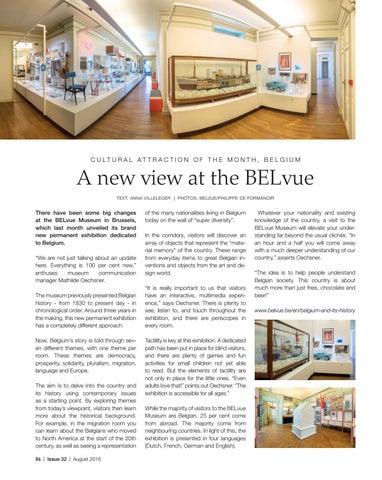
I S S U E 32 | A U G U ST 2016
SYLVIA
HOEKS T H E TO A S T O F H O L LY W O O D
P ROMOTI NG B ELGI U M,
THE
GOURMET BELGIUM & LUXEMBOURG C O N T E M P O R A R Y C R E AT I V I T Y I N T H E N E T H E R L A N D S FLANDERS ACTIVITY GUIDE PLUS: DESIGN, CULTURE AND TOURISM
NETHERLANDS
AND
LUXEMBOURG
la qualité avant tout
BRASSERIE GUILLAUME
L’ O S T E R I A
12-14 Place Guillaume II L-1648 Luxembourg
8 Place Guillaume II L-1648 Luxembourg
www.brasserieguillaume.lu Tél. : 26 20 20 20
www.losteria.lu Tél. : 27 47 81 25
Discover Benelux | Contents
Contents AUGUST 2016
38
68
COVER INTERVIEW 38 Sylvia Hoeks She is the Dutch actress taking Hollywood by storm. Our cover star Sylvia Hoeks tells us about being cast alongside Harrison Ford and Ryan Gosling in the eagerly anticipated Blade Runner sequel.
THEMES 9
Top Dutch Architecture Guide Read about these exciting architecture firms and we guarantee you will be inspired.
11
18
Gourmet Guide to Belgium & Luxembourg Feeling hungry and thirsty? From Belgian wines to Luxembourgish beers and an array of firstclass restaurants, our gourmet guide will undoubtedly whet your appetite.
16 Top Galleries & Art Exhibitions in the Netherlands 2016 Besides the world-famous works of the Dutch Masters, the Netherlands has a booming contemporary art scene. Discover the country’s best galleries here.
24 Discover Flanders: Top Things To Do & Places To Visit 2016 From beautiful nature to historic towns, Flanders has it all. Do not miss our guide to this picture-perfect holiday destination.
42
Amsterdam: The Ultimate & Unforgettable Summer Destination Our selection of the top food, drink and sleep spots in the Dutch capital’s most happening neighbourhoods, from the elegant Museum Quarter to hip East Amsterdam.
68
Maastricht & South-Limburg Special Check out our guide to South-Limburg, home to the stunning city of Maastricht and some of the most picturesque countryside in the Netherlands.
82 Belgium, Top Wellness & Beauty Guide In need of some R&R? Plan some pampering with our wellness and beauty guide.
FEATURES 22 On show at the The Hague’s Mauritshuis
museum until 4 September, Brazilian artist Vik Muniz’s fascinating Verso exhibition displays recreations of the lesser-known side of famous masterpieces. We spoke to Muniz about this highly innovative concept.
DON’T MISS 6 Fashion Picks | 8 Desirable Designs 88 Out & About | 93 Columns
24
Issue 32 | August 2016 | 3
Discover Benelux | Editor’s Note
Dear Reader,
Executive Editor Thomas Winther
Ella Put Frank van Lieshout Isa Hemphrey Juliën L’Ortye Koen Guiking Lidija Liegis Martin Pilkington Matt Antoniak Michiel Stol Sofie Couwenbergh Steve Flinders Stuart Forster Thessa Lageman Xandra Boersma
Creative Director Mads E. Petersen
Cover Photo Foto Floor
Editor Anna Villeleger
Sales & Key Account Managers Mette Tonnessen Kirsten Schoon Katia Sfihi Micha Cornelisse Veerle Barten
Discover Benelux Issue 32, August 2016 Published 08.2016 ISSN 2054-7218 Published by Scan Group Print Liquid Graphic Ltd
Assistant Editor Charlotte van Hek Copy-editor Isa Hemphrey Graphic Designer Mercedes Moulia Contributors Adam Jacot de Boinod Berthe van den Hurk Bettina Guirkinger Cathy van Klaveren Demelza Stadhouders
Publisher: Scan Group 15B Bell Yard Mews Bermondsey Street London SE1 3YT United Kingdom Phone: +44 (0)870 933 0423 Fax: +44 (0)870 933 0421 Email: info@discoverbenelux.com www.discoverbenelux.com
We are a media you can trust. The print circulation of Discover Benelux is audited by the Audit Bureau of Circulation (ABC), which is the UK body for media measurement.
© All rights reserved. Material contained in this publication may not be reproduced, in whole or in part, without prior permission of Scan Group – a trading name of Scan Magazine Ltd. This magazine contains advertorials/promotional articles.
4 | Issue 32 | August 2016
2016 certainly seems to have gained momentum with August already upon us, so I hope you will find us up to speed with this peak-summer issue. Perhaps you are taking a break in your homeland or going off on a journey of discovery somewhere new. Whatever your plans, this issue should encourage you on your way. Until 4 September there is the opportunity to travel with artist Vik Muniz on his own personal journey of discovery to The Hague, final destination The Mauritshuis’ Verso collection. Brazil is hitting the headlines this summer with its hosting of the 2016 Olympics. With Muniz’s roots in São Paulo, The Hague can now claim twinning with South America. This epic artistic trek has taken 15 years and a clue to the artist’s inspiration is to wonder ‘what’s behind a face’ when first meeting a person. Share his journey by discovering what is literally behind some of Mauritshuis’ resident masterpieces by the hand of Rembrandt and Vermeer to name but a few. Turn to page 22 to read our feature on this unique and highly original exhibition. Meanwhile, fans of the revered sci-fi movie Blade Runner will not want to miss my interview with Dutch actress Sylvia Hoeks. The Netherlands can already claim fame with the original Blade Runner, starring Rutger Hauer, and earlier this year it was revealed Hoeks will appear alongside Ryan Gosling and Harrison Ford in the eagerly anticipated sequel. We chatted about her acting roots in Europe to her new destination Hollywood (another journey!). Wherever you are travelling this summer, I wish you a safe and pleasant journey.
Anna Villeleger, Editor
Foto: Th. Bichler
DISCOVER THE NATURAL AND CULTURAL BEAUTY OF THE MULLERTHAL REGION – LUXEMBOURG’S LITTLE SWITZERLAND
Regional Tourist Office Mullerthal Region – Luxembourg’s Little Switzerland Tel.: (+352) 72 04 57, guidedtours@mullerthal.lu
www.mullerthal.lu
Discover Benelux | Design | Fashion Picks
AUGUST FASHION PICKS
Effortless chic Our selection of elegant, understated pieces will ensure your transition into the next season is effortlessly stylish. TEXT: ELLA PUT | PRESS PHOTOS
Photo: Sophie Rata
1. An air of mystery Designed in the city of diamonds, this gorgeous ring makes a great asset to any wardrobe. Jewellery designer Christa Reniers knows how to combine dark colours with mysterious designs, making her rings stand out from the crowd. €2000 - €2900 www.christareniers.com
2. Black and white Whether at a meeting or a formal dinner, Anna Heylen’s designs make you the best-dressed guest everywhere. With this exclusive limited edition top, you are the definition of effortless chic. €520 www.annaheylen.be 6 | Issue 32 | August 2016
Discover Benelux | Design | Fashion Picks
3. That’s a wrap! This luxurious woollen Aymara scarf is perfect for confronting the changing seasons ahead of us in style. €220 www.aymara.be
5. Little black dress
4. Best foot forward No more struggling in high heels. These exquisite flats by Belgian-born creator Diane von Furstenberg will take you to any destination in comfort and style. €228 www.dvf.com
It is always difficult to find a perfect dress that will get you through the last days of summer and the first days of the autumn. Luckily, Belgian fashion designer Gioia Seghers has created the perfect solution with this elegant, dark design. €410 www.gioiaseghers.com
Discover Benelux | Design | Desirable Designs
DESIRABLE DESIGNS
Dress your tech Technology has become an essential part of our lives: we spend more time behind our computers and phones than we like to admit. Why not give your appliances a makeover with these attractive accessories?
1.
TEXT: ELLA PUT | PRESS PHOTOS
2. Marble art Match your laptop with the tables in fancy restaurants and make those working hours a little bit more decadent with a touch of marble. €34 www.myinteriormusthaves.com
2.
1. Cover up Casimoda is a leading brand for technology accessories in the Benelux. There is something for everyone amid their huge variety in phone and tablet cases. Will you opt for a typical Dutch canal-side street or an old Volkswagen van? Both: €16 www.casimoda.nl
3.
3. (Lip) stick it! Fool everyone with this USB-stick disguised as a lipstick. Fun and practical, it can hold up to 8GB in space. €9 www.hema.nl
4.
5. 4. I’ve got the power! Where would we be without our chargers? No messing around with cords anymore, with this fun powercase you will have the power almost everywhere you go. €30 www.modemusthaves.nl 8 | Issue 32 | August 2016
5. The perfect selfie This fashionable phone case in rosé gold by LuMee lights up as soon as you take a picture, creating a special effect to bring the best out of your selfie. €60 www.smartphonehoesjes.nl
Discover Benelux | Design | Top Dutch Architecture Guide
Arnhem Central Station is the result of an ambitious 20-year project –planned masterfully by UNStudio – to redevelop the station area of the city. Photo: © Hufton+Crow
The Erasmus Bridge in Rotterdam, completed in 1996, will celebrate its 20th anniversary this summer. Photo: © Christian Richters
TOP DUTCH ARCHITECTURE GUIDE
Continuously innovating the architecture profession The key to world-class architecture is to collaborate and share knowledge with the best specialists in the world. That is the philosophy of the architecture practice United Network Studio, better known as UNStudio. This architecture design studio, with its roots in Amsterdam, has designed amazing tower buildings, theatres, train stations, airports and bridges in over 30 countries. It also has offices in Shanghai and Hong Kong. TEXT: KOEN GUIKING
Some well-known UNStudio designs in the Netherlands are Arnhem’s new Central Station and the Erasmus Bridge in Rotterdam. “When we designed the Erasmus Bridge, I was only 33 years old. That project has really helped us to get international recognition,” says Ben van Berkel, one of the two founders of UNStudio, who is now considered one of the top architects in the world. UNStudio is responsible for the design of almost all the metro stations that are currently being built in Doha in Qatar, it is involved in designing a major new theatre in Hong Kong and is working with a number of museums in designing their exhibition spaces. From the moment Van Berkel and co-founder Caroline Bos established
UNStudio, they had an international scope. “We both studied in London. We could have set up an office there but, because our first few clients were in the Netherlands, we started in Amsterdam,” says Van Berkel. Soon they were involved in big international projects thanks to their global network and their innovative approach to architecture. “We have always found it important to keep developing ourselves. From the start of our careers Caroline and I have been writing about architecture in journals as well as in the national newspaper De Volkskrant, and we have been teaching and doing research. We believe in sharing knowledge,” says Van Berkel, who also lectures at Harvard University and in September will publish yet another book with Bos. The book’s title says it all: Knowledge Matters.
Time invested in sharing knowledge and building networks could mean there is less time left to design, but UNStudio’s method has paid off. Van Berkel says: “To be able to compete with the top ten in the world, you need to keep innovating; in the designs you make as well as in the way you approach the profession.” www.unstudio.com
The Mercedes-Benz Museum in Stuttgart celebrates the history of the car in a twisting ‘time machine’. Photo: © Brigida Gonzalez
Issue 32 | August 2016 | 9
Discover Benelux | Design | Top Dutch Architecture Guide
Connecting people through sustainable design TEXT: KOEN GUIKING
To create a comfortable environment for people to work, study or live, Paul de Ruiter Architects designs “from the inside out”. The designs aim to make optimal use of natural daylight and natural airflow to reduce the energy consumption of buildings. Paul de Ruiter Architects has been a pioneer in sustainable design since its foundation in 1994. Only once the architects have an idea of how to shape the inside space of a building, do they start designing the exterior. That is not to say the exteriors are an afterthought; far from it. A real eye-catcher is Villa Kogelhof in Zeeland. This luxury home, in the middle of a nature area, is completely self-sustainable. “It generates more energy than it consumes. Surplus energy is used to charge an electric vehicle,” says architect Paul de Ruiter. An abundance of sunlight can enter the “floating”, glass living area. Excess warmth is collected and stored in the earth to heat the house during
colder days. But there is more to this building than meets the eye: “To respect nature, we placed the garage and storage space in an underground volume hidden underneath the pond,” De Ruiter explains. In 1992, De Ruiter started his PhD thesis about buildings that produce energy, rather than consume it. Sustainability has always been an integral part of all his work; whether he designs a school, parking garage or someone’s home. The office of FedEx/TNT that Paul de Ruiter Architects designed in 2009 is still the most sustainable office in the Netherlands. www.paulderuiter.nl
Villa Kogelhof. Photo: Jeroen Musch
TNT. Photo: Alexander van Berge
Discover Benelux | Gourmet Guide | Belgium & Luxembourg
Photo: Mamma Bianca | p. 15
Photo: © Darya Petrenko
A GOURMET GUIDE TO BELGIUM & LUXEMBOURG
Epicurean adventures await From Michelin-starred restaurants and Bib Gourmands to rustic traditional specialties, delicious beers and high-quality wines, visitors to both Belgium and Luxembourg can expect an array of gastronomical delights. TEXT: ANNA VILLELEGER
Photo: Ma Langue Sourit | p. 14
Like their French neighbours, the people of Belgium and Luxembourg enjoy the finer things in life when it comes to food and drink. Both countries boast an assorted regional platter, as well as offering the best of world cuisine, from French and Italian to Asian, thanks to their international populations. The Grand Duchy is in fact home to the largest per capita concentration of starred restaurants in the world. Read our
Photo: Giallo Caffè Ristorante | p. 13
special guide to find the perfect restaurant for your next meal in Luxembourg. Oenophiles and beer connoisseurs will already be familiar with the wines of Luxembourg’s Moselle Valley and Belgium’s world-renowned lambic beers. But in our gourmet guide you will find out about Luxembourg’s exciting new beer brand called Capital City Brewing Company and
Belgium’s blossoming wine scene. Some of the country’s leading wineries such as Château Bon Baron, Genoels-Elderen and Domaine du Chenoy are helping put Belgian wine on the map. Find out more by reading our interview with wine expert Miguel Saelens of Mig’s World Wines in Brussels. Chin-chin! Issue 32 | August 2016 | 11
Discover Benelux | Gourmet Guide | Belgium & Luxembourg
Belgium’s wine renaissance TEXT: ANNA VILLELEGER | PHOTOS: MIG’S WORLD WINES
Belgium may be best known for its beers, but did you know the country also has a blossoming wine scene? Pay a visit to Mig’s World Wines in Brussels and owner Miguel Saelens will enlighten you. “The Belgian wine scene is not actually so new,” explains Mig, a primarily selftaught oenologist who opened his hugely successful independent wine boutique back in 1995. “The story goes that when Napoleon invaded he pulled up all the country’s vineyards. He did not want any competition for French wine.” In a similar vein to countries such as England, where the climate can be “iffy”, Belgium’s wine scene has really started to take off again in recent years. Mig explains that although many Belgians may not yet know about their country’s wine scene, an increased interest in buying local is helping the industry grow. There is of course the “novelty” element, and a curiosity among visitors to his 12 | Issue 32 | August 2016
Brussels store. If you are curious, Mig’s World Wines is certainly the place to go. There are around 50 different Belgian wines available there, from the country’s leading wineries such as Château Bon Baron, Genoels-Elderen and Domaine du Chenoy. While you would be right to expect sparkling and white wines similar to those that neighbouring Luxembourg is renowned for, there are also some red wines being made in Belgium. “For many of the usual red grape varieties to work there is not enough sun. But that is not always the case. Climate wise, the Pinot Noir grape can work in Belgium. Plus, you can find lesser known names on bottles of Belgian wines as grape varieties are sometimes crossed to make them stronger and less prone to fungi in the cool climate,” explains Mig. As the name suggests, it is not just Belgian wine available at Mig’s World Wines. At Ali Baba’s cave, you will find over 700 wines from more than 35 countries as well as around 500 spirits and 60 beers. From
Canada to Lebanon, there are wines from across the globe. Mig always likes to offer the unexpected. “Of course, everyone knows Californian wines, but we have wine from New York State,” he smiles. Feeling inspired to learn more? Visit the company website to learn about its various tasting workshops. Mig’s World Wines also retails online. Mig’s World Wines Chaussée de Charleroi, 43 1060 Brussels www.migsworldwines.be
Discover Benelux | Gourmet Guide | Belgium & Luxembourg
Italian dishes in their most authentic expression TEXT: BETTINA GUIRKINGER | PHOTOS: GIALLO CAFFÈ RISTORANTE
Marrying a touch of sober elegance with fresh and high-quality cuisine for all occasions, the Giallo Caffè Ristorante is the perfect address to rediscover the most traditional Italian dishes in their most authentic expression. Located on the Rue du Curé in the heart of the Grand Duchy and borne out of a passion for good food, the Ristorante Giallo has made a name for itself due to its pleasant atmosphere and very favourably reviewed flavoursome dishes. The menu changes every ten days to ensure the freshness and seasonality of its products. Divided into three rooms by a beautiful waterfall to bring some freshness to the space, as well as a chimney for a touch of romance, everything has been put into place to make the guests feel at home: “Our interior has been entirely designed by an Italian architect who put emphasis on the cosiness yet elegance of our restaurant, relying on prestigious Italian
names for the choice of furniture,” says owner Mauro Giallombardo. Suited for all occasions, from business lunches to romantic dinners, to birthday celebrations with friends, what stays in the minds of the customers is the distinct freshness and flavour of every ingredient used. As Giallombardo explains: “We pride ourselves in having found the best Italian suppliers for the items we use in our menu. From a small butcher for our Parma ham, all the way to small vineyards for the selection on our wine list.” Everything has been carefully hand-picked to satisfy even the most demanding palates. The opening cocktails bring colour and vibrancy to start the meal and mouthwatering desserts provide a perfect end to a perfect experience of Italian cuisine in the heart of Luxembourg. Having recently participated in the Banque & Caisse d’Épargne de l’État Luxembourgeois’ Rallye Restaurants with the highest score
of reviews, the restaurant’s success speaks for itself and invites both long-term clients as well as new ones to rediscover their signature dishes. All in all, expect a gustative feast provided by a changing menu adapted to the freshest seasonal products. Enjoy their delicious menu in a modern and stylish setting for an experience to remember! www.giallo.lu
Issue 32 | August 2016 | 13
Discover Benelux | Gourmet Guide | Belgium & Luxembourg
Gastronomy to smile for! TEXT: BETTINA GUIRKINGER | PHOTOS: MA LANGUE SOURIT
With a mixture of simplicity and elegance, the team at the heart of Ma Langue Sourit aims to bring the tasty experience of food back to basics through a dynamic and ever-changing menu that will satisfy big and small cravings. In the words of chef and founder Cyril Molard: “Julie, four years old, just had the tastiest chocolate mousse and she says with delight ‘my tongue smiles!’ - this expresses exactly the feeling we want to give to our customers when they come to our restaurant.” With sober, yet elegant, decor designed to relax and present the meals in a fashionable ‘artde-la-table’, guests will find themselves spoilt by gastronomy that pleasantly and playfully triggers the senses. First, visually, with a selection of the best products and secondly with an explosion of flavours. Giving a special importance to cooking with the best and freshest products, every item on the menu will be adapted to the 14 | Issue 32 | August 2016
seasons. “The current star of the summer carte is a ‘tartelette du jardin’ made with a mousseline of green celery, cucumber, meringue with anis, fennel jam, spinet sorbet and a sugar-free aneth-based whipped cream,” says Molard. Nothing short of a firework of tastes to please a wide spectrum of palettes. Guests will find a diverse and creative menu in all seasons to discover the newest dishes put together by the talented Ma Langue Sourit Chef.
said that the mission of this restaurant has been accomplished. With a great address for a hearty meal in the heart of Luxembourg, it is the perfect excuse to make your tongue smile. www.mls.lu
The goal of Molard and his team is to provide the customer with cuisine that is easy to understand, yet innovative and full of flavour, evolving with the seasons and based on a philosophy of gourmandise. As he explains: “The creation of this restaurant was the beginning of an adventure I really wanted, to build something out of passion, something that was going to be hard yet extremely rewarding.” Based on the highly positive reviews of both the food and service, it can be
Chef and founder Cyril Molard
Discover Benelux | Gourmet Guide | Belgium & Luxembourg
Raise a glass to the Grand Duchy TEXT: ANNA VILLELEGER | PHOTOS: CCBC
Who said beer could not be educational as well as delicious? New Zealander Mark Hatherly, founder of Luxembourg’s Capital City Brewing Company (CCBC), is telling the story of his adopted country one beer at a time. When Hatherly, a former banker, moved to Luxembourg for work, he thought he would only stay a couple of years. That was in 2002. “My story is a very familiar one. People often come to Luxembourg for their job and end up staying. It is a very, very nice place to live,” he smiles. With fond childhood memories of observing his father Frank’s home-brewing experiments, Hatherly quit working at the bank in 2014 and set up CCBC: “It was time to move on. I told myself, ‘you only have one life’.” He has not looked back. CCBC’s first commercial release in May 2015 was Red Bridge Amber Ale. Hatherly spent a year developing the recipe in his own home, with his first batch of 2,000 litres selling out in
eight weeks. The ale went on to scoop a bronze medal at the London International Beer Challenge in July last year. The ale is named after Luxembourg City’s iconic red road bridge, while CCBC’s Black Jack Porter is named after the General who led US troops into Luxembourg City in November 1918. The company’s Satellite I.P.A., the first India Pale Ale to be commercially brewed in Luxembourg, gets its name from the country’s world-leading satellite industry. “I want to tell
Traditional Italian tastes Since its opening in September 2013, the award-winning restaurant Mamma Bianca and its take-away shop has brought the flavours of Italy to Kirchberg, Luxembourg City’s bustling neighbourhood. “Our emphasis is on traditional Italian food,” explains restaurateur Renato Favaro. The specialties of the house include shellfish ravioli with tomato and basil and sliced Black Angus steak in a stew with rocket and parmesan. Those with a sweet tooth can indulge in classic Italian desserts such as tiramisu and panna cotta in coulis. The restaurant was awarded a Michelin Bib Gourmand in 2015 in recognition of its finequality food at an affordable price. Diners can enjoy a special three-course Bib menu for just 37 euros. Large groups are welcome, whether for a business function or a private celebration. Mamma Bianca can host 100 people for a sit-down meal or up to 250 standing. “Our
this gem of a country’s story one beer at a time,” concludes Hatherly. We will drink to that! CCBC beers are available at supermarkets and bars in and around Luxembourg City. www.ccbc.lu
TEXT: ANNA VILLELEGER | PHOTOS: MAMMA BIANCA
menus can be adapted to suit all requests,” adds Favaro. Attracting both locals and international diners, the friendly staff at Mamma Bianca speak French, Italian, Russian and English. The restaurant is a popular venue for business lunches and dinners, while the stylish and intimate bar makes a great spot for an after-work aperitif. Diners who are coming by car can benefit from free parking at night in the Ellipse building underground car park, with direct access to Mamma Bianca. In addition to the restaurant, due to the high demand for take-away in Kirchberg, Mamma
Bianca has a boutique offering a variety of sandwiches, pastas and salads. “You can also eat inside the shop, or on the sunny terrace, weather permitting,” smiles Favaro. www.mammabianca.lu
Mamma Bianca Ristorante 33 avenue JF Kennedy L-1855 Luxembourg Tel. +352.27.04.54 reservation@mammabianca.lu Open Monday to Friday for lunch and dinner
Issue 32 | August 2016 | 15
Stedelijk Museum, Amsterdam Photo: Gert-Jan van Rooij
TOP GALLERIES & ART EXHIBITIONS IN THE NETHERLANDS 2016
Contemporary creativity in the Netherlands The Netherlands boasts the largest number of museums per square kilometre in the world. Besides the world-famous works of the Dutch Masters, the country has a booming contemporary art scene, hosting major art festivals and exhibitions every year. TEXT: CHARLOTTE VAN HEK | PHOTOS: NBTC Wouter van Riessen. Self-portrait as a clown, 2000, 190 x 145 cm.
Dutch Design Week. Photo: Bo van Veen
Discover Benelux | Top Galleries & Art Exhibitions 2016 | The Netherlands
Stedelijk Museum, Amsterdam Photo: Gert-Jan van Rooij
It is no news that the Dutch have produced some masterpieces over the last few centuries. But history is about to be made in the contemporary art scene as well. The Netherlands is home to one of Europe’s largest developing contemporary art markets, with many emerging artists contributing to an extensive art scene. In addition to the Netherlands’ prestigious centres of contemporary art, such as the Stedelijk Museum in Amsterdam or the Van Abbemuseum in Eindhoven, smaller independent galleries have become a meeting point for artists and collectors.
New masters From the post-war generation of Dutch abstract painters to current social documentary photographers, the Netherlands has spawned an impressive collection of modern and contemporary artists. The Cobra museum in Amstelveen is completely dedicated to the CoBrA move-
Van Abbemuseum, Eindhoven Photo: NBTC
ment, a group of post-war avant-garde artists from Copenhagen, Brussels, and Amsterdam founded by the famous Karel Appel. Dutch photographer Rineke Dijkstra has made a name for herself through her confronting portrait series of teenagers and young adults and has exhibited at the Guggenheim Museum in New York and Holland’s own museum De Hallen in Haarlem. Marlene Dumas, widely regarded as one of the most influential contemporary painters, combines socio-political themes with personal experience to create a unique perspective on relevant issues facing our society. Are you an equal fan of ancient art? Museum Het Valkhof in Nijmegen combines a beautiful collection of Roman works of art with a selection of contemporary art. For our special, we have selected some exciting contemporary art galleries spread out over the Netherlands so you can get inspired everywhere. Marlene Dumas. Snow White and the Broken Arm, 1988, 1.4 × 3 m.
MUST-SEE EXHIBITIONS IN THE NETHERLANDS Rijksmuseum Amsterdam: Reinjan Mulder: Objective Netherlands - photo exhibition breaking down the traditional subjective choices for capturing, generating a true image of the essence of the Netherlands. Until 25 September. Fries Museum Leeuwarden: Claudy Jongstra: Ancient Light – exhibition on Dutch artist Claudy Jongstra, providing insights into her inspirations and motivations and her intuitive and sustainable creative process. Also includes new work. Until 8 January 2017. Affordable Art Fair Amsterdam - this leading global showcase for affordable contemporary art, returns to Amsterdam for its 11th edition. 27 – 30 October Moco Museum Amsterdam: Bansky: Laugh Now – contains around 50 original works by street art legend Banksy. Until 30 October De Hallen Haarlem: Wanderlust - focuses on travel as a source of inspiration for artists, including leading Dutch contemporary artists. Until 11 September. Dutch Design Week Eindhoven - one of the biggest design events in the Netherlands. Takes place around the last week of October and consists of nine days with exhibitions, workshops, seminars and parties at many venues. 22 – 30 October Stedelijk Museum Amsterdam: Dream Out Loud - it has long been a tradition for this museum to host a bi-annual exhibition highlighting current developments within a particular art discipline. In 2016 the exhibition will focus on contemporary design. 26 Aug – 1 Jan 2017
Issue 32 | August 2016 | 17
Discover Benelux | Top Galleries & Art Exhibitions 2016 | The Netherlands
Exclusive art that cheers you up TEXT: KOEN GUIKING | PHOTOS: MAUREEN KNOBBEN GALLERY
The figures on Maureen Knobben’s colourful paintings look at you with big, shiny eyes on their enormous, quirky heads. This art is made to cheer people up. Imagine walking into a gallery full of such pleasantly positive, vibrant pieces of art. That would make anyone happy. Fortunately, there is such a place: the Maureen Knobben Gallery in the Dutch city of Ootmarsum.
the characters in her new CoBrA-style paintings big eyes, using lots of silver pigment, “because the eyes reflect how someone truly feels”. The same pigment is used to connect the canvas figures with one another. “Only a few things in life are really important: loving each other, having a real connection with each another, and enjoying good times together. These are themes you will find in all my work.”
Knobben started painting joyful characters when she was rehabilitating from a very serious car accident. “I was so happy to still be alive; I just wanted to celebrate that,” she reminisces. Before the crash she had worked in advertising, but when it became apparent that she would not be able to get back to her old level she decided to take up her lifelong passion: painting. She started giving all
Knobben also makes beautiful objects in the same new CoBrA style. The gallery in Ootmarsum is now an astonishing showroom with beautiful paintings, lithographs, glass objects and sculptures. The artist even designs and produces her own design furniture. Most of the art found in the historic building on the Ootmarsum’s market square is made and designed by Maureen Knobben herself.
18 | Issue 32 | August 2016
Knobben’s colourful, positive work is now well known in the Netherlands and can be found in various exclusive restaurants and hotels throughout the country. Her work is even printed on wine labels. “My art stands for positive living,” she explains of her choice to design wine labels and to collaborate with some of the nation’s best hotels and restaurants. That is not to say that Knobben’s art is only attainable for the rich and famous. There are various objects for sale in different price ranges. But it is also possible to go very exclusive and have a Knobben painting custommade. For the best impression of Maureen Knobben’s art, one should definitely visit her gallery. Want to instantly get a boost of magical Maureen happiness? Visit www.maureenknobben.com
Discover Benelux | Top Galleries & Art Exhibitions 2016 | The Netherlands
With flying colours TEXT: CHARLOTTE VAN HEK | PHOTOS: GALLERY MARTEN RANDA
A green thumb, out of the blue, a grey area – colours are unmistakably embedded in our world and cultures. Just like emotions, we experience them every day. Painter and gallery proprietor Marten Randa connects both in his work. “My experiences and memories are not shaped in words, photos or numbers, but in colours.”
process of “catching emotions” – the translation of emotions into colours. “Call it an abnormality, but my experiences in this world are best expressed through colours. If I show you a diary I kept for 365 days it is full with colourful drawings, not words. When looking at a certain page, I can still connect those drawings with my emotions on that day.”
with my paintings generally comes across perfectly accurately.”
Located in a 107-year-old mansion, Gallery Marten Randa shows contemporary artists in combination with a solid collection of his own work. The house connects several spaces, all of them adaptable to suit each exhibition or piece best. “Our gallery is not a sterile space, but an actual home - the place where art lives on. This way people can see how a piece of art actually fits into their home,” Randa explains. Behind the gallery an “imagined city garden” arises, filled with bronze statues and a spot where nature and art are in perfect balance.
“I always look for someone’s sensitivity, for emotions that I myself feel too. Emotions like amazement, enjoyment, the feeling of being connected to someone: my paintings show them as colours.” With his paintings, Randa shows the beauty arising from everyday energy, present with everyone at any time. “Translating emotions does not mean every emotion has one solid colour - one day happiness is expressed by green strokes, on another canvas by yellow dots. It is about harmony.” The colour purple is a favourite. “Purple has two different sides. It can be conceived as mysterious, even cold, or rather as a warm and romantic colour. The perception of colour is very personal, although what I want to convey
www.galeriemartenranda.nl
The wide variety of colours immediately strike you when gazing at Randa’s own paintings, resulting from his extraordinary
Music is an important part of the process. “I love to listen to opera from Maria Callas when I am painting: theatrical yet modest. Her songs are great themes to my paintings. But Tina Turner also works like a charm.”
Colours of the nature by Marten Randa (90cm x 90cm x 5cm)
Issue 32 | August 2016 | 19
Discover Benelux | Top Galleries & Art Exhibitions 2016 | The Netherlands
Joyful paintings of voluptuous ladies TEXT: KOEN GUIKING | PHOTOS: FINE FLEUR ART GALLERY
Gerdine Duijsens’ paintings of overweight, upper-class women sipping on wine are being sold in art galleries around the globe. Ironically, they are particularly popular with the high society of whom the artist actually mocks. Duijsens is also featured at the international art fair Art Nocturne Knocke, from 6 to 15 August in Belgium’s coastal city of Knokke.
vasses,” remembers Duijsens. “Sadly, copycats are now copying my art. But if you put their work next to mine you definitely see the difference.” Nowadays, Duijsens has her own gallery, Fine Fleur, in Oud-Zuilen near Utrecht, from where she sells her paintings to big galleries all over the world and in posh places like Beverly
Hills, Cannes and Cambridge. Besides her “fat ladies”, of which she has also made limited edition sculptures, lithographs, books and more, Duijsens’ paintings of running horses and abstract art are also very popular with art lovers. www.finefleurwebshop.com A selection of artworks by Gerdine Duijsens
“It is true that my art subtly criticises the emptiness of the vainglorious lifestyle of those indulging in luxurious dinner parties, but at the same time my paintings show that these luscious ladies are having a rather good time,” says Duijsens. “And in a way it is self-mockery, because I have to admit that I sometimes also find myself at these kinds of parties.” Her images of big ladies in gala dresses and red lipstick, always depicted at a rather unflattering angle, were first sold in the luxurious department store de Bijenkorf. “People were literally queuing to get their hands on one of my can-
A ‘museum’ that sells its masterpieces TEXT: KOEN GUIKING | PHOTOS: LIES VOGELZANG FOTOGRAFIE
A ‘musery’, a mix between a museum and a gallery, is what Sigrid Rhemrev calls Gallery De Ruimte. The art in this ‘musery’ is for sale and, once an exhibition is over, many of the masterpieces make their way into people’s homes. Art from previous exhibitors is sold in the gallery’s shop Het Kabinet. Almost all the artists exhibiting their work in this former post office in Geldrop, near Eindhoven,
are from the two most southern provinces of the Netherlands: Brabant and Limburg. Most of them have years and years of experience, which explains the impressive quality of the art in De Ruimte. The current exhibition, on show until 11 September, is a great mix of beautiful stone, bronze and stainless steel figures, photographs, elegant installations of steel wire, surrealistic paintings and fascinating, hypnotising pen drawings. “The work of six artists is mixed throughout the building. We
don’t give every artist his own space, but we place all pieces in such a way that it becomes one big, new art piece,” Rhemrev explains. De Ruimte promotes art in the broadest sense of the word. “We show visual art, but we also organise music performances, arrange fashion shows, invite art historians to give lectures, provide workshops and so on. Our aim is to connect art and people. Art needs to be seen and experienced.” Visit Gallery De Ruimte at Molenstraat 2 in Geldrop. Free entrance and parking. Open on Friday, Saturday and Sunday from 2pm to 5pm, or by appointment. www.deruimtekunst.nl www.facebook.com/ deruimtekunst
Left: Sigrid Rhemrev
20 | Issue 32 | August 2016
Bianca Filius Untitled, 2015
The first steps of young, professional artists TEXT: KOEN GUIKING | PHOTOS: GALERIE POULOEUFF
Galerie Pouloeuff assists young artists, mostly recent graduates from Dutch art academies, in their first steps to becoming professional artists. “One day, they might be the big names in visual arts. But when they are at Galerie Pouloeuff their work is still affordable,” says the gallery’s artistic director Ine van der Horn. Until 4 September, Galerie Pouloeuff – based in the beautiful fortified town Naarden-Vesting, not far from Amsterdam Castle Muiderslot – exhibits ceramic sculptures, photographs, charcoal drawings and artistic furniture made by four recent graduates from various art academies. “It is wonderful to see the starting phase of young, talented artists,” says Van der Horn. July was a busy and fruitful month for her, as she visited the graduation exhibitions at almost all the arts and design academies in the Netherlands. “I have lots of new names on my list of artists that I will follow in the months to come. If I like how they are developing, I will approach them for an exhibition at Galerie Pouloeuff,” she says.
Pouloeuff scouts talent and brings them into contact with big galleries, museums and collectors. “We don’t keep artists to ourselves. We use our network to get their career started,” the artistic director explains. “There are lots of great artists out there. If you want to stand out from the rest, you need to be able to explain the essence of your work to art lovers and you need to involve your network.” Hence, at the opening of a new exhibition in Galerie Pouloeuff, the artists have to give a presentation about their work. They are encouraged to mobilise their network to vote for them in the online Pouloeuff Audience Award competition.
Design Academy in Eindhoven and the Film Academy in Amsterdam. Galerie Pouloeuff is open throughout summer on Friday, Saturday and Sunday. The entrance is free. www.galeriepouloeuff.nl www.keepaneye.nl
Keep an Eye Foundation Pouloeuff is a not-for-profit gallery, founded by a group of individuals that are passionate about arts and culture. They established the Keep an Eye Foundation in 2008 to support the cultural sector. Besides Galerie Pouloeuff, founded in 2010, it also funds many other initiatives, such as jazz events at the Amsterdam Conservatory and fashion shows at the Arts Academy in The Hague. It also gives awards to talented students from the
Jurre Blom, Untitled, 2016
Issue 32 | August 2016 | 21
Discover Benelux | Art Feature | Mauritshuis Exhibition
Left: It has been two years since the reopening of the Mauritshuis in the The Hague. Photo: © Ivo Hoekstra/Mauritshuis, The Hague. Top right: Emilie Gordenker, Director Mauritshuis. Photo: Frank van der Burg/Mauritshuis, The Hague. Below right: Brazilian artist Vik Muniz displays recreations of the more ‘intimate’ sides of masterpieces in his Verso collection. Photo: Ivo Hoekstra
What lies behind: A rediscovery of Dutch icons TEXT: ISA HEMPHREY
In 2005, Leonardo da Vinci’s Mona Lisa was given a new home in the Salle des Etats room of the Louvre. The four-year-long, four-million-pound refurbishment saw the painting hung behind unbreakable glass that protects it from changes in temperature, camera flashes and general damage. Viewers cannot get up close to the painting as it is cordoned off, under constant surveillance and only comes down once a year for maintenance. What the back of the painting looks like, or indeed that of any heavily guarded masterpiece, may not cross the mind of many. Yet the latest additions to Vik Muniz’s Verso collection, currently on show at the Mauritshuis in The Hague, allows viewers to peek at what he believes is their most intimate side.
renowned Brazilian artist Vik Muniz. “One of the things we've been doing with our exhibition programme is looking for ways to rediscover our permanent collection,” she says. “And people who can enter into an intelligent dialogue with our collection and the history of our building.” Known for his powerful imagery using everyday materials, the artist from São Paulo likes to challenge his audience. The 2010 documentary Waste Land depicted his journey to the world’s largest landfill in Brazil and showed the transformative power of art using materials we consider useless. Verso is yet another one of Muniz’s extraordinary collaborations. “It's a departure from my work, but my process is to reveal the process behind images, to make images more than what they seem to be,” he says.
For the Mauritshuis’ first contemporary exhibition, the museum’s director Emilie Gordenker chose internationally
The Verso collection, which is 15 years in the making, displays recreations of the backs of masterpieces. At the beginning,
22 | Issue 32 | August 2016
when Muniz first saw the back of Woman Ironing by Picasso, he describes it like “when you're with somebody that you know very well and that person's naked”. What started as photographs became an almost Herculean trial in modelmaking, with Muniz and his team reconstructing every texture, dimension, stamp, label, handwriting, bracket, scratch and dent of the backs of the most famous paintings in the world. This, the artist hopes, gives these recognisable icons a new layer of mystery. “It's like a game for children,” says Muniz. “Most people know these works already, they don't need an image to be guided by it, but to create this connection between the back and the front is quite interesting.” The Mauritshuis’ exhibition displays the back of The Anatomy Lesson of Dr Nicolaes Tulp by Rembrandt, The Goldfinch by Carel Fabritius, View of Delft and Girl with a Pearl Earring by Johannes
Discover Benelux | Art Feature | Mauritshuis Exhibition
Vermeer, and View of Itamaracà Island in Brazil by Frans Post. As all of the original paintings are part of the Mauritshuis’ permanent collection, visitors can see both sides of the pieces. Yet they may initially find themselves muddled when entering the exhibition. “When they come into the room they feel that they are in the wrong place!” says Muniz. But the museum director insists that this adds to the experience of the work: “We hope that the exhibition will come as a surprise and be a little bit of a shock to people,” she says. “When you come in, all you're going to see is the backs of paintings. Because they're all paintings that many are familiar with, we hope that they will try to figure it out.” But visitors will not be left entirely in the dark as there will be a free app to guide you through. The exhibition goes to great lengths to show the level of expertise that went into creating this collection through a multimedia tour and displaying proofs and test samples. Not merely a case of building an old-looking frame, these works emphasise the life journey of a masterpiece, which has often prompted the artist to go on a worldwide treasure hunt. Gordenker explains: “For example, The Anatomy Lesson was relined in the 19th century and the painting was given a new linen back. This fabric is no longer available anywhere and in fact modern
looms can't even make this kind of fabric, so Vik and his team had to find someone in upstate New York who has old looms and she wove the exact same fabric. What you see now in the exhibition is so close to the actual painting that you can't even tell the difference.”
considered,” says Muniz, explaining how the perception of these masterpieces changes when you see the back of them. “You're not looking at a symbol anymore, you're looking at an object, an object that needs caring, an object that needs maintenance.”
In the early days of the collection, it was not easy convincing major galleries to show Muniz and his team the back of their most prized paintings. “These galleries are rightfully suspicious of a contemporary artist getting close to a master work,” says Muniz. Yet so accurate is the Verso collection, galleries have asked to see his work in order to assess how to handle the original pieces on their walls. In fact, after recreating the back of the Mona Lisa and placing it next to the real thing, Muniz states that not everyone could tell the real one from his. It is the obsessive perfection of the work and Muniz’s extensive collaboration with the Mauritshuis team that highlight the work done behind the scenes at a gallery. For the more welltravelled pieces of art, each gallery makes its own mark on the back of the piece, which Gordenker describes as a kind of “geology”.
After exploring some of the best art the Dutch have to offer, Muniz is looking to expand the Verso collection with The Kiss by Gustav Klimt and The Scream by Edvard Munch. Additionally, Muniz would love the opportunity to work with a Caravaggio piece or Diego Velázquez’s mysterious Las Meninas. Despite what the future holds for Verso and the new treasure hunts that await him, Muniz can now enjoy being part of the Mauritshuis’ milestone exhibition displaying its first collection from a living artist. “I’m going to be bragging about this for a long time.”
Muniz considers the collection to be a joint effort that could not be done without the help of conservators and technicians. “What these people do deserves to be
Vik Muniz: Verso will be on display at the Mauritshuis in The Hague until 4 September. www.mauritshuis.nl
Left: Johannes Vermeer, View of Delft, c. 1660-1661, Mauritshuis, The Hague. Bottom left: Vik Muniz, Verso (View of Delft), 2016, mixed media, 125 x 144 cm. Middle: Carel Fabritius, The Goldfinch, 1654, Mauritshuis, The Hague. Right: Vik Muniz, Verso (The Goldfinch), 2016, mixed media, 84 x 70 cm
Issue 32 | August 2016 | 23
Discover Benelux | Top Things to Do & Places to Visit | Flanders
Panne. Photo: Westtoer
Photo: Westtoer
DISCOVER FLANDERS: TOP THINGS TO DO & PLACES TO VISIT 2016
Fascinating Flanders Spread out over five unique provinces, Flanders combines wonderful picture postcard cities with beautiful nature and historic towns. Cycling, water and château fans unite: Flanders’ sandy beaches, robust forests and undiscovered villages await. TEXT: CHARLOTTE VAN HEK | PHOTOS: VISIT FLANDERS
Bruges. Photo: Kris Jacobs
24 | Issue 32 | August 2016
Discover Benelux | Top Things to Do & Places to Visit | Flanders
Photo: Patrick Verhoest
Photo: P. Clémént
West-Flanders: holidays with history With a 42-kilometre-long stretch of golden sands, scenic towns and countable Michelin-star restaurants, the Flemish coast in West Flanders is the ideal summer destination. The beach towns of De Haan, Knokke, Oostende, and Blankenberge all have their own character and unique atmosphere. Had enough of sand and sun? Definitely travel to the province’s south-west. Named after one of the most memorable war poems ever written, Flanders Fields was a major battle ground in the First
Photo: Westtoer
World War and witnessed the wounding and killing of more than a million soldiers. The towns of Ypres and Passchendaele are still worldwide symbols for the senselessness of the war.
East Flanders: a cyclist’s love An absolute treasure for cyclists, the province of East Flanders is known for its many rivers, wooded hilltops, and of course the Tour of Flanders. Rivers like the Durme, the Dender and the Schelde have a prominent place in the panoramic views of the region. Ideal for a holiday are the hilly Flemish Ardennes, a dream
for climbers and hikers. Do not forget to take a walking tour through Meetjesland, a historic region home to the grand nature reserve Canisvliet.
Antwerp: wonderful waters The province of Antwerp features Scheldeland: with over 275 kilometres of waterways and countable lakes, it is the most water-rich region in Flanders. Take a boat trip on the Schelde or Rupel and sail past picturesque villages and green shores, or make a trip to the moorlands of the Kempen. This nature region is becoming a popular destination for Issue 32 | August 2016 | 25
Discover Benelux | Top Things to Do & Places to Visit | Flanders
Photo: Alexandre Laurent
BEER IN THE CITY Cannot stay away from Flemish cities? We do not blame you. The capitals of the Flemish provinces are among Europe’s most beautiful historic cities. We can tell you where to go and what to drink. Antwerp: The city of diamonds and fashion and De Koninck beer. Served in the typical ‘bolleke’ glass, this amber-coloured ale is Antwerp’s flagship beer. Leuven: The capital of Flemish Brabant is the mecca of books and beer. Of course you will order a worldwide Stella Artois, which is brewed in the city. Bruges: A fairy-like medieval town. Home to the unique Duvelorium Grand Beer Café on the central market square: naturally the best place to enjoy a Duvel. Hasselt: Limburg’s capital has no lack of good beers, but is really famous for its Jenever, the juniper-flavoured beer from which gin evolved. Ghent: Europe’s best kept secret and known for the ‘Gentse Gruut’, a medieval beer with fruit, herbs and spices replacing hops.
26 | Issue 32 | August 2016
tourists to enjoy the countable bed and breakfasts and the extensive cycle touring network.
Photo: www.milo-profi.com
Flemish Brabant: cardinal castles Bordering Wallonia in the south, it is no surprise that Flemish Brabant hosts some of the most exquisite castles in Belgium. Many majestic chateaus can be found in the Green Belt: a region of scenic forests and charming villages embracing cosmopolitan Brussels. The Zenne Valley and Pajottenland are not to be missed: they are the only regions in the world where the famous lambic beer is produced.
Limburg: home of the Maas This is the land of the Maas river and the only national park in Flanders. The Hoge Kempen National park has 5,700 hectares of pure nature and with its coniferous forests and heath landscapes it is ideal for hikers, cyclists and riders. Along the river you will find a long string of charming villages, each with its own history.
Photo: Westtoer
Discover Benelux | Top Things to Do & Places to Visit | Flanders
In Flanders Fields Museum, Ypres Photo: www.milo-profi.com
Ghent Photo: www.milo-profi.com
Issue 32 | August 2016 | 27
Discover Benelux | Top Things to Do & Places to Visit | Flanders
Ambiorix. Photo: © Henri Savenay
Basilica. Photo: © Jeroen Broux
Antiques Market. Photo: © Jeroen Broux
Largest antiques market in the Benelux TEXT: KOEN GUIKING
Most towns in Belgium can be a bit sleepy on Sundays, but not Tongeren. In fact, Sunday is probably the best day to visit Belgium’s oldest city. This is when the famous antiques market takes place. It is the largest antiques and vintage market in the Benelux, with over 350 stalls and 40 antique shops. Many international tourists go treasure hunting in Tongeren. “The antiques market draws by far the most international visitors to Tongeren,” says Marc Hoogmartens, alderman of tourism in Tongeren. “As we are very close to the Dutch and German border, we get many visitors from the Netherlands and Germany, but the antiques market is also very popular with 28 | Issue 32 | August 2016
British, American and Asian tourists.” The large clientele – a thousand every week, all year round – also attracts professional antiques traders from afar that come to sell their high-quality goods in Tongeren.
40-year-old antiques market Hoogmartens says: “What started exactly 40 years ago, in August 1976, with seven local residents organising a flea market, has evolved into the biggest antiques market in the Benelux.” This has resulted in a large number of antique shops opening its doors in Tongeren. There are 40 of them now, but only on Sundays is the city centre turned into one big – partially covered – market where one can rummage through unique crystal glasses,
silverware and pottery, vinyl records, mannequins, vintage toys, old postcards, old-fashioned furniture, rare collector's items and so on. Tongeren’s antiques market starts very early: at 7am. This is when you will see the experienced marketers in action, scanning the stalls for hidden treasures. They know that they have to be quick to get their hands on special pieces, before someone else scoops them. The market only runs till 1pm, so make sure you get there on time.
Time travel through Tongeren The goods on the market are likely to bring back childhood memories, or
Discover Benelux | Top Things to Do & Places to Visit | Flanders
recollections of your grandparents’ home decor. But in Tongeren one can travel much further back in time. Tongeren was the first city ever established in Belgium. Its most heroic moment in history was without a doubt its win over the Roman army in 54 B.C., prompting Julius Caesar to describe the Belgians as “the bravest of all the Gauls”, before he sent in more troops to defeat – and virtually wipe out – the local Eburones tribe that had embarrassed the mighty Roman Empire. The current-day population of Tongeren is still proud of its Eburones heritage. “The King of the Eburones, Ambiorix, is our local hero. There is a statue of him on the market square, in front of the basilica,” tells Hoogmartens. On 4 September the city will celebrate the 150th anniversary of this statue.
Roman city Under Roman rule, ‘Atuatuca Tungrorum’ developed into an important, strategically located city on the road between Cologne
and Paris. Remnants of this era can still be admired in Tongeren today, such as the remains of an earthen aqueduct, defensive walls and tumuli (Gallo-Roman tombs) as well as a partly rebuilt Roman temple. Definitely worth a visit is the GalloRoman Museum, which is dedicated to the prehistoric times and the Roman age of the region. It was voted European Museum of the Year in 2011 and Best Museum of Flanders in 2014.
Still in a strategic location Impressive architectural highlights in Tongeren are the Begijnhof – a UNESCO World Heritage Site – and the Gothic Basilica of Our Lady, which contains a museum with a vast collection of unique and valuable religious artefacts. Not too keen on all the history? “Tongeren hasn’t stood still in time. There are lots of trendy shops, hip boutiques, good restaurants and cosy bars that serve genuine Belgian beers,” Hoogmartens says. “And it’s just 20 kilometres to Liège and Maastricht,
which makes it the perfect base to explore the area.”
Events this summer Special events take place in Tongeren about once a month. In the first weekend of May, for instance, there was an Italian day, in June Tongeren hosted the culinary event Büfkes Pruuve and in December the city becomes the ‘Home of Father Christmas’. This summer, there are also some events worth mentioning. On 6-7 August there is the beer festival Ambierorix, with brewers from all over Belgium showcasing their best craft beers, and on 2 September the city reveals its newest addition to their art route. “Every two years Tongeren buys a piece of contemporary art. This is part of the art project ‘De Negende Maand’ (‘The Ninth Month’),” says Hoogmartens. On 4 September, Tongeren celebrates that Ambiorix’s statue has been on the Grote Markt for 150 years. www.tongeren.be
Antiques Market. Photo: © Jeroen Broux Beguinage. Photo: © Henri Savenay Tongeren - Ambiorix basiliek. Photo: © Henri Savenay
Teseum. Photo: © Stefan Matthijssens
Issue 32 | August 2016 | 29
Discover Benelux | Top Things to Do & Places to Visit | Flanders
The hidden gem of Flanders TEXT: MICHIEL STOL | PHOTOS: TOERISME AALST
People often speak about Antwerp, Brussels or Ghent when they think of Flanders. But right in between these three cities is a beautiful, somewhat hidden gem to be found. It is charming, has great historical sights and is famous for its Carnival. That gem is called Aalst. With its unique positioning between the three big cities, Aalst is the perfect place for those who want to experience that same vibrant atmosphere of shops, bars and restaurants and culture in cities like Ghent and Antwerp, but in a smaller setting. “People who come here for the first time are really surprised by how lively Aalst is,” says Sandy Osselaer, team leader for tourism in the city of Aalst. “We have a lot to offer tourists and we welcome them with open arms. That is why, for instance, our office is in the centre of the city and is made of glass, so you can truly experience our city and our openness.” 30 | Issue 32 | August 2016
That experience exists, amongst others, in a 360-degree video of Aalst shown in a cylinder-shaped theatre. The movie works up to Aalst’s annual highlight; the famous Carnival, which has been designated a cultural heritage by UNESCO. Osselaer: “The video really marvels people. It shows our city and at the end you feel as if you are in the middle of the Carnival. With over 4,000 participants in the parade and over 100,000 spectators, the Carnival is truly fantastic.” Even though the parade, with hundreds of home built floats, is at the beginning of the year, Aalst honours the craftsmen that work on the floats throughout the year and throughout the city. “In the city museum, part of the exhibition is dedicated to the Carnival.”
History The historic centre of Aalst is built in a star-shaped manner, so almost every street connects to the Grote Markt, or Main Square. “The centre is free of
traffic, so you can really gallivant in the street’s window shopping, or enjoy one of the many but fine terraces at the restaurants,” tells Osselaer. When you end up at the Grote Markt, you will find the belfry of Aalst. “The belfry is one of the oldest preserved in the world. It was built in the 1200s. Truly a spectacular building to see.” In front of the belfry you will find a statue of one Aalst’s famous citizens, Dirk Martens. Martens was the first letterpress artist of the Netherlands. He printed and published work of Erasmus and this year it will be 500 years since he printed Thomas More’s Utopia. Another beautiful and historic building in the centre of town is the Sint Martinuskerk (Saint Martin Church). The construction of this immense building of worship began in the late 15th century. After 180 years, due to financial reasons, building was
Discover Benelux | Top Things to Do & Places to Visit | Flanders
halted. The Saint Martin Church is the burial site of Dirk Martens. In the church is a copper meridian, which was used in the 19th century as the standard Belgian time in order to introduce the timetables of the Belgian railroads in 1832. The church is also home to an original work by painter Peter Paul Rubens. “His work, Saint Roche as Intercessor for victims of the Plague is embedded in an altar in the church. An impressive sight. In 2017 this piece will be part of nationwide celebration of the Flemish Masters.”
Nature Aalst not only offers beautiful streets and buildings, but is also surrounded by magnificent nature. “At walking distance you will find the city park. This green lung is perfect to stroll through,” explains Osselaer. “Right outside of Aalst you can ride along the Dender River. Perfect to explore by bicycle.” Aalst has a loving connection with cycling. The last Belgian to win the Tour de France, Lucien van Impe, is from this region. “This year it is exactly 40 years ago that Van Impe won the race. To honour him and his performance, we have created a route, which brings you to the house of Van Impe, the training trail he practised on before winning the Tour de France and to the café, which is also a museum that Van Impe’s brother runs. Along the route we have placed QR codes you can scan: they will show you his victory and the celebrations of that victory here in Belgium. There is no better way to get to know this legend than to hire a bike and ride along his trail.” Aalst is a warm city, which marvels and at the same time charms you. Osselaer: “Aalst gives you that warm, cosy feeling of a smaller city, but with the same vivacity as the surrounding major cities. A hidden gem you will want to discover!”
Toerisme Aalst Hopmarkt 51 +32 53 72 38 80 www.aalst.be/toerisme Issue 32 | August 2016 | 31
Discover Benelux | Top Things to Do & Places to Visit | Flanders
Photo: © Kempens Landschap vzw
Photo: © Dirk Broeckx
Photo: © Kempens Landschap vzw
Photo: © James Van Leuven
Top left: Open space in Merksplas colony. Top right: Pauper chapel in Merksplas colony. Bottom left: Pauper farm in Wortel colony. Bottom right: Sheep grazing in Wortel colony
Colonies of benevolence TEXT: FRANK VAN LIESHOUT
For centuries, Wortel and Merksplas were agricultural colonies farmed by Belgium's poor. Now, these unique landscapes are nominated for UNESCO's World Heritage list. “Imagine changing one of the world’s most endangered monuments into one of the world’s most valuable heritage sites within the space of a generation,” says Kempens Landschap managing director Philippe De Backer. For almost 20 years, Philippe and his colleagues have been working to preserve the Wortel and Merksplas Colonies of Benevolence, in the northern part of the Belgian Kempen 32 | Issue 32 | August 2016
area. Now it is time to reap the rewards and invite the public to come and visit these unique sites of cultural heritage. “It’s always a strange sensation to be strolling around here,” Philippe smiles. “The orthogonal patterns of fields, forests and marshes intersected by these wide, man-made avenues and canals make you sense that there is something different, something special about the place.” Once this whole area was just wild heathland. But this all changed when in 1822 a few hundred paupers, beggars and orphans – vagabonds who literally
did not have enough money to buy a loaf of bread – were sent to Wortel and Merksplas to cultivate the heathland and turn it into some 1,000 hectares (3.86 square miles) of farmland.
Society of Benevolence The project was part of a plan drawn up by the ambitious young Dutch general Johannes van den Bosch and his Society of Benevolence. Inspired by Enlightenment ideas such as humanity and equality, the Society set out to fight the stifling poverty in the United Netherlands amidst the economic downturn of the postNapoleonic era. Paupers, beggars and
Discover Benelux | Top Things to Do & Places to Visit | Flanders
orphans were transported from the cities’ slums and set to work in the Colonies. In return, the colonists received food, shelter, education and care. Hard work and discipline would eventually earn them the status of ‘free farmers’. Although partly provoked by the bourgeoisie’s not so altruistic wish to rid the cities of the ‘scourge of the poor’, the scheme represented a completely new model for poor-relief at the time – a large-scale, pioneering social experiment which received extensive international interest and was replicated well beyond the Netherlands’ borders. Under Van den Bosch, the Society of Benevolence set up five colonies, three in the Northern Netherlands: Frederiksoord, Ommerschans and Veenhuizen; and two in the Southern Netherlands, which is now Belgium: Merksplas and Wortel. Soon after Belgium seceded from the Netherlands in 1830, the colonists were forced to leave, and Wortel and Merksplas were left derelict until in 1870 the Belgian textile crisis convinced the government to reopen the colonies. From that time until the 1990s, they served as pauper colonies, poorhouses, prisons and anything in between - but the constant factor was the continuous farming of the land, producing the characteristic, varied Photo: © Toerisme Provincie Antwerpen
landscape of woods, farmland, marshes and heath, centred around impressive farm buildings and intersected by straightlined avenues, canals and hedgerows.
A unique cultural landscape
Site by the combined Dutch and Belgian governments. In 2018, 200 years after Johannes van den Bosch’s first Colony at Frederiksoord and 25 years after the abolition of the Vagrancy Act, the dream might become reality.
”Both colonies represent a unique cultural landscape,” Philippe explains. “The ideas that underpinned their establishment and the way they were managed have had a profound influence on our present day concepts about social welfare and social engineering.” This is why the Belgian Province of Antwerp did not hesitate to take action when the abolition of the Belgian Vagrancy Act in 1993 left the two colonies in danger of disintegration. Joining forces with around 40 local authorities, Antwerp set up Kempens Landschap Trust to preserve the unity of the estates, co-ordinate the sale and purchase of land in the area and oversee the management of the estates.
“Recognition as a World Heritage site would be the crowning achievement of all our efforts. It would give us a tremendous boost in exposure and help us to realise our plans to attract more tourists to the Colonies.” These include bicycle rent, accommodation for business conferences and team building events, as well as a visitor’s centre, guided tours and hiking routes with information points. “The Colonies are a fantastic place to visit. They tell a gripping story about the early beginnings of our welfare state, when poor people had virtually no escape from their predicament. And as such, they still offer us valuable lessons for the future.”
UNESCO World Heritage Site “If you consider the state the grounds and buildings were in when we started out and what we have achieved since, I think we can only be proud of ourselves,” says Philippe. “But the greatest achievement would be if we make it on the UNESCO list.” In 2017, together with the Colonies of Benevolence in the Northern Netherlands, Wortel and Merksplas will be officially nominated as a UNESCO World Heritage
You will find more info for your visit to Wortel and Merksplas on: www.kempenslandschap.be/nl/ wortel-kolonie www.kempenslandschap.be/nl/ merksplas-kolonie www.kolonienvanweldadigheid.eu Top left: Pauper bike tour in Merksplas and Wortel colony. Bottom left: Cemetery in Merksplas colony. Right: Lightstreet pauper chapel in Merksplas colony.
Photo: © James Van Leuven
Photo: © Kempens Landschap vzw
Issue 32 | August 2016 | 33
Discover Benelux | Top Things to Do & Places to Visit | Flanders
Unique historical remains TEXT: KOEN GUIKING | PHOTOS: DIEST TOURISM
Throughout history, the small Belgian city of Diest has had to defend itself against intruders. The remains of that turbulent past can still be seen everywhere. This makes it a very interesting place that is absolutely worth a visit. “After Belgium gained its independence from the Netherlands in 1830, King Willem I of the Netherlands invaded the country three times. The young country was not well equipped to defend itself against attacks from the North, so the Belgian government decided to turn Diest into a fortified city,” says Thea Henderix, head of tourism services in Diest. “A city wall with impressive gates was built, partly on top of the remains of the medieval city walls, and a gunpowder warehouse and citadel were constructed as well. Most of it is still preserved today. That makes Diest very unique.” 34 | Issue 32 | August 2016
Like many other Belgian cities, Diest had started to demolish its citadel in the early years of the 20th century. “It was a time of economic downturn. Breaking obsolete forts down provided people with jobs,” Henderix explains. But when the German army invaded Belgium in World War I, it used the citadel as a base, stopping further destruction. After World War II, Belgium’s first battalion of paratroopers moved in. “When the army left, in 2010, the city council bought the citadel,” says Henderix. It is now accessible to the public; but not without a guide. “You can visit the grounds in the middle without supervision, but to go inside the pentagonshaped fort you need to book a tour via www.toerismediest.be or at the tourist office,” Henderix explains. A guided tour is highly recommended, especially for those interested in war architecture. “The citadel is the only fort in Europe with an intact
Chasseloup-Laubat defence system.” It has an ingenious tunnel system and the cannons are masked, providing the cannon operator with a clear view of the enemy while the enemy cannot see him or shoot him. Other places of historical value in Diest are the Begijnhof – a UNESCO world heritage site, the former refuge house Het Spijker and the Demer River flowing through the city centre. “The river was diverted around the city in the 1960s because it smelt and regularly flooded, but since this year the water flows through the city again, partly regulated by the only Waaiersluis [a special type of sluice] in Belgium.”
www.toerismediest.be www.citadelartediest.be
Discover Benelux | Top Things to Do & Places to Visit | Flanders
Sand of stars TEXT: CHARLOTTE VAN HEK | PHOTOS: ZANDSCULPTUREN FESTIVAL
What do Frank Sinatra, Angelina Jolie, and Harry Potter have in common? They are all meeting in West Flanders this summer, performing for the 19th birthday of the Sand Sculpture festival in Oostende. Created by the hands of over 40 artists originating from 12 different countries, the two to six-meter-high sculptures rise from no less than seven million kilos of sand. Together they make a sand-tastic gallery spread over more than 10,000 square metres on the scenic beach of Oostende. This year’s edition honours the greatest legends in music, film and sports. “From Elvis Presley to Arnold Schwarzenegger and from Gérard Depardieu to Shakira, we show celebrities from every generation,” organiser Alexander Deman explains. A special tribute is paid to Flemish icons and
to late legends like Prince, David Bowie and Muhammed Ali. His own favourite? “I think I have to go with the Red Devils, the Belgian national football team. Or Freddy Mercury!” Each artist creates approximately three sculptures and the full preparation takes three months. “Before we start sculpturing on the beach, there are two months of offsite preps like sketching and the creation of 3D computer images.” What if it rains? “That would be a problem, in Belgium! Luckily all sculptures are rain and wind resistant. We use cave sand specially imported from the Ardennes, with a cubicle structure that, unlike normal sand, does not change colour or size.” Besides strolling on the one-kilometre gallery of 155 enormous sculptures, visitors can enjoy a glass of local beer at the festival’s beach café. “Many guests combine the festival
with a day at Oostende, for a visit to the Venetian Galleries, or simply the beach.” Celebrating its 20th birthday next year, the festival has two honourable mentions in the renowned Guinness Book of Records – one in 1998 for hosting the tallest sand sculpture and one in 2010 as the largest sand sculpture festival in the world. Not a fan of sand? In November the Ice Sculpture Festival kicks off in Liège, hosting legends and icons from film, sports, and music, sculptured in ice. “But bring your gloves, as the ice rink is continuously minus six degrees Celsius!” The Sand Sculpture Festival takes place until 4 September. Open from 10pm until 7pm every day. www.zandsculpturen.be Issue 32 | August 2016 | 35
Discover Benelux | Top Things to Do & Places to Visit | Flanders
No time like the past TEXT: CHARLOTTE VAN HEK | PHOTOS: HISTORIUM BRUGGE
Have you always wanted to travel through time? It is possible at the Historium. This attraction takes you back to the Golden Age of Bruges with an invigorating experience indulging all of your senses. Proudly located on Bruges’ central market square, the Historium is the perfect spot to experience the liveliness of Belgian medieval times. The attraction takes you by the hand to themed rooms, filled with decor, film, music and special effects. It places you in the middle of historical scenes, while an audio guide escorts you in your own language. Start your journey at the Gothic gate and the entrance to Bruges, back then the largest commercial centre of Western Europe. “Bruges’ seaside location, halfway between Northern and Southern Europe, made it perfect for trade,” the Historium’s general manager Christophe Roose explains. Follow your guide to the warehouse, a central hub for merchants. Feel the artisan woven ropes, listen to 36 | Issue 32 | August 2016
workers piling and dragging goods and hear the chains rattling – like you are a merchant ready to trade. As well as being an economic hub, Bruges was a major artistic and cultural superpower. Roose: “The advent of the Dukes of Burgundy in the 15th century resulted in the city attracting many artists.” One of the most renowned painters of the Middle Ages, Jan van Eyck, still has his atelier in the Historium. “My favourite room,” says Roose. “You can feel the pigments, touch the brushes and sketches and inhale the scent of oil paint.” Alternatively, be intoxicated by the perfume and warm steam in the bath house, stroll through medieval streets, visit the first stock exchange in the world and inhale the smell of Bruges' canals and waterway. History becomes even more alive with the Historium’s Virtual Reality Experience, allowing visitors to step into 15th century Bruges via a spectacular trip into a 360-degree virtual world. “We are world
pioneers in this area: you literally find yourself in another world.” Want to get a breath of fresh air? With the Historium’s VR City App you can walk around Bruges armed with VR cardboard glasses. Put them on every time you get a notification – you will see Bruges through medievalshaped glasses. Before settling down in the Duvelorium, the only real Duvel café in the world, take the stairs to the panoramic terrace with stunning views over the city: the perfect way to get back to the present! www.historium.be
Discover Benelux | Top Things to Do & Places to Visit | Flanders
Tout le Dendermonde This city is steeped in history, with a versatility to amaze both culturally engaged tourists and culinary experts. Dendermonde is the ultimate destination for a unique city trip in East Flanders. In Belgium and beyond, Dendermonde is known as the town of Bayard, a legendary magic bay horse derived from the chansons de geste, renowned for his supernatural force. The story of Bayard is one of the many tales nestled within the streets of this medieval town. All the historic wonders originating from the 11th century, when the city was built, are wonderfully preserved. “Everywhere around are remains of a bygone age,” says Greta van Acker from tourism Dendermonde. “The Church of Our Lady, the beguinage that is listed on UNESCO’s World Heritage list, and the Town Hall are just a few sites that take you back to the Middle Ages.” Dendermonde has long been a cultural, educational and commercial centre for the region, known for its local specialties and lively jazz scene. Do not leave the city without stopping at the scenic central market square to try ‘kopvlees’, a meat delicacy served with mustard – all
washed away with a local beer like Vicaris or Pauwel Kwak. Once every year, Dendermonde is turned upside down during Katuit, a parade featuring three historical guild giants dancing through the city, surrounded by costumed figurants, halberdiers, and torch bearers. Equally like a fairy tale is Dendermonde’s decennial procession marking the heroic Bayard. “It is literally the event of the decennium. Months before the actual parade you can feel the air tremble. It makes the normally modest people of Dendermonde quiver with excitement!” Katuit takes place on 25 August 2016 www.toerismedendermonde.be
The best of Belgium Exquisite castles and delicious beer are two of the top reasons to visit Belgium this summer. The town of Beersel, located just south of Brussels, will amaze you with the best of each kind. The moated castle of Beersel, built during the 13th century, is one of the very few wellpreserved examples of medieval fortifications in Belgium. “The castle has a rich history,” Joke Vandenbussche of the municipality of Beersel says. “Originally serving as a stronghold to defend Brussels against attacks from Flanders, the castle later became the property of the Lords of Wittem for nine generations.” The castle became neglected after its last habitant left in the 18th century, but luckily has been restored to its old state and welcomes 15,000 annual visitors today. “The castle looks exactly like it did in the 15th century. Visitors really experience what it must have felt like to live like a lord in medieval times.”
TEXT: CHARLOTTE VAN HEK PHOTOS: TOERISME DENDERMONDE
Thirsty from exploring? Beersel is home to the famous Oude Geuze and Oude Kriek, both lambic-style beers. Visitor centre ‘The Lambic’ in the heart of Beersel features this rare type of beer, immersing its visitors in the flavours, senses, sounds and textures of lambic. Instead of focusing on one beer brand, the centre rather focuses on a beer type, which makes it the perfect starting point for a brewery tour. Why is lambic beer so rare? “Lambic is a spontaneously fermented beer produced only in the Zenne Valley and the Pajottenland,” Bruno Wellens of the visitor centre explains. “They are the only beers fermented via wild, airborne yeast.” And a good lambic takes its
TEXT: CHARLOTTE VAN HEK PHOTOS: BEERSEL
time: “Lambic matures in a wooden barrel for three years before it is released!” www.toerismebeersel.be www.delambiek.be
Issue 32 | August 2016 | 37
Discover Benelux | Cover Feature | Sylvia Hoeks
S Y LV I A H O E K S
The toast of Hollywood In April, Dutch actress Sylvia Hoeks was unveiled as the latest talent to join Ryan Gosling and Harrison Ford in 2017’s hugely anticipated Blade Runner sequel. Already a big success in her native Netherlands, Hoeks has two Golden Film awards to her name and, thanks to her flair for languages, she has made a name for herself throughout Europe’s art-house scene. She may be on the cusp of Hollywood domination, but Hoeks is showing no signs of being seduced by fame. For this modest superstar, it is all about the acting. TEXT: ANNA VILLELEGER | PHOTO: FOTO FLOOR
On the subject of her recent casting in the as-yet untitled Blade Runner follow-up, Hoeks is remaining tight lipped. “It is top secret,” she grins. “Everyone is being very secretive.” There is often a great deal of controversy when sequels of such revered Hollywood classics are announced, but take a glance on any online forum and it becomes clear that the fans are feeling excited rather than nervous this time around. Not only have the casting choices so far been impeccable, it is clear the movie will be in safe hands with French-Canadian director Denis Villeneuve. But does Hoeks still feel nervous? “It is scary when you think of all the fans,” she admits. “But Denis Villeneuve is an amazing director. He knows how to bring naturalism, real emotions, real people. I believe in his characters. “All the people involved only want to honour the film. It is not a remake. This is not to compete.” Like her co-stars, Hoeks is a huge fan of the original movie, which starred Dutch movie icon Rutger Hauer. “I love the original!” she beams. “It is such an important film, of such cultural 38 | Issue 32 | August 2016
importance. When you look back at films from the ‘80s they can seem slow, but when you re-watch Blade Runner, everything is still there. The tension, the eerie silences… it’s exciting, scary… it gets you on the edge of your seat.”
Villeneuve [on the Blade Runner sequel] feels very European. It’s an American production but everyone involved is from all over the world. For example, the crew are from Germany, Hungary, Canada, England, Australia, even New Zealand.”
A balancing act
Such a multicultural working environment particularly appeals to Hoeks, who is a talented linguist and managed to pull off a convincing British accent when starring opposite Geoffrey Rush in 2013 romance The Best Offer.
I wonder how shooting such a big budget Hollywood picture compares to the European films that Hoeks is so used to. There are, of course, the obvious differences. “In Europe the budgets are smaller, you are working with a smaller group of people. There’s often a different approach and a different feel,” she begins. “Of course in the US there is more money, bigger budgets…” Ultimately though, Hoeks believes the overall goal is the same, wherever the movie is being made: “In the end, everyone on set is doing their thing. Everybody is focused and it is the same anywhere. A set is a set. It’s always the same. Everyone wants to accomplish the best they can from the sound guys to the actors.” Any European fans worried about losing Hoeks to Hollywood can rest assured. “I love both industries! European films have such a creative way of filming,” she enthuses. “In fact, working with Denis
“I love working in languages that are not my own,” she smiles. “French is so beautiful. I love all the accents in English. For The Best Offer they wanted an elegant kind of British accent. I had to sound eloquent, like I came from a family with money,” she recalls.
Modern love Meanwhile, Hoeks plays the female lead in upcoming German drama Whatever Happens, directed by Niels Laupert. “It’s a modern love story about two people losing sight of each other. The woman has a career, while the man stays at home. They grow apart. It offers a very modern look on society,” she explains. The actress describes the film as a “beautiful moral story, which gets really
Discover Discover Benelux Benelux | Cover | Cover Feature Feature | Claudy | Sylvia Jongstra Hoeks
Photo: Š Marcel van der Vlugt
Issue 32 | August 2016 | 39
Discover Benelux | Cover Feature | Sylvia Hoeks
Photo: Marc Reimann / VIAFILM
close on the skin”. In fact, it is a perfect example of the intellectual European filmmaking Hoeks so enjoys. No special effects, no stunts and no body transformations were required. “I was shooting for 16 hours per day, with no physical requirements,” she explains, adding that she is not averse to physical transformations for the right part. “I just throw myself into the film and do whatever’s important for the part,” she says. “I’m more than happy for physical transformations if they help to create the character.”
Ask her more Talking of physical transformations, we asked Hoeks how she feels about the fanfare of the red carpet and if she empathised with the recent backlash in Hollywood. Over the past couple of years the likes of Reese Witherspoon have been vocal in their disappointment at so often only being asked about the dresses they are wearing. The star’s response is diplomatic. 40 | Issue 32 | August 2016
Photo: Marc Reimann / VIAFILM
“On the one hand, it is a spectacle and it is what people want to know. I love looking and I love clothes and designers,” she concedes. “But, we’ve done our jobs, something we are very passionate about. We’ve taken part in a project, worked with people we’re intrigued by. We have something more to say.”
In general, Hoeks is not so enthralled by the showier sides of fame. “I am not someone who loves to go to premieres. I don’t mind parties if there are nice people there, but I am not very good at networking,” she admits. “In the classroom I was quite an introvert. It’s not that I don’t like doing interviews, it is
Discover Benelux | Cover Feature | Sylvia Hoeks
Sylvia Hoeks plays the female lead in upcoming German drama Whatever Happens, directed by Niels Laupert. Photo: Marc Reimann / VIAFILM
just that I don’t think it is so interesting for people to know all about me.”
Fame does not matter Someone who Hoeks particularly admires in terms of the way she deals with publicity is another European to have made a name for herself in Hollywood - Marion Cotillard. “I like the way she handles press, she’s not at the foreground so much,” explains Hoeks. “I like the way she doesn’t let her appearance overshadow her performance. That’s the way I like to do it.” For Hoeks, it is all about the acting. “I don’t pursue fame that much. I like that it’s about more than that,” she adds. “It’s not important to know me”. Hoeks also respects Cotillard’s intelligent career moves and the way she manages
to make big budget US movies without neglecting European arthouse films. “She has the best of both worlds. She does a big movie with Michael Fassbender, then works with the Dardenne brothers.”
Telling her own story Hoeks cites another French actress, Isabelle Huppert, as a big inspiration, and she would like to work with Austrian director Michael Haneke, well known for his collaborations with Huppert including The Piano Teacher and Amour. Another auteur Hoeks is keen to collaborate with is British director Mike Leigh. “I love those natural, documentarylike films where the layer of acting is so thin,” she enthuses. So now that she has conquered Europe and Hollywood, what is left for Hoeks to achieve? Would she consider directing?
“Maybe,” she says. She certainly does not lack the experience or motivation. In fact, she is currently working on her own script. “I have been acting 12 years and I love telling someone else’s story and being inspired, but it would be great to make one of my own. It’s nice to have control and creative freedom,” she smiles. But Hoeks is far from hanging up her acting hat. While she undoubtedly has plenty of knowledge to impart herself, Hoeks hopes to continue learning from others: “I want to learn from the best, as many inspiring human beings as possible - whether they are actors, directors, directors of photography… I just want my career to be as enjoyable and as creative as possible.”
Issue 32 | August 2016 | 41
De Ruyterkade.
Albert Cuijp.
A M S T E R D A M : T H E U LT I M AT E & U N F O R G E T TA B L E S U M M E R D E S T I N AT I O N
See the city shine It is fair to say that Amsterdam is a city for all seasons, but the summertime is when it truly shines. From bike rides to canal tours and open-air theatre to festivals, there are numerous outdoor activities to keep you entertained. And when it is time to relax, the city’s gorgeous parks and numerous al fresco eating and drinking establishments await. Our area-byarea guide to the best food, drink and sleep spots in the capital will ensure a perfect summer stay. TEXT: ANNA VILLELEGER | PHOTOS: AMSTERDAM MARKETING & NBTC HOLLAND MARKETING
Photo: © Koen Smilde
42 | Issue 32 | August 2016
Discover Benelux | Top Food, Drink & Sleep Spots | Amsterdam
Westergasterrein. Photo: © Matthias Valewink
Museum Quarter
Vondelpark
Read more from page 45 This famous district is home to mustvisit museums including the Stedelijk Museum, the Van Gogh Museum and the Rijksmuseum. Be sure to visit the latter’s beautiful garden, which this summer is blooming with an array of colourful tulips. It is even possible to book an expertguided group tour of the gardens during the warmer months (until 30 October).
Read more from page 51 Popular with both Amsterdammers and holidaymakers, this huge park boasts a stunning rose garden and art lovers should look out for an impressive sixmetre-high abstract sculpture by the one and only Pablo Picasso. The 1965 work was a gift from the artist to celebrate the park’s centenary. Although it is known locally as The Fish, the proper
Vondelpark.
title is in fact Figure découpée l’Oiseau (‘The Bird’). Culture vultures will also appreciate Openluchttheater, an annual open-air theatre event.
De Pijp Read more from page 55 This hip and colourful neighbourhood is where you will find the hugely popular Heineken Experience. After enjoying an interactive tour of the company’s first-
Photo: © Koen Smilde
Issue 32 | August 2016 | 43
Discover Benelux | Top Food, Drink & Sleep Spots | Amsterdam
built brewery in Amsterdam, head to the rooftop bar for amazing views. Another must in this area is the fascinating Albert Cuypmarkt, a street market dating back to the early 20th century and boasting around 300 stalls.
East Amsterdam Read more from page 59 This neighbourhood is home to some of the city’s hippest concept stores and some great museums in the form of ethnographic museum the Tropenmuseum and maritime museum the Scheepvaart. An area highlight is the annual Kwaku Summer Festival (running until 7 August in Nelsonmandela Park). The origins of this multicultural extravaganza lie in celebrating the 1863 abolition of slavery in Suriname and the Dutch Antilles.
North & West Amsterdam
Nieuwendamnerdijk. Photo: © Edwin van Els
Vondelpark.
Read more from page 64 North Amsterdam is home to the wonderful EYE Film Museum. Fans of the seventh art should definitely check out its current exhibition in honour of revered Dutch cinematographer Robby Müller, running until 4 September. Müller has worked with the likes of Wim Wenders, Jim Jarmusch, Lars von Trier and Steve McQueen, and is celebrated for his innovative camerawork and genius lighting effects. Meanwhile, in the West be sure to visit hip cultural centres such as former gasworks turned arts venue Westergasfabriek and De Hallen where attractions include an indoor food hall and a cinema complex. Once you have enjoyed your culture fix, head to the verdant Westerpark to soak up the sun. www.iamsterdam.com
TOP TIP:
I Amsterdam City Card: enjoy free unlimited transport, free entry to Amsterdam’s best museums and attractions, and great discount. Also usable for trips to neighbouring towns around Amsterdam. Prices depend on the length of your stay – choose from a 24, 48, 72 or 96-hour card.
44 | Issue 32 | August 2016
Albert Cuijp.
Discover Benelux | Top Food, Drink & Sleep Spots | Museum Quarter
Van Gogh Museum. Photo: © Jan Kees Steenman
Museum Quarter in summer. Photo: © Edwin van Eis
Museum Quarter Amsterdam’s Museum Quarter is where you will find some of the world’s most famous works of art and historical gems. It is also home to fantastic restaurants and stylish boutiques, not to mention the internationally renowned Royal Concertgebouw concert venue. TEXT: ANNA VILLELEGER | PHOTOS: NBTC AND AMSTERDAM MARKETING
Stedelijk Museum.
DO NOT MISS: Marten & Oopjen, Rijksmuseum - this iconic museum (which in English means The State Museum) is home to masterpieces including Rembrandt’s The Night Watch. Until 2 October the artist’s famous marriage portraits of Marten Soolmans and Oopjen Coppit will be on display alongside The Night Watch. Dream Out Loud, Stedelijk Museum - an international museum dedicated to modern and contemporary art and design. Look out for the exhibition Dream Out Loud (26 August 2016 - 1 January 2017), which will highlight current developments in contemporary design and the discipline’s rising stars. On the Verge of Insanity, Van Gogh Museum - devour the world’s largest collection of works by Vincent van Gogh, often hailed as the greatest Dutch painter after Rembrandt. Running until 25 September is the On the Verge of Insanity exhibition, offering an insight into the final 18 months of Van Gogh’s life. Robeco SummerNights, Royal Concertgebouw - in July and August the Royal Concertgebouw presents a series of superb concerts ranging from classical to jazz and more. P.C. Hooftstraat - shop until you drop on this glamorous shopping street, home to the world’s most iconic luxury brands.
Issue 32 | August 2016 | 45
Discover Benelux | Top Food, Drink & Sleep Spots | Museum Quarter
The art of Cobra TEXT: DEMELZA STADHOUDERS | PHOTOS: JUSTIN MICHEL
Amsterdam is a busy, lively city that has a great deal to offer when it comes to culture and art. While taking all that in, every now and then it is nice to sit down and take a break. Cobra Café, situated at the renowned Museumplein between three famous museums, is the perfect place to do so. Have a coffee, some lunch or try their delicious apple pie. You will be pleasantly surprised when you visit this family-run establishment: it is completely decorated in the style of the 1948 avant-garde CoBrA movement, hence the café’s name. “There are different artworks by Dutch CoBrA artists in the café. Their art can also be found on our plates, the cups, menus, and even on the floor,” explain the Michel family. So while 46 | Issue 32 | August 2016
you enjoy a nice lunch or some typical Dutch snacks, such as bitterballen or poffertjes, you will find art everywhere. The café is a place where everyone will feel at home. “Young or old, tourist or local…everyone is welcome,” says the owners. The café is situated at the lively Museumplein. “It is within walking distance of the Rijksmuseum, the Van Gogh Museum and the Stedelijk Museum.” It is the perfect place to take a break from visiting one museum, before moving onto the next. And while you are there, you will have an exciting view over the fun square. “Our café and terrace overlook the Museumplein and a pond. There is a playground for kids and sports sites including a basketball court and a skateboard area,” say the owners.
So if you find yourself in Amsterdam during the summer, be sure to visit Cobra Café’s lovely terrace to enjoy the view and their delicious meals and Dutch snacks. If you think you are missing out when you are visiting in winter: you are most certainly not! The pond is turned into an ice skating rink and the terrace is the perfect place to enjoy a hot chocolate. Also worth knowing: the café is open until 8pm in the summer and 7pm during the winter. In the evenings it can be booked for parties and weddings. The public restrooms of the café have been awarded the nicest in the Benelux. Visiting them will give you a discount on anything you order. More information: www.cobracafe.nl
Owner and chef Peter van der Linden.
Delicious Dutch dishes TEXT: JULIËN L’ORTYE | PHOTOS: LA FALOTE AMSTERDAM
Located just on the fringe of the everbustling centre of Amsterdam, the cosy restaurant La Falote offers both locals and tourists an opportunity to taste typical Dutch cuisine. We got pretty excited reading the menu, so it was just a matter of time before we decided to step inside and have a chat with owner and chef Peter van der Linden. The Dutchman is just as convivial as you would expect from a place that looks like this, with tablecloths that remind you of your grandparents’ place – which is a good thing by the way - and walls that are full with memories. Nothing but good vibes, that is for sure.
Although the restaurant has a French name – which means something like ‘frisky’, or ‘frolic’ – this place excels in cooking characteristic Dutch dishes. For example, a potato stew with a tasty meatball on the side, or a Gouda schnitzel, which (of course) has melted cheese on top. Or what about the house specialty that goes by the name ‘Peter’s Pan’? According to Peter, this eating house is one of a kind. “Of course there are many places where you can eat potato stews. But you will not be able to eat it like here,” he laughs. We can understand why he says that. The atmosphere in this part of the capital is quite different from the busy city centre; more relaxed and less crowded. But there
is more, Peter states: “I think we distinguish ourselves from other places because of the way we treat our customers. To me, hospitality is incredibly important when you want to run a successful restaurant.” While sipping a cup of coffee, he tells us a story about an aged couple that had dinner there for dozens of years, until the man passed away: “When his wife came to eat here again with her children and grandchildren, I asked her to give me a picture of her late husband and placed it on the wall at ‘their’ table, so he could still be a part of it.” La Falote is a unique and delicious place indeed. www.lafalote.nl Issue 32 | August 2016 | 47
A little piece of Spain in Amsterdam TEXT: MICHIEL STOL | PHOTOS: VIDA CERVECERIA TAPERIA
Spanish living in the centre of Amsterdam: that is what you will experience when you dine at Vida Cerveceria Taperia. Borne out of a love for Spain, Edwin Spitsbaard and his wife created the restaurants to share their love of Spanish cuisine and living with others. “It is our absolute favourite.” Located in the Valeriusstraat in the beautiful district of Oud-Zuid, Vida lives up to its name. “We want you to enjoy the good life. This neighbourhood really breathes that good life, with its authentic Amsterdam houses and its location right around the corner from the Vondelpark and just a few blocks away from the museum district. There is no better place in the city,” tells Spitsbaard. Housed in a 13th century building, Vida blends in perfectly. “We were really lucky with this building. A friend got wind that it was on the market and told us, so we bought it right away.” With interior designers, Edwin travelled to Spain to get inspiration for the restaurant. “We wanted the restaurant to feel warm and to show true Spanish living, radiating the warmth of the beautiful south of Europe.” Vida has an authentic style. The 48 | Issue 32 | August 2016
light fixtures for instance, are made from Licor 43 bottles and the ceiling is covered with Spanish newspapers. “We found out that one particular newspaper showed nude models on the back page every day. We did not use that paper.” Vida also has its own beer: Nules. “With Jopen Brewery from Haarlem, we have created our own special beer. It is based on an IPA, to which we added Spanish tangerine and coriander seeds. It has become a real one-of-a-kind Spanish cerveza.” Vida in Amsterdam is the second of three Vida restaurants that are in the Netherlands. The other ones are in Hilversum and Naarden-Vesting. “Vida is not an all-you-can-eat restaurant chain. Vida is an à la carte restaurant, with all kind of different tapas, including a lot of vegetarian ones,” explains Spitsbaard. “Every dish is made with fresh ingredients of the highest quality. Our chefs prepare the tapas on the spot and put in all the effort they deserve. They are true craftsmen.” “With high-quality food and service, set in a warm and vibrant style, we want you to feel as if you were living the Spanish life for an
evening,” says Spitsbaard. “Enjoying good, handcrafted tapas, Spanish beer or wine. Becoming a little bit Mediterranean in Amsterdam and just enjoying the good life.” www.vida.nl
Owner Peter Janssen.
De Knijp.
Brasserie Bark.
Brasserie Bark.
A tale of two restaurants:
Casual, quality dining in the Museum Quarter TEXT: FRANK VAN LIESHOUT | PHOTOS: BRASSERIE BARK AND DE KNIJP
Bookending a city block in Amsterdam's fashionable Museum Quarter, Bistro De Knijp and Brasserie Bark complement each other in more ways than one. “Bark is a light and lively Parisian-style brasserie, while De Knijp is a true bistro, casual and more intimate,” says owner Peter Janssen, pointing out the differences between his two restaurants on Van Baerlestraat. “But at the same time, they have a lot in common as well. Both restaurants have a really cosy atmosphere – 'gezellig', as we say in Dutch.” Brasserie Bark serves classic meat dishes such as steak, beef tenderloin and lamb, but the focus is on fish and seafood, including a choice of luxurious lobster, oysters and Dover sole. “And all our fish and seafood is 'Fish&Season' certified,” Janssen adds.
“At De Knijp, it's the other way around,” he explains. “Here we serve fish, but are renowned for our meat dishes. These include classic bistro favourites such as beef steak, lamb stew, duck and veal, but also Angus beef burgers and classic Dutch-Indonesian pork sate with peanut butter sauce – a firm favourite with the local clientele as well as adventurous tourists.”
Late-night dining Located only a block from the famous Amsterdam Concert Hall and Museum Square (Rijksmuseum, Van Gogh Museum, Stedelijk Museum), both Bark and De Knijp offer a quick pre-theatre service as well as late-night dining until after midnight. “We have many regular local guests from the Museum Quarter and the adjacent 'Zuid' area who pop in for a meal or late-night dinner on their way back home from a concert or
theatre performance,” Janssen explains. “It's the mix of locals, musicians, artists, business people and tourists that create the unique, informal atmosphere we're famous for. “And, of course, the food is of top quality and our service is friendly and professional. Some of our staff have been working here for more than 25 years. They are a really tight unit who support each other, and that rubs off on the way they deal with their customers. We are proud that hotels like the famous Hilton and Amstel keep sending their guests to us. After all, whether it's at De Knijp or at Bark, we offer our guests a superb dining experience in a great atmosphere – what more could you wish for?”
www.deknijp.nl/Startknijpsite.htm www.bark.nl Issue 32 | August 2016 | 49
Discover Benelux | Top Food, Drink & Sleep Spots | Museum Quarter
A family company for more than 50 years TEXT: JULIËN L’ORTYE | PHOTOS: BRASSERIE VAN DAM
It is safe to say that Brasserie Van Dam is a household name in Amsterdam. It started as a butchers in the 1960s and was turned into a lunchroom and catering company a couple of decades later. As of 2013, it is run by the third generation: Sebastiaan and Nicolette van Dam. The couple transformed the place into a café-restaurant where you can have breakfast, lunch and dinner or just a couple of drinks and some small bites. But how do you make sure that, in a branch that is constantly evolving and mushrooming (especially in the Dutch capital), customers keep coming back to your restaurant? In the opinion of co-owner Sebastiaan, the answer is pretty simple: “It’s all about knowing your guests and working with good and fresh products.” If you ask us, there is way more to this restaurant. What about their famous sandwiches, with truffle egg salad or homemade filet amér-
icain? Or their delicious meat from their own butchers, such as Côte de Bœuf or the special catch of the day like wild sea bass? As the restaurant is settled on the Cornelis Schuytstraat, in the capital’s most prestigious borough, it is a matter of ‘see and be seen’ according to Sebastiaan. “There are locals that visit the restaurant multiple times a day, as well as tourists staying at the surrounding hotels. They start with a healthy breakfast like banana pancakes and finish their day with our famous
Black Angus burger and a gin and tonic.” With so many choices, we see no reason not to visit this exciting eatery. www.vandambrasserie.nl
Vondelpark. Photo: © Edwin van Eis
Vondelpark Adored by Amsterdammers and tourists alike, the verdant Vondelpark is an ideal spot for people watching on a sunny day. Come summertime, look out for the hugely popular Vondelpark Open Air Theatre performances. TEXT: ANNA VILLELEGER | PHOTOS: NBTC AND AMSTERDAM MARKETING
Vondelpark. Photo: © Merijn Roubroeks
DO NOT MISS: Sculpture spotting - look out for the imposing statue of Dutch writer Joost van den Vondel as well as a bronze by Nelson Carrilho and The Fish, a sculpture by none other than Pablo Picasso. Rose Garden - Added in 1936, the Vondelpark’s beautiful rose garden features around 70 different species and is not to be missed. Openluchttheater - every summer the Vondelpark Open Air Theatre presents a series of concerts and performances ranging from contemporary dance to music, comedy and children’s entertainment.
Vondelpark pavilion.
Issue 32 | August 2016 | 51
Discover Benelux | Top Food, Drink & Sleep Spots | Vondelpark
Café Schinkelhaven: the true taste of Amsterdam TEXT: XANDRA BOERSMA | PHOTOS: CAFÉ SCHINKELHAVEN
Imagine this: you are on a trip to Amsterdam, checking out the canals, taking a walk in the Vondelpark and you want to get something to eat. But where? Café Schinkelhaven is the perfect place to take shelter if it rains or enjoy the lovely terrace in summer. And you really must try their burgers. On the edge of the Vondelpark you will see this terrace decorated with colourful lights. It is quite hidden, but will give you a hint of its located on the Amstelveenseweg 126. At Café Schinkelhaven it is always crowded, because there is always an excuse to hang out here. “I bought it back in 2007,” owner Marilyn Heil says. “I loved the location, but we redecorated.” The result is this neat, organised place with many wooden tables and a comfy atmosphere. If you are lucky enough to be there on a Tuesday, you will be provided another excuse to eat at Schinkelhaven: Burger Tuesday! You will get an extra good deal on their famous burgers such as the vegetarian burger. “We spend
extra time creating that one,” Marilyn explains. “Lots of places serve vegetarian burgers these days, but we wanted to make it perfect. So we experimented a lot and came up with this recipe. It gets a lot of compliments.” This is also the case for their service, by the way. The waiters are kind and friendly and will always take the time to tell you about the versatile menu. So if you are in Amsterdam and you want to experience the true taste of Amsterdam: Café Schinkelhaven is the place to be. www.cafeschinkelhaven.nl
A surprising but beautiful place to stay TEXT: CATHY VAN KLAVEREN | PHOTOS: EARLY’S OLYMPIC B&B
It is hard to find a place that has all the sparkling qualities of the city as well as the relaxed calmness sought by holidaymakers. Early’s Olympic B&B in the southern district of Amsterdam comes very close and its location in the capital of the Netherlands makes for a surprising entrance. Owner and host Early Bouwman: “It once was a storage for charcoal. I can imagine people coming here and thinking: where did we sign us up for? But once they enter my B&B, I never have any complaints. Guests are really taken by surprise once they enter here.” Early’s B&B has three studios, all comfortably decorated. Guests have a little kitchenette and from the living room there is a door leading right up to your own personal terrace by the water. The terraces sit next to each other and, according to Bouwman, this can make for good conversation between guests. 52 | Issue 32 | August 2016
Because of the small-scale nature of the business, Bouwman is able to offer each guest their deserved attention. He always welcomes and says goodbye in person, which means he sometimes works from sun up to sun down. His services include picking up his guests from Schiphol airport and organising boat rides for them. To top the services off
with a Dutch twist, he offers bicycles free of charge. “It is a rewarding thing to do, seeing happy people,” Bouwman smiles. Early’s is the perfect place to relax in Amsterdam, with a host who will ensure a worry-free trip in a location you would never have imagined. www.earlys.nl
Owner and host Early Bouwman
Discover Benelux | Top Food, Drink & Sleep Spots | Vondelpark
A tasty explosion for your senses TEXT: ELLA PUT | PHOTOS: RESTAURANT BLAUW
Discover the unknown and rich history between Indonesia and the Netherlands in a feast for your senses. A journey through time, not with the help of theoretical information but with the colourful and delicious traditional Indonesian cuisine served with a smile at Restaurant Blauw. As soon as you enter one of their restaurants, situated at beautiful locations in the delightful Dutch cities of Amsterdam and Utrecht, a joyful feast of the senses awaits you: the rich smell herbs and ingredients freshly prepared in the kitchen will immediately come your way, while the lively and friendly staff welcome you with a smile and offer you detailed information about their extensive wine menu. Once the mouthwatering dishes arrive, freshly prepared in the kitchen, you are set on a cultural experience across culinary history in Indonesia and the Netherlands.
The long history between the two countries is explained, not by boring history books, but by the rich aroma, delicious taste of traditional recipes and wonderful service of Restaurant Blauw. With a modern design, this restaurant offers you the opportunity to relax. This experience, a wonderful feast of the senses, is a unique concept within the Netherlands. Offering high-quality Indonesian
cuisine in a luxurious atmosphere, this type of high-end service can only be found at Restaurant Blauw. It is the perfect ending to a day well spent in the city. A delicious meal that will stimulate all of the senses, while still enjoying a tiny bit of culture. What an experience! www.restaurantblauw.nl
The hidden gem of Amsterdam TEXT: BERTHE VAN DEN HURK | PHOTOS: MARATHONWEG
We all know how much Amsterdam has to offer. The beautiful historic city centre of the Dutch capital has everything one can expect and much more. For those who want to experience a true Amsterdam bar and restaurant with locals and a casual atmosphere, Marathonweg is an essential location. Marathonweg is just outside the famous city centre in the ‘Oud-Zuid’ (old south) neighbourhood. Bernard Walgemoed, coowner of Marathonweg, says: “Because most of the tourists stay in the city centre, we have practically only locals as customers. Therefore, Marathonweg is a perfect location for tourists to get to know the real people of Amsterdam within a pleasant and relaxed atmosphere, and obviously the service and food are of the highest quality.” At Marathonweg you can get coffee, lunch, drinks and dinner. Most of the food is cooked on a Green Egg; a ceramic grill on charcoal.
Life at Marathonweg revolves around a beautiful piece of meat or fish with ever-changing seasonal vegetables. In addition to the varied lunch and drinks menu, there are also wholewheat pizzas and vegetarian options. Making reservations is recommended, but you can also book for outside when the weather allows it; the large terrace offers 130 sunny places. Marathonweg is open every day from 10am, and the kitchen is open continuously. Walgemoed: “For pleasure or business, or when you are in your daily garb or a three-piece suit, Marathonweg is for everyone.” www.marathonweg.com
Issue 32 | August 2016 | 53
Discover Benelux | Top Food, Drink & Sleep Spots | Vondelpark
You never knew a plant-based burger could taste this good
TEXT: XANDRA BOERSMA | PHOTOS: ROOTS
Cold-pressed juices, fresh and filling salads and sugar-free desserts; you will find it all at ROOTS Amsterdam. One thing you really must try is one of their burgers, which are also plant based and very delicious. “If you don’t like it, you get your money back. But that never happens,” says Liset Burrie. It took Burrie and her partner Jørgen two months between having an idea and opening their store. Today, ROOTS is a huge success. “It has been a rollercoaster since the beginning and still is, every day.” This place is a take-away store, yet it is not a quick in and out kind of place. “It can be, but I think part of our success is how down to earth and sociable we are. When people come here, we always have a chat.” Every meal you can get at ROOTS is organic, free of refined sugars and mostly gluten free. Do not expect a lean salad though. “We want to make people aware that they
don’t need meat per se. Which is why for us it’s important that people get a meal that has enough nutrients. So they get a salad, but it’ll be one with chickpeas, spelt and beetroot for example.” Or one of the burgers of course, like the Italian one. “That’s popular! It’s made with sweet potato, quinoa and tomatoes.” Many customers have been pleasantly surprised by their healthy options. “We hear that a lot. People don’t expect plant-based food to taste this good. And that’s exactly why we started ROOTS.” www.rootsamsterdam.nl
Your Partner in Anglo Dutch Business The Netherlands British Chamber of Commerce (NBCC) is the only bilateral non-profit membership organisation solely dedicated to promoting Anglo-Dutch trade and investment. From our start in 1891, we helped thousands of companies and entrepreneurs expanding their business abroad. The Netherlands-British Chamber of Commerce, 125 years experience in Anglo-Dutch trade and investment promotion. Contact us now for: • Access to interesting network events • Participation in NBCC events and working groups • Exclusive access to our intranet membership area • Up to date economic information and market sector intelligence • Market research • Partner searches • Company formation • Virtual office services • Sales support NL Tel.: 070-205 5656 UK Tel.: 03333-440 779 Email: info@nbcc.co.uk Or visit:
www.nbcc.co.uk
Albert Cuijp Amsterdam
Heineken Experience Amsterdam
De Pijp With vibrant nightlife and a fantastic selection of cafés and restaurants, as well as the famous Albert Cuypmarkt street market, this hip and colourful neighbourhood is a must-visit for foodies. TEXT: ANNA VILLELEGER | PHOTOS: NBTC
DO NOT MISS: Albert Cuypmarkt - whether you are looking for typically Dutch treats such as raw herring, international delicacies, jewellery, clothes or beautiful flowers, you will find just about everything at this fascinating street market. Heineken Experience - take an interactive tour of the former Heineken brewery to gain an insight into this area’s rich brewing history. P.L. Takstraat - fans of architecture should pay the P.L. Takstraat area a visit. Here you will find some fine examples of Amsterdam School buildings. Sarphatipark - this small park is the perfect place to stop and catch your breath in one of the city’s most bustling neighbourhoods.
Albert Cuijp Amsterdam
Issue 32 | August 2016 | 55
Discover Benelux | Top Food, Drink & Sleep Spots | De Pijp
A piece of Rome With restaurants in Amsterdam and Rotterdam, Sugo makes delicious pizza that is light, healthy and ready in minutes. It is called pizza al taglio and it is about to conquer the country. “Al taglio means ‘by the cut’,” explains Igor Prkic. In early 2015 he founded Sugo together with Faruk Dervis and Anne Nijs to create a little piece of Rome in the Dutch delta. “Pizza al taglio is Rome’s favourite street food. It’s cut in squares and topped with creative combinations of ingredients from all over Italy. People eat it at any time of the day. The idea is to share with family, friends or colleagues, so you get a taste of different kinds of pizza instead of just one.” The secret of pizza al taglio is in the base. “Regular pizza can be quite heavy on the stomach,” Igor explains. “Our dough is made with a protein-rich, organic mix of wheat, spelt and soya flour. It’s naturally leavened for 72 hours, which gives our pizzas their wonderful ‘light bite’ quality - airy on the inside and crunchy on the outside.”
Sugo’s source of inspiration is Gabriele Bonci, an Italian celebrity chef who makes the best al taglio in the country. “We share his passion for making the perfect pizza base. And we use only premium-quality ingredients. Meats and cheeses are imported from family farms in Italy and all sauces and pestos are freshly prepared on the spot.”
TEXT: FRANK VAN LIESHOUT | PHOTOS: SUGO
Every day, Sugo serves around 20 varieties of pizza with plenty of vegetarian options. Freshly made salads, homemade tiramisu and Sicilian cannoli are also on the menu, along with a selection of lovely organic wines from Sicily and, of course, real Italian coffee. www.sugopizza.nl
International classics at Kingfisher Café TEXT: XANDRA BOERSMA | PHOTOS: MASHA JAHANGARD
In Amsterdam’s most lively district, De Pijp, you will find Kingfisher Café. It is a home away from home, as guests like to call it; locals as well as tourists. Why? Because they love the relaxed and casual atmosphere. “That’s very important to us,” says one of the owners Bas den Ouden. “The windows are big so people know what to expect when they walk in. We only hire people that truly love to do this job. They walk around in their own outfits while doing it. No fancy shirts or a uniform.” That
56 | Issue 32 | August 2016
does not affect the great professional service though. “Guests often find this surprising, because of the casual atmosphere. But we want to serve them the best way we can.” What is it that they serve at Kingfisher Café? “International classics! Our hamburgers are popular and people come back for our hummus, Thai beef and sandwich with ossenworst, an Amsterdam specialty. Our soups and pies are favourites as well, we make those ourselves.” And to drink? Wine, of course, and 20 different kinds of beer, international and local. Every product is of the
greatest quality and is served with a smile, because the staff at Kingfisher Café are a friendly crowd. There is a funny story about the name too. The Kingfisher is a bird that has over 90 different species. “That fits our international atmosphere, doesn’t it?” explains Den Ouden. So if you are looking for a casual bite or just a drink, to have a chat with some friendly people and enjoy this mix between a neighbourhood bar and trendy hangout: Kingfisher is the place to be. www.kingfishercafe.nl
Discover Benelux | Top Food, Drink & Sleep Spots | De Pijp
easyHotel Amsterdam
easyHotel Amsterdam
Omelegg Amsterdam
easyHotel:
Easy, enjoyable and centrally located TEXT: ELLA PUT | PHOTOS: EASYHOTEL AND OMELEGG AMSTERDAM
This establishment is easy and fun, and above all it offers high quality at an affordable price. easyHotel takes all your worries away so you can make the most of your business trip or holiday in the Netherlands. It is funny how our holiday, the time of the year where we hope to find some peace of mind, can be quite stressful when it comes to actually planning it. Where to go? Which hotel to book? Where to find the local hotspots? The same goes for a business trip mixed with pleasure. “With easyHotel we offer a helping hand to make every part of our guests’ business trip or vacation as easy and enjoyable as it should be,” Lucas Drewes, hotel CEO explains. “With our online booking and checkin service, the only thing that our guests have to do by themselves is to arrange their travel to the Netherlands - or in the near future to our Belgium hotels as well.”
Situated at top locations in the centre of cosmopolitan cities such as Amsterdam, The Hague and Rotterdam (with Brussels opening at the end 2016), easyHotel offers its guests the best place to stay in town. You can immediately go to your room where you will find all the essentials to have a good night’s sleep, such as a high-quality mattress, high-speed WiFi and a private bathroom. All of this is included at the best value. When it is time to discover the city, the easyHotel staff are quite handy. Offering special discounts and arrangements with local hotspots in the neighbourhood, you will find the perfect places to have breakfast, lunch, brunch or dinner at a reasonable price in no time. For example, there is Omelegg Amsterdam, the first ‘omelettery’ of its kind, just around the corner from the easyHotel in Amsterdam. This unique
breakfast spot has grown rapidly into the top-rated local places to have a quality breakfast or lunch. With two locations in Amsterdam, you can enjoy a variety of their famous omelettes, as well as other breakfast and lunch offerings, combined with great hospitality and a lovely atmosphere. In every easyHotel the friendly, lively staff will help you in any way they can. No worries, no stress. easyHotel is easy and enjoyable, and with their local collaborations easyHotel will help you get the most out of your stay in the Benelux.
If making a booking between 1 - 14 August you can get a five per cent discount on easyHotel stays until the end of 2016. Use the code: Discover Benelux www.easyhotelbenelux.com www.omelegg.com/nl Issue 32 | August 2016 | 57
Discover Benelux | Top Food, Drink & Sleep Spots | De Pijp
Mouthwatering Eastern-Mediterranean dishes TEXT: THESSA LAGEMAN | PHOTOS: RESTAURANT MAYDANOZ
After a long day of sightseeing, why not head to Restaurant Maydanoz? Here you can try all kinds of delicious EasternMediterranean dishes from countries like Turkey, Syria, Lebanon, Israel and Greece. This friendly restaurant has received many good reviews from Dutch food critics over the years. Maydanoz is conveniently located close to many popular tourist attractions, such as the Rijksmuseum, the Van Gogh Museum, the Vondelpark and the Heineken Experience. “Our restaurant’s name is Turkish and means ‘parsley’, which is a much-used herb in our cuisine,” explains owner Kazim Soy. He adds that all dishes are made with fresh ingredients and organic herbs, which are brought from Eastern Turkey. The main courses are prepared on the typical charcoal grill. Guests can choose between chicken, lamb, seafood and vegetarian
dishes. For starters there is a wide selection of different cold and warm ‘mezzes’, which are comparable to Spanish tapas. “We get many compliments about our tasty hummus and calamari,” Soy says. “Our special pumpkin and walnut dessert, served with homemade cream shanti, is popular too.” The restaurant has recently received several good reviews from Dutch newspapers, for example from the well-known Dutch food critic Johannes van Dam. The independent food critics website IENS.nl named Maydanoz as Amsterdam’s best Turkish restaurant over the years 2012, 2013, 2014, 2015 and 2016. Inside the restaurant, there is space for 45 people. The colourful handmade tiles and lamps create a pleasant atmosphere. Outside on the terrace, another 20 people can sit. Soy: “Here you can enjoy the sunset, for example while drinking one of our excellent Turkish wines.” www.restaurant.maydanoz-amsterdam.nl
Yay to a better lifestyle TEXT: CATHY VAN KLAVEREN | PHOTOS: YAY HEALTH STORE & MORE
When you do what you are passionate about, you do it with all your heart. Kelly Zaal, the owner of Yay Health Store & More in Amsterdam, is one of those inspiring people. As a young girl, she aspired to have a career that would be meaningful and help others. Zaal made her wish come true. Her shop is based in Amsterdam on the buzzing Albert Cuyp street. While this street is known for its everyday bustle, Yay is a calm centre for wellbeing with its own yoga classes and a shop that sells health-related products, including health foods. “When I was 14, I tried out recipes and cooked them for my family. I wanted to try out all the flavours. Not all were a success, but that is the point,” Zaal says. She still enjoys getting to know new flavours and is always searching for original recipes. She loves to travel; for her it is a great way to explore other cultures and learn how people take care of themselves abroad. 58 | Issue 32 | August 2016
As Zaal grew older, she wanted to know the origins of what she was eating, so she decided to study nutrition. It was only a matter of time before she surrounded herself with the right people and shared her wisdom for a healthier lifestyle with the rest of the world. This store is not called Yay for nothing. Want to know more about how to make the best out of your own lifestyle? Zaal’s boutique welcomes you. www.yayamsterdam.nl
The Tropenmuseum. Photo: © Jakob van Vliet and Rob van Esc
East Amsterdam This trendy area is buzzing with bars and restaurants, as well as being home to some of the city’s hippest concept stores and one of the largest museums in Amsterdam, the Tropenmuseum. TEXT: ANNA VILLELEGER | PHOTOS: AMSTERDAM MARKETING
DO NOT MISS:
The Scheepvaart maritime museum. Photo: © Eddo Hartmann
Rhythm & Roots, the Tropenmuseum Running until 30 October at this fascinating ethnographic museum, the Rhythm & Roots exhibition will take you on a journey to discover the African roots of musical genres ranging from jazz to salsa. The Ultimate Sailor: Under Construction, Scheepvaart Museum - Until 29 September at the Scheepvaart maritime museum you can see The Ultimate Sailor: Under Construction, an exhibition exploring stereotypical representations of ‘the sailor’. Kwaku Summer Festival - Running until 7 August in Nelson Mandelapark, this annual summer festival is a multicultural gala combining everything from live music and dance to sports and delicious food.
Issue 32 | August 2016 | 59
Discover Benelux | Top Food, Drink & Sleep Spots | East Amsterdam
New York eating in Amsterdam TEXT: SOFIE COUWENBERGH | PHOTOS: EASTSIDE
It is not easy to find chicken and waffles, New York hot wings and fluffy pancakes together on a menu in Amsterdam. That is, until you head to Amsterdam East, where Eastside quickly became the breakfast and brunch hot spot of the neighbourhood. Eastside is so popular among locals and visitors alike that it no longer takes reservations at the weekend (you can still book a spot on weekdays). They do not need to, as people flock in and out looking for a quick breakfast or a nice long brunch with friends or family all weekend long. The menu consists of both sweet and hearty meals and a wide range of sides to choose from. Those looking for a bit more can take a seat at the cocktail bar to enjoy a food and cocktail pairing. Whatever you choose, you will not go home hungry because the portions here are huge. It is American style, remember?
“It’s something completely different, something completely new in Amsterdam,” owner Simo Zbiri says. He often finds his customers surprised about the dishes they find on the menu and the fact that they can brunch at Eastside until eight in the evening. Aside from the original menu and the approach of combining food with cocktails, Zbiri believes that the atmosphere is also a large reason why people keep coming back to Eastside. “We’re like a family here,” he says. “We want to share that positive vibe with our customers.” www.eastside.amsterdam
It's wine and dine time! Thirty5ive offers its customers a delicious evening of wine and food pairings in Amsterdam Oost. The chef works exclusively with seasonal products and every dish comes paired with a biodynamic or natural wine imported directly by the sommelier. "Thirty5ive is more than just a wine bar," sommelier and owner Simo Zbiri says. "It's an experience." At Thirty5ive, diners come to taste small dishes of fine food in combination with unique wines imported directly by Zbiri. The staff guide them through the options and discuss the wines with them throughout the evening. Guests can choose their meals and wines or let the staff of Thirty5ive do the choosing for them. For the curious, there is even the option of doing a little wine tasting during which several different wines are combined with one dish. Because the chef only works with seasonal products and often discusses new food and wine pairings with Zbiri, guests never know what they are going to get. The menu changes 60 | Issue 32 | August 2016
TEXT: SOFIE COUWENBERGH | PHOTOS: THIRTY5IVE
frequently so that both first timers and frequent guests can experience something new with every visit. Offering seating to a maximum of 30 people, Thirty5ive almost feels like a living room where people with a love for wine and food share their passion not only with their company, but also with the sommeliers and, more often than not, the other guests. "People come for a glass and stay until closing time," Zbiri says. His philosophy is "to make them feel at home from the first sip" and that seems to be working very well. www.thirty5ive.amsterdam
Flavour of Australia in Amsterdam TEXT: STUART FORSTER | PHOTOS: DROVERS DOG
The Dutch capital now has three Drovers Dog cafés and two of them are based in Amsterdam-Oost.
Aussie vibe; and this is a place that you can enjoy at any time of the day,” says Simon, who runs operations.
Each of the venues offer terrace seating. Their inviting interiors feature rustic-chic décor, including wood benches and hand-crafted lampshades fashioned from corrugated, rusted iron. The warm, earthy colours invoke the red desert sands and blue of the southern sky. You will not find clichés, such as boomerangs or Aboriginal art. However, Australian artists do exhibit their work at Drovers Dog. You might also catch a gig by a visiting singer-songwriter.
The multicultural staff, many of whom come from Australia and New Zealand, regularly engage guests in conversation.
“We came up with the idea in 2012. Celebrating quality, Aussie-style brunch, lunch, dinner and a wide selection of Australian beers, wine, locally inspired cocktails and non-alcoholic drinks— all served in a relaxed atmosphere of warm, friendly and professional service,” says Simon O’Connor, one of the three partners behind Drovers Dog.
On evenings, roasted kangaroo loin served with sweet potato purée, sugar snaps and red wine reduction catches the eye of many diners. Salt and pepper squid, prepared with wakame, is another signature dish.
“Drovers Dog is a hybrid that combines Aussie-style coffee culture with a refined kitchen culture. Add friendly, engaging staff, tastefully designed and laid-back surroundings and the distinctively relaxed
Brunch and Bloody Marys draw guests on weekends. Corn fritters served with poached egg, home-style chilli jam, crispy bacon, rocket salad prove popular, along with mouth-watering ricotta pancakes or Eggs Benedict, served with smoked ham or salmon.
Gluten-free veggie burgers and handpressed Angus beef burgers, cooked over a charcoal grill, also feature. People looking for a simple but tasty bite might be tempted by the pie of the week. The dishes are served with imported Australian wines, beers and rum, which
pair well with Drovers Dog freshly baked pastries. Coconut dusted lamingtons plus Rocky Road—made with organic chocolate, marshmallows and nuts—are just two of the offerings that keep drawing people back to Drovers Dog. Taking inspiration and influence from Australia’s coastal restaurant and bar culture – where eating out is basically a way of life - Drovers Dog has fast become a favourite spot for brunch, dinner and drinks for locals and tourists alike in Amsterdam. Drovers Dog has three properties in Amsterdam and their kitchens are open until 10pm. For more information, visit: www.drovers-dog.com Top left: Rare roasted kangaroo, with roasted sweet potato, sweet potato purée, crispy sugar snaps and red wine sauce. Top right: Drovers Angus beef burger with hot chips and aioli. Photo: © Ayako Nishibori. Left: Drovers Dog Wibautstraat with its commissioned artwork of Bondi Beach by Max Zorn. Middle: Terrace at Drovers Dog Eerste Atjehstraat. Right: Roast pumpkin and rocket salad, pine nuts, quinoa, goats cheese and red onion with grilled chicken. Seasonal soup with toasted sourdough bread and soft herbs. Photo: © Ayako Nishibori
Issue 32 | August 2016 | 61
Discover Benelux | Top Food, Drink & Sleep Spots | East Amsterdam
Using the magic of food to transform lives TEXT: THESSA LAGEMAN | PHOTOS: LONNEKE VAN DER LINDEN
Jamie Oliver’s Fifteen Amsterdam, based on the famous cook’s concept, is located in one of the city’s oldest warehouses with a marvellous view on the wide IJ-river. It is a short walking distance from the Central Station and in Fifteen’s kitchen you will find 15 young and motivated teens who now have the opportunity to change their lives forever. On the menu there are local, sustainably produced ingredients of the highest quality, which are adapted according to the season. At the moment, many people like to order the
Octopus carpaccio, says Karla Moust, the restaurant’s marketing manager. This starter is served with grapefruit, wild rocket salad (arugula) and grilled pepper antiboise. “When you decide to have dinner at Fifteen Amsterdam,” Moust explains enthusiastically, “you not only choose a restaurant in a special building with delicious food, you also contribute to a bright future for our apprentices.” Every year, 15 motivated apprentices follow a chef training course here. These young people were unable to study or to find a job, usually due to difficulties in their youth. At Fifteen Amsterdam they get the chance to change their lives forever.
So far, around 220 young cooks have become a chef in the kitchen of Fifteen Amsterdam. “Furthermore, our restaurant is located in an interesting part of Amsterdam, where not that many tourists make it,” says Moust, adding that there is a tram stop very close by. The interior of the restaurant is decorated in a modern, industrial style, which creates a great atmosphere, especially when the candles are lit. www.fifteen.nl Jollemanhof 9 1019 GW Amsterdam T: +31 20 509 5015
A perfect summertime venue TEXT: STUART FORSTER | PHOTOS: RESTAURANT DE TROPEN, GARDEN & TERRACE/SEBASTIAN AICO LIND
During August, sunshine bathes the 100seat terrace of Amsterdam’s Restaurant De Tropen from mid-morning until sundown. It is a laid-back venue where people can enjoy food and drink while looking into the leafy Oosterpark. The terrace is one of the biggest in the Dutch capital, yet the location feels more rustic than urban. The restaurant is within the Royal Tropical Institute, a grand monumental building dating from 1926. This landmark also houses the Tropenmuseum, which displays an array of artefacts from global cultures. People do not have to visit the ethnographic museum to stop by at De Tropen. Piet Boon Studio designed the restaurant’s interior, which seats up to 90 guests and reopened in September after a renovation to make it one of Amsterdam’s hippest meeting spaces. Chic chairs and decorative items sourced from tropical, tribal cultures give De Tropen a smart, 62 | Issue 32 | August 2016
cosmopolitan vibe. By late afternoon the venue buzzes with the conversation of the socially responsible entrepreneurs based in offices within the institute. De Tropen is committed to employing people from deprived backgrounds and sources ingredients from suppliers who show commitment to environmental and social causes. The cuisine draws on multicultural inspirations from the likes of Surinam and Indonesia. Hans Ribbens was appointed chef in June. His team serves light, all-day bites plus lunch and dinner. Black bean hummus, served with goat cheese
Exterior of the Royal Tropical Institute
and salad, and miso yuzu kombu soup, prove two of De Tropen’s most popular dishes. For more information, visit: www.amsterdamdetropen.nl
The Restaurant De Tropen, Garden & Terrace is open daily from 10am until late. The kitchen closes at 10pm. See the café’s website for details of the monthly afterwork party, which next takes place from 5pm on Friday 26 August.
Interior view of the Restaurant De Tropen
Discover Benelux | Top Food, Drink & Sleep Spots | East Amsterdam
A summer beach in the city, every day of the year TEXT: ELLA PUT | PHOTOS: JASPER BOSMAN | IMEDIATE
Stanja van Mierlo managed to create the beach bar of her dreams in Blijburg aan Zee. Built on reclaimed land, it blends Amsterdam’s lively urban vibe with the relaxed atmosphere of a hangout by the sea. “It’s an escape from the city, in the city,” says the founder Stanja. Overlooking a beautiful Iake from every corner of the venue, colourful urban hangout Blijburg might be so close to Amsterdam in kilometres, but with the surrounding nature and architectural ornaments, such as wood from Sri Lanka, it feels like you are in another world far from the crowded city streets. With super-fast Wi-Fi, Blijburg is an ideal spot for a business meeting. Otherwise, just enjoy a lovely lunch overlooking the ‘newfound land’. Meanwhile, Blijburg’s own chapel is the perfect place for a wedding. With a wide range of a healthy and organic food, such as the delicious melon soup, chef de cuisine Else de Bruijn makes a feast out of every meal.
And that is exactly what a visit to the colourful venue of Blijburg should be: a treat for every sense, whether you are tasting a delicious homemade curry, enjoying some of the live music or smelling the fresh, new flowers everyday. This bright beach bar promises to deliver throughout year. In the summer, you can sip your cocktail while overlooking the picturesque Iake, but in the winter you can sip your cup of tea or hot chocolate while warming up at their big and cosy fireplace. www.blijburg.nl
Stanja van Mierlo
Issue 32 | August 2016 | 63
Westerpark. Photo: © Merijn Roubroeks
EYE Film Institute Netherlands.
North & West Amsterdam With countless arts venues, hip independent boutiques and a fascinating film museum, this area will easily win over culture vultures. TEXT: ANNA VILLELEGER | PHOTOS: NBTC AND AMSTERDAM MARKETING
DO NOT MISS: North Nieuwendammerdijk - a beautiful long and narrow street filled with traditional Dutch wooden houses EYE Film Museum - inside this impressive white building you will find a range of film screenings and exhibitions. Until 4 September you should check out the museum’s large exhibition dedicated to revered Dutch cinematographer Robby Müller. A’DAM Toren - new for 2016, this impressive waterfront tower is home to a 360-degree observation deck as well as an array of cool bars, cafés and offices. West De Hallen Amsterdam - situated in the middle of the 19th-century Amsterdam West district is this cool cultural centre where you will also find fashion, food and crafts. Westergasfabriek - this former gasworks factory is now a thriving cultural venue with bars, restaurants, a cinema and a theatre. Westerpark - in this lively neighbourhood you will find independent boutiques, charming markets and the eponymous park.
64 | Issue 32 | August 2016
Skyline, Amsterdam.
Discover Benelux | Top Food, Drink & Sleep Spots | North & West Amsterdam
An African feast TEXT: FRANK VAN LIESHOUT | PHOTOS: LALIBELA
Celebrate food and life in the intimate surroundings of the Netherlands’ oldest Ethiopian restaurant. It was in 1988 Mesfin Hagos remembers it well. Just before the Dutch won the European Championships and Amsterdam had its biggest party ever, he had a celebration of his own: the opening of Lalibela in the Amsterdam district of De Baarsjes. It was quite a gamble at the time. “We were the first Ethiopian restaurant in the Netherlands. Although Ethiopia has a long-standing culinary tradition, here in Europe people were not really acquainted with it,” he smiles. In the decades since, Lalibela has become a household name, known for their friendly hospitality and authentic Ethiopian cuisine. “We cook a mix of meat and vegetable dishes,” explains Mesfin’s wife Frehiwot. “We use familiar ingredients such as spinach,
greens, carrots, lentils, beef, lamb and chicken, but the way we prepare them, with specially imported Ethiopian spices, makes for a very different, exotic experience.” Even more special is the traditional way in which the food is served. Guests sit around a large injera, a high-protein flatbread, with meat and vegetable dishes, called wots, on top. The idea is to share the meal by tearing off pieces of the flatbread and using them to pick up the food and pop it into your mouth. “It’s a wonderful communal way of eating that creates a very special atmosphere,” Mesfin remarks. “It opens people up to celebrate food and life.” Lalibela serve a selection of Ethiopian beers and wines, as well as organic African fruit beers. They also cater for vegetarians, vegans and those with a gluten allergy. www.lalibela.nl/welcome.html
A taste of Indonesian traditions TEXT: XANDRA BOERSMA | PHOTOS: RESTAURANT JUN
If you are looking for authentic, true Indonesian cuisine and you happen to be in Amsterdam: eat at Restaurant Jun. In the kitchen you will only find Indonesians, who want to give you a taste of their traditions. Edy Junaedy, chef at the restaurant, and his partner Jan Jansen want to share the traditional Indonesian kitchen in a modern way. This is shown in the restaurant’s classy and stylish interior. A nice touch is the open kitchen. “We want the staff to be part of the restaurant and the other way around,” Edy explains. This open and friendly atmosphere is also displayed in their service. At Restaurant Jun you do not just pick your food, you are advised. “And if you have an allergy, we adapt dishes as much as we can. You can choose a rice table, a menu or eat à la carte.” There are some interesting picks to choose from: classics like soto ayam and rendang, but also rare dishes like daging kuning, a beef tenderloin in a yellow curry.
“We go to Indonesia for inspiration every year, sometimes Edy's sister has made something we put on our menu here for example. Everything is made to the original Indonesian recipe. Except for the spiciness, that is turned down a little.” Even the deserts are tropical, like watermelon and ginger ice cream and panna cotta with coconut milk. You can find this piece of Indonesia close to the centre of Amsterdam. Just around the corner of the busy streets, it is a perfect place to calm down after a busy day. www.restaurantjun.nl
Issue 32 | August 2016 | 65
Discover Benelux | Top Food, Drink & Sleep Spots | North & West Amsterdam
Relaxation and enjoyment, Italian style TEXT: MICHIEL STOL | PHOTOS: CIRO… PASSAMI L’OLIO!
What better way to relax after a stroll through the beautiful Vondelpark, the Van Gogh Museum, the Concerthal and DeLaMar Theater or across the Leidseplein, than to sit down and enjoy a homemade meal and a fine glass of Italian wine at Ciro… Passami L’Olio! restaurant. “We really want you to feel as if you were in Italy,” tells Alexandra Plumb, one of the four owners. “Fabrizio, Fabio, Ciro and I worked together in another restaurant, but we all felt we wanted to own one ourselves. So in 2008 we started with Ciro… Passami L’Olio!,” explains Plumb. “The name comes from an Italian saying. It means ‘Ciro… Pass me the oil’. It is something our chefs say a lot.” All their chefs are from Italy, like most of the staff. “They are from different places in Italy, so that brings a variety of recipes for our meals, like the 66 | Issue 32 | August 2016
truffle or lobster. All our ingredients are fresh and eco-friendly.” Ciro… Passami L’Olio! is like a Tuscan winery. It really gives you the feel of Tuscany; a relaxing place where you can enjoy a great homemade meal. “We have a small restaurant here in the Tweede Helmersstraat, one of the smaller streets of Amsterdam, which makes it more relaxing. It really fits here, and with all the museums and theatres around us, it is a great place to either start or end your evening.” To create that relaxing feeling even more, Ciro… Passami L’Olio! plays jazz music in the background. “Just to make you more at ease.” The Tuscan winery that Ciro… Passami L’Olio! strives to be is also visible in their wine selection. Wines from all over Italy are available by the glass, with top
selections from Tuscany and Piemont. Prices for their best wines range from 100 to 2,000 euros per bottle. Plumb: “There is a wine for everyone. A lot of local people from around come to us especially for the wines. On the walls of the restaurant, we have displayed the wines. Every wall is covered with them. It started with 600 different bottles, but now it reaches almost 1,000.” With high-quality food, wine and service, Ciro… Passami L’Olio! is a little bit of Italy in Amsterdam. “We are very personal; you are not a number with us. We want you to feel at home, where you can relax and enjoy a great Italian meal and an even better Italian wine after enjoying the city.” www.facebook.com/restaurant. CiroPassamiLolio.Amsterdam
Discover Benelux | Top Food, Drink & Sleep Spots | North & West Amsterdam
Ram’s Roti: ‘Our roti is addictive!’ TEXT: XANDRA BOERSMA | PHOTOS: RAM’S ROTI
The delicious curry smell will reach you from across the street, a sign that you should definitely take a step into Ram’s Roti to taste their authentic Surinamese roti. It is a recipe that has been in the family for over 30 years. Ram’s Roti is a family restaurant, founded by Sanjai Jairam’s father in 1985. Now he is the captain, as he calls it. You will find his brothers and nephews in the kitchen. But that is not the only family element here. “Our roti is a family
recipe,” Jairam says. “Of course the base recipe for roti is the same everywhere, but every family has its own way of making the masala, the yellow curry.” The way the Jairams make it is unmatched, according to their customers. It is by far the most popular dish, but not the only one. Surinamese specialties like bakkeljauw and Saoto soup are accompanied by Hindu dishes like pholouri and dahl. “Our vegetarian roti is extremely popular as well. Watch out, you’ll get addicted!” Jairam laughs.
But what is it that makes their food so addictive? “Continuously guarding the right taste. Continuity and quality are the two most important things when owning a restaurant. We keep our recipes as original as possible. Except for the spiciness, we turn that down a little.” And it works, as people come from afar to eat Jairam’s roti. “I told you it was addictive!” www.ramsroti.nl
The freshest fish, cooked and prepared on the spot TEXT: BERTHE VAN DEN HURK | PHOTOS: ROYALVIS
Since 2010, the Royalvis restaurant has become an established name in Amsterdam. People from across the country and even abroad come especially to Royalvis to enjoy the freshest fish and the tastiest food. Just outside the city centre, in the Amsterdam neighbourhood of ‘het Ij’, you will find Royalvis. The restaurant is famous for its delicious fish and fabulous side dishes. Owner Abdelhafid Rakas: “People always come back to us. We often see people at the beginning of their vacation coming back to eat with us every day. Local people and those from around the country also come to visit us often. There is even a man who lives in Germany who drives to Amsterdam every three or four months to have a meal at our restaurant.” Choose the fish you want and the staff will prepare it on the spot, right in front of you à la minute. They make everything themselves, and the fish are imported from Italy, Spain
and France, therefore the food is always fresh and inexpensive. Their famous fish soup, for example, is only two euros. Rakas: “At Royalvis, four adults can have a great meal for only 50 to 60 euros, for this amount you have a good and complete meal with all your favourites. “We have opened another restaurant, just across street, with Mediterranean dishes,” says Rakas. “People are just as enthusiastic as they are about the fish restaurant. We provide various couscous and tagine dishes. The concept is alike; you choose the meat and dishes you want, and we prepare it on the spot.”
Making reservations is advised for both restaurants, especially in the evening. www.royalvis.nl
Issue 32 | August 2016 | 67
Discover Benelux | Top Food, Drink & Sleep Spots | Maastricht & South-Limburg
MAASTRICHT & SOUTH-LIMBURG SPECIAL
The scenic south South Limburg is home to the stunning city of Maastricht and some of the most picturesque countryside in the Netherlands. But while the Netherlands may be renowned for being flat, this region boasts a beautiful hilly landscape. TEXT: ANNA VILLELEGER | PHOTOS: NBTC
68 | Issue 32 | August 2016
Discover Benelux | Top Food, Drink & Sleep Spots | Maastricht & South-Limburg
Maastricht Read more from page 71 Mention Maastricht to many and the momentous events of 1992 spring to mind. It was here that the famous Maastricht Treaty was drawn up. This, we all know today, led to Europe’s consolidation and the introduction of the single euro currency.
What is not so well known is the fact that this Dutch city had been stamping its mark on history for centuries. Once a Roman settlement, it was to become one of Northern Europe’s main garrisons and the Netherlands’ oldest industrial town, this accolade following the acquisition in 1830 by a local glass manufacturer of the first steam engine.
Maastricht endured a brief interlude without Dutch domination when Louis XIV invaded in 1673 and it subsequently came under French rule for five years. There was another period in the late 18th/early 19th century when it became part of the French Republic. But one can see today that by being quintessentially Dutch it has retained its native charm and
Issue 32 | August 2016 | 69
Discover Benelux | Top Food, Drink & Sleep Spots | Maastricht & South-Limburg
character and, in doing so, has earned its place as a city recognised and respected in its own right, away from the political map.
What to see and do For anyone visiting, there is plenty to see and do. Start with the main square Het Vrijthof and take in its surrounding architecture, moving on to SintServaasbrug, the Basilica of St. Servatius and the Basilica of Our Lady. Museums beckon too with the main art museum Bonnefantenmuseum at the forefront, offering both medieval and contemporary collections, and Museum aan het Vrijthof with its Dutch and Flemish painting and sculptural exhibits from the Middle Ages and the Renaissance. For those wanting something other than art, there is the Natural History Museum Maastricht to take you on a journey through the area’s local landscape.
Many markets As you wander through the city, feast on local produce at one of the many 70 | Issue 32 | August 2016
markets (there is also a Christmas Market to be enjoyed during the festive season). Meander through secret alleyways as you go, or, if you want to be organised and to find out all there is to know about the place, join a guided walking tour or take a Maastricht cruise. There are vineyards to be enjoyed just outside the city too, as a contrast to urban life.
Step back in time Going back in history once again, probably to the Roman era, there are the famous Caves of St. Pieter to explore. As a result of marl mining over the centuries, this major tourist attraction has a hidden maze of more than 20,000 tunnels tucked away. In the past people fled to the caves to seek refuge from military sieges and some of their art and writings remain on the walls to this day.
South-Limburg Read more from page 73 The South-Limburg region is not just southerly by name; it is southerly by nature. Take a trip to this charming
part of the Netherlands and you will be struck by a sense of hospitality that is often associated with Europe’s southern countries. The Dutch like to call the merry southern lifestyle bourgondisch, reflective of the southern inhabitants’ epicurean ways. This region feels like an embodiment of the best of Europe: there are both Belgian and German influences thanks to their geographical proximity, as well as a love of gastronomy that is so closely associated with the French lifestyle. But South-Limburg also has a very strong identity of its own, just pay a visit during the carnival season and you will feel the spirit in the air.
Head for the hills This picturesque region is blessed with a verdant hilly landscape, an abundance of stunning castles and impressive historical ruins. Make sure you explore the numerous picturesque villages filled with charming half-timbered houses and be sure to pay a trip to popular tourist cities including Valkenburg, Geleen, Kerkrade, Sittard and Heerlen.
Above: Amrâth Grand Hotel de l’Empereur. Bottom: Amrâth Hotel DuCasque
Enjoy the Amrâth experience TEXT: JULIËN L’ORTYE | PHOTOS: AMRÂTH HOTELS
As one of the country’s oldest cities, Maastricht cannot be ignored when visiting the Netherlands. Conveniently located little more than two hours by car from Amsterdam, tourists are finding this city more and more attractive. Of course you cannot visit Maastricht just for one day; if you want to be able to see all the hotspots, you will have to stay for at least a couple of days. That is where the Amrâth Hotels and general manager Guido Franssen come in. Both the Amrâth Grand Hotel de l’Empereur (a national monument just across the central station) and the Amrâth Hotel DuCasque (45 rooms, at the ‘Vrijthof’, Maastricht’s main square) are located on truly terrific spots and are ideal places to retreat and relax.
But there is more. “Hotel de l’Empereur is very close to the main highway, so it is really interesting for business guests. And besides that, the hotel provides a lot of opportunities,” explains Franssen. He is right, as the hotel houses an indoor swimming pool, seven multifunctional conference rooms (including a grand ballroom) and 70 parking spots. Whether you are a businessman or a tourist, the hotel offers the best of both worlds. A bit further into the city centre you will find Hotel DuCasque, which is a national monument as well. It has a superb location, on the liveliest square in Maastricht, surrounded by many restaurants and is close to the shopping district. “We completed a huge face-lift here just two years ago. Everything has
been renovated to fit in with the original Art Deco style of the building, with a lot of marble and art from that time,” Franssen says. Hotel DuCasque is not the only hotel that has been renovated, as the manager tells us that just a couple of months ago they completed refurbishing all 149 rooms of Grand Hotel de l’Empereur. According to Franssen, the most important part of this renovation was maintaining the original romantic and Burgundian feel of the hotel. But it is not only beautiful from the inside, the imposing corner building cannot be missed when coming into the city. You do not just sleep at Amrâth Hotels, you experience them. www.amrathhotels.nl
Issue 32 | August 2016 | 71
Discover Benelux | Top Food, Drink & Sleep Spots | Maastricht & South-Limburg
The finer things in life TEXT: FRANK VAN LIESHOUT | PHOTOS: MAASTRICHT CROWNE PLAZA
Enjoy a fine cigar and celebrate life on Maastricht Crowne Plaza's fabulous new Davidoff Terrace overlooking the river Maas.
better city and no better spot than the Crowne Plaza's terrace to create this haven of worldly comfort and luxury that the Davidoff Terrace aims to provide.”
“Smoking a cigar is more than just smoking, it's taking your time to enjoy and celebrate the finer things in life,” says Maastricht Crowne Plaza general manager Harald Peters. According to Peters, there is no better city to enjoy this than Maastricht and no more beautiful view than the one from the Crowne Plaza's new Davidoff Terrace overlooking the river Maas.
Expert advice
Haven of luxury “Although I've lived and worked in 21 cities spread over three continents, Maastricht has always been and will always be my favourite city,” he explains. “The city's steeped in culture and graced with a timeless elegance. And it's a truly international city. It's right on the border with Belgium and only a 30-minute drive from Germany, so the people here speak their languages. Truly, I can think of no 72 | Issue 32 | August 2016
In collaboration with Davidoff Maastricht, Harald and his team have created an exclusive Davidoff section on the Crowne Plaza's 100-metre-long terrace, which covers the full width of the hotel. Located in the trendy Wyck district on the Maas river's right bank, the terrace offers a splendid view of the city centre on the left bank. Everyone from lifetime cigar aficionados to people who are keen to try their first taste of a fine cigar are invited to the terrace, whether they are a hotel guest or not. At the terrace's special walk-in humidor area, where the cigars are stored in ideal circumstances, they will be met by experts advising them on the cigars' various distinct flavours.
Pure bliss To accompany their cigars, the terrace offers a range of special wines from the
Maastricht area, including a Pinot Noir from the Jeker Valley and a sparkling brut from famous Apostelhoeve. “Just imagine yourself basking in the evening sun, sipping your wine, savouring the exquisite nuances of your cigar and engaging in an animated discussion with a business contact, or letting your thoughts wander while enjoying the splendid view of a timeless city – isn't that what life is all about?” www.crowneplazamaastricht.com
Discover Benelux | Top Food, Drink & Sleep Spots | Maastricht & South-Limburg
A special beer for everybody TEXT: XANDRA BOERSMA | PHOTOS: DE GOUVERNEUR
In the lively city centre of Maastricht, you will find a retro café that serves over 300 different kinds of beer. At De Gouverneur they can find the perfect beer for anyone, even those who are not into beer at all. “We always find a perfect fit,” says owner Roel Smeets. When entering De Gouverneur, the first thing you notice are the 18 beer taps. The second thing you notice is a huge range of bottles against the wall. “This place was a mess when I bought it, but I saw something in it,” explains Smeets. No
wonder, in the 19th century this was a brewery and Smeets always had a fascination with Belgian specialty beers. It has now been two years, and the company has grown and been remodelled. “We now have a big basement to store beer and use for tastings.” If you just want to sit back and enjoy a special beer, there is room for you inside or on the large terrace. Their pride and joy is the Gouden Carolus Cuvée! “That’s one of the best! Ladies love it, because it’s a little sweet, and guys like it as well.” This is typical for De Gouverneur, where there is a beer for everybody.
The real taste of Limburg
“Women usually like the fruity ones, while guys - myself included - are more into sour,” adds Smeets. Everybody knows drinking on an empty stomach is a bad idea. Luckily, Smeets and his crew offer an extensive menu for lunch and dinner. “We use local products and try to pair dishes with beer. Our cheese and meat platters are particularly suitable for that and are very popular.” With their wide selection of food and beer, it is no wonder people love this place. www.degouverneurmaastricht.nl
TEXT: CHARLOTTE VAN HEK
Visitors are welcomed by hostess Claudia Bisschops, a fervent oenologist and sommelier. Her passion for wine and hospitality has always been present, even while working as a coach at the Ministry of Defence. “As a trainer I helped people figuring out their strengths, their passion,” she explains. “In 2016, I followed my
own passion and opened Berg & Dal together with my husband and chef Ger Hindriks.” The restaurant exclusively serves dishes made from regional products. All ingredients are carefully selected at local suppliers and many dishes are prepared with organic products. “Think of Bleu Blanc Belge cows grazing in nearby meadows or cheese made in a town five kilometres from the restaurant.” Complementary wines are essential. “Most of our wines originate from South Limburg, however France and Germany are both beautiful wine countries. We serve many wines by the glass, so there is a lot to be tasted!” Besides
wining and dining in its hearty environment, Berg & Dal facilitates wine courses, beer packages, cycle tours, and networking and team-building events. Full and content? It is a short stroll to one of Berg & Dal’s 15 comfortable rooms for a good night’s sleep to prepare for exploring the wonderful Slenaken environment or nearby cities like Maastricht, Valkenburg or Aken. Bisschops: “Guests often compare the region to Southern Europe because of the hilly landscape - and the people’s jovial and warm character!”
Hostess, sommelier-oenologist and trainer-coach Claudia Bisschops. Photo: Rocyka-fotografie
Limburg wild eel from the Canal Du Nord. Photo: Hotel-Restaurant Berg & Dal
Krijtlandpath to Slenaken. Photo: Hotel-Restaurant Berg & Dal
Nestled between green hills and surrounded by picturesque villages, Hotel-Restaurant Berg & Dal serves pure food from the region of South Limburg, accompanied with local yet worldly beers and wines – all topped off with charm and hospitality.
www.hotel-bergendal.nl
Issue 32 | August 2016 | 73
Discover Benelux | Top Food, Drink & Sleep Spots | Maastricht & South-Limburg
Best steak in town TEXT: FRANK VAN LIESHOUT | PHOTOS: JEREMY VAESSEN
Sit down for a delicious premium steak at the excellent Steakhouse Eldorado in Heerlen, part of the prizewinning Parkstad Limburg region. The oak furniture, cowhide seats and warm colours might look like retro chic, but they are the real thing. As is everything else about the Steakhouse Eldorado. Located on Pancratius Square, next to 12th-century St.Pancras church, Eldorado is one of the oldest and most renowned restaurants in town. “We specialise in premium Argentine filet tenderloin, sirloin and rump steaks as well as a range of other prime cut meat dishes,” says manager Andrea Miljkovic. “Our beef comes from grass-fed black Angus cattle raised on the vast Argentine Pampas, where they have all the freedom and natural goodness in the world. The meat has no additives, has matured for four weeks and is cut and grilled on the spot, minutes before it’s served on your plate.”
Originally from the former Yugoslavia, Andrea’s parents Dubravka and Zlatko took over the reputed restaurant 14 years ago. With ‘mama’ Dubravka in the kitchen and father Zlatko and brother Emil in front-ofhouse roles, they have built up a loyal clientele by using only the best of ingredients, fabulous cooking and friendly service as well as adding some exotic specialties of their own. These include Dubravka’s exotic Balkan dishes such as cevapcici and pljeskavica, and Zlatko’s unmistakable talent for making his guests feel at home. “We cater for all kinds of people, nationalities and events here, but whether people have come for a business dinner, a romantic evening or a family party, they all leave with a warm feeling in their hearts. And that’s what really matters.”
www.eldoradosteak.nl www.facebook.com/SteakhousEldorado
Easy like an afternoon holiday That glorious post-holiday feeling after just one relaxed afternoon: it is possible in South Limburg. Feel welcomed by the cosy living room atmosphere and the pure food - at Eathoes A Gen Ing it is always holiday o’ clock. From the food to the hospitality to the name: Eathoes A Gen Ing embodies South Limburg. “The whole of South Limburg breathes heartiness and hospitality. In Limburg, life is just that bit easier,” says owner Leon Michon. And with heartiness and hospitality comes good conversation, good food, and good beer or wine. “We prepare everything with local products, resulting in pure and honest dishes.” Just like the food, Eathoes A Gen Ing’s beer originates from a local supplier. “Our brewery, Gulpener, literally grows the hop around the corner, and brews the beer three kilometres away. They even let us adopt our own hop plant!” Michon got his 26 years of hospitality experience in several Dutch cities and even in 74 | Issue 32 | August 2016
Thailand, before anchoring down in the green Limburg hills and opening Eathoes A Gen Ing with his wife Petra Hogenbirk. “We immediately fell in love with Reijmerstok. The combination of the environment, the possibilities and the conviviality won our hearts. It is a small, but grand, village.” Eathoes A Gen Ing is made for festivities. Thanks to a movable wall it can quadruple its
TEXT: CHARLOTTE VAN HEK PHOTOS: EATHOES A GEN ING
surface and is perfect for weddings, business outings or other celebrations. From a romantic dinner for two to a fully catered night for 400, visitors always feel like guests, yet at home, at Eathoes A Gen Ing. “People forget about time with us – just because we really take our time for them!” www.agening.nl
Discover Benelux | Top Food, Drink & Sleep Spots | Maastricht & South-Limburg
The picturesque castle, once home to various noble families, is now the perfect place for a romantic getaway in the south of the Netherlands.
A very romantic fairytale getaway TEXT: ELLA PUT | PHOTOS: KASTEEL TERWORM
Do fairytale castles exist? When we look at the beautiful, romantic Castle TerWorm one would think so. Situated in the heart of Parkstad, the southern Dutch region that was chosen to be the best tourist destination worldwide, Castle TerWorm gives each and every one of its visitors the royal treatment. The province of Limburg is one of the best-kept secrets in the Netherlands. With its amazing hillside landscapes, adorable villages and delicious foodie culture, it promises to be a little bit of ‘a foreign country in Holland’. Situated in a historical location in the heart of the region of Limburg, with Belgium and Germany just a stone’s throw away, the picturesque castle of TerWorm is the perfect place to enjoy a romantic getaway. The fairytale-like chateau with neoGothic architecture, that housed many noble families throughout the centuries, is nowadays home to the Hotel and Restaurant TerWorm. But even though its function has changed, the hotel, along with the gardens and
restaurant, still have a royal touch: every suite at Castle TerWorm is a royal suite. The big, baroque suites have luxurious bath tops and modern facilities. “TerWorm is a place where our guests can feel like a duke or duchess,” says TerWorm’s general manager Pascal Gulpen.
landscapes, the area is said to resemble the south of France.
Guests can also enjoy the delicious recipes of chef de cuisine and masterchef Andy Brauers or the wide range of wines from the chateau’s wine cellar.
www.terworm.nl
This promises to be an enchanting trip in a magical region. With a stay at the Hotel and Restaurant TerWorm, fairy tales come true.
With ten airports within an hour’s reach, such as Düsseldorf and Brussels, fastspeed train connections to Aachen and Liège and easy-to-follow directions from one of the biggest highways in the Netherlands, this romantic oldrenaissance castle with its beautiful surrounding gardens, is very accessible. Furthermore, the hotel also offers other services such as their own Vespa and electric bike rental. Guests are also more than welcome to take one of the hotel’s picnic baskets filled with delicious treats from the region, to go on a romantic lunch in the countryside. With picturesque villages and beautiful widespread hilly Issue 32 | August 2016 | 75
Discover Benelux | Business | Column
Make your mind up about uncertainty TEXT & PHOTO: STEVE FLINDERS
When I lived in France, one of my main problems was opinions. At dinner parties I would be expected to pull opinions out of the hat like rabbits for my fellow guests to shoot down. If I said I was not sure about something, people looked astonished. And yet the older I get, the better I feel about not being sure about lots of things One thing I am certain about, however, is the need to come to terms with uncertainty, and that is where the UK referendum vote to leave the European Union comes in. I think there is a critical leadership lesson to be learnt from the outcome. The vote to leave was less a forwardlooking vote for change, more an exercise in the politics of nostalgia. The slogan ‘take back control’ cleverly suggests there was an era in the history of the UK – presumably the 1950s and ‘60s rather than, say, the ‘30s and ‘40s when everything was rosy outside the Common
Market. Many older Brits and members of the white working class believe that the reason why things are not what they used to be is the fault of the EU. It is a truism that the political and business establishment have failed to listen to and address the fears these people have about the modern world. In consequence, many prefer to retreat into imagined certainties about the past, rather than consider the futures of most younger people in the UK, who want to stay in the EU. The quantum generation – brought up to accept that even the basic fabric of the universe is uncertain – is more used to change than its elders. The leadership challenge is to help people who find change stressful and threatening to overcome these fears. We live in a VUCA world, characterised by volatility, uncertainty, complexity and ambiguity. A key role of the manager, like your personal trainer at the gym, is to stretch and support: stretch
Steve Flinders is a freelance trainer, writer and coach, now based in Malta, who helps people develop their communication and leadership skills for working internationally: steveflind@aol.com.
each individual to the right extent outside their comfort zone; and at the same time provide huge support to allay their anxieties and concerns, real and imagined. This is also an exercise in communication, and is part of building relationships and trust. The failure of politics and business to do this may have more serious repercussions than we yet imagine.
WINTERSPORT BEGINS AT SNOWWORLD S E S R COU p.p. 5
2,9 7 € rom
f
SnowWorld Landgraaf T: +31 (0)45 54 70 700
WWW.SNOWWORLD.COM
SnowWorld Zoetermeer T: +31 (0)79 3 202 202
Discover Benelux | Business | Calendar
Business Calendar TEXT: ELLA PUT | PHOTOS: NBTC
Sixteenth Century Society and Conference 18 – 20 August Bruges, Belgium This very special event in the breathtaking, historical town of Bruges is organised by the American Council of Learned Societies and will focus on several aspects of the 16th century. In order to understand our future businesses, we need to gather knowledge from the past. www.sixteenthcentury.org
Future of Events 22 – 24 August Amsterdam, the Netherlands The Future of Events is an annual live conference celebrating innovation in the events industry. During three days, visitors can learn more about building a powerful experience and creating a remarkable event. An unmissable date for those who organise events. www.futureofevents.org
Physiological Optics Meeting will cover areas like refraction and wave front aberrations, eye modelling and modern procedures for eye treatments. www.vpoptics.org
Mathematical Structures for Cryptography 22 – 26 August Leiden, the Netherlands The international centre for scientific workshops, the Lorentz Center, offers you the chance to learn more about mathematical structures for cryptography. This is a great investment for your business as these structures are being
used by your browser to set up online banking and other web-based services. www.lorentzcenter.nl
Laracon EU 23 – 24 August Amsterdam, the Netherlands Are you a developer who has a passion for building web-applications and want to start using the Laravel open source network to help create online web applications? Then this might be just the place for you. Laracon EU is the single largest gathering of Laravel developers and enthusiasts on the continent. www.laracon.eu/2016
European Meeting on Visual and Physiological Optics 22 – 24 August Antwerp, Belgium What would we be without our sight? The eighth edition of the Visual and Issue 32 | August 2016 | 77
CONFERENCE CENTRE OF THE MONTH, LUXEMBOURG
Meeting requirements in Europe’s cosy capital Thanks to its ultra-modern facilities in the heart of one of Europe’s most historic and popular cities, Luxembourg Congrès is setting the standard for conference facilities – and it is a standard approved by some very demanding clients. TEXT: MARTIN PILKINGTON | PHOTOS: COURTESY OF LUXEMBOURG CONGRÈS
Discover Benelux | Business | Conference Centre of the Month
buildings as well. “We collaborate with the service providers in the area around us – including 13 restaurants and excellent hotels with more than 620 beds – to develop the concept of a ‘convention park’, almost like a resort,” he says. The idea is to make it easy to arrange not just the business side of the conference, but the accommodation and related social aspects too.
On the world’s doorstep
If conference organisers are seeking to assure themselves about the quality of the facilities offered by Luxembourg Congrès, managing director Patrick Hoffnung can do so with ease: “The European Conference Centre building is reserved for three months of the year, April, June and October, for use by the council of ministers of the European Union. And through 2015, when Luxembourg held the Presidency of the EU, our buildings hosted the majority of its meetings,” he says. Our political leaders tend to choose the best. Those organisers can trust their own eyes too, via a virtual tour of the two linked buildings, the ultra-modern ECCL, and the 1970s retro Hemicycle, courtesy of the organisation’s exceptionally detailed website and a downloadable app.
Big spaces, small spaces With an amphitheatre capable of holding almost 650 participants, one conference room for 800 and another for 146, Luxembourg Congrès can accommodate large groups. Their modularity and flexibility means that these, along with 40 meeting rooms with a capacity from 30 to 380, can handle meetings with breakout sessions and workshops too. And the designers have been able to create effective lighting and a little style into the interiors, as a glance at the Ministers’ Room with its
overhead sculpture, or the artful and airy main conference rooms reveals.
Technical excellence “We are constantly upgrading our technology to meet the expectations of the council of ministers and of course our other clients,” says Hoffnung. “Audio-visual apparatus, security, communications, and the equipment required by translators is of the highest standard and, unlike many other locations, when a company hires our rooms the equipment there is included in the initial price.” Given that Luxembourg is one of the least expensive EU capitals, Hoffnung feels it adds up to a superb valuefor-money destination for conferences and conventions.
Food for (creative) thought Conference delegates will not be disappointed by the catering facilities either, with a variety of restaurants and bars where the food and the atmosphere combine to sideline working stresses. In particular, the high-end Belvedere Restaurant and the quirky, colourful design of the Crocodile Bar catches the eye. “There is a futuristic atmosphere about much of our design,” says Hoffnung. “And that is important not just in making our facilities nice to look at, but in energising the people using them.” Hoffnung is keen to emphasise the importance of what is outside the contrasting
Luxembourg Congrès takes advantage of one of Luxembourg City’s existing advantages: its relatively small size. “You can reach the city centre in just five minutes from here; we have the Philharmonie and two of our greatest museums close by, and the other main tourist attractions are within walking distance,” he adds. “But it’s a city with a real buzz about it, full of energy, a multi-lingual multi-cultural place where about half the population – and it is a young population – are from other countries, many working in international institutions and multinational company headquarters here. Most Luxembourgers tend to speak four or five languages as well, which is good for visitors who don’t have the same skills!” Access to attractions within the city is easy, but then so is access to the city and the conference centre from elsewhere. The airport is just seven kilometres away; the city’s main train station – connected to Paris by the TGV – is ten minutes on foot, or a rapid taxi ride; and Luxembourg is at the heart of Europe’s motorway network. “We hope that some of our visitors will have time before they head home to venture into our beautiful countryside, it would be a pity to miss that opportunity,” says Hoffnung. www.luxcongress.lu HEMICYCLE AND EUROPEAN CONFERENCE CENTRE Two distinct buildings linked by a passage. Hemicycle amphitheatre: 646 places. ECCL conference room 1: 800 as theatre, 450 as classroom, 550 as banqueting hall. ECCL conference room 2: 146 as conference room.
Issue 32 | August 2016 | 79
Discover Benelux | Beverage of the Month | Netherlands
BRAND OF THE MONTH, THE NETHERLANDS
Bubbles of joy TEXT: CHARLOTTE VAN HEK | PHOTOS: EXOTA
A story that starts with an old soda bottle found during the demolition of a ruined shed, is undoubtedly a good one. It happened to entrepreneur Ton Verhoeven, whose discovery meant the revitalisation of the illustrious soda drink Exota. A friendly pop sound arises when opening a colourful bottle of Exota. “It is a bubbly and light drink, just sweet enough,” according to Verhoeven. Served in a nostalgic yet hip swing-top bottle in eight flavours, it is the perfect drink for summer. Verhoeven relaunched the soda brand in early 2015, together with two friends. “After my father immediately started to relive happy memories when we showed him the found bottle, we decided to start a new Exota story.” Exota’s original story starts in the 1950s in the Netherlands when it was the topselling soda in the country. “Sales even topped Coca-Cola. Ask anyone over 50 in the Netherlands about Exota and you will 80 | Issue 32 | August 2016
see their eyes sparkling with recognition.” Its popularity lasted until the 1970s, when a now-famous series of broadcasts shed light on rumours about randomly exploding Exota bottles. The statement was debunked in the 1990s, 20 years too late. The brand never recovered from the decline in sales due to the broadcasting and went under in the 1970s. Luckily, Exota’s rich past did not prevent Verhoeven and his partners to breathe new life into the brand. Although the bottle and logo both strongly resemble the old Exota, the current flavours will mainly satisfy today’s taste buds. “We revised the recipe to make it less sweet and heavy. We even visited Exota’s old owner to let him taste the new formula. We got his full approval,” Verhoeven laughs. The drink is made by Rième Boissons, a factory in the French town of Morteau. “When exploring our possibilities, we came across a bottle from this small factory. The owner turned out to be a soda expert pur sang, coming from four generations of soda brewers.”
Exota is made with real sugar, something that is blatantly put on the bottles, accompanied with the encouragement to drink a glass of water every now and then to keep it healthy. “During this whole journey we decided to stay true to ourselves, and therefore intentionally used slogans that are a bit recalcitrant.There is nothing wrong with spoiling yourself every now and then - there is a reason why a guilty pleasure feels so good!” www.exotafrisdrank.nl
Discover Benelux | Restaurant of the Month / Foodie Hot Spot of the Month | The Netherlands R E S TA U R A N T O F T H E M O N T H , T H E N E T H E R L A N D S
Flavours of the Mediterranean TEXT: CHARLOTTE VAN HEK | PHOTOS: 5&33 KITCHEN
The best things in life are meant to be shared. With chef and Sicilian native Nadia Frisina at the helm, 5&33 Kitchen takes Mediterranean flavours to Amsterdam because la dolce vita is just that little bit sweeter down south. Based in art’otel amsterdam, opposite the iconic Amsterdam Central Station, 5&33 Kitchen applies a shared-dining concept with a menu of simple, fresh and honest food, inspired by the flavours of the wider Mediterranean. “Regional flavours and fresh ingredients characterise Mediterranean food,” Frisina explains. “We adapt our menu to the season, like the truffle or mussel season, and a great deal of our products are handmade. We make our own bread, pasta and ice cream.” Sicilian cuisine prevails at 5&33. “Sicily has many culinary influences. Because of the central location between Europe and Africa it is a cuisine with a curious mind.”
Having worked at restaurants in Italy, New York and Beijing, Frisina sees Amsterdam as the perfect setting for her food. “Amsterdam is incredibly multicultural. 5&33 serves people from across the world.” Frisina regularly returns to her roots for culinary inspiration. “I love to combine heritage with innovation; to take an 800-hundredyear-old recipe and enhance it with a modern touch.” A signature dish is tagliolini with fresh truffle shavings and Parmesan. “We get the truffles from a small farm in Italy, they basically come directly from the ground to us. You can even see the dog’s paw scratches on them.” “Being a chef to me is so much more than cooking – it is about being a food culture ambassador. Food is something that you share with friends and family. An experience you remember. That is exactly what 5&33 does: creating memories and great experiences.”
Chef Nadia Frisina
Social #5and33 - @5and33 5&33 Kitchen Bar – Library – Lounge – Gallery Martelaarsgracht 5 1012 TN Amsterdam +31 (0)20 820 5333 reservations@5and33.nl
www.5and33.nl
FOODIE HOT SPOT OF THE MONTH, THE NETHERLANDS
A modern take on the tea room TEXT: ANNA VILLELEGER | PHOTOS: OLIVIA PIZZALE-BRYCE
The name ‘tea room’ may make you think of chintzy porcelain and lace tablecloths, but at Greenwoods in Amsterdam the concept has been completely revitalised. Here, you will want breakfast and lunch too. With branches at Singel 103 and Keizersgracht 465, Amsterdam’s first English breakfast, lunch and tea room offers a fresh take on traditional English delicacies in a warm and stylish setting. “I always loved English tea rooms but I didn’t like the tattiness of them,” recalls owner Daniel Post, who took charge in 2010. “I wanted to give the place a new feel,” adds the Dutchman, who developed his penchant for British cuisine while living in the UK. One of his biggest successes was the introduction of now ubiquitous favourites such as Eggs Royale, Eggs Benedict and Eggs Florentine to the menu. What you will not find any-
where else is Eggs Greenwoods: two poached eggs on toasted soda bread with cottage cheese, avocado, rocket and flaked almonds. Most ingredients here are organic and everything is freshly made on the premises. If you want your bread gluten-free: no problem. “We always listen to what our customers want. That’s the most important thing to us,” explains Post. Greenwoods attracts a mixed crowd, including tourists, locals and expats. One of the biggest hits with Dutch diners is the cream tea with scones and Devonshire clotted cream. “They didn’t really know that type of cream before I introduced it but they love it!” smiles Post. Also popular is the all-day Full English breakfast. If you want a cup of tea, do not expect a tea bag. Here, you will get a nice tea pot and high-quality loose leaf tea.
Greenwoods Singel 103.
Greenwoods Keizersgracht 465.
www.greenwoods.eu Issue 32 | August 2016 | 81
Discover Benelux | Top Wellness & Beauty Guide | Belgium
TOP BELGIAN WELLNESS & BEAUTY GUIDE
And relax… Looking to preserve that post-holiday feeling? Get the glow with our guide to the Belgian beauty and wellness scene. TEXT: ANNA VILLELEGER | PHOTO: © RIDO
Most of us tend to look our best around this time of year. The combination of a relaxing holiday, sun-kissed skin, plenty of fresh air and healthy summer food all help to make us feel good about ourselves. But that fresh, radiant feeling does not need to be limited to the holiday season. Why not indulge in some personal time with a relaxing spa break? 82 | Issue 32 | August 2016
There is no better place to treat yourself to a spa treatment than Belgium. After all, even the word ’spa’ is derived from the Walloon word ‘espa’, which means ‘fountain’. Furthermore, the word ‘espa’ comes from the Belgian town of Spa, where a therapeutic thermal spring was discovered in the 14th century.
Unsurprisingly for a country responsible for the name of every spa in the world, the choices of treatments in Belgium are second to none. From innovative marine treatments by the coast to healing thermal springs amid the verdant countryside, take your pick of some of the world’s finest health-based resorts.
Discover Benelux | Top Wellness & Beauty Guide | Belgium
Something completely different TEXT: ELLA PUT | PHOTOS: NOOZ
In our exacting and conscious existence, we try to search for more than just materialistic luxury. Noozing is the real luxury that everyone is looking for, but no one can find: a journey of the senses with a unique combination of respected privacy and endless time and space, all shared with the person you love. It is 100 per cent quality time. Far away from crowded streets you can find a place to rest your mind. Situated in a fairy tale-like forest on the Belgium Campine, this relaxing environment forms the backdrop of the ultra-modern, minimalistic villa that houses this luxurious Belgian relaxing experience created to arouse all your senses.
don’t go into the cinema with someone to watch a different movie. No, you want to share the same experience. We offer, as an example, our unique Duo Massage: an experience where you feel and hear the exact same thing at the same time,” explains Nooz manager Wim Vanacker. The setting is your own private massage room with high-end sound installation, unseen architecture, colourful patterns and lovely perfumes. The massages are brought to you to the rhythm of self-developed music. Completely timeless, you can stay on the massage table in your own private room for as long as you want. “Two hours is often compared by our clients to a week on holiday,” explains Vanacker.
The concept of Nooz finds it origins in the word ‘snooze’, which means ‘to enjoy yourself in a carefree atmosphere’. A carefree moment in a relaxed atmosphere, together with the person you love, that is what Noozing is all about.
Your private butler, a unique Nooz service, will take away all your worries but will also respect your privacy. Furthermore, Nooz guests are not asked to bring anything with them. All worries are taken away and the only thing that will remain is a completely relaxed feeling.
“I compare it with people wanting to watch the same movie together. You
Vanacker: “If you are worrying about time, music or anything else, you can’t
fully enjoy the Nooz process. We aim to take all our guests’ worries away. All the masseuses are trained by us in our own academy and give only three massage experiences a day! Quality is key.” With a 5/5 score on TripAdvisor and many awards, such as being named Luxury Wellness Retreat of the Year, this heavenly spot can be a place to fully forget your worries, connect with your senses and enjoy a unique and luxurious moment. www.nooz.be
Issue 32 | August 2016 | 83
Discover Benelux | Top Wellness & Beauty Guide | Belgium
Patient safety must be the first priority TEXT: ANNA VILLELEGER | PHOTOS: DUINBERGEN CLINIC
Are you considering an aesthetic medical treatment? Whether you are thinking about a surgical or non-surgical procedure, it is fundamental that you consider your own personal safety and select your clinic wisely. The plastic surgeons at Duinbergen Clinic in Belgium recommend anyone contemplating an aesthetic treatment to ask themselves a series of questions. Are you sure that who is treating you is a physician and do you know their qualifications? Are they trained to carry out the procedure you are considering? Are you well informed about the process and any risks? “A lot has been written about aesthetic medical treatments. We appreciate the attention for our profession. But unfortunately a lot of media attention is put on things that can go wrong and the consequences for patients. This can be confusing for patients,” explains plastic surgeon Dr. Ivar van Heijningen. “Of course, every procedure has its risks, but it is our priority to reduce these risks as much as possible. A clear and satisfying answer to the above questions help you to stay safe. You take control of your decision and increase the chances of success.” 84 | Issue 32 | August 2016
Also key is knowing your expectations. “Plastic surgery in particular and aesthetic medical treatments in general are about managing expectations!” says plastic surgeon Dr. Marianne Medot. “That means making sure that what a patient wants can be realistically delivered, or else making sure they adjust their expectations. “Serious physicians are members of their specialty’s national society, in our case the Royal Belgian Society for Plastic Surgery (RBSPS.org). You can recognise plastic surgeons with a serious interest in aesthetic procedures because they are also members of the International Society of Aesthetic Plastic Surgery (ISAPS).”
Hendrickx also emphasises the importance of being a member of ISAPS. “ISAPS has been committed to safety in aesthetic plastic surgery for people across the globe. When a surgeon operates in an accredited facility, patients can be assured that their care will meet the highest standards of safety,” he explains.
From left: Dr. Ivar van Heijningen, Dr. Marianne Medot and Dr. Benoit Hendrickx
Plastic surgeon Dr. Benoit Hendrickx offers a few more points for consideration: “Will you be able to approach your clinic with any questions, even at the weekend? And do they have a complaints procedure?” Other important things to consider are whether you have had enough time to reflect on the proposed procedure, and if your clinic will take care of your pre and post procedure care.
www.duinbergen-clinic.be/en
Discover Benelux | Museum of the Month | Luxembourg
MUSEUM OF THE MONTH, LUXEMBOURG
An insight into Luxembourg’s mining legacy TEXT: LIDIJA LIEGIS | PHOTOS: MNM
Luxembourg’s National Mining Museum’s superb collection includes tools, machinery and documents from the once-booming iron ore mining industry. A key feature is the mine’s underground tunnels. In their original setting, the machinery bears witness to over a century of technological evolution.
recently opened permanent exhibition is another highlight, giving an excellent understanding of the mining industry. It covers topics such as work in the galleries, mining and its connection to nature, and mining techniques, amongst others. The exhibition displays a number of fascinating objects that visitors learn about and touch.
“The museum is a place of memory and of national history. Iron ore mining was behind Luxembourg’s prosperity in the 20th century, as well as its cultural diversity,” says museum attendant Aleksandra Gulbicki.
Smaller objects, such as lamps, tools, surveying equipment and photographs are presented in the exhibition hall. There are also exhibits dedicated to minerals and fossils. Over the past 40 years, the museum’s staff collected personal objects that once belonged to miners, like clothes and family photographs.
She explains that the idea behind the museum is to represent and illustrate the daily life of a miner, of iron ore exploration in Luxembourg, as well as the historical development of the Luxembourgish mining industry from 1850 to the 1970s. A must-see feature is the new electric tourist train that takes visitors right inside the mine, providing an unparalleled view of the tunnels and interior. The
castle and tours on the new train. There are a number of gifts, prizes and gadgets to be won throughout the day. The National Mining Museum has a substantial collection of books, periodicals and maps related to mining. It also has an impressive archive, with documents from private and industrial collections. Most notably, these include technical archives from several mining companies as well as photographs. Come and experience a trip back in time, to learn about and explore first-hand the industry that contributed so profoundly to making Luxembourg the country it is today. www.mnm.lu
For children aged six to 14, the museum offers an interactive tour. Participants act out the role of one of the trades, such as mine foreman, miner and surveyor. Children attend mock explosions, smash the ore and push carts. On 13 August, the museum hosts Kids’ Day, a great day out for families and children. Activities include archery, face painting, hiking, a bouncy Issue 32 | August 2016 | 85
Discover Benelux | Cultural attraction of the month | Belgium
C U LT U R A L AT T R A C T I O N O F T H E M O N T H , B E L G I U M
A new view at the BELvue TEXT: ANNA VILLELEGER | PHOTOS: BELVUE/PHILIPPE DE FORMANOIR
There have been some big changes at the BELvue Museum in Brussels, which last month unveiled its brand new permanent exhibition dedicated to Belgium. “We are not just talking about an update here. Everything is 100 per cent new,” enthuses museum communication manager Mathilde Oechsner. The museum previously presented Belgian history - from 1830 to present day - in chronological order. Around three years in the making, this new permanent exhibition has a completely different approach. Now, Belgium’s story is told through seven different themes, with one theme per room. These themes are democracy, prosperity, solidarity, pluralism, migration, language and Europe. The aim is to delve into the country and its history using contemporary issues as a starting point. By exploring themes from today’s viewpoint, visitors then learn more about the historical background. For example, in the migration room you can learn about the Belgians who moved to North America at the start of the 20th century, as well as seeing a representation 86 | Issue 32 | August 2016
of the many nationalities living in Belgium today on the wall of “super diversity”. In the corridors, visitors will discover an array of objects that represent the “material memory” of the country. These range from everyday items to great Belgian inventions and objects from the art and design world. “It is really important to us that visitors have an interactive, multimedia experience,” says Oechsner. There is plenty to see, listen to, and touch throughout the exhibition, and there are periscopes in every room. Tactility is key at this exhibition. A dedicated path has been put in place for blind visitors, and there are plenty of games and fun activities for small children not yet able to read. But the elements of tactility are not only in place for the little ones. “Even adults love that!” points out Oechsner. “The exhibition is accessible for all ages.” While the majority of visitors to the BELvue Museum are Belgian, 25 per cent come from abroad. The majority come from neighbouring countries. In light of this, the exhibition is presented in four languages (Dutch, French, German and English).
Whatever your nationality and existing knowledge of the country, a visit to the BELvue Museum will elevate your understanding far beyond the usual clichés. “In an hour and a half you will come away with a much deeper understanding of our country,” asserts Oechsner. “The idea is to help people understand Belgian society. This country is about much more than just fries, chocolate and beer!” www.belvue.be/en/belgium-and-its-history
Discover Benelux | Museum of the Month | Belgium MUSEUM OF THE MONTH, BELGIUM
A museum of folklore and tradition TEXT: BETTINA GUIRKINGER | PHOTOS: MUSÉE DE LA VIE WALLONNE
Located at the heart of the buzzing city of Liège since 1930 and renovated in 2008, the Museum of Walloon Life brings a unique look at Wallonia from the 19th century until now.
sets the authentic and human tone for the rest of the journey. The museum is also unique in the fact that it does not live in the past but also studies the present, keeping an investigative eye on today’s society. It is a space where ethnographic inquests are being carried out and where a lively programme keeps visitors of all ages engaged and entertained. August will feature the exhibition Jouet Star (Star Toy) for all to delight in. A museum to be lived and experienced this summer.
Besides its ideal location in the historical centre of Liège and the beautiful building that hosts it, the museum is a compulsory stop for lovers of history, culture and folklore. The collection’s various objects take the visitor on a journey through time and shows the evolution of dayto-day life for the common Walloon. Sometimes funny, sometimes unusual, sometimes www.provincedeliege.be/fr/viewallonne prompting reflection, everyone can find a bit of themselves in what they see behind the glass. The permanent collection is divided into five main themes: Wallonia(s), Technical (R) evolution, Day after Day and Life of the Spirit. The visit starts with an impressive lively sculpture of the market square of Liège, which 2_0_3C_Online_Advert_half_page_Layout 2 07/05/2015 09:34 Page 1
Want Sales? Our sales superstars are trained up and waiting in the wings to step up to your business challenge! We have 20 years of experience in the distance selling industry and we provide B2B sales and customer service in the following languages: – Swedish – Danish – Norwegian – Finnish – German – Dutch We supply combined outsourcing services in customer service and telemarketing which have been developed from a unique combination of service and sales rhetoric and technology.
Contact us today! 3C ONLINE LTD 147 Snowsfields, London SE1 3TF Email: mikael.svensson@onlinesverige.se Phone: +44 (0)870 933 0423 www.3c-online.co.uk
Festival Lowlands. Photo: © NBTC
Out & About Rain or shine, the holiday season invites you to explore the Benelux region’s array of cultural attractions at your leisure. TEXT: ELLA PUT
Gay Pride. Photo: © NBTC
Discover Benelux | Culture | Calendar
Amsterdam Gay Pride 5 – 7 August Amsterdam, the Netherlands The biggest party in the city of canals is here! On 5 August hundreds of boats will sail through the inner city of the capital to celebrate the freedom of love for everyone. Dress up and celebrate while love is all around you! www.amsterdamgaypride.nl Sneekweek. Photo: © NBTC
Sneekweek 6 – 11 August Sneek, the Netherlands The Sneekweek is known for being the biggest sailing event on the European inland waterways. In the beautiful historical town of Sneek, situated in the province of Friesland, lovers of sailing unite to enjoy a host of festivities, including parties and concerts. www.sneekweek.nl
Teylers. Photo: © Teylers Museum
Festival Lowlands. Photo: © NBTC
Issue 32 | August 2016 | 89
Discover Benelux | Culture | Calendar
DeLaMar Theatre. Photo: © SannePeper
Burlesque at Blijburg 6 August Amsterdam, the Netherlands Every first Saturday of the month Blijburg immerses you in the wold of Burlesque, with a luscious evening full of humour, seduction and fabulous music. Burlesque embraces women of all ages, sizes, and ethnicities, making the evening a delightful liberation for both men and women. www.blijburg.nl
Live Painting Session: Menno Baars 7 August Breda’s Museum, the Netherlands On this day in August the director of one of the most exciting museums in the
Duinrell Photo: © Renske Endel
90 | Issue 32 | August 2016
Japan Museum. Photo: © Japan Museum Sieboldhuis.
Netherlands will disappear. But where to? During this live painting session artist Menno Baars will turn museum director Van Vulpen into a live painting. Visitors from all over the world can enjoy this unique, creative and, most of all, colourful process. www.breda-museum.nl
Duinrell Until 21 August Wassenaar, the Netherlands After last year’s success, Dutch amusement park Duinrell is coming back with the spectacular and highly praised summer show CirqueLumiere. Come and see the almighty acts of acrobats and
circusartists at one of the best amusement parks in the Benelux! www.duinrell.nl
Lowlands 19 – 21 August Biddinghuizen, the Netherlands Be part of one of the biggest and coolest music festivals in the Benelux: Lowlands! This annual three-day event takes place in the small town of Biddinghuizen. The thrilling line-up includes British band Muse and Dutch comedian Hans Teeuwen. Meanwhile, the Lowlands College stage features inspiring talks from poets and politicians and is a real highlight. www.lowlands.nl
Vrolik. Photo: © MuseumVrolik
Discover Benelux | Culture | Calendar
Nemo. Photo: © Nemo
Lebensraum at DeLaMar Theatre 24 – 27 August Amsterdam, the Netherlands DeLaMar exclusively presents Lebensraum, the award-winning play that was inspired by slapstick from the 1920s. Directed by Jakop Ahlbom and with live music, this play is a must-see! www.delamar.nl
Japan Museum Sieboldhuis Until 28 August Leiden, The Netherlands Of course we throw away an old milk can that we do not need anymore. But what if this milk can was beautifully decorated in an exquisite Japanese style? Find out more about the history of Japanese packaging design at this extraordinary and colourful exhibition. www.sieboldhuis.org
Blijburg. Photo: © Jasper Bosman | iMediate
Issue 32 | August 2016 | 91
Discover Benelux | Culture | Calendar
The Air Balloon – Teylers Museum
Museum of the Images: New Delights
Until 28 August Haarlem, The Netherlands For their exhibition De Luchtballon, the Teylers Museum is showcasing rare and costly highlights from international balloon collections. The museum is also letting its visitors experience a balloon ride using a virtual reality game. www.teylersmuseum.nl
Until 31 December Breda, the Netherlands This year Breda is all about the Jheronimus Bosch 500-year anniversary event, so MOTI presents the exhibition Delights in Breda. This exhibition centres on Bosch’s famous three-piece painting, The Garden of Earthly Delights, and offers a unique view into the world of Bosch and those who have been inspired by him. www.motimuseum.nl
NEMO SCIENCE MUSEUM presents Energetica Permanent exhibition Amsterdam, the Netherlands At NEMO, the coolest science museum in the whole world, you can experiment with the way wind, water and sun all work together. The exhibition is held at a very special location: the rooftop of the museum. There you will find installations and sculptures that you can control yourself. Admission is free. www.nemosciencemuseum.nl/en
Café de Jaren Month of August Amsterdam, the Netherlands Enjoy a wonderful view over the Amstel and the canals from one of the most beautiful terraces in Amsterdam at Café de Jaren. If the terrace is full, there is also a beautiful balcony with the same breathtaking view. www.cafedejaren.nl
Moti. Photo: © Moti
Hotel Kasteel TerWorm Museum Vrolik Permanent collection Amsterdam, the Netherlands What does a Siamese twin look like? How do our blood vessels, muscles and organs work together? And how does our skeleton change? The Vrolik Museum, a part of the Academic Medical Centre, offers a very special view into a collection with information about the human body gathered in the last two centuries. www.amc.nl
Photo: Hotel Kasteel TerWorm
92 | Issue 32 | August 2016
Summer 2016 Heerlen, the Netherlands Spend lovely, endless summer nights at the Hotel & Restaurant TerWorm, situated in the most southern region of the Netherlands. With one of the finest wine selections and breathtaking views, this place is one of the most exquisite pearls of the province of Limburg. www.terworm.nl Cafe De Jaren. Photo: © NBTC
Discover Benelux | Culture | Lifestyle Columns
STATES OF AR T
Causing a ripple
TEXT: MATT ANTONIAK PHOTO: MUSEUM BOIJMANS VAN BEUNINGEN, ROTTERDAM, HANS WILSCHUT
It a sign of a special artist when one is able to captivate minds with such simple means in the way Olafur Eliasson does. The outlandish installations, created often with just light and water, make you wonder if the Danish-Icelandic artist is actually a magician. For this is the man that installed a sun in Tate Modern, a free-standing waterfall at Versailles and a riverbed in a Copenhagen museum. Now, his artistic witchcraft can be seen at Museum Boijmans van Beuningen, where Eliasson has created an absorbing, hypnotic installation with the simplest of all things; water. Ever-changing mesmeric ripples of water are projected and fill the gallery walls. The installation is utterly immersive, and allows a chance for a rather Zen moment of reflection. It is in this moment that you realise that there is more to the exhibition.
Water, of course, is not actually that simple – and nor are Eliasson’s installations. Water is a complex and irreproducible blend of hydrogen and oxygen; Eliasson’s work is the result of rigorous experimentation and the aid of 80 studio assistants. This installation, utilising over 20,000 litres of water and 800 duckboard elements, actually questions how we can alter our environments and our constructed realities. Indeed, it is the viewer who really takes centre stage in the work; their
movements within the gallery altering the ripples of the water through sensors in the floor. It is truly and utterly compelling and I urge you to immerse yourself within it. Olafur Eliasson’s Notion Motion is on show at Museum Boijmans van Beuningen, Rotterdam until 18 September. Matt Antoniak is a visual artist and writer living and working in Newcastle, UK. He works mainly in painting and drawing and is a founding member of the art collective M I L K.
BEER OF THE MONTH
La Chouffe TEXT & PHOTO: STUART FORSTER
This strong, unfiltered blond beer is from Achouffe, a village in Belgium’s Ardennes region. It comes in bottles with distinctive labels that bear a cartoon depiction of a hunched gnome in a red cap with a white beard. La Chouffe was first brewed in 1982 by Christian Bauweraerts and Pierre Gobron, brothers-in-law, in a 49-litre batch. They established a brewery that some beer lovers have come to regard as an avantgarde microbrewery—it became part of the Duvel-Moortgat Brewery ten years ago, so is now exported to many countries worldwide. The Brasserie d’Achouffe retains a pleasant quirkiness and there is even a tongue-in-cheek legend that tells how the
recipe for La Chouffe was whispered by a gnome. It features coriander, which contributes to the beer’s lightly spiced aroma and crisp, refreshing finish. Inverted sugar syrup is added during the brewing process, contributing to the beer’s high percentage of alcohol by volume. That, though, is masked by La Chouffe’s balanced, sweetish flavour, light hoppiness and delicate, fruity tones. No single fruit dominates, meaning this beer complements seafood and fish dishes, should you be looking to pair it with food. Some cooks think it pairs well with chicken and pork dishes. The beer is unfiltered, allowing it to referment in the barrel and the bottle. The yeast residue can be a factor in La Chouffe’s
slightly opaque appearance when poured. Ideally, this beer, which is burnished amber in colour, should be served in a tulip-shaped glass, so that its aroma and complexity can be best savoured. Brewer: Brasserie d’Achouffe Strength: 8 per cent Stuart Forster was twice named Journalist of the Year at the 2015 and 2016 Holland Press Awards. Five generations of his family have been actively involved in the brewing industry.
Issue 32 | August 2016 | 93
Discover Benelux | Culture | Lifestyle
LANGUAGE SERIES
Lost in translation Writer Adam Jacot de Boinod breaks down some language barriers to help you on your colloquial journey in the Benelux. TEXT AND PHOTOS: ADAM JACOT DE BOINOD
Sweet dreams I am ending this series with a look at well-known nursery rhymes. Perhaps recounting them may help lull tired children to sleep on board long journeys. If the classic Frère Jacques does not do the trick, there are two lullaby songs from the Netherlands and Belgium respectively that should work however fluent the whisperer... Frère Jacques The famous French nursery rhyme Frère Jacques has direct equivalents both in English and Dutch:
Frère Jacques, Frère Jacques, Dormez-vous? Dormez-vous? Sonnez les matines. Sonnez les matines. Ding, ding, dong. Ding, ding, dong. Are you sleeping, Are you sleeping, Brother John? Brother John? Morning bells are ringing. Morning bells are ringing. Ding, dong, ding. Ding, dong, ding. Broeder Jacob, Broeder Jacob, Slaapt gij nog? Slaapt gij nog? Hoor de klokken luiden, Hoor de klokken luiden, 94 | Issue 32 | August 2016
Bim bam bom, Bim bam bom. From the Netherlands…
Slaap kindje slaap daar buiten loopt een schaap een schaap met witte voetjes, dat drinkt zijn melk zo zoetjes slaap kindje slaap slaap kindje slaap. Sleep, little child, sleep Out there walks a sheep A sheep with white little feet It drinks its milk so sweetly Sleep, little child, sleep Sleep, little child, sleep. And from Belgium…
Dodo, kindje do, slaap en doe uw oogjes toe. Je moet niet liggen gapen als je toch niet kan slapen. Dodo, kindje do. Sleep, baby, sleep, sleep and close your eyes. You must not lie yawning because then you cannot sleep. Sleep, baby, sleep.
Adam Jacot de Boinod worked for Stephen Fry on the first series of BBC programme QI. He is the author of The Meaning of Tingo and Other Extraordinary Words from around the World, published by Penguin Books.
KNOKKE BOAT
A UNIQUE EXPERIENCE ON THE WATER!
SEAL DISCOVERY You will get to meet these very photogenic and friendly animals in an intimate setting.
POWER BOAT WITH OR WITHOUT A CAPTAIN If you have a licence you can defy the waves yourself, otherwise our captains will sail you to the most beautiful spots.
WATER SPORTS FUN
Discover all our activities online on our website and get your sea legs ready with the images on our social media accounts.
K
Lounging on the beach all day isn’t your style? Our wakeboards and water skis offer a healthy dose of water fun for all sports lovers.
N
OKKE
WWW.KNOKKEBOAT.BE
RBSC Zeebrugge Rederskaai 1 8380 Zeebrugge
River Woods Beach Club Zeedijk-Het Zoute 832 8300 Knokke-Heist
Tel. +32 78 48 40 60 info@knokkeboat.be
Dam 21, Amsterdam www.ripleysamsterdam.com