HL Unit 8, Day 3: Planes
8.3.3
217
Intersection of a Line and a Plane
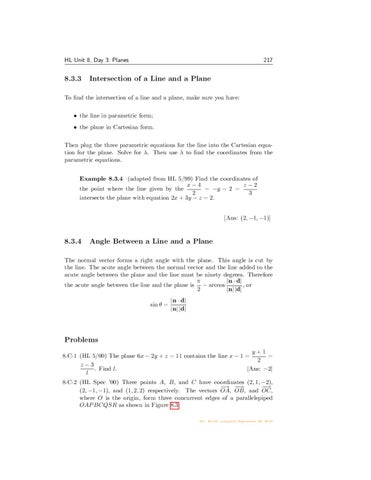
To find the intersection of a line and a plane, make sure you have: • the line in parametric form; • the plane in Cartesian form. Then plug the three parametric equations for the line into the Cartesian equation for the plane. Solve for λ. Then use λ to find the coordinates from the parametric equations. Example 8.3.4 (adapted from HL 5/99) Find the coordinates of z−2 x−4 = −y − 2 = the point where the line given by the 2 3 intersects the plane with equation 2x + 3y − z = 2. [Ans: (2, −1, −1)]
8.3.4
Angle Between a Line and a Plane
The normal vector forms a right angle with the plane. This angle is cut by the line. The acute angle between the normal vector and the line added to the acute angle between the plane and the line must be ninety degrees. Therefore |n · d| π , or the acute angle between the line and the plane is − arccos 2 |n| |d| sin θ =
|n · d| |n| |d|
Problems y+1 = 8.C-1 (HL 5/00) The plane 6x − 2y + z = 11 contains the line x − 1 = 2 z−3 . Find l. [Ans: −2] l 8.C-2 (HL Spec ’00) Three points A, B, and C have coordinates (2, 1, −2), −→ −−→ −−→ (2, −1, −1), and (1, 2, 2) respectively. The vectors OA, OB, and OC, where O is the origin, form three concurrent edges of a parallelepiped OAP BCQSR as shown in Figure 8.3. Mr. Budd, compiled September 29, 2010