Commendation for SAS Mathematics Development It was gratifying to read the final preschool through 12th grade mathematics curriculum document after the exemplary interactions of SAS faculty devoted to community and school feedback, research, school-wide review and discussion, writing, and editing. One special feature that I found was the focus on the key objectives for the grade levels rather than a repetitive list of objectives in each level. This will indeed assist teachers in knowing where the emphasis should be placed and where time should be spent exploring the concepts and procedures in depth. Teachers will be able to study the strands across the grade levels to meet the needs of students who require additional introductory work on some objectives or who are ready for extensions of the topics. From my interactions with teachers at Singapore American School, I have found that teachers know how important this attention to the grade level content is to student growth from grade to grade and from course to course. As a result, I am also pleased to see that this curriculum is well-articulated, clear, and precise, and also addresses the interests recently published by the National Council of Teachers of Mathematics in their document on Curriculum Focal Points. In all grades and courses, the attention to vocabulary, the properties of operations, equations, and inequalities gives students the tools that are used consistently in mathematics. The objectives in the strands are written with specificity of content. For example, in third grade, an objective clearly states: “Compare and order fractions (halves, thirds, fourths, sixths, eighths) using models and benchmark numbers.” I found this to be the norm for the objectives throughout the Curriculum. Topics that had been “slighted” in the first versions are now included. For example, the topic of conics is treated in Geometry and also in the Analytic Geometry Strand in PreCalculus. Again and again, I saw the development of topics, concepts, and procedures through the grade levels and courses. Please congratulate your teachers for the excellent work they have done in preparing an internationally strong and challenging mathematics scope and sequence for the students of Singapore American School. I am proud to have had the opportunity to work with you and with them and to have had a small part in this project. The SAS MATHEMATICS CURRICULUM, with the much enhanced consistency of the new selected texts and resources, is a strong tool for teachers and students. Of highest importance are the dedicated and well-prepared teachers who creatively teach the content and nurture the students as they learn in their individual styles. Best wishes for a successful implementation of the Mathematics Curriculum and the new texts! – Shirley M. Frye, international mathematics consultant and Past President of the National Council of Teachers of Mathematics
AP Guidelines By Ellen White, HS Social Studies Teacher
A
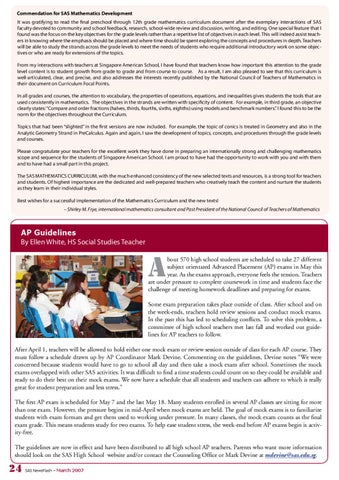
bout 570 high school students are scheduled to take 27 different subject orientated Advanced Placement (AP) exams in May this year. As the exams approach, everyone feels the tension. Teachers are under pressure to complete coursework in time and students face the challenge of meeting homework deadlines and preparing for exams. Some exam preparation takes place outside of class. After school and on the week-ends, teachers hold review sessions and conduct mock exams. In the past this has led to scheduling conflicts. To solve this problem, a committee of high school teachers met last fall and worked out guidelines for AP teachers to follow. After April 1, teachers will be allowed to hold either one mock exam or review session outside of class for each AP course. They must follow a schedule drawn up by AP Coordinator Mark Devine. Commenting on the guidelines, Devine notes “We were concerned because students would have to go to school all day and then take a mock exam after school. Sometimes the mock exams overlapped with other SAS activities. It was difficult to find a time students could count on so they could be available and ready to do their best on their mock exams. We now have a schedule that all students and teachers can adhere to which is really great for student preparation and less stress.” The first AP exam is scheduled for May 7 and the last May 18. Many students enrolled in several AP classes are sitting for more than one exam. However, the pressure begins in mid-April when mock exams are held. The goal of mock exams is to familiarize students with exam formats and get them used to working under pressure. In many classes, the mock exam counts as the final exam grade. This means students study for two exams. To help ease student stress, the week-end before AP exams begin is activity-free. The guidelines are now in effect and have been distributed to all high school AP teachers. Parents who want more information should look on the SAS High School website and/or contact the Counseling Office or Mark Devine at mdevine@sas.edu.sg.
24
SAS NewsFlash – March 2007