SPOTLIGHT ON THE ARTS
caught myself humming a nursery rhyme as if to soothe a sick child to health. The situation was nearing a total disaster as my pot was starting to wobble—the very act of which was making me feel nauseated. I turned, and as luck would have it, Rob Stickney had returned from lunch. With 27 some years of teaching Ceramics under his belt, I assumed that he would be able to guide me through my sudden artistic crisis. However, he offered the services of Tim Stockton, a Grade 12 student, who had followed him to the Ceramics Studio. True to Rob’s impish sense of humour, he gave Tim the option of serving a detention or assisting me. Thankfully, Tim chose the latter, to help me out.
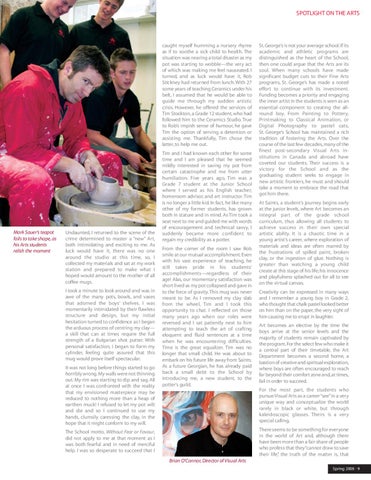
Mark Sauer’s teapot fails to take shape, as his Arts students relish the moment
Undaunted, I returned to the scene of the crime determined to master a “new” Art, both intimidating and exciting to me. As luck would have it, there was no one around the studio at this time, so, I collected my materials and sat at my work station and prepared to make what I hoped would amount to the mother of all coffee mugs. I took a minute to look around and was in awe of the many pots, bowls, and vases that adorned the boys’ shelves. I was momentarily intimidated by their flawless structure and design, but my initial hesitation turned to confidence as I began the arduous process of centring my clay— a skill that can at times require the full strength of a Bulgarian shot putter. With personal satisfaction, I began to form my cylinder, feeling quite assured that this mug would prove itself spectacular. It was not long before things started to go horribly wrong. My walls were not thinning out. My rim was starting to dip and sag. All at once I was confronted with the reality that my envisioned masterpiece may be reduced to nothing more than a heap of earthen muck! I refused to let my pot wilt and die and so I continued to use my hands, clumsily caressing the clay, in the hope that it might conform to my will.
Tim and I had known each other for some time and I am pleased that he seemed mildly interested in saving my pot from certain catastrophe and me from utter humiliation. Five years ago, Tim was a Grade 7 student at the Junior School where I served as his English teacher, homeroom advisor, and art instructor. Tim is no longer a little kid. In fact, he like many other of my former students, has grown both in stature and in mind. As Tim took a seat next to me and guided me with words of encouragement and technical savvy, I suddenly became more confident to regain my credibility as a potter. From the corner of the room I saw Rob smile at our mutual accomplishment. Even with his vast experience of teaching, he still takes pride in his students’ accomplishments—regardless of their age! Alas, our momentary satisfaction was short lived as my pot collapsed and gave in to the force of gravity. This mug was never meant to be. As I removed my clay slab from the wheel, Tim and I took this opportunity to chat. I reflected on those many years ago when our roles were reversed and I sat patiently next to him attempting to teach the art of crafting eloquent and fluid sentences at a time when he was encountering difficulties. Time is the great equalizer. Tim was no longer that small child. He was about to embark on his future life away from Saints. As a future Georgian, he has already paid back a small debt to the School by introducing me, a new student, to the potter’s guild.
St. George’s is not your average school. If its academic and athletic programs are distinguished as the heart of the School, then one could argue that the Arts are its soul. When many schools have made significant budget cuts to their Fine Arts programs, St. George’s has made a noted effort to continue with its investment. Funding becomes a priority and engaging the inner artist in the students is seen as an essential component to creating the allround boy. From Painting to Pottery, Printmaking to Classical Animation, or Digital Photography to pastel cats, St. George’s School has maintained a rich tradition of fostering the Arts. Over the course of the last few decades, many of the finest post-secondary Visual Arts institutions in Canada and abroad have coveted our students. Their success is a victory for the School and as the graduating student seeks to engage in new artistic frontiers, he must and should take a moment to embrace the road that got him there. At Saints, a student’s journey begins early at the junior levels, where Art becomes an integral part of the grade school curriculum, thus allowing all students to achieve success in their own special artistic ability. It is a chaotic time in a young artist’s career, where exploration of materials and ideas are often marred by the frustrations of spilled paint, broken clay, or the ingestion of glue. Nothing is greater than watching a young child create at this stage of his life; his innocence and playfulness splashed out for all to see on the virtual canvas. Creativity can be expressed in many ways and I remember a young boy in Grade 2, who thought that chalk pastel looked better on him than on the paper, the very sight of him causing me to erupt in laughter. Art becomes an elective by the time the boys arrive at the senior levels and the majority of students remain captivated by the program. For the select few who make it a central part of their timetable, the Art Department becomes a second home, a bastion of creative and spiritual exploration, where boys are often encouraged to reach far beyond their comfort zone and, at times, fail in order to succeed. For the most part, the students who pursue Visual Arts as a career “see” in a very unique way and conceptualize the world rarely in black or white, but through kaleidoscopic glasses. Theirs is a very special calling. There seems to be something for everyone in the world of Art and, although there have been more than a fair share of people who profess that they “cannot draw to save their life”, the truth of the matter is, that
The School motto, Without Fear or Favour, did not apply to me at that moment as I was both fearful and in need of merciful help. I was so desperate to succeed that I Brian O’Connor, Director of Visual Arts
Spring 2008 • 9